Why Bank Traders NEVER Look At Forex Charts
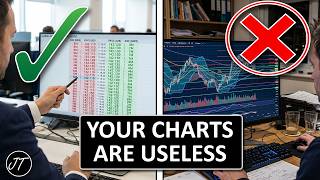
Retail forex traders bet on price direction through brokers, but banks that actually move markets don't use charts. The interbank market is 69% utilitarian hedging and funding, with retail accounting for just 0.09% of spot volume. Banks profit from spreads and triangular equilibrium between currency pairs, not speculation.
Chapters
I explained in my last video that as forex traders, we are not actually trading the forex market. Forex is a strictly interbank market, off limits to the retail public. However, we do place bets with our broker as to which direction we think the price in the real market is going to go next. We are betting on the market, not in it. And if you're going to bet on the direction of price, it would be sensible to have at least some understanding of how and why the price prices move in the first place. Sadly, that is something most retail traders have never bothered to learn, and so in this video I'm going to pull the curtain back and show you exactly what forex really is, how it works, who the participants are, how they trade, why none of them are actually speculating, and ultimately what causes the price to move one way rather than the other. But when you understand how the real market works, making money from it is a whole lot easier, much easier than any trading you've done in the past. All of the information I'm going to present comes from the Bank of International Settlements triennial Central Bank Survey of Foreign Exchange Turnover, published every 3 years, with the most recent in October 2025. So let's start with the structure. Forex isn't one market as such. It's actually made up of several different segments. We bet on the spot market, which is the primary market and determines the exchange rate price. Most people are referring to this when they talk about forex. Spot, or the cash market as it is commonly referred to, is used for the simple physical exchange of one currency for another. You take delivery of the foreign currency in order to use it. But spot isn't the biggest segment. It's 31% of the overall market with $2.9 trillion in turnover every day. The other segments are forwards, which is 19% of the market with $1.7 trillion daily turnover. And a forward is the exchange of one currency for another at a price we agree on today, but you don't take delivery of until sometime in the future, usually 1 to 12 months. People use forwards to avoid the risk of currency fluctuations. For example, imagine I was building a new house in the French Alps, and the whole thing was going to cost €1 million. Right now, that's about £880,000, but in the 12 months it takes for the construction to finish and I need to pay builder, the exchange rate may change and it will cost me an extra £100,000. So I use a forward contract to protect myself from that risk and locking today's price. The option market is very similar, but this time it's the right but not the obligation to exchange at a pre-agreed price sometime in the future. So this is more flexible. Using my house building example again, a year from now when I have to pay the builder, if the pound has depreciated against the euro, meaning it's now going to cost me more, I would exercise my right on the option and I would get a more favorable exchange rate so I don't lose out. But if the pound appreciated against the euro, meaning it would now cost me less, I would let the option expire. I would exchange my money at the current more favorable spot rate, and I would have some profit left over. The option market is 7% of total turnover with $631 billion daily. The biggest segment is the FX swaps, which is 42% of the market with over $4 trillion daily volume. A swap is essentially a short-term loan. You exchange currencies via a spot transaction today and take delivery of the money, but with an agreement to exchange it back via a forward contract at a later date at the same price thus avoiding the risk of currency fluctuations. The smaller currency swap segment is the same as FX swaps but with longer maturities. This is just 2% and $164 billion per day. In total, there is an average of $9.6 trillion traded in forex every single day. Now, understanding what each of these instruments are used for, you can see there's not a lot of speculation going on. Spot transactions are utilitarian. People are taking delivery of cash because they need it to make a purchase of some kind. Fords and options are used to hedge against the risk of currency fluctuations. Swaps are used to fund short-term cash flow needs while simultaneously hedging against the risk of price fluctuations. People use Fords, options, and swaps specifically because they don't want the price to change. They are actively trying to avoid price moves. That's at least 69% of the market by volume, which has nothing to do with speculation. And the people using spot have taken physical delivery of the money and spent it elsewhere, so they don't care what happens to price. Almost no one is using Forex for speculation. It is a utilitarian marketplace. However, with that being said, there is some speculation, and to find out how much, we need to look at who the counterparty is on each trade. Who is doing the trading and creating all of this volume? Broadly speaking, the market is broken down into reporting dealers, other financial institutions, and non-financial customers. The reporting dealers are the major tier 1 banks and market makers. This is the true interbank market and the tier 1 banks trading between themselves accounts for 46% of volume. This is called inter-dealer trading, one bank trading with another, and I'm going to explain how and why they do this in a moment. It's quite eye-opening and it will expose exactly how the game is rigged so they can't lose. Trading with other financial institutions accounts for 50% of volume. This is the tier 1 banks trading with smaller banks institutional investors, hedge funds, the official sector, and what are referred to as other, which I will come back to in a moment. The non-financial customers are when the Tier 1 banks trade with corporations and businesses. These are the most massive of international companies who choose to trade in the interbank market directly rather than going through their bank and having the bank do it on their behalf. This is quite rare and only accounts for 5% of volume. So who amongst these counterparties are speculating? Well, the Tier 1 banks dealing with each other are not. This is primarily banks exchanging currencies on behalf of their customers, and I'll explain how banks trade and make money in a moment. It isn't from speculating. Neither are the non-reporting smaller banks. These are also mostly exchanging on behalf of their customers. Neither are the non-financial customers. These exchange money because they need the cash to run their businesses internationally. The institutional investors are also not speculating, which you might find surprising. These are mutual funds, pension funds, and insurance companies, and they use forex to hedge and manage the risk that they are exposed to from their other investments and holdings elsewhere. In other words, They use swaps, forwards, and options to protect their portfolios from exchange rate fluctuations, as I described earlier. That just leaves hedge funds, official sector, and other as potentially speculative. At best, assuming those entire segments are doing nothing but speculate, that is still only 12% of the total market, a small fraction. But that is actually being overly generous and is not at all accurate. Hedge funds have to file with the SEC and declare what investments they've made so we can see what they're doing. If we look at Citadel, the biggest hedge fund in the world, it has just under $400 billion under management. They've allocated that out across 12,000 different investment positions, none of which are currency trades. They're primarily all stocks. Now, to be fair, hedge funds do not need to declare their cash holdings in SEC filings, so we don't know if they are holding cash. But what we do know is any cash they are holding is less than 1% of their total portfolio. We know this because we can see the percentage allocation for the rest of their portfolio and measure what's left over. And we can see the same information for every other hedge fund as well. Hedge funds, if they are speculating in forex at all, are doing so in minuscule amounts, hardly worth mentioning. So what are they doing with their forex transactions, which account for 8% of the total market? The same thing as the institutional investors and everyone else. Hedging and offsetting their risk. A US-based hedge fund like Citadel invests in stocks all over the world. To invest in a Japanese company, they need to use yen, so they exchange their US dollars for yen in the spot market. 46% of hedge fund currency transactions are concentrated in the spot market. Two years later, let's say their Japanese stock investment has appreciated by 20%, but when they go to cash out, if the US dollar-yen exchange rate has depreciated, when they exchange their yen back into US dollars, that 20% stock gain may be wiped out because of the adverse drop in the currency exchange rate. So to avoid that, they hedge their risk by using swaps forwards, and options. And we can see that 54% of their activity is hedging with forwards, swaps, and options. So whilst a very small part of the hedge fund sector does potentially place some speculative trades, it's tiny and certainly not the full 8%. More than half is used for hedging, so it would be generous to say it's a quarter of that. So about 2% of the overall market at best. The same goes for the official sector, which represents sovereign wealth funds. These are also using forex to hedge and protect their portfolios from exchange rate fluctuations. Forex is a non-speculative market. It is used for utilitarian purposes to facilitate other business and investment activities and risk management elsewhere. So that just leaves the other sector. Who is this? It's the retail market— you and I. Now, as you know from the previous lesson in this course, you and I are not actually ever allowed to participate in the real interbank market. So what this really is are the brokers. When you place a bet with your broker, they offset their risk with positions in the interbank market. I'll explain exactly how this works in Lesson 4 of this series. But to keep it simple for now, when you, me, and all other retail traders place a trade, it is counted here. 2.4% of the total market. That's it. That's the only segment we can say for sure is linked to speculation. And here's the kicker: only 0.09%, less than 1%, is traded in the spot market. Most of those positions your broker submits to the real market are in forwards, swaps, and options. And the reason for that? Because they are hedging their risk from the bets they've taken with you. So with all of that said, if you combine hedge funds and the retail sector together, we are looking at no more than about 3% of forex trades being speculative. I think you will agree that's a rather different reality from the one retail traders imagine in their forums. I'm sure this comes as a surprise for most people, and I'm equally sure most people will refuse to believe it because they won't want to admit they've been wrong. But if you want to succeed and actually make reliable profits, it's vital you understand the market you are trading. If you don't even know how it works, you can't expect to have any chance of beating it. And just as a quick side question, why aren't the professionals, the big boys as it were, speculating in Forex? Well, as I said in the previous video, Forex exists to facilitate international cross-border trade. The prices are mathematically constrained to oscillate within narrow ranges, and it's so big, it can't be manipulated. So the strategies that work in stocks do not work in forex. Quite simply, it's too difficult to profit from for the massive institutional traders. Stocks, on the other hand, are designed to go up indefinitely and can be manipulated, and therefore are far easier to profit from for the bigger players. In short, professional investors, the big institutions, would never waste their time in forex because it is not designed for speculation. That's not the game they play. Only naive retail traders are daft enough to believe that forex can be traded the same as stocks. Now don't worry, the point of this course is to show you how the market can in fact be beaten, and quite easily. For retail traders, this is better than stocks. But to do this, we need to be real and work with the facts, not the fantasy nonsense that 99% of losers believe in. Okay, so moving on. The next thing you need to understand is how the prices move. After all, we are betting on price moves. This will have to be a simplified explanation because it's a very complex set of calculations, including interest rates, GDP, inflation, government bet and budget, etc., which determine the prices, but in essence it comes down to supply and demand. Think of two big buckets, one of British pounds, the other of US dollars. This is all the available money for these currencies in the interbank market. If I put my pounds into the pound bucket, I've increased the supply and there are now more of them for other people to get hold of. If I remove some dollars the dollar bucket, I've reduced the supply and there are fewer for other people to get hold of. That is what happens when I exchange British pounds for US dollars. I've increased the supply of British pounds and reduced the supply of US dollars. And so the relative value of the pound goes down because it's more abundant, and the relative value of US dollar goes up because it's scarcer. Simple supply and demand. But now let's add the euro as a third currency to the equation. When I added more pounds and removed dollars, the euro also changed value relative to both. It's more valuable than it was a moment ago compared to the British pound because there are fewer of them relative to the more abundant pounds, and it is less valuable than it was a moment ago compared to the US dollar because there are more of them relative to the now scarcer dollars. This means the exchange rate of the euro-pound changes, as does the euro-US dollar, even though there was no buying or selling of euros at all. The only real money that changed hands was between the British pound and the US dollar. This is called triangular equilibrium. The price of every pair chart is mathematically fixed to every other pair. If the pound-US-dollar price is 1.34524 and the euro-pound price is 0.87864, the euro-US-dollar price must be 1.18198. I'll show you. If you multiply the pound-US-dollar price by the euro-pound price, it gives you the euro-US-dollar price. If you divide the euro-US-dollar price by the euro-pound price, you get the pound-US-dollar price. And lastly, if you divide the euro-US dollar price by the pound-US dollar price, you get the price for the euro-pound. All pair prices are calculated like this and mathematically fixed. Pause the video and prove this for yourself with any 3 related pairs like this. I hope you can recognize the shocking implications of this. When a trade is made on the pound-US dollar, the price of the euro-US dollar is changed without any buying or selling taking place whatsoever, and the adjusted euro-US dollar price alters the euro-yen price, which in turn changes the Aussie dollar-yen price, which changes the Aussie dollar-Swiss franc price, and so on across every pair in the market in a cascade chain reaction. 96% of all price changes across the market are because of this mechanism, which is controlled by high-frequency mathematical algorithms. If you want to see this in dramatic effect, open 20 different charts during the US non-farm payroll news release, and you'll see the price spike on every pair. It will be biggest on the US dollar pairs, but even seemingly unrelated pairs like the Aussie dollar, Swiss franc will have the same price move, albeit on a smaller magnitude. It makes a complete mockery of the clueless amateur retail trader looking at his chart, convinced the price is moving because of the pretty shapes and lines he's drawn on it, when in fact there are zero real orders taking place, and what he is seeing is a ghost move triggered by an order taking place on the other side of the market. This is one of the main reasons technical analysis is such a farcical, meaningless delusion in forex. But what about the real orders? How do real orders move the price? Well, it's from the way customer demand interacts with liquidity supply. On the one side are the liquidity providers, sometimes also referred to as market makers. These are the tier 1 banks who supply the liquidity to the interbank market. What these basically do is quote a price which informs the entire marketplace the amount of currency they are willing to buy and sell and the price. For example, they may say they are willing to buy $1 million at price A, and they are also willing to sell $1 million at price B. And there is always a gap between the level they are prepared to buy at and the price they are prepared to sell. They always buy low and sell high, and the gap in between is their spread. This is the market maker's business model. They want to buy from one customer and then sell the same amount to another customer at a slightly higher price and pocket the difference as their profit. Market makers do not want the price to move. They are not speculating. If the price remains stationary, they are guaranteed to profit all day long simply from buying and selling either side of that spread. It's risk-free money. The risk comes when the price does move. A trend is the market maker's nightmare. If they buy from a customer at price A and then the price quickly falls lower, they have to sell to the next customer at a worse price than they bought, and therefore they take a loss. There are two really important things to note about this. First of all, Forex is an auction market. The prices you see quoted on a chart are not the price a real transaction has taken place. It is merely the price a market maker is announcing they are willing to trade at, and they can change their mind and change that quote whenever they like. This is going to be important to remember later in the course when we talk about trading around news events. The second thing is, because they are at risk when the price moves, to protect themselves and limit their exposure, they trade in small amounts. $1 million at a time, unleveraged. Now imagine a 1-pip spread. 1 pip is 1/100th of 1 cent. When they buy $1 million and sell it again 1 pip higher, they've just made $100 profit. Now that may not sound like much, but with $2.9 trillion exchanged in the spot market every day, this process can produce over $290 million of potential profit every single day for market makers. Is in these small $100 increments, repeated tens of thousands of times. And the price doesn't even need to move for them to make this profit. If it remains stationary, which is what they hope, they make profits. The price does need to move for them to take a loss. It needs to move two levels. One level isn't enough for a loss. It would mean they break even. This is an extremely low risk business model, but it does mean that when a customer comes along and asks to trade $50 million, there is no one to take the other side of that trade. Think about it. If someone wanted to buy $50 million and someone else sold that full amount to them, the price would never move. It's equal buying and selling, and they cancel each other out. That's not how forex works. Instead, this is what happens. There are hundreds of market makers all competing against each other, and they all quote slightly different prices. All we see on our charts are the best bid and the best offer, which may actually come from two different liquidity providers. The best bid and offer are what we call at the market, and all of the other quotes are behind the market. And it forms a ladder effect known as the depth of market. And because there are hundreds of market makers, the depth of market can go several hundred price levels. But for the sake of an easy example, let's just look at 10 levels deep. When a customer submits an order for $50 million, the order is transacted in $1 million packets. The first $1 million consumes the first level of liquidity, and when that is removed from the market, the quoted price jumps up to the next level. When that is consumed and removed, the price jumps up to the next level, and as each level of liquidity is consumed by the customer order, the price gradually moves higher until before $50 million is filled. This is what causes the price to move. This is demand versus supply, and it's the same in both directions. When customers buy, they consume the liquidity at each off-the-price level and move the price up. When customers sell, they consume the liquidity at each bid price level and move the price down. In both directions, they are demanding and consuming the supply of liquidity. The bigger the customer order, the further the price will move because liquidity is always supplied in $1 million increments. Now it is a little more complex than that example because there are hundreds of market makers all competing with each other and they are most competitive close to the market. So you often get several of them overlapping. So there may be $5 million at the market, $4 million one level behind, $3 behind that, then 2, and then 1 million at each level after that. Additionally, when liquidity is removed at a level, another market maker may submit a new quote which fills the gap, so the price initially goes up one level, then back down. And of course, they are trading in both directions simultaneously with multiple customers, so the price never moves as uniformly as that example, but the process is exactly how prices move when real orders are involved rather than that triangular equilibrium that we discussed a moment ago. So we can see what the market maker's business model is and how they make money. They are not speculating on price direction, and in fact it is safer for them if the price doesn't move. They simply profit the spread between the bid and offer. But what about the customers? Well, the customers are the banks. Remember, forex is an interbank market. Only banks are allowed to directly participate. So when we talk about customers, what we mean is banks exchanging currencies on behalf of their customers. When Google want to exchange money They can't directly. They have to go to their bank, and the bank makes the exchange for them in the interbank market. And this is how it works. The customer asks their bank to exchange, let's say, $100 million into British pounds. A trader on the bank's trading desk looks at the current interbank rate of the pound-US dollar to find out what price he can get, and he knows that exchanging $100 million will likely move the price between 10 and 20 pips. So he quotes the customer a price perhaps 100 pips higher. So the bank and the customer agree to exchange at the higher price. Then the bank trader submits the order at the lower interbank price, which is filled over 10 or 20 pips. So it's filled 80 to 90 pips lower down, and the bank pockets that difference. On a $100 million order 80 pips is about $800,000 that the bank has just made in profit. Now, the extra spread that they quote each customer varies on the customer and the size of the order. Bigger customers like Google who trade with the bank frequently and in high volume will be quoted more competitive prices. Someone like you or I will get worse prices. I've just looked at my own bank standard rates and they are quoting a spread of 300 pips if I wanted to exchange pounds for US dollars today 150 pips or 1.5 cents either side of the true interbank bid and offer. Google may be quoted only an 80-pip spread, but the model is identical in all cases. The bank exchanges at the interbank prices but quote the customer a much worse rate and pocket the difference. You can see that once again the bank is not speculating. Why would they when they are guaranteed to profit on every single trade? Can you imagine how utterly ridiculous it would be for a bank trader to turn around to their customer who wants to exchange $100 million and say, "Oh, sorry, I can't. I've just noticed a head and shoulders pattern appear on my chart and I expect the price to reverse." Here's a secret that is important for you to remember. Bank traders don't even have charts. All the bank trader looks at is the current price. The current price plus the depth of market ladder is all they have on their computer screens because that's all they need to know. Where is the price right now? How far will my next order move it? So what spread do I need to quote my customer? That's it. And once they fill the order for customer A, they move on to customer B. Then C, then D, and on and on, buying and selling in both directions indiscriminately and randomly, without a care in the world about where the price actually goes. A bank trader's job all day, every day, is to execute these transactions on behalf of their customers, always quoting a worse spread and always guaranteeing to make a profit. This is the reality of forex and why there is no speculation going on. Forex is an interbank market. Only banks are allowed to trade there, and they have two virtually risk-free business models, both of which guarantee profits. Number one, market making. The tier one banks provide liquidity in $1 million units at each price level. All controlled by automated algorithms with mathematically determined prices whereby they pocket small profits from the spread hundreds of thousands of times a day. Number 2, they exchange currencies on behalf of their customers and once again pocket a spread, this time a much bigger spread. And the real kicker about this is that banks are both sides of the equation. Collectively, the Tier 1 banks agree to create a market and provide liquidity for all the other banks to trade with. This is the market-making division and is what creates the interbank market. And then the dealing desk division executes orders on behalf of the outside customers in that interbank market they've just created. The banks are profiting from both activities. The real forex market is the banks trading with themselves. Like I said in the previous video, this is an exclusive members-only old boys club. The whole game is rigged for their benefit. They don't need to speculate. Why would they expose themselves to risk and losses like we do when they have a complete monopoly on risk-free guaranteed profits? Now, the reason I've explained all this and shown you who the participants are, what the structure of the market is, how prices move, and how the banks make money is because if we're going to play this game, we need to know the rules. You may think I'm painting quite a bleak picture of forex, but that couldn't be further from the truth. I think forex is the easiest market in the world to profit from for retail traders. It's far easier than stocks. But if you want to exploit it, you need to understand it. It is not the stock market. Most amateur traders are attempting to play the game by the wrong rules. It's like trying to win a game of chess using the rules of golf. Of course they fail. What I'm hoping to do is not only teach you the rules, but also give you a cheat code. That all starts with learning about the real market. Not the make-believe world you see people discussing on forums and social media. And so with the information and facts we've covered in this lesson, the next video is going to dispel all the myths and nonsense you've previously been taught by influencers and gurus. I'm going to show you, prove to you, why all the techniques amateur traders use and believe in, like technical analysis, are meaningless crap and cannot have any application or relevance in in forex. If you're going to join the 1% who succeed, you're going to have to unlearn and stop using the mainstream gobbledygook that the 99% of losers adhere to and which keeps them losing. So I hope you will join me for that lesson, and I'll see you there.









