Why Does Everything Change When the Money is Real
Randy Howell explains why traders who crush paper trading fall apart with real money. Your evolutionary brain treats risk like survival, triggering urgency and dominance instincts that wreck probability-based decisions. He contrasts the impulsive gunslinger approach with patient sniper trading, and teaches emotional regulation as the fix.
Chapters
The broadcast is now starting. All attendees are in listen only mode.
Welcome everyone. My name is Randy Howell with Trader State of Mind. And I'm delighted to see you here. Actually, I don't see you technically, but I welcome that your presence is here. And just a little bit of house cleaning is that first and foremost is. Can you hear me? If some people will just type in a Y into the. To the chat box or the question box, I would really appreciate it. I know that I'm not talking off just into Wild View Laundry. And I see. Yes, thank you. Thank you, Mark. Okay, the second thing is I hold my questions to the end. Okay? So feel free to write questions into the question box. But I'll be getting to them as at the end of the thing because I've discovered a lot of the things that people ask about are going to be covered during, during the presentation and also, to be frank with you, is that when I start answering a bunch of questions, I forget where I'm at. And then I have to kind of follow myself up and get my act back together. So it works both ways. So here we are. Let's take a look at this.
The thing, what I really want to do is take this thing and say, what is actually going on? Why can't you have emotional control when the money's at risk? Why does it keep happening over and over and over and over again? You know how to trade. You've proven that by paper trading. And you'll understand that you've really invested in that. And if you were left to that, you know, you could just. Things would be good. But.
When that money's real, when it represents a real loss, something fundamental happens. And a lot of people, a lot of traders that are trying to evolve to become profitable don't understand the concepts. The first one is traders really, truly do not understand the emotional brain and the power of what drives the emotional brain. You're going to be learning about that. But just start it here is the emotional brain does not understand money. It has no concept what that legal tender is.
It represents it by power, by safety, by status. And it's a huge problem because you no longer have control over something that you're saying, I'm going to have control. And then the second is your whole idea of psychology about winning. And I have a question for you, okay? Today, if you traded today, who in here has ever muttered or said aloud, declared, I'm going to make money today, I'm going to make some money today. How many people in here have done that? Probably More than half of you will have done it today.
Yet at the same time, what I want you to understand.
Is that you are declaring the intent to make money when you have absolutely no control over whether or not you win or lose in a definitive way.
You have an edge. You have an edge in probability, but it's not an assurance that, yes, yes, I can win. No, you can't. You're not in charge of that. So that we're going to be looking at the psychology also of winning and losing, I might add. So we've gotten there and we go, well, you know something? So we're getting it down to these things. I don't understand the emotional brain and the way it reacts to uncertainty. And I don't understand my own personal psychology of winning as it applies to consistent profitability in trading. So let's really talk about this. The first thing, when people start looking at trading and they start getting really seduced by the promises, you say, you know something? Wow, you can make a lot of money here. You can really. I can have this personal freedom that I want. I can spend time with my family, with my kids, with my wife, with just doing other things. Oh, and I can only spend a couple hours a day, and I can just be knocking this stuff out. All I have to do is do the numbers and you scale them up, and all of a sudden, wow, the sky's the limit. And you get really excited.
Okay?
It's that very excitement that is priming you to not be able to manage the mind that works with probability and uncertainty. That excitement is your death. So then we go, okay, well.
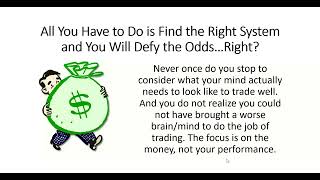
Traders get into this. And I remember when I used to do trade shows, Dolores and I would sit at our booth and we were like a repellent magnet toward people. Nobody wanted to come to us. Everybody was looking for how much money could be made. And, you know, all you have to do is find the right system and you can defy these odds, and you can really do that. And yet.
Nobody really sits there and really, truly asks, what does your brain, what does your mind actually need to be able to produce that money? For instance, we have a friend who has made in excess of $180 million in the last three months. Now, by anybody's standards, that's a really serious trader. And he's playing with size now and stuff like that. What's interesting about him is that he's not really even thinking about winning and losing. He likes the game. He wants to win. But what happens is what he wants to really do is to perform. We're going to be talking about that because fundamentally, you have brought a brain that doesn't know about money and risk.
Into a game that's all about probability and capital, and yet the brain doesn't know about it. Why do you think you could have problems at the thinking brain? You're sitting there thinking, man, all I have to do is find this right way. And, you know, I'm gonna. I'm gonna. Man, I can just see. I can see the numbers add up. I'm ready to go. And yet, when you do the magic, when the money comes real, everything changes. And the question is really, what went wrong? You're trying to do success, and you're trying to do it like, yeah, I'm going to win. I'm going to win. I'm going to win. I'm going to make money. I'm going to become. I'm going to think positive. I'm going to think success. I'm going to declare that I'm a winner. I'm going to do all that and never do. You keep asking, does that work in trading?
Success in trading really looks more like the second arrow over there. It's just swinging. It's going all over the place. It's assuming in trading. The assumption is the brain you brought to trading is incapable of basically mastering the self that needs to be there to manage probability. That other success, that success that everybody knows about, it's really about dominating. It's about making things happen. It's about controlling outcome. It's about not losing. Yeah. And yet, at the same time, one of the marks of a really great trader is that he or she is a great loser. Whoa. Do you see the gap that's really beginning to step between success in other domains and what it takes to build a mine that produces consistent profitability? Yeah. Notice I didn't say success. So we're looking at that and we're going, wow.
What we're doing, we bringing. Most the time, we're bringing an alpha mind that was developed during our caveman days. And I want. I want you to see right here is you're looking at some humans and their partners, wolves or canines. They're shopping for dinner. I don't know about you, but that really giant bull doesn't look like that. He wants to be meal. And what happens is that a man, to be able to be hunting like this, to be able to produce the kind of success that feeds a community, feeds a clan, he's going to have to have an ability of rushing into Things and making and believing deeply that he has a bias to win. He's going to win this thing. He has to for the survival of species. But what I want you to see is that same mind that allowed them to be able to conquer this giant bull also gets in the way when you start trying to trade. We bring that to from caveman days and understand you needed to be motivated. You had the hunter's stick, you got excited about that chase, the encounter, you know, and you're going to win. The belief in winning and it truly did allow our caveman ancestors to thrive. And understandably so that through natural selection, that particular trait is going to get locked in to our genetic material that we have today. And.
Many a guy that I've known have been very successful in different businesses where that push that world. Warder, I'm going to win. I'm going to win. Really brought them success. And then they think, well, you know, I'm tired of all this. I want an easy life now. You know, I don't want to work like that again. And he'd start trading and realize the same mind that brought success there does not bring success in the mind that they bring to trading. Hmm. So.
The key is you're still stalking opportunity, just like our caveman answered. Believe it or not, they stalked that bull, they stalked a mammoth, they stalked all that stuff, and they went after him. These are the traits that allowed us to endure. But the real key is they were successful. Here we look at that, we see that key to success. The money. In caveman days, it wasn't about the money. Again, he didn't know about money, but he did know about survival. He did know that if he were the one who brought in the meal, that he gained enormous amount of respect and status in his community. He was given leadership. He also, from an evolutionary standpoint, had access to breeding on a higher level than people who were not alphas. That's the genetic transmission of survival traits into the future. And what would it look like today? Do you remember Bond? James Bond, 007? You take a look at Daniel Craig here. What happens is he's an actor portraying a particular role that's very definitely rooted in alpha man success. And understand, though he's an actor portraying that, that's not necessarily who he is as a human being, but it becomes familiar pattern. We learn about winning. Where I played football in high school, there was a sign over the dressing room that we would. We would hit our hands on before we went out to play. And what it said was a Winner never quits and a quitter never wins. Okay? And it was. It was as if, you know, if we just kept on, kept on, kept on, kept on, we would win. In trading, that rule is flipped and it doesn't work. And what we discover is this. The very traits that created success in trading have turned against you. All those survival traits, particularly the alpha, the one that wants to win, the one that doesn't want to lose, the one that wants to control outcome, the one that wants to make things happen, those fairy things are what lead to over trading. How many Alphas do you know? And if you're one that will be sitting there and they're watching for setups, nothing is happening. God, five or ten minutes have gone by and you are so bored that you just say, you know, I'm just gonna just play around while I'm just sitting here waiting, doing nothing. And you go to another market, you see something, it's not in your plan, it's not that. But all of a sudden that desire, that urgency to hunt is right there. And suddenly you see through the eyes of belief that there's. That there is an opportunity there, and you jump in it and you started the deal. Of course it's a bad trade. And you say, now I'm losing. I can't lose. I can't allow myself to lose. And here we are. Here we are. Okay, this focus on winning and this is this next photograph. It's actually a fairly famous photograph. God knows this kid's probably in his 20s now, but this embodied that I'm a winner. Yeah. How to think like a winner. And yet controlling income outcome, being right, making things happen and not being wrong, losing.
Simply is not under your control. You know, you just can't force yourself. You just can't be determined. You just can't be persistent. You can't just think like a winner. You actually have to think very differently to become a consistently profitable trader. Notice I'm not saying winner. That's the whole point. These very traits become dangerous.
And what do you do? You end up with, whoops, we're having a control issue here. Hold on one moment while we get where we get back control a little. Look, there we go. This actually is a tag I saw on the back of a car one time. Not this exact one, but there was a car with a tag, and on the back of it it said, got to win. And that Alpha wants to seize opportunity, seize that day. And there is an urgency that allows him to attack that bull and to take advantage and to seize that moment. And that's the whole point. Now what we discover is that urgency, that desire to jump into things and take control. We discover something really powerful. It blows up accounts. It causes you to lose. It causes you not to have the very mind that you need to be able to work probability, to work, to work uncertainty. So and what happens when you get excited and all that stuff and you want to go in is that you get excited. That Alpha sees opportunity, it's outside the plan, he takes it. And that's the overconfident bias that every alpha is going to have to learn how to control and manage or he's not going to be able to make what he needs to do. And then afterwards, after it's all over, when they come talk to me, he says, randy, I have no idea what happened. I was sitting there fat, dumb and happy. I was okay. And the next minute I know I'm doing these crazy trades and then I don't want to lose and I just compound the problem and I get up. That, friends, is an unmindful mind that is really pulling from our caveman days, pulling up the alpha needed for survival. And there you are. And what we're doing is saying that overconfidence bias is something that's going to it. I mean it can just cut your jugular off. Or if you're into a person who just takes a bunch of mining little cuts and you start bleeding from all that stuff, it's still the same thing. And here is the piece that you really need to really, truly comprehend what you're doing.
You're actually projecting your beliefs.
Once you probably don't even know you have really about your ability to control outcome onto the markets. And what you're seeing in the health of your trading account is whether or not those beliefs are effective for pulling out more capital out of the markets than you put back in. And the unfortunate problem here, I want you to notice in this graphic that beliefs and truth are related to one another. We do not see something and then believe it because we see the evidence. We believe something and then our mind makes up the truth out there. That's how it happens, folks. It doesn't happen that you are actually your truth. That certainty you have in how you feel about it actually.
Is a chemistry that's in your body causing you to believe that what you believe is actually true.
I want you to hear that.
The sense of certainty you have about your beliefs being true is chemistry. But that chemistry causes you, this observer, to believe that your beliefs are true.
How many Times have you gotten in trouble about that? How many times have you known what the market's going to do? How many times have you done that? And you just. True, it feels true, it isn't true, it feels true. And as a trader you're going to have to learn how to take the feeling out of the truth and you're going to have to look for the empirical evidence in which to build your beliefs about the way you're going to manage uncertainty. Superstition doesn't work very well. Okay, now here's the key though is what are you going to do about it? I've told you a lot about, you know, what do you got to do. But the answer from Plato, I mean this guy was he was there long before the start of modern times. And what he's quote from the Greek is we can change our reality by changing our mind. And my question to you, how many of you use affirmations? How many of you use visualizations, tapping, going down the list, positive thinking, you know, my basically control over the subconscious, all that stuff. And when you're doing that, do you happen to notice that when you get into stressful moments where all of a sudden another gear instincts kick in that they fail?
What we want to do is we want to start taking personal responsibility for our performances, quitting the fishing stories or the hunting stories. But what we really want to do is start looking at it and going, okay, if my trading account is revealing the beliefs that are driving my performances, what exactly are the beliefs driving my performance? That's what we really want to know. And then how do you develop. We're not saying that the alpha is bad. Alpha just simply has to change his ways. There was a while back I worked with a trader who.
He actually started out as they own a large spread in Oregon and what they do is they end up compressing hay into these super, super balls. They ship them over to Southeast Asia, into China and they ended up getting into options because if you can send stuff to Chinese, you need options to cover the spread. And what he discovered, and this was a self made man, I mean literally when he was a young, young man, they rode horses and they had, they had pistols at their sides because they needed him on their range. They had 10,000 acres of land. Now the key though.
Is what John had to learn is the mind that he brought to trading was not going to produce the success he had in trading. What he had learned and what he, the person he was was really more like a gunslinger. He described himself as a gunslinger, as A matter of fact, he had. He had a giant illustration of John Wayne behind him. And that was his hero. That was his idea of a leader. And the key is, is I said, you know something? We're not asking the ruler, that dominant alpha guy, to disappear. What we're asking him to do is to morph, to evolve. We want to be able to change him from a gunslinger that gets hit a lot. I mean, you know, you go in blazing guns and people are going to get hit. We wanted to change him into the mentality of a sniper. Both are deadly, but the sniper is much more like what happens in trading than a gunslinger. Gunslingers are dangerous. So what does the mind really need to look like? Well, that's where we go right here, is I want to compare two animals, two apex predators. On the left, you're looking at an African lion and a big one, and he's going after a water buffalo. I want you to notice those horns that buffalo has. The key is, is that the African lion has developed a strategy where they know there's going to be enormous amount of capital loss, bodies, lions loss. Because those guys, when they butt you, they can rip you open. In the same way when you're chasing a horned animal. You can get gored, you can get kicked in the face. And there's lots and lots of heavy losses. They have a breeding program to rebreed the capital so they can keep that up. It works on the Serengeti. But what happens is, what you see is these guys are accepting really heavy losses, but they have the capital, they're creating new capital all the time to replace the capital that's getting hurt. And a lot of people look at that male line and say, I want to be like that male line. I want to be the tough guy. I want to be that. And yet what you're looking at is, man, I'll tell you something, they have heavy losses. And after you have a broken jaw or after you've been gored, your days are numbered. So then what I want you to do is take a look at on the right. What you're looking at now is the American cougar. The American cougar is also an apex predator, but they're different. The American cougar has a different style of hunting. The deer, that's its favorite target. He climbs a tree, a rock facing, and he sits where the deer can't see him. The deer can't crane their neck up so they can't look up. And he sits there very patiently because he's sitting at A site where the deer come by. There's a deer path there. So there's a setup. A deer gets into the setup and that. And that cougar comes down from 20ft. And if it's lucky, what it does, it snaps the neck of the deer, and the deer just simply drops. It may be a little scuffle where they try to suffocate it really fast, but it's over in 20 seconds. That's it. There's none of this stuff that the male lion right here is doing. And what happens if the deer gets up and runs away?
The cougar does not chase.
He accepts the loss, a small loss, climbs back up the tree, gets comfortable again, and awaits for the forest to provide another meal. That's exactly the kind of mentality.
It's patient. It's not sitting there going, I need to make a kill. I need to make a kill. Even if it's hungry, it is very patiently waiting for the. For the deer to show up in the trap. If. If it misses, what it does is it lets it go. Takes a small loss.
So the cougar does not need to be replacing a bunch of flesh capital all the time. So there you are. You know, you're looking at it, is that both these are successful apex predators, but the environment that they have become successful in is very, very different. This one right here on the African savannah. Yeah. Stalking and running down and having coordinated chases and taking heavy losses. Yeah, it can. It can be. It can work. To the cougar, if you put him in that environment, he'd die. But at the same time, in the American forests, where there's trees and there's deer, what he does is. What it does is work. And this is the model.
One of my clients has a giant poster of a cougar in a tree, waiting for the prey to come to him. And if you were to look at that cougar, you would swear that he was just being lazy, hanging out, absolutely good for nothing. But what he is, is he's watchful, wakefulness, waiting not with boredom, but with patience. He doesn't have a story about, I got to be doing something, be doing something. The story is patience pays off. You begin to see two different hunting styles. You've been taught over to the last one. But what I'm asking you to consider is the one of the American cougar that is an incredibly successful, successful predator. But the thing is, is that when you start saying, well, how do I change this? How do I go about developing a mindset like the American cougar, that's not a stalker, it's an ambush predator. And it waits patiently for the deer to show up.
For an Alpha particularly, there's always that urgency to act all that, you know, I got to make things happen. The very first thing is that actually has to be. You have to learn to say, I need to anticipate that. I need to be able to say, how do I go about dampening that effect that is built into my very genome? Remember, if it weren't for the Alpha male, we would have never got out of our caveman days. But at the same time, the alpha male, now as a traitor, that same set of skill sets, genetically programmed skill sets, are no good. So the money. And understand, to an Alpha, if you really get down to an Alpha, they need to make money to be able to prove themselves, to prove that they matter, to prove that they're powerful, they have to prove it. They do not have a place where they accept an inherent worth that dwells within them. And this is the whole game is they, they've got to prove themselves. One guy was living in a very expensive apartment in New York, but what happened is he looked out the room, he looked out the room and he was looking across the way where Those apartments cost $5 million. He was only going to feel successful if he was in one of those and he was trying to trade to get in there. And again, he should have found a different profound profession rather than trading, because that kind of thinking doesn't work in trading. But once we start using emotional regulation to calm down that suddenly what you have is in this thing right here. You're looking at a reptilian brain looking at basically a reward chemistry. That reward chemistry right there to the brain looks like oxytocin. It's going to calm you down. It's going to give you that real, oh, great, I feel wonderful. And ultimately what you discover is that with breathing and muscle relaxation, you can actually control the intensity of the emotion so that the emotion may start building. That's called emotional arousal.
But it never gets to the moment of hitting a flip switch of where it's aroused enough so that the chemistry, the emotion starts flooding through the system. And that's when you become just absolute toast. That's when the woman who's holding back that need to have that oxytocin fix, what happens is that it lets go here we're saying with using breath, you can actually regulate the intensity of the emotion so that it doesn't take over mind. And that's the first step to becoming a much more powerful trader. Is it going to solve the problem? No, it's not.
What emotional regulation will do is that it will get you to the door of the mind. And I'm going to tell you something that's more than enough. Because most people. You know, again, one of the big things I hear is, Randy, I have no idea what happened. I was just. I was minding my own business, and all of a sudden I just got took by this urgency to act. And before I knew it, I was just blown out by the emotion that is mindlessness. What we're doing is you're saying, okay, if I calm myself down enough, I can start building. I can actually start building mindfulness to be able to catch the urgency to act before it actually takes up my rational thinking offline. Powerful. And all of a sudden you discover something powerful that you and your thoughts, you and your beliefs are not the same. In fact, you're not having beliefs and thoughts, they're having you. They're creating your destiny. And by being ignorant of this, of how the brain actually works and how mindfulness and how emotional regulation are just absolute, indispensable tools to begin the journey of trading, you leave yourself in a place where it's really hard to win. But the key is, is that you have to be able to observe the feeling good. I've actually been in China speaking to a large fund, and I made the statement, you're not allowed to feel good when you're trading. And one guy raised his hand and understand China had been on a bull market for about 50 years at this time, and you could throw darts and make money. He says, but I like feeling good. I like feeling good. And I said, well, you can feel good all you want, just not when you're trading. And I ended up having about 25 people walk out of the auditorium there. Two days later, they had a basically 2 1/2% market check meltdown. And the guy came to me, actually, I actually respect this. He said, I see what you mean now is that I see now that my overconfidence didn't allow me to see all sorts of signs that I should have been getting out and getting into capital rather than in futures. Too late then. But the thing is, he began to see the power of mindfulness. But what are we doing with mindfulness? What we want to do is actually start developing the mind for trading. This is actually from the movie Disney Picture Inside Out. And what you're doing is that the producers went in and actually hired Neurobiologists to tell them, how do emotions really, how do they actually work in the mind and all that stuff. Here you're looking at emotional programs at the control panel of the mind. And the mind is a little girl. And what you're doing is you're looking at the conflict going on between basic emotional programs trying to take control of the girl's mind. This is the way it really works. So we need to really begin to understand that you do not think and have them have emotions. CBT's wrong. What happens is that all thinking is emotional state dependent. So the real key is to recognize that my job is to create the emotional fundamental base from which thinking arises. Instead of fear based or like aggression based mind, what you're looking for is you're looking at a, you're looking for a disciplined mind, you're looking for an impartial mind. And these emotional programs can be built, okay? And what you discover is that the brain itself is a community of rival emotional programs that are highly competitive and are duking it out to take control of the construction of the self. That's what you call you. And usually it's already done and you would never know that it's going on. But this is the kind of struggle that is constantly going on in your brain. Now what happens though, when that brain produces mind? Things become really interesting. Those emotional programs are still present, but they have then been given voice. And the emotional programs are talking in your head. They're forces on the governing committee of the mind. And you might know it as self doubt, you might see it as urgency. You know, get it, come on, get in, get in, don't lose it. And after you really screw up, oh, you just dumb idiot, blah, blah, blah, blah, blah, blah. And oh my God, should I, should I, should I, should I? I don't know. More confirmation. More, more, more, more. You can hear them talking, these elements. And what you really want to do is you want to start saying, how do I control the emotional programs that give rise to the mind that I bring to trading. And here's the deal is again, if you accept that all thinking is emotional state dependent, you begin to make sense out of this graphic here where the, the emotional brain has just beat the slop out of the thinking brain. Well, that happens all the time. And it's going, okay, bat the house. All of a sudden you're in urgency. You're that you think that you have this sense of like, wow, I can conquer anything, I can do this, I can do this. And wow, that's feeling good. And that's actually, that's dopamine, whose closest cousin in the other parts of the drugs is cocaine. And if you're feeling certain this is the drug, this is the hormone that is going through you, dopamine. And you don't want to trade with a dopamine based brain. You want to learn how to go, wow, I want to produce the observer. I want to be able to observe what's actually running around in my head. And I also want to be able to manage the intensity of it so that I can have a rational head rather than doing the kind of foolish things that make me jump into trades and do really dumb, stupid things. Things. And from here what you discover is this.
You get it. The mind is dependent upon the emotions you bring here. You're actually looking at a committee and you're looking at say two forces on that committee standing off on one another. They could be having a disagreement. Have you ever had a disagreement in your head about what to do, should I do this, should I do that, blah, blah, blah, blah, blah, blah. Well, this is using a picture to be able to look at that. And what you're really looking at is who in the world controls this committee of the mind? The way I like to be able to produce it is when you start really developing mindfulness. You wake up and you realize that you have been asleep at the wheel and that there's a mutiny going on within the ruling committee of the self. And what you need to do is you actually need to say, well, I've been asleep. And that's no way for the chairman of the board to be doing. I need to start reorganizing who actually runs this show so that I start with the kind of best self that I, I can produce to go trade with. Most people don't do that. They do not trade with an intentional mind. They may have mantras, I'm a disciplined trader. I'm a disciplined trader. No, you have to get it at the emotional level. And that emotional level includes what you really believe about yourself, not what you believe, bluster about yourself or boast about yourself, but what actually you believe about when nobody's looking. So now we're going, oh, so now we've laid this thing and we finally got into the mind. And you know, the thing is, it comes down to this.
How do we go after that impulse? How do we work with that? And if you go into trading with them with this, I'm going to win, I'm going to win, I'm going to make some money or I have to make money. Today I was working with a guy who has. It's a. It's a really tragic situation. They're having some very significant problems with, with an adult son, you know, in his 30s. He's got significant problems that has caused them to have hemorrhaged a lot of cash.
And he can't stop impulse. That's what it really amounts to. And it's gotten him in a lot of trouble over time, not just with the law, but all over the place. And the key is that.
Do you want to listen to temptation? Do you want to listen to another Chase story? Or do you want to actually come to the moment of saying, what is the mind that I actually need to build.
To be able to trade with my promise to you? It's like, I actually also teach intuition to some people that progress enough in my work. And what they learn initially is that you have to be able to discern intuition, which is kind of a gift freely given. And this urgency to act like, oh, I got it, I got it, I got it. You have to be able to pull between those. You have to calm yourself down. You have to produce a mind that can really listen to that intuition. So if you ever come to the moment of going, what was I thinking? You know, that you've let in the impulse, the instinctiveness of wanting to win or not lose or take a loss, you're letting it win. So what we want to do.
At this moment, as you develop mindfulness and as you start looking at this committee, the first thing that I teach is that there is two powerful forces, players in this committee. One is what I call the inner critic, depicted here by that guy with pitchfork and horns. And also what I would call the adapted voice, poorly depicted here by someone with a halo. That adapted voice is fear based or aggression based. It's the one that over trades. It's the one that doesn't get into trades. The temptation of this inner critic is what I call it, is constantly telling you things. And if you have not developed, if you have not developed the ability of being.
Ever, ever vigilant of your mind, this kind of hijacking can take control. And this is also where the beliefs and your certainty, this is where they really get you in trouble. The thing is, there's nothing certain. You know, someday we say, well, the fun's going to come up one day. It's not okay. And again, here you're recognizing that you have to build a responsibility for the mind that you actually bring into the Game called trading. Because what you're going to see here.
Is that behind the aggression of an alpha is a deep need to prove the self. It is trying to prove that it matters by power, by money in particular, and this is where we want to really get here, is that our caveman ancestors didn't understand money. They didn't understand any of that. But what happens is for survival, you had to be able to control outcome. You had to win. You had to win the fight with that bull. You also had to be able to control your loss. You could not allow yourself to lose because understand this, it's the caveman. To lose was become somebody's meal. Now you begin to see money. They didn't understand money, but they understood power. And the third part of power is safety. You know, if you have power, if I've got a big, massive banking account, if I'm winning, I'm large and in charge, and I also have cushion. I'm bigger than I. I'm bigger than the demon that's stalking me. So what you're really looking at is going.
Winning money means mattering. You have power, you have safety, you have influence. You have all that you have. You know, you're safe from, like, being.
Moneyless. And you also have. You have this incredible thing where you can control outcome. You believe that you can make things happen. And what you discover, as my good buddy Carl Jung said, one does not become enlightened by imagining figures of light, but by making the darkness conscious. What we're looking to do in trading, if you want to master the mind that trades, is we have to find your own darkness. That dark side, all of us have, and we have to learn to master it because it will find you in the most unique of places. And you will be trying, as your orphan nature to win, to make yourself look powerful. And there will be part of you that will always be saying you don't measure up. However, the good news is this.
Is that in the same way that there is this destructiveness that lives within you, there is also constructiveness, there is also empowerment living within you and what you see with yourself. Unfortunately, we begin to not see a lot of stuff. What we really want to do is we see, okay, we see our surface, but what we want to do is we want to get below that surface. And what we want to do is we want to find our strength, we want to find our hidden strengths, and we want to bring them and nurture them so that they're the ones controlling the outline. Basically, the mind that engages uncertainty and here's what it kind of looks like.
One of the greatest archetypal movies ever done was the trilogy by Tolkien. And what you're looking at here is you're looking at the different kind of archetypal.
Renditions that face up to the ultimate uncertainty, destruction. And there are some like Aragon there with the sword. He is a ruler, he brings discipline, he's able to manage things under pressure. You're looking at Gandalf, he's kind of like a musician, a sage that has wisdom. You're looking at Frodo there who understands the war going on within the self. What you also discover is there warriors who stand and protect that ruler. What you also discover is that there are caregivers, there are parts that love, that nurture and believe.
These are just simply aspects of your genome, of the human genome. And so within you is the discipline of a ruler, the courage of a warrior, the self soothing of a caregiver and the impartiality of a sage. They're in there. They probably have not been promoted. I know that. For instance, I grew up in a pretty hardcore military family that had a really serious alcohol problem. And ruler was not really encouraged around my house. We all were supposed to be, we were all supposed to be NCOs, taking, taking the orders of the colonel. Okay. And so you're looking at it and you're going, you know, something that never got developed. But for me to really get to a higher expression of my potential, I needed to be able to find out how, how to bring that pushed off part of myself into the light of awareness and to start building around that part of myself. And that's what's done. The key though is even after you do that, after you start really producing self mastery, it's not as if you're going to go off into the sunset and stuff like that. Life is challenging. Matter of fact, what I my own view is that life is struggle.
Suffering is optional. And what you're looking at right here is kind of have you pull all this stuff together in the creation of the United States. George Washington was pretty much the father of our nation. You're looking at him on a boat in a river, I believe it's the Delaware. And he's about on Christmas Day to go attack the Haitians. The Haitians, I'm sorry, who were the best military, mercenary military people in the world at that time. And he's bringing pretty ragtag group of guys with him. They're in a boat. And what you're looking at is that people will follow George Washington, he's got everything on the line. He's got a huge plantation, he's got all this stuff. And if he loses, that's all gone, he's dead. And you're looking at everybody rallying around him. He's maintaining order under pressure. You're looking at, in this case, a lot of warriors out to protect, out to bring forth something completely new. At the same time, everybody has to be patient. You have to be calming down. And also to be able to do this attack, you had to have clear thinking to plan it because these guys, it's Christmas day morning, my guess is the Haitians are drunk. And so you're looking at it and going, wow, this is the way it works. It's not as if they're not facing challenges, they are facing challenges, but the difference is that they are bringing a particular mind for performance within that challenge. They're certainly hoping they are going to win, but that's not what they're doing. They want to perform well. And friends, this is the edge that you're going to have to develop if you want to become consistently profitable. And so when it really comes down to it, the real question, and from my standpoint in trading, most of the people I work with figure out that the mind they brought to trading is not working four or five years in and, and the last thing they finally figured out and then they start looking for someone who can help them. What I'm asking of you is one, is that what you brought is not going to work and I'm okay with you disagreeing with me, go out and prove me wrong. I simply know that the vast majority, up to 98% of traders do not make money. And in three years they're blown out their account, they pissed off their spouse enough so they have to leave. And at that particular moment, what I'm asking you to do is say, well, how do I embrace the future? How do I do that? How do I actually start, how do I actually start building the mind that is comfortable with uncertainty and doesn't freak out and trigger the fight flight response? That's the real question. And out of that what I encourage is this, is that if you're really looking for change, if you're really looking, the first thing, the most obvious place is go to my YouTube site, go to my website, start looking around and really start recognizing that you and your emotions, you're the embodiment of emotion. But you can learn to manage them very differently. And once you say and then to get the free ebook okay, it's free. You just download it and there you go. But then when you start really getting serious after you've kicked all the tires and all that stuff and what. There are two basic routes. There's the group course that comes. It'll be happening in January here and it's half full, just to let you know, we limit it to 30 and it has five group meetings with me and you receive copies of all the recordings. Because we work all over the globe, it's really important to record everything so people can study this. And if you, if you sign up early.
What I, what I'm going to do is give you a free emotional regulation program that you can pay $199 on my website for. I'm not asking, I'm not doing it to entice you to sign up. I mean, I'm, I want you to sign up early because when you get to the course, you realize that the thing starts at a maddening pace and you better be prepared when you get there. If you just say, well, you know, I'll look into it, okay, I'll sign up for it. And you show up, you're already behind.
This is for people who want to learn the skills to be able to trade effectively. The individual course is best way to say it is highly comprehensive and very personal. You and I meet 10 times over the course of three or four months and we follow curriculum that is similar to the group course but a lot more complex and it's got stuff in it that's not in the group course. The main thing is it comes, it comes, it actually comes with me, it comes with the teacher. And you realize that I, I'm in a place where I want people to see what they've walked into.
And once they grasp that, wow, what I've walked into is, I bet I better do some training. That's when I'm interested in talking to you and working with you. Because you know something.
Pavel, you're welcome. Okay.
He's a group course. He's just finished the group course.
Yeah, yeah. The cougar. Yeah. So the key here is that you have a choice and whatever you do is a choice. And I'm okay with you wanting to prove to yourself you can do this by yourself. And if it works, good for you. Good. Good for you. And here's Alan. Let's see what Alan has to say.
Nvm. Oh, oh, I'm sorry. Is it normal to first get an intuitive feeling that is quite. But quiet, but then to go to impulse and feeling shortly after, yeah, it's very, very common. Let me, I think I can finish it from there. Is that the one thing about it, until you learn to be able to develop a trading mind that is can produce profitability, you have no business trusting your intuition. Intuition is something that has to show at least a 60% accuracy rate to be able to add to the edge that you have by method. Most people don't understand that. They don't. They look and see. And a truly great trader is using intuition as part of their trading thing. But they trust it because it has shown that they can perform. What happens is intuition can get you into trouble because you say, oh wow, I had this intuitive feeling. But you cannot discern it between a gift freely given, which I call intuition, or a sense of urgency to act. What I would consider coming from what I call the inner critic, it's important.
And what you have to understand is that the yin Yang is about destruction and construction. In my business, I look at the inner critic as something lives destructively within us and it will destroy you if you give it a chance. And a lot of us do. There's also something enormously constructive within you. The key is what you have to learn. It's which of these aspects of the self that you're going to feed. Okay, I hope that answers your question. And Zan is saying, how is Randy's book chiming along? Zan, I'm coming out with two new books in the next three months and they. I have the proofs. We just haven't got the new website up and stuff like that. But it's going to be a lot different. It's going to be a lot different. Okay, I also got some questions. This is from Andy. And what I'm going to. I'm going to preface this by I'm going to read these questions. And what I want to show you is this is the problem. A trader shows up to the game with this, with and would ask these questions. This is, and I don't mean to insult you, Andy, I'm trying to say this is what you need to wake up to. I have several questions for the seminar. How can I get rid of limiting my trading journey belief that I am not good enough, that everyone is smarter than me, that I am not.
Worthy of being a good trader. That's what this course is all about. It equips you to have the tools to recognize that what you're looking at right there is social conditioning that you probably got from your family and that you have swallowed those beliefs and you don't even see them. Is something that can be. That should be challenged. In this course, what happens is you learn to challenge that belief and you learn to be able to build much more powerful elements. And you also become acquainted with something that I call inherent worth. Inherent worth. Because we're social mammalians, we grew up around groups that each member of that group had inherent worth so that other people in the group would take care of them. That's what our caveman ancestors did. And that's what we have to do. We have to discover that inherent worth and discover that we have to distinguish between our performances, which are about competencies, not you and the being that you are. And that is what has to be done. And all I can tell you is that's what these courses build toward. Okay. And I. But, you know, magic. I haven't got any answer to that. Are there any quick techniques to reset your mental state after losing trades and becoming ready for trading again? I'll give you one. Quick things like this just rile me. Because the thing is, when you take a loss, there is a process that has to happen. And you've got a bunch of cortisol in your system, which once you've taken a loss, the very best thing after you take a loss and before you start trying trade again is go exercise, burn out the cortisol so that you're starting out without the cortisol, and you can start focusing the mind to do. And then. Then you start your breathing so that you're calm. But at the same time, what happens is in this course, what you would be learning is how to calm that part of the self. And you would also be learning how to pull forward the more empowered parts.
I am trying to make my trade entries and exit. Perfect. Good luck. And that leads to frustration. No kidding. Even after I have a winning trade. What should I do? Train your mind. That's the best way I know how to describe that. Okay.
Is that there is no magic that I can speak words to you. They'll go down in your head, and it will change the way you trade. You have to train. You have to ultimately retrain the very foundation of what it means to win, what it means to lose. Okay, let's see here. This is the first one here. Right, Right here. Okay. This is from David. Learning to build a new mind from filtering your thoughts to know what. What is one thoughts. And learning to replace with proper emotional intelligence suitable for trading. Thanks, Randy. Still developing my performance. Good. I hope you spend the rest of your life learning how to do that. That's what we are here to do. Okay.
This is from T. I took two trades today. One was a sell and one was a buy. I took them both at the same time. Both were losers. It really confused me and made me wonder what was going on. I wound up walking away with about $13 profit. I know. It is confusing, isn't it? What is really going on this way, I'll explain this is that it goes back to when I made this statement that all thinking is emotional state dependent. When you look at charts, you are looking from a particular emotional state and you see certain, certain things. If you change, if you change the emotions that govern the mind that's looking at those charts, what you see in those charts are the same. And that's where you're realizing that there is no chart. What there is, is. There's a representation in your brain and your brain is making the best guess based on the emotional response to uncertainty at the time. That's your answer. True. What if we are at the stage where past losses has led to psychological issues that cause physical distress at the very thought of trading? That's what I call ptsd. Post Traumatic Stress Disorder. I often also will call it acute stress syndrome. And you have to fundamentally.
What a lot of people who have taken my work have noticed is how similar it is to the PDSD work they were doing in other areas. And the reason for that is that when I was a therapist, that was one of the populations I worked with, people who had PTSD from a very overwhelming situation that the brain could not integrate. Whether or not it's a bomb going off beside you or a massive loss, it's the same thing. What you ultimately have to do is. And by the way, it starts with breathing, it starts with mindfulness and recognizing that you are not your thoughts, you are not your episode and that you're. You keep calming it down. But at the same time it's ultimately, you have to be able to develop the capacity, the inward strengths to be able to face that situation very differently than you did the first time. Okay. And I wish there.
You need more work than words can say. But it's good that you notice it. Okay.
Howard, another outstanding webinar. Thank you. As a now retired psychotherapist. Oh boy, my favorite kind. I am impressed how you have taken these fundamental concepts to an entirely new level. Thank you for helping myself understand in trading. Thank you, Howard. I'll tell you this is that.
I was a cognitive behavioral therapist until I went to a four or five day work With Steven Stosny when he was still a professor at the University of Maryland. He, at that time was one of the fathers of emotional intelligence. And after four days, I remember coming home and looking at Dolores and saying, dolores, I have no clue who. What I am now. I know that I'm not a cognitive behavioral therapist anymore, but I have a lot to learn. And what I have strived to do for the last 20, 25 years is going okay. And also I had the. I had the. I now look at as an opportunity where I was doing a lot of groups for the mental health agency I was working for, and my. My. My sources came out of criminal court, juvenile court, out of child protective services, and all sorts of stuff like that. So I was getting all sorts of stuff. And what I discovered is the cognitive behavioral work that I had been doing for 10, 20 years before then just simply didn't apply. And I had to start looking for deeper processes, and I ultimately found it. And a lot of. And a lot of my neural biology comes out of David Eagleman. Really an incredible guy. But the getting in to understand how the neural biology produces the mind that engages this uncertainty is powerful. Thank you. This is Mark, last question. How do I rid myself of FOMO syndrome?
You take a magic pill and it goes away the next day. No, what happens is that what you're looking at is anxiety. You're looking at either FOMO of I'm scared that what I have is going to be taken from me, or that I've missed all these opportunities, I have to jump in. What you're really looking at from my perspective is that you have allowed yourself to ramp up.
Okay. And that can, again, the emotional regulation work and the mindfulness stuff is really good application for there. But you would also, in the language that I use, the inner critic is just feeding on you. And the orphan nature, the adapted self is trying to prove itself. What you need is you need to find the discipline of a warrior, discipline of a ruler, the courage of a warrior, the compassion of a caregiver, and that clear thinking of a sage as part of yourself. And to begin to really come down and find the inherent worth of that lives within you. Because really none of these things.
All these are performances. They are not you. And with fomo, what's happened most likely in your family of origin is that your performances became characterization of who you were. And usually it's don't lose, don't lose, whatever do, don't lose, oh, you're not good enough, blah, blah, blah, blah. All that stuff that's normal for traders to work through, but that's not an easy answer. That's the kind of work where you start going, I need to start investing in the psychology to be able to build a psychology. And instead of pretending that the mind that I brought trading is going to cut the mustard. And I wish you well, I really do. And the courses we offer. Read my book. You don't have to go jump into all that stuff, but get some of the free stuff if that's what you want. But my book, Mindful Trading explains it. Okay, but you know, ultimately it comes down to, on a neurological level, you have to change the beliefs that have been organized or organized you into a self. And it's not easy work. Don't ever. Don't let anybody kid you. Anyway, friends, I want to tell you, I really appreciate this. I love it when. I hate it when you finish something and nobody has any questions. You guys were guys very active and you're asking really interesting questions. So I really appreciate it. If I can be of help, please, please review our stuff. If you're just getting started with this, get the free book, get the free stuff. If you're just kicking tires, get the cheap stuff and just kind of work around and finally come to the moment of saying, I'm looking at my trading account now and it's revealing what the problems are. Am I willing to listen? Am I willing to do anything about it? Those are the guys that I'm interested in. I wish you guys a very happy Turkey Day, and I hope for the Americans and for everybody else in the world, just have a great day, have a great week. Next week we're going to be gone because we're going to go take some time for ourselves.
And celebrate our 35th wedding anniversary.
Which, by the way, has not been too much of a struggle. So there you go. Anyway, I thank you guys. I wish you well and have a great evening.