Why I Tell Everyone to NEVER Trade Forex
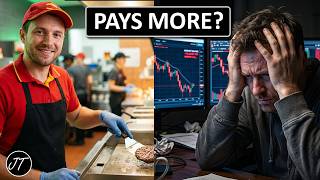
Kardec, a trader since 1998, opens a series by explaining why 99% of retail forex traders lose: brokers act as dealers taking the opposite side of trades, imposing 10-50% spreads, and psychology breaks most people. Yet for the rare disciplined trader, forex offers 1,000:1 leverage, 24-hour liquidity, and $9.6 trillion daily volume with minimal costs.
Chapters
This is the first lesson in a new 10-part series where I'm going to show you the mathematical, technical, and fundamental strategies that are proven to help you beat the forex market. In my opinion, forex is the best market in the world for ordinary people to safely and easily make money. I've personally been trading forex since 1998, first as a bank trader, then as a money manager, and since 2008 I've been trading my own account full-time. I absolutely love this market. However, as the title of the video suggests, Forex, at least the retail segment, is rigged. It was created to be virtually unbeatable. So I'm going to start this course by explaining why you absolutely should not trade Forex. It's a terrible idea and a complete waste of time and money for most people. Whenever friends and family ask me my advice, I always tell them to avoid it like the plague. I don't recommend trading to anyone, and my advice to you is to stay as far away from it as possible. This is not a gimmicky intro to hook you into watching my video. I'm being absolutely serious, and I'm going to spend this first lesson in this course trying to convince you not to watch the rest of this series. If, however, you get through this and still think you have a chance, then the other videos in the course will teach you how to tip the odds in your favor and exploit the loopholes. I I do think that for the right person, Forex is a dream market, and I personally wouldn't do any other job. But it is important you come into this without the rose-tinted glasses and fully understanding what an enormous challenge you face. Let's start with the known statistics of failure rate. If you go to any regulated Forex broker website, you will see their legally required declaration showing what percentage of their customers lose money. The number is around 80%. There are only two outcomes from a trade: the price either goes up or it goes down. So simply tossing a coin to pick the direction would only lose 50% of the time. An 80% failure rate shows that something else is going on, and the odds are stacked massively against traders. It is worse than a random coin flip. And the thing is, I Those stats are only reflecting the most recent 12-month period. A more reliable independent study tracking traders over a 15-year period was published in the Journal of Financial Markets. It concluded that less than 1% of traders were able to reliably earn positive returns over the long term. In other words, whilst some traders are able to make some profits in the short term from random luck, In the long term, when luck balances out, 99% of them fail. To put that in perspective, the only profession in the world with a lower chance of success is if you applied to becoming NASA astronaut. Statistically speaking, you have a better chance of becoming a rocket scientist, engineer, or brain surgeon. If you think those are difficult professions, trading is significantly harder. Please let that sink in. People come to trading thinking they can make some easy money with a part-time effort. The truth is, it is easier to be accepted for and graduate from med school and then go on to become a neurosurgeon. So before you waste your time attempting to trade, ask yourself honestly if you really are one of the rare maverick outliers in the top 1% of the population. If you're not, and you want that little bit of extra income, I suggest getting a part-time job in McDonald's because McDonald's workers make a hell of a lot more money than 99% of traders. That is harsh, but it is true. So with that in the back of your mind, let me explain what is behind those stats and why making money is nearly impossible. There are several reasons. First of all, Forex is uniquely a utilitarian marketplace. It exists for very specific purposes. And it is not designed nor used for speculation. If we first look at stocks— stocks are designed for wealth accumulation. That's why they were invented back in the 1600s. Groups of people in Europe shared the cost of buying an empty ship, sent it off to India, and when it came back stocked full with spices, they each had a share of the profits from the sale of that stock. Stocks are a means of speculating on future profits and are intended to always go up. Now, of course, it doesn't always work, but that's why they exist. Forex is no such thing. The entire market is structured to discourage speculation and constrain prices within a narrow oscillating range, which by definition immediately limits and reduces profit potential. You see, forex has two unique and very specific functions. The first is to facilitate international cross-border trade by exchanging currencies to enable entities in one country to transact with entities in another country. The second is to distribute government bonds and push the new money supply printed by governments into the general population and circulation. Neither of those functions have anything to do with speculation. They are purely functional. Forex is essentially the machinery which operates behind the scenes to keep a global capitalist economy running. It is a non-speculative market, despite what Wikipedia claims. I will explain exactly how the market works and why there is virtually no speculation taking place in the next video. The next, and perhaps even more damning thing, is Forex has always been and still is a closed interbank market. It is not open to the retail public. This always comes as a surprise to amateur traders, but no matter what your broker tells you, you are never trading the real forex market. You can't. Unlike stocks, which have always been open to the public since inception 400 years ago, forex has always been and still is closed to the public. It is a strictly interbank market, only accessible to the largest banks, and one, by the way, that is not a zero-sum game like all other normal markets. For one bank to profit, another does not have to lose. They don't compete with each other in the typical binary sense. Every bank is always guaranteed to make a profit without ever speculating, guessing price direction, or taking risks. Again, I'll explain this in the next video, but for now, let's just say this is an exclusive club for members only. And you're not in it. So what is retail forex trading then? Well, I'm going to be blunt and call it what it is: a scam. In the late 1990s, with the rise of the internet, callous opportunists identified a new opportunity to part people from their money. They realized that with some good old-fashioned dishonesty and bare-faced lies, they could trick naive members of the public into gambling on the direction of currency exchange rates. And hey presto, retail forex trading was invented. It is quite literally a brand new industry created specifically to take your money. Technically, there is no such thing as a retail forex market. That's a deception. And who are the people who created this new industry? Well, they call themselves brokers, but they're not brokers. They are dealers. They call themselves brokers because it sounds better. And it disguises their real business model, which is to exploit naive, uninformed amateurs. You're not their client or even a customer. You are the product. When you place a trade in forex, the terminology is misleading. You're not making a trade. You don't buy or sell anything, and you're not participating in the forex market. No currencies change hands. No assets are exchanged. You're simply making a bet with your broker that the price is going to go in a certain direction, and be in no doubt, this is a zero-sum game. If you win your bet, the broker must lose. Your broker is always the other side of your bet. They are the counterparty, always, no exceptions. They are the only entity you ever interact with, and remember, They created this industry from the ground up for their benefit, not yours. They wrote the rules and rigged the game to ensure they always win. So guess who the loser is? They've done an amazing job of fooling people into thinking you are trading the forex market. You're not. Ever. Forex is strictly off-limits to the retail public. So what's really going on then? Well, it's not quite as straightforward as the broker trying to make you lose on every trade. It's not that nefarious, and I will explain exactly how brokers work and the different ways they stack the odds against you in Lesson 4 of this course. But for now, as a simple explanation, the best analogy is that of the casino, which really is exactly what forex brokers are. On a roulette table, you are always betting against the house, and sometimes you win and they lose, and sometimes they win and you lose. Those results balance out and cancel each other over the long term. But of course, the casino has a house edge in the form of the green zeros, and that small edge is enough to ensure that every gambler loses in the long run and the house always wins. That is a mathematical certainty. Forex casinos— I mean, brokers— have exactly the same type of house edge in the form of spreads and/or commissions. However, Las Vegas casinos have a house edge as small as between 1% and 5%, and that tiny edge is enough to fleece their victims for millions of dollars every year. A Forex broker's edge is rarely lower than 10% and is often over 50%. It's truly staggering, and it explains why 80% of their players on any given month lose money, and why 99% of them lose over the long term. Forex brokers make Las Vegas look like amateurs. Now, as I said, I will explain exactly how all this works in Lesson 4, and more importantly, through the whole course, I will show you how you can overcome the terrible odds and actually use the broker's own rules for your benefit. Different brokers have different business models, and some are better than others, and we can certainly be profitable when we apply particular strategies. But being no date, the odds are always stacked against you massively, and that's just from the market structure and how the industry is rigged. The bigger problem, and the main reason 99% of traders fail despite there being thousands of profitable systems freely available, is psychology. Everybody thinks that all they need to do is find the system or indicator that gives them an edge and they'll succeed. They won't. The system, particularly the entry, is the least important part of trading. Psychology is what separates the 1% winners from the 99% losers. If you cannot master your own psychology, and most people can't, then you can't master the markets. Nothing else matters. Despite everything I've said so far, from a systematic and mechanical perspective, Trading is actually extremely simple to profit from, and in this course I'm going to show you exactly how to do that with step-by-step instructions. And yet I know that at the end, 99% of people who watch this video series will still fail to make any money, not because the strategies don't work, but because they as individuals can't execute those strategies effectively thanks to their maladaptive psychological traits. Now, this course is not going to go into psychology at all. I have a separate course dedicated to trading psychology on my channel, and I highly recommend you watch that one before risking any money in the markets. But to briefly summarize the problem, the human brain is hardwired to make terrible decisions in financial markets. You will take risks when you should be playing it safe. You will play it safe when you should be taking risks. You will make precisely the wrong decision at precisely the wrong time, and money will disappear out of your account just as fast as you can click the buy or sell button. This has nothing to do with emotions or lack of discipline. It's simply a biological fact of how your brain, particularly your amygdala, is designed to function. If you are a normal, healthy human, it is nearly impossible for you to trade profitably out of the box. You need to retrain your mind and strengthen your decision control to be effective in the uncertainty of the trading environment. It's a high-value and extremely rare cognitive skill, and like any other skill, it takes time, hard work, and dedication to develop. I cannot overemphasize the importance of this. Of all of the odds that are stacked against you, your own psychology is the biggest and most harmful. If you don't want to be just another statistic amongst the crowd of 99% losing traders, you must do what the crowd refuse to do, and that is focus on your psychology. Your mind is your edge. It's the Holy Grail everyone is searching for. If you develop it properly, it will become a trading superpower that unlocks the doors to success. But as I said, I have a course dedicated to this topic, so please make sure you watch that as well. Now, there's one last thing that really stacks the odds against you. And that is all the scams. When it comes to scam industries, forex is the jewel in the crown, the scammiest of scams. Trying to find anything legitimate amongst the avalanche of nonsense is like trying to find unicorn poop. Forex is a magnet for the most immoral, unscrupulous degenerates willing to say and do anything to take your money. And for the last 30 years, the lies have been repeated so often and with such certainty that they now accepted as fact. The blind are now leading the blind. As an amateur trader trying to navigate through this junk, knowing what to believe and what not to is virtually impossible. So no wonder the vast majority of people are using strategies and tools that don't work and actually make things worse. The problem is so prevalent and insidious that I've dedicated the last lesson of this course entirely to identifying and educating you about the scam, so I won't go into too much detail at this early stage other than to say this: remember that retail forex was originally invented as a form of gambling specifically to take your money. So the services and products that have sprung up in support of the industry are, for the most part, merely variations on the same original con. Assume that everything you see is an attempt to part you from your money rather than offering you an opportunity. Remember You are the product. Okay, so with all of that said, I'm now going to contradict myself and tell you why forex is the greatest market you could ever dream of and the perfect place for retail traders. Just to be clear, I'm still saying that 99% of people watching this video are better off working at McDonald's if they want some extra income. 99% of people are going to fail miserably at any attempt they make at trading. However, for the right person, the one person in every hundred, which is hopefully you, the forex market is an unrivaled utopia within the trading world. And here's why. Ironically, because retail forex was originally targeted at lower-income traders who couldn't afford to trade proper asset classes like stocks It was created with super attractive conditions to lure in as many suckers as possible. With a little knowledge and careful planning, we can turn the tables and take advantage of these fantastic conditions for our benefit. So let me first of all explain how brokers have inadvertently made it easy for us to exploit their own rigged game, and then I'll explain how the underlying structure of the real interbank market itself, which we ultimately are speculating on, also facilitates a greater ease of profitability for us compared to other markets. The first one is the ease of accessibility. Forex brokers will let you open an account with as little as $100. They are not elitist and they don't discriminate. You don't have to already be wealthy to be able to participate in the opportunity. They give you much higher leverage than you can get with other markets, typically up to 50:1, but in some cases as much as 1,000:1, compared to only 2:1 in most stocks. Now, leverage can be double-edged, and it must be used wisely, but when it is used wisely, it means not only can your profits be 50 to 500 times bigger than in other markets, but you don't have to risk as much of your own money. Leverage is a way of using the broker's money and letting them hold the burden of risk. That high leverage also means low margin minimums. Forex brokers only require you to put up perhaps 5 to 10% margin to support your positions. Stocks typically require 50% of your account capital. That means in Forex you are able to open more positions without having to deposit or commit more funds to your account. Your money goes a lot further in forex than it does with stocks. Forex brokers charge the lowest fees. There are so many of them competing to draw in traders, they are constantly reducing the size of the spreads they offer, to the point that spreads are often zero on major pairs. And the commissions they charge for a round-turn trade are a fraction of the costs in stocks and other markets. Forex has the lowest transaction costs of any market. It's a phenomenally cheap market to trade. They also provide free charting packages, indicators, tools, news, and data feeds. With other markets, you often have to pay a monthly subscription for the charting platform and price feeds, but in Forex, everything is provided free of charge, so you have zero ongoing monthly maintenance costs. It's basically a free-to-run business with little to no overheads. And the position sizes, or lots as they are called, are completely customizable down to the dollar. Other markets have fixed contract sizes, which often means you can't afford to open certain positions because the risk is too great. FLY8's brokers will accept any contract size, so you can structure your position to anything you like without ever overexposing yourself to risk. Actually, Reduced risk and risk management is perhaps the most important advantage of forex, and I will talk about this more in a moment. I've already pointed out trading is hard and 99% of people fail. Joining in the elite 1% who succeed requires a long learning curve with trial and error and usually a lot of mistakes. Well, the brokers' greed when they created this industry has inadvertently made forex the place to come to get that experience and practice and learn the appropriate skills of trading trading at a tiny cost. Learning and mastering Forex is considerably cheaper and less financially risky than any other market. So thank you, brokers. But that's only half of it. The market itself, and I mean the real interbank market on whose price we're speculating, has its own intrinsic characteristics that make it the best market for retail traders. First and foremost, it is the biggest market in the world with an average of $9.6 trillion worth of volume exchanged every single day. Compare that to the New York Stock Exchange, which is only $360 billion. So Forex is about 26 times bigger than the biggest stock market in the world. Thanks to that enormous size, It is also the most liquid market in the world, which translates to meaning you have the freedom to trade what you want, when you want, at the price you want, with little to no slippage or partial fills. And it's a 24-hour market. Any time of the day or night, no matter what time zone you live in, there is always liquidity and the ability to trade. So you can fit trade in around your current job without needing to be at your chart at specific inconvenient hours. And you can trade in both directions, and both are identical. There's no such thing as going long or short in forex. Let me give you an example to explain why this is important and an advantage. Imagine you've bought a stock and that stock starts to go down in value. In fact, 1834 So you want to sell to get out. Who do you sell to? It can be difficult and sometimes impossible to sell a depreciating asset because no one wants to buy something that is losing value. In fact, sometimes stocks can get locked limit down and all trading is suspended, so exiting your position is literally impossible. Just ask the people who tried to sell their Lehman Brothers shares as the price was falling to zero. It's totally different in forex because exchange rates are in pairs. Any exchange is a two-way transaction with one currency being sold and the other being bought, and when one currency value is going down, the other currency is going up an equal amount. There is always a profit on one side of the exchange regardless of the direction, which means trading in either direction, getting in or out is equally easy at all times. This is one of the unique features of forex and why it is so safe, not least of all because currencies can never go to zero, ever. I will explain exactly how the market and the prices work in the next lesson. But going back to the size of the market and its structure, forex is the least manipulated market. It's so massive Nobody is big enough to have any influence or manipulate the price, not even central banks. They've tried, but they fail every time. With $9.6 trillion in volume every day, to move the price requires billions. It's simply too expensive for anyone to achieve. And it's not only the size, it's the structure. Forex is decentralized without a single exchange. That means No one controls it. No individual sets the price. It is a free, open market with hundreds of competing market makers, each setting their own price. And if one tries to alter the price too far from the others, the others jump in and undercut them. Anyone trying to artificially manipulate anything is quickly punished by the rest of the participants. Take a look at the Bank of England, who lost over £3 billion and were forced forced to leave the European Exchange Rate Mechanism on Black Wednesday when they tried and failed to drive the value of the pound up. This makes forex a completely level playing field. No one has an advantage. You're not up against the big boys, insiders, smart money, or any of those things. Every single participant, big or small, is on an equal footing, so you have the same chances as everyone else. Trading is hard enough as it is, but in other markets you're not only having to beat the inbuilt market odds, but you're playing against more sophisticated participants who do have insider knowledge and can manipulate the price. Good luck if you think you can beat them. In Forex, they're not a problem. They don't exist. Forex is also more predictable than other markets, partly because of this egalitarian nature, but also because of its utilitarian function. Remember, Forex is not intended for speculation, and almost no one other than retail traders are speculating. It exists to serve as the engine facilitating a capitalist economy. I will explain this in detail in the next video, but the result of this is there are repeating patterns that can be predicted with almost perfect accuracy in Forex, and when you know how to exploit these patterns making money is easy. Finally, the last thing is safety, and there is no other market anywhere as safe as forex. Now, all trading is inherently risky, and if you're not a risk-taker, you should not be trading at all. There is no such thing as a safe market, but forex is as safe as it is possible to get. If you want to reduce your risk to a minimum, this is the market to trade. That safety comes from a combination of the factors I briefly listed above. High leverage and low margin requirements mean you can trade with very little of your own money at risk. Small account sizes mean you can practice and make beginner mistakes without losing much. The high levels of 24-hour liquidity mean you can get in and out of of positions easily and instantly. Prices can never go to zero, and the market cannot be manipulated or controlled. You're never competing against another participant who is out to get you. Forex is a low-cost, fair, and level playing field that is easy to predict. As I said, it's a utopia within the trading world. So, should you trade it? No, probably not. The fact still remains that 99% of traders lose money. Statistically speaking, you are extremely unlikely to be in the top 1% who succeed, and on that basis, I recommend you walk away and you find another way of making an extra income. Try something easier, like finding a cure for cancer. However, I know no one is going to listen to that advice because everyone believes they are the exception to the rule. So to give you the best chance, in the rest of this course, I'm going to show you exactly how Forex works and what strategies make money. I'll give you fair warning though, the information I show you will contradict just about everything you've been told by the gurus, influencers, brokers, forums, mainstream media, and your next-door neighbor who gives you tips over the garden fence on Sundays. What I teach is polar opposite and in some ways makes a mockery of the standard approach to trading, so I have no doubt it will be rejected by most people. All I'll say is the crowd are wrong about everything. If 99% of traders fail then what they believe to be true is clearly false and what they believe works clearly does not. Do not follow the crowd. This course most certainly won't. So let's get into it. I'll see you in the next video.









