Winning by Living in the Present Moment
Rande Howell explains why traders fail: your amygdala hijacks decisions under uncertainty, triggering fear or aggression instead of the clear thinking probability demands. He teaches diaphragmatic breathing, mindfulness, and self-compassion to rewire your brain and trade from intention rather than emotion.
Chapters
Welcome, everyone. It's. Apparently we have a trickster virtual reality. We just had a little thing. I don't know if you saw it or not, but it happened. Anyway, I welcome you and I wish you the beginning of a happy holiday. Okay. I really do. It's great to be here. And what we want to do is really, we'll want to take a look at ourselves as traders and begin to ask, you know, I need to evaluate myself and I need to start really digging to find out what's going on between the gap between what I know is possible in trading and what I've achieved. And in here, what you can discover. We're going to be looking, we're going to be looking at winning and losing and we're also going to be looking at what you really have control of. That's where we're going to be. Now, a couple things is one, I want to find out if people can hear me. You know, I'd hate to be talking all this talky talk talk and discover that nobody can hear me. If some people would just write in, into the chat box the question stuff and just let me know that. Yes. Okay, good, we've got it. Yep, yep, yep, yep, yep. Okay. Now the next thing that you need to know is that I hold questions toward the end of the, of the presentation. I found that if I get interrupted by questions, I lose my train of thought and I don't finish my project. And also a lot of the questions that people have get answered during the course of the presentation. That doesn't mean you can't write in the questions. I want, I'd like, I'd like that. And at the end, with whatever time we have left, we'll answer a few. Okay. But meanwhile, let's just start taking a look at this is what in the world is winning by living in the present moment. Okay, let's just see what that's about.
Okay, we have it. There we go. There we go. We were having a little bit more of that trickster going on there. What I, what I ask of you.
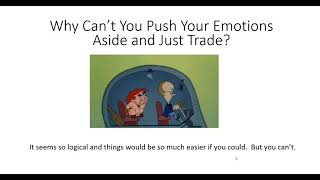
This is what most people think when they get into trading. They think they're this modern human being that's driving the machine and everything, everything's just fine. What they don't recognize is in the backseat is a very primitive brain that is focused on survival. And what it's really focused on is making its best guess about what is about to happen. Okay. That's what it's built to do. And unfortunately for the trader is that the emotion that organizes human Experience when facing uncertainty is fear and, or anxiety, okay? And this is what automatically right there takes you out of the present moment. We want to be in the present moment where there's no future.
There'S nothing to worry about in the future and there's nothing to drag up from the past. There's only now, there's only my charts, there's only me working with each chart with this trade. And there is no future, there is no past. There is now. Yet.
Yet.
Why can't you just push your emotions away? If you understand that it's all just triggering the moment that you hit uncertainty, the brain trips to that little caveman right there. And suddenly and without warning.
The cool looking cognitive fella in the front seat driving is no longer driving. A wild man is in the front seat driving. And that's what happens. So you just can't push your emotions away, okay? That's what we get and what we really are saying.
Emotions aren't even really what you think they are. And in this work, ultimately what we have to do is we have to start figuring out how to bring the emotional brain, also known as the limbic brain, with the thinking brain, known as your neocortex. We have to build them into a partnership. Unfortunately, there are some design flaws in the way that we ended up with our brain. The first thing is the emotional brain is about short term survival, controlling outcome and prevailing. Because if you did not win, you were somebody else's meal during our prehistoric times. The thinking brain is out in the future. It thinks abstractly, it thinks in probability.
Unfortunately, if put to the test under stress, unless you have a really well trained brain, is that emotional brain is going to overwhelm, absolutely overwhelm the thinking brain. And what you don't really guess is that why can't I separate them? Well, you can't. The best analogy that I have for the emotional brain shown as the heart here and the thinking brain showing as that cerebral cortex there, is that. If you can imagine Siamese twins joined at the head.
They'Re inseparable. If you try to save one, you may kill both. And so you're kind of stuck there because they have such a shared brain, they can't be separated. When you look at our brain evolving over 600 million years, and then six and a half million years ago, Homo sapiens began its march toward the sea. Is what you have to grasp is that the neocortex grew as a tumor out of the emotional brain. So what you discover is there's lots and lots and Lots of communication from the emotional brain into the thinking brain. But there's two tiny, tiny, tiny telegraph lines from the 18th century, 19th century coming back into the emotional brain. And what you've got is that you haven't got a good way of the thinking brain to manage the emotional brain. That's why you keep trying to put emotions down. They pop up. It's got that like a whack a mole, you know, you can't get rid of them. They keep popping up and they keep blowing up a perfectly good plan. So ultimately what we're going to have to do is we're going to have to, we're going to have to build a new partnership, one where you are acknowledging emotions are just simply part of the game of trading and that they have to be managed, they have to be used to create the mind.
That you take to the management of uncertainty called trading. So literally understand this, it's not so much that you have an untrained mind, of course you do for trading. So yeah, the thing is the emotions are going to fire based on primitive instincts. I mean, when you, when the brain experiences uncertainty, think about it, that's pretty much everything in trading. It immediately feels vulnerable. And I'll tell you, the brain does not like feeling vulnerable. It immediately gets confused, it gets kind of panicky and is easily jumped to the amygdala. And then to fight flight, if you've ever over traded, if you've ever not been able to get into trades, cause, oh my God, I might lose and I'm fearful or anxious. If you've ever revenge trade, if you've ever never wanted to take that loss, you have experienced it, okay? You have experienced this thing. So emotions really take best guesses. And what they do is they learn from it and they, they also are trying to anticipate in the short term. So what do you think? If you're in confusion, say like this guy is, what do you think's going to happen? Do you think the thinking brain is going to sit there and be the master of the brain? No, it's going to get overridden very quickly because suddenly that emotional brain is seeing danger, danger, danger out there and it's already on high alert and a little later you're going to see what happens. So we get that, okay, Is that it takes best guesses. It's, it's assuming short term in the future and is built to fear uncertainty. Do you see a problem here becoming, training the, the brain you brought to trading to become one that can engage uncertainty? I Hope you have, because it's dangerous. And what I want to do is I want to show you exactly what the problem is in this little graphic.
This is as deep into biology as we'll get. When you see emotional stimuli down there at the bottom of that graph, think of that as data coming in that your eyeballs are looking at your charts and they're seeing all that stuff on the charts, okay? And then it goes into that data, comes into what is known as the hit sensory thalamus. And it's making, if you saw it kind of like as a traffic cop at a big intersection with lots of cars going one way and the other, and the traffic cop, every once in a while we'll have a fire engine or a police car come with its sirens blasting. And out of that, what happens? He has to stop all traffic and let that one through. Well, the traffic cop through the thalamus is about the same. When you're sitting there and all of a sudden there is really strong data that seems very threatening. Or if you're into the throes of, like, urgency of over trading, you know, suddenly that traffic cop is going to stop everything else, hijack the mind and let that one through and move through at emergency speed. That is known as the low road. And the distance between that sensory thalamus and that amygdala, the chain reacts to the fight flight is, guess what? Nanoseconds. Now, if you have everything under control and everything's going fine, that cop is at the, at the intersection and everything's going fine. So it's going to let traffic go. And that information, the data, then the data streams of the traffic that go up into the neocortex, and that's where all your thinking does. And that's all the wonderful stuff that you're supposed to be doing as a trader. And that's called a high road. Unfortunately, it takes a quarter of a second, a microsecond for that information to get from the outside through your eyeballs to the brain. And by that time, guess what? Guess what? The amygdala has already acted and the chemistry of fear is already in the body absolutely taking out your perception. And all of a sudden you act crazy. And by the way, the hippocampus is sitting there as memory, because there will be memory that's associated. Like you've taken a really. If you've blown up an account and you remember that, well, that's remembered in the hippocampus, and all of a sudden that becomes active and that's what Activates the traffic cot to make an emergency out of it. Friends, this is what you're doing every day, and it's something that's not going to change. You are hardwired to be able. Your brain wants. When it sees uncertainty, it is hardwired to feel vulnerability and understand. Caveman didn't like being vulnerable. That usually meant that he was about to die. I mean, it was a big deal. You know, to live was, you know, to win. To die was to lose. And all of a sudden you begin to realize, oh my gosh, I'm activating those old, old circuits. Yes. If you see that and you go, okay, well, I see that, but good gracious, what's. What is it like? How's another way of describing this? It's like you were a train. What I want you to recognize is that we like to think like in that car with the caveman in the back and the 21st century guy driving. We like to think that the thinking brain is in charge of everything. Your thinking is the caboose.
Okay? That's what it is. It's where you. It's kind of like for show. The locomotive would be the emotion. That's the power to move you down. The engineer who's driving that train would be your beliefs about your ability to manage uncertainty. Friends, this is the deal. And what happens is if you. If you are not examining the real true beliefs that are being revealed by your trading account, not by your positive thinking and that, that.
All that wonderful stuff where nothing bad's gonna happen. And I'm all, I'm all good, I'm jazzed up. I'm. I'm in a winning mindset. The typical winning mindset is gonna produce this kind of stuff right here in trading. Winning assumes that you can exert your will and prevail. In trading, there is no exerting your will. The. The markets are so vast that you're need to win and not lose is just simply a non secular. And until you change the way the brain looks at winning and losing looks at risk, looks at uncertainty, this is the train wreck you're looking at. So, you know, you think about it. If emotion has this much power.
Over your thinking and your action.
You'D think everybody just really want to learn about it.
This is what's so crazy is we don't like to acknowledge this guy. Rene Descartes all did us a terrible favor when in the 16th century, he said, I think, therefore I am. He started the revolution that separated the body from mind. And I'm Here to tell you that we now know and.
In biology, in neurobiology, that you can't separate the mind emerges from your biology. And so if you're not taking care of your biology, then you're not taking care of your mind. Like, for instance, if you're sitting there and watching tomorrow, if you're trading tomorrow, if you're sitting there and I want you to notice if you have tenseness in your body. You know, a lot of people care. The gut, the chest, the arms, the fists, the jaws, all those places, okay? And then what I want you to notice is what you're breathing. Do you notice that you're holding your breath? Do you notice that you're only breathing the very top of your of your lungs friends? That's an emotion you're feeling. You're feeling the arousal, the what is known as emotional arousal. And that emotion, it's just not sitting there with a little bit of tightness and a little bit of breathing. It's preparing you for fight flight. And you didn't even see it until it just absolutely hit you right in the mouth. Okay? We have to think about it differently. We have to take those blinders off in order that we may be able to understand what we're doing so that.
We have to develop some intelligence. Okay, in the very first place is defining an emotion. There's two ways I like to do it. First of all, emotions are literally biological action potentials. I want you to hear those words. They don't have anything to do with psychology and thinking. They are level on a level of biology, and they're about taking action. They're not about you feeling something, they're about you taking action. The feeling that you have when an emotion's there is the chemistry of that emotion in your body propelling you into action or inaction. And this is what you've got right here. This is the kind of brain you've got. It's got the tiger attacking you from the front, but you're stepping back. You know, I'm thinking, oh my God, what's going to happen next? What's going to happen next? This is what happens. Emotions coordinate both perception and action between the organism, that would be you, the trader, and the environment. That's the markets. They overwhelm psychology. And if there's a change in status, okay, in the markets on your charts, there is automatically a responding emotional trigger that the emotion pops up on. Now, if you understand that the whole idea of thinking that you're going to trade without emotions is pretty silly, okay? And it gets, it sounds good, it feels good, you know, it's, it's. As Steuben Kuber once said, it sounds truthy, but what I'm asking you to recognize is this is just simply inherent to our body, to our brain and also to our mind. Because I consider the mind to be an extension of, of the brain and the brain's biology. Okay? And we've become conscious and what are we going to do about it?
And basically, here's a choice friend, right now.
Your instinctive emotional programming from your ancient ancestors, those cave people and the ones who were on the African savannas there, it's triggering automatically and it's controlling the kind of thinking and perception and action that you have. Okay? If this is not retrained, what happens is you get into tight spots and you become the gorilla who just absolutely blows the whole mind apart. I actually use the reference of the mind is a, is a governing board. If you saw this as a governing board and you saw this gorilla getting upset, you know, it's, it's a. Most upset is really about being afraid. Even anger is about how to respond to threat. And you're looking at it and all of a sudden you're taking losses. You know, think it's not going your way, it's. And you see an opportunity, I need to jump on it. It's, well, that's not in my plan, but I'm going to jump anyway. Well, you don't even think that because that's gone. The 800 pound gorilla has totally wiped that out. So.
Bottom line is that your brain views uncertainty as a threat. Okay? A big threat to your ancient cavemen ancestors. To be uncertain.
Was literally just the everyday life. And the thing is, uncertainty was almost always bad. If something arose and you didn't know how to deal with it, there were really big predators after us and we get this and you really literally have to go. You know something? I carry this from my evolutionary psychology. No wonder I have a little anxiety, a little dread that when I finally get profitable, I want to take that profit now instead of waiting for it to see if it'll reach target. You know, the thing is, it could be taken from you. It's no walk in the park. As a matter of fact, you think about it. I want to show you an illustration. Now here's some guys, probably about 40, 50,000 years ago, trying to get a meal. There's no McDonald's, there's no sit down restaurant. So they're having to go whip up a meal and they run into this buffalo type character, this bison. And so they're. They've got a. They've got a clan that everybody, you know, the clan's one, and their job is to go out and secure something for the clan to eat. Here they are. Now, you can say they're being aggressive, but when I'm looking at the guy, he's running from the bull, there's another guy being aggressive, firing an arrow. There's another guy that's already been hurt and is down on the ground. This is literally what it was like to get a meal back in caveman days. Can you imagine eight men tracking down a woolly mammoth that is five, six times as big as an African bull elephant and deciding that we're going to take him down with these puny little bows or arrows or spears, and.
His tusks reach way out there, and there's high likelihood. There's strong likelihood that you're going to be hurt or killed. But the thing is that you're rewarded for it. You get status, you get all this stuff, and you learn to say, I'm willing to. I have the urgency to act. I'm going to do that. This is where the urgency to act. It's a thrill. But. But the thing is, there's enormous rewards. A lot of dopamine back there, okay? So now.
He had to control outcome or you die. You know, to win was to eat well, okay? And you had to predict the future. You had to indicate. You had to indicate. You had to know where other animals would come up that were easier kills than this, this bison. So you begin to see that's the brain that we brought into training. And you're going, wow.
Wow. And then what the other thing you're recognizing is your inner caveman is the locomotive, the emotional brain that absolutely powers the train called you. And you think about it, you're going, wow. You mean if I'm not tuning into my caveman and learning how to work with that aspect of my being, that really primitive ancestral brain that I brought from a long time ago, and the instincts that drive their relationship with uncertainty, my likelihood of success are very low. Yeah. You know, the thing is, is that you were sitting back in the caboose and thinking it was a pretty good ride, this is not going to be as hard. Oh, it's just a little bit about probability. You never talked about. You never talked to your caveman ancestors, okay? They live there. Anybody who has a hard time pulling the trigger, anybody who's jumped into trades, anybody who's jumped out of Trades with, they've got a little profit, has experienced this stuff. And then the big one, the beliefs, the engineer, how you react to uncertainty. And the truth is, yes.
Unless you've really taken heed of your trading account, your beliefs about winning and losing are in fact killing you. You've inherited beliefs. And I think one of the hardest things in the world is for an Alpha who's done very well in business, very well in corporate, has amassed power, has gotten wealthy. He comes in and he's, he's large and in charge and he's just going to translate those winning ways into trading. And he's, he's, he's going to get it done. He's heard all the stuff. But, you know, thing I'm going to win, I'm going to make things happen. Those are the people who blow up accounts. They want to be in charge. They can't be okay, it's far beyond them. They're a little minnow in a vast ocean.
And they want to make things happen. The truth is, traders know better than trying to make things happen on an, on a random scale. What you're doing is that you're beginning. You have to learn to hunt, much like a cougar, where.
They are ambush predators. You're waiting to see what the markets will give you. The beliefs that you have about your ability to manage uncertainty are being revealed every day by your trading account and friends. They're not hard. You don't make them hard. They're about your mattering. If I win, I'll matter.
Please go back. They are like, wow, my worth. Do I really deserve making easy money? About your competency. I'm not good enough about your scarcity, about, oh God, what I have will be taken from me, or your powerlessness. If you've ever been in a trade that's really whipsawed on you and you felt that, aha, then you know what powerlessness is. These are beliefs about your ability to manage uncertainty. These are the beliefs that have to be gotten to and changed. Otherwise you're back to Mr. Gorilla here and this committee of the mind.
And the problem is, is that you're not being intentional. You're not living in, you're not choosing to live in the present mind and developing the skills to live in the present moment. Because again, if you start thinking the future, your brain's going to think negative on you or it's going to think urgency to act. If you're living in the past, you're going to be revisiting old traumas or you may be revisiting past victories where you got lucky and you've mistaken that for skill sets. So the key here.
Your job, is to prepare an intentional mind to meet the moment of uncertainty, the challenges, the challenges of your living. And what I want you to do for a moment is just name the biggest problem you have in trading. Okay, they're pretty, it's not. And also what people like to think is, oh my God, mine are so special that blah, blah, blah. No, they're, they are categorized. They're pretty easy. You know, you have entry problems, you have problems with managing the trade. Trades going against you, trades going for you. Call causing euphoria, taking a loss, taking a win. There's just very strategic points all over the place in trading that. And a lot of people don't realize that your, your, your beliefs about winning.
Are a problem. Okay, in trading. Because what happens is when you win, if you feel good, if you feel you're for it, what you're feeling is your brain moving from the kind of centered, intentional mind that you need to one that is starting to believe that I've got it. The good times are going to roll on forever. So name your problem. Now what I want you to do is say the way I handle the problem, is it avoidance based or is it aggression based?
If you can't get into the trade, it's avoidance fear. If you get out of the trade early out of a fear of missing out on the profits that you have scarcity thinking, it's avoidance. If you can't take a loss and start doubling down, that's aggression. If you, if you, if you revenge trade, you're going to get that money back that you lost. That's also aggression. Urgency to act and take advantage of a situation, aggression. What I want you to see, aggression in trading will blow up accounts. And this is your caveman talking or cave woman. Okay, so you're looking at it. Are there, are they both? This is the whole point is that notice how the successful short term response becomes locked in to emotional pattern. Then you keep doing it all over the time. You get traumatized, you get the hippocampus remembering that thing and just being on alert for everything like that. And there you go. It's pretty deadly.
And this right here is what it's like to be an uncertainty. Have you ever felt that? Oh my God, I don't know what happened. Well, the brain doesn't like that. And this is going to jump into fear or aggression almost immediately because understand anger is really a response to threat. And a confusion, I'm not in control. Powerlessness. Okay. But however, when you feel angry, you feel powerful, there is a short term gain in feeling that power. Unfortunately, once anger takes a hold and all of a sudden you've done the damage, you wake up and you realize that anger did not serve you.
In non threatening, biologically threatening circumstances. You needed a much cooler hand to be able to deal with that. So you're looking at it and going wow. And this is all happening in nanoseconds. The information on the long road that's taken, that's taken. That's like the post office. It's just taking a, it's taking its sweet time. And you've got to have a better tool, machine as a brain than what you've brought to the game. So the question really becomes is how do you begin to change the way our brain responds to uncertainty? Okay, you don't have to change.
There may be by magic, you may just stumble onto finding the mind that works. I mean you've seen some people do it, why not you? You may get lucky, you may just, if you just keep at it, you may just finally get there. And the truth is about the average lifespan of a new trader is about three years. They come come in capitalized and by three years the capital's gone. And by five years their spouse has gotten really angry at them and it's time to get on with life. So you have to really acknowledge that there is a problem that positive affirmations and visualizations are not going to solve. You're going to have to look at the emotion and you're going to have to look at the belief that's driving that emotion. For you to react to uncertainty the way you do that is where the game's at. Now. How do we do it? Well, I can tell you right now this is basically, this is pretty much anytime a person does any of our work. This is the process, the very first thing. That person is going to have to develop a very different understanding about emotions and learn to realize that ignoring emotions is really foolhardy and that you really to master the self, to master the mind that trades, you're going to have to learn to use emotions. Okay, use emotions. All thinking is emotional state dependent. So what happens is you have to develop an emotional cocktail from which a mind emerges that can handle the uncertainty. You have to become a master of your own destiny. Now to do that, after you get a little knowledge, that's not going to help. I see lots of people reading my books and all that Kind of good stuff and reading articles, watching videos and they learn a lot about emotions. But nothing changes because ultimately you have to decide that you are going to change. The way the emotional brain reacts, engages uncertainty in the very first place is in understanding the emotion. You understand that breathing and tension are part of the emotion as it arouses or calms down. So the very first thing is you have to learn how to breathe. Breathe. I call it bellows breathing. It's known as diaphragmatic. You have to be able to learn to release tension. Basically what you're doing is you're interrupting the arousal of an emotion before it becomes a feeling or chemistry in the body. Altering perception and your ability to behave, taking action. That's why all that stupid action you do after emotion takes over, that's not enough emotional regulation. A lot of people do that. Randy. This is all your work is emotional regulation is not going to change the problem. However, if you don't have emotional regulation to calm down the emotion, you'll never get to the door of the mind where all the good stuff is. You have to be able to recognize that I have to cool the emotions down from hijacking the mind that I'm bringing to trading. The next big tool is mindfulness. You have to be able to start recognizing that you and your thoughts, you and your beliefs are not the same. Is that what you are is an organization of potential that has been put into a self that the brain did in order for you to survive in the environment. And then in mindfulness you're beginning to say I'm not that okay, I'm not having thoughts but they have been having me. I need to start stepping out of them and start really beginning to realize that I don't have to be just a mindless participant in trading. I can be both participant, the person who accent trading and also the observer of that trading. They can become influential and teach each other how to trade and work effectively. That's the heart and mind working together. Then the next thing you're going to have to do is you're going to have to find. You're going to have to find your self owning beliefs. There is, there's no other way around it. You're not going to ignore them. If you ignore them, it may work for a while but with a time compression of trading is that they're going to, they're like instant karma. They're going to bite you. And what you discover inside of them, what you discover is that you know there's a lot going on and so you, first, you've got the emotional regulation down. You learn how to breathe. You. You learn how to breathe under pressure. Is that first step with mine is I'm teaching how to breathe. But I want you learning in the. In the environment that you're going to be using it in. So what you do is you learn how to calmly breathe under the. Under the influence of the chaos and the uncertainty of trading. That's where it's important then.
In the mindfulness. What you're doing in this little diagram, what you're looking at is on the left, what you're doing. You're seeing a person caught up in his thoughts. He's a participant in life, but he's not an observer. And he thinks, these thoughts are me. These are just me. And then you're looking at a person who's developing mindfulness. And what you suddenly, you begin, oh, my God, this is observer mode. These are thoughts occurring in my mind. They are not me. But this is what a disorganized mind looks, looks like when trading. Because I'm going to tell you right now, trading will test. Will test your ability to do that. The key is with mindfulness, ultimately, it's also a tool not just to check in to see what in the world's going on inside the hood of your mind. It's also where you become a designer of the self. This is important because here's where it gets interesting.
What happens is that.
From a biological standpoint, your brain would be actually a community of rival emotional programs that are highly competitive and also cooperative with one another. And what they're doing is they're organizing the self that exists in the environment. My dog does that. I do that. Now, the key, though, is this is at some moment what you recognize is this, is that the mind that you brought to trading is not organized, right? And that mind and that brain as it produces mind, becomes a committee, a governing committee. Okay, A governing committee. And in that committee, that board of directors, there are powerful forces trying to take the company called you one way, are powerful forces taking it another way. And you're waking up in mindfulness. You begin to wake up and you begin to look out and begin to realize, oh, my God, I have a mutiny. I have a disorganized self that I'm bringing. It's very unintentional. It's just the one that. It's the one that I just happened into. And you realize that has to change. So you realize you're not organized, right? And unfortunately, there's this internal conversation going on within you and that internal dialogue. What you'll discover is that there is a very destructive part of the self that I call the inner critic. And you will know the inner critic by if you've ever beaten yourself up, if you've ever just talked yourself into doing a stupid trade, you know, the inner critic's criticism. And you know, it's temptation. It lives within you, not outside of you. You're creating this reality, you know, it's something where you realize that is never going to go away. You're not going to out positive think this destructive tendency that dwells within all of us. And in trading, we're forced to see happens. And you, how many times have you said, what in the world was I thinking? Why did I do that? Well, you fell victim to this part, highly destructive part of the cell. In addition to that, what you also discover that.
It'S more than just that. You realize that there's this historical internal dialogue that's not good for you and it's really focused on negative things. This is what you're seeing here. One of the major things this committee of the mind is rooted in both destructive and construction, constructive ways of being in the world. It's kind of like the dark side and the light side of the force, okay? And what you're realizing, it is like yin Yang is construction and destruction are happening simultaneously. And if you're unprepared, if you do not have an intentional trained mind, the chance of you knowing how to develop a mind are incredibly, incredibly small. And this is just something that has to be worked with. And two of the major pieces that people try to ignore in trading, and it kills them almost, is that there's an inner critic living within you, okay? That inner critic is destructive. It's the one that judges you. It's the one that criticizes you. It's the one that tempts you. How many times when you have made a mistake that that mistake becomes taunting you and calls you a loser? Where performance and your worth as a human being are one and the same thing. In caveman days, they were in our days. Your performance is about competencies. Your inherent worth is not about your trading. It's a whole other domain of action. Okay? It's really actually accessing an inherent worth that lives within all of us. However, the inner critic is going to be the one that criticizes judges. When you beat yourself up. And the lingo that I talk is the inner critic has taken over and it's beating up on the adaptive voice that's the guy sitting there with the ears didn't want to hear anymore. Oh my God. Please, please, please, please. And just shrinking, shrinking, shrinking. What's happened there is desperately. Someone needs to come and become a different mentor to the mind between that adaptive voice and the inner critic. Someone needs to separate the inner critic from beating up on this childlike part of the adapted voice. That's where you get because understand is that you take a look at this graph, you see how tiny the thinking brain is? Okay. Do you see how big.
The primitive ancestral mind is when you consider all of it? Well, it's not fair. The thing is, is that that limbic system is going to produce assumptions that are really below thought. Okay? You see, you see the beliefs reflected in your, in your trading account, but they're not cognitive. You have to get drive to them and you have to, you have to always look and say, you know something? I know this is really about the way the beliefs I hold about my ability to manage uncertainty, winning and losing and not being aware of them. It's just simply bad news for your trading account. You have to have victory of this and out of this. This is where the big piece of the puzzle starts coming in. In the same way that you have the fear and the anxiety and the urgency to act of your orphan nature, that's the adaptive voice. In the same way that there is a presence of criticism, of judgment and temptation living within you, there is also the discipline of a ruler, the courage of a warrior, the self soothing of a caregiver. Very missing with most men and women. They tend to have, they can have compassion for others, but they can't have compassion for themselves. And unfortunately the self soothing, the compassion is the, that's the ticket for changing the core beliefs about your ability to manage uncertainty. So it's just a, it's, it's insane. There's also the impartiality of a sage. These are there, they just kind of got opted out when your brain was organizing you at birth through about five, six years to survive in the family of origin, the community and circumstances that your brain basically was organized you to survive in. They're there, but they just simply weren't developed. That certainly happened with me. I grew up in a military family where it just really wasn't a very good idea to have the discipline of a ruler or the courage of a warrior and talk back. It could get you hurt. So the thing is you have two sides. You have this internal force. There is an internal struggle always. And what we don't do Is we do not honor that struggle by honoring it. We begin to say, no, this is natural. This is. This is the way my brain got organized to deal with uncertainty for survival's sake. It doesn't mean that it's the final thing. Your, Your brain and mind are incredibly malleable. They can be reorganized and you become a very different human being. And I, in fact a very good. I am a. I'm the poster child of that. You know, the person I was much earlier in my life is radically different than the human being that I am now. So here it goes. Is what we're really doing in my work. I take two rates ways.
One way I. I looked something that.
It'S called. It's actually called memory. Reconsolidation is the neurobiological term where we're taking memories, we're getting access to particular emotional programs that are. That were.
Not properly encoded by the brain into memory. And we're teaching you how to get the brain to basically deconstruct that memory back into experience and then to coax it into being able to organize and recognize that when you've been challenging circumstances, the discipline and ruler has been there. Like you take a look at Winston Churchill. I want to tell you something. He put the free world during World War II on his back. He. He withstood the greatest army and air force, the Luftwaffe, that the world had ever known. And he got two diametrically opposed enemies to work together, Roosevelt and Stalin. He literally. I would probably be speaking German if it weren't for him. So the thing is, as you begin to see, that stuff dwells in you, that discipline. If you find the memory, you can pull it up from memory, not from one to be. And then what happens? Warrior, that's the ability to take courage and turn toward your fears. It just so happens the warrior symbol that I use for my own work is in fact a wolf caregiver here. It's the Dalai Lama. You know, the thing is, is that one thing about it. He knows that compassion can change lives. It changes the brain. He's even given a lot of his monks over to science so they can study basically compassion meditations and the impact of them that exists within you as human potential. Also, you're just not directing your attention to channel that part of the self and summon that up as part of the. The emotional programs that give rise to mind and impartiality is that, you know, the thing is you have to be able to think clearly. That's the whole point in trading. You have to be Able to think clearly and not get clouded by other emotions that are not friendly to the development of mind for managing probability.
Once they're developed, you begin to go, wow, okay, this is there. And I can revisit the internal struggles that I have been avoiding. I know that there are destructive elements living within me. I know that there are corrupted elements within me. But I also know that these other parts are there, and I now know how to awaken them. I know how to nurture them. I know how to pull them up. So they are parts of the working mind. That's what you're doing that is literally building the intentional mind. Not the one you came stuck with, but the one that's necessary. And out of that, you're still in a position where there's going to be challenges, there's still going to be uncertainty. But the difference is this, what mind is coming into that moment, okay, into that very present moment. Here, when organized properly, you're looking at a standoff. But what you're also recognizing is, hey, what happens is what he can control is the mind he's bringing into the moment. He can't control the future. The past is gone. He can control the mind that he's bringing into that moment right now. That gives him an enormous power and ability to manage uncertainty. He's not trying to control the outcome. He's not trying to be right. He's performing because when he performs well, that gives him the best chance of winning. Okay, this is the mind that can be developed, and I've just basically told you how. And then the main thing is that, you know, I played baseball when I was a kid, and the on deck circle, a place that you go, and you start preparing your mind to hit the pitcher if he's got a big fastball, got a big sinker, big curve, and you're beginning to prepare yourself. And the kid that I was started learning that. And then you'll see professional athletes, major league baseball players, they're starting the same rituals that they began in Little League. What they're doing in that on deck circle, they're getting their mind right. When they go to the batter's box, you will see them. After each pitch, they will take one step out, reorganize the mind, step back into the box, prepared to hit the baseball. That's exactly what happens in trading, too, is you. You have to first learn how to build the mind that you need, the intentional mind that you need for trading. And then you have to learn to maintain it. You have to learn to call it up and to take care of it. And when you do that, what happens is that it's much like this is a surfer, you know, he's not in control of that wave.
That wave is up and beyond him. Yet if he keeps his wits together, what he gets is he gets the right of a life and he and that wave become one. And what he's controlling is not the wave, but himself. This, my friends, is ultimately, this is what the winning mindset in the present is. It's letting go of winning and losing like a power thing. It is literally becoming a mind that performs very, very well. And all of a sudden, your edge, I hope that you have suddenly can be realized because your psychology is no longer messing up. The edge of that friends, is winning in the present moment. And I want to thank you for being here and just to let you know is that in January 13th, we're starting a new group course. We already have a number of people that have already started because they wanted to get a good head start, which is highly recommended, and we recommend it so much and encourage it so much that if you sign up before the deadline, you get a free gift from us. It's a workshop that I want you to get, start studying this stuff. Because a lot of people show up who sign up late. They get into that course and it's overwhelming at first because I'm expecting you to have worked for two weeks to a month before you get to the first class. So we're doing that. We're saying you get a free gift by signing up early, by the 7th of January. Okay. And the key is it's, it teaches exactly what I have been going over here. This, this is the very framework, the very skill sets that you'll be learning. The other thing is there's a personal course, individual course, and it's, it's very highly personal and it's very comprehensive. And it's for people who really, they really want to work with me. They want the mentor, mentorship of working with me. And it's, it's just something where I want you to really evaluate this. I want you to go to the website www.trader state of mind. And what I want you to do is look up both courses and read about them. They're extensive. I have extensive wording up there that allows you to truly understand this stuff. If you're not ready for that, then if you're still kicking tires, you know, I have over 200 videos on YouTube. I know that. I am told that people have Randy Howell weekends where they're watching, watching way too many Randy Howell videos. But the thing is they're looking and they're trying to learn. If you're just starting, you've never, you've never been, you've never heard of me and stuff like that. I invite you to go to the our website, get my free book, okay? And just start really beginning to implore. And then for those of you who want to take it deeper, get my mindful trading book which kind of outlines the process and basically the psychology that's needed to trade well. Okay. So the thing is what I really ask of you is to recognize that it's not your fault that you don't have the right mind to become. To be a successful trader right now, it would be an anomaly for you to have done that. You bring a brain that was designed for short term success and winning and you bring it to the arena of trading where you have to think in probabilities and you have to think long term. You have to act.
Basically executing rather than making something happen. It's big difference what I ask of you. If you have a question, type it in and we got one. Okay. Why is it so easy to have compassion for others instead of myself? And why? What are the ways to have self compassion for myself? Rachel that's a great question. And the truth is most of us are taught in our families of origin not to be too compassionate towards self.
America has a system of raising children that guarantees about 5 to 6% of those children are going to grow up and become and be behind bars. You start recognizing we grew up in families where the love coming out of the parents is conditional.
It's not freely given, it's not unconditional. We start finding out that we couldn't make mistakes. We get yelled at for making mistakes rather than a mistake being an open to learning. There's, there's a lot of reasons that we're just taught that it's not right. And sometimes it's.
We're taught that it's good to be kind to others, but we're rotten inside. And what happens is those beliefs become so familiar, so embedded that we would never even know they're there. You just think they're you. And it is through self compassion that change happens. Rachel. Okay, it is through self compassion that change. It has to be developed if it's not already there. I just.
I don't know. In 15 years of doing this with traders, I've maybe found four or five traders who have self compassion for themselves before we started working together. So you can see it's a problem.
Marilyn, can. Can we ask question, direct questions during group classes? Absolutely. I want you to. Okay, is that. That's a very good. I don't understand why people don't take advantage of that. Because what happens is my group classes, I'm doing a lecture, but really what I want to do is I want to get feedback from my participants so that I know how to teach them. So yeah, you can actually ask questions just like you're doing right here. But more than that, what you can do is you can ask for the mic and you and I, you and I can have a conversation. Okay. Not a question and answer, but a little. Your conversation where we explore things together. So yeah, absolutely. That's a good question. Oh, and you have some email, but you have to be sure not to over overuse that. Okay. Also, how can we prepare best before the group classes? Same thing, get in early. Get that? Get the. What happens with most people is that they don't realize that biology is an emotion. Emotions are not psychological, they're biological. And that breathing, the way we hold tension are in fact parts of the emotion. The emotional regulation work should be done for a month before you show up for the first class and to the point where you're also using it while trading. And we want to see you first learn the skills, transform it, transfer it into trading so that you can see what impact emotional regulation has. Because if you can't regulate, a lot of the stuff I do in the group is all about mind and the brain producing mind. And then the trader can't get on first base because, oh, I thought it was really good. I took too much time, I guess. And you know, the first class, I'm talking about that. And I'm moving to mindfulness so people get behind. But yeah, that's how you do it. Here's Damien. Can you prepay for all courses upfront for self study before one? Oh, absolutely. That's the, that's the smart way. That's at your own pace. Okay. And yeah, at your own pace option. And that's actually, I'll have you know, there's a story behind that because several years ago it wasn't an option. Then this Romanian guy says, look, I don't want to wait two months, I want to start now. And so he paid up front. And what he had is he had full access to the virtual classroom and was incredibly well prepared when he got when the cat. And that's when I thought, well, I wish I had thought of that. And since Then we've added that option and it's actually, we probably get what, 50% of the people that. Yeah, we get about 50% of the people who, who are smart and they say, well, I know that Randy's telling me this is a lot of rote training and that thinking about it and doing a few stupid guided meditations and then just kind of half assed trying it in the front of my screens is not going to work. No, you drill yourself in the same way that a professional performer drills themselves. It becomes a skill. It's Ruben, I have only six months in trading. Do you think I should learn more of trading before I join your class?
What I'll say is this. If you have already experienced the reaction of uncertainty, you know the value of emotional regulation, building the mind. I realize at six months you have a long time before you actually develop a competent edge and process. But if you are, if you're trading paper and you don't have a, an emotional reaction while you're doing paper trading. No, it's not time. If you're trading paper and you're, you're getting emotional reaction even at that, it's time. If you're trading money, I mean, if you're really risking capital and you've already experienced that.
Your perfectly good mind just goes flying out the window. That is when you recognize it is time. In fact, start training the mind. Now I'll tell you another thing that's really the good news is that when you join this, the virtual classroom is that you have access to that virtual classroom virtually forever. We know that someday in the future, sometime it probably, I mean, I'm going to pass from this world and stuff like that and eventually it'll disappear. But for this foreseeable future, we like people, people come to this virtual classroom and do the courses over and over again. They review. They review or they review. So with you at six months, you're taking the course and then as you learn more, you can go back, go to the classes and do it.
Fake trading, that's play trading. You're paying a trip.
Demo. Okay. Demo, demo trading. It's not real. You have a reset button and you really didn't feel the pain of loss. Okay, does mindful trading book has some instructions about how to work on myself? Yeah, a lot of people say that what it's not. A lot of people use that and then some of the retail guided meditations that. By the way, those retail guided medicines do not come out of my personal work. This ones are built for that. They have all sorts of ways. The thing is, is that mindful trading gives you a setup of understanding the mind. But I want to caution you, this is that a lot of people, they'll say, well, all I need is this book knowledge. I can read this knowledge and it should change my trading. I know hundreds of guys who have worked with me that worked with Mark Davis Douglas, and they knew his book backwards and forwards, knew everything, but it didn't improve their trading. The key is, is that there is a place for intellectual understanding, but there is also a place for emotional learning. And that's what I'm focused on. This is from hummus. Can the ability to love a small loss be beneficial? I think acceptance might be a better word, is that you come to accept that this is part of the game and that you're at a place where the thing is, is that you have compassion for yourself. You love yourself, and you realize that you have to calm your caveman brain down. I mean, taking a loss to the caveman truly is death. And so there's a need to calm that part down. Again, I wouldn't call that love, but I would say it's something that you need to bring compassion to yourself because you've taken a loss, you've lost capital, and you need to be able to be able to take your orphan nature, the adaptive voice, and comment down so that it doesn't get highly reactive.
Okay, is, Damien, I have been trading several years and have not been profitable. Will this course help me? Yeah, it'll help you. I'm not promising that it's going to make you profitable, but the thing is, it'll give you the basic skills you need to become profitable. It will show you how to develop the brain and the mind, the intentional mind that is needed to produce the kind of successful trading you're seeking. And it really, what I've discovered in both my individual and my and my group stuff, it really depends on this. The student, if the student thinks that there's some magic pill that I'm going to open up his brain, pour stuff into, and everything's going to be done. Magical thinking. It's not going to work. People get a hold of this work and they realize, oh, my God, this is the missing link. And what they do is they realize the opportunity they have and they seize it. They work their butts off, they seize it, and out of that, they change their minds. Here's Christopher. Until we know it somatically, we don't really know it. Mark Douglas was mostly about the what, but did not Teach the how. And you might not know Christopher, but he's a well known trader. Okay. And the key is, is Christopher's right and, and understand I've read Mark Douglas, I expect anybody to read Mark Douglas because he has a good handle on basically the brain and well, the mind, the concepts of the mind. The thing is he doesn't know how to go about basically bringing change to that and it's not his fault. You know, the thing is, is I spent my life as a, you know, and working with violent prisoners, working with at risk youth and building programming to help regulate emotion and all that. That's, I mean that's my background. You don't, you don't see that. And I'm an emotional intelligence guy. I'm interested. Thinking to me is a afterthought. It's a behavior that neurons do. I'm interested in how, what triggers emotionally from deep, deep, deep inside you.
Okay. This is Dajean. Hi Randy. No question here. I just wanted to thank you for your amazing work. I got your book and read it in a way. Read it in a week. I can't believe the impact it had on me. I can already see things differently and much more clearly. I bought the workbook and will be taking my time with everything for the next three to six months. Thank you. Well, I'll tell you what, thank you very, very much for that and what I would also do if I were. If you got the book and you've got the, and got the workbook, I would encourage you to get some of the retail guided meditations. A lot of people use that kind of like jokingly as a poor man's course. And they put it together and they, I've, based on the email that I get, it's, it's taken them to a great, a great, a great length into becoming.
Really honest to God successful trader. Okay, folks.
It'S time to stop. I want to thank each and every one of you because I really enjoy this. For me, this, I understand that people have no idea what they're stepping into when they step into trading. They have a brain that has been designed for one thing and they're asking it to do something else. And it's hard and nobody's out there really teaching them how to do that. Okay. And I understand that. And for me I'm, I'm, I'm just preaching and I'm, I'm not going to stop talking and trying to open this up for people because this is far more than just trading friends. A lot of my work, the people I work with have nothing to do with trading. It has to do with their self development. This is powerful stuff. Take advantage of it and have a great holiday, okay? I. I am. I'm. I'm looking forward to it myself. So be at peace, friends. And I'll see you in January and hope to see you. Take care. Bye. Bye.









