Winning Can Be Dangerous to Your Trading Success
Randy Howell explains why winning trades can sabotage your success. Your brain links money to survival and status, flooding you with dopamine that triggers overtrading and revenge trades. He recommends breath work and mindfulness to cultivate discipline, patience, and clear thinking instead.
Chapters
The broadcast is now starting. All attendees are in listen only mode. Welcome everyone. My name is Randy Howell, trader state of mind. And I am delighted you're here. And we're going to be looking at something very powerful and it's called how can winning be dangerous to your success as a trader? We're going to be looking at that and see what's behind that. But first, let's make sure you can hear me. If some people, kind people, will just simply type in a yes or a Y. Yes. Okay, we got it. We're down, Rolling. And also just to let you know is we're having a monster thunderstorm going on outside and should it knock out power, just simply come back in, our reserve generator will kick in and we'll be back up. So just let's hang out there. And it's never happened, but we have that generator there just in case it did happen. So what we want to do is go, you know something, what is actually going on? What's behind all this? And this we're going to be looking today at evolutionary psychology.
Yeah. Oh, and the other thing is I. I hold questions to the end. I'll answer them then. However, what I encourage you to do is to, when you come across this material and you have a question, type it in so that we have some questions to get us started. So started, rather than sitting around awkwardly waiting for a question to show up. I'd appreciate that. So here we are. And what I want to do is say, what is it about winning that can be dangerous to your health, to your success as a trader? And here we go. I want you to take a look at this image really closely. What you're looking at, this is a caveman and he's spearing money as if it's like something to eat. What I want you to get is this is most people, when they get into trading, when they meet me, they have a fear based trading that they bring to mind. And they're scared money. And they think, you know, Randy, if you can just cure me of this fear that I have about what's going to happen in the future and all that stuff. And if the money going to be taken away from me, if I can learn to manage that, I'm home free. I am so home free. And ultimately it's not hard to get to that point. And then they discover on this journey their own, there's an even bigger monster winning. The point is this.
Your caveman brain simply does not know what money is. What caveman knows is how to live. You Know, is he taking energy from the system, that dead deer right there, and consuming it and producing energy, or his energy going back into the environment and being, say, becoming part of a save the toothed cat. They had no idea of money. If you put money in front of them, they wouldn't know what to do. It's all about, am I surviving in this moment? Now you might think, well, I'm not a caveman. Yes, you are. You. You bring the caveman, cave woman, mind, brain from. Remember, we didn't become homo species until 6 to 8 million years ago. Before then, we had not broken away from the path of other great apes. Suddenly, we're going there, but what happened is what we came stuck with is this emotional brain, or what is known as the mammalian brain. And it's an emotional brain, okay? And out of that grew a thinking brain. And unfortunately for you, as a trader, your thinking brain has no clue that the emotional brain sitting there in the background, just kind of trolling, making sure in the moment that it sees danger or opportunity, it's triggering to instinctive, very primitive protocols. And suddenly your programming fires, and you're either scared or you're in lust to get things done. That's what we knew. We know the caveman knew the power surviving, and it knew that there was a lot of danger around it that was trying to take its life in the same way that they took this life of this. Of this deer. There were plenty of animals looking for us, too. So what I want you to get to this emotional brain way that back there, and it's so far removed from that thinking brain of yours that thinks in terms of all these elaborate schemes of trading.
To that primitive part that the thinking brain came from. Money has become symbolically linked to the power to live. And out of that, what you really discover is this. Hmm. On the part of, you know, something. Take a look at this image. You're looking at some people living as far back as 150, 200,000 years ago, as close as 12,000 years ago. And what they're doing is they're coming across a very dangerous animal. But at the same time, it's also. If it. If they're able to take it down and kill it, it feeds a village for a month. It's just a powerful thing. So what happened is these people became prepared very differently to engage that. And. And it's kind of like this. Is that what they learned to do? That stress of that challenging moment was converted into excitement. Oh, boy, look at that, man. And all of a sudden, that big woolly mammoth became money. I can make a lot of money. And all of a sudden what happens, the excitement, the euphoria, the confidence swells up and suddenly what you believe it's not going to happen to you and you end up attacking this thing. And there's history that they became very good at it. But there was a high, there's high fatality rate. So what you're beginning to see is we are bred, we are built, we have evolved to get into a moment of where we can look at danger and get excited by it and believe honestly that we're going to get through it and we're going to win. Dig. We do it every day in Trading Friends. When you start thinking, I'm going to win big, I'm going to do this, I'm going to do that, this is what happens. The deal is the reward for the hunters was extreme. They and their families got the first food. They got leadership, they got status, they mattered because they brought home the bacon. They brought home the power to survive. They brought home what later, many millions of years later would become. They brought home the money, then they also got first breeding rights. This is how risking stuff and getting excited enough to be able to chase after something that's dangerous, this is how it got built. So now every time that you over trade, you're playing this ancient drama. But what I want you to notice in this scene of these primitive humans, the alpha that's the one giving food to different parts of the clan, some are favored, some are not. This is when you're the one leading the pack that attacks woolly mammoth and all that excitement. This is the reward. Power. And the thing is, is that in trading money is about power. You know, the thing is, is that if you make a lot of money, you matter. You make a lot of money, you're safe, you make a lot of money, you're respected, you make a lot of money and all of a sudden you're lovable. People want to be around you. And yeah, you get sexy too, even if.
You don't look very sexy. And all of a sudden it's amazing what money can do. Look at Richard Rupart, I mean, you know.
Ruparp, the guy, 95 years old, just married his fifth wife, Rupert Murdoch. Yeah, I'm sorry. What you're looking at is a 95 year old man married to a 30 something year old female. And suddenly what you're looking at is that power, that money, it produces attraction. That same instinct, okay, is working from way back then till Right now. And you're going to have to learn to work with it. So the thing is, understand what we're saying here is that challenging moment, that woolly mammoth that could feed a village for a month, suddenly what happens is it ramps up into excitement. You start feeling euphoric, you believe.
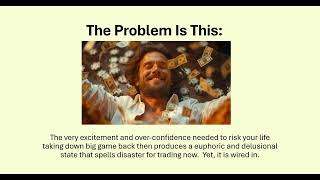
Totally that you're going to conquer that and you're going to get it down and you're going to win and you're not going to lose because if you lose back then you're dead. Okay, but they're linked. So now we're sitting here going, okay, we're having a little moving problem here. It doesn't want to move there. So what I want us to do, I want you to look at that chimp like character. Where? Way back over there. That's not a chimp. That is a common ancestor that we had up until about 6 or 8 million years ago that we had in common with bonobos and with chimpanzees. We departed from that and we started evolving and we started growing this gigantic brain that led to the thinking brain. But what I want you to notice is the guy sitting at the, at the desk on his computer trading has the same emotional brain as that chimp like character way on the left. So in effect, in effect, here's what's really happening. You sit there in this, you go, wow, you know something? This is so cool. I have made this money. I feel great. I feel wonderful. I see it there, I can just touch it. I can almost touch the money. I want a few. I feel good. I have it now. You are now falling into euphoria. You would also say that you're falling into delusion. That drug euphoria is dopamine. That is very similar to cocaine. Now would you trade snorting cocaine? I hope not yet. When you start getting cranked up, got, start getting excited about what's possible, how this money can be made and stuff like that. What you're basically fundamentally doing is you're snorting cocaine and trying to trade. At that moment, you're gonna. And when you're, when you're in that euphoria from dopamine, you think everything's good, everything's gonna go on, it's gonna go on great forever. Everything's fine, I've got it. I have finally figured out how to trade. I know it. And by the fact that you moved out of the trader state of mind into a euphoric mind means that you do not know how to trade. You may know technically how to trade when there's not risk. But until you are facing risk and working with risk and triggering there you realize that the worst thing in the world you can do when you win is to start celebrating. Yeah, yeah, yeah, I want more. I want more. Give me more. When that happens is that you stop trading. You go and whip it up, have a good time. But when you come back, there are only three emotional programs you want present when you're trading highly effectively. The discipline of a ruler, the patience of a caregiver. Okay. And the clear thinking of a sage. That's what you want to have these emotional programs coming together to create a cocktail that produces that. You do not want this. This is a dangerous, dangerous way of thinking that you're going to be a successful trader. So now we're looking at this and going. I actually had a. A number of years ago I was in China doing. I was teaching at this very large fund that had portfolio managers, fund managers and all, and also traders there. And it was a pretty good sized auditorium. And we'd come to this moment where I made the statement that in trading you're not allowed to feel good while trading. And everybody just kind of in Chinese, of course, and one guy stands up speaking really good English and said, Mr. Howell, but I like feeling good and I've made a lot of money. And what I've said is that China has been on a bull market for about 50 years.
One day you're going to have to wake up and you're going to actually have to learn how to emotionally manage the mind. At which time he got up and left and several other people got up and left and all that kind of stuff. And two days later the Shanghai had a 2% correction and he blew, he blew a lot of his capital. Okay. And he actually found me and says, Mr. Howell, you're right. Which I thought was pretty amazing that he acknowledged this. He said, I should have seen this. It was right in front of my eyes. But because I was so confident, euphoria, I could not see it. And I walked right into a meltdown. That's what I did. So this is the thing that's happening and it is wired in from that little, from the time of that little pre human part of us that grew into humanoids and grew into this Homo sapiens that sits in front of a computer cranking out stuff. Now we've gotten that and I'm hoping you can see why.
Feeling good, euphoria, winning, that is linked to feeling good. It's linked to I matter. Look at me. I really matter. I'm winning. I'm a big dude. I've really got it. I'm, you know. Yeah. Well, as long as you're thinking that, you're going to be in trouble. Now, what I want you to notice now, these are images from inside out. And they did one of the best jobs I've ever seen of being able to take emotional programs and show you how they operate to create mind in the competition between them, to take over the mind of a little girl or a boy.
The point is, this all thinking, the stuff you're supposed to be doing in a rational way while you're trading is emotional state dependent. If you are not leading from emotions that give you a sense of discipline, a sense of patience, and a sense of, like, clear thinking, then what happens is you're no longer in a state of mind that can effectively engage the markets. That's what's happening. Because that euphoria really does make you think the good times are going to roll on forever. And what we now are saying is that the moment that you fall out of your. If you fall out of the discipline, the patience and impartiality needed for success in trading, what you're doing is you're showing that you're not emotion. Your emotional intelligence is not there to match your iq, your knowledge of trading. You have to have knowledge of the subject. You have to know that. I know plenty of people that have great knowledge. They can teach it like crazy, but when they put risk in front of them, they can either go crazy by over trading euphoria or they can just, you know, they can take a loss here and there, and all of a sudden, before you know it, they're. They're a rebel and they're wanting to. They're hating that loss and they're not willing to accept the loss. That also is caveman. Understand? Caveman didn't want to accept the loss of death. He would fight to the very last breath. Okay? And that's the same thing that takes over your mind when you go from euphoria and start losing. Then you start falling down and you start saying, I'm going to get that money back. I'm going to get that money back. Revenge trading. And suddenly it's not endorphins that are. It's now you've got adrenaline, you are running through the thing, and now you're scared, but you're scared for your life and you're going to have to fight for it. There you go. So this is a state thing where if you're going to be successful in trading, what you're going to have to do is you're going to have to become an emotionally intelligent person. You know, being just, just being a guy who doesn't know what emotions is and they slap him in the face and he doesn't feel it and he doesn't understand the nuance of them. Go find another feel. Because this requires emotional intelligence. It requires you being able to set a mind that engages the uncertainties, trading while risking capital. So that's what we've got. And now we're going. Okay, well, you know, hmm. At the very bottom, this illustration really gets to show you what's going on here.
That little geek driving the brain looks like he's in control. You know, he's got, he's got the steering wheel, he's on the brakes, man, he's got it. He's got an elaborate system. He's got all this stuff, he's got this training. He almost is entitled to go out and just take a leisurely walk and make money. But what he's forgot, what he doesn't see is the emotional brain. That caveman sitting in the backseat, that caveman, as long as everything's copacetic, everything's cool. He's cool. He's just sitting in what is known as homeostasis. Calm, cool and stuff like that. And it just so happens our caveman ancestors did that a lot when they were fed and they were just kind of relaxing, they just chilled out there. They spent about 90% of their time like that. But then when the saber toothed tigers showed up, ah, everything was saying, suddenly fear took over and aggression became part of it. And then when they got hungry, they had to go hunt. And you know, they just didn't hunt little critters. They also hunted those big gigantic woolly mammoths. So you're beginning to see three. That is part of your history. And it just so happens that when nature built the modern man, he did not start from scratch and build this really cool, cool brainiac. What happens, he built it on top of all those ancestral changes that go back to the common ancestor. That's what we have brought to trading. And you don't see it because it's so primitive. It is just on automatic. It's instinct and it takes over when perceived threat or opportunity shows up and triggers you. That's the deal. That's what you're going to have to learn to deal with. And folks, I mean, this I see, you know, I've been doing, I've been working with traders about 17 years and I have seen them come and go and I know that most of you are not going to make it. No. Good, good, good. Go. What happens is that there is just a mindset that has to change. And it starts with recognizing one profound thing.
We learned that winning is everything. That's what we're taught. We want to win. What that means is that in winning you matter. You look at this, I'm powerful. Look at me, I am powerful. People are worshiping me. I am on top of it. And boy, I guarantee the babes are going to be coming to me now. And I've made a lot of money, I have a lot of power. That's what's going on here. This guy's being lit up from an ancestral mind standpoint. Okay? And understand in that game. Yeah, that's okay. However, in trading, that kind of euphoria, that kind of look at me, is going to blow your trading account up now. So a lot of people have come into trading and have produced success as being a winner. I want to be number one. I want to make things happen. I'm. I'm going to. You know something? I am good. I'm going to push it. I'm going to be. I know I can just push through this in real life. You can't. In the small little world that you were in before the markets, yes, you could. So now we've come in and tell me, well, you know something, the problem is, is we cannot control winning or losing. But winning, we can't control that. It's a probability. You can do everything right and you can still be wrong or you can do everything wrong and still be right. I've seen people who have said, Randy, I finally understand what you mean by this orphan stuff is that I was trading yesterday and it's like something possessed me and it went over and started trading. And I knew that I shouldn't do it, but I did it anyway. And, and the truth is I should have lost $5,000 yesterday. I made 300. But I finally began to understand.
What you mean by orphan and how it can become an 800 pound gorilla and just take over. So we've gotten that and you win. It feels so good, but it's not true. Winning is only landing on the right side of probability. Your understanding at a very deep level of winning has to be relearned. It's not. Winning does not make you matter. It does not make you worth. You do you, when you're doing that, you're confusing self worth with net worth. Okay. And you're going, okay, now I've made money, so I have self worth. No, that money is going to burn a hole in your pants. That's what it's going to do and find a way out. So we've gotten this, and what I want to show you is how this works. Now.
I'm going to be up front. This right here is actually the addiction process. And what you discover about addictions versus, say, habits that blow you up is that addictions have an outside agent that produces. It's not dopamine, it's heroin or cocaine or something like that. It's an external agent. The thing is, is that when you start there and you say, you know, when I do that, I get this dopamine, I get this rush and I feel really good. It creates a habit and then you do it more and it reinforces it till it becomes an automatic hardwired response. And then when you don't have the craving, I mean, the feeling good, I want some excitement, I want that. That's actually a craving. That's a craving that's actually asking you to go seek out the drug winning.
Not the drug like alcohol, the drug called winning because it's connected to that dopamine. And you get it and all of a sudden you start craving it more and more. And then you start seeking the thrill of winning. The alpha story, you know, what happened is alphas know how to win in the world that they came from. And they get to trading and they're going to just bring that success model right there with them. Then they do that, they get some thrills. But what they also discover is this, is that they're sitting there and they start getting bored when things don't start happening because they want to make things happen. They haven't figured the patience. They haven't understood that the rules of success and trading are different. You wait for things to come to you rather than to force action. They think they're going to win, they think they can do this and they get bored. And all of a sudden they go, you know, nothing's happening here. I'm just going to do some emails, I'm going to, you know, I'm going to check out some stuff. And all of a sudden you're on. You're looking at, you're looking at some markets that you have no business in. And also you see something, oh, that looks great, and you jump in, which gets you out of the boredom and gets you back into the excitement, gets you back into the dopamine and you feel good, you're ready, you're alive.
And all this time you thought thinking was king.
Thinking at this particular moment only becomes an alibi maker for what the emotional brain is already doing. And so what happens is that seeking of the thrill of winning because you want the dopamine reward, you start doing things and you have the elevated mood while trading. And my promise to you is the emotion that create the traitor state of mind or discipline or patience or clear thinking. Okay. Of a sage. So you're looking at that and all of a sudden you're going, oh, I can see how the habit got formed. Okay. That would say I want the thrill of winning. And I have this delusional thinking that I can, you know, if I make the money. And I am, I am, I am, I am. It's kind of like the adolescent brain thinking that, you know, driving fast and drinking is not a bad idea. It never happened to me. You know, interesting. When you study teenagers, what happens is they know that drinking and driving are very dangerous, but they also believe that it's not going to happen to them. Same thing the traders do. Most traders I know, I have been around, I've discovered, don't believe they need to alter their psychology to become a winning trader. And I many years ago stopped trying to convince them otherwise because they need to run into it when I discover it takes four or five years for this kind of arrogance, this kind of blindness to finally start dissipating. And most of the time after four or five years, they've gone through their capital, okay. And then I get lots of emails here where, you know something, I wish I had done your work a lot earlier. It's been out there for the how long? Friends, they probably saw it, they just thought it was bs. And now you know something, I can't afford anything, but can you help me? And the truth is no. You didn't have the sense when you had the money to be able to say, what kind of mind do I need to be able to engage uncertainty? You were not built to engage uncertainty. You were built to engage the surety of living in the moment. Short term survival. So this is what's happening. This is the way you get addicted. This is the way you get habituated to making the same mistake over and over and over again. It's on a loop. It's on a loop, buddies. And the real key is, are you ready to do something about it? Because the key, it is a false assumption that winning and your being are equivalent. That's what happens. I get all bummed up if I lose, if I lose money or the big one is I'm going to make some money today. Yeah. And I have a certain amount of gold for money right here. And what I'm asking you is nobody thinks really about, you know, what kind of state of mind are they bringing? Because if you get it, that you cannot control outcome, you have to ask the question, what is it I can control.
Friends? What you can control is the mind that you bring to, to the moment of performance.
If you have an edge in your methodology, you have then created the edge in your psychology that can manipulate and use that edge, that method edge to generate more capital being extracted from the markets than you put back in. That's the assumption. But it has nothing to do. You're winning and you're being not the same. Basically what happened is that you're looking at your competencies that you need to improve, but your being is totally separate from your performances, whether or not you win or you lose or anything. Matter of fact, a very close friend of Doris Nyers is a guy who has made enormous amounts of money in the last several years. I'm talking two, $300 million type of money. And it really came down to him. He says, randy, where I learned this, where I learned to separate performance from being. Yeah, 203 million. And what happened is that he said, randy, I lost a quarter of a million dollars when a quarter, I mean, three quarters of a million dollars, when three quarters of a million dollars was an enormous amount of money to me. I mean, it was like paying the rent type stuff. And I came to my wife and I told her and thinking she was going to be really angry, divorce me, all the negative things. And what she did is she held me and we cried together. And what I learned out of that is, come win or lose, I'm lovable. And that allowed me to be able to start taking these positions, start doing this stuff. And I was no longer scared of women or are just hot to trot, to chase money. I'm just following my plan, working the system and moving on because I knew that I was lovable up until that time. He was making money to prove that he was respectable, that he was lovable and all that stuff. He separated performance from being and friends. That's what I'm asking you to do. Okay? And in that, what you're going to discover is that.
Trading really becomes a journey into self discovery, a journey into self mastery is that for you to become successful on a significant scale, you are truly going to have to master the problems that you bring from your evolutionary psychology and from your psychology that was learned in your family of origin, in your communities and, and your culture and the circumstances that happen. It becomes a strong journey. And it's a journey where you learn in fits and stages. You don't learn from winning.
You actually learn from losing, where you make mistakes and you can actually look at the mistake and learn from it rather than avoiding it and pretending you didn't see it, which means it hasn't been mastered. So the whole point.
Is, how do you go about.
Looking at your trading account and seeing that it's really your best friend? It's telling you the truth whether or not you want to hear it or not. And it's telling you about the beliefs that you are projecting onto the markets, about your ability to manage the uncertainty and the challenges of living. And it's all in this tight little network called trading. And the question is, are you ready to sit there and look at that and really get. Look at this thing and say, I have to work at my. At myself, at the level, at the very level of belief. Okay, but how do you do that? How do you do that?
Because otherwise. This is from Planet of the Apes. And that was to me a great series because it's really about what you're really seeing is what happens the ape, the one that well understand. We're great apes too, but we're. Let's just say we were advanced. Money, power and the illusion of control get linked in the caveman, in that ape. It comes from that ape up into us. And we Homo sapiens now get to the point where we look at ourselves and we don't see the mammalian brain. We don't see the emotional brain that links us to our ancestors who were in fact great apes. And we are that. And the key becomes how do I go about how you want to win money? I get it. Which represents power and control. But the thing is, that ancestral brain has enormous influence over your thinking brain. With your thinking brain not even knowing it's there, you going to have to learn, train the thinking brain to be able to see and be present to the emotional brain and start teaching it and learning how to be in different partnership. This is the ancient instincts that you bring to trading friends. It is going to have to change in order for you to be a successful trader. And the question is, do you want to be? And this is where it gets. You're looking at these dice and you have to have iq, you have to have knowledge of trading, you really do. But also what happens is you have to have the emotional intelligence, the eq, to be able to use that knowledge, to be able to use that intelligence, to be able to play a totally different game than you were built to play. You were built to play where you maintained safety for short term survival. Now you're looking to maintain emotional sobriety for long term benefit. That's going to take a heck of a turn. So you need to be able to say, okay, I know that that mammalian brain of mine, that eight brain of mine, that caveman brain of mine is back there and it's working. And as long as I ignore it, it's going to continually seize me and get me into winning and get me excited and have me doing really stupid things, or the exact opposite, whatever it is. The thing is, is you're not determining which emotions are giving rise to the mind that engages uncertainty. And then you're going, well, how do I do that? Well, what I'm inviting you to consider. And we're back to inside out. Now, this is what happens right here. I define the emotional brain as a community of rival emotional programs that are duking it out for control of the construction of the self. That's you, that is going and trading. And what you're looking at is the control panel of a little girl's mind. And you've got anger there, you've got disgust, you've got joy, you've got anxiety and you've got sadness. And there are more emotional programs. But the deal is this, is that you are actually looking at what your job is going to have to be. Emotions are not what you think they are. They did not develop as feelings.
Dasopoda fruit fly do not have feelings. They have emotions. When they see shadow come toward them, they fly.
That's an emotion. It's a biological action potential that coordinates activity between the organism, the fly, and the environment. A predator like us in the environment trying to kill the fruit fly. And we have lots in our wine cellar downstairs, so we know about that. So the deal is, is what you're looking at going, oh, that's what a primitive emotion is. And then you start working up the chain. You finally get up to humans and we have very sophisticated emotions that have cognitive units plugged into them and stuff like that. But.
They'Re coming from a brain that was there 6 to 8 million years ago. Actually a lot longer than that. But this is the kind of way you're going, oh, so really my brain is really a community of rival emotional programs. And in this Particular, if you've ever seen emotional the inside out. It's the girl's very sad about having to move from Minnesota to Silicon Valley. And what happens is that her family doesn't allow for anything but joy there. They don't allow, they don't allow sadness to be present. And the girl's grieving. And what happens is because of that there comes an imbalance in the mind and anger shows up and depression goes off and starts really running amok. And the fear gets great and then the joy is just beginning, beginning to be damped down. This is emotions, friends. This is what you're going to have to learn. They don't show up as little cartoon characters. They actually show up as electricity that has a neural network around it that creates this stuff, God knows how. Okay, but now we're looking at it and going, okay, that's the very first thing. The second thing you're going to have to do is you're going to have to produce emotional regulation. You're going to have to make it a lifestyle change that you start breathing and diaphragmatically a habit. Like for instance, I check into my breathing about 30 times a day and when I exercise, I do this hour worth of walking and I walk up this 6 to 8% grade of a hill three times. And what happens is my body wants to go to more shallow breathing because it really, it doesn't need to fuel the brain, it just needs to fuel the muscles doing the work. At the same time, I am intentionally practicing diaphragmatic breathing as I walk up the hills because I'm training myself. Unless there is real biological threat to me, there is no reason at all to have tension in the body or to be breathing shallowly or holding your breath, which leads to fight flight, which leads to hijackings, which leads to all the euphoria slamming you down on the ground and robbing you of your potential. So that's the thing is you're going to have to learn to do this so that your breathing is not just kind of, oh, I can do this in the yoga studio. No, we want you to do it in the combat of trading, where there is real loss. Only then are you actually going to learn how to manage the intensity of an emotion while trading. It's a powerful event. And of course we teach that. The second third thing is you're going to have to learn mindfulness. You're going to have to come to the moment of you recognize a eureka moment that you and your thoughts are not the same. In fact, you're not having thoughts. You fell into streams of thought that are generations old, and you got drowned by them. And what happens? They are creating your future. You're just drifting in history. And you will do that until you decide to wake up and recognize that I have been asleep at the wheel. But the good news, when you wake up and no longer fear fear, you begin to recognize, oh, my God. I have been given the gift of being able to construct the self. Or as Nelson Mandela said, after three years of solitary confinement. What they did is they taught me that I was captain of my own destiny. Powerful, powerful response to three years of solitary confinement. So now we're beginning to say we have to produce the mindfulness. So we're no longer identifying with our thoughts and our emotions and our beliefs. We just see those as things we picked up along the way. And they may be useful back then or they now not be useful. And you realize that through becoming the observer, you can start changing those out, but it's not easy. This is an organic substrate. So now we're going, oh, wow. The fourth thing is that you're going to have to recognize something very, very true is that.
There are destructive parts of us. On always you're going to discover that there are parts of you. Have you ever beat yourself up hard on yourself? A lot of people do that. And they go, yeah, yeah, I did. I have never found a trader yet who said, yeah, I've been beating myself up. And it's really helped my trading a lot. In 17 years, I have not found that. And what I'm saying is, is that if you recognize, oh, that is a particular conversation going on inside the brain between a part of myself that I call the inner critic and a part of myself that I call the adapted self. And what happens is I'm allowing that by my mindlessness. I'm allowing that to sink me. It's pulling me down and I'm losing what I made and then some. This is how we have to go. Okay? This is just simply part of the deal, being positive and saying, I'm just going to be positive all the time. It's going to blow up in your face. What we're looking. We want you to be effective. We want you to be able to build an effective mind that is open and understands that losing simply means you landed on the wrong side of probability. And you can learn from losing. You can learn one. Is this a method mistake? Is this a psychological mistake? Both those can be corrected, or is this just probability not landing on my side? If you did everything right and it still didn't land there. I call that winning. I call that winning. What you did is you maintain order of the mind and you executed according to your plan and it didn't work out. You have an edge. Doesn't mean that it's going to be right all the time. You executed and that's what you can do. So we've gotten there now.
And then.
In my work, what happens is that you develop what I call the empowered resources that are living within you, within me, within everybody. And what you discover. And it was so brilliantly portrayed in Lord of the Rings that there is a ruler, the ability to maintain order under pressure, discipline, living within you. It may not be a ruler who wants to run a corporation, but it has to run a governing committee of the mind. You need that ruler.
You need warriors that help to maintain order, to confront what I would call that destructiveness within ourselves and look at it and master it. You also need the self care, you see, the self nurturing that a lot of the characters, like Sam.
Without Sam, Frodo doesn't get rid of the ring. And out of that, if you do that, you're able to produce a mind that can think very clearly. This lives within you as potential. It just didn't get chosen the first way through. But you can redevelop. Unfortunately, the brain's very plastic. It can be reorganized into higher functioning. We teach that. So out of that, when you get that together, you're ready to master the dragons. You're ready to master your fears. You're ready to master yourself. You now know that anything that the power of what I call the inner critic, that's the part that judges you. It condemns you, it seduces you. It gets you doing dumb, stupid things and laughs at you. The only power that part of the self has is the part is the piece that you give it. And you're learning in self mastery, not to give that away. You learn that. Yeah. I am the one who can build the mind that engages the challenges of the world. Yes. I no longer need to fear fear. That's powerful, friends. Really powerful. And then truly trading becomes a journey in self mastery. And here what you're looking at is my work with Monkey Mind of the East. Is all that monkey mind still there? But what happens? Is that me? Actually, that's my photograph. I've come to a moment of where that does not dominate me. Occasionally it takes over and I fall out of practice and I pull my practice back up and I go over again. But the thing is, this is what's possible for all of us. We can become. The monkey mind is going to be there, but we're no longer being sucked back into it. We have reached a level of self mastery that we become the captain of our own destiny. We become the captain of the destiny that you have. In trading, you know that you can produce an edge in psychology that drives your method edge and you execute it. You're no longer chasing trades, you're no longer scared. Money, you just, it is all about performance. That's what you can control.
Now the deal is, this is your trading account is going to reveal all this to you. You start allowing that trading account to really speak to you and pull back the veil that you've been hiding from yourself. And what you discover is that you can rebuild the self. You're not stuck, okay? You've got a pattern. It's in habit. It's. It's produced habit. It's automatic. But you can change that with effort. And it just so happens I teach you the tool to be able to, how to do that. That's the gift, friends. That is the gift. Now the truth is, is that.
If you have just come across me, I invite you to take the free stuff, kick some tires, go to YouTube, watch all the 200 plus stuff I have there, go website, read the articles and just really start exploring, get my free book and just start really going, what in the world is this guy talking about? Does it make sense? And I'll tell you.
The neural biology of emotional intelligence makes a heck of a lot of sense. But as you do that, then you start saying, well, I can get his book, I can look at that. But now I realize, okay, how do I actually start training myself? Well, if you're, if you're not ready to commit capital to helping build a future, you can start buying a couple things that people put together. And it's kind of like, it's kind of a mini little course and you can kind of work with some of the stuff, but it's kind of primitive. Then if you're really going, okay, I want to plunge into this. It's time to do something. I encourage you to look at our group course. What happens there? You have five group sessions with me, okay, In a webinar floor, Matt, over a period of two months, you get recordings. Because we work all over the world, we need the recordings because, you know, a guy in Australia and a guy in the United States and a guy in China are going to. It's all different. So the thing Is, is that in there what you learn are the basic steps, the tools that you need to be able to build a mine. It's powerful because you begin to see, oh, I just fell into this, I had no idea this is going on. And what we do, we have one that starts in September and a lot of people, people already, people are already signing up now because they want to do they want to start having practice with the emotional regulation stuff before it starts? Okay, so they're ready, they've started the learning process and I encourage that we give you $200 gift for doing that. I'm not encouraging you to take the course, I'm encouraging you to start it early so you get the, you actually get out of it. And we also have the individual course that is really built for, it's in depth, you really get to know, you get to find out what makes you tick and you begin to go, you know something, this is, I begin to see that it comes with 10 sessions with me and it's kind of like really more like a multimedia graduate level course. And that's the one that you know, if you were looking at it going, you know something.
I want to have a personal mentor, I actually want to learn with Randy, that would be the one you would take. But the thing is I want you to take a look at it and start exploring this because no matter where you go with this, you're going to have to develop emotional intelligence skill sets if you're going to be a successful trader. And it's alright with me, if you want to take 4 or 5 years, it's alright with me. Explore around and you may find some really good teachers and I'm good with that. The thing though is I'm asking you to look at your self trade and notice how you're breathing, notice how you hold tension, notice the conversations of self doubt, the conversations of impulse that run in the mind all the time. And notice that right now until you have control of that, you do not have an edge.
To extract your method edge. So friends, I welcome you to explore. And now let's take a few questions. Okay, hold on. I have to change glasses. It's one of those things where I can tell. It's one of those things that happen. Okay, this is, this is from Sunny. I find myself in the greatest difficulty when I am in the green. Yeah, that had often and I'm not saying it's particularly with you but your scarcity thinking right off the bat is that when you've got the green it's what you're really doing. You're saying, oh, I've got money. Oh, my God, they may take it from me. That's scarcity thinking. You also be running up against your sense of self worth. A lot of times when you start getting green, particularly if you have kind of the American worth echo at working hard is that you haven't worked hard for your money, so you don't think you deserve it. But it could be easy. Of those next question, what is sage? Sage is an emotional program that Carl Jung would call an archetype. And it is.
It is the wise part of you. It is the part that the kind of the engineering mind that can think clearly. And the difference is, is it's also the last of the archetypes, last of the emotional programs that developed, that made us human and nothing like some of our ancestors. And it is easily. It's easily disrupted. And that's why you have to be able to do the emotional regulation. You have to produce the discipline. You have to produce calming. You have to produce being able to defend the boundaries of the self in order for that sage to be the wise one who can trade. Well, that's what sage is.
Great image, Randy as the two men in the car. Perfect. Yeah, it is. That's Timothy. It is. It's kind of like. And what I really like about it is the geeky guy driving the car thinks he's in control, okay? That's what the humor is. And he doesn't even know the emotional brains there. He's taught himself not to see it. And he's basically as Einstein said, Is that really the intuition? The emotional brain is the master. The thinking brain is the servant.
Here's Sonny. Money and self worth is what I suffer from and caused me to blow my account. Yeah, well, you're going to have to learn to master that because money has become symbolically linked in your emotional brain. Money doesn't exist in your emotional brain. It exists as your sense of worth. Okay? And that's where you have to get at the beliefs. Some of it is inherited from your evolutionary psychology. Some of it you got born into in your family of origin and your culture and the deal. It is nobody's fault. This is just the human condition. And you're going to have. You have to accept responsibility. It's kind of like when One of Paul McCartney's songs, he said, you take these broken wings and learn to fly. That's what you're going to have to do. What is your book? My book is Mindful Trading and it is Available only on my website. Okay. And I and I even if I do say so I recommend is a view. It's a deep dive into the theory behind the process that I teach. And what I teach is a process. This is from William. Hi Randy. Is the use of mindfulness in breath exercise a form of inducing a trance like or even hypnotic state in a person? This is a tricky question. What happens is that we are always in hypnotic states. Right now I'm in seminar delivery state and it's something I prepared and got into and here it is. Often people get into the trance of victimhood. The deal is what we're saying is we want you to be able to choose the trance you're in. That's Stephen Wolinsky's work who had enormous impact over me. Understanding mind is that very few people have a trance of no trance. That's what if you're in self mastery that's what you want. But yeah. Is it a possibility then?
If this is possibility then a person should be shoulder be at least aware of what they're putting themselves into before they proceed and using them during the trading set. Yeah they should. They have to take full responsibility for it. Can there be a downside to be being in a state of heightened awareness while you're trading? Well it depends on again what happens. It's not the awareness that we're worried about. It is the emotional programs producing that awareness we want in trading. You are going to want the discipline, the self soothing and the impartiality that can be produced. That is the awareness you want to engage uncertainty from and the challenges of living. It's not a time.
So you are constantly in states of mind in trance like states. We want you to wake up from that and to become designer of the trance state. The state of mind, the mindset you bring to trading. William that's what we're looking for.
Okay. I experience fear even in simulated trading. Yeah, that's actually pretty common. And what happens for me is I generally want to work with people while they're actually trading live. You may take a lot of the, a lot of the money down so that it's you're doing micros. But if the person already has fear with play money we have to start there. You know it's something where you know ultimately it is that fear that you have to master. Whether or not it's in the morning when you wake up and have dreadful even before you get into the trading room or when you turn on your machines and the charts start popping up is Those are the areas that you have to learn to stabilize the mine, produce the mine, and then move a little deeper until you're finally watching setups. And eventually you're actually getting the moment of where you're risking some capital to doing that. But it sounds like you're. You're a ways from that. And like I said, we start where you start. My preference is that you're live trading, but you're not trying to blow yourself up by making a lot of money. You're just simply trying to do micros where the worst loss you can get is 35, 50 bucks. That can be enough. But with you, I would probably say I've worked with plenty of people where we had to start a lot earlier.
Okay. I have spent more money learning than I lost in the market. But I find myself scared to enter a trade because of just fear of losing money. How does one detach from money? FYI, I don't see my P and L while trading, only see the points. But you've already. You've already got a mindset. Speaking of these trances that William was talking about, you're already in a dread trance. You're already sitting there with the dread of losing. Okay. And that's the scarcity, thinking, I can lose what I can lose what I have. And then what happens is that you never. You hardly ever get into the trades because you want more and more confirmation. More and more confirmation. Again, this starts. The fear that's there can only maintain itself if you stop breathing or if you start losing. Using the top third of your lungs to breathe rather than doing. But diaphragmatically. What I would encourage you to do is get a phone, your phone, put it on you so that you're watching yourself or a mirror. But the phone's pretty interesting. You can record yourself and watch yourself trade. And you will see the tension in your face as fear grips you. You will see the breathing stop as fear takes hold. If you allow that to go through, then you're going to get consumed by fear. However, what I'm asking you to do is to say I'm going to alter that with diaphragmatic breathing and tension reduction, where I'm releasing the tension. I'm releasing the tension. Okay. Yeah, we have guided meditations exactly for that. Okay. And I would encourage that. Okay. What emotional programs do you think are holding me back from. From staying patient for quality setups and not letting FOMO take over me into entering bad trades? Well, it comes back down to what alphas do is what happens is they want to make money, okay? And what happens is that they want to make money and they want to make it right now. And they've found that to be successful and they get into trading and they find out that that.
Is dangerous. And you're basically, what you're looking at is getting in the trade. And winning means that you're a big man. It makes you, you know, or big woman. It makes you matter. It makes you have a sense of worth. It makes you feel adequate, it makes you feel good. And it's just not that way, though. Okay.
Here'S some jet. This is a good question. Is there a good way to differentiate between confidence and hubris euphoria? In some ways, what happens is that you have to develop the skill of mindfulness, okay? And it's a big thing, is you have to. Particularly when I teach intuition, I'm asking people to be able to delineate this quiet, soft voice where the gift is there. You can take advantage of the gift or not. Are this other voice that is telling you information and telling you you need to get. You need to get it. You have to learn to discern that. And until you slow down breathing, become mindful, you're never going to have a chance of doing that. But what you can do, if you do that and you open the door of the mind, you realize that there are these emotional programs called inner critic. And that inner critic is there to be destructive. It's just the destructive. It's kind of like in Star Wars. They don't really give an explanation of how the force got divided into.
Destruction and construction, but it is, I find it to be true. The yin yang, the whole min yards. The thing is, is that I also hold that which aspect of the destructive or the constructive part of ourself are we feeding? So it really becomes there. Can we ever kill the caveman? Yeah. You take a gun and blow it out and hit the emotional brain, you won't have a problem ever. The thing is, is that. No, that was a joke, by the way. Can we ever kill it? But no, you can't. What happens is that you can redevelop the relationship between the thinking brain and the caveman brain, and you begin to bring his resiliency, his caginess into the trading committee. But the thing is he's instinct, and you have to become alert to that and learn how to soothe him. That's how it goes.
Randy, I found running a YouTube with one of those.
42Hz blah, blah, blah, alpha wave background noise, background noise on YouTube to be very low volume throughout the workout and very calming. Yeah, they, you know, they are. And what happens is that they do not produce permanent change.
Looking for permanent change. The waves entrainment is that you end up being able to train or kind of organize these brain waves into particular patterns. The problem is, is that it does calm, but when the moment you stop it starts being a tick, it wears out. And the question is, do you want to stay stuck and saying, oh, I've got to have brainwave stuff to be be able to trade, or do I want to produce the mind that can trade? I would actually say both together. I've had a number of people that will use entrainment with the technology that I teach, and they use it together and.
It helps them maintain mine. But if it's working, for God's sake, keep I look at it and going, well, tell me, are you consistently profitable? If you are, I know that you're in a place where you may need to size up, but you figured out how to maintain emotional sobriety. If that includes wavelength entrainment, then okay, okay, friends, I have really enjoyed myself. I'm thoroughly delighted to have the opportunity of speaking with you. And no matter what happens, my hope is I wish you well. I hope that life is good to you. I hope that you are good to life. My hope is that you will go out tomorrow, really watch yourself trade and see the biology reflect what the mind's doing and then say, do I need to change this? Do I need to work on this? Is it part of my trading? Or is this something that I'm okay with? I just need to focus on 10,000 hours. I'm okay with either, friends. But if I can help you, if you come to the moment going, you know something? I'm beginning to figure out that trading is about 80% psychological. You'll find that a lot of people finally come to that conclusion. My hope is that you come to that conclusion before you run out of capital. Meanwhile, I wish you all well. Thank you, thank you, thank you for being here. Been great.