Your Hidden Beliefs About Money are Killing Your Trading Why Can t You Trade Succ
Randy Howell explains why traders fail: not from lack of skill, but from hidden beliefs and emotional hijacking under pressure. Your limbic brain creates false narratives that sabotage rational decisions. Building a "trader state of mind" through emotional regulation and mindfulness beats hard work or positive thinking alone.
Chapters
Cast is now starting. All attendees are in listen only mode.
Welcome everyone. My name is Randy Howell with Traders State of mind. And before we even scratch the surface and get started, let's just find out that we can hear each other. Okay. If some of you will just type in yes or Y into machine that's saying that yes, I can hear, hear you and everything's copacetic. Good. Okay. We had an extraordinary thing happen today and we basically had a cyber attack.
Yeah, not necessarily on our website, but what happened is GoToWebinar had a cyber attack and basically.
A lot of people who do webinars just like this suddenly started finding a lot of Eastern European and Russian sounding names just smacking and filling up, filling all the spots. And ultimately we had to crash the system. We had to start over. And that's why you got these alerts right after, you know, just, just a few minutes ago practically. And we have to go and manually check each person to be able to ensure that they're not a bot that takes over and starts filling up space and blowing things apart. And you know, truth is, is.
Yeah, in five minutes we're going to be taking a small break and Dolores is going to let the last folks come back and get in that are there. So I apologize for all this. And it's just something where I, it's just, it was really unthinkable to me, but here we are. Now what we're here to really talking about is your trading. What we're here to talk about is the difference, the distance between the potential that you see in your trading to be able to literally provide you kind of life you're looking for and the kind of time element that you would like to have. And you see that and you go, yeah man, I got it, I got it. I can see that. It's, I can, I can smell it. And yet at the same time, day in and day out, what you discover is hey, that's not what's happening. What we want to do is we want to take a look at this and say what is happening? And this is where we start. We want to actually say, you know something at some moment a trader in their evolution, if they're going to survive, is going to have to notice that their, their movement to success in trading. There's a couple puzzle pieces that are missing that if they don't figure out how and how to make those things disappear, they're not going to reach the success they know is possible.
They try hard, but that's not the kind that's not the point. They're rational. That's not the point. They can problems. That's not the point. You believe in yourself. That's not the point. The point is what mind are you bringing into the engagement of uncertainty with risk there? And the truth is, what you're going to discover is that if you're a typical human being, I promise you, you're not bringing the right brain and you're not going to get the right mind to be able to produce the kind of success that's possible in trading. It's always going to be elusive. So ultimately, what we're looking to do, if you take a look at one of the way that we talk about the brain, there's an emotional brain, that's your right brain, and a rational, logical mind, that's your left brain. And what happens is in between those is called the corpus callosum.
Ultimately it takes the emotional brain and the rational brain to be able to produce the trading mind, or what is in here is called wise mind, is that you need the emotions.
And what you have to grasp is this. A lot of people say you get this axiom, yeah, just trade with no emotions. Just leave emotions at the door. Well, friends, you can't do that. There is no freedom of emotion. The very act, the very act of thinking.
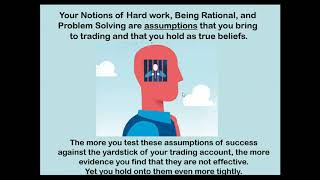
Is influenced by the emotional brain. Rational thought simply is making up excuses, stories, narratives that supports what the emotional mind has already decided. So there is no freedom of emotion. Oh, wait, I'm sorry. There is the freedom of emotion. Okay. But not from. Don't listen to that typo guide that I did right there. Okay? The key is, is that you are an emotional being. And your deal, if you want to become successful in the probability mindset of uncertainty, you're going to have to develop a very different mind than you came, than you came with. Okay, we. Doris is going to take a pause here and we're going to see, we're going to. We're going to let the rest of the folks in. And I really would like to apologize for this, except, you know, it spooked us. You know, we came into a moment where we thought, well, you know, what is this? You know, is that it's not like thought. Who's trying to ransom me? That's crazy. And what we basically discovered is that it's a much bigger problem on Gotowebinar and it's happening with frequency apparently today. So this is just happening. We're gonna breathe, we're gonna get over this and we're gonna move on. But the pieces we're back. So the key is, is what we want to do is we really want to start saying the very notions of hard work, of like being rational and problem solving. These assumptions.
These assumptions that you hold about what the right mind is, is in fact holding you prisoner to the potential you have in trading. That's what we want to see. And the thing is we want you to test these assumptions. So believe me, look at your trading account. If you accept that your trading account reflects the effectiveness of the beliefs about your ability to engage uncertainty, okay.
You are looking in your trading account at how effective those beliefs are. They're not the truth, they're not right. But we're looking at and saying are they effective? And what you discover, whether or not you have an alpha and you've just been very successful in other walks of life. You come into trading and you're trying to duplicate the same thing by being right, by making things happen and by being a winner. What you discover is man. That just does not work in trading. You'll do some revenge trading, you'll do impulsive trading, you'll do that at the. On the other hand, the assumptions of trading not to lose are not going to work either. Perfectionism doesn't work. And you're going, wow, I can test these and I can see them in my trading account. Yes, friends, that's where you see them. And then it comes down to this age old thing. The very first roadblock, okay, is literally about your belief that you and your trading are separate from one another and that all you have to do is leave emotions out of it, just turn off the feelings. Well, I'm just going to check into trading, I'm going to turn those off and then I'm just going to trade. I'm going to trade what I see, not what I feel. And.
The truth is, is that also can't be done.
Is that if you understand the relationship between the emotional brain and the rational brain is literally that rational brain is making up alibis to support whatever the emotional brain has already decided. And so you're going to be getting feeling states, you're going to be getting the chemistry, the emotion feelings and they're going to be triggering. And the real question is, can you manage them? Can you turn toward your discomfort, calm it down so that it doesn't trigger and overwhelm your thinking mind? That's what we want to look at. That's what we want to look at. And you know, when we do this going well, you know something, is there something I'M not seeing about trading that I really need to understand better. Yes, there is. Absolutely there is. And I want to show you. This is what we would call the three legged stool of successful trading. And what you notice in the middle of that is the trading account health. That's the barometer. Not what you say, not what you think, not all that talk you do with all your friends, but literally the health of that trading account. First of all, you'll notice the trading system, the platform and the methodology. How do you manage risk over on that left side? And everybody, everybody teaches that. You get that and you say, okay, if I get that, all I have to do is, you know, I do my charting and all I have to do is I see what's going to happen there, I see the probabilities, and I'm going to walk into that. And unfortunately, what nobody told the left brain is that you were going to push it into uncertainty and you were going to trigger very primal, primal survival urges that overwhelm thinking mind. And what you discover is that your caveman brain, your beliefs, your trading psychology is going to be a partner of yours whether or not you like it or not. And again, what we're saying is this, is that we're not asking you what you feel.
The certainty you feel about how good you are. I'm just around the corner. It's just around the corner you. It's going to happen almost anytime. Anytime. I'm going to, I'm going to, I'm going to. It's. I'm going to start minning money. No, what happens is once you have a trading system and once you have a methodology, what you discover is the distance between success and the using. The knowledge of that trading system and methodology is your trading psychology. And that's something that isn't taught well. And it's something that you're going to discover is that you are actually going to resist. Yes.
Okay, we're going to pause one more time to let the last people in. Okay. And I thank you for your patience. Like I said, this is something where, you know, today, if you happen to have an Eastern European or Russian spelled name, you're not going to be coming to this particular workshop. Okay. Is that we, we have some clarification that we need to do and it's just one of those things. So I think we're good. Are we good now?
No, she's still not right. Ready? There we go.
Now.
So we're here and we're going. Okay. What I'm hearing is no, back one. More. There you go. You got it. That second roadblock is that believing hard work, luck is going to produce success in trading. Take a look at this graph. You know, what happens is it's thinking, you know something, I'm just going to keep working hard, working hard, working hard, and sooner or later, that ship's going to come in, I'm going to break through. I'm going to be the. I'm going to be the one that, you know, I'm going to be the one that really made the difference. The problem is hard work produces an urgency to act. It's the death to traders. It also burns out the trader's mind, so it's incapable of thinking like a trader. It also holds you to have to do something in most trading. To be honest with you, you'll find a lot of really good traders don't do a lot. What they're doing is they're sitting. What they're doing is waiting. They're waiting to see what the markets will give them, not what they can push and get out of the markets. This is big deal. And also this notion of hard work blinds us to other end understandings of work. And what you're going to discover is I'm going to be presenting a different idea of work. So the point is.
Hard work equates your value as a human being with your performance. And I promise you, if you give the trading gods that kind of power, you're in trouble. So the big key here is that no matter how hard you work, no matter how many hours you're putting in, all that 10,000 hours stuff, the deal is, is that all that is, is knowledge. The key is, can you use that knowledge.
Under pressure? And the answer is, for 98% of traders, the answer is no. What we want to do is say, hmm, how do we improve the ability to use all that knowledge that you're acquiring in the stress of not knowing? That's what we really want. And now I want to show you hard work. You ready? Here it is. You're looking at a North American cougar. He is the apex predator in North America.
He's top dog. And what you'll discover is that we, what they will hunt. How they hunt is just like this. They can be on rock outcropping. They can be on a limb. They're sitting up high. And what they're doing is they understand the deer.
They, they understand that you know something, I have a setup. I know that deer come through here. I know that it's a reliable probability. And Possibility that they're going to be coming here. So what I'm going to do is I'm going to sit here and wait for this in the setup, and when the deer comes by, I'm going to take it out. Most of the time what I'm doing, though, as a cougar is practicing patience. There's not urgency to act. They're practicing patience.
More money is made by patiently waiting for the moment to arrive than by chasing action. I can't tell you how many people who keep chasing in the dream that they're going to win. But what happens is the moment you start chasing, you're gambling. You're gambling. Now, that third roadblock is believing that you're a rational being. Okay. Oh, my God. And even worse, that markets are rational. Remember, people used to believe that you are not a rational being.
Though it looks that way. It seems like you could be rational. You are an emotional being that rationalizes. That's what you are as a human being. You see that all the time. How many of you can do your charting, get everything together, and you rationalize. I've got it this time. Everything's fine. Then you get into the thick of trading, into the tension, into the pressures of trading, and suddenly you just get hijacked, end up doing really dumb, stupid things. And then what happens is you discover is that I don't know what happened, Randy. I just disappeared. It's like I was there one minute rational, and the next minute I'm just absolutely taking down the vortex. That's because you're a rash. That's because you're an emotional being.
Who is rationalizing that they're rational. And what we're doing is we're saying if you grasp that you're really an emotional being, you're going to have to learn how to manage emotions. You're going to have to work with emotions. You're going to have to integrate the emotional brain with the thinking brain. That's what's going to happen. And that you start discovering is that you're assuming you're seeing a world out there. All that charts and all this. That and the other, what you're really experiencing is somebody putting numbers and distinctions upon the emotions of ebb and flow and supply and demand. That's what you're looking at. And the thing is, is that to believe for a moment that you're separate from your beliefs is insanity. Because what you discover is this.
Here's a.
Here's an axiom in neurobiology is you do not see and Then believe. What you do is you believe. And then you see out of your beliefs, you see what you think is the truth and you think it's certain when in fact all that certainty is chemistry hijacking your mind. That's all it is. And if you want to take a look at this, you know, whether or not you're pro Trump or anti Trump, what you discover is there's two camps and neither will listen to the other. They don't want to hear a truth other than what they already believe.
Okay.
That'S okay for politics.
That'S not okay for the trading mind as it engages uncertainty. You have to grasp that, oh my God, I'm seeing through the filter of beliefs that's telling me the truth, that's having me believe I'm right around the corner. It has me believing that this thing's going to all come true and I'm going to win, when in fact what you're doing is that you're acting from your beliefs. You're not acting from the truth. And we're not even saying that there is a truth. What we're saying is we're looking to be able to evaluate your beliefs by the health of your trading account. And a very famous early psychologist, Karen Horny, she's one of the, I would say the fathers of modern psychology, but she's one of the mothers. She said, listen to this.
Rationalization may be defined as self deception by reasoning. How many people have you rationalize all the time? I want you to hear this definition is that it's so easy to produce self deception. It's right around the corner, I'm almost there. When in fact you haven't got your psychological head together. You don't even have a grasp of how biology really dictates emotions and how you are going to have to truly deconstruct how emotions react to uncertainty based on 6.5 million years of natural selection. That's what you're up against. And then what will pop up is rationalization. But understand this is that the biggest problem with traders is they keep falling into self deception, believing they're almost there, believing that the, you know, the ship's gonna come in when in fact they hold a mine.
That cannot produce success in trading. Cannot produce success in trading. And I'm gonna talk to you about that a little. I'm gonna talk to you about more about that. And so the key is this. Take a look at this guy. You know, games on the line, a couple free throws, they've got all those same frilly Things they're doing there, they're doing everything they can to spook this guy's mind. We don't know what hit the state of his mind is, but what we can say is this. As long as you're looking outside of the self, success is going to elude you. It doesn't really matter how many free throws he shoots. What matters is where his mind's at when he's shooting the free throw. Particularly under pressure. When you're sitting at practice and you're shooting a hundred free throws, there's no, there's no audience like this jeering you and stuff like that. That's when the music, that's when, that's when the pressure's on. And the question is, what are your beliefs about managing pressure?
Okay. Not what you say they are. No, what your performances are. And what happens is successful traders know that at least 80% of success is in their head. You know, the.
The methodology.
Is just simply the ticket to the game.
The thing is, is guys like a Michael Jordan, what they do is they elevate their game. They finally hit a level of mastery and they're playing to perform. That's what they're doing. And because they're playing that, they're focused on that. They're not, they're not listening to the crowd. Their self esteem is not based on that powerful stuff.
The next thing is, oh my God. The avoidance of fear and anxiety. You know, this is like the fear of losing is that trying to avoid the fear of losing by being right.
Or finding a system.
That is so convoluted that yeah, it gives you higher predictive value but it's so awkward to use that you lose the fluency of being able to go in and actually do that. The key is, is that at some moment.
That fear, that anxiety is not a detriment. It's the path to self mastery. Okay, if that's really a saber toothed tiger, there is the shadow of that hand. You should have fear. If it's uncertainty there because you don't know the outcome, that is the task. That is the job of the trainer to traitor, to train his mind to be able to engage that moment not with the idea that you're going to control outcome, but with the idea that you're going to control the mind that you bring to performance. Big deal. Because here's what you're against. This, you know, this is a, it was a tacky movie, okay I admit that. But if you think about it, this is something that had been happening 20, 30,000 years ago, this scene could be happening. And there is a man. And by the way, the men were a lot smaller than. You're looking at that guy. That's all well studied and stuff like that. And I might add, the saber toothed cats don't have that big of teeth. They're six inches, not a foot. However, what you're looking at is primal fear, biological threat that the organism, in this case the, the caveman, is being exposed to. The question does he regulate that fear.
And maintain a clear headed mind or does he trigger to fight flight and try to flee or become aggressive? That's the only question.
And what we're doing, this very scene plays out in your mind every time you face the uncertainty.
Of risking capital on a trade. Every time this is what you're provoking. There is a part of your brain that is looking at it going, oh God, this is, this is a potential loss. And that limbic system doesn't know that that loss is just simply psychological discomfort. No, to the limbic system, that loss, biological threat, friends. So what does it do? Rational thinking is simply hijacked in the heat of the moment. And there you have the problem. This is what has to be retrained, friends.
No amount of the, no amount of knowledge.
Is going to get you past this moment right here of facing uncertainty with risk on the line.
Not choking.
You don't do it by ignoring the fear.
You do it by mastering the fear. That's what this is all about. You know, we talk about this and what I want to do is ask you, I'm going to show you a different way of understanding emotion.
What is an emotion?
Where we are now in neurobiology, we recognize that they're biological, they're not cognitive. They don't happen in the mind, they happen in your deepest biology. They're biological action potentials that organize interaction between the organism, the trader and the environment, the markets. The moment that there is a change in status, the moment that you enter the unknown, you automatically trigger emotions as a potential order matically. You can't leave them at the door, you can't pretend they're not there. Oh, you can, but they're gonna, they're gonna bite you. Now, if you want to start learning how to use emotions.
To your advantage, you start saying, okay, Randy, that's really interesting and emotion's not a feeling. And ignoring emotions is dangerous for my trading. Absolutely. And you're beginning to say, well, and what you're saying, Randy, is I need to be able to learn to produce a particular Emotional mix. Yep. That the mind comes out of. Because Randy, what you're telling me is, is it all thinking is emotional state dependent? Yes. And unfortunately an untrained mind is easily triggered to fight flight survival instincts when it's uncertainty and risk. And the challenge is going to happen real soon.
Yet when you, when you break it down, you go, okay, that's what the emotion is. Then you start saying, well, what are the. What makes up an emotion? You'll know these things. Have ever experienced arousal? That's the body cranking up tomorrow. If you're trading, notice your body, notice how tense your body gets. Notice how it's in your chest, your neck, your thighs. And then start noticing your breathing. You're holding your breath, you're breathing high and light. That's arousal. You have triggered the emotion. The emotion is on the war path and it's beginning to arise and aroused and getting ready to for action, either aggression.
Or avoidance. When you feel that arousal, it's leading to a feeling.
Now, a feeling is not touchy feely a feeling, the feeling component of an emotion is literally the chemistry of that emotion in your body and your brain altering perception. Fear produces a very different perception than patience. And you begin to say, oh my God, I see it's aroused. It reaches a particular point and it, a flip is switched. And then all of a sudden it's not arousing, it's not getting ready, man, it's pumping. It's pumping adrenaline, it's pumping cortisol, it's pumping all sorts of stuff into the system. Testosterone, all that risk, all that fear.
That's the feeling. You already shot yourself in the foot. The third thing is motivation. Every emotion is going to tell you to do something. It's either going to approach, which is what we want to do, but you're going to have to do some training for that attack. That's revenge trading, impulsive trading. Avoid fear of losing. I can't even get in the trade or I have fomo, you know, I get profit. Then I'm scared that I'm gonna the profits gonna take away and I grab it. And all of a sudden I pay my broker, but I don't pay myself. The fourth thing is the meaning, the belief, the assumption that's been hardwired as an unexamined belief into your brain that absolutely trips. It's always about your ability to manage uncertainty.
That's it. Deal, friends, temperament. Something that I don't get into because it's beyond my pay grade. It's about genetics and some people are just a little more anxious than others. And other people are more risk tolerant and neither is bad nor good, but they need to be managed. So now you know the components, then go, wow. Okay, now tell me more. Well, the brain and the mind on self preservation of the status quo. Friends, your brain is a negative assessment machine. That's what it's built to do. It's built to stop you from going past your comfort zone and exploring new horizons. You're gonna have to do that. Most people get pushed into those new horizons. They don't jump into them by themselves. The second thing is, and this is really important.
Your brain does not distinguish between uncertainty from fear. The moment that experiences uncertainty, the brain experiences vulnerability and confusion, which it lows. From there it is hardwired into fight flight. You can see the trouble. That's its wiring, that's the way it wants to go. Yet that's not the way that you can build the brain to be able to manage probability. You know, here you're trying to survive, you're trying to manage survival, the certainty of survival in the moment. We're looking for a probability mind.
Now. And it organizes you to avoid uncertainty. That's why you keep lying to yourself. It's just right around the corner. You know, I use a slide that is, you know, the, you know, the people are at a movie and a reassuring lie has a whole crowd going to it. The uncomfortable truth only has one person at it. Okay, it's that kind of stuff. But ultimately, as you find, as the brain finds a solution, it locks it into pattern of either avoidance or aggression. And that's what you're, that's what is being exposed by your trading account. Your performances in trading. Then of course the patterns going automatic and you don't even know they're happening. So you're trading from a position that's gonna kill you. What does it look like? It's pretty easy. This is why, you know, basically 95% of traders lose money and only 2% actually make money. A lot of people are marginal. They get a little bit of stuff, but it's not a living. But the emotional state determines the state of mind you're thinking. You get it? That state of mind you're thinking produces the perceptual map. How you read the world in front of you. Then how you read the world in front of you are the actions you take for better or for worse than trading. Okay? Then those actions create the reality you experience. That's what you're seeing in your trading account. That maybe you don't like and you just self deceive and you talk a talk when you're talking to other traders and you talk about the one that got away, you talk about this, talk about that, but nobody talks about everybody's losing money, friends. Just about everybody's losing money. They don't talk about that. They would have to start talking about the psychology and all that ooh, sensitive stuff. And then that, that feeds back into the loop of the emotional state of engaging uncertainty. Again friends, this is what, this is what you inherited from history. And no matter how hard you try, like this guy, this homo sapiens fellow right here, he's looking back on his ancestors and stop following me. That man carries the caveman brain inside him. It's called the emotional brain. You're going to have to train it.
Not by wishful thinking, not by saying I'm going to hocus pocus and this, that. No, what you're going to do is you're going to have to learn how to regulate it. You're going to have to learn how to cool it down. You're going to have to really, truly learn how to produce different beliefs.
This is the emotional brain that has to be included for with the rational mind of the neocortex. It's not, it's not a choice. And this is the one that most people get stuck in. You know, the thing is you want to be right and you know, I hear it all the time, I'll be listening to people. You know something, I really saw what the market was going to do. No, you did not. You saw potentiality. That's all you saw. You saw a potential that it might go that way but the truth is you don't know. And I can. This little thing in this cartoon, you know, did you read my paper on confirmation bias? Yes, but it only proves of what I already knew. Everybody, you know, you talk to traders outside of the, the act of trading and it seems like they know a lot of stuff.
But when you take a look at their trading account.
They don't seem to know what's important.
How to manage the emotional mind on uncertainty. So this is where we get stuck and what we want to do. This very instinct of this mindless self, this limbic learning that has organized you to engage uncertainty and risk on an automatic level without you ever knowing it and just absolutely hijacking your mind. We have to get at these self limiting beliefs, we have to get at them other side. Otherwise we stay stuck in the performances that we have because ultimately it goes back to it, friends, is when you're looking at the health of your trading account, you're looking at the effectiveness of the beliefs that you're projecting onto the markets. That's what you're looking at. And if they're limiting beliefs, you're going to see the problem in the trading account. If they're empowering beliefs, you're going to see the good news. And that's kind of the way it works. So we're getting this. And when you're looking at this thing from a real way, the inner map is rooted in the beliefs that you bring to your ability to manage uncertainty, your beliefs about success. And what we're doing is we're saying, what I want you to do is to challenge your beliefs and their ability to produce success.
Prosperity thinking, positive thinking you discover really quickly just doesn't work in trading. It assumes that you can program the unconscious, the emotional brain by repetition and by having positive thoughts. Well, the trading gods don't care.
So again, what we're doing is recognizing that beliefs are really assumptions that take on the force of truth and cause you to see what you see. And they become wired into neural circuitry and they shape the world that you see and work in. And man, there they are all the time, friends. And you're going to have to decide whether or not you're going to continue telling stories that don't reflect effectiveness in your trading account, whether or not you're going to face the fear behind.
The belief that allows you to change that thing totally. And out of that.
This is where it really gets big. And this is when we start going, how do you get out of this fix? The key is most of us believe that you are your beliefs, that my beliefs and I are the same. My thoughts and I are the same. The truth is, is you're not. You do not have beliefs, they're having you. And the truth is, is that those beliefs were formed before you could think they were in. They were downloaded from past generations, from your present generation, and before you even knew it. You're actually using those beliefs as if they're the truth. If you bring those beliefs into trading, you find out whether or not they're effective or not. What we're saying is if 90%, 98% of the people that I'm that are in this audience are going to have a hard time because they're not effective. So what we want to do is we want to unlock awareness from the beliefs that shape the performance line you bring to trading. That's what we're really wanting to do. And this is where the very first things that I teach are emotional regulation and mindfulness. Emotional regulation has everything to do with using your breath.
And using your muscle tension to interrupt the physicality of an emotion. Emotions, being biological, are going to have a breath signature and a tension signature as part of arousal in emotional regulation. What you're doing is you're disrupting that and you're learning diaphragmatic breathing to be able to maintain a calm mind rather than getting it agitated and going bazonkers on you. Then you develop mindfulness where you become the observer of emotion and beliefs and the self you're no longer fusing. I am not. I am not this, I am not that. What happens is I have been organized, my potential has been organized into a particular self. And that self was adaptive. It worked. However, now that organization itself is not working in the performance for trading. And we need to reorganize the potential of the self. Okay, These are the tools. This is the things that begins to set the prisoner free.
And out of this, what we have to do is we have to start reconstructing the historical narrative that you keep telling yourself, the narrative that produces the peak performance trading. And what you discover is this. The brain is really a rivalry of competitors for dominance. Okay, There are different emotional programs that are constantly duking it out. Literally the winner takes all. It is really well documented and shown in the movie Inside out by Pixar Disney. You really begin to see primitive emotional programs basically in rivalry with another, in competition with one another and in cooperation with one another, basically forming the mind of this girl. And this is what you have to grasp that this is the challenge is between your ears and learning how to work with it. And the big deal, the huge deal is you move from the brain as a community of rival programs, duking it out to the mind in this miracle of where mind appears. And that community of programs is given voice.
And suddenly you're beginning to realize is that, wow, there's a lot of voices going on inside my head. A lot of us know the, you know, the struggle between two voices. You know, when you're arguing with yourself about what to do, One says yes, another says no. But what happens as you gain awareness? You start realizing there's a lot more than two in there. And the truth is, is that with an untrained mind, you rarely have the right ones there. And as you develop mindfulness, you discover there's an internal dialogue going on that you're going to have to become master of. Otherwise it's going to be your destruction. But when you first start doing this, you discover that the Committee of the Mind, there's a mutiny going on.
The good guys are being thrown off the ship and the ship is still sinking because the bad guys are going to sink that ship.
And you have to decide whether or not you're going to sink your trading. And understand this. Traders, highly motivated, ready to learn.
Are gone. In three to four years, they've burned their capital out and they have to move on because they can't move. That's, that's, that's the nature of this beast. And you're going to have to decide how you do it. In our training, what we're doing is saying what we want to do is we want to teach you how to access the emotional programs that give rise to the probability mind, that give rise to the traitor state of mind. And we've defined those as courage, as discipline is self compassion or self soothing and of impartiality. Those are emotional programs, friends.
And the first thing I do is I teach you how to access the emotional program so that you are the one summoning the emotional programs that give rise to the mind when engaging uncertainty rather than your history, which is what's happening to you right now. But further on you go from just emotional enrichment where you're finding that emotional program to you're finding that the brain's really cool place is this is where the emotional brain and the thinking brain start working together. Is that courage becomes representative of a warrior. Where the warrior turns toward your dragons, turns toward your fears and protects the innocent. You need the discipline of a ruler, a George Washington. I mean, I'm going to tell you something. When the guy was on the boat across the Delaware attacking Persians, Prussians on Christmas Day, he, you know, he commanded, people believed in him. He was able to organize a ragtag argument to be able to beat the world's power most powerful military. Now he had a lot of help from the French. But understand that quality of discipline as a ruler lives within you. The quality of self compassion, of self soothing to being able to calm your fears down, also lives within you. Here shown by my mother Teresa. But it can be shown by something else. But someone who had deep compassion for you, even for yourself. When those are working, those three emotional programs are working, what happens? It cools the fight, flight response. And out of that impartiality.
The clear thinking of a sage shows up. These are qualities, both its emotional programs and archetypal symbols that you can manifest, work with and build the mind that engages uncertainty rather than try to jam the mind that you brought to trading to do something it's incapable of doing.
So I want to point out, I want to show you what the stages of long term change are. It starts with emotional regulation. Friends, a lot of people don't believe that. But if you do not manage emotions in the beginning, you're never going to get to the door of mind, you're going to get hijacked. Second stage is when you start opening the door of the mind and looking in. You need a tool. It's called mindfulness awakening the observer. And this is when you step back out of thought and realize that you and your thoughts aren't the same. You and your beliefs aren't the same. And through mindfulness, you begin to build the mind.
That can engage uncertainty profitably. This third stage is you start using that new mind to disrupt the internal dialogue, the struggle that goes on when you're facing uncertainty. Oh, should I shouldn't do it, I shouldn't do it. I'm going to lose, I'm going to lose. No, I'm going to win that. Back and forth, back and forth, back and forth. The truth is you don't know. You're going to take your best guess based on your methodology, based on your platform and it's going to give you an edge. That's what you know. Yet at the same time, the thinking brain may want to do that. The emotional brain is thinking short term survival doesn't want you in the trade or it wants you in aggressive taking over things. Stage four is you start developing the peak performance elements of self. You start living and realizing that these are, this is not hocus pocus. This is something that with practice you can rebuild the mind. You know, again, you don't get past the inner struggle. It's always there. But what happens is that the mind that engages that struggle, wow. That's what changes, friends. That's what you can learn to do and that's what I can teach you to do. So my question is pretty simple.
Who's in charge of the organization of your trading mind?
If you're like 90, 98% of traders, that's a big universe is you're not history in control of it. And the question becomes, who's going to populate that trading committee?
Who is going to populate the trading committee in your mind.
Waiting for it to show up on its own, for your luck to change, for you to hit the stride.
Just try it, see if it works. So we see that we Realize that's our responsibility.
And the real question is that on the left, what you see is the mind that you bring to trading. By definition, it's going to be impulsive and fear driven. Even if you're an Alpha that's produced success, it's impulsive, it wants to win. And at the same time, you're putting in a situation where it's not in control of winning. And the mindless trader is also blind to the internal dialogue. He doesn't want to hear it. He doesn't want to master the self. He wants to win. What happens, though, in that mindlessness, you're unaware of your potential? The inner critic really becomes a source of this stuff. It's very active in you. And that adapted voice that, that orphan nature of yours just doesn't have the leadership it needs. Or on the right side is the mind designed for trading. You have an emotionally regulated, calm, focused mindset. You have a mind you have where it's in command of the internal dialogue that's engaging uncertainty, the unknown. It's not falling over to fear. It's not falling over to aggression. It's falling into disciplined impartiality. That's the mind needed. And this is what we call the traitor state of mind. This is where, you know, you just discover these are elements living within the cell. And you have the ability of forming that. But you're going to have to work to do it. It's not going to happen naturally. You already see what's natural. And here's the deal. This is what I see all the time. I see a bunch of guys, stubborn as mules, and they go in and they just say, you know, I don't want to change. I'm going to work this thing out. I'm going to do that. I'm going to do this. And they create all sorts of stories and they lose a lot of money. I can't tell you how many people come to me and said, randy, you know something? I wish I had listened to you a long time ago. I just blew a lot of money and now I can't afford to use you. Can you spare a dime? And my answer is no. You know, this is. This is. This is natural selection. This is evolution. What happens is you're out of the gene pool. It's up to you, friends. And the key is, while you still have capital and time, my encouragement is to train the mind for probability. That's what I really do. So what becomes the next step? Well, if you have just met my work, you know, read all My content, you know, read, I mean, there are 200 videos up on YouTube. Read the articles, they're, they're endless. You know, start really getting in and saying, golly boy, I'll tell you, this is amazing. But when you get, when you start getting serious, you start saying, okay, really, when it comes down to it, you drill down and it really comes down to, you know, to train myself. I'm looking at the group course of the individual course to make that decision. I would be very happy to talk to you. But the main thing is start with a book. Start really beginning to see that this is a big deal, friends. You're not going to get the mind that you brought to trading to produce the success you're looking for. And again, don't believe me? Keep working at it and seeing what it does. Look at your trading account. So you're looking at it and going, okay, you know, ultimately it comes down to I'm gonna have to develop the mind that trades. Yes. Just like in another profession, you're gonna have to develop that mind for trading. So the real key is.
How do you become the change?
Well, it starts right there. It starts with the group course. It's a really great course. It got invented because I had a number of trader trainers saying, you know something, Randy? I have a bunch of people that simply can't afford individual work. Can you design a group course that teaches the basics and gives them tools that they can use? And that's what that is. The group course is that, you know, fundamentally it's five group meetings. You have access to a classroom 24, seven, fundamentally, for forever. And if you're smart.
You register early so you can begin early because a lot of people get in just in time and they discover they're way behind. I'm assuming before we ever meet in the group course, that you've already started the regulation work.
The second is the individual course. This is a very comprehensive and very personal course. And it's like basically a graduate level course that's multimedia and it's highly comprehensive. The biggest thing is that it's going to come with 10 consults with me where we go through the process of this change.
And the big deal is that you have a mentor walking you through what your brain doesn't want to see, but you need to see. And if you're thinking about that, ask for a free consult and hit contact us and let's talk about it. Okay? The deal is you can do nothing and can be stubborn as a mule. And the trading gods don't care, you know, eventually what happens is that you may get lucky. You may be one of the few, all that and you may be one of those guys who just somehow figure it out. You become successful.
About 2% of a chance. Okay? Everybody's smart. Everybody works hard. That's not the point. The key is it's not the smart ones that make money doing this. It's the emotionally intelligent ones. Okay? Now, if you have any questions, please write them in and.
I'll answer a few in the next five or six minutes that we have left. And.
From Pablo from Ecuador. Hello, Pablo. How are you doing? It is good to hear you again. Take care. And the key is, is what I wanted you to do is really think and to begin to go, you know something?
Am I really willing to do what's necessary to produce the successful, successful mind for trading?
Okay. Or do I want it to magically happen? Most people work for magic and it, it just never happens.
So.
My hope is, this is my hope is that.
You have a great time in trading. You learn how to do this, and if I can help you get past where you are now into the next stage of the journey.
That would be just great for me. I enjoy doing that. So come to the website, take a look if you're ready. And saying, you know something, I'm going to look at that group course, I'm going to look at that individual course. And you know something, I'm really seriously considering this and I'm going to ask Randy for a consult. That's what you do, friends. And meanwhile, we hope that the, the.
Cyber attacks are over and we will see you in the future. So take care. It's been great.









