Your Unseen Money Beliefs that Block Your Success
Randy Howell examines how evolutionary money beliefs sabotage trading performance. Deep-seated ideas about power and scarcity, wired into us over millennia, shape how traders make decisions and manage risk without realizing it.
Chapters
The broadcast is now starting. All attendees are in listen only mode.
Welcome, everyone. My name is Randy Howell, trader, state of mind. And I am delighted that you have shown up tonight. And we're ready to have this conversation. But first, let's just make sure that you can hear me. If you can hear me in your question mark box, just simply type a Y. Okay. And that way I'll. I'll know, and I'll know if somebody else. Thank you. Thank you, thank you, thank you. Okay. I know that I can be heard by at least one person. So what we're here to do is to look and say, you know something? What are the money beliefs that I have at the very core of my being that radiate into my performances and look like something else? But ultimately we want to take a look at somehow what happens with money beliefs and how they impact trading in their various ways. Okay, Last thing is that I take questions after I finish my presentation. And yet at the same time, if you will, when you have questions, go ahead and type it in. Okay? Just put it into the questions, the question box. And then what happens? We won't hit that awkward moment of going, okay, if any questions, somebody has to think up of a question, stuff like that, and they have to get at me and we. We have this awkward moment. Okay, if you would, I would appreciate that. Meanwhile, let's really get started at this. Okay? I'm assuming this. I am assuming that you know how to trade. Okay. Trade in the sense if I have a methodology that, if I could control myself, would extract more capital out of the markets than I put back in. But my question to you is, you know something? What stops you from performing in the heat of the moment? Because, you know, when it really comes down to it, we believe in a formula about success, and it says, hard work plus persistence. I'm not going to give up no matter what is equal to success. And what I would like to propose for you, this is a false belief. This is one of the most powerful false beliefs that plague. Plague traders trying to harness. Trying to harness one of the most difficult things in the world to do. I mean, you have a brain designed for one thing and you're asking it to do something alien, okay? And that's difficult enough, but then you start going, I bring in a false deception that hard work.
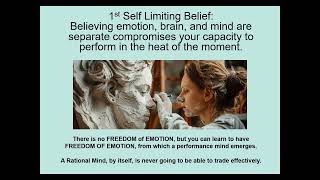
Plus persistence equals success. And yet most of the world, particularly America, is built on that. We're a country of immigrants, or at least we used to be. And people came here, including my ancestors, they wanted to have a chance that's what they wanted. And they came here and says, if I work hard, if I'm really persistent, I'm going to be successful and generate a completely new life rather than the life they had where they came from. So I want you to look at that because I'm going to pop you with something here pretty soon about what are these beliefs and what in the world are beliefs? So let's take a look at this. The very first self limiting belief is actually believing that emotion, brain and mind and spirituality I might add, are separate. This is going to compromise your ability to perform in the heat of the moment. Because ultimately, when it comes down to it, what you're going to discover is those beliefs, okay, are rooted in your ability to have a sense of power.
And the problem with that is this. A long time ago, in a place far, far away, before we were Homo sapiens, we were still in hominoid groups. But ultimately our caveman ancestors did not know about money, but what they knew about was the power to survive. And when you are in a situation where you're actually in a trade and that thing's going against you, it's coming down to your hard stop. And you're just fidgeting and you're wondering, should I move that stop? Should I give it some room? Should I double down? Should I do all that? What you're actually doing is you are activating the caveman brain in you and it is taking over your thinking brain. The belief is this, is that when you take a loss to that emotional brain, to that caveman brain, the belief is that you're about to be eaten by a saber toothed tiger and you're going to fight to your last breath.
At the same time you can also say, well, you know something, Randy? There's also this other in aggression. It's is that, you know, when we jump into trades, when we over trade, we get all excited and do really dumb things and blow up stuff. What's on there. It is another belief about power and money. And all the beliefs are going to be talking about are coming from these two deeply held caveman beliefs that take on different shades of gray as we move into trading. But understand this is that we hunted big game, much bigger than us, foolishly. It's kind of like a woolly mammoth is 30 times the size of a man and eight of these guys would attack it and they had to believe they were going to win. They had to believe. They had to believe that they were going to win and prevail.
If they did what happened is they got tremendous prestige beside the food, they, they also got ruling energy and they also got first dibs on breeding to project their genes into the future. Out of that arose the alpha male, the one who over trades at the same time on the other side, the one who is scared of the loss. That's the one that evolves into scarcity thinking.
These are anywhere from 12,000 to 250, 300,000 years of programming. The truth though is this. You and I are very different than the rest of the animal kingdom. You're looking at a person self designing herself. We are the animals that can reorganize our beliefs to produce completely different outcomes. We can take beliefs that are being held long time as limbic learnings from our caveman days and we can convert them into probability thinking that we can do. So. The thing though is, understand this, is that you think, well, yeah, of course the body and the mind are separate. Didn't Descartes prove that? He's the one that said I think, therefore I am. And what we know today is I am, therefore I think a completely different Descartes, as brilliant as the man was, had it turned around 180 degrees. So the deal is this. What I want you to see is that we come loaded with beliefs before money, before money. And then as caveman evolved to have this thinking brain, money showed up, but the caveman never understood it. And you're seeing the evidence of that every time that you feel as though the trade's going against you and you're going to have to double down, you're going to have to do anything, but you can't take a loss because that loss is going to kill you. And to the aggression where you know something, we're going to, we're going to live in a delusion that we're going to conquer this and we're not going to be in danger. And people died, but at the same time, the rewards were so heavy that they would do it. But the thing is.
We still have that ability of redesigning ourselves. So let's take a next step. The next thing is we are told go back one. I'm sorry, you're right. No, no, no, you're right. Okay. So what we gotten out of this is that your notions of hard work, being rational and adeptness at problem solving, these are assumptions that you bring to trading that have become beliefs. And that the truth though at the root of an emotion, and I tell you what, an emotion actually in neural biology, it would be defined as a biological action potential that manages the relationship between the organism that would be the trader and the environment that would be the markets. Anytime that there is a change in status in the markets, there is automatically an emotion that fires and it's a biological action potential. It's actually moving your biology. It's about action and it takes over mind in order to do it. So the thing is, is we get locked in to thinking we're rational, to thinking that hard work is going to win, and we become imprisoned by that. When in fact, I cannot tell you how many people I know that the traders come in and they have worked hard, they have done everything that you can imagine. They're persistent, you know, they are taking heavy losses, they're doing all this and they, they know they're just right around the corner. And what they're really missing is that all their failures is telling them that the way they believe is producing a world that is never going to extract the capital out of the markets they're looking for. So you're going, wow. And then you go this.
Go back one.
There we go. The other thing is, how many people in here have been told, just leave your emotions at the door. The thing is just stuff them, push them around. What happens is you can turn them off. And again, what we're hearing here is that emotions are their biological action potentials. It's not like you can just turn them off. The other thing is that we do not have emotions, okay? They have you. And what's amazing at the very end of that you get it, is that. Wait, you're telling me. And by the way, the feeling, when you feel an emotion, you are actually feeling the chemistry of that emotion in the body and the brain. It's revving up and it's about to take over and knock out the thinking brain and produce an emotional split second reaction rather than a thought out reaction that you want to be taking. So you've gotten that and you're going, ooh, this is really interesting. I've really got myself into something.
Well, what I want you to do, let's take this thing and we have a graph here, a graphic here, that's really talking about what it takes to produce successful trading. The first thing, no doubt about it, you, you have to have a trading system, a platform that works. It has to be able to respond, it has to be able to do things, but that's not enough. You've got to find a methodology, you've got to find a set of rules that allow you to manage the risk and reward so that you Just don't blow up your capital. You know, it's kind of like. There is a fairly new book out. It's called, you know, best loser Wins. And it's really very true. You know, the thing is, is what happens is you're going to be taking losses, and the problem is your brain is totally set up against that because it doesn't want to lose, because it perceives losing as a loss of life. So you can see the dilemma. But you need this methodology to be able to have a. To basically have an edge. Okay? And it's very common in my work is that as a person gets his head together, his psychology together, what he realizes is that the edge that he thought he had, he. He didn't really ever have. And then they have to go out and find and build how to produce an edge that now matches up with their psychology. So now we've gotten a trading system, and we've gotten an edge out how we can actually extract more capital out of the markets than we leave. And then we go, okay. And there's that state of mind stuff, okay, When I. What I'm asking you to grasp is your trading psychology. The state of mind are the beliefs about your power in the world being projected onto markets. And what the markets are telling you in no uncertain terms, is how effective those current beliefs are to extract more capital out of the markets than you put back in. That's what the trading account can tell you if you're not living in fear of it. You know, if you're, oh, my God, there it is. Oh, my God. And at the same time, if you're looking at it and going, what is the trading account telling me? It's telling me about the beliefs that I have about money and performance. Who I am as a human being are merging together, and they're producing a kind of result. What I'm asking you to do is not hide from them. I'm asking you to turn toward that. You know, as you're. As you get a better mind built for probability rather than the certainty of living. The next moment, what you discover is your trading account. Health grows up. And finally you come to the moment of where you're extracting more capital out of the markets than you're pushing back in. And remember, at the very bottom of this is the understanding that first, caveman doesn't understand money. It understands money as the power to survive. And at the very bottom, the two big, big beliefs that got developed by cavemen was about aggression, okay? Where, you know, thing is, you had to come to believe that you were going to win against all odds, against something 30, 40 times your size. And a lot of people died in those hunts, but at the same time is that reward was work so you could get delusional. It's kind of like this. The military does not recruit 25 year old people.









