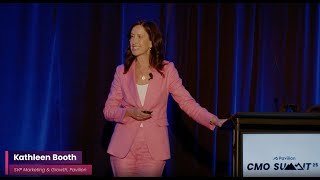
This CMO Just Revealed How She Dominates With AI w/ Kathleen Booth
Kathleen Booth, CMO at SQL, runs an AI-first marketing operation that shipped 12 product launches in 12 days using voice-to-draft workflows and custom GPTs. She warns that junior marketers face a skill gap as routine work gets automated, and argues owned channels like newsletters and podcasts are now critical since AI is reshaping how customers discover brands.
Chapters
We're doing 12 product launches in 12 days and it's just an insane pace and we're a startup, so for us to do this, I have to use AI. That's the only way to make it happen. You know, the question is like to what extent should AI do it?
Hey everybody, welcome back to the Evergrow show and today's guest is somebody I am so, so excited to have on. Kathleen Booth is a battle tested CMO who has spent the last two decades turning fast growing B2B tech companies into category standouts. After founding and selling one of HubSpot's first partner agencies, Kinten Marketing, Kathleen dove straight into leading high velocity marketing teams at venture backed startups such as Attila Security, Clean IO and Tradeswell, two of which were actually successfully acquired. Following three years as SVP of marketing and growth at Pavilion where she guided the brand demand and community strategy for a global network of over 10,000 go to market leaders. She now leads marketing at SQL, the webinar solution for data driven marketers. Kathleen, I'm so excited to have you on with us today.
Hey Philip, it's great to see you again.
Fun fact, Kathleen interviewed me for her own podcast quite a few years ago and it was such an awesome chat and I have no doubt that today's will be even better.
Agreed.
Well, I'd love to kick it off with kind of an open ended question, but can you tell me some things that you're really excited about right now?
Oh gosh, yes. There's so many. I'm gonna have to try to boil it down. I think one is, I mean AI is absolutely top of my list. I there, you know, marketers are approaching it in a lot of different ways. I am one that is really leaning into it. I really love it. It has made my job so much easier. We are moving at lightning speed at SQL. We're currently in the middle of releasing 12 products in 12 days and I couldn't do any of what I'm doing without AI. So I'm very excited about that. But I'm also excited about like the polar opposite which is anything that is like extremely not AI. Things that are like hard to scale and do that really build brands that are moments of humanity that are hard to recreate, you know, that are creat. And so I, I just think we're living at a time when there's going to be, you know, we're going to all have to learn how to use AI, right to work better and smarter, but there's going to be A backlash amongst buyers, I think, who are going to crave human connection and engagement. And I am so here for it. I love that kind of marketing. And so I'm really excited about it and thinking about how that's going to manifest for us. So I would say those are probably the top two things for me.
Yeah, and I love that you mention kind of the different camps of AI first, folks. Right. You have really three camps as it pertains to AI. One is, I'm categorically opposed to it. There's no way in hell I'm ever going to use it. But then you have, you know, the two camps that I think are most relevant are folks that are just so bullish on AI that they use it for absolutely everything from start to finish. You know, it's just AI, AI across the board. And then I think you fall into the camp that, you know, this is a very important tool. This is drastically changing the landscape of everything that we're doing. But at the same time, it's so, so important to just remember the human aspect. You know, I think as marketers, we, we are ultimately selling to humans. We are ultimately telling stories that, you know, are going to make humans pay attention. And so if you completely forgo the human aspect, it just kind of, you know, starts turning to AI slop, which is, I think, what the thing that the best marketers are a bit afraid of. But, you know, seeing as you are an AI first CMO, what does AI first really mean to you beyond just prompting?
ChatGPT yeah, it's a great question and I love that you use the word slop, because I think, if I'm not wrong, that that is Merriam Webster's word of the year, because it has become so prevalent. And I've definitely been guilty from, you know, time to time of maybe like over indexing a little bit on AI. And I've produced my share of slop in the past, so I'll be the first to admit to it. But, you know, you live and you learn, and I think we're all on this journey together figuring out what the right balance is. I don't know that I have it perfect yet, but I'll tell you where I land today, and that is that, interestingly, it was about a year ago that I think Shopify CEO Toby Luckey came out with a memo that was widely circulated where he was like, and it was specific to hire, but he was saying, when we go to hire, the first question we're going to ask is, can AI do this? And if the answer is yes, we're not hiring a person. And it was very controversial at the time, but, you know, and. And I was probably one of the people who was like, ooh, that feels kind of icky. But the more I've kind of like, traveled along this journey, the more I've come to believe that that is actually the right way to approach it. Which doesn't mean that I don't believe we should have people and that I'm, you know, about all about eliminating people from the equation. I think what it just means is that, you know, like, we've gotta be smart about how we grow. And I would use this analogy of, like, over the years, we've had other technology that has introduced efficiency like this. Not at the pace that AI has, but, you know, we think back to computers and like, things like Microsoft Office and word processing and spreadsheets and stuff like that. And, you know, there. That introduced a lot of efficiencies that probably eliminated roles, but it just happened over a much longer period of time, so it wasn't as obvious. And do we, you know, in the age of spreadsheets, do we still want people manually doing all of that work? No, we really don't. It's not smart to do that. But, you know, and so I think to me today, the question is really like, when I think AI first I think, can AI do that? But I would introduce one caveat to what Toby Luecke did, which is the second question is, should AI do that? And so AI can do a lot of things. You know, it can write, it can do data analytics, it can ideate and help you with strategy. There's just, you know, it can. It can create automations and workflows. It can do tasks. But you do have to ask yourself, should it do it? And, you know, so some examples are like, right now I'm leaning very heavily into AI for product marketing. And I'm probably gonna start to write a little bit more about this soon, but I kind of have to, because we're doing, As I said, 12 product launches in 12 days. And it's just an insane pace. And we're a startup, so I don't have a huge team. I don't have a product marketer on my team. It's me and like one other marketer and a BDR and, you know, the rest of the company, which is like the product team, the CS team, et cetera. So for us to do this, I have to use AI. That's the only way to make it happen. You know, the question is like, to what extent should AI do it? And I think you alluded to this where you were like, they, you know, there are some people who will just take whole cloth. Like this is something AI put out. I'm just going to copy it, I'm going to paste it and I'm going to go. I think, you know that product marketing is a great example of where you like can't do that. Like AI has. I've trained it really well. I've gotten pretty good at like training my custom GPTs and things. And yet it still does hallucinate and it will spit out fully baked product blogs that say, like, this feature is available to all customers. When I'm like, it's actually only available to enterprise customers. So like, you have to be really careful and not just about the factual date things, but also the that you're capturing an authentic human voice and tone and that your humanity shines through. And so I'm a big fan of like first drafts with AI and then have a human go in and like update it and make it reflect, you know, their opinion, their voice, their tone, their insights. So it's actually to back up my process with like generative AI is to bookend it. I start by brain dumping into a voice assistant and telling it what I think and giving it my point of view. I then use that to train the AI. The AI writes a draft and then I go back and kind of massage it. So done properly, the end result should be something that reflects my point of view because that was the starting point. So that's just an example of how I'm thinking about it. But I do, like, some people may disagree with this, but I do think that there are roles that will be eliminated because of AI. And I think in many cases that's okay. But on a personal level, like, I didn't want to be involved in going to a company where I had to fire people because of it. Like, that doesn't feel right. And so that's part of why I went to a startup where I have this opportunity to build from scratch in an AI first way. So it's not about job elimination, it's about like when we hire, we're going to hire people where we really need humans and we're going to have all of our humans working on the things that AI can't do so that they feel like their brains are being used for, like the really strategic things, which I think is exciting. And it's like, makes your job more fun when you're not doing the menial stuff. So anyway, that was a very long diatribe about how I'm thinking about it.
Makes perfect sense. You actually made a couple of really interesting points. I think. I like to equate AI and automation tools to the same types of robotics and automation tools, tools that were implemented in factories. You know, prior to robotics and automation, you had to have humans at every single station. The whole thing was wildly inefficient, maybe even, you know, a little bit different from marketing, but maybe even to some extent dangerous. And now you have these amazing technologies that make things move so much quicker, so much more efficiently. But I think as it pertains to marketing and growth, you can't make something that's shitty more efficient and expect great results. Right. I think it is a tool to ultimately make things move more quickly, make things move more efficiently. And you know, the keyword is right there, it's automation. But without that human creative input, without someone who has the wisdom, has the knowledge, has the experience to guide these tools and give them the guardrails, you're going to get blog posts that are completely inaccurate. You're going to get creatives that look super creepy and are completely skewed. And then on the beginning input side, obviously you need the creativity on the inputs, but then I think the sanity check at the very end, right, like copy pasting something from an AI tool just creates this very dangerous situation. And even more so dangerous when these AI tools are starting to learn from the inputs that are generated from AI tools. And so it becomes the self reinforcing cycle which is, I think, going to really differentiate the best marketers from ones that are just relying on this technology to guide everything that they do.
Totally. And I want to add one thing to something you said earlier, which was really interesting. And it was about like, there's a class of people who say, I'm never going to use AI. And I actually do think that there is a place for those people. But the way I would think of it is like that is going to be more like a craft industry where it's like, for example, when you going back to your example of the factory floor, there's mass produced fashion, for example, and then there are like really boutiquey fashion brands where they're like, we're making jeans and we're hand dying them and there's like four people in our, you know, in our factory that are hand sewing the seams and you're gonna pay like $1,500 for that pair of jeans. And there is A market for that. There are people who are like, I want something that no machine has touched. Right. And the same goes for, you know, there's, with art, there are people who will only paint and use more traditional mediums as opposed to using digital forms. And like, there will always be a space for that level of craft. And I think that's true in marketing and any other discipline. Like, there will be marketers who, who build their brand on like, hey, we use zero AI and they carve out a niche for that. And I think that's great. I just think that for, you know, like, in any industry, the craft piece of the industry is going to be a small percentage of it because there's only a small percentage of buyer that puts a premium on that approach. Whereas the, like, I don't know what, 90, 95% of the rest of companies, for mostly, like, economic reasons, are going to need to use these tools to scale. And it makes sense and it lets them reach a broader audience. So that's kind of how I think about it. Like, I would never say, hey, if you don't like AI, you're crazy or you're not going to succeed. I think if you don't like AI and you don't want to use it, lean really hard into that and make that your brand and become like one of those craft creators and make it all about that. But if you're going to do it, you got to be all in, right? And you got to. It becomes almost like an art form versus the rest of us who are not choosing to go that path. It becomes about how do we use it smartly and be super efficient.
Yeah, and that's such a great point. I mean, it's a, it's a really good way to look at it. And I mean, we've seen entire platforms emerge from craft, right? If you look at Etsy, the whole point is that, yes, you can go on Amazon, you can go on any of these platforms and buy stuff that's made in China, mass manufactured, or you can go on Etsy and you buy something that is handcrafted, that is made with love. And I do tend to agree with you. It depends on the buyer, right? If you look at somebody who enjoys fine dining, they go to the restaurant, they care that the chef is making every dish with love, they care about the ingredients. Or you can 100% just go to McDonald's and get, you know, the same calories, but a very, very different quality of meal. And I think ultimately, like, it depends on the end user, right? What do they value? What do they care about? But you know, and I see oglivie on advertising sitting behind you. So obviously you are somebody who values the human input and human creativity. But I do actually that there's room for AI technology to assist even in the craft industry. And as you were speaking, I had this thought of like, okay, I am somebody who, you know, handcrafts clothing and I have my sewing machine and I have all these cool fabrics that I source from everywhere, but I still have to answer customer service emails, I still have to print out shipping labels, I still need to do xyz. Just the, the boring logistics of the business that actually have nothing to do. Maybe customer service is a bad example because I do think human touch is still important there. But just some of those things that are so radically inefficient that take away time from my core competencies and are not the things that make my business special. Perhaps there is some room for the technologies to coexist with the human craft. Right?
Yeah, totally. And you mentioned Etsy and that's even a great example because on Etsy I would argue there are tons of products being sold that are not handcrafted. But what it is is somebody will take a mass produced product and they'll add, put their stamp on it, whether it's like how they decorate it or what have you. And I think that's actually the closest analogy to what I'm talking about with AI where it's like, you know, let's let AI do the part that doesn't need to be handcrafted. So like on Etsy it might be like a customized mug where the mug is produced by whatever, you know, factory, but the design that you create on that mug Perhaps is like 100% uniquely yours and that's what somebody's buying it for. They don't care if the mug has come off of a, of an assembly line. They just care that like the customization is on point. That's kind of like where I think that middle ground is with AI, that we're adding in a layer of human insight and taste and judgment that I can't create on its own. And we're letting AI do the piece that is very like replicable and mass market.
100% agreed. And you know, we, we talked a bit about kind of how AI is restructuring teams and how we use it for work and how we use it to ultimately, you know, output a more efficient, more productive end goal. I would love to get your thoughts on how you think AI is actually reshaping the other side of the equation, which is the customer journey.
Yeah, you know, and I, I think we're seeing this both as marketers and the buyers that interact with us, but we're also feeling this because we are all buyers ourselves. Right. Like, we, we live this duality. And so I think most of us have experimented with using AI as we've purchased things. And it, you know, ranges from people going directly into AI and asking it to, you know, for what are the top three providers of X to. Recently, for example, I planned a trip using chat GPT and it gave me my destinations, it gave me the tour guide providers that I should reach out to the exact experiences the museums go to that I never would have discovered without it, you know, and so that process of discovery is really now happening more so than ever on AI. You know, even like, it's really even kind of starting to like, supplant how we use search engines. I think search engines are still relevant. Just to be clear, there's a lot of people out there who'll be like, oh, Google's not really relevant anymore. I don't think that's the case. I think, you know, it's easy for me to say like, oh, I planned my trip on AI. I don't know what percentage of people are doing that. But, you know, it's the classic technology adoption curve. I think we're still seeing the innovators, the early adopters are the ones that are heavily leaning into AI for these things. But it's like any technology adoption curve, it's going to grow. And so the direction things are heading is that, you know, in the past buyers have gone to websites for really two reasons. One is to get educated on what is this product, how does it work, what does it cost, what are some use cases, who else has bought it? And then the other reason is to engage. And that could be to request a demo, to speak to a salesperson, to attend an event, to use an interactive tool on the site. I think it's becoming more and more clear to me that in the future people are not going to have reasons to come to websites for education because AI is going to provide that and it's going to draw from a lot of sources. Now, one of those sources will be your website. So your website still needs to have a lot of good information on it to train the AI. But I'll be able to go to whatever, pick your, pick your platform, Gemini, ChatGPT, Perplexity, Claude, and I'll be able to get a lot of the information I got on a website, but arguably it could be better because it's drawing from multiple sources, it's doing my homework for me. And eventually my bot will go to your website to get educated on my behalf. And eventually it might also just purchase for me. I think we're already starting to see that. So the question then becomes like, well, how do we, how do we actually interact with buyers? Because we can't control what these platforms say about us. We can, like, try to through how we train them with our content, but ultimately it's some other algorithm that's going to decide what people see. And so in my mind, like, as marketers, we've always said your website is the place on the Internet that you like, 100% own and have control over. So. So as a marketer, I always want people to come back to my website. I've invested a ton in building it and creating the content, delivering an experience that really feels like my brand. And so if that's true, if you believe what I just said, then education isn't going to be the thing that gets people there. I still need to put that educational content on my site, but they'll consume that off site. So I need to figure out how to engage with my customer, my potential customer. And that does mean making sure that I have tools on the site that, that allow for that level of engagement. And there's a whole suite of different, you know, providers out there that are emerging to help with this, like, cool platforms like One Mind, which has digital superhumans. We implemented one of these at the last company I was at. And it's like, it's like a person who's not a real person, but who can talk to you and interact verbally, who can pull up slides, who can show you a demo, but you just have a conversation with them in natural language. And that's a form of engagement. And if they can't answer it, you can program the digital superhuman to hand you off to an actual human. Um, you have, you know, things like what my company SQL does, where we, you know, we're a webinar platform. But what's different is we actually have you host your webinar on your domain. Great way to get people to come back to your website. If they want to go to your webinar, they have to go to your website. And so, like, there's all these different ways that you can still get people to come if you're willing to build engaging experiences for them. And then once they're there, it's all about like, okay, now we've got them here, how do we keep them here, guide them through a journey and get them to purchase. And so that's how I think it's changing is that, you know, they, it's going to start with experiences on the website, not education, whereas it used to start with education. And then once they were on your site they'd be like, oh, maybe I'll check out these experiences. So kind of flipping things.
Yeah, it's funny, you couple of super interesting points you mentioned one mind. My friend Marty is the CFO at OneMind and I just hopped on a catch up call with him and, and he showed me the platform and I was like, wow. Oh okay. Like we, we are in a new era. And I love the point that you actually made about hosting webinars on your own website as opposed to taking them off platform to places like Zoom. There are so many things you can do on your website. You can first and foremost pixel everybody, right? You start building those audiences and you get people, you know into your funnels. But really the amount of merchandising that you can do, I don't think there's ever been, you know, that opportunity in some of the webinar platforms that I've personally used in my businesses. So yeah, I love, I love like the sort of innovative approach. And then I think you, you said something that really I think about a lot, which is I constantly have to remind myself and there's a really good foundational principle in marketing which is self reference criterion. I am probably not my target audience. So I really need to zone back into reality and understand that the world doesn't change as quickly as, as my habits do. And so even though I'm super excited about some of these opportunities and I think everything is getting flipped upside down when I see something new or I see some kind of innovation, it definitely takes some time to, to adapt as far as, you know, the, the majority of the population. And so keeping that in mind has definitely been helpful to me and I think has helped me put on the gravity boots as to taking them off like I like to do sometimes and center myself back in reality. But I think, you know, kind of zoning in on, on SQL, right? You guys are basically helping folks enhance and build their owned channels, right? Like their website and adding functionality to the website. How do you think owned channels are becoming increasingly more important to marketers as time goes on and as technology shift?
Well, it's, I'm glad that you phrased it as own channels because it doesn't have to just be your website. Like you have a podcast, right? I think what modern marketing is all about, and it's marketing's always been about this, but I think we're just seeing it become more important is share of attention, right? Like the people that we're trying to get our messaging in front of have a lot of different things that they can choose to spend their time, their mental energy, you know, their focus on. And it's not even just marketing. It's like everything in their lives, our lives are overwhelming with information. And if we want to grab a share of attention and if we want to do that in a way that's future proofed, we have to do that through an own channel. Because, you know, we've seen how platform algorithms change on a whim. How I'm, you know, any day Now I'm expecting OpenAI to start to announce that they're taking advertising, for example, and that's going to change things a little bit. So all of these, these other channels, whether it's AI, whether it's social media, what have you, search engines, they will always prioritize for themselves and solve for themselves, not for you. They'll, they'll solve for the user, but they'll solve for themselves in doing it. And so how you solve for your own needs is through your own channels. And ultimately what that needs to be about is about building an audience and engaging with that audience. And so I've always been a fan as a marketer of a media strategy which is like, how do you become your a publisher and how do you build? You know, the phrase is owned audience. There's people who like take umbrage at that because they're like, you don't own your audience, they own themselves. Well, it's just a marketing phrase, right? It just means you own their contact information. They've given it to you of their own volition. If you have that and you have control over the medium of delivery, you know, you have something really special that has value. That could be a newsletter that you're publishing, that has a loyal readership, that could be a website that has traffic that keeps coming back month after month. There are a lot of different ways it can manifest. But I think as a marketer that it's really, really important for you to not be building your house on rented land, right? You want to build your house on land you own and that's an investment that will bear fruit over the long term. So at SQL, we have chosen to focus on like what happens on your website. We do have this vision that in the future, websites are going to need to be intelligent. And what we mean by that is they're going to have to be engaging and interactive, but not just for the sake of interaction. They're going to have to do it in a way that's contextually appropriate based on who the visitor is, what stage in the journey they're at, what they're interested in and what they should be doing next. And so that's kind of like the suite of tools that we're working to build. And we started as a webinar platform and webinars are. And virtual events are still really at the core of what we do because we have this belief that, like, look, they're one of the few marketing tactics or channels that, that are equally impactful at every single stage of the funnel, top, middle, bottom. So there are great ways of getting engagement with potential buyers. And if you can again deliver it on your website, you've got an audience, right? All of a sudden you have people who've given you their contact information, they've come to your site, you have them there. What are you going to do next? And so that, what are you going to do next? Is I think, the other piece of what we're looking really closely at and starting to build product around. How do you continue to engage with those buyers while they're on your site, after they've been to your site? And how do you construct a really contextual buyer journey around what you know about them?
I. That vertical integration and depth is just so important, right? Once, once you have them, how do you hold their hand and guide them through the rest of the journey? I think it's becoming increasingly more important with, you know, all these distractions that we as, as humans have on a daily basis. But aside from, you know, own channels, which I do agree is just such a critical piece of infrastructure that if a company does not have strong owned channels and are not putting intensive effort and time into them, they should really evaluate, you know, how they're operating and really refocus on making those important. But aside from building up strong owned channels, what do you see as some of the major opportunities in the next one to three years, let's say, in the world of marketing and growth?
I think. Well, I definitely think just to double down on what I just said, that building an audience is key. And I don't see a lot of brands actually doing this. I think that that media play is a really exciting play. It's something that I had just started to build at Pavilion before I left. They have a media brand called Topline and it's got a newsletter and a couple of podcasts and they're building out a YouTube channel and it's exciting to watch where that's going. So like that's something that I'm following closely and it's similar to something I worked on years ago when I was at Impact, that that's going to build a large loyal audience and I think more brands need to be thinking about doing that sort of thing. Sequel's much earlier stage company, but we have the kernel of it. We have something called Game Changers, which is our media brand and it's, we've got a show within that called CMO series. We have another show called Masterclass and that's something we're going to be investing heavily in next year and probably like widening the aperture to think about what are other ways that we can repurpose the content we're creating through these series to add more value to the people that are following it. So that media play, I think is number one. And that what's great about that is it you can, you can host that media on your own domain, but it also creates all the assets you need to capitalize on whatever the platform of the moment is. Like right now I feel like YouTube is having a real moment. Like it's fueling a lot of traffic on and interest in search engines and, or sorry, answer engines are pulling a lot of information from it. So if you're hosting media on your site, you can repurpose it and put it on YouTube. You can, you know, use it to create content that can go onto Reddit or whatever other channel you know you think is going to help you at the moment. But it has to start with your own content. So that's definitely number one. Number two, I just think this is the year of events. I mean, I've spent the last three years when I was at Pavilion building out a ton of in person events and there's just so much interest in that. It is, it is not as easy as it sounds, I will say, because the way people think about events has really evolved and the demands that event goers are making of the events they choose to attend are significant. Like people don't want to just go to regular conferences anymore. They don't want to sit and see a PowerPoint presentation. They want things that are experiential. Which funny enough, is what I was saying about websites. Like it is becoming an experience economy where we all know we can get information easily. So how are you going to entertain me? How are you going to create opportunities for me to interact with other humans in a way that is really qualitative and builds a relationship and gives me an experience that I'm going to remember and that's going to imprint on my mind and remind me of you and your brand. Like that's something that holds so much power and I see a few pockets of companies doing it really well. But I'm very excited for this coming year to experiment more with that for SQL and to see what other marketers are doing with events and experiences generally. So those would be two.
Yeah, for sure. And to double click on what you said about media, one brand that I'm really, really seeing just absolutely crush it is Andreessen Horowitz, a 16. I mean they, you know, obviously I've always been a very notable VC firm and they have a very strong brand and a strong reputation, but man, have they been so powerful with their media arm. Going to market with just amazing high quality production videos and rolling them out across all of the team members and, and just sequencing this media engine. And I've just watched in real time how powerful that can truly be. Whereas, you know, before, I think to your point, right, it's the engagement economy, but I think it's also the attention economy when there is so much in terms of scale, right? AI content and just short form media and all of these things. How do you make sure that yours is the signal to the noise, right? Yours is basically cutting through all of the potential alternative ways that that folks could be spending their time and their attention. So yeah, I love that and I would absolutely strongly encourage everybody in marketing to really think about what is that media strategy. How can I be a media first company and not just doing it for the sake of doing it, but truly doing it to entertain folks, to inform folks and to, you know, captively hold people's attention. And then like 100 thumbs up for what you said about in person events. I think the world and especially the business world has experienced some really, really serious whiplash from, you know, events were important, but then we were kind of getting bored of conferences to Covid where it's just really not an option anymore. And then post Covid, everybody wants socialization. We as humans need the in person in order to fuel just our, our existence as, as a species. Right? But I think what we can all agree on is that doing it the same way that we'd always been doing it, it's just no longer interesting, you know, because there are so many alternatives and because, you know, now I, I have just such a wide array of things I could be doing with my time. When I'm invited to an event, immediately the first answer in my head is no. And then the second, the second thought that I have is, okay, well, who's going to be there? What are we going to be doing? Is, am I just going to be sold to the whole time? Is this, you know, a unique experience? Is this something that I'd rather just do on my own or with my friends or my family? And I'm starting to really pick in person events apart, not for, you know, the sort of fact that I'm going to an event, but for the value that I'm going to be getting out of it. And I think as much as I think in person events are really making this huge comeback and are going to be the crux of a lot of what we do as marketers, especially in the world of B2B. Right. Is getting folks together and providing an amazing experience and a ton of value for them. And then, of course, reinforcing the fact that, hey, you know, there is an underlying product or service that is responsible for making all of this happen. But yeah, at the same time, I really do think that that the, the barrier to entry or, or the bar for the quality of these events is, is really, you know, going to be set very high. And so we, we really need to get creative and figure out what are those things that people either can't do for themselves or wouldn't do for themselves, or the people that they wouldn't be able to get into a room with otherwise and figure out how we can orchestrate that in a way that gets people super excited.
Yeah, I want to double down on one thing you said, which is about the bar being raised. And I think that's true across the board because with AI empowering us to do so many things and so many more things, you know, AI will get us so far. And it's, it's not raising the bar, it's. It's allowing us to move faster and deliver at scale. So I think, I do think that we're already seeing a, a need and a demand for humans when we do work on something to do it exceptionally well. And I think we're seeing that in events. You know, it's like not just any event. The best event. I think we're seeing it in content. There's a ton of content out there. And you mentioned a 16Z. One of the reasons they're Doing well is they're producing exceptionally great content. And there are some amazing content creators out there. One good example is Lenny Rachitsky from Lenny's podcast, who he is successful because he's creating exceptional content. Right. And I think this is going to be true of across the board, the things that humans work on. The bar will be raised for all of it. Because if we agree that it is worth the time of a human being and not an AI, we will not be okay with settling for mediocre, because that's what an AI can deliver. Right. And so it. That has a lot of, like, it's exciting, but at the same time, it has a lot of implications for our careers and how we think about work and the standards we hold ourselves to. Like, we have to hold ourselves and the people that report to us to really high standards because we're. We're paying, essentially, we're investing in having people do things that an AI cannot. So we have to prove that the product that's coming out of that work is something that couldn't be replicated in any other way. And that's a high. That's a high bar to meet. But I think for people who are ambitious, who are hungry, who are interested and curious, that is going to be a very exciting challenge.
Yeah. And I think that really reinforces the sentiment of, like, the age of the specialist is really starting to go away. And I think this is the age of the creatives. They used to say that ideas are a dime a dozen, and it's really the execution that matters. And I think that whole sentiment's been flipped on his head where it's, no, now we need the best ideas, we need the most creativity, we need the things that can't be be produced by a computer. And then we can have the computers and the machines, you know, help us along and make that thing a reality super, super quickly. Like, you guys are running with your. Your holiday campaign. I mean, there are so many benefits and so many potential opportunities as it pertains to just this radical technological shift. But I would love to hear if. If you have any fears or doubts about the new era that we're entering and, you know, just generally, like, how you feel about uncertainty potentially in the AI era.
Lots of fears. Where do I start? I fear that I am getting worse as a writer because I am leaning a lot on AI to go. To go fast. And I, once upon a time, was a fantastic writer. It was one of my superpowers. I. I'm sure I still hold that talent inside of myself. But like, any muscle that you don't exercise frequently, I think it's like atrophying a little bit. And I think that that's just probably symptomatic of something that's happening to a lot of us. Like, it's like, you know, when you. When I was in grade school, we had to handwrite everything because I'm old enough that computers weren't that widespread, which makes me sound like a total dinosaur. But I used to have like this lump on my finger from, like, holding the pencil and. But I could write really quickly and now, like, my hand, I can't write that fast and I'm. It's out of shape for writing. Like, the same thing happens with our brains. And I do worry about that a little bit. I worry a lot about, like, I have kids who are in college and what it's going to mean for their careers. I think, like, on the one hand there's exciting aspects, but it's also kind of scary. Like, are the things they're studying still going to be careers in the future? What should they be learning to future proof themselves? I don't really know the answer. Those things are scary. And then I also think, just like, there's a liability that rests in the background of everything we do today. If we're using AI, that, that I think a lot of people aren't taking seriously. And, and you know, I, I worry about, gosh, are there AI produced things that are coming out of our teams that we haven't looked really closely at that are going to expose us to liability, whether that's because the information is incorrect and then we have to honor it. Like I talked about earlier, where it spits out the wrong pricing plan information. Yeah. Or if there's factual information that's incorrect or if there's something that's a copyright infringement. You know, like, these are things that kind of stress me out. I think by nature I'm like a rule follower. I like to operate within the bounds of legality and the rules. And it makes me a little nervous that I think with all this AI, it's very hard to tell when AI produces something. Like, did it copy something else? Is this information real? Did it just make it up? And then, and then you sort of wonder, like, by the time I've gone and checked all this, should I have just written it myself in the first place? Like, those are all, you know, thoughts that I have. But, you know, and, and I just, I do worry in general for, like, employment in our world and in our country and, and particularly younger people just getting started, because I do think there's this dynamic where those of us who've been around for a while, who have a level of expertise, who are, who have seniority, we're going to be fine, at least in the next 10 years or so. But how do you, how do you start your career if, like the day to day things that you would have done five years ago, starting out are precisely the things that AI can now do, how does someone get started? And there's like this chasm of the first three to five years of your career that could easily be replaced by AI. So it opens up this question of like, how do you go from I have no experience to I have enough experience that I've surpassed that chasm and I'm hireable and employable and specialized enough that somebody wants me for what I can do. I almost think we need to rethink the earlier stages of people's career development to try to figure that out, because that's, that's the question I don't think anybody's really answered.
Yeah, that's such a great point. And what I'm seeing a lot of right now is actually folks that would have entered the workforce and would have gone to some entry level job or, you know, potentially internship, I actually love to see, and this is more on the positive and optimistic side, I love to see folks having the opportunity to build things that were just never, you know, available to them before. Right. So whether it's people creating content, content creation obviously is just such a huge category right now. Whether it's people building tools with vibe coding, starting businesses as solopreneurs, having the accessibility in order to be able to do that has just never existed at the level that it does right now. And I do think there's, there's a pretty drastic shift in the world of, you know, is that the right path? Is it, do we go into the workforce? And I know entrepreneurship has been, you know, being encouraged for a long time since the days of Carnegie, but then became more prevalent when we also saw Mark Zuckerberg, you know, out of college, build Facebook. And you know, there was the whole startup era. Everybody wanted to be an entrepreneur. But I think, you know, there were so many barriers to entry before that. You had to have a whole team and you had to have funding and you had to have this and that. But I think now just the accessibility level is so high that maybe we do see the world transition from, okay, they're just a bunch of, you know, companies with hundreds of employees to now every single employee that could have been an employee is now their own company, is now building their own product, is now creating their own value, and can actually facilitate and fulfill every aspect from building to scaling, to everything that goes along with building a product. But yeah, to your point, you know, it's definitely, there's a lot of uncertainty around that and I don't think anybody really knows like, what the right path is. But I guess, you know, to get your perspective on as a marketer, if I was, you know, kind of just starting out in my career or I was thinking about going into marketing, what are some of the things that you would tell me to, to, to pay attention to or, or get on top of as it pertains to the world of marketing today?
I think there's probably two things that I would focus on. One is actually going back to some of the classical teachings of marketing, which is one of the reasons I have Ogilvy in the background. I think that there are some fundamental truths of marketing and that are grounded in human psychology that will never change. Right. It's like how people think and feel, what scares us, what gets us excited. Like, you need to understand at a very fundamental level those drivers. So I would start there, but then I would lean in super, super hard to AI and I would learn all the tools I possibly could and I would build as many things as I could. Because I do think when people go to higher entry level people, what they're looking for today is somebody who has taste and judgment and that I think a lot of that can come from learning the classical aspects of marketing. But they're looking for somebody who's also insatiably curious and who has what I like to call a high figure it out factor. So who's like, we know technology's gonna change, so you want somebody on your team who's like, who just wants to figure it out, who wants to get in and be like, oh, this new tool just came out. Or Gemini just released this new feature. Nano Banana just has this new thing. I am going to be the one to get in there and build stuff with it and I'm gonna make cool things. And if you can walk into a job interview, like, look at the stuff that I built. I built my website with AI on it. There's an interactive chat that you can ask it anything about me and my resume. I've made this video about myself using like, you know, Sora or whatever. All the images are from Nano Banana. I built this thing in cursor that lives on the site. Like, if somebody came to me with all that and understood the classical, like, truths of marketing, I would be all over that person as a candidate because that just proves to me like, you will be successful wherever we drop you. And it doesn't mean your whole job needs to be about AI But I think being able to show that you have leaned in and you have said, like, I see the future. I'm going to make it my business to know as much as I can about this and to learn by doing and prove through my actions that I'm capable. That is very, very meaningful.
I couldn't agree more. I mean, psychology, I think is just the fundamental underpinning of everything that we do. We have channels, we have strategies, we have tactics. But I think psychology is really the glue that holds everything together. Why are we doing this the way we're doing this? How are we conveying our message? How are we packaging our offer? And so if you, if you know the fundamentals of psychology, you have just so much power as it pertains to orchestrating that in marketing. And to your point about building, there's this concept of high agency individuals that I really love. And I try my best to, to really you exemplify what it means to be a high agency individual. But it really is, in simpler terms the figure it out person. It's not, I can't do this because of X, Y, Z or oh man, like, that is such a hard challenge. I'm worried about it. It's no, we're going to figure this out. Or actually I'm going to dive in or maybe there's something new out there that I haven't heard about yet. Or actually I have this fundamental belief, here's all this new data that counteracts that belief. And so I am going to adjust my beliefs based on the new data that I'm getting. I think high agency has always been important, especially in the business world. And that's, you know, I think the force behind some of the best entrepreneurs, some of the best marketers, some of the best leaders in the world of business. But I think it really needs to be something that applies to absolutely everybody. Because if you have high agency and you have the power of psychology behind you, you are an unstoppable force. And I totally agree with you that those are definitely some things to look out for, both as somebody on the hiring side, but also as somebody who is looking to get gainful employment at a great company and work with some really great folks. I have this Kind of a curveball question. But I love to ask it just because I think it's really interesting to get perspectives. If you can get one message in front of. Of every single founder and marketer in the entire world, what would that message be?
Oh, my goodness. That's a lot of pressure.
Told you it was a curveball.
One message about marketing.
Anything, anything that you think is important to get in front of all these folks.
Goodness. You know, it's. I probably could come up with something much better if I had more time to ponder this, but I would say sure. I think that the future of growth is going to be AI powered and human first, if that makes sense. It's like that duality is the duality we need to master in the future. And so I think companies need to lean into it. I think marketers need to lean into it. You've got to figure out how to leverage AI while still putting your humanity in front as the headlights of your brand.
And that in itself is just so powerful. Like, that's. That's why I like to ask it as a curve ball question, because I think it's the first thing that really comes to mind. And, and I think that is probably. It's. It's the intuitive, the instinctual something that just resonates with you and holds so true. And, and yeah, I, I think absolutely spot on that. That is definitely something that I think people are going to want to rewind and then listen to again and then incorporate on a daily basis, because the world really is shifting and we are all at the forefront of it changing quickly.
That's for sure.
Yes, indeed. Well, Kathleen, it's been an awesome conversation, and I'm sure that folks are going to reach out to me and ask, where can I hear more? Where can I, you know, follow what Kathleen's working on? So if. If folks want to follow along your journey, where should they look?
You can learn more about me and connect with me on LinkedIn. Make sure to mention that you heard this podcast or you can check out SQL at SQL IO and I. I'll have lots of content on there as well.
Awesome. Well, f. Folks, you heard it here. Kathleen, thank you so, so much for taking the time with us today. I'm so, so excited to get this out into the world, and I think folks are going to get a ton of value out of this.
Thank you for having me on, Philip.
More from Kathleen
The Counterintuitive AI Strategy That's Working for Top CMOs Right Now w/ Kathleen Booth