5 Reasons You're Not Signing Clients
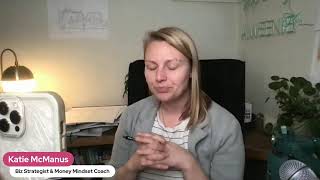
Katie McManus (business strategist & money-mindset coach) presents a live session outlining five common reasons small-business owners don't sign clients: 1) not marketing enough / lacking memorability; 2) confusing or poorly articulated offers; 3) undercharging, which lowers perceived value; 4) niches that are too broad; and 5) not learning/practicing sales. She emphasizes consistent visible marketing, clear packaged offers or proposal processes for custom work, pricing aligned with value, niching and iterating, and learning a humane 'holistic selling' approach. The session includes audience Q&A about oversharing (share emotions, not graphic details), niche adjustments, and daily visible actions.
Chapters
I can taste yo, yo, yo I can taste yo, yo, yo, yo I can taste yo, yo, yo. Hello and good evening. I'm Katie McManus, business strategist and money mindset coach, coming to you live tonight on a few different platforms. We're on Instagram over here on my phone. We're also on Facebook, LinkedIn, YouTube, and Twitter. Tonight I want to talk about the five reasons that I see people not getting clients. There are a lot more than five reasons, though. So these are just kind of like the top five that came to mind to me tonight that I wanted to talk about. I had something. How's cute? Oh, that's right. So I've been noticing lately that sometimes not all my comments come through on Facebook, LinkedIn, YouTube, Twitter. We're not even thinking about. So if you're commenting, I love this to be interactive. Absolutely love it. I love answering questions. I love hearing your take on what I'm talking about. However, if you comment and I don't call you out and I don't put your thing up and I don't like, thank you for interacting. It's not you, I promise. I'm not mad at you. You are perfectly fine. It's just simply that sometimes the technology doesn't work. Okay. You know, I love Stream Yard. I absolutely love it. And also, it's just technology and sometimes it malfunctions. Oh, well, I still love it more than Restream, by the way. I'm still. I still am having a fight with them. I'm not really. We've. It's a cold. It's like the cold war. But anyway, so new business owners. This is for my new business owners. This is for my business owners who have been in business for a while, and you. Maybe you got your first wave of clients through referrals and you're just not sure how to get your second wave of clients. And I just want to normalize that. It's really hard to start a business, okay? Not only that, you can launch a business and you can get a whole book of clients in that first wave and still struggle with your next wave of clients. Okay? That is totally normal. Okay? I. There's a stage about six months to a year into starting a business where what worked for you before stops working. Okay? Because what works for you before is, hey, everyone, I have this exciting announcement. I'm starting a business. Isn't that exciting? Here's who I'm helping, here's what I'm doing, blah, blah, blah, blah. There's a lot of energy behind that. Okay, so your friends, your families, your family, your former colleagues and classmates and everyone, they were so excited to hop on that bandwagon with you and tell you, like, oh, my God, great job. Let me introduce you to some people who I know could work with you. Doesn't work over and over and over. There's only so many times you can announce that you're starting a new business. Andrea, Celeste. I love the validation preemptive for any potential rsd. Yes. We want to be rejection sensitivity dysphoria cognizant in this space because, you know, we're an ADHD safe space. Thank you. Lovely to have you here. So, yeah. So just want to normalize that it is so easy to get into a funk and think that there's something wrong with you. And I don't want you quitting this business. I don't want you giving up. I don't want you starting struggling unnecessarily with self doubt when it's not you and it's just a natural stage of starting a business. That said, there are absolutely some ways in which you are getting in your own way, okay? I'm getting in my own way. We're all getting in our own ways, okay? This is not. I'm not calling you out when I can't. I'm not calling myself out, okay? Everyone does some variation of what I'm about to talk about, okay? The key here is to not get a shame spiral about it. And it's not to freak out. It's not to feel bad about yourself. It's to stop doing it. And if you don't know how to stop doing it or you don't know how to do the thing that I'm going to talk about. Go and get help, okay? I help people with this stuff. There are a gazillion other business coaches who help people with this stuff. Don't stay stuck, okay? You are literally costing yourself money every single day that you let yourself stay stuck without clients, okay? You need to be making money. You deserve to be making money. You do not have to sacrifice like X amount of months of doing free labor to justify charging money, okay? You are confident just as you are. All right? I'm going to start there. And any questions you have along the way, please do pop them in the chat. This is a safe space. There's no judgment here. What I want is this to be that fire that's lit under your butt for you to go and make changes. All right? By the way, my new favorite mocktail, because I Haven't I've been dry for coming up on 500 days. I'm on. I have an app to keep track because I think it's fun. Anyway, this is my new favorite mocktail, and it's club soda. It's like halfway club soda and then apple cider with lemon juice. And normally when I'm. When I'm not lazy, I go out to the garden and I get some rosemary. It just. It feels like a cocktail. It's so exciting. Okay, Anyway. All right, so the first way that I see people getting in their own way and not getting clients is they're not marketing enough. Okay? So here's the thing. If you're a small business, you do not have a marketing problem. Okay? I'm. You and I are not sitting at a table with a marketing agency planning out our commercial for the Super Bowl. You know, I'm trying to figure. Figure out how we can squeeze Taylor Swift and Travis Kelsey into it or whatever his name is. Right? That's not our problem. Hi, Javi. Welcome. Our problem is not marketing. It is memorability. Okay? We need people to remember that we exist. If they do not remember that we exist, they cannot give us their money and hire us to do the thing. Okay, let me see. Andrea, ADHD is over share and especially new business owners providing services. What are some strategies to avoid over sharing advice that you usually offer as part of your business services? Oh, that's such a great question. I will absolutely get to this. Okay. And Javi. Oh, a Swifty. I know. I'm. I'm a fun current event. It's, like, the first time ever that I actually know what's going on with, like, pop people and, you know, like. Like, what are they called? Athletes. Those people that do the sports. I know. I'm like, I'm gonna use that reference until it's dead. Anyway, so we don't have a. Like. Exactly. We don't have a marketing problem. We have a memorability problem. Okay? Taylor Swift. It's done a beautiful job in being memorable. Okay? Travis Kelsey's learning how to be more memorable by associating himself with. With Taylor Swift. All right, I hate to break it to you. So when. When I talk to people who just started their business or they've been at it for a little while, but they're still struggling. And we talk about their marketing efforts. Sometimes they come back. I mean, they're like, well, I spent all this money on this website, and I hate to break this to you, but I'm pretty sure I Think the number is every single hour. Hour. The average amount of new websites on the interwebs is 250,000 per hour. Okay. You creating a website is just one of 250 per hour. How the fuck are people going to discover it? They're not. Okay? Unless you actively go out there in your social media circles and start promoting it and start talking about what you do and you start showing who you're helpful to. Right. No one's going to have a reason to discover your website unless you do this now. I know you're going to say, you might say, okay, well what about SEO? You know, and if you're not sure what SEO is, it's search engine optimization. It's basically the keywords that you use to make the Google machines show your website to more people based on what they're searching for. Yeah, sure, SEO is great, but it takes a long time. It's also pretty expensive to get an SEO expert in there to start optimizing for it. So like unless you're independently wealthy, absolutely. Go to SEO game. I'm sorry, if you're independently wealthy, go the SEO game. But still, you're still going to need to build a presence on social media. They're going to be people. Hello, welcome. They're going to be people who will see your stuff and they'll be so intrigued and they'll want to know about working with you and they'll want to know about your services and they'll want to just, you know, go further and they are going to be the ones who, who check out your website. Okay? They are not going to find your website unless you get in their face about it. All right? When I work with clients, I create a non negotiable. Every single day you're doing something visible. Every single day you're doing something visible for your business. Okay? Could be posting social media, it could be commenting on other people's posts. All right? You want to be hyper visible, right? Because you don't want people to forget that you exist. That's it. Essentially. There are a whole bunch of different aspects of marketing. I'm of the belief and a lot of different people have different approaches here. I'm of the belief that when you first get started and you're building your audience, don't spend money on ads unless you want to spend like a couple dollars a day. Not a lot like that retargets people who've already gone to your website. Right? That, that like don't spend too much money on ads. No more than like 90 bucks a month. Okay, but really, like, test your. Your content, right? Your content should be growing your. Your network organically if it's good enough. And if it's not good enough, you need to make sure it's good enough. It should be getting you clients if it's good enough. If it's not good enough, you have to get training on that. You need to be in people's faces. You need to go where they're already hanging out. This could also be networking. This could be, you know, virtual meetups. This could be in person, happy hours, whatever it is. You have to get out there and you have to be visible. Okay? People cannot hire you if they don't know that you exist. All right? And how are they going to know that you exist? You literally have to post and post and post. And for those of you who are like, well, I don't want to post too much because I don't want to be annoying babes, only about 5% of your people are seeing your posts. 5%, okay? That means there are so many people that are barely seeing your posts. You have to be annoying, all right? And it's going to be annoying for you, no one else, because they're only seeing 5% of your posts. And remember, they have the choice to scroll past. If they're not interested in it in that moment, they don't have to read it. Okay? But you do not want to go days and weeks and months without posting, because all the people who are your potential client, they're not going to get you. They're not going to see you. They're not going to have any awareness that you exist. Right? So you need to be marketing your services. So this actually ties in. Andrea, I'm going to come back to your question because it kind of goes into marketing, because part of what we're going to do is we're going to let people get to know us as human beings. And there's this tendency. I'm just going to pull the question up over here. There's this tendency for ADHD years to overshare, especially in new businesses when they're providing services like, we want to come across as relatable. We want people to understand our journey. And there are a few different strategies that I work on with my clients who have ADHD who are concerned about oversharing, basically. Is it something that you would be embarrassed for anyone to see if, like, you'd be worried about ex boyfriend seeing it? If you'd be worried about friends from college or high school seeing it? If you'd be worried about family members seeing it, you know, if there's anyone in the world who you'd feel uncomfortable with seeing that post, you kind of want to check in with yourself and ask yourself, is this something that I'm still willing to post? All right, you know, the other element here is when I, you know, we're all about, like, be vulnerable online. Be vulnerable to your audience. It'll build trust. Yeah, but vulnerability is a spectrum, okay? Vulnerability, like, could be, you know, here's how I take my coffee in the morning. That's actually a pretty intimate thing to know about someone. You know, what's your favorite cocktail or mocktail? That is. That is a detail that you really only know about someone when you spend some time with them. All right, so what we're trying to do when we're sharing vulnerable facts about ourselves online is we want people to feel like they know us, right? Like. Like there's a friendship here. And like, that is. That is the seed of an actual friendship, right? Because as we're on social media, we are being social with other humans, not just getting clients. We can actually create genuine relationships. Hi, Mel. Hi, Mike. Welcome. So sharing details about yourself, you know, it doesn't have to be your deepest, darkest secret, okay? It also doesn't have to be your fears. It also hasn't. Doesn't have to be your trauma. You know, there's also. I'm gonna just readjust here, okay? There's also sharing about the emotion around something and not the details. Okay? So, like, let me give you an example. So when you're sharing the details of something, you're saying, oh, my grandma just got diagnosed with stage four breast cancer. She's seeing this doctor. Here are her symptoms, and you list off all the gruesome symptoms. And here's her prognosis, and here are her visiting hours. And, you know, here are her allergies. If you want to drop off food, you can do that. That's kind of something that you would post to, like, your Facebook profile. And if you're really connected with a lot of your friends and family in that neighborhood, you know, who know your grandma, right? It's relevant to them, okay? Versus, like, being on LinkedIn or an Instagram where you have a much broader following. The organic reach is there. Okay? So, like, for instance, I have people who, you know, book calls with me all the time from Australia. Okay? I have never been to Australia. I would love to go. Please. I would like to get more clients in Australia so that I have an excuse to go and hang out there because I hear it's beautiful. But they don't need to know about my grandma. Like, they don't need to know about all that stuff. It's not relevant to them. And also, it kind of feels icky when it's not something you need to know. It feels like it's too personal. Right. So what you want to share is what's your feeling behind it? You know, like, the feeling might be, you know, we got crushing news this weekend. My grandma, who I love so much, who took care of me after school every single day through third and fourth grade, who taught me how sew, who taught me this, just got diagnosed with cancer and doesn't look good. And I'm looking back and I'm really grateful for all the time I've gotten to spend with her. I'm really grateful that now that I work for myself, I'm going to be able to be flexible with my time and spend more time with her, taking care of her. Our community has really gathered around us and are really supporting her and my parents and, and, you know, my aunts and uncles right now. And I'm so grateful for all of it. And my only hope is that she stays comfortable through this. Like, you know, of course, I hope we get a lot more years out of her. But, like, I. My utmost intent with this is I want her to make sure that she knows that she's loved and supported and that she never feels any unnecessary pain. Right. Like, that's very emotion based. You're not giving a lot of, like, the gruesome details. Right? And it helps people kind of understand what kind of person you are, that that's the kind of stuff you care about. Right. You could say that same thing a million different ways and highlight different things that you care about. Also, you don't necessarily have to use, like, your dying grandma as a post. That's just an example. Um, but yeah, you know, and of course, like, this is practice. This is practice. Like, you're gonna post something and immediately after you hit post, you're like, vulnerability, hangover. I'm feeling shame, I'm feeling embarrassment. And then you're gonna go back and you're gonna delete it. Because you don't need that. Like, you don't have to put yourself through that. All right, Full permission. You own the delete button. Okay. Like, yeah, once it's on the Internet, lives forever, but you're not famous. If Taylor Swift were to post something about her grandma, it would live forever. People would be Screenshotting that shit. And it would be somewhere on some Reddit page, right? You're thankfully not famous yet. Maybe someday at that point you'll have learned what kind of stuff you're comfortable posting, what kind of stuff you're not. But, Andrea, I hope that answered the question. There are a lot of different ways that you can approach this, but, you know, when in doubt, post stuff that is empathetic to your clients. You know, when in doubt, like, if you feel like, I'm not sure I want to post this yet, you don't have to post it, okay? You don't have to post every single thing that you write every single day. That's not how this works. You can write something and you can put it in your drafts and hold onto it for another day and maybe post it later, but post something that's more promotional that day. Okay? Full permission here. All right. Okay. I hope that answers the question. Great question. So, okay, so the first reason you're not getting clients is you're not marketing enough. Okay. The second reason, which I'm going to get into is you have a confusing offer. Okay? And let me explain how this usually shows up. When I get on a phone call with someone who's thinking about, you know, signing up for my program or maybe wants to work with me, and I ask them, what is your offer right now? Like, oh, well, it's different for everyone. Okay, that's confusing. That's confusing. So if it's different for everyone, when I'm on a sales call with you, if I'm a potential client, when we get to the portion where you're telling me about working with you, like the fact that you can't tell me who's a business coach, exactly what your service is, exactly what your offer is, even if there are a few different tiers of it, they're not going to know what to do with it. They're not going to have any idea what your offer is when they're on the phone with you. Okay? So you need to have an offer that is in your back pocket, ready to go. Here's the details. Now, if, say, you do custom work, right? So you do custom work, it is actually different for every single client. Maybe you do leadership training, incorporate incorporations, right? And it really depends on, like, how many people are going to be there, what level they are in, what the challenges in the company are, blah, blah, blah, blah, right? You get to say, okay, cool, I'm going to put together this proposal. We're going to schedule proposal presentation time and we'll go over it then. And you go over it then. You do not need to pitch anything in that moment, okay? That if. If you have to put a proposal together, that first call is just an information gathering call for you, okay? You get to propose that presentation after the fact. Okay? But I want you to remember this. A confused buyer never buys. And you know what creates confusion? Usually the seller not knowing what they're selling, right? So know what you're selling. Know, like, even just the base amount, if you're. If you do any kind of retainer, have, like a package that covers most of the stuff, all right? Know that you can fine tune it, you can make it more bespoke in the service, okay? But know what you're selling, okay? If you're confusing, if you have a confusing offer, no one's going to sign up for it. That's the reason you're not getting clients. Okay? Now number three always surprises people. I'm just going to take a sip here. Number three always surprises people. So one of the reasons you might not be getting clients is you're actually undercharging. And I know that sounds crazy because people, like, they're so concerned that they're going to overcharge and no one's going to sign up for that high rate, okay? And that's totally. That's totally a valid fear. You could absolutely charge like half a million dollars for one session. That's too much. Okay, That's a bit excessive, right? But here's what happens more often than that, is you undercharge. And here's what happens. People associate cost with value. All right? So if you're. If your price doesn't actually correlate with the value that you give, what's gonna happen? They're gonna hear what you charge and they're gonna think, oh, that's a red flag, you know, too good to be true. If they're saying that I can go from here to there and it only cost me 300amonth. Nope. This sounds like this smells like snake oil. This. This seems like a snake. Snake oil salesperson. There's no way I could get that for this. I'm going to go find someone who charges more. I'm going to go find someone who has a more. A higher quality service that I can employ. Okay? So when you undercharge, you actually tell people that you're not that good or you completely undercut trust with them because they're not going to believe that you can provide what you're providing. If you're not charging the equivalent amount, all right, so charge more. That's not going to help across the board. There are a lot of other things that go into it, but do not undercharge. It will actually hurt you over time. Now, number four, the fourth reason why you're not getting clients is your niche is not niche enough. Okay? Your niche could be. Nichier always wanted to say that. Anyway, what I'm talking about, I'm going to use life coaches as an example, okay? Because this happens so often, you know, So I talk to life coaches all the time. I'm a trained coach myself. I'm kind of immersed in that world. I don't only work with coaches, though. I like to specify that. But, you know, coaches, like, they want to help everyone, right? Because they have this skill and they can help people, like, really find their way out of the dark, right? And it sounds super vague, because it is super vague. You know, a coach actually doesn't know. Have to know shit about your work, about the details of your life to be able to help you go from where you, where you are now to where you want to go. It's an amazing skill, okay? If you're a coach, you have a superpower, okay? It's incredible. And also, people don't know how to refer to that. People don't know how to say, oh, well, I have that problem and I want that solution, right? So, so often I hear life coaches say, oh, my niche is people in transition. Everyone's in fucking transition all the time. Like, like I'm, I'm in a very drawn out move right now. That's a transition. I'm also scaling my business. That's a transition. I'm also thinking about getting a second dog, a puppy for Luna. That's a transition. You know, there are people who are entering new relationships, exiting relationships, starting new jobs, exiting jobs, starting side hustles, starting fitness routines, trying to lose weight. Like their transitions galore. Like the people, the people are all in some variation of a transition. Transition could also be age, you know, like women going through menopause. It could be, you know, like going through retirement, you know, being a grandparent for the first time, being a parent for the first time. There's constant, constant change. So saying that you work with people who are in transition is not a specific enough niche. Okay? If you wanted to say that you work with, um, men in their 50s who are changing jobs for hopefully the last time before they retire, you're helping them overcome any adversity that they come up against with Any age discrimination, how do they head that off? How do they highlight how they are still relevant in the workforce? And I say that knowing. So, like. Like this. I know this is a fear that a lot of men in their 50s. I don't want you guys thinking that I'm here thinking like, oh, God, you're irrelevant. You're in that. You're in. You're amazing humans anyway. That is a niche. That is absolutely a niche, okay? People in transition is not niche enough, okay? You have to pick a niche. And I know so many people are afraid of picking a niche because they're like, I'm going to scare away clients. Well, you're already scaring away clients, okay? You're already not getting clients. So pick a niche, and if that doesn't work, pick another niche and then go from there. I promise you. You know, when I started my business, I started off as a dating coach for men, okay? It was the wrong niche, okay? I didn't end up with a lot of male clients. I got one. Everyone else is a woman, all right? And then I changed my niche, and I changed my niche again. And I changed my niche again. I got clients all along the way because I didn't just go into it saying, oh, well, I don't have a niche. I'm not sure what I want to do. No, I just picked something. I said, this is what I do. And people started signing up for it, right? People will not sign up for you for your service if they don't understand specifically how it's relevant to them, okay? So you have to make sure that they understand that. All right? Pick a niche. Get Nichier. Deal. That is the fourth reason why people do not get clients. Now, the fifth reason I actually didn't realize, like, this is the foundation. Hi, Jocaine. Welcome. I actually, when I started my business, I completely took for granted that I had a whole career in sales and marketing. I went into it just knowing how to sell because that has been my career for. That had been my career for a really long time. And I sold a whole different slew of things, you know, from fitness memberships and personal training to solar energy to homeowners to Internet security. I sold yarn. I managed a yarn shop for a while. I took for granted that not everyone knew how to sell, okay? I had a whole bunch of experience. I went through new trainings every time I started a new job on how to sell that particular service or program, right? I went through it, okay? I practiced. I did that 50 hours a week. Week, for God five or six, seven years. I've lost track of how old I am for a long time. If you're just starting a business and you've never sold anything before and you're expecting yourself to jump right in and be able to sell without ever getting training, I want to just bring you back to reality, okay? Because that's not how it happens. You have to get trained in sales. This is one of the things that I train in my group program. Build your own business. And I do this with my one on one clients. Because you, like, you can't get clients if you don't know how to sell them. If you don't know how to enroll them to work with you, there's no way you're going to get clients, okay? Just no way in hell. It takes practice. You also have to find a style that works for you. So there are a bunch of different styles out there. The style that I teach, I call it holistic selling. Because you're not just trying to like get people's money, right? There's a lot of sales styles that you know, like, it's very clear. The objective is manipulate this person to open their wallet and give you whatever money they have access to so that you can have their money. Right? It's very pushy. It's very manipulative. It doesn't, it's not very kind. Okay? There. And unfortunately there are a lot of like business gurus. Like Grant Cardone talks about a lot of the stuff. He also uses a lot of these tactics in his group stuff. I'm not about that. I don't like that I train on holistic selling because when I'm talking to someone, when I'm on the phone with a potential client, like, I'm not sold that I should be the right solution for them. Not because I'm not the right person for everyone. I'm not. I'm on that phone, on the phone with them, listening for, do they have problems that I can genuinely help solve? Do they have goals that I genuinely have experience in helping people get to? And also, are we the right fit for each other? You know, on a personality level, you know, because we have to like each other fist to go anywhere. You know, for me to be the best, like provider for this client, they have to enjoy talking to me. They have to trust me, all right? Now if I'm not feeling that both ways, then it's not going to work, right? So when I'm, when I'm listening to my potential client, I'm listening for all this Stuff. And I'm making sure that I'm making a recommendation, whether the recommendation is to work with me or to work with someone else, but I'm making that recommendation in service of them, of their whole selves. Right? Because that is what is going to help my business grow. I can't tell you how many times I've had a sales call with someone and we decided, like, mutually that it just wasn't a good fit for whatever reason. And that person, weeks, months, years later has turned around and referred me other clients. And they were able to do that because they were able to understand deeply what it is that I do because I was so honest on that sales call. And when they're out in the world and they hear someone who is similar to them but not exactly the same, who kind of rings all the bells that I was ringing, they're able to make that connection and hand it back to me. And especially, like, people want to do this, especially if you give them, like, refer them to someone who's a better assistant or a better person for them or maybe to a resource that could help them that maybe they don't need to work with a coach and. But you have to learn it, okay? I have clients who come from a sales background. They still have to learn this model of selling because selling a car or a house is so different than selling your time, your expertise, okay? The rejection sensitivity to selling your time is so much higher than it is for something else. Okay? So if you don't know how to sell, if you're really struggling on those enrollment calls, we cut yourself some slack here, okay? You need to learn it if you want to learn it. If you're really serious about getting this business off the ground and getting really committed, high paying clients. This is one of the foundational things that I teach in the build your own business group program. Okay? If you don't know this, you need to learn it. Neither learn it with me or someone else. Okay? Now, Andrea, you're full of great questions today. How many times did you adjust your niche to get to where you are today as a business owner? Oh, that's such a good question. I'm going to drink some water before I answer. Hmm. Okay, here is the timeline of all of Katie's niches. So, number one, started off as a dating coach for men. Okay, Got one, dude. Nate. Women. Okay, so then dating coach for women, which really didn't last long because I'd gotten all my clients with a dating coach for men, like terminology. So I really didn't market Myself as a dating coach for women, I just kind of like figured, okay, well, I'll just flip the gender because it worked. But I started when I was working with my, my nine clients. Then I started noticing that only one of my clients, one of the women, actually stuck with the dating topic. Everyone else was struggling with how they were being at work. Like, they were struggling with boundaries, they were struggling with how much they worked, how much time taking on new projects and all this stuff. And like everything that was, that was happening at work was directly getting in the way of how they could actually have a personal life. Like not even just a relationship, like seeing friends and family and taking care of themselves. So I started, I started like noticing we were working more on executive coaching and leadership training, which I'd also gotten trained in. And so I was like, cool. Well, I actually like this. This is great. Like, I'll just build a leadership coaching company, right? I'll do executive coaching. I'll do some leadership training for corporations. Great. Totally down for that. So I shift, I shifted. And this is where, like, I shifted my marketing because, you know, like I said, I went from dating coaching for men, got clients, didn't really need to market anymore for that next round. And I just had all these women. Had all these women. Sounds like I had. Anyway, that was a joke that probably shouldn't be made. Anyway, so leadership coach. And then I. So I'd gone to coach training, right? Cti, the Coactive Training Institute. Become friends with a lot of my classmates and continue that friendship. I'm still friends with a lot of them today. It was interesting because, you know, we'd stay in touch and we do these calls and like, we'd assist. We go back and like do these weekends where we'd help out at the school and then we'd like be in certification together. And they started asking me like, wait a minute, how did you do that? How did you go get clients? Because they were all struggling. Because the advice that had been given to us in the Coactive Training Institute was just go and give free sessions. Like, give free sessions to anyone who will accept a half hour session from you, and that's how you'll get clients. That's not how it works. And I totally understand why they told us that. Right? Because their initiative was to produce good coaches. All right? It wasn't to produce good business owners. All right, so how do you become a good coach? You practice. How do you practice? You get all these random clients and you practice on them. So anyway, so it wasn't Working for them to get clients. So they started asking me, like, how did you do this? And again, like, I had completely taken for granted my whole career in sales and marketing before moving into coaching. Right. I kind of just assumed everyone knew this. And so I started, you know, like, oh, well, you know, like, when you sell someone and they're like, no, I don't know. Please tell me. And so I started explaining it to them, and they started getting clients themselves, and they started growing their businesses and started being really happy about it and motivated. And they started referring clients to me for this and saying that I should really charge for it. Like, this should be my service. And so I started accepting these clients, kind of figuring, okay, well, I'll train them on some stuff. I'll be a proper coach for them, and other stuff. Great. And I started working with clients, and it was like, oh, wow. Like, I didn't realize how much I knew that was helpful to other people until I really got into it. And then the pan, like, I built my business up. So it was pretty split, 50, 50, you know, 50% leadership clients and 50% business building clients. Then the pandemic hit. Okay, And I'll let you guess what happened, right? And we all know, like, my leadership clients, they all panicked. A lot of them got laid off. Others, like, their corporate funding for it crumbled. Like, it went away. Some of my businesses, like, they just had to cut budget for it. They just, you know, because they weren't sure what was coming down the pipe. And so I panicked. I had, like, a month where I was, like, in a deep downward spiral. And it happens to the best of us. And then, you know, people started waking up and being like, you know what? I'm not going to let this get me down. Always want to start a business. Now's the time. And I started getting more and more referrals, and I started talking about it more on social media because it really wasn't something that I. I marketed up to. That point is really just, you know, word of mouth. And I'm an extrovert. So, like, the word of mouth was created by me going out and socializing, which was not happening. Right. And so really, like, my business kind of blew up on that end, and I completely ditched leadership coaching after my. My last few clients completed with me. And then it really evolved over time. And I noticed over time that all of my clients seem to have, like, adhd, with a few exceptions. And when I went to start my podcast, I was really reckoning, like, do I want to Just day like a business strategist and coach, or like, do I want to differentiate myself further? And I realized this is the thing that had that most of my clients had in common. And that's when I really niched down further into being an adhd business owner, business strategist, right? Because as someone with adhd, I found it was really challenging to go out there and find a coach who understood how to support me with how my brain works, right? And so I figured, let me just make myself hyper available to people like me who need a different kind of support, right? And so really that's how I evolved into what I do now, you know, but like, I got clients along the way. Like, picking the wrong niche did not hurt my wallet. Picking the wrong niche made me money along the way as I was building. When you're trying to decide on a niche, like, you cannot sit in a room by yourself in an echo chamber and guess and get the right thing, okay? You're not going to know until you get out there and you start talking to people. Sometimes you could think a niche is a great idea and you get out there and you're marketing it and no one responds. No one's interested. No one even gives you like a, oh, wow, this is amazing. It's just not a niche, right? You might think it might be a niche, but it's not. Like you have to pick something and then you have to iterate from there. I'm a big believer that the universe wants to take you from where you are to wherever you want to go, right? But I want you to imagine it's like this big dance, right? But for you to get from here to where you want to go, you have to get up and you have to get on the dance floor, you have to start dancing, you have to start dancing with someone, right? If you start dancing with the wrong person, the universe is always, always going to pair you up with someone else and pair you up with someone else and pair you up with someone else until you get to the person or the niche or the thing that will take you across the dance dance floor to where you need to go. All right? That's what I believe. That's what, what has always been true in my life and in my clients lives. And really, I mean, the thing, this little list of the five things that are preventing you from getting clients, you know, not make marketing enough, confusing your offer, undercharging, not being niche enough, never learning to sell. The common thing here is being a fucking perfectionist. All right? Like all this Stuff. It all boils down to, I want to be perfect, but perfect is impossible. So I'm not going to do anything the way I should, like, because I don't want to half asset. Right. So you don't ask it at all. Right. I am a firm believer that half ass is better than full assed. Right. Because oftentimes we never get to the full ass. Right. It's like a Ron Swanson quote in here, but the opposite. He's like, I never half ass anything. I always use my full ass. No, we're not doing that here. Half ass is better than perfect. Okay? Quarter ass is better than perfect. Okay. It doesn't really matter. Like, even just, like a little bit of the butt cheek is better than getting it absolutely perfect. Okay. Perfectionism is never going to make you money. Never. People actually don't like perfect perfect. You know, it's not approachable. It doesn't. It's not human. It just. It feels like you're greater than me. And I don't want to be vulnerable to someone who's greater than me. I want to be vulnerable to someone who I can relate to. Right. So full permission. Like, I stuttered and stammered on this. I've used the wrong words. I've forgotten words like this live. I've been live for 42 minutes at this point. You've seen me make a lot of mistakes. Okay? I'm not worried about that. Okay. I can't be right. Because what I want my people to see, my audience, is that it's okay to go live and stutter and stammer and get words wrong and, like, get your mouth dry and take a. Take a big glug of water and all the things. I've spilled water on myself in my lives. I've forgotten the point of what I was talking about. Those are really funny because the whole chat erupts into, like, this scavenger hunt for what Katie was going to say. You know, imperfect is the thing that we all relate to. So do it imperfectly. It up. Do it wrong. It's the only way that you're going to get to write. Okay? Okay. I actually was not intending to be live for this long, but we had so many great questions from Andrea. So thank you so much, Andrea. I was planning on going live on TikTok. I'm thinking it might be a little too late for that for a Monday. But I will be going live later this. This week, and I will be answering questions. Let me see. Carrie. Oh, hi. Hi. Welcome. I will be answering questions on TikTok later this week. I haven't really decided what day yet. I have look at my calendar, but I will be doing 10 minute deep dives either on your LinkedIn profile, your Instagram, whatever, wherever you're trying to get clients. So if you're curious about that, shoot me a DM and I will let you know when I decide to do that. Otherwise, just keep your eyes open. I will be posting about it. Let me see. Andrea. I tell my clients, chase consistency, not perfection. Yes, 100%. And consistency is not perfect. Right. Consistency in working out could be doing pushups for five minutes one day and working out at the gym for an hour the next. Right. You still worked out both days, right? Love that. Anyway, wrapping this up for now. I hope this is super useful to you and I hope this has inspired you to get up off your butt and stop doing some of this stuff. Hi, Mallory, Welcome. You're just catching us as we're wrapping up. But anyway, to everyone who's joined, Andrea and Javi and Joe Kane and Carrie, thank you so much for being here. And the real Shalimar. I love that name. Mike and Mallory, thank you for joining over on Instagram. I hope this is helpful. I'm Katie McManus, everyone. Business strategist and money mindset coach. Thanks for being here. And I will be going live every day Monday through Friday this week. So stay tuned and I can't wait to see you soon. Okay, bye, everyone. Got to end in both places.
More from Katie





How to do self care right now, so you can do what needs to be done, for yourself, your business, and

How to do self care right now, so you can do what needs to be done, for yourself, your business, and

#greenscreen How to build a consulting business that makes you $200,000-$700,000 a year

#greenscreen How to build a consulting business that makes you $200,000-$700,000 a year

Maybe we’re not the imposters…? #businesscoach #startup #entrepreneur #smallbusiness #consulting

Maybe we’re not the imposters…? #businesscoach #startup #entrepreneur #smallbusiness #consulting
