Biz Lab Live: Episode 4
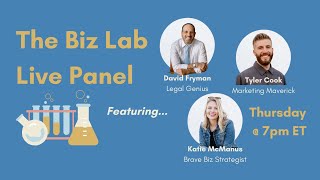
Hosts Katie McManus, David Fryman, and Tyler Cook brainstorm a business idea drawn from a jar: a matchmaking/dating service. They evaluate existing models (high-end matchmakers charging $7k–$50k, mass-market dating apps), then explore middle-path offerings that combine vetting/onboarding, emotional-intelligence screening, coaching, and in-person retreats or local community hubs. Proposed features include therapist-verified or questionnaire-based vetting, personality/emotional-intelligence assessments, multi-tier pricing (premier coaching + retreats vs. lower tiers), hyper-local rollouts (start in Seattle, expand city-by-city), workshops/newsletter marketing, referral/viral loops, and an application fee to deter unserious applicants. They also discuss risks (venue/general liability, refunds, scaling, privacy/invasive checks) and productization paths (start service first, later build software/database). Tone is exploratory, practical, and cautious.
Chapters
Sam. Hello. Good Evening, I'm Katie McManus, Business Scratch Leadership coach. This is Biz Lab live and we have. You're supposed to introduce yourself.
That's you, Tyler.
Oh, that's me. Oh, Tyler. Sorry, I. My bad. I thought it was like zoom where everybody was always, you know. Okay, can we start over? Tyler, marketing guy, you know, specialize in email marketing, customer journey flows, stuff like that. And then.
Yeah, it's the same everywhere.
Yeah.
For startup founders and entrepreneurs. And we are going to have a tech problem free live tonight.
Well, I mean tech problem free, but maybe like human problem.
We might have some attention Spanish glitches here, but at least the tech works so well.
I want to just out myself. I like am coming down from way over caffeinating myself. The beginning part of this week from just being writing hole. Tyler, I'm gonna out you. You had a baby. So you're not sleeping at all.
Well, I was involved in the process a little while ago, but I didn't necessarily have the baby.
But that's what I mean. You have a newborn in the house.
We do have a newborn in the house. And he's awesome. He is actually our best sleeper. So fingers crossed that that continues.
It won't. Right. Best of luck.
Can we kick David off? Can we kick him out?
First you have to identify where on the screen I am.
Yeah, exactly.
What's your case this week?
I. You know, pretty well rested. Had an okay week.
Okay.
Not over caffeinated, but plenty caffeinated.
Okay, good. So you are. You're manning the ship today.
Oh, God help us. Okay, here we go. I don't have the jars, Katie. You're gonna have to sew that part.
All right, well, if you haven't joined us for BizLab Live before, the whole concept is we don't know what biz or business we're designing. We pull an idea out of this handy dandy jar, and whatever we get, we design a business around it. We do marketing, the strategy and anything legal to protect this imaginary business. And if anyone wants to take this idea and run with it, depending on how good it is, then please do and tell us about it. All right, let's get a good one.
Yes. Last week's, or I guess two weeks ago, this was really fun. I enjoyed that. Yeah, Lemonade stands.
Lemonade stand. Yeah. That was awesome. Okay. Oh, this is a fun one. Are you guys ready?
Let's go. Let's hear it.
Yes.
Okay, matchmakers. I feel like I have an advantage here. As the only single person on this.
Call.
Having been a dating coach for men.
Yeah, but that didn't work out, remember?
Have you guys seen Filler on the Roof? Do we need to play like that matchmaker song right now?
Yeah, yeah. What is it?
All right.
Okay.
Okay. Matchmaker too. This is. I'd be curious if.
It's basically a dating broker. The business model is form of brokering. It's just brokering in the dating landscape as opposed to houses or businesses or mortgages or whatever. So the standard business model of a broker is. Well, it's not going to work because the standard business is the broker is paid some commission based on a transaction. And here you can't get a commission on a date. There's no like. Yeah, but, but some, some. So, okay, so let's think. So there's no shortage of dating apps and platforms that I know nothing about.
Okay, so matchmakers can charge anywhere from like 7,000 for low end to 50,000 for high end. What?
Yeah. Are you.
No, I'm dead serious.
Really?
Not for coaching, just for an introduction.
Just for introduction.
7,000 to $50,000.
Yep.
I know single people. Why can't I do.
Lee Markham? So glad he didn't say we're brokering. Me too, Lee. Me too. Not that kind of show. No, but so, so the business model is like you, if you're charging that much, you have to pretty much guarantee that everyone is kind of at that financial level, which, paying $50,000 to enter into this, this company's, you know, database is a marker for that because if you're only making $75,000 a year, you're not gonna be able to afford it.
So you're saying like these, these other businesses are basically saying we own, we work with, I don't want to say like high end people, but like affluent people, if you will. They have access to money and that's how they're based. That, that's like their, their qualifier.
Right.
So not everybody's in there.
Typically matchmakers will guarantee a certain amount of introductions. And that's pretty much it. So you can sort through like a whole database of people and choose. I want this person, this person, this person to be introduced with. And if they agree, that counts as one introduction. So Talkify has tried to make this like affordable for a bunch of people. And so they basically, as soon as you go to get to the third date with someone, they drop you. Which I've gotten to plenty of third dates that do not turn into long term relationships.
Interesting.
What do you mean they drop you? What do you mean they drop you?
They, they, they think their work is done.
Oh, got it.
At least that's how it used to work. Several years ago, an ex boyfriend who told me that was his experience. So, okay, so you have that pricing model. You have to figure out, you know, who's your demographic that you're serving, what matters to them. Right. For me personally, like there's no match as the matchmaker.
Right?
Yeah, exactly, exactly. And also like here's, here's my beef with background checks because I have legit done criminal background checks like the ones that you pay like $20 for online on people who I know who have a criminal background and nothing shows up. So I almost want there to be like bounty hunter plus matchmaking together.
Private investigator.
That's better. Not bounty hunter. Private investigator and matchmaker.
Bounty hunters is if the date goes really badly and you need them to be taken. That would be a different service. Probably wouldn't have a lawyer on here talking about it.
That's mafia and matchmaker put together.
Oh my gosh.
This is so take you out on dating camp. Yeah.
Oh my gosh.
Interesting.
Interesting.
So with these other companies, is it mostly, have they niched down mostly based off of income level or does it get even more specific of like, you know, I'm, we only work with like founders or entrepreneurs of companies because we know that like typically speaking they kind of fill this Persona and the best Personas for, you know, entrepreneurs and stuff like that kind of fit this mold. So we only work with.
So here's, here's the, here, here's the, the, the array of what you can do. So you can have a very small niche of paying clients. But remember, you have to match them successfully to have anything happen in your business to grow it all. So if you haven't niched down that much, you actually have to build up a whole network of non paying people that you're matching with them. Right. So you could specifically go towards like we work with successful entrepreneurial women who are paying a matchmaker and we're introducing them to non paying men or vice versa. Or you could have it be the standard where people are all paying a ton of money, you know, to be basically guarantee that the people that they'll be introduced to also are at that level of net worth. Right. You could also do it like religion is a big thing for a lot of people. Like marrying outside of your religion is a huge thing. So I mean, you could say, know I'm Buddhist or I'm Catholic and I really don't Want to marry outside of Catholicism. I mean, let's look at dating sites like Farmers Only. I had a girlfriend who got kicked off of Farmers.
I didn't even. I thought you were joking. This is a real thing. Farmers Only.
Farmers Only is a real dating site because the, like, the lifestyle of being a farmer, like your schedule is so different from everyone else. Right. So. So dating is really hard unless you meet other farmers who understand that you have to be up at 4 o' clock in the morning to go and feed the chickens.
But what if you want to meet a farmer?
Not. You're not allowed on Farmers Only.
They want to date other farmers. Okay.
Yeah, like that's, that's in the name. You have to. Only farmers. No, this girlfriend, she was like, I like farmers. I think they're like masculine and sexy. And she like, was like talking to this guy and she said, oh, no, I'm not actually a farmer. I just really, really like farmers. And he reported her and he. She got kicked off. Yeah.
That's amazing.
Jd. JD is for people in the Jewish community. And you can, you can specify like, you know, what denomination of Judaism you follow and what else. There's Christian mingle.
Yeah.
What else is there?
Kristen? Just Kristen.
Oh, yeah.
Oh my gosh. That's so funny. I had no idea.
I think catering to like a single, a single demographic would be. That's the way to do it. Because everyone's looking for a niche.
Yeah. I mean, what if, what if it was a little broader than founders or entrepreneurs? What if it's digital nomads?
I think digital nomads can't quite. I mean, you still have to be location, like you can.
Could set up a system and it's like, cool. We have, we have these people in the northeast corridor right now. They could meet. Right. We have these people who are planning to be in Asia for all of next year. Okay, let's connect them and introduce them. I mean, it's an idea. I'm not attached to it.
Well, I guess, I guess. Where are we? So where are we seeing opportunities here? Right. Like, I guess that's where I'm coming in. Because there, there's a few different ways that this could get pulled off. So what, what is, what are the potential, like low hanging fruits? So on one hand we've got like product like a service that's $50,000, really pricey. We also have stuff like hookup apps. Right. That are essentially free. Right. So is there, are we saying that there's an opportunity to kind of like come kind of like squeeze in in the middle where it's not terribly expensive, but you do have some skin in the game. Are we thinking that niching down and we have more opportunity on like audience types?
Oh, no. I just had an idea because this is a big thing for women these days is looking for men who've done their emotional work and have gone to therapy. So to accept it into the matchmaker, you have to have like a doctor's note from your therapist saying that you've.
That's awesome.
Onto therapy.
This person is not totally a psychopath.
No, they're. They're insane. But in progress.
Yeah, exactly.
Exactly.
I mean, I'm in therapy. I'm just a little nuts. Fun enough, but because, you know, there's all these, there's all these articles these days in like Psychology Today, and it's like we have this, this uptick in Lonely Men because women are being more emotionally demanding of their partners and the men don't have the, the EQ to, To meet them.
Wait, what?
Yeah, that'd be interesting. That's interesting.
So the niche is for. So everyone's just. The men have been to therapy or everyone's been to therapy in this.
I think everyone. I think a lot of women go to therapy.
But the thing is, is it's got to be therapist recommended. It sounds like is so you would go to your therapist. I, you know, I'm single, I'm looking to date. Here's this awesome thing. But what I need is I need a recommendation. Recommendation letter from you or could go off the rails.
I think there has to be some kind of like just general evaluation.
Well, the. Katie, what you mentioned off camera about your. The evaluation process. Wait, but that with money story, with personality testing, you can incorporate a lot. I know very little about dating apps, so I don't know if this is a thing that's standard or out there, but a matchmaking service where you really have like a series onboarding ramp where you. There's assessments, there could be coaching as part of it. There can be like, you know, several meetings digitally or in person with somebody to like really put you in. I don't have to put you in a category because that sounds like we're talking like really kind of figure out where you are in a systematic way.
Right, Right. Yeah. I mean, out there.
Do you know of any, any.
Do you know of any services that do that?
Well, I mean, I, I guess that like, if you, if you were working with this other company that's charging $50,000, I would assume maybe Maybe I'm wrong. I'm assuming that they have a pretty robust, like, onboarding process.
They. So when you think about that. So the onboarding process is asking things like, you know, where do you expect to spend time with holidays for holidays, like, what's your relationship with your family? What does your partner's relationship, their family have to be? Like, what kind of sex do you like and what kind of sex do you want your partner to want? Where do you like to travel? What are your interests? Like, what are your absolute deal breakers? Pretty much everything that you'd consider in a relationship. But remember, if their number one sorter is for net worth, that's generally the top priority of the people who sign up. Yeah, right. I think they do, they do, like, do some sorting probably for on the call. Like, if someone seems like they're not. So they're not going to introduce them to other clients because they're going to lose clients that way. Yeah, right. Yeah. So something like people have to take personality tests, like the disc profile. Yeah, something like that.
Lee.
Exactly. After three dates before he get. Drops couples therapy. Yeah. And actually, that's actually a good idea, Kristen, because you could actually incorporate that. Like, they get to come back and get couples therapy from this organization, you know, ongoing as they, as they get. I don't know. I don't know. What do you guys think?
I don't know.
Like, it's, it's kind of interesting here because, I mean, I, I feel like this is a kind of a saturated market. Like there's there, there's a lot of ways to kind of get what you're looking for, you know, and so, but, but I do think that there could be a good service for people who are really serious about entering into a serious, a more serious relationship. Right. So, like, I mean, one thing that, that you could do is in this, you know, you have the couples therapy or is it like the first, the first meeting is over zoom, and it's recorded and it gets sent to like, a relationship coach or whatever that watches it and is like, oh, like, you guys actually got like, some really good, like, interactions or you two are super awkward. I may not recommend a second date or something like that. Married at first sight. I don't know what married at first sight is. What's married at first sight? I mean, it sounds amazing.
I've never heard of it either. But yeah.
I, I'm a little bit weary of like, over. Right. Because I feel like there's a danger of weeding out people. That could be a Good match. If it's because, like, compatibility and interest, all of that is only, like, one part of relationships.
Right.
Certainly successful relationships where interests are very different, personalities are very different, but yet there is compatibility and there's complementary interest or aspects of their personality that make it a good fit. So I'd be a little bit wary about, like, overdoing it in that direction because I feel like you just might accidentally eliminate people. That could be really good fit. I don't know.
Yeah, well, I mean, it's also, you know, you get an extrovert, an introvert on a date, and the introvert's gonna be a little more withdrawn than the extrovert. Like, it's just not their natural, like, setting, you know, where the extroverts like a new person. Amazing. I get to entertain, you know.
Yeah.
Also speaking as an introvert, we like extroverts because they talk for us. Right. Like.
Right. But for the extrovert, that's kind of exhausting because you're talking for yourself and for another person who you don't even know yet. Right.
Yeah.
Well, Kristen, it's a sociologist, pastor and psychologist who match people. This topic is harder than I thought it would be. I thought we'd have so much, like, we'd be able to, you know, snap somebody.
We can. Let's see.
We can.
We can drill down. Are we. Are we app based or something else? Has there been. I have not been in this scene in a bit. Are people sick of apps? Are people looking for new apps? Are people using multiple apps? Are we necessarily competing with other apps? Because. Yeah.
Yes, yes, yes, yes, and yes. Well, I think. Okay, so. So what is it? I think the interface is either it's a computer program or it's a human that they're working with. I think people are kind of over the computer programs, like the dating apps are just exhausting, and you don't really have any guards for who you met match with. Right. Whereas if you have a person who's kind of vetting someone on the other side, having extensive conversations, like, kind of making sure they are who they say they are.
Right.
Through a series of conversations, I think that's a lot more reassuring to someone. And I also think that there comes a time in some people's life where they're like, I'm willing to throw some money at this. Right. Because it just hasn't worked out until then.
Yeah. I almost say that it's kind of a mix of both. Right. Because if I'm thinking about once an introduction has been Made. There's gotta be some level of like easy communication to go back and forth to kind of like take things to the next step. So what if it is app based? But before you can set up a profile, you basically have, there's like a vetting process kind of built into getting access to it. And so it could be like an in person or like a zoom call onboarding where this person is essentially gathering all the information that they need. This person is setting up your profile, and then you get an email invite essentially to the app that then kind of unlocks everything else. That way you still keep it very high quality. You're getting all the right data that you need and then the ecosystem kind of becomes unlocked.
Right, right. And I think there has to be like some kind of like psychological evaluation and it could be just a series of questionnaires that kind of doesn't really tell you what it's asking. It doesn't indicate what it's really asking about. You can tell I've dated like a lot of crazy people.
What do you see in this ink blot?
Like, I think Social Security numbers should be put in so they can check against like different things.
Right.
You have to submit like your IRS tax stubs, you know.
Okay. I mean, I think that's a little. Is that from a sales perspective? Is that too invasive? Is this like right off the bat?
But here's the thing, like if you've had a background of dating crazy people, like, you're like, awesome. Yeah, I want to know.
Maybe that's the audience. Yeah, maybe this is for either people that have been in long term relationship. Long term relationships, recently divorced, or. We lost Tyler.
He ran. He ran away. Now his devices are not connected, so I think he might be having Internet issues. So we'll just catch him up when he comes back. Well, I think that's, that's a tough niche to, to market to because, like, oh, have you been in a shitty relationship?
You know, and definitely say it in that, like upbeat, you know, just like Nick.
Have you been taking advantage of. You've been in a shitty relationship, then.
This is for you. So, okay, this is interesting.
What about.
I really do like the idea of going through the emotional intelligence. Like we, we work with people who are actively working on themselves and want to continue that. Right. I think that that is like a very unique messaging in the marketplace. It's not. We're going to help you hook up really fast.
Right?
Right.
Yeah. And it's a gradual thing over time. Like you could even prioritize like establishing friendships beforehand, you know, and you could also do stuff that's kind of like in person retreats. So the way you could think about it is people sign up for a year instead of just a certain amount of introductions, and they pay something like 20 to $30,000, but they get access to like three different retreats throughout the year. They get access to, like, in depth conversations that are about, like, personal growth topics. So they actually get to see people showing up and working on themselves in action.
Yep.
And. And they get to reach out to coordinators and say, hey, you know, Tom was really interesting. You know, is he open to an introduction with me? You know, so like a connection is made with consent on both sides outside of these kinds of interactions.
Yeah, I like that. I. A old mentor of mine, a few years ago, him and his wife went through a divorce. And one of the things that he started doing was there was these divorced singles travel groups and there was like a very specific travel agent that they worked with. And so I saw. And he would post a bunch of pictures on like Facebook and stuff. But I saw that this is how he was like trying to expand his network of like, okay, I'm, you know, I was married for 15 or 16 years. We've got four kids. Like, there's a very specific type of person that kind of like, I'm looking for there. And so it was interesting to see that. So love the in person retreat idea. I think it's a great way to make a lot of friends network with a lot of. Network. Right. With a lot of people, but make a lot of those connections really fast and then have. Have kind of like a. I don't know how you would do it, but having a follow up process of like, okay, like, do you. Do you feel like you connected with anybody there that you would like to have a kind of a more intimate introduction with? Right?
Yeah.
Yeah, I think that would be awesome.
Right. And it could be. It could be literally like retreat, like some meditation, there could be some yoga, there could be some vision boarding, you know, and you could go to different activities and really see other people.
No, I. Okay, we gotta. We gotta build in some competition here. Competition is where you see the real how well therapy has actually been working.
We send them out on the.
On a.
On a motorboat in like threes and fours with a faulty motor, and we see how they deal. Yes, exactly.
This is survival. Survival matchmaking.
Right. Relationship boot camp.
Oh, God. Oh, my God. That's so funny. Yeah.
Five men, five women go out into the woods Two come back, they're gonna get married.
How did this turn into hunger meat?
No, this is.
Okay, what if we go hyper local like instead of the. What if we just like pick a city that's like really bad dating.
Yeah, I think, I think that's, that's really a smart idea because instead of.
Right. Instead of trying to be. Yeah, pick a city and you know, we make it. We, we. And maybe the service is. We do all the admin work, come up with a cool idea for. Based on preferences. We come up with, we provide coaching to, you know, so that you can just providing a service on top of. It's a way to stand out.
Yeah.
So let's say you're so in this particular city, you sign up for this program, we make the bar to entry. You know, we charge a higher fee than, than most. And on top of that you have to do work which prevents the 2 in the morning scrolling. I'm lonely. I'm gonna sign up on, you know, sign up for 27 more dating apps. This is not going to be, this is not going to be that because you're going to have to do too much work.
Right. Well, I think also you know, in the beginning if you're having coaching, you could really set up coaching calls with each participant to help them really get clear on what it is that they want. Like they may have self awareness and be emotionally intelligent and know that they want a relationship but not really understand what kind of relationship they want. Right. So there's like lead up where they're involved in a lot of the things but they're going through this process also. So it's like self exploration, meeting people and then these like consent bound introductions. And I think that's the key because I think, I think like the environment would try start to get a little like mtv. What's that MTV show where everyone was living together. You guys never watched mtv, did you?
It was like on my, on its way out.
Yeah, I know it's no longer a show and I never watched it. It's just one of those things that people refer to. But anyway, they just live together in a, in an apartment. Everyone like hooks up and it's like very toxic.
Yeah, that sounds like, sounds like something that wouldn't go. Everyone in the house, everyone's having sex with everyone. Couples off afterwards. What are the author.
No, no. Yeah, there's a lot of antibiotics that are required later.
Antibiotics, shots. Yeah.
Anyway, but, but yeah, okay.
So the idea is, right, the opportunity that we're seeing emotional intelligence there's got to be some sort of emotional intelligence involved. Because of that, there's going to be kind of this service while the product itself is still going to be essentially introductions. Right. Like you're making introductions between people, but then the services that are on top of that are essentially going to be kind of centered around emotional intelligence, like making sure that you are moving forward in that also, like, almost like relationship coaching. But I don't want to necessarily say relationship coaching. Right. But that is, it seems like that could potentially be an aspect of this.
Yeah.
Is some, some relationship coaching there? And I think we're in agreement. I think that like, the best way to get this off the ground is to prove it in a location first. Right?
Yeah.
Go hyper local to a specific city. Start, start generating traction there. So in that case, like, are we all on board there? Like, I'd say that that's a pretty solid start.
I would, I would add to this that we need to focus on a city that has a larger population of men than women because naturally more women are going to have interest in this program. Right. If, if it's skewed and there aren't enough women to go around for all the single men, we're going to get enough buy in for the men to join into the program. Otherwise there's not going to be that need on, on the male side.
Wait, can you explain that again? I lost that. How come, how come there's more interest from women?
Because women are. The ones that are walking are saying, I'd rather not be in a relationship if I can't have an emotionally intelligent man.
Oh, got it.
There's, there's like a scarcity side on that. So if you have, you're like, you don't want to have like 50 women and two guys and these retreats, like, that's not gonna work out unless you're.
The two guys, but. Yeah.
Right?
Yeah, unless you're the two guys, but.
Yeah. So I think like, okay, that makes sense. Seattle has a higher percentage of single straight men than, than it does single straight women.
All right, we're going to Seattle.
Yeah.
Okay. Seattle is where we're kicking this off now. The. Well, I just totally forgot what I was gonna say. So never mind.
Let's talk about like age groups and how you're getting in front of people. Right. So I mean, I. Oh, yeah, that's.
That'S, that is where I was gonna go with that is. I think you're looking for a kind of an. Not an older, older, like I'd say say probably like 25ish minimum.
I would even say 30. Like 30 to 45.
Because like we have 25. When you're 25, you still think that like you can just meet someone you haven't been burned enough to like?
I guess, I guess I started, I had a pretty rough childhood, so I started therapy when I was like in, in high school. So. So like to me I just. Yeah.
25.
Doesn't everybody go to. Oh, come on.
I was in, I was in elementary school. I got beat.
Tyler, you're also from the center of the us like the coasts. People wait a long time. Like I, I've had two friends from school get married. That's it. Everyone else is still single. We're in our 30s. And. Yeah.
And and to add on that I'm also lds. And it's like the LDS culture is like, oh, you can walk great. Get married.
Yeah, same in the community. It's, you know.
Yeah. So I. Yeah, okay. So people, people tend to. Wait, I get that. So yeah, 30, maybe even 35 then in that case.
Yeah. Market primarily to like the 35 to 45 and like people who like you retarget if they're over 30 and they visited your website.
Yeah. Just kind of building up that, that brand awareness relationship.
Yeah.
Okay.
And anyone who doesn't know what retargeting is, I know this. If you visited a website and then you later see a Facebook ad, that is a retargeting ad. Just in case. I learned that from Tyler.
I've heard of it. You did?
You learned something from me?
Yeah.
Yes. Mission complete. Do I mean, does this make sense for even older than 45 or. Not necessarily.
Like, I think here's where you have to be very specific. Is like, is this pool of people wanting to have children or wanting to like have children as an option, you can absolutely create like a secondary group for people who are 50 plus.
That's true. That's true. Getting started, you want to focus in really hard on one, one group of people. Yeah, I like that. I like that.
If you're a 35 year old woman and you're like going in to find someone who's like within your age range and you meet like a really nice seven year old man who has done therapy and stuff, that's not necessarily who you're going for. You know.
That'S be a lot of therapy.
Yeah, there's a lot of therapy that's gotta be involved in there.
I mean, he might be real handsome. I'm not, I don't Want to discount him. But yeah, typically she's going for for like 10 years difference. Most within.
Yeah.
Okay, okay, cool. I like that. That makes sense.
Regardless, even if it's somewhat arbitrary, I feel like because there's so many apps and there's even more, like there's established apps and platforms and there's even more people trying to get in and coming up with new ideas. You got to be like super specific. Like, it's got to be like, you know, 34 to 37, left handed, like part your hair to the right. Like, you know, like really. Because otherwise it just, it's such a saturated market.
Right.
Well, okay. So I actually push back against that just slightly because I think from the, at like the marketing standpoint, you need a large enough audience that you're able to get a lot of people signed up for the service. But then from there I do think that you have to then start creating your, like essentially your sub markets, right. Your segments of people that are, are blonde, blue eyes, left handed, part their hair in a specific way. You know, things like that. Want kids, don't want kids. So then you can start matching people up into these different groups, but then also start doing, you know, some cross group pollination, if you will. Because I mean, to be honest, like, my wife and I are like super, super, super, super, super, super, super crazy different. Right. I would guess that if we had gone through a matchmaking service that she and I would have never been matched at. Like, she is like super organized for Christmas. She wants a laminator and she wants a label maker because she just loves that stuff. Right. And I am not like that at all. Right. But it's like that in almost every aspect. And so that's why I think it's also important. Yes, you need all of this trying to match up based off of interest, but then also figure out how to get different groups to interact with your. Interact with each other because different groups do are kind of attracted to each other, you know.
Right. Well, and here's the thing. Like matchmakers will actually ask, like, okay, are you really organized? Oh, you are. Okay. Does it matter to you that your partner be super organized also? You know, I don't know what Brittany would have said. Maybe you guys still wouldn't have met, but you might have been like, no, I'm organized for two people. Like, that's fine, you know, but where.
I probably would have said yes.
I also think interest is misleading when in the dating context because I, I don't think that. I mean, I have a like really Small sample size between my dating life and people in my circle. But I feel like interests. Does it like, that's not like you build a relationship around, like, oh, we both like watching sports movies and hiking and Chinese food. Great. But like, that's not. Or yoga or whatever it is. But I feel like personality types and emotional intelligence. Like there you can like really find something and you would find it in ways that the people who are dating might not be aware of. And so it might not make as much sense to ask, oh, is this important to you? Because they might say, yes, because. But yet when you put Tyler in front of his wife, you know, it's like, okay, you know what? I get this. This seems to work.
Yeah, yeah, yeah. Well, like, I'm a knitter. I don't, I, I don't necessarily like, need my, my boyfriend or my husband to be a knitter. Like, I don't know, like, like, if they like watching sports, that's okay because I have knitting. Right. Like, I don't have to.
That. That's complimentary. That's an example.
Yes.
You don't know that one person knits the other one.
My friends used to invite me to all the sports games and I just bring food and I just knit my nephew idea.
What's going on? I love it. I love it.
But yeah, so I think, I think you have to charge enough so that you can cover the overhead of different events throughout the year. I think having like, like continued, not continued education, but like workshops that are virtual and like, people get to like, discover more about themselves and have exposure to other people is going to be really helpful. I think the coaching aspect in the beginning where you get really clear on what you want and like some continued coaching, like maybe you could, you could buy some coaching from someone as you're starting to date someone and like, you know, you're learning more about yourself and kind of getting to know them better. This making sense?
Yeah, yeah, yeah. No, like, I mean, growth. Now we're moving into like some growth strategies. Strategies, right? Like, how do you actually get attention so people want to sign up. I think, I think like a newsletter is going to be bomb for this one, right? Like, just like a relationship style newsletter where you're covering different aspects of relationships and kind of how to handle them. Like, things like that. I think you hit the nail on the head with like, workshops, like taking that newsletter, those newsletter topics, like problem solving in relationships, like, and doing a specific workshop around that. Things like that I think would be really, really good. And that could Be done either live in person, you know, or virtually.
Right.
I think that would be. Be a great way to, to grab attention there. Ads. I think, I think the ads would work well for this Facebook ads, probably Google Ads as well. People are, you know, searching terms all the time, so you can kind of capitalize on that. It also be interesting to advertise in other newsletters. Right. That are also speaking to your audience. I think that would be really effective. I mean. Yeah, but I think it's all, it's got to be centered around the different aspects or the different stages of relationships.
Right? Yeah, yeah. I'm thinking like one of the newsletters that you could probably cross cross with is like any egg freezing services.
Yeah.
Because that's a big thing for women who are 35 plus. It's like, okay, well if I'm gonna have kids, like you want the freshest eggs possible, you know, and you want to make sure that you, you have like a backup plan if it takes longer than you think.
Going along with that part of the onboarding process could be like the 23andMe stuff and you can basically guarantee you're never going to date your brother or sister.
Yeah, that's a good one. I like that.
I heard that in. I think it's Iceland that has such a program because it's such a homogenous population that like everyone's basically related or enough of the population is related to everyone else that like you actually really need some. Yeah. You know.
Basically we should send each one of these people to Iceland because no one there can date each other.
In Seattle.
Apparently.
That's quite the business venture. And we'll take a commission and that's the business.
Yeah, yeah, yeah.
So, yeah. So I question is, how do you scale if you're going to have a local based business with a specific business model, you're going to be limited to like a certain pool, but like, okay, keep running events. But how do you blow this thing up?
I think, I think you have to do it city by city. I think it's, it's going to be one of those like you do Seattle, you know, you have that machine kind of running. And then I would pick like somewhere like Denver next. I think, I think you're going to second cities first. Right. So Denver and then, and then New York City. You know, I, I think once you have like those three, you have like the west coast, you have the center and you have something on the east coast, then you can kind of branch out into smaller markets.
Yeah, I think, I think eventually, like, you'll just for ease, like you'll need to have some sort of software based database for this. And so I think like, honestly the growth path that I would look at is Facebook's.
Right.
Like Facebook was originally created as, as like a Harvard communication tool essentially. Right. Like that's, that's the idea that Zuckerberg had was. Yeah, at least I think he was going to Harvard, I don't remember. And he created it specifically for his college campus. But then it got so popular that other college campuses were like, we want this for our college campus. And so then he started expanding that way. It's just, I don't think that you'd want to start with the app first. Right? Like, I think you want to start with the service. You want to get the service dialed in and get the, get a community. A community in, in Seattle. Right. Very excited about it because then, then that will then spread to places like Denver and then you go and duplicate it in Denver and then you grow in like three or four cities before all of a sudden now you're like, oh, I guess I do need some sort of software based circuit support because now I'm getting more attention than I can handle growth wise. Right. So I need to figure out how to capture that information and set up these hubs in these different cities.
Right? Yeah, no, I think that's, that's solid reasoning.
It's the best reasoning.
Yeah. Well, I think also, you know, you have, you have the premier offer where people like get the coaching and they get access to the retreats and they get access to all these things and you start off with that and you have it be really community based. But over time you get to offer like a lower tier option. Right?
You can. And also with those workshops, like those workshops, if you're doing them virtually, like you don't have to limit yourself to advertising those just in Seattle. You could advertise them everywhere and basically track where people are opting in from. Right. And then when a city hits maybe like critical mass for, you know, men and women who have signed up, then you can create actually a pretty interesting launch strategy of hey, we're doing this specifically in Seattle. We just hit critical mass in Denver. We're going to get started here. We need your help. And then you get that community involved because you already have that, that those contacts there. Right. I think that would be super, super effective as well. As long as, you know, the workshops were high quality, you were collecting that information, you're continuing to nurture them. Those contacts that they don't forget about who you are and things like that. Right?
Yeah, yeah, no, totally. I imagine there's also other businesses very much like whenever SoulCycle opens up some place like Orange Theory, so it's focusing on let's sell franchises there.
Yeah.
You know like there, there must be other businesses that this could kind of piggyback on and be like, oh well if you're gonna open there, I think we could do well to here too.
Right?
Yeah, I think we have it.
All.
Right, cool.
Yeah. Oh, you know, one other thought as like a growth strategy. Sorry, I'm just thinking about, I think something. So I've talked with some communication apps and one of the problems that always exists with software or at least especially with communication is this service only becomes more valuable with the more people that use it.
Right.
That's the only way that this takes off. And so there's got to be some sort of mechanism, almost like a vi. Like a viral loop I think is what the correct term is of when somebody is getting onboarded. They're also bringing along two friends.
Right.
That's in a similar situation as them that has to be built into the, into the ecosystem because again this, the service is only as valuable as many people use it.
Right, Right.
And so that could be another growth strategy. There is that kind of like referral process or new user acquisition process.
Right. So like if you refer in two friends then you get $5,000 off and they also get $5,000 off.
Right?
Yeah. Or, or it could be instead of monetary of 5,000, it could be, you know, you get by paying this, you get your three in person events. We're going to throw in a bonus all paid for event when you bring in three additional ones. Right. And that could be specifically just for that group of people that helped, you know, reach a larger audience. But that sort of viral loop has got to be crucial to this.
No, totally.
And there's got to be some non refundable application fee because there's. The evaluation process itself is going to require work and the more selective you are, the more you're. The more applications you're going to have to review to even before you accept a client. So what happens if you reject four applications because you've set your standard here and they don't meet your standard but you've now reviewed or have had staff reviewing applications and coaching and the more in depth you make it, there's got to be some like a one time fee to apply. And it'll also help weed out people that aren't serious.
Well, here's the thing. Like if someone has invested $20,000 in this, you know, you could say, hey, listen, you know, through the evaluation process, we've actually kind of determined you're not quite ready to be entered into the pool yet. Let's introduce you to our network of therapists to get you like, you genuinely want this, right? Or we can refund you $15,000 based on all this. Like, because I would rather have someone like, be fully committed, be like, I'm in. And then, and then be like, oh, I need to work on myself some more. Interesting. That's some feedback.
Right? But even if it was just like something much, even if it was like $500, let's say. Yeah, just to apply, raise the fee, you know, so you're paying $500. You're probably not going to do that on a whim, right? Like, meaning you're. It's to prevent like just getting an influx of like, why not? Because that's going to be a resource.
Drain for you, right?
Yeah, I mean, I think we'd have to, we'd have to flesh that out like what the, the intake process is. I was imagining it was more of like a pretty pre qualified test that kind of like kicks out some answers.
Like an, again like a, an AI or, or algorithm that can. Okay, but it's a quiz.
How emotionally intelligent are you?
Right. Well, because like, for instance, you know, just, you know, when I did egg donation, they, they make you go through all of these psychological evaluations and it's like, yes, no, yes, no, or not applicable. And the questions like, after a while, like, if you're psychologically unsound, they're gonna figure it out, but the answers are no different. Like if you're answering a certain way like that, you can train the computer to, to read it.
Right?
Right. But if someone does like come through the cracks and, and pay $20,000, you get to say, hey, listen, you know, based on the feedback that we're seeing, like, this isn't gonna work. We'd rather give you your money back for, you know, a portion of it, then have. This be a frustrating experience for you. I would rather, I would rather have someone go to the cycle and, and pay the money and, and then decide, this isn't gonna work. My computer's gonna die.
Yeah, I think the application process would have to be robust enough that, that itself weeds people out that wouldn't be more or less committed.
Right. Sorry, I'm kind of a weird setup with my charger.
Hold on.
So I'm kind of curious, David, from.
What are.
What are potential liabilities that you see in like a dating service, matchmaking service? Because, I mean, you're essentially, you're introducing people if you're going and traveling there could be. In my travel liabilities, you're getting a group of people together that some, some people main, you know, slip through the cracks. And, and I, I don't know what I. I'm just curious.
I think in terms of the events, like the in person part of it. I think the main risk are the kind of things typically come up when you have a venue. You need general liability insurance. If somebody. Because, you know, when you're hosting space, you're hosting people and it's a public venue, whether you, you know, you rent space or you just, you know, have space hosted in various restaurants or bars or clubs or whatever space you rent out, you. You'd want some insurance policy that protects you there when it comes to your clients. I would. It's important to have a very clear refund policy, whatever it is, so that you don't have. Because if especially you're charging a lot of money and it doesn't work or somebody is really not the right fit, but they slipped through the cracks and you let them in and now they paid a ton of money for this thing and there's no matches for them because you set it up where they're really not a right fit. Have an sop, a very clear procedure for. What do you do when that person sends an angry email? How do you talk to them? What do you offer them? What can you afford to offer them? Because when you're starting out, I mean, you have to make sure that you have a business model where you're not depending on every application that you have in your books so that you allocate certain amount of money that's going to have to be refunded.
Yeah, yeah.
It's a hard. It's a tough business. We picked a tough one.
Yeah, it is a tough one.
A good one, but a tough one.
Yeah, I'm glad we got this one. Yeah.
This is interesting.
More challenging.
This has been a little bit harder to figure out the details, but I also think the challenge is this is a really saturated market. Right. And I think that's where the difficulty comes in is like, we haven't done any prior research to understand where even the opportunities are.
Oh, totally. Yeah.
This is good. This is good.
Yeah. I. Yeah. I'm so glad we did this. I. I can't wait for next Time when we have something that's a little easier.
Yeah.
Can we just eliminate progressive overload? When you're working out, you know, sometimes you just gotta. You gotta go for the power lift.
I know. This is our power lift. Matchmaking. There you go. I think it's safe to say that none of us should be starting a matchmaking company.
Yeah, yeah, yeah, yeah, yeah.
With all of my dating knowledge. Yeah. I mean, I, I, I. I'm glad it exists. I'm glad there are people who are good at this because, you know, it looks rough out there. Yeah. Yeah. I'm not gonna keep going there. I'm just gonna. I know when to stop.
All right, so are we good for two weeks from now? The next episode of Bizlab Live.
Go for it.
Yeah. Tyler. Okay. Amazing. Tyler, David, thanks for joining tonight. Should we sing ourselves out with Matchmaker, matchmaker, make me a match?
Oh, yeah. We planned. We didn't look before. We could have done the.
We're just gonna. We're gonna sing along with it.
I don't know if you want me to be seen.
It's okay. Okay, here's a YouTube video. You're the oldest yenta has to make a match for you before she could make one for me. Can you hear this? Well, somebody has to arrange the matches. Young people can't decide these things for themselves. Well, she might bring someone wonderful. Someone interesting and well off and important. Matchmaker, matchmaker, matchmaker, make me a match Find me a find Catch me a catch Matchmaker, matchmaker, look through.
We're killing this.
All right, if we get a music production business next, I think that we're just gonna have to pass on that. Not sure we have what it takes.
I actually only know the first few words, so. Yeah, that was. That wasn't the best idea. My part, anyway.
All right, thanks, everyone, for joining.
Thanks for joining. Thank you, Kristin. Thanks for being involved in the conversation. We love this to be interactive. And to everyone else who has been joining us for the last hour, thank you for being here. We can't wait to see you next week or in two weeks when we do our next episode of Bizlab live. I'm Katie McManus.
I'm David Fryman.
And I'm Tyler Cook.
Okay. And we will see you in a couple weeks. All right. Bye, guys.
Bye, guys. Have a good night.
More from Katie





How to do self care right now, so you can do what needs to be done, for yourself, your business, and

How to do self care right now, so you can do what needs to be done, for yourself, your business, and

#greenscreen How to build a consulting business that makes you $200,000-$700,000 a year

#greenscreen How to build a consulting business that makes you $200,000-$700,000 a year

Maybe we’re not the imposters…? #businesscoach #startup #entrepreneur #smallbusiness #consulting

Maybe we’re not the imposters…? #businesscoach #startup #entrepreneur #smallbusiness #consulting
