Biz Lab Live Panel - Episode 1
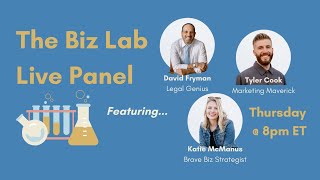
This content was created by Katie McManus. This content was uploaded by Katie McManus. This is a YouTube video titled "Biz Lab Live Panel - Episode 1" created on July 22, 2022. It features a live panel discussion with Katie McManus, David Fryman, and Tyler Cook. The panelists discuss brainstorming business ideas, specifically focusing on starting a tutoring business for children with ADHD and expanding it to professional tutoring. They explore various aspects such as niche selection, marketing strategies, and potential business models.
Chapters
Sam.
Hello, everyone. I'm Katie McManus, business strategist and leadership coach. I am so thrilled to be with you here tonight with David Fryman from Fryman PC, a lawyer for entrepreneurs. And we're going to be tapping into his brain this evening. And of course, Tyler Cook of Hypermedia, who is a brilliant marketing mind and we're going to be tapping into him as well. This is our new show where we pull a business idea out of a jar. Literally, we don't know what we're going to get, and we are literally just going to spitball ideas and we may know stuff about the industry, we may know nothing about the industry, but we're going to use our brains to kind of come up with a plan. Guys, welcome. Thanks for joining me.
I'm so excited. This is going to be hopefully fun.
No, it's going to be a ton of fun. This is awesome.
Here, blow on the jar. So, yeah, let's get a good one, this first one. Okay. Ready? Okay. I'm not looking. I should have picked a bigger jar with a bigger top because I can't my finger in. Oh, okay. So we picked a tutors, a tutoring company.
Tutors. Okay.
Okay. So the, the, the business we are building today is tutoring. So my mind goes to, you know, my first stop is always, what's the niche? Like, what are you tutoring on? And also what's the age range you're going to. Because I think that that implies like different levels of liability and who you can market to and all that stuff. Where, where do your brains go?
Yeah, I was thinking also, like, is this, is this like one on one tutoring? Is this more of like, you know, group tutoring? You're getting five, six, seven kids in there, that type of thing. That's kind of where my mind went first is like, what type of tutoring there, you know?
Right, right, right, right.
I was thinking professional test prep, which I think is, I don't know, I don't know a lot about the industry, but my sense is that like, I paid for that kind of tutoring and a lot of people I know went to even just like college grad school. I feel like that's a pretty robust field and it's like it's not going anywhere.
Right?
Yeah. Hi, Tanya. Welcome. Well, I think, okay, so we have to pick a niche first and foremost. I kind of like that high ticket college prep. Also, I imagine for very highly certified industries like law, like medicine, there are tutors who help you get through the bar or get through Your licensing, right?
Yeah, yeah, they're bar tutors. Like LSAT tutors. I know. Just, you know, in the legal field. I paid a ton of money on bar prep. Very big industry.
Can't you just hire somebody to take that test for you?
So that's another business idea. Less legal, but it is certainly a thing. I guess you can get money for it, but that's probably a bad idea.
You know, that's one of my favorite parts of that movie, Catch me if you can.
That was a great movie.
I know. It's such a good movie. But the character who is played by Leonardo DiCaprio, like, he actually just passed the bar. And I think that's actually part of the true story. Yeah, that's based on he, like, studied for three weeks, then passed the bar miraculously. David, how does that make you feel?
I feel personally attacked. Why don't you get him on here instead of me? He might have some ideas too, Probably.
Well, should we. Should we. Should we ask anybody in the audience?
Yeah, if anyone in the audience, if you have any experience with anyone.
Start a tutoring business.
Yeah, anyone who's starting a tutoring business or, you know, cast your vote. Do you want to talk about high level tutoring? I mean, one thing that is top of mind for me is so. My oldest is 5, and he starts kindergarten on Monday. And so, you know, just Brittany, my wife and I, we've been having loads of conversations about schooling. And, like, in Arizona, where we live, like, schooling is kind of. It's kind of like you can go anywhere, which is kind of fun. And there's private schools, charter schools, public schools. So it's been, like, actually a ton of work to figure out where we want to send Harvey. And I'm like, man, this would have been nice to just hire somebody kind of like in our neighborhood, get, like, five other kids in there and, like, be done with it. Right. So let us know.
Yeah. So Tanya's kids were tutored. Math and SAT crap. You know, I say let's. Let's cover the gambit. Let's cover tutoring. That's for kids, where you have the decision maker that are. That's the parents. So you have to market to the parents to help them with their kids. And then let's also talk about professional tutoring. Let's. Let's just split this into two different kinds, because I. I find this fascinating. I love. I love businesses where you have to figure out how to appeal to the person who doesn't actually need the thing. They actually are making Decisions for the other person. Right, right. So do we want to start there and then go into Sarah? That is so possible. I'm not sure what you're talking about, but maybe it's, it's Tyler's.
The universal standard. It's all possible.
Yeah, everything's possible. You have to cut impossible out of your dictionary. Not a word that we want to use. Can we start there?
Sure.
Yeah, let's do it.
Okay, cool. So, I mean, you guys have kids?
Yeah. So I'm. My oldest is seven. We're not as ambitious as the Cook families. I'm not getting tutors for my seven year old quite yet. We're gonna wait till second grade. That's the.
I don't know if you should be saying ambitious. It runs in the family, right? Like, let's just put it that way. I left my keys in the ignition. Okay, so I had an appointment. I was trying to find my keys, couldn't find my keys anywhere. And my wife's like, you took the SUV like a couple days ago. Did you leave it in the car? Did you leave the keys in the car? And I was like, hun, I'm dumb, but I'm not that dumb. Apparently I am that dumb. So that's why we're getting started now.
So look, if you had had a tutor, that'll be the first line of marketing. It was like just a picture of Tyler leaving his keys in the. And then it just, it just breaks to. If you had had a tutor in seventh for seventh grade math, this wouldn't be, you. Know, how's my marketing? How's my marketing skills?
That's, that's fabulous. Well, can I share? When I was, when I was a kid, I like was a slow reader. It took me like a long time to learn how to read. And I think I just, I had add so I couldn't sit still, still. And you know, I didn't like how they were teaching me once I learned how to read. Like that's how I learn is reading stuff. But my mom got two tutors for me and I hated one of them. She's a really nice woman, but I just hated going to her. My mom once offered me the same amount of money per hour that she was paying this one tutor if I just wouldn't throw a temper tantrum before going. She offered me $30 an hour in third grade.
Did that work?
I turned it down. I just didn't want to go.
Go. All right. Oh, speaking of niche tutor for ADHD kids.
Yeah, I think that's A really good one, because, you know, ADHD runs in families.
Yeah.
Parents should know that.
Right.
You know, and.
And there's already built in community there.
Right.
Like, there's ADHD forums or ADHD playgroups. Like, there's all of that. So there's kind of like moms and dads of ADHD kids typically want to hang around with other moms and dads that also have those same struggles.
Right.
And we. We tend to buy impulsively. So.
Never.
Never.
Well, the other cool thing about kids with ADHD and any neurodiversity is they get really, really interested on one topic. Right. So, like, I was really interested in Balto, you know, the. The sled dog for a really long time. And so the. The tutor that I really enjoy just found me a ton of books on Balto, you know, this husky that ran, you know, whatever that I did. A rod.
Yeah.
So part of. Part of this niche would be, you know, a tutor who focuses on ADHD kids. But their selling point is that they discover what that kid is, like, hyper interested in what they're hyper focused on and give them things that relate to that.
Yeah, yeah.
Because otherwise they're not interested. They're not going to keep their attention.
All right? So, I mean, if we were to put this at least. At least the first couple of steps in a business plan, right. It would be one, you got to find your niche, right? Like, are you going to be focused on kids? If so, what age group, how many type of kids? Right. Like adhd. You could also specialize in a couple of other areas, too. Right.
Doesn't have to be.
So figure out your niche is step one, and then number two, take it a step further, understanding that you're marketing to parents. Are there any. Are there any groups like communities that you can kind of insert yourself into? Just like we were talking about with adhd? Other parents tend to know other parents that have ADHD kids, so it's a lot easier market. You're not. You find one family that kind of becomes your advocate. Right. They help you find the other five kids or six kids that fill your classroom, right?
Yeah, yeah. So, I mean, a great resource would probably be like the. The guidance counselors in the schools, because they're always looking for resources, because schools really don't have the resources to give to parents. They're always looking for people to introduce, maybe doing a donation at, like, PTA fundraisers, you know, like a learning experience or whatever. Like, maybe, maybe. Because here's another thing about kids with adhd. Is we like to move while we're learning. Yeah, right. One of the reasons I thrived when I went to Waldorf as a. As a child is that they had us learn our multiple multiplication tables while tossing beanbags in the air, while walking on a balance beat. So we're not focusing on it. We're, like, moving, and we're getting our bodies integrated. And I feel like a good ADHD tutor should also integrate those things in their work, which makes it more fun for the kids.
Yeah. One of our local libraries, the Queen Creek Library, my wife took our kids there, and there was a scientist there. I don't know if she was actually a scientist, but what they did is they had like the little, you know, going back a ways, they had those, like, little film canisters that you used to put, like, the actual camera film in, and you'd get. What is it? Vinegar and baking powder. Right. So she'd put a little bit of vinegar in the bottom of the canister. The baking powder would be in the top. She put the lid on. And then they'd count down from five. And, you know, it's fun to see all the kids go, five, four, three. And then the lid pops off, and everybody's just like, you know, they lose their minds. Because it's like the best thing ever. Like, that's another advertising technique. Like, could you develop a good. A good relationship with any local libraries and host events like that where you're teaching something simple, getting things, getting parents there and kids excited, and then also saying, hey, I do, you know, group tutoring or I do private tutoring. If your kid really enjoyed this, I could do more of it. Right?
Yeah. Yeah. Well, the other thing here is, you know, Facebook groups.
Yeah, Facebook groups.
You know, I'm not pro Facebook these days, but. But the Facebook groups, where there are moms who, like, are at their wits end with their kids, I mean, you could absolutely get into the right Facebook group and then you're just referred around.
I think, for when you're selling consumers, I think Facebook groups are a lot more effective. B2B, I think, is probably a totally huge waste at this point. But if you're still. But people still socialize, even if they're not coming on thinking business, they're still, like, hanging out with their friends. They're still getting info about local resources. Folks. It's still pretty common to see Facebook posts, though. Like, you know, I need X, Y and Z. Can you recommend a plumber? Can you recommend whatever we have?
Sorry, we have a librarian on who's yeah, she's perfect. Libraries.
I think from a sales perspective, you're going to be targeting parents that already may or kids that already have a negative association. Right. Like, because you're. It might not be the first tutor. So maybe the marketing angle is going to be focusing on parents and kids that are already unhappy with their tutoring. Like, they had a tutor or he might have tried to have a tutor and they might be on their third tutor and it's just not working. And that's like the pain point that you can, you can ping for that audience.
Right. Well, I also think that most tutors work after school.
Yeah.
And I think ADHD kids. I know I was like, tapped out. I didn't want to.
Early mornings.
Yeah, early mornings or on the weekends.
Yeah, early mornings.
And I think in person is better for kids with ADHD because you get to get active and you could do something physical.
Also, I can tell you zoom school ADHD kids.
No, no, no online class I've ever taken.
I tried this in my house.
But no, like having. Having a set place on Saturdays where literally your appointments just come to you.
Yeah.
And then maybe a couple early mornings throughout the week. Right, right.
Yeah.
Yeah. And I mean, one, one other, you know, this is kind of thinking about other revenue streams, if you will. The other partnerships is there are tons of, you know, let's say like, kids influencers that have, like, toys that, that help or different activity boxes that you can buy. And if you developed a really good relationship with them, you could probably get discounts off of their stuff and kind of, you know, be a affiliate of those products. So it's like, hey, we use these toys in, in my classroom. Right. If you want this toy at home, here's how you do it. Right. And then those people also start referring people to you because they're like, oh, my gosh, like, this person is awesome. They're using my stuff like this. Amazing. And so that, that, you know, increases some revenue that way.
But yeah, toys, you gotta get branded. Future toys. That's gotta be the thing. The logo should just be like half a dozen fidget toys in a mess on the carpet. That would be the. Maybe with like a calculator in there to like, show the. That's the image that. Yeah. Lots of. You need lots of fidgetoys.
Oh, Amanda has a great idea. I'm wondering about a tie in with local children's museums or through a ymca. Absolutely, absolutely. I mean, could you imagine like, you know, those old, like, YMCA gym gymnastics rooms and just having Like a mass math class where you have like groups of kids, like calculating if they divide themselves by three or whatever and trying to figure it out together. It would be absolute chaos, but it would get them all thinking.
Yeah, any energy would be very, very good.
Oh, yeah.
Yes.
So here's another idea, is like this person is going to have limited time because the kids have limited time to do this. They could absolutely put together some kind of certification process for other tutors in different regions to get ADHD certified and license out any ADHD specific like worksheets, training books, all that stuff. So, so that they could use that for their clients.
How about an agency?
Could be. Absolutely. Be an agency agency.
You can, you can. If you have a really good branding, you trademark your branding and then you license out the. Right. Like a certain style of ADHD tutoring. You, you know, this is your thing. You have a system. It has a particular style that goes with. It has. For kids. Maybe there's like a video or a jingle that you open your, your ads with that's like really catchy so that it gets in their head and then they never stop humming it, like ever. That's.
It's like the baby shark of tutoring.
Yes. Yes.
There you go.
My wife and I always joke in the car with, you know the, the movie Dumb and Dumber. Hey, you want to hear the most annoying sound in the world?
Yeah.
Oh my God.
You can't play that game with your kids because they'll take you up on it. Oh, they will.
They'll be like, oh, this is the greatest thing ever. Challenge accepted.
Yeah. So funny.
So, all right, so if we were to recap, at least on the kids side, find your niche. Right. Or niche, however we want to say it, look for areas that already have kind of built in communities.
Yeah, right.
So then your customers kind of become your advocates and it's easier to fill your classrooms and create partnerships with people who are also talking to your customers. Libraries, YMCAs. I mean even if you had like a local farm that did events like that would be awesome to like go out there and do stuff there. So is there anything you could do with that? So developing those relationships and partnerships with those businesses to kind of get things off the ground long term, as you see the success, start documenting everything that you're doing. So you can either turn it into a full fledged agency or just license all of your content out.
Yeah, yeah. I think also figuring out the math of how much you should be paid is going to be really critical here as well. Yeah, you Know, because you know, how.
Much do we charge?
Well, so you're specialized with kids who have adhd. They're probably like terrors for anyone else who's just a tutor. You have more overhead because you, and, and really more assets that you bring to the table because you're doing ADHD friendly style tutoring. I think it would be perfectly fair for this person to charge like 100 to $150 an hour or a session. And I think you have to have a kid go at least once a week to work with the tutor, depending on what they're working on. And so I think it would be fair to be, you know, between two and 300 a week and I would have it packaged out in three months because hopefully the kid, you know, gets up to speed. You know, maybe they were just behind for a little bit and they just need to get up to speed and then, and this is just a tough time for them, you know. So if it's $200 a week, it'd be 800amonth times three.
Right? Yeah. Words, you got to have rewards. You have to be like, you know, if you cooperate and pay attention for however long the session is, or realistically like 90% of the session, then you get something, you get a toy, you get even a sticker or chart. Like you have to build in that structure.
Yeah.
And yeah, yeah.
Well, it's focus time. Right. They get rewarded for the focus time, the time that they continued trying.
Right.
Yeah.
Right. So I mean if you have 10 clients and you're charging 800amonth, that's an $8,000 a month business.
Yeah. That's only for you. It doesn't even count the agency stuff.
Exactly. So if you have other people that knew, you just pay them 50% of that around that. And then of course, any affiliate programs that you put together, that would just be money on top of the pot.
Right, right, right. 8k a month isn't bad. That's pretty awesome for 10 clients.
Yeah, I mean it would be, it would be an amazing part time business. You'd have to live in a fairly affluent area. And here's the key is like if you wanted to make your work more approachable for people who couldn't quite afford that, you could put together some kind of group program for each, for like the grades that you focus on, you know, where you have, you have a small group where they're, they're all paying much less, but it's, it's a group thing and they're just getting more learning. But they're getting it in an ADHD friendly way.
Yeah, yeah. I mean, there are quite a few spin offs that you could make on this. I mean, eventually you could also develop your own products off of this. Right? Hey, I use this, I use these toys all the time and if I combine them, it would be like a game changer. Right. And so then you develop that and now you have something. So, yeah, there's a lot of different revenue streams here.
And I mean, just what if, what if you did a partnership with like Lego?
That's awesome.
You know? Or what are, what are the toys that your kids always play with, Tyler? That you're always magnetiles?
Oh, yeah.
I mean, there's a whole industry of sensory.
Yeah.
Oh, sensory.
Sensory toys like weighted blankets and things that are specifically appealing to neurodivergent.
Right.
Kids. So it's natural partnerships.
Right.
You can. Because it's part of your branding. Even though you're a tutor, your, your marketing is all about your, your audience. They're gonna be dealing with these things.
Totally. Yeah.
Yeah.
I actually thought I was getting a fidget, a stress ball with my logo, and I was like.
That'S actually a great idea for your business. If you're not familiar with David's business, he basically helps people sue other people or if they're getting sued by someone else.
So it's hugely stressful. Right. So stress ball is like, you know, take out your stress. A lot of good angles there.
I think that's brilliant. Brilliant. I love it.
From the legal side, David, what kind of liabilities do we have to protect the tutor from?
So look, anytime you're working with kids, you probably would want some form of insurance policy when it comes to your, your branding. If you're gonna go the licensing route, trademark, you'd want to develop some proprietary taglines, imagery, pictures, worksheets, even ebooks that you can, you know, develop as you go and you see what works. And you sell, you can sell lesson plans to other tutors once you've worked out certain systems. If you make it part of your branding, then you can charge a premium. You can also, it makes it much easier to license it out if you're going to do the agency model, you know, first you'd want, I mean, you still want the intellectual property protection. You'd also want to make sure that you have non competes, non solicitation agreements in place so that, you know, you hire a tutor to work for you and they don't just take your clients and set up shop.
Right.
You'd Want to make sure that you have some. A vetting process for the people you're hiring. You know, you have to come up with some oversight so that you, you know, if you're. It's a tough thing, I think, for any agency type business, but especially when you're dealing with kids. And, like, any red flag or any hiccup could be, like, a huge mark against you. Yeah. Those are some thoughts that jump out at me.
Yeah. And then I'm curious, Tyler, from the marketing angle, I know we. We kind of decided on, like, community outreach and Facebook, but do you see any other opportunities with, like, ads or email marketing?
Yeah, I mean, email marketing is going to be a big driver and also, like, text messaging, in my opinion, for this business, because it's creating those relationships. But then also it's. You know, my wife and I were, you know, we're expecting baby number three in just a couple of weeks here. Right. So if we got in with a really good tutor with Harvey, who's our oldest.
Right.
And then when Quentin, our second right. Is ready, is kind of at that age, and that tutor sent that email right. At the right time, then it's like, oh, yeah, remember when we worked with this person? Oh, oh, here's this. You know, work with this kid. And then number three. Right. So email marketing is going to be big because, you know, you could work with multiple kids in the same family, and to be honest, I really wouldn't pursue ads in. I mean, you could maybe do Google Ads, but you're going to be much, much better off really focusing on doing events and, like, group outreach. Right.
Yeah.
You're gonna have so much better results. And that way you don't waste any money on ads.
Yeah. Because who wants to waste money on ads?
Yeah. Who just likes to throw that stuff away? You know, it's not important.
Yeah. If you're independently wealthy and you're just doing this for fun and you want to try ads, but. Yeah. Cool. Okay. So that's the kids tutoring. We just started a business. Congratulations, guys. I think we did a great job.
All right. Yeah, I want to watch this thing. When are we doing it?
I know, I know. Well, I don't. I don't think anyone wants me tutoring their child.
Well, hey, wait, wait. Katie, we. We missed you. I would be very curious because we've got a legal side, we've got the marketing side.
Yeah.
How would you approach this from the sales side? Is this. Is this just solely one on one in person? Are you, like, how would you handle the sales side of things.
Yeah. So I mean, well, you have to market to the parent obviously. Right. But here's the thing. Your, your sales process. Cause the parent want to make, the parents at this point will want to make the right choice for the kid. Right. So your sales process is actually going to be in person where you're doing like a little bit of an activity with the kid to make sure it's the right fit energetically and personality wise. And you know, the kid has to like you to be able to learn from you, you know, and so you're just showing up, being yourself. And if they like you, great. And if they don't, that's fine too. There's plenty more kids out there. But basically you're saying, cool, we're going to slow this down because I want to make sure I'm the right fit for you. And so you're going to have that little meet and greet. If it goes well and like you and the kid get along, then you're going to say, great, let's do a follow up and we're going to talk about all the details of the program and you can share some of the details beforehand because I think some parents will want to know some of the details before they take time out of their day to meet you. But then go into, you know, here's how I work. You know, I work with my clients for, or my two T's for about three months at a time because sometimes they just need to get over a hump of something that's difficult for them. Sometimes they need longer term support and I'm happy to do that. But let's start with three months and then you lay out, you know, I think, you know, the best, the best support for your kid is going to be something that's midweek and then a weekend day. You know, when they're refreshed, they've had a good night's sleep, they haven't expended all their energy at school and it really keeps that learning going throughout the weekend. And you know, and then you explain the pricing and everything. I think having it on, either they pay in full or you have it on autopay. It's just always the best choice. That way you're not chasing people down for money, right? You're not like having to like slip a note in a kid's binder, hoping their parents see it, that they owe.
You 800 bucks, pin the note to.
Their shirt, just draw it like on their forehead, like.
That note is never coming home.
There's no chance of that. You know when they used to send grades home with you, I, I don't know how I did this, but I got my dad's, I got my dad to write a signature somewhere and I spent hours learning how to forge my dad's signature so that when I got my report cards I could sign them as my dad and then turn back that, turn them back in. So my parents never saw my grades because.
Yeah.
Anyways, we'll move on.
So, yeah, we want to just completely bypass that. That is not a cool scenario scenario. And I think that's for, that's for your one on one. And of course your one on one business is always going to be your fastest path to cash. I think once you start building a reputation and your one on one business is full or you started getting people who are really interested in working with you but they can't afford that, that price level, then you start building up a group program. And I would really pick like two afternoons, you know, during the week and I would have two different sessions depending on what grades and what subjects you're working on. And I'd say, hey, awesome. So I actually have a four month program where you can enroll your kids. It's like an after school daycare kind of situation. But we have fun while learning and I'm helping them just get into the groove and build that confidence that they can stick with stuff, that they can figure out problems and it shows them a lot of different strategies to do it while, you know, with their ADHD brain that's creative and needs to move, I think that's the best way to do that. And then as those kids, you know, kind of graduate through, they, they may need more one on one support. But once you've built that, that credibility with them, that they're building their confidence and their kids are seeing them looking forward to going to, that you're going to be able to sell them better on the more expensive program, right?
Yeah.
Yeah, totally.
Yeah.
Cool. The marketing side, did we mention pediatricians? Because pediatricians, psychiatrists. Because we're thinking about this as well. It's part of education. But like when a kid is diagnosed with ADD or prescribed medication, they're already having a conversation with a professional. That's their doctor. That's, that's before they talk to their teachers. That's before they start looking for anyone that's already a professional relationship. I feel like the pediatrician is, oh yeah, you're having trouble in school. Of course you are. And you know, I just heard of this or, or we work with this or.
Yeah, yeah. I also think like a well lead or a nicely timed, like sponsored happy hour for teachers.
Yeah.
You know, because they're really the ones that are writing notes home, you know, on the, on the report card saying, yeah, I think your kid might need to get on some Ritalin.
Yeah.
You know, but if they know this person, they trust them and like have had an experience, good experience with them. I think that's really right.
Yeah, totally.
Okay, cool. Are we ready to switch to the other kind of tutors where we're talking, we're selling and tutoring the exact same person.
Let's go. Cool.
Well, I mean, David, you know more about this because you've had professional tutoring for, you know, your continued education.
Yes. Now that I'm thinking about it, I'm wondering if you keep the same business. Just accept expanded. Right. Because. Oh yeah, in the tutoring space, there's, when you work with kids, there's the sense that, well, you have to be really specific to their learning needs and learning differences and differentiated learning and really make sure. And then you get to a certain age and we're like, hell with it. We're just gonna put a professor in front of a room and they're going to talk to you. We're just going to assume that you can all figure out how to learn.
Right.
But there's no reason why that would be remotely true. And so I feel like there's still the same need. If there's a need for kids to have a tutor with expertise in ADD or autism or dyslexia or whatever it is, why would that need be any less when they're taking Sats or GREs or GMats or LSats or the bar or whatever other licensing exam? If anything, the stakes are higher, the material is harder and there. And there's more on the line. Right. Because when you're selling a prep course for a licensing exam, there's money on the table. Like, I need to make a living, I need to pass this test is now, now I can tell you it's worth X dollars. Right. Because I'm gonna make this much money if I pass and if I don't pass, I'm not making it thousands of dollars.
I love this because this is such a great selling point for the parents of like the 8 year old who are at their wit's end because their 8 year old having a hard time with math. It's like, you know what? Your eight year old is going to be an ADHD Doctor. You know, because we actually support our ADHD kids from figuring out their division, you know, stuff, long division, all the way through their, like passing the bar or getting their license as a doctor. You know, this methodology that we use here, this fun, this energy, this creativity, we actually carry all the way through. Yeah, right. And it shows. Yeah.
Plus you have you built in. Right. So I mean, talk about having, you know, the a. What's the expression? Like the, the client journey. Oh yeah, client journey. Like we're talking about a lifetime now. Client journey that like starts when he's 6 and ends when he's, you know, 27. That's huge. Right.
Well, I think that it means that we. There has to be like a defined methodology. Methodology sounds so stodgy and stale. But you know, I mean, like, there has to be a defined way that they, they tutor in this ADHD neurodiverse way.
Right?
Yep.
And then they just, they, they are able to license and, and almost certify through them these tutors that specialize in, in different areas.
Right.
You know, because someone who teaches like reading to a seven year old is not going to help someone with the bar, I don't think.
Right. Well, I mean, there is like our special ed teachers. I feel like if you're, when you're hiring. So I'm thinking the agency model. So I want, I mean, I'd want some special ed teachers on my staff. I'd want teachers because, you know, ADD sometimes comes along with dyslexia, sometimes comes along with other learning disabilities. And so if I'm operating agency and I have a child and I'm looking at their IEP or a neurological workup and it's like ADD and dyslexia and some other things. Oh, well, perfect. So here's this person who is trained in my ADHD method and also a reading specialist and specialized in dyslexia. I got my person for you. You build out that agency, you can offer a much more powerful service.
Right, Yep. Right. Well, I also think, you know, the, the older they get, obviously the more they're paying for this because the more specialized it is.
Right, Right, right, right.
Because you're, you're then paying someone who's gone through the bar, ideally.
Yeah.
To then tutor you on how to get through the bar.
Right.
You know, and it's also an easier sell because like you're, you're basically selling. You have to train everyone who is a tutor within the business to know how to sell their own program within it. Because, you know, that relationship is the thing the person's gonna trust.
Right.
You know, it's gonna be really hard for me to, like, sign up with John and then get Kathy.
Right. Oh, another idea. Because we're focusing on in person as much as possible, because when you're dealing with learning disabilities and neurodiversity, that's much more effective. You can franchise, you can have. So I'm in New York, I'm gonna set this business in New York, and then I'm gonna find somebody who wants to open up the Texas version, the California version, Wisconsin version. And as a franchise, they're running a separate business. Nothing with me. And I can franchise. I can make it international, I can have a Europe version. I can have, you know, divide Africa into a few segments. And. And then when it comes to differences in pricing and style, I don't know. That's not my problem anymore.
Right.
Their problem. Right. I. I have my method, I have my branding and my name and my reputation. I give that to you, I get a fee for that, I get a cut of your profits. And I don't have to learn every sub market in order to turn that into money.
Right. And you also don't have to manage all those people.
Right.
Right. And you're not taking on all that. That liability also. Yeah. Tyler, what do you think?
No, I think it's brilliant. I think it's brilliant. I think that. Yeah. Kind of keeping that same energy. You know, Honestly, even if you did specialize in adhd, like prep for the bar exam, I would imagine that just because you are more fun or you seem more fun and you, like, the study becomes less of a study, that you'd actually own a huge percent of this market just because people are like, this looks like more fun than having it.
Right.
I mean, I've never been tutored for the bar, so. David, I would go back to you, and I like how I imagine it going, is somebody, you know, kind of like in a shirt and a tie showed up and said, here's. Here's what you're studying today. Let's do some flashcards. I don't know.
I'm actually going to. I'm going to. I'm going to one off that. It's suit, tie. Here's what we're going to be studying today. Here are some flashcards. Like, no, no.
I mean, I protect the standard one that everyone used, Barbary. Now there's some others that are more recent. And we went so you could sign up for, like, the live version. I did the recorded version, but like you went to an auditorium to watch a video, like on a big screen. Because it wasn't. It wasn't streaming, I guess, for. So they keep their proprietary. Whatever. See, if you couldn't just, like, copy it and invite a bunch of other people over to watch it with you. And they had, like, these notes and outlines they would give you. Yeah. By the way, it's. It's July, and the bar, I think, is like two weeks. So if there's any recent law graduates that are watching this and having ptsd, you're studying, you're gonna be fine. Just.
Keep your schedule, send you a stress call, remember to.
And I'll see you on the other side. Just, you know, I just realized the. At the end of July. Yeah. So I think it's next week, actually. Yeah. So. Yeah. So I lost what I was gonna say. I had a thought there.
I know. I love that we all just kind of like, hopped on the ADHD train. It's almost like it would serve us.
A bit, you know, it's total coincidence. I don't think it's any.
Doesn't mean anything.
Nothing at all. Nothing. Nothing at all. Nothing to see here. No. But I like. I think that would be amazing because. Because it would be very interesting. Right. Very entertaining for, let's say, neurotypicals who are setting for the bar who are kind of like, I'm a little burned out from just sitting down and just like, trying to focus and studying. This is a new way of learning. And who knows, maybe they'll even get better results because of it. So, yeah, you would focus on ADHD people, but I would guess that the majority of your class wouldn't be ADHD people just because they're finding it.
So what you could do is instead of. Instead of using adhd, I mean, obviously it would. ADHD would be in your marketing, but instead of it being the focus, maybe your focus would be distraction, difficulty paying attention, things that are traits, qualities that obviously people with ADHD are going to be struggling with, but not necessarily. Right. It doesn't exclude other people. There's plenty of people that have trouble focusing or paying attention for a dozen different reasons. And if your approach is helpful for people that struggle with this particular task, its relevance is. And also it also takes. Take the stigma away, I think. I mean, I think the stigma is. It's much less than it was like, you know, a couple decades ago. Still there might be people that just, you know, are denial or aren't diagnosed or don't know what it's Called. But like when you describe distractibility and focus and fidgeting and needing to get your, like the exact amount of exercise and sleep that you normally get. Right. You start describing that and then be like, oh, yeah, I didn't know there's like a special acronym that goes with that. But that's my life. If you ever approach that works with that, it's going to work.
Right. Well, the other element here is I imagine there are lawyers who get kind of targeted by law firms before they've passed the bar. So you could. Right.
Like almost.
Almost kind of like recruiting.
Yeah. Recruited.
Oh yeah.
No, it's a huge industry.
So. But like you could actually sell packages of this to different big law firms.
Yeah.
To like ensure that they're. They're getting through the.
Oh yeah, that's good.
I think every, even the not so big law firms pay for, pay for, for the prep courses. That's pretty standard.
Well, and then the other thing is that like, as you're building the business and as you have people going through it, they're seeing, wow, this is really helpful. They get to their career and they're like, actually, I don't want to be a lawyer, but that looked like fun. I imagine you have some people who go through it and then they're like, I want to open my own franchise. Yeah, that's cool as well. They passed the bar.
Squirrel Tutoring. That's the name.
Squirrel Squirrel Tutoring.
Oh my God. Yes.
That's awesome. Squirrel with reading glasses and like, you know, trying to focus on a book and just like can't see it. This is awesome. All right, that's, that's gonna be the logo. A little gif of like a squirrel that like can't like.
The jumps from their computer to reading a book, to writing, to scrolling through their phone.
Yeah. You know. Oh my God. So funny.
I love it.
I love final thoughts on our tutoring business.
If anyone wants to do this, reach out to us if you like. If you're watching this, I'm like, oh my goodness, I'm going to launch this business. I would love to like be along for the ride.
Yes.
I think this content would blow up on TikTok and reels 100%. Every ADHD person, including myself, that I know is severely addicted to either or both. So like, just by way of attention, you'll get there. But then it's just like bite sized content where you can be, you know, continually educating and showing things and being fun. You'll just get a lot of attention that way.
Yeah. Absolutely. Yeah. And I think, I think.
I think.
I think the biggest overhead is finding a space to do this. Right. Finding. Finding the right real estate that's easy for people to get to.
Right.
But I mean, if you can figure that out, if you can lock something in, I mean, there's a lot of. I know Philadelphia because I just moved there. There's a lot of storefronts that, like, can't be restaurants, and so they're like frame shops and fabric stores. But, you know, you could absolutely get something for low rent.
Yeah, right. I mean, the real estate is. Is going crazy in some sectors. Office space.
Right.
There's a ton of offices that are just empty or they're 30 capacity that you can convert into a educational studio.
Right.
So, I mean, also depending on, again, your teaching methodology, could you go to something, like. Because, I mean, you're working with adults at this point.
Right.
Could you, you know, sublet for a little bit like a gymnastics area? And so now they're learning in a gymnastics place or at like a trampoline park or, you know, something like that. Could you say, I want to bring in a class? Yeah, this is what we're going to be studying, but I'm going to be using your equipment to kind of teach these different things.
You know, that would actually be a really fun thing to do, is like a monthly get together, is like, go to a climbing studio, go to a trampoline park, Go to those things. And you pair people up as learning buddies and, like, as they're jumping, like they're asking questions. I mean, you have to get like, David's probably, like, squirming at the liability here, but I'm not squirmy.
I make my. I make a living in litigation. So I'm like, bring it.
Yeah, let me know.
Twist your ankle.
Yeah.
David's gonna be out there tripping people.
Just pouring oil on the trampoline.
You've been injured by squirrel tutoring compensation.
So good. So good.
Well, I think on that note, we should wrap this evening up, guys.
So pumped for the next one.
Oh, my God, me too. We have a whole jar. I actually made my mom help me cut them up and put them in the store. I'm gonna find a bigger jar, though, so I can fit my hand in it. I want to invite the. The audience. If there are any business types you. It may already be in the jar, but if it's not already in the jar, please put it in the comments. DM it to us, and we will add it to our jar. Of ideas. This is, you know, gonna be a co created experience with you all and David and Tyler. I'm so excited we finally got around to doing this. I know we've been talking about this for a while.
This is awesome.
We have, haven't we?
Yeah.
Yeah, yeah. Well, thank you guys and I hope you have a great Thursday. Thursday night. Today's Thursday, right?
Yeah. It's been a long day.
It's been a long week. Yeah. Have a great rest of your week. Tyler. If the baby comes soon, good luck.
Yes, good luck.
Well, August 12th, so hopefully not too soon. Yeah, we're. Brittany is actually hoping that it's either going to be the 15th or the 18th, because Quinton was born on the 16th and Harvey was born on the 17th. Obviously. Separate months.
Oh, yeah.
She's kind of hoping to keep this, this, you know, trend going.
So fingers crossed.
Yeah. The first time I've ever heard my wife. I hope the baby comes late.
Yeah, I don't think anyone's ever said that that might be the.
So, yeah, good times. Good times in the cook hassle, but.
Oh, yeah. So I think our plan is to do this every other week. Ish.
All right, I'm game.
We're kind of learning this on this live. Yeah. So. Okay, cool. Now that I've gotten you roped in. Into that and we have, you know, witnesses, I think we should call it a night.
All right.
All right, sounds good.
Thank you. Thank you, everyone for joining. And we will see you in a couple weeks. We'll be promoting it and tune. I'm just gonna play the video that I just made for this again to.
It.
More from Katie





How to do self care right now, so you can do what needs to be done, for yourself, your business, and

How to do self care right now, so you can do what needs to be done, for yourself, your business, and

#greenscreen How to build a consulting business that makes you $200,000-$700,000 a year

#greenscreen How to build a consulting business that makes you $200,000-$700,000 a year

Maybe we’re not the imposters…? #businesscoach #startup #entrepreneur #smallbusiness #consulting

Maybe we’re not the imposters…? #businesscoach #startup #entrepreneur #smallbusiness #consulting
