Breakdowns to Breakthroughs
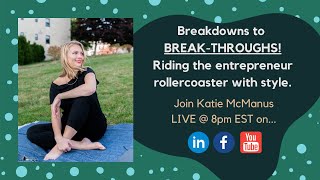
Katie McManus argues that entrepreneurs should stop hiding their breakdowns. She shares three stories from her own business: a meltdown in Brooklyn, near-bankruptcy, and panic after landing big clients that led to a six-figure year. She says emotional processing, not suppressing it, is what creates breakthroughs.
Questions this video answers
Katie McManus, business strategist and leadership coach.
"Breakdowns to Breakthroughs" — uploaded April 22, 2021.
At a workshop in Brooklyn, New York, in December (year not specified).
Her coach Rick Tamlin.
She credits that breakdown with helping her hit six figures in that year.
Chapters
Hello, everyone. I'm Katie McManus, business strategist and leadership coach. I am so excited to talk to you about this topic this evening. And actually, I just want to make sure I my mic to see if it's working, but I think it is. If you guys could, you know, whoever's watching, you could just tell me the mic is working. I realized I plugged it in after I did the mic check. Anyway, this is one of my favorite topics. This topic is so a part of my life and business. It is about the. About. About the meltdowns and the freakouts and the breakdowns that happen when you're doing something exciting that is so aligned to your core values. For me, this is my business, okay? This is being in my business. This is doing something brave. It's putting myself out there all the time, and it's figuring out problems as they come up and trying to anticipate them. So one of the things that I hear most often when I talk to clients, potential clients, and people who are in my audience is the number one thing that they want is they want to be able to live their authentic self, their authentic life. They no longer want to have to hide in this corporate scale, okay? They no longer want to have to fake it till they make it. They want to actually get to be themselves 100% of the time. And let me tell you, yes, that is wonderful. Absolutely. But also, there's this leftover baggage when you actually start doing it. There's just leftover baggage from our conditioning. It's from school, it's from work, it's from. You know that if you have a meltdown, if you start having kind of an emotional spike, that you have to go and hide yourself, that you have to go and make yourself look nice, that you have to go and, like, make sure everything's put together. There's no snot leaking out of anywhere. You know, all the tears are, like, hidden away. That is not what we mean when we say we want to live our most authentic lives, okay? The reason most of us quit our careers, quit working for big companies to start our own businesses, is because we're sick and tired of hiding in the bathroom stalls of our work, dabbing at the tears, hoping that no one's hearing us cry. We're tired of having to hold it all together throughout a meeting that just isn't going well. And actually, this whole pattern that we are conditioned into from a very, very young age. I don't know how your family dealt with you having temper tantru or having Meltdowns when you're a kid. But that started the conditioning of what is acceptable to the outside world for you to be like, you know, don't show anger, don't show sadness. Show that you're happy all the time. This is not the most authentic life if we're hiding this part of ourselves. And this is actually something that I had to really come out of my closet with because I'm an emotional processor. And I noticed that many of my clients who are attracted to working with me are also emotional processors. So I'm actually trying to figure out how I reword how I describe what I do to include this, because I think it is so key. Emotional processors, we have really, really high highs. We can feel so much joy. And when good things happen, we take the moment to stop and celebrate. And good things from like landing a $10,000 client to being on a hike and noticing some really beautiful flowers that are just a beautiful vibrant purple that just jump out at you, okay? So we celebrate and we feel joy in this really beautiful way. We also, on the other end of the spectrum, we can dive really low, okay, we can plummet really fast. Something happens, something that takes us off track. We get in a funk and someone just asks us the wrong question at the wrong time. This happened to me on Monday. I wrote about this. I was feeling super, you know, Covid depressed. And that's a normal state for a lot of us right now. And the consultant that I was working with, and, you know, she was headed in the right place for most other people. But for an emotional processor from that place, I cannot dream big. So she's asking me to dream big, to kind of get me out of it. It has the complete opposite effect. So, so sorry to her. So the beautiful thing about this is that if you're an emotional processor like myself, if you are an emotional processor who started your own business, and an element of why you did that is because you want to be able to be more authentic every single day. You never want to have to hide yourself again. You know, you. It feels weird, but you have to accept all parts of yourself, including this part of you that has meltdowns, including this part of you that can just ugly cry for 30 minutes over something. Something ridiculous. One of my meltdowns, I'll share this with you, was over landing two very high paying clients last fall. You know, a ton of money started coming in and my meltdown was, oh my God, I just did this now. Now I have to recreate it now. I have to do this and this and this and this over and over and over again. And I had this complete downward spiral that I had to call my coach and have him talk me off the ledge because I all of a sudden turned this really incredible happy thing into, oh, my God, this is doom and gloom for me and my business. Like, this is going to create so much work for me. It's crazy. It's crazy. But there's nothing wrong with crazy. We make it wrong. We're taught that this part of ourselves has to be shoved in a closet and hidden. When actually, if you're an emotional processor like I am, if you feel things really deeply. When we have breakdowns, it's usually where our most creative ideas come out of. Because the things that we have, the breakdowns around, we. If we let ourselves go into the emotion, if we let ourselves just really feel it for however long it needs to be felt. And then we start thinking about how this could be used for someone else or how could I leverage this feeling into something else? That's where magic happens. I refer to it sometimes. I had this major breakdown around the time that I almost had to declare bankruptcy. I used to be really bad with money before I healed my relationship with money. It's one of the reasons that I focus on relationships with money with my clients is because it is so critical. And I never want anyone to be in that position that I was in. But I had this meltdown. And let me just tell you, I was actually at a workshop about money, about healing your money story. And again, just the teacher asked me the wrong thing at the wrong time when I was in kind of a fragile mind space and I had to literally run out of the building. It was at this workshop. It was in Brooklyn, New York. Never forget it. It was December. It was fucking freezing. I think it was like 27 degrees out. Okay. There was like frozen snow on the ground. I left the building, had my coat, didn't grab any tissues, just sobbing and snotting everywhere. I had my big puffy jacket, and I went in like an alleyway and sat on these stairs and in this alleyway, it was like the stairway to a startup as well, because people kept going past me to get back to work from lunch, and I'm just ugly crying. And I called my mom first, and she was like, call your coach. I can't handle this. Good on you, mom, for knowing your limits and what you can handle. So I called my coach, and he, to this day, whenever we talk about this moment, he cheers up. And what he did is like, you know what, let's just make everything suck, okay? You're in this place, let everything just be bad right now. Just go deep into it. And in coactive coaching, for those of you who are coactive coaches, this is called process coaching. It's where you allow just for the emotions to happen because I don't know, have you guys ever tried to avoid feeling an emotion? It doesn't usually work. You know, you either shove it down with food or alcohol, maybe some pot and then, or, you know, you try to distract yourself, it always comes roaring back and it's always like 10 times worse. And yeah, it's like, it's like, I don't know, trying to cover up a termite infestation in your house. It just gets worse unless you deal with it. Anyway, so he let me process it with him. And I remember like just sitting, freezing, just like all this stuff all over my face. And I kept going like this with my jacket and I had to have my jacket dry cleaned afterwards because it was just so gross. And all these like, you know, people working for the startup were like, what is wrong with this lady? I accredit that breakdown, that meltdown, that complete freak out to why I hit six figures in that year. Without that breakdown, I never would have let myself go there. I never would have seen the dark side. Seen the dark side and I would never be able to be there with my clients. You know, there's, you know that saying what doesn't kill you makes you stronger. What doesn't kill you also makes you a very empathetic and wise guide for other people going through a similar situation. And there's no jumping over emotion. If you're an emotional processor like myself, there's no jumping over it. It is just gonna, it is gonna come through and you have to. Usually we process emotions far faster than the people around us. And what that looks like is you'll be angry about something that happened. Maybe someone said something and it like just really struck you the wrong way or is kind of rude, you'll be angry about it, you'll be pissed, you'. Fuming. And by the time they've realized what they've done and that they, they stepped on your toes in some way, shape or form, you've already gone into like, you're making it right in your own head. So them apologizing is like, it's too late, too little too late and you've already kind of processed yourself out of it and you've actually like gone back and like figured out how you're going to redesign your relationship with them and they have no idea what happened. And for those of you who aren't emotional processors, if this doesn't make sense to you, don't worry. It just means you're not an emotional processor like my poor family. I think I am. I think I'm the one emotional processor of my four in the nuclear family of mine. No one knows how to handle, like, when I'm emotional. Like, they just know that I'll figure it out. I'll go deep into it and then I'll figure it out. And there's nothing. I feel so bad for them. There's really nothing that they can say that will help the situation along anyway. That's a different. That's a story for a different day. But. So here's where you can leverage this. If you're in this up and down roller coaster as an entrepreneur, know that it's normal. Know that is so normal. There is nothing scarier than putting your life, your livelihood, your reputation, all that stuff on the line to do something that you love. Okay? There's nothing, I mean, going to war, maybe, yes, sure. But in our everyday life, the things, the scary things that we have access to doing, like maybe going in, like asking Cindy Crawford out on a date would be, you know, the equivalent or Ryan Gosling, you know, that's also terrifying. But this is like your life's work. This is the impact you want to leave, the legacy you want to leave. It has a bit is big deal energy to it, okay? So it's totally normal to freak out when you know, things don't go right. Okay? The other thing is that you are actually not living your authentic life if you don't let it happen. So all that lip surface you paid to. I'm quitting my corporate job because I want to go and live my most authentic life. And I want to be able to live life on my terms and do things when I want it. You're bullshitting yourself and everyone else. If you're not incorporating the part of you that melts down into that authentic life, okay? If you're not bringing it out of the closet and saying, you know what? This is nothing to be ashamed of. I'm going to just let this happen. Maybe you design with the people around you. You know what happens when that goes down, so they have some fair warning and they know how to deal with it in a way that won't make it worse. And finally, finally, this is one of the things that I had to learn. My coach Said it to me in a way that kind of made me feel a little defensive. But I'm glad you said it in this way because he was so right. If you try to pretend like everything's fine all the time, it's creepy. It's creepy. If you try to pretend you're perfect and it doesn't happen to you, it's freaking creepy. Okay? He called me a creep, and it was totally on point. I had this image of me as an entrepreneur out there doing amazing things and serving clients and doing this and also baking a casserole and blah, blah, blah. I was trying to be a Stepford wife. A Stepford wife in my business, okay? No, there's a reason that's a scary movie, okay? We don't. We don't quit our corporate lives to start our own businesses so that we can live our authentic lives and be our true selves all the time. To then dress ourselves up as a Stepford wife and pretend everything's hunky dory all the time. No. No. And here's the thing. No one out there expects that of you. No one out there expects the Giles Thompson business owners are naturally optimistic. Yes. Let's give everyone credit for having that optimism, that you can have everything go well. Yes. But let's also balance it with some realism, that there are emotions that happen. And running your own business, even if you're not an emotional processor, is an emotional roller coaster. Okay? There are ups and downs and all arounds. Okay. And your world turns completely upside down on a regular basis. Okay. Just from good things and bad. So, yes, optimism mixed with realism. But if you're trying to. No one expects you to have everything perfectly put together. And here's something further, is that if you present that front, if you go out there and you try to present as I'm perfect, I have everything sorted, everything's fine. You actually don't win anyone's trust. No one is going to trust you. No one is going to think this is a person who will understand me at my worst and who will be able to advise me how to get through the bad times. I don't know about you, but, like, I would never. You know, I've gained a little bit of weight over the last year or so because of a medication that I was on. And then, of course, the pandemic and, you know, being locked down, being a little, like, depressed because I haven't been around people. You know, I have never gained weight before. I've never had to lose weight before. So in thinking about Who I want to support me in losing weight. I'm not going to go for the bodybuilder. I'm not going to go for the person who is a bikini model. I'm not going to go for the person who's never struggled with their weight. No. I want to go for the person who has a similar story to me, you know, who struggled and knows that it's hard and knows, like, changing your habits after being in lockdown for a year is, you know, challenging. Where. Where you are most broken is where you have the most credibility. It is not where you have to hide yourself. I'm going to repeat that again because I think it's important. Where you are most broken is where you have the most credibility, where you have risen from the flames. Okay? The Phoenix metaphor, okay? I don't care who you are. Your life has burned down in some way, shape or form along the way. I don't care if you lost your home, got it repossessed. I don't care if you had a death of a very close loved one. I don't care if you went to jail. I don't care if you lost a leg. Okay? There are so many ways in which our lives have burned down around us and we've had to recreate ourselves. You overcoming that struggle is what makes you so credible out there in the world. Okay, like all, all of these books, all of these self help books and personal development books, okay? 95% of them start off with the introduction or the very first chapter. You know what that chapter is for? It's to build credibility. Most of these books start off with, this is how I fucked up my life. This is how everything went to hell in a hand basket. This is none of these, none of these books start off with, oh, well, here's how I had the most perfect life and I went to Ivy league school schools and everything was wonderful. And here's why you should trust me. No, because that's not what builds credibility and trust with people, okay? So however you process your emotions is perfect. It's absolutely perfect. It is what you need to do. And hi, Philip. And hi, Steve. And thank you, Phillip. Yeah, I'm feeling a little powerful right now because this is very, very important to me. We. We hide ourselves too much. We hide ourselves too much. We play chameleons. We try to please everyone. We try to make everyone comfortable except for ourselves. You know what we do? We bend ourselves into pretzels to try to make other people comfortable. Can't do that anymore. You can't do that anymore because it actually, it doesn't make other people comfortable. It makes them wary of you. I've just messed up all my color coded books too. Oh, well, it's a hobby for another day to fix that. Anyway. So my plea to you this evening is stop making yourself wrong for having emotions, for having meltdowns, for having breakdowns. I mean, the best example here, I can't believe I haven't referred to her yet, is Brene Brown. I mean, the thing that launched her career, that launched her into being a household name is that discussion that TED Talk that she did where she talks about the breakdown that she had. Okay, she could have gotten up there and she talks about this. She was going to get up there and she was going to present. Here's the academic research that I have done on how to be vulnerable. And here's the thing. And she decided after going on a three day leadership thing that she was leading for leaders in Silicon Valley, after leaving there the day before, she decided, no, I can't go there and tell them they have to be vulnerable and not be vulnerable myself. And she figured, you know, like maybe 500 people will see this. Maybe like a thousand people see it online. Like big deal. Millions, millions of people watched it. It went viral. Because we all need to see that. We all need to see that there's someone out there who also is having breakdowns, who's also being vulnerable, who's also, you know, letting themselves fall to hell and letting it be okay. I think the reason it went as viral as it did is because it reassured everyone else that whatever you're struggling through is okay. It is absolutely okay to struggle. It is absolutely okay to have a hard time. And it's one of the reasons, you know, it's so important for anyone who's listening, who's watching this, if you're struggling, you know, share, share about it with your, your group of friends on social media, whatever, and don't share. You don't have to share about it to ask for help, but you can share about it to normalize that. You know, we all have a really sorry, I'm getting text messages from a client. I'm just, it's, it's popping into my world and I want to make sure everything's okay. So I have to remember to call him back when I'm done with this. It's so reassuring to the people in our lives to know, oh, I'm not the only one. Because we all take that shame. We take those moments where we're Crying and we're a mess and like everything's going wrong, we shove it in a closet. You know, when you do that, you actually fraction yourself. And when you fraction yourself like that, when you fracture, fracture, we fracture ourselves. And when you fracture yourself like that, you actually rob yourself of your own power. Because your power doesn't just come from all the good parts of you. Your power does not just come from you being happy and in control. And I've got this. Your power actually also comes from the ugly parts of you, the ugly crying parts. I'm gonna reference something that I saw on TikTok. I don't have any academic references for it, but I found it very interesting, this concept. There's this woman on TikTok who is a historian. She's going for her doctorate and she talks about pre Christian religions in Europe. Like that is her field of study. And she. I mean, what she was talking about was fascinating. And I'm so bad, like, I shouldn't be referencing this if I don't have the actual reference points. But you know, I'm just trying to make a point here. Go along with it, please. She's talking about how there were all these pagan and polytheistic religions before Christianity. Christianity became a thing in Europe. Right. I get nervous when I talk about religion too. So if I start stuttering or something, like, just know. I just get nervous talking about religion and using examples of it. But I'm gonna make myself do it because it is such a great example. And so in looking at all the deities that they have, all those, all those statues of women, you know, the, the goddess, the earth goddess, you know, like the really plump woman who has the big breast and the big belly and the. And the big legs. And it's usually like they're just in a statue. So all of these different statues actually represented different female deities, different female goddesses. And yes, there was goddesses of rain and of fertility and of a good harvest, but there was also goddesses of filth, of destruction, of mess. And I think we have. I mean, historically, we recognized that those parts of us are equally as powerful and equally as necessary. Okay? Because I mean, if you tell anyone your story, you're not going to just leave out the parts where things fell to hell, fell apart and. Hi, Ron, welcome. You're not going to leave those parts out. Those are critical parts of your story. They inform it. They're powerful. The moments of destruction, the moments of filth, the moments of whatever. So when we try to shove those parts of our personality into the closet. And we try to ignore them when we try to hide them from everyone else, we're actually robbing huge parts of our power from ourselves. We're just sucking ourselves dry of any oomph or power or resonance that we could possibly have. And so this is my call to all of you brave flag brave souls who are doing something that is in alignment with your values. Who's that? Who are trying to make a difference in the world. Do not hide that part of yourself, okay? It is the part of you that gives you credibility, gives you power. And you're never going to be as powerful as you could possibly be if you ignore it. Anyway, I'm worked up. I'm, like, hot and sweaty. And this is, like. This is a topic that I really, really care about. And of course, like, inspired by the meltdown that I had this week. And by the way, I have meltdowns pretty much every week. You can talk to my coach, Rick Tamlin. He gets calls about all of them. Some of them are real doozies. Anyway. Oh, there I go. I just hit the mic. I hope that didn't hurt your ears. Anyway, that's all I've got for this evening. I do have a client who's texting me. They have a 911, I think. So I'm going to get to that. And I hope you all have a great evening. Thank you for watching. I'll be going live. What is today? Wednesday. Tomorrow's Thursday. I'll be going live tomorrow, and I have my first moderna shot, so I'm very excited about that. When it rains, it pours. I got three offers for three different shots, so I'm very excited. I'm going to be safe from COVID very, very soon. But Anyway, I'm Katie McManus, that business strategist and leadership coach. Thank you for joining me this evening, and I will talk to you tomorrow. Okay, have a good night, everyone.
More from Katie





How to do self care right now, so you can do what needs to be done, for yourself, your business, and

How to do self care right now, so you can do what needs to be done, for yourself, your business, and

#greenscreen How to build a consulting business that makes you $200,000-$700,000 a year

#greenscreen How to build a consulting business that makes you $200,000-$700,000 a year

Maybe we’re not the imposters…? #businesscoach #startup #entrepreneur #smallbusiness #consulting

Maybe we’re not the imposters…? #businesscoach #startup #entrepreneur #smallbusiness #consulting
