Dealing with overwhelm
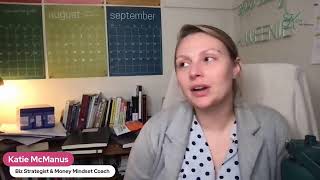
Katie McManus, a business strategist and money-mindset coach, breaks overwhelm into two types: competing priorities and creative overload. She recommends taking breaks, checking priorities with someone you trust, and noticing what your body tells you about what needs to change.
Foreign. Hello and good evening, everyone. I'm Katie McManus, business strategist and money mindset coach. Coming to you live this May 23rd. Today is my sister's birthday. By the way, if you know Chrissy McManus, please call, text, and otherwise harass her to tell her happy birthday. But coming to you live on the Facebooks, on LinkedIn, and on YouTube, and I'm talking about one of my favorite, slash least favorite topics, and that is overwhelm. Overwhelm is something that I struggle with a lot as a human, as someone with adhd, as a business owner, as a human. It is something that we all face. There are many factors that can exacerbate overwhelm, however, and I'm going to be talking through my whole process to kind of get myself back on board when I get into those modes, but there's no one way that works for everyone. Okay? So as I talk through what I do, some of it may work for you. It may also make things worse. So as you're really understanding yourself and how you deal with your to do list and with like, you know, balancing all the priorities in your life and you really understand, like, what causes overwhelm for you, it's really important to not hold yourself to a standard that does not work for you. Okay? So for instance, whenever someone shares, like a mindset tactic or shift and it worked for them, you know, sometimes those of us who get kind of hung up on hacking life or have adhd, like, we can get really upset. That doesn't work for us as well, you know, and we can try to, like, make it work. We can try to force it and just doesn't work that way. So as you're getting to know yourself, as you're noticing when overwhelm happens to you and what your whole process is around it and what helps you get out of it, there's no right and wrong. There's right for you and there's wrong for you. And especially if you have adhd, that will change over time. Okay? The real fun thing about having ADHD is that the different methodologies that we use to manage ourselves all have a shelf life because we get bored with them and we have to find out new ways. So I'm throwing that out there and let's dive into the top of a rum. By the way, if you're joining us and hello, welcome. I do love this to be interactive. If you have any questions or if you particularly struggle with overwhelm, then please share in the chat. Chat. I love these Things to be interactive. Okay? So first and foremost, there are a few different flavors of Overwhelm. So I always like to start there before we get into how I manage them first. The first flavor of overwhelm is like the classic. You have competing priorities, all right? You have so many important things to do, and it's hard for you to kind of sort for which one needs to be done first. All right? This is especially true for those of us with adhd. It's really hard to prioritize. Oftentimes this kind of overwhelm. It's not that we're particularly excited to do any of them. It's just that we have to do them, and they all seem super important, and it's hard for us to figure out which one we need to tackle first. That is one flavor of overwhelm. Another flavor of overwhelm is you're just creatively overwhelmed. You have too many ideas, and it's really hard to understand which one you should run with first. Okay, so this. This can happen when you're creating content for social media, right? So you're sitting here, you're. You've come up with, like, 17 and a half different ideas, and you just can't decide which one is best, right? And so instead of writing all of them or even just one of them, you write none of them, right? Because you're just so in your. In your, like, overwhelm. A hamster wheel of, like, I'm not sure which one to do, so let me just, like, figure it out, right? And there are a few different ways we want to deal with these things, okay? So first and foremost, if you're in the first version of Overwhelm, where you just have a shit ton of stuff to do and you don't really feel particularly inspired to do any of it, and it all feels super important, and you just can't figure out which one to tackle first. The number one thing that I do when I hit that wall is I take a break. And I know it sounds counterintuitive because, you know, if you have all the stuff to do, who are you to take a break? But what that tells me, when I can't really, like, look at a list of things that need to be done and discern which one is most important for me, that tells me that my brain is actually too tired to actually to tackle any of them, right? So breaks for me, look anywhere from going on a walk with my dog, which she really enjoys, I don't do it enough. Going for a walk with her, going to work out, finding an excuse to run an errand. A break also looks like, and this happens midday sometimes. A break also looks like me just kind of of like vegging out and watching the show. Usually a show I've seen already because I don't want to get like sucked into new things. It can also look like just going and sitting outside and just letting you know some UV rays get absorbed and you know, watching birds or something, just, you know, completely checking out from work. But really, like, when you're in that mode, when you're in that overwhelm mode and you have a lot of stuff that you need to do but you don't particularly want to do is incredibly helpful for your brain, for your body, for your general well being, to simply just walk away from it. Right? The funny thing about most things that we feel are urgent or super important is that it really doesn't matter if we don't do them right away, right. Like, there's nothing in my day to day that if I didn't do right now would end my business tomorrow. Right. It doesn't work that way. And now that I've said that, I'm like, oh wait, I have to do that and I have to do that and I have to do that. But of course, like, that's how brands work. Okay? So taking a break can feel like you're procrastinating, but when in fact it's actually resting your brain so you'll have more energy to come back and do the thing that you don't want to do. You know, when you're in a creative overwhelm, taking a break will also help you kind of like feel, figure out which one, which idea you're more excited for, right? Because you're walking away from it. And oftentimes when you walk away and you can like change your environment and you expose your, your brain to like other sights, smells, people, whatever, you, you find ways to like connect all the ideas that you had in a way that you hadn't seen before, right? So taking a break can be really powerful. When you're dealing with overwhelm, the number. The second reason that I, or I'm sorry, the second way I deal with overwhelm is I have a priority check, right? And this is specifically with the overwhelm. That's like, I have a ton of stuff to do as someone with adhd, I really, really struggle to figure out like what the top priority is. And so oftentimes when I'm in overwhelm, I will either call someone who's a trusted advisor to my business and kind of like, you know, brain dump out all the things that I think I need to do and ask them what do they think is the biggest priority. They might not be right, you know, but just having someone to bounce this off of and talk through. So like, maybe like on my priority list is like, send the newsletter, send a new client welcome packet, film a video for my course, Whatever they may think, oh, well, send the newsletter. You know, you have to do that. You do that every, you know, day of X day of the week. And I may hear that and say, oh, okay, that's what you think. Cool. And then get off and be like, no, no, that's not what I want. It's kind of like when you go the to restaurant and you ask the server, you know, what are your, like, between these two options, which one is your favorite? And as soon as they say one, you realize you were hoping they'd say the other. You know, having someone to bounce off of is really incredibly helpful. If you don't have someone to bounce off of, then creating a list, I find is really helpful. And going through and crossing out the things that don't need to happen today and then circling the things that, like, would make a big difference to your business in your life if you did them today. And then really understanding of the things that you circled, which ones will actually move the mean, the needle the most for, for your business and will have the most direct impact on your clients. That's one of the ways that I help prioritize and do a priority check when I'm overwhelmed. Lastly, understanding why I'm overwhelmed. Okay, this is one of the most important steps to dealing with overwhelm. Because there's no alarm, you know, there's no, like, light that starts flashing, flashing when you're overwhelmed. When you realize, like, oh, my God, I'm stalled out on everything because I can't figure out what to focus on next. It really does make a huge difference when you realize, oh, I'm in overwhelm right now. Okay, what's going on with my body? Like, what am I feeling in my body? What's the emotion that's coming up and what's, you know, the monologue that's running in my head. When you understand that and you really do check in with your body, sometimes other things come up. Sometimes it's that you haven't eaten in seven hours and your brain is running on fumes. Sometimes you're overwhelmed because maybe you've been sitting in the same space for too long and you're starting to just feel like really stale there. You know, sometimes you could just like be burned out. Honestly, a burned out brain cannot prioritize very well. And so doing that, like kind of check in and understanding a. Like, what does overwhelm feel like to you and what signals are you getting from your actual body and spirit? And also understanding what's causing that overwhelm, right? Understanding. Are you getting external pressure from something? Does that actually matter? Understanding. Have you set like an unreasonable expectation for yourself? And if so, why? Like, what, what made that seem so important to former you that you created all this stress for yourself? I had a mentor a long time ago who made the point that we're born behind. We're just, we're born being behind on the eight ball. We're born not knowing how to walk. We're born not knowing how to talk yet. We're. We start school and we're behind on all the schoolwork that we're ever, ever going to have to do, right? We start businesses. And let me tell you, when you have a business, you are behind always. There's no getting ahead. There's no getting ahead because there's a gazillion things that you can do in your business. I can't tell you a single day in the year, and I'm sorry, the six and a half years that I've run my business that I haven't ended the day thinking about everything I didn't get done, okay? There's always, always a long list of stuff that you could have gotten to that you didn't. If you let that burn you out, that's a recipe for disaster. It's not going to work out for you. Your business is going to run you into the ground. And actually it's not your business at all. It's you. You are going to run yourself into the ground, okay? Allowing yourself to have more work than you can ever get done. That is a skill, plain and simple. As your business grows, you'll be able to outsource some of that stuff to other people. But there's no way in hell you're going to get everything done that you want to get done, okay? It's never going to happen. I want you to look around your home right now, wherever, or think about your home if you're not at home. And I want you to think about all the things that you have that you want to get done at home. Maybe you want to like, replace some doorknobs or maybe you have a leaky faucet. Or maybe you have that one or two or three or seven closets that are stuffed full of crap that you need to go through and organize. Maybe you need to sort through some clothes and get rid of stuff that doesn't fit anymore. Maybe there's that one room that you've always wanted to paint a different color because. A little depressing, right? The list goes on and on and on and on. Okay. As humans, we're so good at identifying things to do, but often we identify way more than we can ever accomplish. All right? And that's okay. There was a point made when I went through coach training that we're not human doings. We're human beings. And as a Western society in particular, we're really well trained on the doing side of things. Okay. We're really well trained to, like, be constant doers. And we forget the inherent value of just being. Just being a human who's being right here. That's not going to put you behind if you spend a moment just being a human being. Just so you know. Anyway, that's how I handle Overwhelm. It's not perfect. It's how I handle it. It's not necessarily what's going to work for you. If you have any other tips or ways that you handle Overwhelm, I'd love to hear them in the comments or DM me. Other than that, I want to name this is day. Oh, my God. What is it? Day six of me going live every single day for 30 days. Okay, so we are a fifth of the way through. My consequence for not going live, if I ever miss a day, is going to be that Lauren Lefkowitz gets to pick a song for me and I will be required to sing it and record myself singing it and share it on the interwebs. So you can bet your favorite shoes that I will be going live every single day, because no one wants that. Anyway, thank you all so much for being here. I hope this is useful and there are any topics you want me to go live on in the next. What is it, 24 days? Then please DM me, because I will need ideas at some point. Anyway, I'm Katie McManus, business strategist and money mindset coach. Thank you for joining and I will see you all live tomorrow. Bye.
More from Katie





How to do self care right now, so you can do what needs to be done, for yourself, your business, and

How to do self care right now, so you can do what needs to be done, for yourself, your business, and

#greenscreen How to build a consulting business that makes you $200,000-$700,000 a year

#greenscreen How to build a consulting business that makes you $200,000-$700,000 a year

Maybe we’re not the imposters…? #businesscoach #startup #entrepreneur #smallbusiness #consulting

Maybe we’re not the imposters…? #businesscoach #startup #entrepreneur #smallbusiness #consulting
