FUN? anyone?
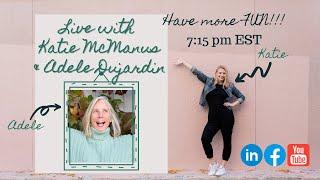
Katie McManus talks with coach Adele Desjardin about why adults stop playing and what happens when they start again. Play boosts creativity and productivity, but hyperachievement culture kills it. Simple fixes: breath work, naps, movement, and finding your people.
Chapters
Hello, I'm Katie McManus, business strategist and leadership coach. And I'm so excited to be here this evening with Adele Desjardin. I love her last name. I want to say it over and over again. It sounds so fancy and French. She's a brilliant coach. She's trained in coactive, just like I am. Coactive leadership. That's the boring stuff. She spends all of her time helping her clients have more fun in their lives, and she's just such a joy to spend time with. So, Adele, thank you so much for joining me this evening.
You are so welcome, Katie. It's really a pleasure to be here. I always love talking with you.
And tell me what's going on in your world right now.
What is going on in my world right now? Well, professionally or personally, I could go either route. So you pick.
Let's start with personal.
Okay. So personal. Just did a long visit to Maine, State of Maine. Visited it last summer. Fell in love with it. And so my husband and I returned to check the area out a little further as we consider other places to spend time. And I'm always excited to be by water. Maine has that rugged coast that really appeals to me. And anything else. Personal. I have a daughter who's about to graduate, a niece who's about to graduate, and a stepson who's about to graduate. One from graduate school and two from undergraduate.
Oh, my gosh. So there's like a commencement energy.
Yes, yes. That may feeling of graduation. Even though they're all virtual, I will be going to support them and have some type of celebration with them, even though the parents won't be attending. The typical marching down and getting the diploma handed over.
Right, right. Here's the piece of paper you spent all that money on. Okay, so that's personal. What's going on professionally?
Professionally, things are busy as well. I am working with clients. Gosh, from 80 down to 29 years ago.
I love that you start at the oldest because normally people start the youngest. Yeah.
Let's start with the wisdom and the experience. Yeah. So my younger clients also have a lot of wisdom and experience. It actually always surprises me. Like I think to myself, gosh, I wish I knew that much when I was your age, or I wish I had it together like you do. People are just up to really cool stuff in general and have big dreams and are eager to make them happen. They don't want to sit on the sidelines. And I love that. I get super energized by helping people get clear and then create the steps. It's just the best feeling when you speak to someone and you can hear the difference in their voice because things are starting to happen that they've wanted to create.
Yeah.
Yeah.
And from our previous conversation, it sounds like you're also doing some group stuff that helps people not only grow themselves and reach certain goals, but also create some community and some support systems with, you know, actual living, breathing friends.
Yes, yes. Like, I just. Yeah. And it was interesting because when we did the. A group recently, one of the people was saying how it was so helpful because of that. Right. Like, they were thankful for the actual work. And then the added bonus of community. Like, you know, we are hardwired to be in community. And I say that as an introvert because even I can experience these times, especially now during COVID where it's like, oops, I haven't connected enough with other people in a meaningful way or just in a way that I just feel like I'm really getting to know someone or sharing on a deep level. And it just always astounds me how much we really can support each other through community. Like, you just like, it's like, oh, you too. Oh, my gosh. Okay. I'm not the freak. Yes. That's just what I was feeling. Or I'm having a bad day. And also, I love the cycle of it.
Right.
Like, you can be having a bad day, but not everybody's having the bad day. But then someone shares the bad day. They have to normalize your bad day. So it's just kind of this gorgeous cycle of support and humor. You know, I feel like some of the people that I call for support, like you included, are people who have a really good sense of humor. And I can also really laugh at my.
I agree. I have an excellent.
Yeah, keep nodding there. Yeah. I just, you know, that ability to laugh at ourselves. Right. It just. Just kind of takes the. The pressure valve off and, you know, it's just such a comfort to be able to laugh and. Yeah. Because, like, we do, you know, largely create our own misery by how we're looking at it or reacting to it. Yes. Yes. Well.
And you work with high achievers. I think we both recognize that we're both high achievers. We tend to hold ourselves to such a high standard, and we don't let ourselves off the hook for anything.
No. And what I love about what you're saying is you're realizing that at your young age. Like, at my young age, when I was in my 30s, like you are now, I thought to myself, that what I was holding myself to was normal or wasn't, wasn't even enough, right. That I should be holding myself to even higher expectations, greater expectations, working even harder, have more degrees and go to this school and that institution. And you know, I can even remember in graduate school I had my master's in education and a professor called me after I handed in a project and I hadn't felt very good about how I've done it especially. It wasn't my wheelhouse, it was a science related project about, you know, how to teach science in the elementary school. And I thought, oh no. Like, oh no, you know, he's calling to say you need to redo the class. And he said, I'd really like it if you co authored a piece, you know, an article with me this summer. You know, I can't remember exactly how he proposed it, but it was to join with him and his, his research. He was, you know, already had his PhD, etc. And I was like, oh, so it's that hyper achiever mentality is what I'm describing, you know, and that like, that was a memorable moment for me of like how my perception was so out of whack, right? Like here I was doing so well, but I didn't even know I was doing well because I was just constantly demanding so much from myself. And that's really exhausting. Yeah, yeah, it is.
And it's not something like you can catch yourself in at once, but then continue that pattern over and over and over again, right?
That's the thing. It becomes a cycle, right? And you kind of feel like, oh, but if I, if I slow down or don't ask quite as much, then it's like, you know, this idea that you're slipping that it's, it's weak, you're not going to produce as much or you know, maybe advance as far in your career. And one of the things I've loved about becoming a coach is all the neuroscience behind happiness, right. And healthy approaches to life that, you know, entering more into a play mindset, actually saying no to things, actually, you know, getting the hours of sleep you need, hanging out with friends, you know, going for the hike. In nature, all those things that bring us joy are not just these add ons, they actually then return the value and increase your creativity, your productivity. So it's like all those things as hyperachievers are really into, you know, this we think so great. Or like, you know, it's counterintuitive, but it's like going back to like kind of what we did, you know, as youngsters, you know, sometimes doing nothing, like doing nothing is actually a good thing.
Well, it's so funny you say that because you know that I'm quarantined and spending the pandemic at my parents place on Cape Cod. And I was saying to my mom this weekend, I'm like, right now I'm working really hard to relax. Like I, I'm working so hard to relax on the weekends.
And she's like, yeah, go get them. It's hard.
And I'm like, yes, it's hard to relax.
I know, right? So you kind of have to learn it, you have to relearn it. Right? Because I really think. And I, you know, it's, it's, you know, the body becomes accustomed to that. The speed at which we're, we're behaving and I know our cortisol's levels do rise, you know, so. And then it's kind of being asked for more of that. And so it's like to go is a retraining of the body, the mind, and also culturally. Right. We've been indoctrinated that, you know, to work really hard is a great thing. And it is, but it's not the only thing we are meant to do quite the opposite. You know, heart, mind, body, spirit, and all those things need to be taken care of so that we really feel alive, that we're physically healthy. You know, our relationships are good. And then also the work does benefit even more. But yeah, we become so micro focused, you know, on like a slice of our lives.
I almost think we're all addicts because what's the happiness hormone? Is it endorphins or oxytocin?
They're endorphins, right? When we produce endorphins, the happiness.
Yeah, yeah. I think we're all endorphin addicts because when you finish a task and you cross it off, you actually get a release of endorphins, you know, and then we're like, okay, cool. That's where we get our endorphins from. Great. Instead of, you know, all the other things you can get.
Yeah, Gratitude, connecting with other people. Like there's, you know, great studies. Barbara Friedrichson, Ph.D. out of. I think it's UNC, has done a lot of work on the micro interactions between people and how our brains are like so happy when we're encountering people and conversating with them and conversating. A word I don't even know. I have a friend who has a business Called conversate. Here's a shout out to Taylor.
Hi, Taylor. Well, it's a word now.
So it's a word now. Right. And I made up. I shared that made up word the other day. What was it?
De grump. Degrump. I love. I'm using that word every single day.
Yeah. So like I'm a happiness and success coach. And then I'd also say I'm a D. Grump coach. Right. Maybe that should be my new right. Helping people get out of their. Their grumpiness or their. Or their patterns that create grumpiness. Yeah.
What's the term? You're like, you're helping curmudgeons become recovering curmudgeons.
There you go, there you go. Or curmudgeon. Yeah, like shedding your curmudgeon skin to return to your five year old skin or something. It's like, it's like a, like the, A body scrub or something, you know? Yeah, yeah.
Like a special salt that you just rub all over.
Yeah.
And I love your story because you started off as a kindergarten teacher. Oh, and hi, David, he said de grumping is definitely a thing.
It is. And hi, David. Yeah, it totally is. And that, that was. Those were the mirror neurons happening. Right. When my husband said, oh, do you need to be degrommed? And he stood in front of me with this big smile, then I started smiling. Right. So again, like, we're not meant to be in these silos, just constantly doing one thing. Hyper. Well, Right, Well.
And this is one of the things that has been so challenging about this year is that like we've just been in silos doing the one thing in front of us, which for many of us is work and taking care of housework.
Yeah.
And you know, it's bad when the introverts are also missing their human contact.
So true. Yeah, so true. But going back to your question about my teaching. So yes, when I graduated college, I actually first taught high school, year of high school at a boarding school in Connecticut. And it was a good year, but I thought my life's repeating itself a little too much. You know, I was in like, here I am in school again. And so I went and tried a bunch of other things for a year or two. Lived on Martha's Vineyard, New York City, worked in retail. And then I was like, no, the school thing really is where it's at for me. And so I started to work in admissions at a Quaker school in Brooklyn. And I was in the lower school and I saw what was happening in the Classrooms there. And I was like, oh, this is cool. Like this is not how I was taught. You know, it was, there was block building, they were painting murals collaboratively, you know, that the play was so part of the learning experience. So that's when I went back to graduate school. The graduate school I went to was very much about that experiential based learning. And yeah, then I taught kindergarten, first grade, second grade. And I helped start a school here in New Jersey that's now 3K through 8th grade school. And the curriculum I helped develop there, along with the teaching I did, was really play based. The first grade study is about learning about a town. You know, how what a town does. Right. Like so a child understands that they're participants in a larger community. So, you know, visits to the bank, the fire department, the road department. And so in the woods in the back of the school, the students I taught, they recreated their own town. You know, they, they applied for the jobs they had. And they would be busy out there like digging roads, building the library. Then in the classroom, they were writing books to submit to the librarians to see if they're buried at the library. And you know, sometimes there'd be fights out there. Their onion grass was the currency. And they come in and they'd say, we need a town meeting right now. And they'd have a town meeting about like what was going on out there. Like someone stole a shovel or someone was speeding. And then when the police tried to pull.
When you say town meeting, like Gilmore Girls, New England style, Right?
Yeah, yeah, like, yeah, like, you know, they always sit in our circle on the rug and they, you know, so anyway, so this is my teaching background, very play based. And you know, the more I read about play for adults, the more I feel like everybody should just be screaming from the rooftop, like, go play. You know, I mean, the studies are astounding in terms of what it does for our mental, emotional and physical health. And again, going back to work, what it does at the workplace for creativity and team building, it's just like plays where it's at. Yeah.
Which is so funny because I've worked in so many work environments where like they had the, the ping pong table and they had games and they had video, blah, blah. But there wasn't the permission for people to actually go utilize them. Like you'd sit at your desk and you just kind of like look over like, oh, well, I don't want to be the only one who goes and plays ping pong. You can't play ping pong by yourself, that's a bad example.
But it's it.
You're so right. Like, once you do check out and do something that's fun, you get inspired or you have like this new burst of energy and you can go do all the boring work that you needed to get done.
Yeah. And then you raise a good point there. Right. Part of it, we need a cultural switch. Right. On the individual level and then on the collective level. Right. So that it's okay to be playing ping pong and you don't feel guilty about it or you're not going to get, you know, there's not going to be any shame there. And also too, like, I love the idea of the ping pong tables and I've heard that, you know, newer workplaces, that's the case. But you know, it's important to remember too, like, there's so many kinds of play and it doesn't always have to be a physical activity, you know, art, storytelling, what else? Writing. Right. Even daydreaming.
Right.
And it's really when you gauge in and you feel like you've lost track of a sense of time, there's surprises that are along the way. You know, there's an unpredictability to it, but there's always delight.
Right.
Because you can also play and it not be a lot of fun. Like that happens with me with golf all the time. Right.
I think that happens with a lot of people in golf.
Yes. I'm still trying to figure out why people play that. And I say that to myself maybe 50% of the time when I leave the course.
Curtis Hammond here says, find the child inside yourself again, which is exactly what.
You do with your clients.
That's so on point, Curtis. Thank you.
Yeah, thank you so much. I agree. And the good news is we all have the child in us. Right? All have the child inside of us.
And speaking of children, Steve Foley, at his last job, they had a nap room.
Naps were encouraged.
You know, we need to take a page out of the kindergartner's books. They have nap time.
Yeah. Well. And sadly, a lot of kindergartens, you know, have done away with that. Right. And have done away with play, even. So even at that level, like our society earlier and earlier are still starting to, you know, decrease that and take that away. And, you know, when you read studies on divergent thinking, it's the kindergartners who score the highest and it quickly decreases. And that's what, you know, we need that creative thinking, especially in the workplace, even at home. Right. When you're trying to problem solve in a relationship. Right. You want to be able to think of different ways to approach a problem.
Right.
And that comes about when we stay playful because play allows us to be super creative.
Yeah, absolutely. And it's. So I went to a Waldorf school.
Oh, I didn't know that.
I went to a Waldorf school from. I actually had to go back a grade. I visit in the middle of fourth grade. I had to go back to the middle of third grade. It was honestly the best decision. I have add. So, like, it was the best decision for me because I was in a California school system. California has the worst schools. And it was so play based.
Just.
I mean, in the mornings we would have like story time main lesson, and we learn our multiplication tables by walking on a balance beam while tossing beanbags. And then we learn about Native Americans and their cultures by going out and actually building huts, you know, to the different region specifications.
Wow.
And it was just. It was so much fun. It was very dirty, but I wasn't really. I was a clean freak as a kid, but it was so much fun. Like, we went and lived on the farm for a week and we became farm workers, you know, like milking cows and collecting eggs.
Yeah. I mean, I'm even hearing you talk about it, Right. Like, there was a time where you felt. I can hear the aliveness in your voice. Yeah, yeah.
Like, I don't remember sitting at my desk and learning other maths. You know, just sitting there, you know, repetitively writing it out. That doesn't stick with me.
Yeah, yeah. Right. Well, we do. You know, our body is a great way to, you know, it's that by. It's that bi directionality. Right. The body can inform the mind. The mind can inform the body. And when it's working together, that's when we really pick things up and it stays in our core. Yeah. It's why, you know, people do like to knit or doodle, right? It's. Yeah. Or even have some, some type of thing in their hands or to get up and walk around. You know, often you, you know, you'll realize, like, you're stuck on finding something or you. You're working on a piece of writing, the idea is not coming. You get up, you go do something else. You come back, it's like, oh, now I got it. So, yeah, movement is so important. So. Yeah. So going back, you had mentioned the groups. Like, you know, one of the things I like to do in the group work is, you know, talk about how the Mind can get in the way. Like how we can. And I do this with my individual clients as well. How, you know, we've given so much attention to the beauty of the mind and the intellect that we often neglect that connection to, to, you know, body, heart and spirit. And so. And it's. And to use the best part of our mind, right? Because a lot of times we have this negative self talk that just can deflate us and just, you know, put us right back into the grumpiness. So yeah, a great way to de grump is to be hyper aware of the self talk and you know, think, you know, who is that talking? You know, is that the best part of me? Is that the, you know, really wise loving part of me that's gonna just energize me and open the world up to me or is that the part that's gonna like keep me in fear, keep me anxious, you know, have me feel about this small, you know.
Well, it's so funny as you're describing that, I'm thinking like you could almost play improv with yourself inside your own head. Oh yeah, like the two voices just.
Like totally, totally, totally. Right? Like, oh, it's Monday and I gotta get up. I have so much to do. And I'm like, why am I doing this? You know, versus okay, what do I have today here? You know, like. And like in that going that gratitude and Yeah, I mean we have those parts of ourselves and it's. We have choices, you know, what part of ourselves we really want to pay attention to, give life to. And one is life giving the other just kind of sucks the joy right out of things. And that's one of the reasons I've become so interested in and helping people around this idea of, you know, our thoughts matter and bringing play back. Because, you know, I got derailed. I was like, I was a child who played my way through my childhood. You know, hello, mom, out the door, off to the woods, off, you know, playing with other children in the neighborhood, you know, was active as a swimmer. And then, I don't know, somewhere along the way I learned like, you know.
This became do lists and grown ups have to be hyperachievers and grown ups have to like, you know, hit this level of success?
Yep, yep. And just slowly I kind of, without noticing, I gave it up. Right. And it's not like one day I decided, okay, I'm not going to have fun anymore. Maybe a whole different talk. It was corrosive, you know, and even like, even in some of the best things that happened in my life, brought that on. Like having children made me even more. More responsible. Right. And then I had wishes for them. Right. And. And wanted to make sure things were happening in their lives and yeah. Just didn't, you know, so there was a good period in my adult life where I neglected those things and all of a sudden, I don't know again if that was all of a sudden, but there were, there were just little headlines where I can remember feeling like, you have a choice here. This doesn't have to be that way. Right. So it was again. It wasn't. Yeah, it wasn't. It was a slow opening, just like it was a slow closing. And I'm still, you know, it's not like I'm like got it all together and like have that work life, balance thing all figured out and you know, I'm the play lady and there is.
Someone who calls herself that, by the way, psa. If anyone's watching and you're like, oh, but coaches should have it all together. No, if you're talking to a coach who's saying they have it all together, they are lying. The reason we're in this work is.
Because we had to trouble.
We had to struggle with it ourselves.
Yeah, yeah, yeah. So I've had those openings and that's really one of the reasons I'm doing this work is I want to share it with others. Yeah. You know, because those aha moments have been fantastic.
Yeah. Can I just ask you, so when you were going through like your non fun adult life.
Yeah.
What was the cost of being that person?
I think I was less present to those I was close with.
Yeah.
I took starting the school so seriously in the first year. Didn't go well. It's a tough thing to start a school and you know, a lot depends on who's lined up. And you know, you've got this gorgeous vision on paper and you know, the execution is something altogether different. And that really threw me. That really threw me. And I went through a tough six months where I was, you know, felt really low. And you know, that's that hyperachiever thing where you're, you know, the external achievements are very tied to your identity. Yeah. And I hadn't really failed in at least in my eyes, in a way that like felt so significant until then. Yeah. So that was big. That was a big, big wake up call and not that. Yeah. I mean, I'm thinking of myself in the classroom. I was actually fun. I mean, I, you know, chase them around as witchy poo, but they'd always be like, can you do witchy poo? Can you do witchy poo?
We'll have you do it next time.
Yeah, there you go. Let's have a moving camera. So, yeah, I'm trying, I'm trying to remember your question.
No, no. Well, actually we have a couple comments, so hold on one second. So Steve Foley said that his nap times, he was a liquor distributor, so he had a lot of late nights entertaining. So naps were better than calling in sick. I agree with you, Steve and Martha. I forget where we were in the conversation when you said this. She said we always have a choice on how to define it.
Yeah.
But I think that pretty much applies to every section of this conversation because we're always in choice.
Yeah, we really are. And then again, too, that's where that community piece comes in. Whether, you know, you're collaborating with a coach one on one or you're in a community in terms of like a coaching group or even in a friend group or a family group. Right. It's, it's we, we often know. And I know, I experienced this myself too. Like, I know the better choice to make. I don't always make it right. And I can be conscious in the moment. It's not like after the fact I say, oh, that would have been better to do this. I sometimes can even be saying something to my husband if he's bothering me, saying like, you really shouldn't be saying so. So that. But this is why community helps, right? It, just because it normalizes the human experience, helps us be our, it calls us, you know, if we're in the right community, calls us to be our best, better selves. Right. We get inspired by each other and then we, we have someone and then we're held accountable by, by another person or, you know, a group of people. And it's, it's really by community that we can, I think, even make better choices and make better choices and feel like we're on solid ground and making them, that people are there holding our hands.
Yeah, no, I 100% agree. It's one of the things that's been so challenging about this year for me is my whole community is on the other side of the country. I didn't mean to be, you know, on Cape Cod for a whole year long pandemic.
Oh, yeah. Your community has become your canine one.
I know, I know.
What is the other dog's name?
I have Charlie and Lily.
Okay, Charlie.
Yeah, Charlie girl and Lily. And one's a doodle and one's A poodle. So we call them the oodles.
Okay. All right.
And they. They get up into so much mischief. And it's so funny, you know, talking about building play into your life. I've actually made it part of my work day that I have to go and play with them because if I don't, like, I just turn into this. This, like, automaton that, you know, is stressed out and drinks too much coffee and. I know.
I think that's, like. Right. Like, yeah, if. If someone's having a hard time playing or just finding joy or, like, a break in the day, like, to your point, like, okay, where. Where are my play muses? Right. It could be, you know. You know, children in your family. It could be the pets in your family or maybe, you know, tennis game. Something that is going to just shake things up. Yeah. Break the. Break the pattern. Right. Get. Force you to get up out of that chair. I mean. Yeah. We're not meant to sit here all day long.
No, no, no, no, no, no, no, no. So I wanted here. Because I asked you about what was the cost when you were not fun, Adele. Oh, so what was the cost?
Yes.
I said no, but you covered it so beautifully. But what's it now that you've got kind of discovered that you need this in your life and that you're actually doing this work in the world to help other people access fun in their own way?
Yeah. I feel like the best way to put it is I feel like I'm more myself.
Yeah.
You know, like, I feel like it's just. Yeah. Because I think part of. Part of what we do when we're on the hyperachiever track or the perfectionist track, and even as we're handed that script that we think we're supposed to follow.
Right.
At whatever age, we. You know, most of us do get handed a script, and sometimes it's a perfect fit. A lot of times it's. It's not a bad fit. But it's still not custom. Right. It's not that it's not the script for us. Right. We're the ones who author that. And once we really are living the script that we're authoring that we're meant to author that like, that that deep longing is in us, then, like, we really more, you know, are becoming ourselves, and then it's more fun. It's just it. It's more fun to be yourself than anybody else. And then the thing I get the best joy out of is not just that, but the component is. I see how Others respond to me now. Right. Because it's, it's like real. It's like authentic. Like, I have fun no matter where I go, because. And not to say I don't again, I need to be de grumped. But I, you know, I don't want to think I'm like, Pollyanna, life's great. It's. It's because when you're like, really, like, kind of like activating this, like, you people respond to that.
Right.
Like, that's why we respond to children, babies, puppies. Right. Dogs. Right. Animals in general, because they're, they're that, like, they're just being so themselves, we can't resist them.
Right, Right.
Irresistible, but totally more. More compelling. Yes. I have a better time.
Well, I love that because you just spoke. You just listed a bunch of, you know, beings who, whenever they have a desire to play, they just start playing. They don't, they don't look around and think, oh, do I have permission to play now? They're just, you know, around.
Yeah. And they act from that urge. Yeah. And they're not, they're not apologetic about it. I mean, I bet your dogs Charlie and Lily can be, like, obnoxious about it. Like, probably stuffing their snout in your lap, like, to get you to play.
Oh. It's like they, they'll come in with their nose and go to your arm.
Yeah.
And it's like, hi, I'm here. Yeah. They'll literally come over with their big paws and like, just whack you when you toy.
Yeah.
I love it. I love it. I know it's kind of annoying sometimes, but.
No, Yeah. I mean, it's like we, like, they're great models for us because they ask for what they need. Right. And part of, part of the work I do with people is like almost remembering we have the need. Right. Because we get so used to turning off the need. Yeah. Just to play, but like to be like, you know, other kinds of self care or, you know, just kindness. Right. Or even asking what. What do I want? Or, you know, so it's like first, like, you know, getting kind of in touch with like, what, you know, that, that need. Right. And not just always pushing it aside.
Totally, totally. We have. Steve Foley had a question. How close are you to the beach? The dogs must love the beach. I'm about a three minute drive from the beach. The dogs do love the beach. However, Charlie is. What my parents, they were calling her an asshole before, but they decided assholes for boys. And she's a girl, so she's a shithead because she likes to take the ball and hide it in the water because Lily doesn't like the water, and she doesn't want Lily to have the ball. So she's kind of a pain in the butt. It's really funny to watch, though, because it's just everyone's yelling at this dog, and she just thinks she's having the best time ever. She doesn't understand that she's in trouble. One of the hardest things we do is to relax and be ourselves and have fun.
Ah, it's so.
It's so funny. It's like the world programs it out of us, which, I mean, to your. To your credit, you saw that schools were doing that to people, and then you saw this other beautiful way of teaching children, and you. You made it. You made a whole school out of that. And now you're doing that work for adults as well.
Yeah. And I mean, I. When we were, you know, working on the curriculum and that, you know, there was a. You know, there was two founders and there was a pioneer group of us, and, you know, one of the things we would say repeatedly as we were debating, you know, what to have the kids be doing, it's like, just because they can doesn't mean they should.
Right.
So just because they can learn to read at a super early age doesn't mean they should. Right. Just because we can work 80 hours a week doesn't mean we should. Right.
I'm writing that down.
Yeah.
Just because you can doesn't mean you should. And it's so crazy. Like, we. We hold ourselves to the cans all the time and we make them into shoulds. Yeah.
Yeah.
I love that. We've already hit 35 minutes together.
Can you believe that? I do. Because I could spend the whole evening with you talking, what's next? What's the next topic?
I know, right? We need to, like, open up some wine or something.
But anyway, for the sake of our.
Audience, because I know it's a long.
Time, we will let them go. Well, what's.
I would just love to end this with. What is your final words of wisdom that you would like to leave with everyone who's been watching this evening?
Yeah, I was. You know, there was something you were saying earlier. I can't remember what it was, but it was like, you know, one takeaway. Right. And I. We've heard this before. Many, many, many, many times. Breathe, breathe. And why do I say that? Because it resets us. And how. I was talking about first becoming aware of what you need. Right. When we breathe, nice, long breath in, longer breath out, we're centering ourselves, and we have more of a sense of what it is we need at that moment, and then we can start to honor it.
Beautiful.
I just.
I just calmed down when he said that. Well, Adele, thank you so much for joining us this evening. It's been so lovely to have you and so much fun. Thank you.
Yeah.
For everyone who's watching, if you're a higher, hyper achiever and you want more fun in your life and you think it's going to make a huge difference, I can tell you Adele is your lady. You need to get in touch with her. She's very active on LinkedIn, so I think that's the best way to contact you. Right?
Yeah, absolutely.
Okay. Awesome. And thanks again for joining me.
Thank you, Katie. It was a pleasure.
Thank you, everyone, for watching. I'm Katie McManus, business strategist and leadership coach. I will be going live with the intention of doing this every day this week, so tune in. It'll be planned and also not planned because, you know, life comes up and you have to play with it sometimes.
Improvisational.
Exactly. Anyway, have a good night, everyone. Thanks for joining us.
Bye, Katie. Bye.
More from Katie





How to do self care right now, so you can do what needs to be done, for yourself, your business, and

How to do self care right now, so you can do what needs to be done, for yourself, your business, and

#greenscreen How to build a consulting business that makes you $200,000-$700,000 a year

#greenscreen How to build a consulting business that makes you $200,000-$700,000 a year

Maybe we’re not the imposters…? #businesscoach #startup #entrepreneur #smallbusiness #consulting

Maybe we’re not the imposters…? #businesscoach #startup #entrepreneur #smallbusiness #consulting
