Hooking for engagement
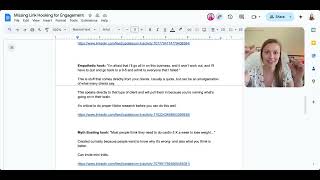
Katie McManus breaks down how to write hooks that actually work: listicles, stories, shocking claims, empathy angles, myth-busting. The rules are simple: spark curiosity, be interesting, make clear who it's for. Then use one CTA per post with a clear if-then statement.
Chapters
Welcome to the missing link. In this video, we're talking about hooking for engagement, which is not necessarily what it sounds like. I know there is so much stress out there when you're creating content to have a hook, and I know it can get you all flipped out and it can hold you up in a whole bunch of ways. But I want to show you exactly how you can find the correct hooks for your content so that people actually read them and the correct calls to action. I'll call them CTAs. That's the industry lingo to get people to take action either to engage on your content, to sign up for something that's free, or to buy from you. Okay, so let's redefine what engagement actually is for business owners. It is not likes. It is not just comments. It is any action a person takes to get closer to you. It could be that they join your newsletter, that they DM you, that they buy from you, that they book a sales call, they share your post, they visit your website, they refer business to you, or they talk about you or your post after reading it. Now, some, if not a lot of this engagement will be completely invisible to you. You will have no idea that that it is happening. So there's a very deep need for trust when you're creating content for your business that it is having the impact that you want it to have. But today we're going to cover developing hooks for your content, calls to action or CTAs, and both of these will help you get more people to see your stuff. Okay, so let's talk about hooks. Okay, so a big myth that's out there is that you have to figure out what your hook is before you write your post, and that is complete bullshit. You do not need to figure out your hook before you write your post. I typically don't worry about what that first sentence is going to be until I've already written the vast majority of the post and I understand what it's going to be about. Sometimes you can focus on the hook first if it helps you understand, like, where you're going with the post. But for a lot of people, it can stall you out and make you feel like you're stuck. Okay, so. So there are several types of hooks, but here's what they all have in common. Number one, they spark curiosity, right? Someone reads it and they're like, I need to know more about this. Okay? Number two, they're interesting, okay? People have a very, very limited amount of free time, okay? And what they're looking for is some entertainment. We're not going to spend our free time and our energy and our attention on. On something that doesn't look interesting to give our attention to. Number three, it is clear who it's for. All right, so this can be very targeted to your niche. It can also just be targeted to people like you. All right? And then finally, they mostly make sense. And I say mostly because sometimes a hook that doesn't actually make sense can be the thing that gets you the most engagement. All right, so let's go through a few different types of hooks and of course, I am going to have some examples in the little description area underneath this video, so you can go and check them out there. All right, so listicle hooks. You see this a lot by the Hustle Bros. They can be valuable. They can also be kind of bleh. So an example of this is the five things my grandma did to get six pack abs at age 82. Now, of course, that's crazy and I am not helping 82 year olds get six pack abs. I don't even have them myself. But it teases a very specific bit of information that is appealing to your ideal client. And you want to be as specific as possible about the results you got or the problem you solved with this list. All right? We want to stay away from things like five things to get clear on your vision that's too fluffy. We need to get really, really specific. Okay? So for practice, I want you to come up with five things that would work for your content to talk about what it is that you do with your clients. The second one is the storytelling hook. Okay. I'll never forget the time my boss called me into his office. It creates curiosity because you want to know what happens next. And usually it's a crowd pleaser, as everyone loves a story even when it's not told, totally relevant to them. And it's honestly the easiest thing to do because it's that thing that you know how to do when you want to get someone's attention. Like, guess what happened the other day? Right? Okay, this is a fun one. The shocking hook. And this is the one that typically doesn't make sense, right? So stitches, nipples. Ow. Okay, so that's an actual hook that I used for a post a few years ago, all right. And that post was all about the fact that I got breast reduction surgery and I made it make sense to. To what I do for my work. Okay? So don't worry. But like, you wouldn't expect to see that on LinkedIn. And why are we talking about nipples and stitches and ow. Yeah, that sounds really painful. Sometimes a post has some odd elements to it, and you can use those to create a what the fuck hook that makes people wonder what the hell it is that you're talking about. The trick is you have to immediately make it make sense so people don't get annoyed with you by being so cryptic all the time. Right. So if you're starting off with a hook that's really cryptic, weird, and out there, you have to immediately bring it back to, here's what I'm actually talking about. All right? Next we have the empathetic hook. Now, this is something. If you're in any of my programs and you've done your market research and you understand your ideal clients, this is what you want to do. And this is going to be the one that is going to be most effective in you attracting your ideal clients to come and work with you. So I'm afraid that I'll go into this business and it won't work out, and I'll have to quit and go back to my 9 to 5 and admit to everyone that I failed. So this is a sentence that I hear out of the mouths of my clients all the time. And so I will actually create content with like a summation sentence like that in quotation marks. And I'll go into, I hear this from my clients all the time. Okay. And this is the stuff that comes directly from your clients. So if you're working with clients already, you can pull it from what they already tell you. It's usually a quote, but it can also be an amalgamation of what so so many of your clients say. And it speaks directly to the type of client and will pull them in because you're naming what's going on in their brain when they maybe haven't even mentioned it to their closest friends yet. Um, it is critical to do your proper niche research before you can do this. Well, if you don't know who your ideal client is and what their problems are, you're not going to be able to empathize with them. All right? And there's a great example of this in the description below. Okay. Another hook that you can use is the myth busting hook. Most people think that they need to do cardio five times a week to lose weight. It creates curiosity because people want to know why it's wrong and also what you think is better. It can invite many trolls. Just so you know, people will come in, be very upset that you're. You're giving a Different opinion than they may believe. The key here is you want to point out where your ideal clients are doing it wrong right now, but not in a conference, confrontational way. We want to do it in a way that's like, hey, most people get this wrong, and that's okay. I'm letting you off the hook here. If you got this wrong before, and also if you want this thing, then here's what you actually need to do. And I know that because I'm a professional and I help my clients do this all the time. All right, you can absolutely go with myth busting hooks if you see a lot of misconceptions in the work that you do. Okay, so those are the hooks you're going to be using. Let's go on to CTAs. A CTA is a call to action. Okay? So as someone's reading this at the end, there should be something that tells them what they should be doing next to engage with you. Okay? So the core things to remember about CTAs is people do not know that you're for hire unless you tell them. And the example that I like to play with is this question. How do you buy banana? Right? Like, you know exactly how you would buy a banana. If you wanted a banana, you would go to the store, you'd go to the produce section, you'd pick out a banana that was the right ripeness level to your preferences. You'd take it to the cashier, you'd buy it, and then you'd walk out of the store and congratulations, you are now a proud owner of a banana. If I were to ask your ideal clients who have never spoken to you before, how, like, what specific steps they need to take to hire you, would they be able to lay it out as simply as I just did about buying a banana, probably not. Okay. So we want to give people very clear instructions as to what they need to do next. And in general, people are highly suggestible if you tell them to like and follow. Oftentimes they will without even consciously realizing they're doing it. Okay. People also tend to get confused. So we want to be sure to only use one call to action at a time. Okay. If there's too many, people get overwhelmed, and then they just keep scrolling. All right, so the golden rule no one talks about. When we talk about calls to action, it's not about, like, go and buy my thing right now and do this and do that. A good call to action is really just a solid if then statement. Okay? So if you have X, y, and Z problem and you want a B and C result, then book a call with me. But you can't just spring that kind of call to action on them without setting a foundation for it. The whole post that you write up until that moment has to build up to that instruction. All right, so if, say, you are a tutor who helps kids who are late readers because they have dyslexia learn how to read and be better in school, you can't just say, if you have this and you want that for your child, then book a call with me. You have to write a whole post about the struggle parents go through in trying to support their kids when they don't understand what's going on in their kid's brain and dealing with the teachers and, and the frustration their child is having when they're falling behind in school and the pressure that's falling on everyone in the family and blah, blah, blah, blah, blah, blah, blah. And then you have to say, you know, if this is going on for you and you want your kid to be successful in school, to have tools to be able to overcome this, then book a call with me and let's talk about working together. All right? You see how much more powerful that is. If I were selling a course on how to sell, I would need to write a post about how hard it is to sell the fears people have when they go to sell something and what failure looks like and feels like early on. And then I need to give them hope by telling them my key to turning it around for myself or about how I help my clients turn around. Then you go into the if, then by the time you get there, they are so hungry for it, they're hoping that you'll share the secret with them. They're hoping that you will share the secret with them, even if there's a pay gate to it. And there are a couple examples that I'm sharing in the description that are perfect for this. And just to reiterate, this takes time. This takes practice. Okay, you're going to try this. You're going to not do so great, and then you're going to get better, and you're going to get better. Okay? So try it. Work on it. Put it out there. You will start seeing results from this if you practice.
More from Katie





How to do self care right now, so you can do what needs to be done, for yourself, your business, and

How to do self care right now, so you can do what needs to be done, for yourself, your business, and

#greenscreen How to build a consulting business that makes you $200,000-$700,000 a year

#greenscreen How to build a consulting business that makes you $200,000-$700,000 a year

Maybe we’re not the imposters…? #businesscoach #startup #entrepreneur #smallbusiness #consulting

Maybe we’re not the imposters…? #businesscoach #startup #entrepreneur #smallbusiness #consulting
