How to not get sued
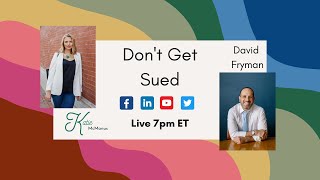
Katie McManus and David Fryman, a litigation attorney, walk through how service providers and founders can stay out of court. Don't promise outcomes in marketing, be clear about equity from the start, disclose conflicts of interest, and give clients an exit in your contract. Scaling creates liability through your employees and agents, so be intentional about it.
Sam. Hello, I'm Katie McManus, business strategist and leadership coach. And I'm so delighted this evening to be with David Fryman of Fryman PC, who is an incredible litigation attorney. And we're talking about how to not get sued. And we were just talking previously before the countdown, which, by the way, David, agree with me. I feel like Morgan Freeman's voice should have been, like, speaking over it.
Oh, my God, that would be amazing, right?
It was, like, up to one of the movies that he would have been in.
That's amazing. All right.
Before that, we were talking about, like, how, like, we both don't like saying stuff that's stupid in these lives, and so let's just get it out of our systems. Like, what's the stupid thing opening?
It's like me, you know, fixing my shirt or something. I was like, oh, Chris is here. Maybe can you get the Morgan Freeman, like, you know, Count Count down?
Oh, my God, could we. Chris, I don't know if you're that well connected, but could you get Morgan Freeman to, like, make me an intro video?
I would love that. Or say Mel Jackson?
Yeah, like, it's like, if you want to stop being a weenie, then something like that.
Oh, my God, told me to stop being a weenie. I. I would. That would.
I should probably drop, like, a good 50k for that. Like, that would be hysterical. Would that be a good business?
All right. If anyone in either our networks is connected to Samuel Jackson or. Or Morgan Freeman and can put us in touch, you would be eternally gr.
Point. We're probably gonna get some. Who is like, I know, Kathy Griffith, you know? No. Oh, Chris, you're gonna send. Send him an email. Thank you. I appreciate that.
That'd be awesome. My kids would really appreciate the Count from Sesame street, you know, like, you know, that'd be cool, too.
Count Chocula or something. Count Dracula?
No, Count Von Count is Sesame street, which is, you know, making fun of Count Dracula. But yeah, my.
My best friend's husband was terrified of him growing up.
Oh, that's so sad.
He went to a live filming of Sesame Streets that. And he just, like, he started screaming and crying because he was afraid.
Oh, my God, that's so scary.
I love the man, but I always think that's funny, and I always make fun of him for that. Hi, Brittany. Welcome.
Comments. Of course.
Comments in here. Oh, man. Okay, cool. So everyone, this is my first try and restream. Chris Hennessy turned me on to it. I used to do Streamyard. This is so Much better. There's so many more toys. I feel like I'm in mission control. Whereas Streamyard is like, you know, it's just so janky. No offense. Stream yard.
I've never used any of it because I've never. Oh, I've gone line. Got a live through your stream yard but never actually used on this end. This is so much fun.
I know. This is, this is like. I feel like this is the Cadillac. Chris. Actually, since I'm recommending it, I know you have an affiliate link if you don't mind dropping that in the comments if anyone wants to get on restream. But anyway, that's not the point of why we're here tonight. We're here to talk about how to not get sued, guys. Which is should be a top priority.
For people if you want to get sued. That's fun. That's fine too.
Yeah. On the flip we'll explain dme, I.
Have lots of ideas if you want to get sued.
Before we get into how not get sued, David, tell us like your top three ways that people, if they want to get sued, how should they do it?
All right, so top three ways to get sued are being very casual about offering equity in your company if someone will help you out. And this happens because a lot of startups are very, they go from 0 to 60 quickly and you'll find text messages that kind of imply maybe it's like, look, I can give you some equity if you help me out with this. That sounds great. And the conversation doesn't go further. You know, two years down the line, their success was worth something. And someone comes out of the woodwork and says, oh yeah, you know, I did that consulting thing for you. I did that marketing thing for you. I introduced you to so and so we say I was getting some equity for that. That was a text message that I forgot about since then. And are you crazy? Turns out they're not crazy and you're going to spend a lot of money in litigation to sort these things out.
That's crazy. Okay, cool. So don't offer equity in the company willy nilly in text message or in any other written form or at all.
Yeah, if you are going with a co founder, I mean there's nothing wrong in principle with trading equity for consulting help. Partnering up with someone who's an industry expert or someone who's just been around the block before. You want to do it really carefully. You want to do it precisely. Equity in exchange for general consulting or you know, introduction to industry players isn't Good enough. You got to do better than that.
Right. You know, it's interesting you bring up equity as the first one because actually in the coach's code of ethics, that if someone were to offer me equity in their company to coach them, I can't ethically accept it.
You know, that's really interesting because. And, you know, I don't know exactly where the line is between coaching and consulting, because in consulting, it's somewhat common. I've seen it a bunch of times. And so, you know, I don't know exactly. There are some coaches that also do some consulting, and then there's some hybrid. It's interesting. I don't know where that line is.
So with coaching, I think the idea for this being like an ethical standard is that, like, I'm supposed to coach the person, right? The person, the founder. And I'm supposed to have their best interests at heart if they're miserable running this business and. But I have equity, so I want the business to do well. I'm in a position of power. So I could then like, kind of gaslight them do some really shady shit to get them to do stuff in their business that'll make the business a success at the cost of the client.
Right.
So that's, that's where it. It gets a little shady as a consultant to come in and I'm the. The. My client is the business, not the people running it, then that's a completely different story.
So I'm curious, when you do leadership coaching or when leadership coaches are, you know, companies have coaches that train their staff.
Yeah.
Are they. Is their loyalty to the, like, you know, each executive that they coach, or is it. It's understood that it's for the company that they're, you know, being hired to.
Teach the coaching is not effective at all if there's no trust.
Got it.
And so when I've gone into companies, I have to be very clear with whoever's bringing me in that I am coaching the person. I'm not. I'm not sharing any information there. If I'm hearing a general theme of stuff going wrong, then I can bring that general theme, but it's only if I'm hearing it from the vast majority of my clients there. But, like, no one's going to be honest with their coach if they think that their coach is then going and telling their boss. And so literally, if. If you're bringing a leadership coach into your company and to work with your people, that coach, like, ethically is bound to work with that client, even if that Client is saying, hey, I want to leave this company. What should I do?
Right. So, yeah, that's a really good point. Which brings me to another example of a great way to get sued, which is like, completely ignore conflicts of interest.
Right.
You know, I've seen. So, for example, I know that I don't have personal experience with this, but I've just come across it in research. Franchises, a lot of franchises will offer coaching as part of their service, and they call it coaching. And I have no idea if the individuals are certified by anyone other than the franchisor, but they'll offer business coaching. But they clearly work for the franchisor. They're paid by the franchisor. They get their business that way. And when it's disclosed properly, it's perfectly fine to have a conflict of interest. It's normal. And that's life. As long as everyone's on the same page. If you're pitching something, if you're pitching a product or a service where you get a cut, potentially where you get maybe a large cut of your business and you're pitching that to your client, that can be fine as long as it's fully out there. Right. If you're pitching your client on. I really encourage you to look into this marketing agency. I know you want to explore TikTok, and these guys are experts, and this would be perfect for you. And I know you have your concerns because it's really expensive, but I'm telling you, I trust these guys. Guys. Now, that conversation feels very different if it turns out you were getting a kickback.
Right.
And then it doesn't go well.
Right, right.
Just giving your opinion and it doesn't go well. It's not a guarantee.
Right.
Hopefully your contract says no guarantees in big letters, but in general, it's not a guarantee. But yeah, if you're getting a kickback and it doesn't go well, that's. That's gonna. That's not a best practice. Put it that way.
No, no, no, no, no. So that's. That's number two.
Yeah.
Three.
So.
What about guarantees and marketing?
Oh, that's a big one. Don't do that, don't do that. And that per. That dovetails into, you know, the. The. I think what we want to talk about, which is good communication.
Right, right.
I talk a lot about contracts, legal protection, using corporate structures to protect you from liabilities, all those good things. And they're great, and I could talk about them all day. But the truth is, the most important thing you can do to protect yourself doesn't even involve hiring a lawyer. It's about making sure that you communicate clearly and effectively and honestly.
Yeah.
If you do that. Yeah. Like, if your clients like you, if your clients appreciate you and they respect you and they trust you, they're less likely to sue you.
Right.
Even if you mess something up, which can happen even if you can't deliver what you're supposed to deliver, which can happen even if you can't adhere to the terms your contract for whatever reason. It's a lot easier to deal with that when you have a healthy working relationship with your client than when you don't.
Right. Right. Well, what's the statistic about doctors?
Yeah, it's.
Doctors.
One gets cited everywhere. But it's true about every. It's true about everyone.
Right.
And honestly, I don't want. I'm not gonna. I was gonna say she feels very passionate about.
Now we have a dog on our street named mufasa. He's like £150. He's huge. He has so much hair. And Luna's not a fan, and I think he's walking past Mufasa. So, anyway, welcome to my life. Okay. I swear, she looks for him around this time of the evening. Luna, chill, chill. He's fine. He's fine. He's outside. Anyway. Well, what I love about this topic is that, you know, when I train on holistic selling, you kind of pinged up and you're like, hey, this is something that could be super helpful for people not to get sued, because the whole. The whole framework is based around consent and being kind and really seeing if you can be of value to this person and finding ways to really honestly align with them.
Right. So I did this training with you, and you went through holistic selling, and then you had some videos on it, and you've. You've spoken about it before. You've written about it. And I was thinking that, yeah, I do a lot of the same thing. Right. I, like. I. You know, I coach my clients to use contracts, protect yourself legally using trademarks, copyrights, LLCs, all the things. I'm a lawyer. That's in my right. That's my toolbox. But the truth is, I also work my clients on communicating honestly and effectively and clearly setting expectations, making sure they buy in. Don't try to slip things past them, don't try to use fine print, not only because it's just a nasty thing to do, but because you're going to undermine that trust.
Right.
And I was. And we were talking about this, and I was thinking that it's not, it's not a coincidence that the same strategy. Oh, that's funny. This works for sales and it's a good way to protect yourself. No, it's the same thing. Right. The reason, the reason it's effective as a sales strategy is because the client feels that they're bought in, that they're trusted, that they're listened to, and that they're the ones driving the relationship. That's the same reason that they're not going to sue you or they're less likely to sue you if it goes south. Because there's a relationship there.
Yeah. Yeah. Well, you know, and, and from the sales side, you know, I come from a sales background and like, the reason you sell in this manner where you really understand them, you're making sure that the thing that you're selling is a really good fit for them and that they're really consciously wanting to invest their money in whatever it is you're selling is because the next month, the next quota, the last thing you want is to have a cancellation come through.
Right?
Because, I mean, that's happened. Every single salesperson out there has started off a quarter or a month, like in the red, like negative, like three. Three deals. And it's the worst feeling in the world because not only are you starting from zero, you're starting from behind the mark, and now you have to make that up. So. But yeah, no, and when you do that, you really do get them invested in the thing that they're. They're trying to accomplish with you.
Right.
And, and here's the fear is like most people, when they think about selling something, they're worried, like, oh, well, I don't want to be manipulative. I don't want to be pushy. I don't want to make people do stuff that they don't want to do. And as a salesperson, a former salesperson, there are absolutely tactics that you can use to make people do stuff they don't actually want to do. Right. And I love, I love that you're backing up my opinion on this. That that's actually a great way to get sued.
Yeah, yeah, yeah. Because the, the, the, you know, like I, I speak to clients and, you know, I'll suggest that they're, you know, the way they've worded something on their, on their website or their landing page or their ad could be a little misleading. And one of the services we offer is, you know, basically audit. Audit your marketing to make sure that there's nothing in there that, you know, Goes over any red lines. And a common, a common response is, oh, come on, client's not going to sue me, you know, over, over the way you phrase this. And it's true, that's not going to motivate the client to sue you. But when your client is unhappy for reasons that may or may not have anything to do with something you did, it could just be that the thing didn't happen. The, the they didn't win what they were supposed to win. Get the funding they were supposed to get, get the clients they're supposed to get. Again, maybe it was their fault, maybe your fault, maybe both. Maybe just bad luck, right? And they're going to hire me or someone like me. They're going to say, here's a contract I have. I didn't, didn't deliver what they were supposed to deliver. Figure out a way out. And then I'm going to look on your landing page and someone like me is going to pour over everything you've ever written and be honest. If you did it yourself. It's not that hard for me to find something that is 100% honest.
Right?
It's not that hard. And so like something you could do, something everyone listening to this can do right now. And it doesn't involve hiring a lawyer, but it's something that will help you in reducing liability. Go through your marketing, go through your, your email newsletter, go through your ads and go through your copy. Is there something that you could say a little more clearly? Is there something that, like, isn't dishonest, but like, is, you know, a little bit fuzzy on the facts? Something that's not technically a guarantee but could be read as implying that like, this never fails?
Yeah.
Using words like always and never again. Not technically guaranteed, but could be read that way. All of those things are going to make you come across as more trustworthy and more real. Just for me as a consumer, it's always a red flag. When. Always, never, you know, I've never had a client. X, Y and Z. You either don't have a lot of clients or you're lying because it's just, it's not true.
Yeah, well, it reminds me of like Yelp reviews for restaurants. You know, like if you go to a restaurant Yelp page and they have all like 5 star reviews and everything's amazing, like, bullshit. You hired a bunch of people to do this. Yeah, but if someone leaves a review and they're like, listen, the lobster ravioli is out of this world, you want to have, you know, an old fashioned here The Manhattans could use some work. The forks, however, the forks are a little annoying. Like, maybe bring your own fork from home. You can eat the food faster.
Right.
You know, you're gonna. You're like, oh, like life changing ravioli and a great old fashioned. Okay, I'm down and I'll bring my own fork. You know, or I'm down to like have. Have that little bit of annoyance of the fork, but it just makes it more believable. There's just like a little like, you know, a softening of it.
It reminds me when I was looking for a contractor, we did renovation a few years ago and one of the things we did is we found people that were unhappy.
Yeah.
With the contractor. I want to know why.
Yeah.
Like, what's the worst case scenario?
Yeah.
Turns out, you know, the things they were upset with were things that we sort of could live with.
Right.
You go to like, you know what I mean? Nobody said he was stealing. Nobody said he was, you know, over billing or, or playing games with his subcontractors. Okay. So someone said he didn't come back when you called him three months later.
Right.
If you can live with whatever the worst things that people are saying, then I feel much more comfortable doing business than if everyone says, this is the greatest contractor ever. You're. It's going to look amazing. You're going to. It's just not true because I've never met a contractor that didn't have like, somebody that wasn't happy.
Right.
And yeah, it just. Your credibility skyrockets.
Right, Right. Like, this guy, you know, tells really long winded stories and, you know, wasn't the greatest at painting. You might want to bring in another person for painting. That's something you could deal with. Right. You know, who doesn't like a talkative contractor?
I'm curious about something, Katie. When you teach holistic selling, what's the biggest pushback you get from clients?
It's a great question. Um, you know, the clients that I teach holistic selling to, they. The structure of it. It's a very simple structure. It's literally four steps in a half hour conversation. I made it super easy for people to remember and follow through on. I think people feel weird towards the end when they're making the ask.
Right.
You know, because it's like they're. They're making the offer for someone to pay them money for their service, and that just feels weird if you've never done it before.
Yeah.
You know, it's. And it's weird across all sales, like My very first sales job, I got so nervous the first couple times I asked someone to buy. And really, I say the first couple. The first couple dozen times I asked someone to buy. It just is not. We don't normally have conversations where we are instructing someone what to do at the end if they want to be in business with us. And so it's not natural for us. And so it's really something you get. Have to get trained on. But the thing that I always remind them on is that, like, this is a. A person who has free will. They have their own desires, they have their own fears, they have all that stuff. If you follow this framework, you're never going to make them do something they don't want to do, you know, and you always have the freedom to let them go and think about it and come back. You know, you're not going to hold their feet to the fire and say, like, you know, what is the guy. What does a guy got to do to get you in a minivan today, young lady? You know, we're not using sleazy, use car salesman tactics, you know.
Right.
And also, here's the other thing is like, well, what if I don't want this person to be my client? Do I have to ask them to be my client? That's another pushback. And it's like, no, absolutely not. If there's any red flags. If there's any red flags, or it's just you don't really enjoy the conversation with them. You know, honestly, the way I choose clients is when I'm on the phone with them is if neither one of us is laughing, they're not my client. We're not. I'm not even making the offer. I'm giving them resources, you know, to go somewhere else. Because if we're not having fun in that first call, it's obviously not going to be a fun few months.
I don't think we've had that problem.
No, no, no, no, not at all. But yeah, it's. Yeah, it's, you know, it's just such a simple framework. Once people learn it, they're like, oh, it's this easy.
Yeah.
You know, okay, great. So that's so. I'm so happy to hear that. What I teach is helping people not get sued. Now, you talked about onboarding also being a process that could buffer managing expectations.
Is something that is, again, it's important in sales. It's important for business reasons. Most people don't think about it as a legal issue, and it's not. But it, it goes a long way to building that trust, Right? The example you gave of a used car salesman. I imagine that there's people I have not have to deal with a lemon, but I imagine somebody that deals with a lemon or has car issues or feels like they were ripped off. I feel like there's a lot of people really excited to sue that used car dealership. Oh, yeah, Like, I feel like it. I don't think people are going to, like, convince themselves out of it, right? Because they feel, okay, great, you made the sale, great, you got the commission, and hopefully everything goes well. But the second somebody has an excuse to start causing, causing problems for you, they're going to do it, right? They're going to do. Because they don't like you, because you made them feel like they lost something to buy a car.
Right?
And you know, the flip side of that is if you make somebody feel, feel like part of the process, they feel in the onboarding, they feel taken care of, they feel prioritized. And here's the important. They feel their expectations are managed properly. So they know here, okay, we're starting, we're doing work together. Here's what's going to happen a month from now. Here's what's going to happen six months from now. They're not disappointed because they don't get the results you told them to expect.
In six months, right?
It's a big deal with startups. You bring on investors and there's a temptation, a strong temptation to promise a lot, right? This is the greatest product ever launched in this field, in this industry. This is going to be huge. And I get you're trying to make a sale, but if you win, great, you got the sale, you got the money, fantastic. Everything's going well, and then it doesn't work out. There's some hiccups, right? The patience that your investors will have for you, their willingness to forgive missteps along the way. Because if you're a founder, especially if it's your first time, even if it's not, you might make some bad hires, you might flush some money down the toilet by spending it stupidly, and your investors are going to put up with you in direct proportion to how good they feel about you, right? You have their trust because you, you brought them in, you gave them the, the, all the upsides and also all the warts. It's going to go a long way towards you being able to come to them when things aren't going so well and say, all right, I made mistake X, Y and Z. And here's my plan for fixing it.
Right, Right. Which, I mean, I don't know. Like, I'm sure you have friends. I. I always trust my friends more when they tell me, like, not only the good things about their lives, but also the bad things.
Yeah.
Right. It's like, oh, cool. Like, you're not all like glitter and unicorns, right?
Yeah. There's like a social media analogy to this too. It's like different seeds where it's like nobody believes you're this happy. Like, it's. There's no way you're that happy all the time. And you just, you know, look at. Have you ever seen these. These. These people's morning routine? You get up, then you meditate, and then you spend three hours journaling your thoughts and then go for. And then spend time with your kids. And like, I don't know, it must be like three in the afternoon by now, but apparently you then get a full day of work in.
Right?
Yeah. So, like, it's. I mean, it doesn't. Yeah.
My problem with, like, the influencers in the coaching space where they're like, poolside, having a daiquiri, you know, on their computers in the sun. And it's like, have you ever used a computer in the sun? It overheats for one, and for two, it's sunny. So I hope you're wearing spf, but, like, SPF is super greasy. So, like, you're just up your keyboard. Like, it's just gonna be so gunked up.
Yeah.
And also you're drinking and working. Is that a good idea? Maybe it's a virgin daiquiri, but still, like, I. If I'm hiring a professional, I want to know that they're at least sober while they're working on my thing.
Yeah, Right. I feel like being drunk while negotiating a settlement for my clients might not be. Definitely not something I'd want to like, advertise on. Tick tock.
Right. Yeah.
If that's your brand, you do you. As long as, you know, as long as that's part of your pitch.
Yeah.
Yeah, that's.
Yeah. Yeah. Okay, cool. So, okay, so onboarding and creating expectations, you know, and this is one of the things that I push with my clients is like, create a designed alliance with them where you're designing how this relationship goes, even if it goes badly.
Yeah.
Verbal conversation. And it's basically you're giving permission to your client to just say, hey, I'm not that happy, or this isn't going the way I want, or I need something different.
Right.
And, and you're able to say, oh, oh my gosh, okay, cool. Well what do we need to clean up? Like let me take some ownership and, and own any like bad and bad impacts that I've had. Okay, great. So let's clean that up. I'm so sorry. Or you know, make it right. And then what do you need going forward? You know, is this still a fit for us to work together? A and B, if it is still a fit, then let's, let's get you what you need going forward. Right.
Super important. Just reminds me is have, have an off ramp.
Right.
It's very tempting, especially when you have all the leverage to sign clients up to long contracts and you know, make it difficult for clients to terminate. And I certainly get it from a business perspective.
Right.
If you're selling, you know, a year program, if you're selling subscription, that's, you know, cheaper. If you sell it a year or six months rather than month to month or week to week.
Right.
I get the business issues, but here's the problem. If somebody wants out because they no longer want what you're selling, service, product or whatever, and they can't, they will start looking, some amount of those clients are going to start looking for a way out.
Right.
That's human nature.
Right?
Right. So anytime, and this is, this happens with non competes, this happens with partnership agreements. If you don't give somebody an off ramp now, your offering can be reasonable. It can be something like, you know, pay something because you did get a discount.
Right.
Because we were going six months rather than month to month. But if you don't have any off ramp out of necessity, somebody trying to get out is going to call me or somebody like me and say I want out of this contract. Can you find anything here that would justify a lawsuit? And then, you know, I go through with a fine tooth comb. And the truth is it's probably not that hard to find some line in your service agreement that wasn't technically followed, which would have been totally meaningless if you had had the kind of relationship where your client could have come to you and said, look, this isn't working. Can we, can we work it out? But because you didn't have that, now there's a lawyer on the other side who is carefully reading every word, trying to trip you up.
Right, right, right. And if you're like a lot of beginner service providers, you probably didn't get the best lawyer to write the contract. You maybe had the family lawyer or you got a template from online or you Maybe wrote it yourself, you know, because you just wanted to get up and running and get some money in the business.
Right.
You know.
Yeah. And if you. Right. And so if you're going to do that, and I don't recommend it, but if you're going to do that, you really need the kind of trust with your clients that they're not going to read that agreement very carefully.
Right, right.
Because that, that you're essentially doing business on a handshake.
Right, right.
And that that relationship is, look, I'm going to tell everyone to get properly drafted contracts and make sure you have a legal strategy to protect you. And that's just, you know, standard device they'll give you. But whether or not you have that, because the truth is you can do everything right legally. And I've seen this too, on the other end, you can do everything right. Have the contracts, have the, the corporate structure in place to protect you. But if you're just like an ass to work with and you're difficult and your onboarding is confusing and your clients are frustrated, they're going to find a way to make things difficult for you. And if you have to sue to enforce every one of your contracts.
You'Re.
Not going to last very long.
Right.
You just won't.
Right. Well, you're not going to last very long. And also, like, the energetic cost of that.
Yeah.
Like, like feels dirty and.
Yeah.
Fun.
Look, I, you know, I litigate for a living, but I will tell you, my clients going through it, in addition to the legal fees and the cost of settling litigation and having to give something up to maybe get a good deal, there's, there's also just the emotional drain of this relationship that didn't work out. That you're just like, is constantly pulling at your, at your heartstrings and, and that makes a lot harder to just move on and get on your next sales call or get on your next. Prepare for your next investor meeting.
Right.
Because you still have this baggage that you're carrying around. It's a big cost.
Right, Right. Yeah. And you're a creative, amazing human being who can go and impact so many more lives if you're not dealing with this.
Yeah.
Right. Yeah. So. Okay, so Clear Communications, make sure that they're making a conscious choice to work with you onboarding and setting expectations. Any. Any final piece of advice for people to follow so that they can avoid getting sued?
I mean, we cover the main ones. One thing I would add is that the, when you're dealing with, when you're at the place in your business. When you're ready to scale, you need to be intentional about how you grow. Because I've seen, I've seen clients who run perfectly successful solopreneur businesses and they want to take it to the next level. And when you take your business to the next level, well, so when you're a solopreneur, let's say, keep it really simple. Let's say you're a one on one coach in the fitness space.
Right.
So you're, you know, you have some potential liability with certain regulations around what costs medicine or therapy. But basically you're just, you're providing one on one services. The universe of things that can go wrong is somewhat limited. And then you start scaling. And so now your, your risk of liability starts expanding in ways you probably don't see coming. So for example, basic rules of agency, I'm oversimplifying here, so all the lawyers don't jump on me here, but very broadly, right. When, when you hire somebody to act on your behalf.
Yeah.
You are potentially liable for whatever they do. And that means the VA you hired to write your copy, if they want to infringe on somebody's copyright and they, they copy someone else's content, they think they changed it enough, but it was late at night and didn't quite change it that much. Right. Nobody's suing your va. They're coming after you.
Right.
If you, if you hire a salesperson to do sales for you and they're super manipulative. They didn't take Katie's training.
Yeah.
Right. You're, that's.
Can I share an example?
Yeah.
When I started working for Equinox, you know, we're, we were doing pre sale for a club that had not opened yet. So like it was under construction. So we're doing pre sale. We're selling memberships at a discounted rate. If they sign up before it's ready the first, the first week they kept saying, don't say it. Pool. Don't say it has a pool. Because it was not going to have a pool. There's no, nothing in the plan. Like there's no secret pool in the basement. Don't sell that it has a pool. And we were like, we get it. Why do you keep telling us not to sell that it has a pool? They're like, because at one of our past openings we had some sales people guaranteeing that it would have a pool and that location did not have a pool.
Yeah.
Don't do that. Right, right. But if you have a salesperson doing that, that opens up your company to some liability.
Yeah, yeah, you have, you know, once you start using VAs and affiliates and profit sharing and employees, all of those things open up new strategies for you.
Right.
And you want to be intentional about how you're scaling. You want to think about your corporate structure.
Right.
These things might not be worth it for a small solo business. Right. But if you're at the point where you're, you want to scale, you're planning to scale, first of all, congratulations, because that's great. But with that comes responsibilities that you want to think about. If, you know, as the theme is, you don't want to get sued.
Right.
Oh, and especially investors. Anytime you start bringing on investors, that completely changes your potential legal liability. And you want to, again, there's nothing wrong with it. You just want to do it intentionally and thoughtfully.
Right. Right. Cool. So thank you so much for coming tonight. You're doing some research on what. Because I want to make sure people, if you're watching this and you fit this, this description that you can sign on to do some market research with.
David, I appreciate that. Thank you. So I love working with my startup, my startup clients, and I want to do more of it. So at Katie's urging, and thank you for pushing me to do this, I've been doing market research interviews with startup founders to help me understand the kinds of struggles you're going with, going through and your hopes and dreams so that I can serve you better. So if you are a, an entrepreneur that roughly meets this criteria, you launched more than a year ago, you anticipate more than half a million in revenue this year. You want to build a professional team around you so you can run the business without having to do everything yourself. And you want to scale without the constant fear of everything crashing down on you. I'd love to interview. If you're seeing this on LinkedIn, the my pinned my featured post or there's a link in the about section on Twitter. There's a link in my profile. It's also my pin tweet. So. Or DM me anywhere and or comment here and I'll find you, David.
And if you can't find David, DM me and I'll get you in touch.
Yeah, find me or Katie or someone or just, you know, or post to the ether if anyone knows where. David Friedman will find me. Carrier pigeon works too.
Smoke signals. Amazing. Well, David, thank you so much for joining me today.
Thank you so much.
It was a pleasure, everyone watching. I hope this has been useful. If you have any questions on the legal side of your business, I'm sure David's open to being contacted.
Absolutely right. My DMs are open. Just, you know, don't be creepy everyone else.
David, I just want to celebrate you for a moment in that your way of being with clients, because you've been helping me a little bit is. Is so easy to work with. Like you, the way you explain things, you make things not scary. You just take the pressure off. So if seriously, if anyone is thinking about, you know, oh, crap, I'm not protected in my business. I need to do this thing. I need to do that, and I haven't done it yet. There's no shame when you work with David. He's absolutely incredible.
I really appreciate that. Thank you. And it's a pleasure to work with you.
Yeah, thank you.
Make it easy.
Oh, my God. Love fest. Okay, on that note, let's wrap up, everyone. Thank you for joining us this evening. I'm Katie McManus, business strategist and leadership coach. This is David Freyman with Freman PC. Thank you for joining us this evening. I hope you enjoy the rest of your Tuesday and the rest of your week, and we will see you all soon.
Thank you very much. Have a good night, everyone.
More from Katie





How to do self care right now, so you can do what needs to be done, for yourself, your business, and

How to do self care right now, so you can do what needs to be done, for yourself, your business, and

#greenscreen How to build a consulting business that makes you $200,000-$700,000 a year

#greenscreen How to build a consulting business that makes you $200,000-$700,000 a year

Maybe we’re not the imposters…? #businesscoach #startup #entrepreneur #smallbusiness #consulting

Maybe we’re not the imposters…? #businesscoach #startup #entrepreneur #smallbusiness #consulting
