Journalling Dreams into Reality
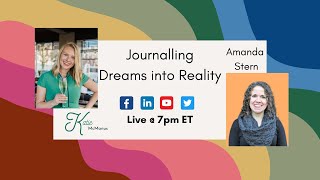
Katie McManus talks with Amanda Stern about why journaling works and how to start. Amanda recommends defining your purpose first, using prompts to stay grounded, and beginning with just one sentence. She runs morning journaling groups and a three-week program at goodthingscometothosewhojournal.com.
Chapters
Hello, everyone.
I'm Katie McManus, business strategist and leadership coach. And I am delighted to be here this evening with Amanda Stern, who is a journaling specialist. She runs journaling groups, and she's building her journal empire. Amanda, thank you so much for being here tonight.
Yeah, thank you for having me, Katie. I'm really excited to get to chat with you.
I know. Oh, my God. Well, to give everyone in the audience, you know, some background, I've been seeing Amanda's post coming up on my LinkedIn feed, and, like, I'm like, oh, my God, I want more. I want more, and I want to hear more. And that sounds really cool. And that sounds really cool. And so I reached out to her, and I was like, can we be friends? And also, do you want to do a live at some point?
And I'm so glad you did. I was telling my husband how cool it is that my world has gotten so big since I started hanging out on LinkedIn. And since I started talking about journaling, it's gotten even bigger. And I've connected with really, the coolest people. People. And I'm so, so grateful.
Oh, my God. I. I had a very similar experience with LinkedIn. I started seriously in May of 2020, and it's like, it's. It's a whole social world. It's filled this gap that my extroverted self wasn't getting during the pandemic, and now I don't want to leave it behind.
Yeah, no. I was a little later to the party. I had gone to a conference. Oh, well, it was a library marketing conference I had gone to in 2019, and. And I sat through a workshop about social media and libraries and social media. And my one takeaway was that LinkedIn was a place of opportunity, and I didn't really know what that meant, but it stuck with me. And so one of my goals for 2021 was to really figure out how to leverage LinkedIn. And again, I came to the platform not really knowing what to expect, not really getting it. I actually took a workshop from the New York Public library, which demystified LinkedIn for me. And the magic trick of you have to connect with people that you don't know. You can't treat it as Facebook if you want it to be any fun, because no one in my world uses LinkedIn the way I use LinkedIn.
And not that we're not calling the people we know not fun, but they're probably not having fun on LinkedIn. Right?
Yeah. But my platform, or, like, every time I showed up, there was nothing in my feed. And I was like, why is this fun? How is this going to be a place of opportunity? And it was when I started really showing up, connecting with different people, jumping in and just having conversations and getting over that fear of, oh, someone's going to be upset that I hopped into their comments was huge.
Right? It's amazing how we convince ourselves that we're intruding on other people's space when really, I love it when people are in my comments.
And it was so. The whole experience was so new for me that I didn't really know the etiquette. I thought maybe there was some etiquette. Really, the etiquette is just be a nice human and support other people and have a good time. But I really didn't know what to expect. And I remember the feeling of trepidation when I jumped into somebody's comments. I had just finished this really rigorous goal setting process and someone had a post about goals and what kind of goals do you set or how do you do it? And I jumped in. I was like, yeah, here's how I did and here are the goals that I set. And I was waiting for her to be like, get away, get out of my comments. And she was like, I'm so glad you're part of the conversation. And now we chat, you know, fairly often, which is really cool.
That's so cool.
That's so cool.
So we talked initially about your, like, your journaling journey and the work that you're doing now. I. I think this is super cool, like how you got into this. Do you mind sharing that again?
Yeah. So I have, like four big journaling moments that I love to share. I talk about how I discovered journaling when I was an angsty teenager. I was having a really hard day. None of my friends could come to the phone, so I picked up a notebook and a mechanical pencil and I just started writing. And I can't tell you what I wrote, but I remember that I wrote for a really, really long time. And that when I was done, I felt better. And that was the first time I really connected writing with feeling. And I liked the way it felt. So I picked up my pencil the next night and the next night, and before I knew it, I had this really robust journaling practice that took me through high school and college, took me to about the time I got. I got married and had young kids. And then it kind of fizzled out for a while. But it was always there for me to call on it when I Needed it.
Right.
So I pulled it out. Moment number two was when I turned to gratitude journaling. The day my then husband told me he didn't want to be married to me anymore. And I was like, holy cow. I have a choice to make. I can either spiral into negativity, or I can reach out and grab hold of every good thing that came my way. So I forced myself to open my journal to write what I was grateful for. And, Katie, I will tell you, it was really hard. I didn't feel grateful for much, but I came up with eight things. And I thought, if I can be grateful for eight things on the hardest day of my life, it's a pretty good life that I'm living.
I mean, that's incredible. I actually. You didn't tell me that before. That's amazing. Yeah. I mean. Yeah.
Yeah. And, you know, it's funny because the way I had always remembered the story was that I wrote three things and I had three kids. So I'm like, oh, I probably just wrote, I'm grateful for each of them. But I went back a few months ago, pulled out that journal, and looked, and was smart, really surprised because I didn't remember being able to write so much. Yeah. Yeah.
And, like, what a buoy to, like, kind of lift yourself up and just kind of stay above the waves of everything you must have been going through in that moment.
Yeah. Well, gratitude journaling is the best way I know to lift myself up. Regardless if my life is great, it's a great way to make it greater. If my life is not doing so hot, it's a good way to really just level it up. A level or two or three or six, you know, to get myself in a good, much better place.
Yeah. Yeah. So I'm curious, when someone's trying to start a journaling practice, what's the first step that you have them do?
Yeah. I always tell people, start with your purpose. Figure out why you want to journal. Because journaling is something we've all heard of. We know is good for us. We know we should do it. We may want to do it. We. But starting can be really hard. Like, opening a blank page and staring at nothing can be really intimidating. Right. So knowing what kind of journaling we want to do and what our purpose is. Right. So do we want to use journaling to better understand what we think and how we feel? Cool. Then you'll kind of choose techniques that'll get you there if you want to track your progress toward goals. Great way to journal. That's a Totally different approach. If you want to Gratitude journal. If you want to just record all of your memories and the wonderful events of the day. Right. Whatever you're looking to do. I like to start with that in mind and then reverse engineer it to figure out how. How to go about it. Because sitting down and just doing stream of consciousness writing can be really helpful for a lot of people in a lot of circumstances. But for people who are highly anxious, highly, highly accessible to shame and sadness. Right. People like that, we shouldn't just free write or at least shouldn't free write for a long time, because what happens, right? My life is so terrible. Why can't I. Right. And you just spiral into negativity.
It becomes what was me kind of faster.
That's exactly right. But if you have, like a journal prompt, you know, a question that you can ask yourself, it serves as a really safe container for your thoughts. You can go deep and explore, but you're staying within these constraints. And it's a safer way to journal.
Right, Right. It's so funny. You know, as a teenager, my friends and I would always talk about, like, oh, well, we want to be the kind of person who journals. You know, we want to be like that cool girl who, like, goes to her journal every night, records everything, and then years later comes back and reads. And I think there's this voice in your head, especially if you don't know how to. How to structure it so that you're. You're doing it in the right way. Luna. No. No treats for you right now. You're fine anyway, if you don't know how, like, you do kind of go down that downward spiral, and then you get self conscious about, like, oh, my God, like, I don't ever want to read this again. What if someone else reads this?
Yeah. So the next thing I always tell people is to remember that your journal doesn't judge. Right? Right. So we shouldn't judge ourselves either. And that includes our spelling, our grammar, our handwriting, anything we put in our journals. And it's so funny, Katie. I've talked to so many different people of all levels in their journaling journey, and I love sharing this message that our journals don't judge. There is no wrong way to journal. And I can just watch the stress melt off people's faces, even people who journaled for a long, long time. I. I told someone that not long ago, and his response was, I just released a sigh, you know, of worry that I didn't even realize I had been holding for years. It was amazing.
Right? Right. Because how you mentioned this, like, how many people start off with, I'm sorry. I haven't written in so long. And it's like. It's like calling your mom after, like, not calling her back for a couple days.
Yeah. And that is the. That is the biggest thing, because I've had periods of my life where I was a very inconsistent journaler. And every time I sat down to journal, I would start with, it's been six weeks and four days since the last time I journaled. Like, it's confession. Right. But guess what? My journal doesn't have feelings. It doesn't care. And when I stopped treating it like that, I was able to get back to my journaling much more easily and with no guilt. Right. So it's been a while. Big deal. I'm here now. I'm jumping in, I'm doing it, and that's what counts.
Right? Right. Yeah. It reminds me so much about, you know, like, New Year's resolutions. Someone says, okay, I'm gonna go to the gym every single day, and they're good for about a week, and then they miss the day, and then they're like, oh, no, I'm a failure. And then they miss another day, and they're like, I can't even go back to the gym because it just reminds me of failure, and it just becomes this downward spiral. And I can imagine that happens a lot in journaling as well.
Yeah, I think so, too. And especially people who start journaling at the beginning of the year and they have all these plans. So I like to tell people, start really small. Yeah, even a sentence counts. A sentence counts a lot. I still have been journaling since I was a teenager. I still have days when I just write one sentence. I sit down, and that's what I've got. I have some days where I sit down and I write pages and pages, and my ideas are flowing, and my pen is dancing on the page, and my handwriting is beautiful. And I look back, and it's like. I don't know. There's, like, music in the air because it's so beautiful. And then there are days that I call stuff sticky. Days where no matter how much I try, I can't pull two coherent sentences together. And it just. It's hard and it's painful. But the most important thing for me is showing up. That when I show up every day with my journal, whether it's for one sentence or two minutes or 45 minutes, whatever that is, I sit with it and I show up. So that on those days When I do need to journal, I'm there, and the habit is there, and it can serve me and help because I have people ask me all the time, well, how often do you journal? I journal every day because I need to do. I think everybody does. Probably not, right. And so when I say be consistent, consistent is what works for you. For me, that means every morning. But some people might journal once a week, and that's great. Some people might journal once a month and get everything that they need. You know, whatever works for you. If it works for you, you're doing it right is what I always love to say.
Right. So I'm curious. You mentioned a few different types of journaling. I wrote them down. So there's like, the feelings, the gratitude, the goal setting and tracking anything that I missed.
Oh, golly, there's like a hundred million ways to journal. I'm just curious.
That's not really my question. My question is, how does someone figure out what's the best way to journal for them?
Yeah, um, Great question. I would start with, what are you looking to get right? So for a lot of people who are just. So I talked to a lady a few weeks ago, a couple of months ago, I don't know, a while ago now, and she was like, I want to start journaling. I don't even.
Do you have add?
I don't. I just. Well, I don't know. I've never been diagnosed with it, though. I was watching your Live yesterday, and I was like, oh, that would be really helpful. I don't know that I have add.
But, you know, like, there's now, there's later, and there's the other day. And the other day could be anywhere between, like, yesterday and 10 years ago. So I'm sorry. It was the other day.
No worries. But. But I asked her, like, what are you looking to get out of your journaling? Why do you want to journal? And she's like, well, I just feel like I'm really negative, and I just. I don't want to be negative. I didn't used to be negative. And, you know, we're all in the same boat. We've lived in a pandemic for a couple of years. There's crazy stuff going on in the world. We have our personal stuff. And she's like, I feel like all I do is, like, complain and think of negative things.
Right?
And I was like, well, have you tried gratitude journaling? Because, again, it's the fastest way I can think of to pull myself from negative to, you know, at least Baseline. And she was like, oh, well, what would that look like? And I was like, well, you can gratitude journal a whole bunch of different ways. You can start with just making a big old list. What are you grateful for? Because sometimes I need to see the quantity. What are all the good things in my life, right? And I pour them out on the page. Sometimes, though, I need to dive really, really deeper, right? So I'll pick a thing. What am I grateful for? Why am I grateful? Right? What does this thing do for me or this person or the circumstance? What would my life look like without it? And then how can I show my gratitude? How can I take it off the page and into my life? And that, Katie, is really my secret. And the best part of gratitude, journaling. And I think it's what really helps bring it to life, that it's not just, I'm grateful for my health, I'm grateful for my family, I'm grateful for my car. Right? All of those things that we are grateful for.
Coffee always ends up on the list because I'm drinking it and I'm like, I don't know what else to say I'm grateful for.
Right? But. But deepening the practice a little bit and really feeling it takes it from being kind of a rote of resuscitation to really feeling it. Because some things we are grateful for every day. I'm grateful for my family every single day. But sometimes I'm grateful for different reasons, right? I'm grateful that my husband pulled the covers up this morning when he got out of bed, so it was really easy to make the bed. And whereas a couple days ago, you know, I wrote, I was grateful that he's. He's there and he's supportive and he cares and he listens and he makes me laugh, right? All these wonderful things. But when I can be grateful and really dive into why, it just adds this whole other dimension. And then when I take it to, how can I show my gratitude? It really helps me live in the spirit of gratitude and not make it something I. I do, I write it, I close the book, and I'm done until tomorrow.
Right, Right. You know, as you're describing this, it's making me think of, like, you know, hundreds of years ago, they would burn women at the stake for being witches. And part of the evidence would be, oh, well, they have a grimoire. They have, like, a book where they're keeping track of, you know, wanting it to rain and, you know, things that they're doing to influence their life. And here's a herb that I discovered. And it makes me think. I think they were just journaling.
They were witches.
I think they were just journaling and saying they wanted their life to be different. And here's what they're. They're taking out of life.
And I love that, Katie, because there are so, so many people out there who are journaling and don't realize that's what they're doing. They're like anybody who plans their day or jots down notes or sketches ideas or does morning pages. Guess what? Those are all. It's all journaling. It's all journaling. If you keep a workout log when you go to the gym, guess what? That's journaling. I mean, you're going to get different benefits than if you sit and write about your feelings. Right. But it's still journaling. You're still keeping track of something. You're keeping data, you're collecting patterns. You're, you know, tracking your progress. Those are all great, great things we can do with our journals.
Yeah.
What's.
What's like the most amazing thing that you've seen happen in someone's life after they start journaling?
I can tell you what happened in my life. So at the end of 20, the end of 2020, I changed the way I journaled. I had always been an evening journaler, which meant I could journal at night if I wasn't too tired. And I remembered to do it before I fell asleep. Right. But In December of 2020, I started journaling in the morning. I remember my high school English teacher said to me, he's like, yeah, I journal in the morning, and it opens up my creativity. And I thought, how in the world does anyone have time to journal in the morning? Well, thank you, Pandemic. My kids were in school remotely. I had a little extra time in the morning, and I had just put up my Christmas tree. So I thought, I'm going to get up a few minutes early, sit down, cover up with my fuzzy blanket, and journal by the light of the Christmas. Christmas tree. And I had three glorious weeks of reflection and goal setting. And it was some of the best work that I've ever done. And what came out of it was this desire to keep my goals front and center, because I always set goals, and I'm really good at writing my goals down in a really safe place, closing the book and putting it away. And next year, I pull out my journal and I'm like, oh, yeah, I remember I was going to work on those things.
Right.
So I instituted what I Call Sunday accountability journaling. I sit down each Sunday morning in my journal, and I just report to myself the progress that I've made toward my goals, however small. And it's been really wild because I'm a person who sets goals here, and I'm happy to celebrate when I am here that all of this stuff doesn't really count. It's easy. It's not hard. It's expensive. Of course I can do that, right? So in this process, I learned to celebrate and acknowledge every tiny step. And it's been really cool because last year, my wins added up so fast. And I was telling someone about this, I think, in July or August, and they were like, well, what have you accomplished this year? And I made a list, and I sat back and I looked at it, and I was like, holy cow, that person is awesome. And that person is me. I'm awesome. And guess what? That also explains why I always need a nap. Right? Like, I'm just. I'm so amazed at what I accomplished. And without realizing it and without planning it, I gained this confidence that I had always wanted and just never knew was possible or how I could achieve it. And I achieved it by documenting the small, tiny bits of things. And when I say tiny bits of progress, one of my goals is to get at least seven hours of sleep a night. So when I report in, it's. I got seven hours of sleep a night on Monday and Wednesday and Thursday. Well, why didn't I get enough sleep, you know, the other days? Well, it's because I allowed myself to get distracted and, you know, watch TV too late. And what did I do to help make sure that I went to bed on time those days? Well, I. Oh.
I'm not sure.
For bed early. And I.
Okay, sorry. You froze for a second there and then came back. But I don't know if it's you or if it was me.
Sorry about that. If that was me. No, no, no, no.
It's all good.
But, yeah, I would say that was the greatest transformation for me, just gaining this confidence that I didn't. I didn't see coming. It just snuck up on me one day.
Yeah. I love that. Because, you know, there's so much talk, especially in the business building and in coaching spaces, about the importance of accountability, and we forget that, like, hi. Hello.
You are your. Your.
Your best friend and your worst friend.
Yeah.
And you can be there for yourself. And you can be there for yourself via your journal also.
Yeah. And it doesn't have to be a complicated system. I do. It all in narrative form. I just write sometimes it's bullet points. It's not even complete sentences. You just have to have some way to track. And I will tell you, there is nothing more motivating to me than writing no progress two weeks in a row.
Right.
I mean, it motivated me to do something. Even if I'm doing it at the 11th hour on Saturday, I'm doing something that week. So I have something to report on Sunday morning. Right. You just. You just said.
You just said a sentence that sparked something for me and that you do it in narrative. And I have a question on the back end of this, but I'm thinking, like, oh, my God, it would be so funny to do journaling where you're like, have like Rebel Wilson, like, doing the narrative. Like you do it in her voice or Bill Murray's voice or something. It would just add a creative spin to it, like if they were observing your life. But what's the other option if you're not doing a narrative?
Oh, you can make a habit tracker. You could kind of. Kind of do like a bullet journal kind of layout and pull in some of those techniques. I don't bullet journal because I get too lost in the rabbit hole of all the stuff. Stuff and the layouts and making it pretty. And then I don't do any actual journaling, though. I think it's really cool. And I know people who are able to be really successful with bullet journaling.
Yeah, it's funny. I used to bullet journal before I had a concussion, and I had a concussion that affected how my eyes process information. And I cannot. This was in 2017 that I had that car accident. To this day, I still can't bullet journal the same way I used to. Wow. I look at my old bullet journals and I'm like, it was amazing how I could organize information that way. And it's just not possible to me now.
Wow.
It's crazy.
Well, and I think it's important to remember when we're journaling that our journaling doesn't have to look a certain way. Sometimes we have these expectations, especially if you've ever gone to Pinterest or TikTok and journal, you know, searched up journaling, because people do these beautiful art journals and these beautiful bullet journals. And I'll tell you, my journal isn't really pretty. It looks like this. It's boring. Every page looks like some version of this. But it gets the job done, you know, and remembering that how I journal is going to look different than how you journal. And that's okay, because a. We'll never know because we don't usually compare journals anyways. But just get rid of the idea of what journaling should look like, because if it's working for you, then you're doing it right.
Right. Right. My. My go to, like, bad tendency when it comes to journaling is like, I buy a beautiful journal and I, like, write something to myself in the beginning, and then I start journaling and I'm good with it for a few days, and then I'm like, frantic one day and I need a piece of paper and I go in and I like, write a grocery list in it and then it's ruined. Oh, it's ruined. I've, like, ruined the sanctity of the journal by adding a grocery list. And then it just becomes the grocery list book that happens to have some personal shit in the.
Well. So I will say to that lists are great things to put in a journal. You know, like, I love to. I don't know. I'm feeling kind of stuck. Let me brainstorm 10 places I'd like to go. Let me make a list of all the pink things I can think of. I'm going to make a list of my favorite people or people I should call or. Or. Or I think sometimes we get these ideas that our journals are very sacred things, and they are. But guess what? In the end, it's paper. It's paper that we're putting ink on. Like, we put a whole lot of pressure. Tell you, I hear all the time, people say things like, I'll be able to journal when I find the perfect journal. I'm looking for something that meets my exact specifications. And then when they finally find something, it's, oh, this journal is too beautiful to use. I'm waiting until I have, like, the perfect thing to write. I'll tell you this one. This journal I got as a wedding present when I got married, my first wedding in 2001. I carried it from house to house to house for 10, 20. 20 years was a long time ago. I finally pulled it out in January and started using it as a health tracker. I wrote down how much sleep I got, what I ate when I went to bed, how much I moved, how much water I drank. Right. I did it for like five days. And then I was like, I'm kind of done. It's a beautiful Italian leather, beautiful book. You know, whatever. It's a book. In the end, it's paper.
Right. So do you have different journals for different things that you're tracking?
Not if I Can help it. I pull out. I pull out any specific things, like my health stuff, stuff I pulled out. I keep a workout log that's separate. Everything else goes in here. Because I don't have the mental fortitude to be able to facilitate different books. Like, I've talked to lots of people who say they have all kinds of different. Different books that they use, and they use this book for this and that book for this. And I think that's awesome. I think for me, I would just get overwhelmed because I couldn't. I couldn't remember which book was which or the one I wanted wasn't within arm's reach, or I travel and I don't want to bring six books with me. So this is the one I use. This is my second one this year. I go through about one a quarter. It's nothing fancy. I bought it for $7.92 at Walmart. Going back to it, because it has everything I need. You know, I look for a book with a hardcover. It lays that the pages are smooth and the lines thinly ruled.
Like, I apologize.
We have a cat. Dogs.
We have a cat. I don't know if you can see there's a cat that's on the sidewalk over. Luna is kind of obsessed. So Luna's gonna come over here with me. No, Luna, come here. Oh, my God. She's just a psychopath.
I love it.
Sorry about that. No, I love that I. I'm kind of obsessed with. Look, term journals. They're. They're getting so expensive, but they're just beautiful. They have that hard color. They also. I love how they lay flat.
Yeah.
You know, I hate it when there's like that. That dip around the page.
Yeah, those are beautiful. Moleskins are beautiful. And at some point, maybe I will grow up enough to, you know, trust that I will do as good journaling there as I do in my eight dollar Walmart journal. But for now, this fits the bill. And, you know, it's. It's funny. I have people talk to me all the time like, oh, you. You should buy this journal. You should get that journal. And I was like, well, does that journal cost $8? Yeah. Then I don't. I don't want it. Like, I'm. Oh, I'm super. The worst Katie. I'll go to, like, I went to Barnes and Noble a while ago with a gift card burning a hole in my pocket, and I was like, I just want to buy a new journal. And I think I picked up every single one. I flipped through it. I put Every single one back. And I walked out empty handed because of things like the lines are too wide. I like like a college ruled line journal and some are just really wide. And I don't want quotes in the middle or things to interrupt the flow of. I just want empty paper so I can fill it with whatever I want to fill it with. Right.
I'm a dot person. I love having the dots. I used to be a grid person. I don't know why. I think I wanted to be an architect for a while. So I just like to be able to draw houses in between. So you're starting a business based on guiding people through learning to journal and creating a journal practice. Can you tell me a little bit about that?
Yeah. So I'll tell you all of this. For me, even though I've journaled my whole life, I didn't really ever talk about it until last year. Um, I was doing a program called Brand 30. It's a 30 day personal brand building program for LinkedIn. And I needed something to write about. Kind of the tenant of the, of the program is pick something. Could be two, no more than three, but you have to have something you're going to write about. And I was like, well, I don't know, I could probably write about journaling for three or four days, maybe a week if I stretched it. And that'll buy me some time to figure out what I really want to talk about, right. And as I started writing about journaling I was like, holy cow, people are interested in this and people have questions in this thing that is so intuitive for me, is not intuitive for everybody. And I think I really did myself a disservice early on because I was like, come on, if 16 year old me can figure it out, anybody can figure it out. Like I was not that smart, right? Getting that thinking. Like some people think rocket science is really easy and some people think, I don't know, all these terribly complex things are really easy. And so getting to meet people from all, all over. And when I started this, Katie, I was talking to, I think the first people I talked to in the first week, a guy from Chicago who does finance, a digital marketer in Canada, a guy who does supply chain stuff for Nike and Amsterdam, like really smart people from all over the place. And they were like, tell me about what you're doing. How can I journal better and how can I get started? And I was like, really? Like really, like the first conversation I had blew my mind because we had a phone call. This was my first LinkedIn phone call and I almost canceled because I'm like, this dude's gonna try to sell me something. And I don't know or trying to recruit me to do something I don't want to do. My husband's like, just have the call. You can always say no. And the first thing he said to me was, can you tell me everything about how you journal?
Yeah.
He's like, because I've never heard anyone describe journaling the way you describe journaling. And I think I just really have a knack for making it easy and fun and accessible to other people. So I'm still kind of dreaming up what I want this to be. But I've been running some journaling workshops that have been fabulous. I have a group of people who come and journal with me every weekday morning from 8 to 8:30 Eastern. It's super fun. I'm going to be doing a three week morning program in May. We're going to focus on like self discovery as our theme and they show up. I have journal prompts and we just do, just do some time journal sessions. It's really great. I've got this handy dandy visual timer that I love and then we have time in between to share if we want to. Right. What came up for you? What was your experience like? And to. To see people learning from each other has been really amazing and wonderful. Watching people go from I don't journal to hey, now I journal and I'm a confident journaler and here's how my life is better is really amazing to watch and witness and be a part of.
Yeah, no, I can imagine. And you know, I. There's a spectrum of like hard and easy and simple and complex. Right. And like meditation, I mean you're describing journaling and the way you do it is very much how I do meditation. And I know it's simple, but it's also hard af.
Yeah.
Because it's a practice and you have to show up and it's not easy every day. And some days are magical, but most days are just like, oh, I'm doing this again.
Yep. But just like meditation, if you show up and do the work, even if it's messy, even if it feels terrible, even if it feels painful on Tuesday. Right. This is preparing yourself for the great things that are going to come on Wednesday or Thursday or Friday. Right. Showing up puts us in the right place to be there when inspiration strikes.
Yep. 100%. 100%. Well, I'm so excited to see like what you come out with. The different programs that you Roll out. And if people wanted to get in touch with you, how should they do that?
Yeah. So people can find me on LinkedIn. You can find me. It's Amanda Jane Stern. Or if you type in Amanda Stern, journaling, you'll find me. You can also find me@good thingscometothosewhojournal.com that's a kind of link to all of the things there. I've got a collection of journal prompts that I've curated that are available there, links to my journaling groups. Finding me on LinkedIn. I've got a newsletter that comes out every Monday morning. I've been told it's quite fun to read. I put kind of an interesting piece about journaling, some journal prompts. A cool journaling idea. And where you can find me.
Cool. And what's. What's a journal prompt that you could leave our audience with?
Yeah. I will tell you, we did some really fun ones this week. Oh, dear. So today. Yeah, today we did. What was the best advice you were ever given? Or if you can't think of the best advice, what is a piece of advice you were ever given? Yeah, that was really fun. And the other fun one was, what is one thing you can do today to show up as a more authentic version of yourself?
Love that we both invite. You know, here's how I can be better, and here's me giving myself full permission.
Yeah. And if that feels too heavy and hard, I always tell people you can start with what you had for breakfast, Right. Just describe it. Look out your window. Describe what you see out your window. Because if feelings feel too heavy, just start with what you see and what you notice about the world, and you'll get there. Build that habit. Build that stamina. Just build your tolerance for journaling, and you'll discover before long. It's really fun and rewarding. Yeah.
That's so cool. Well, Amanda, thank you so much for spending time with us this evening. This has been amazing. I know. I'm gonna go and dive into my journal right after this. Great comments from Mushtaq. And I'm so sorry, I'm gonna mispronounce your name and please message me and tell me how I'm supposed to pronounce it. I think that's how I'm pronouncing it. But please correct me if I'm wrong. I hate mispronouncing people's names. And Julie Griffin, of course. Hi, Julie. So great to have you guys. And for those of you who didn't comment, thank you for watching. I hope this is super useful to you all. I'm here with Amanda Stern, who is an amazing journal, a journal advisor, journal coach.
Name any name. We're still figuring it out there.
I'm Katie McManus, business strategist and leadership coach. Thank you for joining us this evening, and we hope to see you soon.
Perfect. Thanks, everyone.
More from Katie





How to do self care right now, so you can do what needs to be done, for yourself, your business, and

How to do self care right now, so you can do what needs to be done, for yourself, your business, and

#greenscreen How to build a consulting business that makes you $200,000-$700,000 a year

#greenscreen How to build a consulting business that makes you $200,000-$700,000 a year

Maybe we’re not the imposters…? #businesscoach #startup #entrepreneur #smallbusiness #consulting

Maybe we’re not the imposters…? #businesscoach #startup #entrepreneur #smallbusiness #consulting
