Leading in the Great Unknown
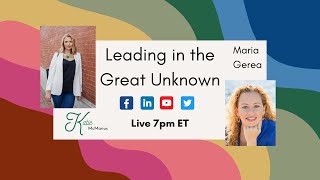
A conversational interview between Katie McManus (business strategist/leadership coach) and Maria Jaria (executive leadership coach) about leading through the post-pandemic "unknown." They discuss challenges of return-to-office decisions, the difference between technical vs. adaptive problems, the need for teams to co-design how they work, and leadership behaviors (listening, vulnerability, investing in connection) that support creativity, retention, and business resilience.
Chapters
I'm Katie McManus, business strategist and leadership coach. I'm here today with Maria Jaria, who is an incredibly creative executive leadership coach. Maria, thank you for being here with me today.
Thanks for having me. I'm here and as I'm so excited. It's been a long time coming, right? I think over a year.
Over a year, yeah. To have you here. Oh, gosh. And I'm all of a sudden getting all the things that I'm live. Whoa. I'm really popular. Anyway. But we're talking today about the unknown. Yes.
And the unknown is also the fact that I'm also. I didn't mention, you know, I am a leadership coach and I'm an executive coach working with people, with leaders, team leaders and teams. So you want to make that known.
Oh, yeah, yeah. So while we're talking about the unknown in the. In the corporate leadership and development space. Really?
Yes, yes. And you and I share some, a lot in that, you know, appreciation for what people are going through currently and working with the unknown with our clients. And I think, you know, what, you know, I wanted to make real right now that also the unknown for me is this live thing because I. I'm on my first live with K. Right, right.
Well, live. Yeah. So you're based out of the Seattle market, right?
Yes, yes, I'm in the Seattle market. I have been here for over 22 years, working in the corporate world and deciding about 6 years to take a. Make a move towards leadership development because of the things I was seeing in. In organizations, how people were people's value, people, talent were under utilized. The potential to connect teams and to really innovate was completely unutilized. And I'm a believer in human potential and I have a lot of passion around that. So leadership coaching was the. The path. It was not a linear path for sure. It was a lot of unknown. Speaking of the unknown, I often get asked how I got here. And it's. There are many strands and ways and detours that got me here. And that's actually how we're connected. Right, Katie? Through that leadership development.
Exactly.
Coaching world. Yeah. Yeah.
So, I mean, well, the last two years have dealt the world a hell of a lot of unknowns. Not just like, what is this new thing that's happening in the world? And also the unknown of how do we deal with it? And not only how do we deal with it, how do we handle it in a way where we get to lead the people who are beneath us or behind us to also be able to handle it well. And we're now seeing this whole shift back into the workplace kind of. And then people are revolting and leaving, and there's just a lot of unknowns. And how the hell do you lead as you go forth? And I'm curious, what are like the main problems that you're seeing happen in this whole shift back to. To whatever the normal used to be.
Yes, yes. And I have to see that. I've seen this moment happen the last. For the last two years, having had that background of working in this. This world and understanding. And we're there. We're at that point where the shift is real, where we. There's no longer the past. Right. We're moving into new future. And what. We don't know what that is. Right. And what I'm seeing, I'm seeing different things. I'm seeing leaders who are companies. Right. Who and have tried a few times over the last year, giving a strong message that we're coming back, people, we're coming back. The offices are opening. Right. So very implicit message. We're expecting you in the building. Right. I'm hearing that. And a big range to the. The other end of the spectrum were. We don't know. We don't know. We're gonna wait it out. We have no direct guidance. I'm talking to people who are interviewing employees, you know, and, you know, the battle for talent. Right. It's real right now.
It's funny, all the companies that are making this big splash about we're going back to the office, we're recruiters are actually using that as a method. They wait to hear it, and then they go and pick people off. They reach out and say, hey, I hear you going back to the office. Do you want to go back to the office? Because if not, I have opportunities for you.
Good strat.
Yeah, I know.
Good strategy. Right? Right. Or this unknown. Right. We don't know. We have no idea. Right. We don't even disclose how we're thinking about it. How are we thinking about it? So. So I think people are left in the dark. And there's. There's like a range between either being too forceful, pushing people back to office, or just to lose about it and undecided. And people, you know, it's. It's. It's risky. Feels risky. Right. To take a bet on those companies. So, you know, intentionalities. And I think we talked about this a bit about how are we actually thinking about this? What is our evolving philosophy? And I think it's more about less than Having answer more about our approach. Right. What is our. The process by which we'll shape the new way of working.
Right.
Yeah.
Well, in a world. In a world where it's like, it's really, really hard to plan on a. On a social level, in a housing level, in all the different ways, even just hearing from your employer that you can plan on one thing can be helpful one way or the other or the other.
Yes, yes. And. And the planning, you know, you can plan on, you know, us having conversations. I see. Wants to get in the conversation here.
She likes knowing when she's going to get food and when she's going to get walks and when she's going to get treats.
She wants to know. Right. She does not want, like, unknown. You know, Kitty, this. This makes me think of. There's simple problems. There's problems like Luna's problems. Right. There are technical problems, right? Yeah.
Like, where are you gonna sit on the couch?
Katie hopefully can provide a predictable schedule of meals and water and walks to Luna. Right. That's like. And Katie became an expert. She's an expert right now, right?
You'd hope so.
And we have a vast amount in the world of work, of technical problems that can be solved by that way of make a plan, execute, find problems, troubleshoot. Right? Yeah. We're not in a. This return to work is not a technical problem. It's. It's adaptive challenge. Right. It's. It's something that will not be done by one plan. And this is it. Right. So that's. We're moving into a very different type of leadership that is needed.
Yeah. And what are you saying? I'm just imagining, like, the leaders. The leaders right now are requiring to be more flexible than they ever have before.
Yeah. Yeah.
Like, flexible and like, ability to change like that.
Absolutely. And ability to be okay. Not to have the answer and actually engage in a dialogue. Right. To see what's in the room, in the virtual room. Right. What are their voices, what are ideas are there? And how can we discern what's actually needed based on the different needs. Right. Different needs. We have needs for individual needs, people need. But you also have team needs. Right. We need to collaborate, and we know innovation can't happen in this very disconnected way. We have. We need that kind of collaborative innovation to whatever business challenges, we have to deal with those. But I'm kind of coming back to us, right, Going through the pandemic, that was a big experiment for everybody, Right. In this adaptive challenge where we had no recipe. So what are. I'm curious about you. What were some of the ways you dealt with it? What?
Well, I mean, I think the biggest challenge for me personally is that I'm an extrovert. I'm an extrovert. And I just happened to be visiting my parents for two weeks in March of 2020, and I had. I had previously given up my apartment in San Francisco. So I was kind of being a nomad for a year, and all of a sudden I'm in my 30s and I'm living back with my parents and I'm having to a. Get my social time from being with them. And they're great people, but they're also my parents and they drive me crazy. And so then there's like. Like having to turn to my friends and being like, can we socialize on Zoom? So finding technologies. Like, for a while, my friend group and I were doing. We found this online platform where you play cards against humanity together. So we'd have a Zoom going and we'd be playing cards against humanity together on Zoom.
Yeah. Yes.
It was just like needing that social interaction and then.
And you're running experiments, right? You are trying different things to see.
Yeah, yeah, yeah. With varying successes. There would be days where I would just be crying, like, what is happening to our world? Is it ever going to go back to normal? Are we all going to die? You know, and then there would be other days. It's like, okay, this is working. This, this filled that cup enough.
You know, there was also that reflection, right, like that you. You needed to do some self reflections. What works for me, what else doesn't, Right?
Yeah. And then of course, all the, like, funny experiments that we were all doing. I don't know if you got on the sourdough starter wagon. I, I was fully on that. I had Maude, I named her. She went strong for about eight months there, but, you know, it was just. Yeah, it was crazy. It's amazing. And I made these amazing friends on LinkedIn. Literally, like, the pandemic was my push to really get in touch there. And I have these amazing friendships with people that I still haven't actually met in person to this day, you know, but finding different ways to fill those cups, you know, and I actually, I'm so invested in LinkedIn these days that, like, if. If someone were to say, you're too busy now, you can't do LinkedIn, I'd be very sad.
Yeah, it's part of. Right. It's part of your tool set, right, that you develop. Right, to stay connected, be connected, and, and to develop. Right. A new way, adapting to a new way of being a new world. And you know, that's the very. That's very similar to what teams and leaders can do. Right. I mean, you included humor. Right? Humor. Creativity in time, dark times. Right. That's. That's necessary. It's an ingredient. We can't just go back in the office and do the same old things and, or go back to some. I see vet is here. Hello. From Delaware. Awesome. Hi, Vet, Welcome. Yeah, so it's, you know, I go back to those off sites and strategic meetings that I've been in and the, you know, glaring neon lights and sometimes a window. Most of the time, no windows. And, and really no spark. No, no creativity. And. And we need a balance. Right. We need a balance of. Of all right. We need structures, we need creativity, we need connection, we need teaming, we need individual needs to be integrated. Right. So I'm, I'm kind of looking towards, you know, I'm looking with a big lens on, on possibility. Right. If, you know, of what can we create right now in the workplace and excitement. Yeah. Yeah.
I love that you're, you're pointing to all this stuff, but I'm thinking of this as a consumer. If I'm looking to do business with a company and I'm seeing them not be able to do this stuff, I mean, I start questioning like, okay, if they can't be adaptive with all these things going on, when other companies are figuring it out and doing it, do I actually want to buy their thing? Because is it really going to be adaptive with me if they're not being adaptive? And then also what's the service going to be like if they're not being adaptive and people are leaving? That's a lot of changeover. Am I going to have a different account manager every single time I call?
Yeah.
You know, so companies really have to look at this not just from a, an employee retention perspective, but from a getting business perspective, because people are watching.
Yeah. The eyes. Right. And it's so transparent. In today's world, everything transpires. We have glassdoor. We have a lot. Right. So, so that's. I love that. I love that. Right. So it's beyond, of course, I mean, your employees are your business, but it's beyond that. It's your business. Right. And the impact you have in the marketplace. Yeah, yeah. So, yeah, I'll tell you a little bit about how I like some of my adaptive techniques. I mean, it sounded similar in that when the pandemic started, I, first of all, One of my things is like I kind of see what's coming, you know, they see a few steps down the road and I'm going into this, how can I invent new, you know, ways to deal with this situation? That's, that's, that's how I operate. Right. Everybody has a different way of being faced with the problem. It's, I'm, I'm challenged with staying with the, with the harder emotions and that's the work. I'm learning myself to be okay, not be okay. Right. Everybody has a little bit of a different challenge. So I'm quickly trying to anticipate and create new solutions. And for me was so the same thing. I'm a very social person. And so probably in the first few weeks I started four experiments really of, you know, one in my daughter's community, school, community, getting on a zoom weekly with parents. One and local, my neighborhood. And finally, you know, from those four different initiatives, there was one that stuck and I never expected it to be that one. I have a group of close, not close friends, but they're, you know, we haven't been that much in touch before the pandemic, but we got into this routine of meeting every two weeks outside initially mostly on site outside the last two years. And that's been really the thing that carried me through. And we share the background. So we went back into that like space of talking about our childhood and music from our childhood and all that. So that was one way to adapt.
Well, I, I love that you're pointing to this because it really points to what companies need to be doing now is, is acknowledging what has changed in their employees lives. You know, what new gems have kind of come out of this. So like for many employees, spending more time with their kids throughout their day because they're not commuting is so special, you know. And how do you, even if you do need them to be back in the office for certain things, like how do you honor that?
Yes.
Because you can't ignore it. You can't ignore it and say, you know, don't care, you're coming back to the office. Like, there has to be some acknowledgment of, hey, this has been such a gift. And also like, we need this. How can we make this work for everyone? Yeah.
And we need this, you know? Yes. And right. We need this. But why do we need this? Right. We need you in the office is not good enough, right? No, we need you in the office. We need you in the office because we think there are certain things Right. That require us to be together to understand each other so we can roll our sleeves and work together on this task. Right. Projects strategic plan. We believe we're more creative that way. Can you know, we believe that probably, you know, a good majority of people actually need that, that personal connection every once in a while. And it's going to be a, you know, a time of, of connecting and you know, the way I talk to my clients is I tell them it's time to invest. Right. Is put money in the bank, in the connection bank by having occasional meetups and then that carries through in the remote work. Right. Because that, that those connection persist what's been happening and I'm curious to hear, you know, what you've noticed. But in the remote space there's a lot of information that doesn't carry through. Right. That you know, all the non verbal communication, all the hallways. Right. That person took their left when they saw me in the hallway. Right. There's so much information that gets missed. Or that person smiled and, and turned towards me when they saw me. Right. That is missing. And our brain, what does our brain do when there's no information?
Yeah, yeah, yeah.
So there's been, I've, I've met, I've coached a few relationships where there are these stories that got created in the absence of physical presence. Right. And people got to a point of contact conflict and we had to untangle of those stories and get to the core, right. You know, of what was real. The real was they are not in the same space and there was no, you know, so no ill intent. No, you know, and yes there were some. We didn't, you know, we did as professional. We didn't learn how to manage this relationships and be proactive in communication in this space. Right. So we need to learn new skills. So that's, that's the, the point, right. To learn to be together in this new way. We need some space time together and build those trust bridges.
Right?
Yeah.
Yeah. Well, it's interesting. I have a friend who's a fashion designer and you know, during the pandemic they had to like look at colors digitally. But I don't know if like you've ever shopped online for clothes. Like you're like, oh, that's a gorgeous color. And then you get it and you're like this is hideous. I don't want this, this. So there's different ways in which companies are like okay, cool. Like this part we do have to do in for in person. But this other part doesn't necessarily have to be that way.
Yeah, yeah. And even that, right. The intentionality, right. You put up, put it up for discussion, right. Is there any other way, right. To get this creativity, this, you know, collabor, you know, collaboration, creativity in a different way. Let's, let's, let's. Because this is what we want, right? That the gist of it. This is what we need.
Yeah. So yeah, I'm curious, what do you see as the future for companies going forward in this, in this area of like bringing people together, like creating collaborative creative spaces? What do you see as the future for that?
Yeah, I see and you know, I am inspired by many thinkers and I'm developing, you know, I'm really have a clear sense of vision around companies learning to manage this, becoming we're babies, toddlers in this space right now. Right. But design teams learning to much more dynamically navigate this move between co located work and distributed work where there are this intentional coming together and they can co design and co create as a team. Right? As a team, they develop this. They own the design of how they're going to work together. And the leaders, the team leaders are those people who are facilitating this design approach to how they work together. This would be in my ideal world right now, in this very moment, all the teams would come together and say, okay, how do we design the way we work together? We listen to each other, right? And every business has their own specific. Then they'll come up with an approach and it can be, you know, occasional, frequent, could be bi weekly, can, could be every other week, monthly. Let's come together for these purposes, right? And be clear about those, what those are. And these are the other tasks that we can do remotely and that's fine. And this is how we'll be together. And the source of this work is really defining who we are as a team, our team identity. Right. So because in a very similar way as people, individuals have an identity and a way of defining themselves and you know, their beliefs, their fears. Teams have identities. So who are we as a team? That's probably the first conversation needs to happen. And that's ultimately the team culture. Work culture is very used, but nobody really can define it fundamentally. But you know, it is an identity. You know, what are our beliefs, what are our fears? What are the things we're hiding away as a team? Putting them more in the open.
Yeah, well, what I love about this is that when someone is a part of a team that has an identity, I can imagine they're far more invested, far more loyal to that team, like they're going to stay with it for a long time, they're going to grow with it, they're going to help other people grow within it. Versus the old model that businesses really believe this is how we bring our business to scale is everyone's a cog in the machine and they can be swapped out easily. That, that no longer seems to be the model that is effective or is even like, yeah, it's not effective. It's not producing great results for the employees and it's, it's in some cases inviting the unions in.
Yes, yes. And it's, you know, we know that's not no longer effective. There's research that's no longer effective. So the matter is just leaders being brave enough. Right. To step into the space of unknown. It is unknown. And to actually start rediscovering. Right. A new way of working together where they listen more. Right. Where they're able to not be the one who knows it always has the answer. Right. When you know, they can actually be challenged and be okay and actually appreciate being challenged because they know new ideas and better ideas are going to come in.
Yeah.
So that's, that's the new model, right? That's. And having a sense, I mean there's always people and we need anchors. Right. It's like the you unknown is, is scary enough. Right. So having a shared sense of why are we here. Right. Our sensors, sense of purpose. Right. That why are we doing this? For the sake of what you know. And yes, the team owning. Right. Owning this. Right. How we're go. Who are we are, how we're gonna grow. Right. Learning has to be out. You know, I love the lol. Learning out in the. Out loud, right? Yeah. Yeah. So learning out in the open, owning right. How, how we are, how we work together as a team is motivating, I think gives people ownership.
Yeah, yeah. You know, it's. I had a thought. Where to go. Well, there, there's a certain level of autonomy that mid level managers like in this model actually get to step into. They actually get to step into some power. But it requires a new set of skills where they get to speak power, truth to authority, tell their bosses what their teams need and advocate for them, which I think fosters greater leadership abilities that they can climb higher and do better work in higher ranks.
Yes. Yeah, yeah. And that's, you know, that's really one of the reasons many mid level managers started leaving right. Right now. So with this opportunity. Oh, I have William from Nigeria. Hello.
Welcome.
Hi William. Yeah, so that's, that's right. That's a win win. Right. It's, it's the team benefits and you have retention there, building an employee retention there where you give leadership opportunities. Right. And we, you lift leadership in, in the organization. Yeah. There's a report from like even four or five years ago that was showing people leaving because of that lack of development stretch opportunities. Right. They, they were disengaged. People are disengaged. And when you create this collective sense of ownership for how the team operates, how the team performs, then it's, it's a different ball game. Right? That's a very different ball game.
Well, even on the employee level, you know, if I'm an individual contributor and I'm part of a group of 10 people and we have to sit down at the table and design how we all work together and design like what expectations are and we all have a say at the table, you know, if I then apply for management, I've already been part of that conversation. And so it's so much easier to then lead that rather than me just doing my own job and staying in my own lane and all of a sudden I'm a manager and I have no idea how lead people, which is the classic problem that happens in sales and engineering in any, any, you know, org structure that you have individual contributors who are responsible for their own work and nothing else.
And yeah, and in the empowerment. Right. That comes also with, I mean, how much permission right now to oh, you, you can, you contributed this, you contribute your ideas. Welcome are welcome. Your idea, ideas are needed. So how much more innovative potential you are building in, in the fabric of the, of the team. Yeah. So I, I, I, I'm, I'm really excited by what's possible. Right. Not seeing as a problem to be solved. Right. But as something, and that's, that's what I want, you know, leaders to move away from seeing things as problems, stay reactive. Right. And getting in touch with, you know, what's, what's, what are those fears and you know, the things that get them in this very active mode. Right. And then moving more towards why where's the possibility, where's the opportunity here, right. To lead differently, to create something new to, you know, empower others, to lift others and, and really there's, honestly, I mean, I, I mean, Katie, I'm curious, you know, what you're thinking, because I, I don't see another, a different way. Right. I don't see there's no other way to go about it in this, you know, Linear problem solving way where we're going to dictate this is how it's going to happen, it can be that way.
I mean, I think some companies will absolutely continue that way. I don't think they're going to continue to be the most innovative. I don't think they're going to continue to have an advantage in the marketplace. I don't think they're gonna be competitive in attracting top talent because top talent wants a say. They wanna, even if they're an individual contributor, they want to have their voice heard. And right now we're moving towards this market, especially in employment where employees get to say what they want and they're getting it.
They are. Yes.
And one of the things that I'm seeing also with unknown, is that, you know, even if a company can't necessarily say what the plan is going forward, if they're able to say, here's our top priorities, your happiness, at least employees can trust in that. Especially if the company's, you know, showing up in some other way and proving it.
Yes. Right. You have to show it. Right. You have to back it up somehow.
You know, it's like you can't, you can't post like, you know, Black Lives Matter and, you know, Black History Month one month of the year and then not do anything for diversity and inclusion the rest of the year. Just completely hypocritical. You have to actually show up and do something to show your, your employees that you're, that you're caring about them.
Yeah. And, you know, it's so easy to see through those, you know, those checking the box. Right. People see it. People are savvy to see through it when a company is truly committed and, and honestly, when a company is owning mistakes. Right. Hi, Christian. Thank you. Yeah. So employees are savvy now by now to see it. And, and really, I think part of the repertoire of being true is to own mistakes too. Right. That's when you're actually reaching, you know, higher level of integrity when you own the mistakes and you, you know, commit to making better. Yeah.
In point, like, you can't have a creative environment if mistakes aren't allowed.
No. Yeah.
You know, no one's gonna be willing to try new things if, if making mistakes and failing is going to be super punished.
Yes. I love that. That's such an important point. And that's kind of. You asked me, like, what's the, you know, what I do, I see going forward, I think I see teams be much more open about, you know, the things that they Want to develop and the. Their shortcomings, individuals, teams. Right. Putting that out, you know, in the open and not covering their, you know, ass in the, you know.
Under the bus and.
Yeah, exactly. In, in, in, you know, because that becomes the work becomes that. Right. Covering their mistakes and their challenges versus focusing on the real work, which is their product or whatever they're creating. Right. So once you're able to reveal as a team, like, this is what I'm struggling with, and leaders go first. Right? Leaders go first. And it has to be authentic, then, you know, we go and we go more in that territory of mistakes are okay, how do we learn from them? Right. What's to be learned from them?
Right, Right.
Yeah. Yeah. There's always this fear of, oh, if I'm gonna share my mistakes or my shortcomings. Right. Then what I'll be, oh, well, it's.
So instinctual to, like, make a mistake, have it happen and have other people, like, have it happen in a way where people are going to find out that something went wrong. And your brain just automatically goes to, how do I cover this up? How do I make myself look good? You know, I did this. So my brain went through this last week. So I'm interviewing to. To create some more content for copywriters and lawyers because I'm getting more and more of them as clients, and I messed up something in my booking, and so people were getting booked over each other, and I was able to very quickly fix it, but I already had these appointments set over each other, and I'm like, oh, my God, like, what do I tell them? Do I tell them there is a mistake? And it's like, no, you tell them that you made the mistake. You know, but it's like, I train on this, and I also, my brain automatically goes to, how do I not look bad?
Yeah, we do it, right? We do it. I. We. I, I. Yeah, I know as you are talking, actually, I was thinking like, oh, look how good of a talk I give. I'm really good at, like, the, this theory thing. And, you know, I'm also, you know, I'm. I'm trying really, as much as I can to eat, you know, what I'm preaching. But I'm also not, not, you know, I'm. It's hard. It's really hard. We have this Personas, right. That we've cautiously, carefully cultivated. Right. And got us to a certain point.
Right? Yeah.
And now all of a sudden, we actually have to say, you know, actually, not really. So, but yeah, there's. There's a growth. Right. That comes. There's a growth that. That is needed. Where we no longer define ourselves by how others are seeing us or by how we believe we're strong. You know, each of us have different beliefs of what makes us strong. We define ourselves more by, you know, what really matters at the end of the day in my life. Right. Or for our team. That sense of direction, of purpose. Yeah. And speaking of the unknown, I. I remember this. You know, we don't have a roadmap right now, but what we need is a compass. Right. As leaders. Yeah. And that's the sense of purpose. Our values are that compass, I think.
Yeah. And that's essentially how you make decisions going forward. Yeah, absolutely. Final. We're coming. We're past a half hour. Oh, my gosh. Blown by. I'm curious, what's your final word of wisdom for anyone who's leading people right now?
Oh, yes. Expanding that capacity to listen. Listen and asking questions and getting very curious about what's. What's important for people individually and also for the team. So don't, you know, both. Right. Speak to people, talk to people one on one, but then also get together as a team and listen to the collective. What. What's needed and what's important for them.
Great advice. And if people wanted to get in touch with you, what's the best way to do that?
My LinkedIn.
Beautiful.
We're linked here, so it's perfect. Yeah.
Maria, thank you so much for joining me today. This has been so much fun.
I don't know why we. I've wait, I. I thought me for over a year, but here I am. And yeah, it's been really fun. And we'll do it again. Yeah. Thank you.
And thank you, William and Christian and Yvette for joining us today and everyone else who watched but didn't comment. Thank you for watching. I'm Katie McManus, business strategist and coach. This is Maria Jaria, executive leadership coach, and we will talk to you all soon. Have a great Friday. And this is new, so I have to figure out where the end.
More from Katie





How to do self care right now, so you can do what needs to be done, for yourself, your business, and

How to do self care right now, so you can do what needs to be done, for yourself, your business, and

#greenscreen How to build a consulting business that makes you $200,000-$700,000 a year

#greenscreen How to build a consulting business that makes you $200,000-$700,000 a year

Maybe we’re not the imposters…? #businesscoach #startup #entrepreneur #smallbusiness #consulting

Maybe we’re not the imposters…? #businesscoach #startup #entrepreneur #smallbusiness #consulting
