Magic of Marketing! With Tyler Cook!
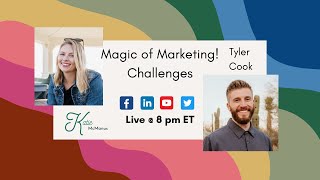
A recorded conversation (YouTube) between Katie McManus (business strategist/leadership coach) and Tyler Cook (Hypermedia) about using short marketing "challenges" as an effective way for coaches, consultants, infopreneurs, and product businesses to attract attention, build memorability/trust, and convert prospects into paying clients. Key points: marketing framed as three steps — (1) a good offer, (2) get attention/memorability, (3) catalyst to purchase. Challenges flip the hard-sell model by delivering a small, demonstrable win in 3–7 days, creating trust and qualifying prospects. Tactics covered: run paid or free challenges, leverage organic social (LinkedIn, Instagram), partner with complementary audiences, use email lists, include simple promotions (email signature, posts). Examples & metrics discussed: a client with ~7,000 LinkedIn followers ran a paid $97 challenge and got ~40 participants; ad spend of ~$1,500 produced ~15,000 page views over three months while 8 Instagram reels produced ~15,000 page views in seven days. The session closes with a plug for Tyler's webinar on running challenges (Tuesday the 24th) offering a detailed case study and backend metrics.
Questions this video answers
Tuesday the 24th.
About 7,000 followers (LinkedIn reported just over 7,000).
$97.
About 40 people.
About $1,500 spent over three months produced ~15,000 page views to the offer.
Chapters
Oh, I can taste yo, yo, yo.
Yo I can taste yo, yo, yo.
I can taste yo, yo, yo I can taste yo, yo, yo I can.
Taste y.
Hello, I'm Katie McManus, business strategist and leadership coach, and I'm here today with Tyler Cook, my man from hypermedia. Tyler, I'm so excited to have you today.
I am really excited to be here.
Did you like my Hype up music?
I did. I was dancing along to it, to be honest.
It's catchy, right? Yeah, I have a lot of fun with it. Anyway, we're here to talk about the magic of marketing, and you're my marketing guru. So I. I mean, when you think of. Of marketing, what is the first thing that you want to start with?
Yeah, I mean, marketing really can be quite a nebulous concept, right? Like, what exactly is marketing? And so really, I think about marketing kind of in two ways. So one way is really just getting attention onto you, your offer, your business, whatever. So it's really that however you're getting attention, and then also with that is creating demand for. For your product and services.
Right.
Is typically how I generally just categorize marketing.
Oh, and we have Debbie Cook saying, looking good, Tyler. I imagine you guys are related.
That is my beautiful mother.
Hi, Debbie. Nice to meet you.
No embarrassing stories in the chats.
Can we have some baby pictures, please? Just like in the chat, please. I love that, you know, it's. You know, I love that saying, like, you can't be a secret and a success at the same time.
Oh, so true.
So true. Right. But, like, it is, you know, and I have this philosophy that small business owners don't have really a marketing problem. They have a memorability problem.
Yep.
Right. You have to be remembered for people to be able to buy from you.
Yes. Yep. Yeah. And, like, you know, when I think about, there's a lot of marketing gurus out there that teach very complicated systems and processes and all of those types of things. And when I'm thinking about a marketing campaign, it really can kind of be broken down into three steps, and you kind of nailed one of them is that memorable step. Right? So step one is you have to have a really good offer. You have to have something to sell right. Before you can do any sort of marketing campaign. So that's kind of step one is having a really good offer. Step two is getting attention on that offer, right? Becoming memorable, getting eyeballs on that stuff. And then step three is having some sort of catalyst to get people to purchase. Right. Whether that's a sales call, emails, text messages, all of those things. Yeah. Attention and memorability. That's a big one.
Yeah. So, I mean, you pointed to a couple things that kind of direct us into the topic for today. Is that challenges, you know, a way to get attention and a catalyst to get people to enter your world and potentially become a client.
Yeah.
And if not become a client, at least get an experience of you so that they're. They remember you and maybe want to be your client someday.
Yes. And. And like I said, for coaches, consultants, infopreneurs, in my opinion, challenges right now are the best way to do that.
Now, what makes you say that?
So there is. So there is so many promises that have been.
I'm sorry, Nathan. Nathan wants you to know that you're rocking the beard, my man. We're getting a lot of, like, appearance compliments. I'm getting a little. I'm feeling a little left out.
I work hard to maintain this. Yes.
As.
As a good friend calls it, the. The flavor saver. Yeah. That could be good or bad, but so funny.
I'm sorry, I completely interrupted you.
No, you're totally good. Totally good.
I'm back to what. What makes challenges really, really helpful for infopreneurs, coaches, consultants.
Yeah. So, I mean, when you look at the marketplace, I mean, you're scrolling through Facebook, you're scrolling through Instagram, there's so many ads out there now that's like, purchase my course, and you're going to solve all of the world' problems. And the claims have to get bigger and better. Right. All the time. Because all of these infopreneurs are kind of competing against each other, even though they may not have the same topics. Right. They're still kind of competing against each other to get that attention. Oh.
I mean, I'm in the business coaching space, obviously, and there are so many business coaches out there that are like, get you to seven figures. I'll get you to seven figures. And it's like most. Most businesses shouldn't be at six figures or seven figures.
Right, Right. And sometimes those claims. And sometimes those claims don't work because you're like, I'm trying to get from, like, two grand a month to six grand a month. Right. Like, get me there first. And so. Yeah. Yeah. Every day, I mean, I get hammered with them. Yeah. And what. What. What the challenge is, is, is that it's all of those claims become less and less believable. Right.
Yeah.
And so how do you. How do you kind of, like, combat that? How do you. How do you approach this from an opposite way? And that's why I love challenges, because basically a challenge kind of flips that model on the head is it says, instead of saying, hey, purchase my course, where I'm going to get you to seven figures in, you know, eight weeks or whatever, the challenge really goes, let me get you a small win in like five days.
Yeah.
And then if you get that win, then I'm going to tell you about how I can get you to seven figures.
Right, Right.
Or, you know, whatever your actual offer is. But it kind of flips that on its head right to where now you're offering value. Right. The whole nebulous also saying, just provide value. You're. You're actually helping somebody get a solid result.
Right.
Which builds your credibility, builds your trust. Right. With that prospect in a fairly short amount of time. And so it takes that purchase because you think, I can get you some results to, hey, you should purchase because I actually helped you get this small win. Right. How cool is that? That totally changes the conversation.
Yeah, well, what I'm hearing you say is, like, you're creating trust, you're committing, creating community, and you're creating that connection. Whereas, like, going on social media and just like shouting out like, here's some helpful advice. It's kind of like that weird old man that sits on a bench in the park. And like any young mother who comes up, he's like, do you have a leaky faucet at home? Because here's how you should fix it. And like, that's useful information. I don't really need it right now, you know?
Yes. Creepy old man.
Thank you. We have a great question in the chat from Nick. Chief, how do you do that with no marketing budget? What is the most uncomplicated or easy.
Suggestion to run a challenge? Just a little clarification about that. How do you market with no marketing budget?
Nick, if you're here and you're willing to clarify your question, let's go with that. Yes. And then if it's something different than Nick, please clarify, because I think this is useful for many people.
Yeah. Yeah, good question. So without a marketing budget, I mean, there's a couple, there's a couple of avenues that you can pursue. And one of the reasons, I mean, so there's a lot of reasons why I really love challenges right now. One of the many, many reasons is challenges are somewhat like inherently shareable and kind of exciting. Right. And so if you don't have a marketing budget or you have a very small marketing budget, okay, perfect. So, yeah, we're heading down the right way. A couple ways to advertise these. Include it in your email signature. Right? It's an easy offer to include in your email signature. Join my five day challenge. Right. It's also an easy, it's an easy offer to go out to other people who speak to your audience. Right. And say, hey, let's partner up on this. I'm doing a five day challenge and you can work out whatever you want. I'll give you a split of the back end profits or I'll share all of the leads back with you. Like, there's a lot of ways that you can do that, but it's an easy offer to go to other people and kind of get in front of their audiences because they're like, oh yeah, my audience does struggle with this. So yeah, I'd be willing to help you advertise. So those are a couple of big ones that I've leveraged quite heavily in the past. Also, if you have an email list, send that out as an offer to your email list most definitely. And advertise it on LinkedIn. Right. So just recently I wrapped up a challenge with one of my clients. Her, her audience is not going to be on Facebook. She targets very high executive women in Australia. And so we primarily did everything through LinkedIn. We had 21 days of social media posts and we were able to get about 40 people in her challenge just from LinkedIn. So consistent posting there.
Do you mind me asking how many like followers, connections she had or do you not know?
Oh, I don't know. Off the top of my head. It's a good question. You want me to look it up real fast?
Yeah. Do you mind? I love snooping. I don't want to out this person, but I want to.
Yeah. I didn't get permission to like, who is it?
Tell me all the details. What does she do? No.
Okay, so.
And if you're just joining us, we're doing a little LinkedIn snooping because I had a question about how many followers someone had because they did a challenge and it was really successful. And I want to give everyone like as many details of like, you know, what level of success you can, you can accomplish here. But also you said that her, her ideal client was like very successful executive women in Australia. So a small population of people.
Yeah, Very, very specific type of people.
Right.
And demographically and also geographically.
Right, right.
And she's gotten a lot of her leads historically from LinkedIn. So she's invested a lot of time on LinkedIn. So she's got about. LinkedIn was reporting just over 7,000 followers.
Okay. Yeah.
And so, yeah, we got four and 47,000 followers. And 40 people may not sound amazing, but this was also a paid challenge, so we actually charged $97 for it because of her audience. And so that's pretty solid for no marketing budget. So that's. Seriously, if you don't have any marketing budget, figure out where your audience is spending attention, start posting there consistently about it. And if your challenge is like, if the topic is exciting to them, they're going to join. Yeah, right.
Yeah. So it has to. So I'm hearing it has to solve a very specific problem that people have.
Yeah. What I say your challenge, you should design a challenge that gives somebody the smallest big win you can. Right. You want the challenge to be short, you know, five, three, five, seven days, and you want it to solve a very, very specific challenge. So that's why I say solve a small big win for them.
Right, Right. So, like, if it's a weight loss challenge, like, we're gonna have you drink enough water that will support you losing weight. Yeah, something like that. Okay.
Yeah. Another challenge that I did kind of in that same vein with the health and Wellness is a 5 day healthy habits challenge. So each day we introduced a new habit to help people build a good solid morning routine. And that was like day one was drink 16 ounces of water after waking up. Right?
Totally. Yeah. Andrea. So Andrea wants to know what are the most exciting topics you recommend? And I actually have a question for Andrea is what industry are you in? Because it's going to depend on a lot on who your ideal client is and what kind of things you do for them. But like, Tyler, do you have an off the off the cuff answer to that? Of the best topics, the best topics.
Are the ones that your audience cares about. There's actually a pretty good strategy that you want to think about when you're thinking about the topic. So when I'm working one on one with a client, one of the things that we do is we. We look at client milestones. Right. Okay. So life and business coaching. Okay, perfect. So the. So Andrea. Andrea. Hopefully I'm saying that correctly.
Andrea. Andrea. I vote Andrea. You say Andrea. Andrea. Just tell us who's right. But continue. Tyler. Sorry.
The first thing that. To do some coaching here for you real quick. The first thing that you want to do is you want to think about your offer and you want to think about the milestones that people progress through. Right. So typically that's going to be three to five stages. Right. Where the first stage, they're kind of almost too new to probably work with you. They're probably not a good fit for you Right there.
We're both right. I love that. I love being right.
I love it. I love it. And then stage five is they essentially don't necessarily need you anymore. You've gotten them all of the results that you can. Right. And so where I find the best challenge topics exist is right at the tail end of stage one and right at the beginning of stage two. That means that they've progressed far enough in their journey that they're like, oh, crap. Like, there's a long way to go before I get to stage five.
Yeah.
And I probably need some help, and I don't know how to get there. And so that's typically what I have clients sit down and figure out is we figure out what those milestones are, and then we categorize, okay, what does stage one look like, what does stage two look like? And how do they progress between those? And then we dial in, okay, here's the small, big win here. And then we launch that challenge.
Right. It's funny. You're describing the steps of competency. Have we ever talked about this before?
I don't know if you're gonna talk about it.
I'm gonna draw something. Hold on. Oh, I'm out of paper, so I'm gonna draw on the cardboard. Okay. It's gonna be very artistic. Tyler. You're gonna be so blown away by my talent. Okay, so these are. These are the steps. So the first step is unconscious incompetence. So you have no idea what. Like, you know that you don't even know something. You're completely unaware of it. And then you kind of, like, learn enough to realize that there's stuff you don't know. That's the second step. And the third step is conscious competence. So it's like, you have to try really hard to do it well or to do it at all. And then unconscious confidence. So, like, driving a car. So when you're a baby, you don't really. You just kind of, like, get transported around. You have no idea. But then you're a kid, and you kind of realize that mom and dad know how to drive the car, and you don't know how to drive the car. There's, like, stuff involved, and you have no idea. And then you get your driver's permit, and you kind of, like, have to try really hard, and then all of a sudden, you're in your 30s and you can. You don't even remember getting behind the wheel to drive to the grocery store.
Yeah. Oh, that's amazing.
So you're trying to get people just as they, like, realize the stuff that they're incompetent at.
Yes. That. That's like the sweet spot. Yes. Realizing that there's that gap.
Yep, yep, yep, yep. Yeah. And then Carol has a comment. So there's so many challenges out there, it becomes noisy.
Yes. Yes.
Yeah.
An aha moment. I love that. That's perfect. Thank you. And you're not wrong. There are a lot of challenges out there right now. The good part for you is a lot of challenges that are done. Are done not well. And so while it's noisy, it doesn't actually take that much work to make your challenge kind of stand out against all of the rest of the noise.
Right, right.
Which is really awesome.
So. And I imagine part of that is just having a really engaged audience.
Yeah, Having. Having an engaged audience. And then also really thinking about kind of that. That topic that you do want that challenge on. Right. Really thinking about that pinpoint. Because so from my experience, how a lot of people will come up with challenges is more. More along the lines of this. Well, I always get asked this question. So I'm going to design a challenge around this question, which isn't necessarily bad, but the reason why I don't kind of approach challenges from that point of view is because that doesn't. That. That only solves, like, one piece of a larger challenge for that person, if that makes sense.
Right.
And it doesn't that. That that question may or may not be directly related to what you actually are going to be selling them.
Yeah.
Right. Versus if you sit down and you're like, okay, clients progress through stage one, two, three, four, and five, and I want to get challenged. Right. As soon as they're entering six, stage two, here's what they look like. And you design a challenge around that. Guess what? Well, the people who are coming into your challenge are going to be interested in the service.
Right, Right. It's like, I'm running a challenge and you're actually helping me with it, and I'm super excited. It's my very first one. Social to sales. If you're interested in this, please register. I'll share the link later. But anyway. But like, if I were to share a challenge, it's like how to train your orangutan. It would be interesting. I'd have to learn how to train orangutans first. But like, it's not useful to any of my clients. I don't work with orangutan trainers.
Okay, can you reveal some, some real data about your challenge? Is that okay?
Yeah, no, please. No, I'm very open. Yeah.
Okay. So, so some back conversations because we've been talking about running a challenge for probably three months at this point.
No, we've been talking about running a challenge for like eight months. And I keep chickening out because there's so many steps to do it well. Like, there's just a lot of steps to do it well. And like, I, I'm a perfectionist. And the thing that holds me back the most is like, well, I want to do it perfectly. And I don't know if anyone in the audience can relate to that.
Well, it's, it's also nerve wracking too, because you have me saying, you know, you want the client to see a result in five days.
I know the pressure is on, you know.
Okay, so we've been talking about this for months and we've actually gone through like four or five different topics. I know. We finally settled on, on social to sales. Right. So to get, to give the audience some back, some backstory here. The first one that we talked about was a five day challenge around sales calls.
Yeah.
And how to design your sales call and kind of move forward with that. And then we were eventually like, ah, but, but this is kind of like too far down the process.
Right.
If somebody started getting sales calls, they, they don't necessarily need a challenge around that. So then we. Another topic was no distractions. Yeah, yeah, you remember that. That was like one of the more recent ones that we talked about is doing a challenge around. Let's see, what was it? The, the, the, the five things you need to do every week or something like that to grow your business.
Yeah, the three things. Yeah. And it's, it's actually folded into sales, but it's like, it's a small piece of like what people need to start doing to be successful.
Right, right. So we kind of walked it back just a little bit. And then what we really focused on was using social media to get sales calls. Right. To actually get people to reach out to me. Because at that point what we realized was like, okay, for your ideal clients, they're, they're kind of at the point where they've got somewhat of a stable business and now they need to kind of grow that. And oftentimes they don't have a huge marketing budget. And so the default is you have to build A very engaged audience through social media. And so that's kind of the process that we went through to get here. Right?
Yeah, well, and it's funny, like, they, they've done really successful things. Like they, they know how to reach out for referrals. You know, they give like, complimentary sessions and like, they network really well, but there's nothing that they know how to do that isn't, like, really active on their part. It requires, like, a lot of activity for them to go and hustle and get those clients. And it's just a lot of work.
Yes.
When posting on social media, like, okay, like, it is work, but it's not that much work. You're not collecting business cards at the BNI meeting and then calling through everyone and like meeting everyone for coffee. Like, I don't know, I don't know about you. If I have more than three cups of coffee a day, I break out. I can't do it.
Nice. I love it. No, I mean, social media is very powerful right now too, because the way that I think about it with my marketing background and advertising background is I had a client a little while ago who had a very, very limited marketing budget. And so over the course of three months, we spent about 1500 ads. So in advertising, like, that's not a lot of money. And we generated about 15,000 page views to her offer. Right. Versus. And that took like three months to get there. Right. She did, she did eight Instagram reels and got 15,000 page views in seven days. Right. So it's like, go where the attention is. Right. Because it. One, it's, it's sort of free. Right. It takes a little bit of your time. Yeah. Yes. Lol. But that just gives you kind of a framework of reference of if you don't have a huge marketing budget, invest that time and energy into organic social. Because you're gonna, you're gonna kind of make up those page views for free.
For free. Yeah. Yeah. I mean, it really. I mean, you know, five minutes over coffee, you write up, you copy and paste some of the, the copy from your email for your challenge.
Yep.
And you write a post. And here's, here's what's gonna help you with. And if you wanna register, the link is in the comments for LinkedIn.
Yep.
Yep. Yeah. So simple.
It's so simple. And, and if you want to, if you're interested in running a challenge and also taking some content, building some content, if you have a client who you can use as a case study, one of the best things to do as well is reverse engineer their case study. So just pull out one win for that client and say, hey, this person. I was able to help this person get this result. Here's kind of a step or some and, you know, some random insight into how we helped him get there.
Yeah.
Did you know that I'm running a challenge about this kind of to like get you on the right journey. We'll join here. Right. That's how I use. That was the process that I used for a webinar that I did a while back about challenges. And, and I had tons of people sign up from social media by doing that. There's a result from a challenge that I ran for a client. Here's kind of how we got it. If you want to learn how, join me for this webinar. Here's the link. And I had, I did that solely on LinkedIn myself and I think I had like a hundred ish, give or take, people sign up for a webinar just by doing that.
Yeah. Yeah. Well, and here's what I love about challenges, and this is how you sold me on it, is that like, you get, if you're a small business owner, it's not like you're looking for, you know, 300 new clients. You can't handle that.
Right.
Especially if you're in this like, infopreneur space, as you, as you call it. I love that term. But like three clients is, is awesome. And if you can do like three clients every two months, you know, especially if you're charging a lot for your offer, that's incredible for your business. That's game changing for a lot of new business owners.
Yeah. Yeah. Like I said, I could talk about challenges for a long time because I've thought a lot about the whole process. Right. One of the other things that I really love about challenges is it, it's just a very good offer. Like when you think about white papers or ebooks or lead magnets or not lead magnets, like PDF downloads.
Yeah.
I always kind of get the feeling that people are like, I'm doing this because I see other people doing it, but I don't necessarily. Like, I'm not like, me personally as the person who's providing this resource. Like, I don't even love it. So, like. But I'm to do this because people told me to.
Right, right, right.
Versus if you ran a challenge for five days and you had, let's say 10 people join the first time. And you know, because some people get busy, some people don't finish the challenge, or whatever. But you had seven people actually finish the challenge and get a good result. Like, how much more excited and bought in are you to that challenge to where you're like, oh, my gosh, this actually works. Like, this is amazing. I gotta tell everybody that you get excited to share it.
Right.
And then just because you're excited, other people are like, oh, yeah, like, I can do that.
Like, email.
I'll do it.
Yeah. Well, what I love about this is, like, it's so active for people to be in challenges. You know, you made that great point about lead magnets. The way I see lead magnets is like a bookmark. You know, I'll download, load someone's lead magnet just because I want to remember who they are. And I know that if I do that, I'll get added to their email list and they'll remind me who they are.
Right.
Whereas the challenge is like, no. Like, this solves a problem that I want right now. I'm going to opt into this. I'm going to be there. I'm going to be present at least for a few days.
Yeah.
You know, and get more of an experience to this person.
Yeah. So let me ask you this question then on the reverse side, as thinking about that you just signed up for somebody's challenge. Right. When you see their name in your inbox, do you pay attention to it OR no?
Oh, 100%.
Yeah, yeah, yeah. So you start actively looking for their content. How often do you remember? Like, they're not necessarily, like, you know, just randomly, but when you're, like, doing things throughout the day that are somewhat related to the challenge topics, like how well do you remember that brand?
Oh, so well.
Yeah. Which goes back to what we were talking about before. Right. Creating that memorable brand.
Yeah. Well, like, a great. A great example is, you know, I. I'm on Instagram a lot. I really like Instagram. And Instagram has figured out the type of clothing that I like to wear, or at least the type of clothing that I like to pretend to shop for. You know, I put it in the cart and I never buy it. But anyway, so I'll go on and I'll like, you know, give them my. My phone number or my. My email so I can stay in touch. And sometimes I get. I'm like, I don't even remember what this brand is like. Obviously, it's a little more difficult with clothing brands. They could run a channel, a challenge. I don't know. I mean, they actually could. That might be an interesting sell for them, but. But it Would be so much more memorable if they were like cool. Like let's go through your own, your closet and see what's missing.
Yeah.
What staples do you want? I would remember them so much better from that.
So you bring up such a good point. So for service based businesses, typically a good challenge is going to be helping somebody see some sort of result that you offer. For a product based company that wants to do challenge, generally what I suggest is doing a challenge around an action or something like that related to the product. So I mean your, your use case is perfect if you, if you have a clothing brand, hey, we're going to up level your wardrobe in five days with this challenge. You don't even have to purchase like our clothes. We can help you up level. An E Commerce client of mine has a red light therapy device. Decrease your pain and your inflammation in your knees.
Yeah.
And then you're doing. Interesting. Yeah. Super awesome. It's like amazing. This company is going to be like a hundred million dollar company. I'm super excited about it. But so right now we're actually working on a knee pain challenge. So it's going to be a five day challenge where we're working with a couple of high level physiotherapists that work with like the MLB and they're putting together a five day challenge. These videos where you just do these, this exercise each day for five days and it'll help reduce your knee pain. Right. Has nothing necessarily to do with the product.
Right.
But we're going to use that to bring interested people into, into their list. We'll educate them a little bit and then we'll say hey, we have a product that kind of helps solve this as well.
How about you purchase. Right, Right. Which I mean like I'm not signing up for that. I don't have knee pain. Knock on wood. But Barry Bonds might. He had a knee replacement surgery.
Yep. High intensity athletes, you know, boomers.
Yep. Literally my, my aunt Anne's just had knee replacement a few months ago and then while my computer's gonna die, while my Aunt Vic was helping her get ready or recover, she realized that her hip was going. So she literally just had hip replacement surgery. A bionic family. But, but yeah, no, I love, I love that idea for something that's a product. It's not just for service based businesses, it's also for products.
Yep.
I was honestly just making that up for the, the clothing brand. But I like that idea. I should pitch it to them.
You should pitch it to them? Yeah.
They'll make Me more fashionable except for my, you know, outside of my, my dog park gear. Um, anyway, so we're coming up, we're, we're over the half hour, but Tyler, you're running a training, a pop up training webinar on how to run a challenge.
Yes.
Yeah, yeah, yeah, yeah.
So it's going to be in a couple of weeks to give, to give me enough time to advertise it for myself. Right. But really what we're going to be talking about with that is I've got a case study. So one of, one of the clients that I worked with, actually, the Healthy Health Habits Challenge client that I mentioned a little bit earlier, she gave me permission to basically reveal all. And so it's going to, that's going to kind of give some high level education about how to structure a challenge, how to think about the challenge, why challenges convert so highly. And then I'm also going to show you exactly how we designed that challenge, what each page looked like. She even gave me permission to share her emails, which is crazy. So you can see the exact emails that we sent out and she. Outside of specific revenue data, she let me basically pull all of the metrics for you. So you can see the conversion rate between the opt in page and the thank you page. You can see how well each email converted and things like that. So she agreed to do a ton, reveal a ton of back end information for us and so join me on that webinar. Katie threw in the link to register because you'll get one, get a ton of information about how to run a challenge, how to think about a challenge, you'll get some resources so that you can launch one on your own and then also, yeah, I'll deliver those resources there for that. And like I said, the best way to grow right now. So I'm like join, you know.
Yeah, absolutely. And if you want to see so literally everything that Tyler's going through in this webinar, like I have gone through it, it's a lot of writing but it's actually pretty simple, you know, to put together in a challenge. So like if you're curious about my challenge and you want to see at least the landing page and see how it goes, like just click on the link there. But tell you, this is like such a gift to people because really, like, I mean getting, getting clients is the biggest hurdle that any new business owner has.
Yeah.
Especially when you don't have a marketing budget, so you can't really invest in help. And there are a lot of charlatans out there trying to sell you stuff that, you know isn't verified. And I apologize. My dog has a toy and she's, like, making a ton of noise in the background.
You're totally good. You're totally good. And the other thing, too, that I found is how do you. How do you stop giving away your consultations for free? Right. How do you hop on? How do you have those sales calls with people that are actually interested in purchasing? Right, right. And a challenge is a great way to do that because they've already shown that they're willing to put in some work. They're already qualified by kind of going through the challenge. And so those people typically convert really highly because they kind of qualify themselves by going through the challenge.
Yeah, yeah, that's an easy.
Yeah, it's an easy way to stop. Stop just hopping on the phone call with every random person that's like, I would love to hop on a consultation with you. And then you spend, you know, 30 minutes, 45 minutes, an hour.
Yeah.
And then, like, let me think about it.
Yeah. Or they're trying to sell you something.
Yeah. Yes.
I love to hear what you're up to. I'd love to hear more about your work. And then you're all excited and you're like, this is a sales call. This is a sales call. Gotta, like, prep. And then like, have you heard about my product?
Yes, yes, yes. A challenge is such a great way to weed all of those people out.
Yep. So, yeah. Yeah.
Join. Join the webinar because you'll learn a lot.
And what are the dates for the webinar?
What are the dates? Oh, good question. I don't think. Let me double check that.
When is this happening, Tyler?
Yes. The 24th.
The 24th. Okay.
Tuesday the 24th.
Okay, fabulous. So you heard it here first. Register for the webinar on how to do challenges with Tyler Cook. The link is in the chat, and I. I think it's only going to the Facebook Pages and to YouTube. So I'll be going into the LinkedIn comment section, adding them after the fact. Tyler, final words of wisdom for our audience.
Be kind.
Be kind. I love that.
Okay, so I get, I guess, two pieces of words of wisdom. 1. Well, time will be. It's kind of a crappy time, to be honest. Noon, Arizona time.
I think that's gonna be like 3.
O' clock Eastern time. But it's the only time to fit in my schedule that day.
He's a busy man, people.
So, yeah, it's kind of a crappy time. But It'll be good. We'll still have a good time. Yeah. Final words of wisdom first, because I know your challenge content, like, intimately. If. If anybody here needs to learn how to use social media effectively to actually get clients, like, like, no questions asked, just go sign up for that link should be in the comments, too, right?
It is. Yeah, it is. Yeah. Thank you. Thank you for those vlogs.
Like, to be honest, I mean, I stole some of that content. I did. I was like, oh, this is, like, free consulting for me. Go sign up for Katie's challenge. And then really, really attention. Right. If you're having problems with marketing, it's usually because you're not going to the right place. So if you're having challenges marketing, think about your ideal client. Where are they going and where are they spending attention? And just start showing up there.
Yeah.
Show up there consistently, and you'll start winning.
Yeah. Wouldn't it be nice to run a business where, like, all your ideal clients just hung out in Cabo?
Yeah.
We need to figure out that business.
Yes. Yes.
Cava. The south of France, Italy. Like, who are these.
These people?
We need to figure out a business.
And what do they. What do they need help with? Let's think about this.
They need. They need someone to, like, rub the. The sunscreen on, like, the small. The part of their back that they can't reach.
Yes.
Yeah.
Yes, we'll do that.
We'll do that.
So you know what's funny is, so every year for Thanksgiving, we actually go down to Mexico. It's our little family tradition. Goes to another family, and then it's awesome. And one of our favorite things to do is they sell mangoes for, like, five bucks each one. So it's kind of, like, kind of expensive, but, like, they put, like, lime juice on it and, like, some Cajun sauce or whatever. They're, like, the greatest mangoes ever. But this. This last year, we went down and they were like, there's no mangoes this year. So for the, like, for the first two days, there weren't any mangoes, and everybody was, like, devastated. And then on Wednesday, there were mangoes, right? And I was like, wow, that is such a good, you know, kind of positioning there. Maybe I'll move down to Mexico, start buying up a lot of mangoes.
I'll hire a mango guy on Monday.
And Tuesday to run down the beach and say, there's no mangoes. We had a short shortage this year. And then go through the beach on Wednesday, Thursday, and Saturday selling mangoes. Like, you just create Right.
Like, how awesome would that. You know, it's so funny. I didn't realize I was a yearly occurrence for you guys, because I think during the pandemic, you and I were talking about Thanksgiving, and I was like, what are you doing for Thanksgiving? And you were like, oh, my wife and kids and I are gonna go to. What was it? Costco? And go to the taco truck.
Yes.
I was like, that's such a weird thing to do.
We went to Costco and bought their little taco thing, which is awesome, by the way. No affiliation. Like, I don't get any kickback for that. But those little tacos things are amazing. Yeah. That's what you need for dinner.
I know. Well, you said it. And, like, I just was like, well, that's weird. I didn't realize there was a tradition that you guys are trying to.
Oh, yeah, yeah. It's because this tradition that we always go down in Mexico, so we. We wake up thinking weird, craving for tacos, like, you know, pop pop. Is it Pablo's dogs? Right. Like, we've trained ourselves on Thanksgiving. We're having talk at the time. Same.
That's hysterical. Oh, my God. Okay, so you're hosting a retreat around Thanksgiving in Cabo or somewhere in Mexico. Everyone's going after. They're super successful in all the challenges that they learn how to do. In your webinar.
Yes. And then just know that there won't be any mangoes at the beginning, but there may be mangoes later. Yeah.
Just hold out hope. The mangoes are coming.
The mangoes are coming.
Have mango. Faith.
Yes.
Tyler, this has been so much fun. Thank you so much for joining me tonight. Any other final words you want to leave, or is that it? Is that the bulk of what we're getting tonight?
That's the bulk. I can't reveal everything. I gotta leave something. I gotta leave some secrets. Right. So then people are like, I got to join this webinar.
I know. People are like, it's not live. It's fine. I have the whole plan. It's all good.
Yeah. I only gave you, like, a tenth of what you need to know to pull off a challenge. So.
Right.
If that scares you, join the webinar.
There are nine other parts. You're gonna get them there. Well, thank you. Thank you so much for doing this. This is so much fun. I've had a blast. I am hearing from the. From everyone in our audience that they're also having a blast. Michael. Jesse. Mangoes and chili is a popular snack. Oh, yeah. Okay. We're I think everyone wants mangoes now. So. Michael Bridge. Andrea or Andrea Carol. Nick Harish. Who else did I miss? Nathan. Debbie Cook, Tyler's mom. Thank you all for joining us. I hope you found this super useful. I'm Katie McManus, business strategist and leadership coach. This is Tyler Cook, book owner and marketing man extraordinaire for hypermedia. I can't say it. Hypermedia Marketing. Thank you for joining us tonight. And I hope you have found this super useful.
Yeah, this was fun. Let's do it again sometime.
Yeah, we should. All right, see you all later. Bye.
More from Katie





How to do self care right now, so you can do what needs to be done, for yourself, your business, and

How to do self care right now, so you can do what needs to be done, for yourself, your business, and

#greenscreen How to build a consulting business that makes you $200,000-$700,000 a year

#greenscreen How to build a consulting business that makes you $200,000-$700,000 a year

Maybe we’re not the imposters…? #businesscoach #startup #entrepreneur #smallbusiness #consulting

Maybe we’re not the imposters…? #businesscoach #startup #entrepreneur #smallbusiness #consulting
