Monday Momentum
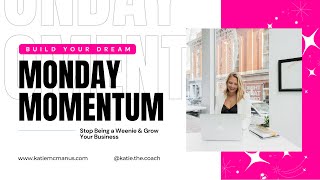
Katie McManus coaches on keeping momentum in an intellectual service business. The three killers: overthinking, overwhelm, and doing the wrong things well. She prescribes committing to a plan, validating offers through customer interviews, reverse-engineering goals, and finding a mentor.
Questions this video answers
January 14, 2025.
1) Overthinking and doubt; 2) Overwhelm; 3) Doing the wrong things (well).
About five months of consistent posting.
Brave Biz Lab — a free coaching call on the fourth Friday of every month; weekly livestreams (Mondays live; also Wednesday and Thursday shows during a 12-week program).
She is live around 9am Eastern (Monday); she will be live Wednesday at 6pm Eastern; she mentions a pop-up training on Tuesday the 14th at 4pm Eastern.
Chapters
I can taste yo, yo, yo, yo I can taste yo, yo, yo I can taste yo, yo, yo, yo Words I can taste yo, yo, yo I can taste yo, yo, yo, yo, yo, yo I can taste.
Good morning, everyone. I'm Katie McManus, business strategist and money mindset coach, coming to you with some practical tips and tricks to build momentum in your business that you can start living the life that you want. Just a little housekeeping. So I am going live in several places today on my Facebook profile, my Facebook page, on LinkedIn, on YouTube, and on Instagram. And now I love this to be interactive. So if you have any questions or comments as we go along, then please do pop them in the chat. And just a little caveat here. Sometimes, because technology is technology, the technology doesn't. Technology, it fails us. And so sometimes I go and check on the places after the fact, and I see that people have commented and I didn't shout you out and I didn't respond to your question and just know it's not you. I'm not ignoring you. It's legitimately just the technology is not doing its job. So if that happens, I do apologize in advance. Hi, Katie Young. Welcome. But today I want to talk about how do we. How do we, like, start the momentum and then build the momentum and have the momentum actually get us somewhere, Right? Because building momentum on something, you know, can be incredibly helpful. It can also be completely useless. Okay? Like the example of that game that kind of pops up randomly after, you know, someone has a party if there's balloons kind of floating around. You know what I'm talking about? You go to a friend's house and maybe they had a party the day before, and there's like, a balloon that's lost. It's like helium vibrancy to float up to the top of the room, and it's kind of just like wafting along the floor. Invariably, it doesn't matter where you are in the world, invariably, someone taps it up into the air, and then someone else taps it to keep it in the air, and then someone else taps it to keep it in the air. And all of a sudden you have this game of don't let the balloon hit the floor. The floor is lava. And the further along you get with this balloon in the air, the more tense the room becomes, right? Because no one wants to be the person who fails and lets the balloon hit the ground. And it's not a game that anyone's like, hey, there's a balloon here. We should play this game. It's just a game that just happens naturally. Right now that is a completely useless instance except for like the general entertainment enjoyment of everyone. That's, you know, a pretty useless use of momentum. But momentum can be used in so many other ways. Momentum can be used to help you start your business, get your first five high paying clients, help you fill up your client list, help you, you know, have enough people who are wanting to work with you who can't. Either they can't afford your high prices or you just don't have the availability. But to help you scale that business and help you really live the life that you want, make the amount of money you want, you know, have the freedom and flexibility to control your life, to be the actual narrator of your story. Okay? Momentum can get you all of those things, but only if you're doing it the smart way. So I'm going to be talking through the three killers of momentum and I'm actually like on the verge of one of them right now in this moment. So I'm going to go into like the feeling of what it's like to be there. Actually, I'm in the middle of two. Two of them, two of these, like, and they can come at you in very wily ways, you know, because like they're tied to your brain, you know, like these fears that we have around, like why it's not going to work and I'm getting overwhelmed, blah, blah, blah. It's tied to your brain. They're just as smart as you are. Right? So however smart you are, your, your voices of fear are going to be just as smart, if not a little smarter because, you know, they're sneaky. And then we're also going to go through like the two things that really help you stay in your momentum and commit to it. All right, we're just going to caffeinate a little bit as we go because it is Monday morning and wherever you're joining me from, I'd love to hear in the chat. I'm on the east coast of the United States, so it's about 9am for me right now. If you're coming from the west coast, it's going to be a little earlier actually, you know, as I'm talking about the west coast, just want to say to those of you who've been impacted by the fires in LA and those of you who know people who are impacted and have loved ones there, just want to take a moment and tell you my heart goes out to you. I've, you know, been watching the news over the last few days. And it's incredible. Like, I don't have anyone that I'm super, super close, close with these days who lives out there. Andrea in the uk. Hello. Good morning or good afternoon to you, but just the devastation that's happening in LA right now, my heart goes out to everyone who's impacted and everyone who's, you know, fearful for their friends and family. You know, there's so many different people who are organizing to help, so if you can help, I invite you to do so. There are a lot of vetted links that are being shared around. I'll share one in my. In my post later today. But, yeah, it's. It's just unthinkable. And what we can all do, honestly, is just not spread misinformation about it, right? So whenever you're hearing information, you're like, oh, my God, that's awful. And you have, like, this angry response to it. Just check the emotion for a second and go and look to see if it's valid. Go and fact check it. See if anyone has debunked it. All right? Because spreading misinformation is not helping the people who are losing their homes right now and who are in fear for their lives. All right, with that, let's talk about some momentum. All right, you ready, Andrea? And let me see. Let me just double check on Instagram. Yeah, guys. All right, let's go. Okay, so the three things that kill momentum, we're going to go through them one by one. The first one is overthinking and doubt. Okay. And I want to share. This is kind of where I'm at right now. And this is something that our brains know how to reach for, right? When whenever we're doing something that's slightly outside of our comfort zone, we start overthinking it. We start doubting, is this going to work? Is this the right thing to do? Right? And that voice comes up with, like, a lot of different metrics that we can measure by right? So when we're starting to do something in our business, when we're starting to, like, do the thing to go and get clients, you know, say you're going out and asking for referrals, you know, your brain with. When you don't immediately get a result, your brain is going to be like, whoa, are we sure we want to do this? Because so far, it's not working. It's not working. And, you know, we don't want to embarrass ourselves. We don't want to put people in uncomfortable position. We don't want to ruin friendships. We don't want to. On and on and on and on and on, right? And it's really easy in that moment to be like, oh, my God, like, maybe this isn't going to work. Maybe. Maybe I'm doing it all wrong. And you start picking apart your own plan, right? Your own plan to get clients. Like, because it doesn't immediately give you the feedback that it's going to work. Well, guess what? Things don't give back immediate feedback, all right? Especially in growing a business. Especially in getting clients, right? Everyone. Everyone doesn't matter. Doesn't matter who you are, how long you've been in business, but everyone expects that. Like when you're going doing activities that are meant to bring in clients, it's kind of like a gumball machine, you know, and you sit there or you crouch down and you put like a quarter in and you get a gumball out. I think. I think gumballs are a quarter. I don't know. I. It's been a while since I've. I've gotten a gumball for myself. And then you want another gumball, so you put in another quarter and another gumball comes out. And it's just like that. It's one in, one out. One in, one out, right? On and on and on and on. And like, sure, that works for gumballs, and that works for some other stuff. Like if you want to go to the store and get something, like, you give them money and they give you the thing, you have an immediate result for your activity. Getting clients is not like that, right? And it really doesn't matter what activity you're doing, right? It could be creating social media content, it could be asking for referrals. You have to sit there and just keep putting in quarters into this gumball machine until one comes out, and then maybe two will come out, and then maybe another one and then maybe three, right? And. And it's unpredictable, right? But. But it's what you have to do to get to the point where it becomes predictable, right? So, like, for my clients who just start their social media journey, it's like, it's such a mind in the beginning because there's a period of time where you know your ideal client, you've worked with a few of them, and you have to start posting to social media to try attract. To try to attract more of them. It's Monday morning. I can't really talk yet. Gonna have a little sip of my coffee. Also, I'm just realizing this is only my first one, so Maybe I should, I should budget more time before this to have my second one also. But anyway, so there's this period of time when you're first starting your business where you just have to have faith. You have to like continue doing the work and continue showing up and just have faith that over time it's going to work to bring in clients. When I first started posting to LinkedIn, no lie, it took me five months to get my first client from the interwebs, right? Took me five months of posting consistently almost every single day. Sharing personal stuff, sharing stuff about my work, inviting people to like webinars or Brave Biz Lab, which is my Friday. I do a free coaching call once a month, every single month, on the fourth Friday of the month. If you want to go check that out. There's a link in my bio and I can share it if you want to. If you want to DM me, I'm doing pop up trainings. I am also doing a pop up training on how to set realistic money goals. That is happening tomorrow night if you want to come again. I will be sharing that in the chat and in all the places. I think I already posted about it this morning actually. So if you just go to my other posts on LinkedIn, you'll be able to see it. But anyway, Anyway, took about five months for me to get that one client, that one first client, right? Consistency 100%. It is, it is the name of the game in doing this. But once I got that first client, I was like, okay, cool, this worked, right? Five months of just going on sheer faith that if I just continue doing this that it will work. And then got that first client and I got my second client and then my third and then my fourth and then my fifth and on, on, on, on and on. So we have to do the thing with zero feedback for as long as it takes without changing the strategy. We have to just commit to the strategy and continue doing the strategy, right? Without letting this doubt, this overthinking mind come in and start taking over, right? We have to do that. And so what helps us to like tie it to other things, right? So like we need that dopamine hit. We need to feel like we're winning, right? So you can tie it to other goals. You can tie it to, you know, increasing your follower count. You can tie it to getting more engagement on your posts, getting more comments, getting more likes. You can tie it to how many people download like a freebie or join a webinar or whatever. All of those things by the Way the last few things I named are all top of funnel things which help them eventually become your client. Okay. But we'll talk about that another time. But yeah, there's just this period of faith and, and it's so easy for that voice that like, loves to come in and overthink things and just like spew doubt, like vomit doubt all over your plan to come in and be like, are we sure about this? Is this gonna really gonna work? I don't know. You seem, you seem to be floundering right now. You don't seem to be having any results from this. Are you sure you want to do this? So it's really important in those moments to recognize that you have a voice of doubt. That you have a voice that like, is wanting you to overthink the whole plan and change the whole plan, right? Because that's the safe thing to do, right? When you overthink the plan and you doubt it and you're like, oh, I'm, you know, this isn't going to work. This isn't going to work. I've tried it for a week and a half and it's just not going to work. I better go back to how I was doing things or how I was doing nothing and just like start planning again, right? Because here's the thing about being in the planning stage, it's super safe. It's super safe because you're all alone. You're sitting in your office or in your, in your little workspace in your home and you're just there and you're like planning and you're doing like, you're writing like post it notes. You're like, this is gonna be amazing. That's part of the plan. And here's another part of the plan, and here's another. But the thing that you're not doing is you're not actually putting yourself out there. You're not actually doing the things that are going to get you the clients, right? It's something that's just like happening in your four walls, right? So it's absolutely safe because you're completely safe from rejection. You're completely safe from failure because you're not actually doing anything that you could fail at. You're just spinning your wheels in your head, you know, just, you know, making up things that you're going to do someday, right? By the way, when you get stuck into this, into this vortex of just planning to plan to maybe plan to potentially plan to, you know, plan to plan to plan to plan to maybe launch at some point, My friend, that's a delay tactic. That's a delay tactic. That's not actually work. It's busy work that feels good to do in the moment, but it doesn't actually work. A plan should be created once and then you have to do it. There's a saying when I worked in sales, plan your work and then work your plan. Right? Because a lot of salespeople, you know, have a little ADHD and want to go for the next shiny object and get to school discouraged, right? But when you do the pre thinking, when you plan out the work and then you just follow through and do it, it always works. It always works. And even if it's not a great plan, it's going to work in some way, shape or form, right? So long as you're putting yourself out there and making the ask. Right. And that consistency in making that ask, like Andrea said, and I'm sorry, I'm probably pronouncing it. It's probably Andrea because you're in the uk. I'm a dumb American, so Andrea for me, anyway. But, you know, whatever it is that you do, if you do it consistently, like, chances are it'll work. And then, of course, over time, you're going to learn how to augment it. You're going to learn, like, oh, well, I get more results when I do this part of the plan than I do these other parts. Right. But you're only going to get to that point where you can retrospectively see which works best when you've been consistent. You've shown up. Right? So the number one thing that kills momentum is overthinking is letting doubt. Oh, good, I'm glad. I hate it when people mispronounce names and, like, they don't ask. All right, so don't let that voice of doubt, don't let that part of your brain that wants to overthink everything come in. And I'm just laughing because of David's comment. Come in and run the show because it's never going to help. David, how do you sound coherent this early? I don't know. I don't know. I always say I'm not a morning person, but it's funny because I've worked several jobs where I've had to be up like a stupid early time, like at 4am to start at like 6 or 7, depending on, like, how long my commute was or whatever. And I'm actually, like, really, really, like, pleasant in the morning. It's weird. I don't know. I don't. I don't feel pleasant inside my head, I feel grouchy, but it just comes out like this. So thank you. Also, you missed the point where I, I like completely tripped over my words and, you know, didn't get the, the sounds out correctly. So I'm sure that'll happen again, but you know, it's pretty early, but thank you, I appreciate that. All right, so killing momentum. The number one is you start overthinking it, you start doubting the plan and then you stop plan. Okay. Number two is very, very similar to that. Right. And I'm very guilty of this. I'm also in the phase right now, so I don't know. I've, I've, I've talked about this a little bit. I'm in the middle of doing the 12 week year, which. Do I have the book somewhere? I probably moved it somewhere else. Anyway, I'm doing a 12 week year. So basically I've planned out 12 weeks worth of work. Right. And I've never done a 12 week year before. Right. So like planning the work and assigning stuff for myself, um, in this manner and doing lives like this and actually scheduling stuff and showing up at the time that I said I was going to do it outside my wheelhouse, you know, like, I like, I like feeling for the vibes. I like, I like doing live when I feel like it, when I feel like there's something for me to say. I've never done a show or three shows at a regular time every single week. And for the 12 weeks I'm going to be doing this show every Monday morning when we doing a Wednesday evening one and a Thursday afternoon one. Right. All on different topics. Right. But that's like, it's different and it's weird and like I'm a weekend and my brain is starting to overthink. Well, you're a weekend. You haven't gotten close to your goal yet. I don't know that. I have no idea if I've gotten close to my goal yet. I'm only A weekend takes time. These are gumballs. I'm sorry, These are quarters. The gumballs are coming. But anyway, so I'm in that overthinking stage, but I'm also in that, that second part that kills momentum, that, that overwhelm phase. Right. Because what we tend to do as people is we completely underestimate how long things will take to do. Right. And I know I'm preaching to the chorus. I know I'm talking to a bunch of people who, who, you know, make the plan and think I'm going to just be the most perfect robot of a being, and I'm going to get all this stuff done because it's now on my, like, neat little list. And it'll be perfect when really, like, each and everything is a massive project and there's no human way for you to actually do it. And when you don't follow through and do it, you feel like you've already failed at it. Right? This is the overwhelm. Okay? Overwhelm kills momentum. Andrea, I hear you. I promise myself to find the vibe every single day, regardless of the overthinking. Lol. Yeah, Right, Right. And it's amazing. Sometimes the vibe is, like, right there. It's your bestie. It's just hanging on your arm. It's like, yeah, yeah, yeah. Let's go, let's go. We got the vibes. And some days, like, you're just like, where'd you go? Where is it? There's no vibe here. Doesn't matter how hard you try to find it, you can't find it. I'm seeing if the vibe likes to follow a schedule also. So see. But anyway. But this overwhelmed stage, this overwhelmed stage where you're like, you're looking at your to do list that you gave yourself for last week, and you're like, oh, my God, I didn't get half of the things done. I didn't get this done. And I didn't get this done. And I didn't get this done. Oh, my God, I'm failing. I'm failing. And when we start thinking that we're failing at something, the first thing that we want to do is quit, right? The first thing we want to do is quit because it doesn't feel good to fail. Right? And that's not the point of making a plan to succeed. Like, if, like, it's one thing to, like, you know, do the whole plan perfectly and fail at getting the result. Like, yeah, but, like, if you could do it perfectly and, like, be proud of yourself for doing it perfectly, that's at least something. But if you only get a week in and you fail at doing some of the plan, like, fuck the results. You've already failed. Right? And it doesn't feel good. And so oftentimes when we get overwhelmed by the plan and we don't follow through on all the things, we tend to go back to the planning stage because that part felt good, that part felt productive. Right? But when we fail at doing the thing, oh, it just. It takes the wind out of our sails. It just, like, Guts us, right? And that's just one part. One. One side of overwhelm, right? Because most of us are pretty creative. Most of us have a lot of different ideas that we can dance with in any given moment, right? Overwhelm doesn't just come from the activities that we've told ourselves that we're going to do. Overwhelm also comes from our creative side, right? Our creative side has, like, this idea and this idea and this idea. And if we've already, like, planned all the work that we're going to be doing to get this specific result, like get clients or hit a certain income threshold, there's really no room or flexibility for that creativity to come in. You know what I mean? So that creativity, like, wants to, like, insert itself into the plan, insert itself into the work, right? And then we're sit. We're sat there and we have this idea, and we have this idea, and we have this idea, and then we have this long list of things that we, like, need to do. And the overwhelm comes from all these different creative ideas trying to come through us at the same time, right? Oftentimes for people who are entrepreneurial at some point, in their spirit, in their soul, like, at their core. That's what I meant. In their core, we're really creative, right? We think of, like, really creative solutions to problems. We think of, like, really creative ideas to, like, launch things. Those creative voices, like, they want to do business with us in that moment, right? And so, like, when we don't have time to play with them, like, they make themselves feel like a priority, right? And so sometimes. Sometimes overwhelm isn't about, like, the to do list. Sometimes overwhelm is about, like, which creative idea do I go with first, right? And it's just as dangerous because whether you start getting overwhelmed by the list. When I'm in overwhelm, like, I don't get anything done, I just back away from the whole thing. I'm just like, oh, God, I'm overwhelmed. I need to walk away, right? It's the same thing when we're overwhelmed by all the ideas, which is like, oh, God, like too many ideas. I don't know which one is to pick. I don't want to pick the wrong one, right? I don't want to pick the wrong thing on the list. That doesn't make an impact. So you just back away from all the work. And that is not helpful, because when we back away from the work, we stop doing the work, right? When we stop doing the work, we kill momentum and the momentum doesn't just pick itself back up. Right. So we have to be very careful to not let ourselves get overwhelmed to do. When we're doing the planning of the plan, to do all the pre thinking of, like, which one will be a priority? Right, which one? Like, we need to have kind of a metric to measure which one is going to be a priority right now. So that when we feel that, that sensation of overwhelm hit us like, it just hits us like a tidal wave. We understand, oh, this is normal. It's normal to get overwhelmed. Now let me just go back to, like, my framework of making decisions. You know, like, here's the number one thing that I need to decide which one fits that criteria. Okay. These three. Cool. Here's the next consideration. Okay. Only these two follow that. Cool. So I'm down to two. And then the next one. The next one. Then you're down to one. Right. And that's the thing that you want to do. So you need to do all that pre planning beforehand, all that pre thinking, so that when you do get overwhelmed, you have a way. You have like a yes, no kind of flowchart to figure out which one is going to be the best thing for you to do. All right, so overwhelm is the second thing that kills momentum every single time. And really, like, overwhelm and overthinking are buds, right? Because like, planning. Planning a ton of work is. Is a lot. Right? Like, that's the point. You're committed to doing something. Hello, Heather. You're committed to doing something. And you know, that's. And you make a plan to do all the work. Like, looking at that whole plan can be super overwhelming. And when you get overwhelmed, that feeling of like, oh, God, this is too much. Buddies up with your. The part of your brain who wants to overthink it. Right? Because then it's like, it's overwhelming, like, oh, God, like, what if it's also the wrong plan? What if I'm overwhelmed by the wrong plan? Okay. And that really does kill momentum. All right, so that is one and two of what kills momentum. Number one is overthinking and doubt. Number two is overwhelm, both of which stop your progress. Now, number three is one that is really, really hard for new business owners because you just don't know. You've never done this before, right. This is the first time you've started a business, and it's the first time you've gone out to try to get clients for yourself and to make money for yourself. You know, there's just. There's so many things. You don't even know what questions to ask because there's things that you don't even know that you don't know, right? But number three is honestly what I help my clients with the most. And that is, you know, the thing that kills momentum at this level is doing the wrong things right? And because it's so easy to do the wrong things right, you know, there are a lot of people out there who believe that getting a TED Talk is like the first step to starting a business, right? Because it's like, oh, I'll launch myself into fame and people will see me, me, and I'll get all this attention, right? And then from there I can start a business. And sure, like saying that you are on a TED Talk is impressive. I'm not. I'm not saying it's not. But, you know, like, that attention is kind of fleeting, right? Because your video is going to go live, right? You're going to be in front of that audience for a moment in time. If you don't, then have something for people to, like, see you speak and then be like, oh, my God, I need to work with this person. You're like, they're not going to come back six months later. They're not going to remember that feeling they felt hearing you speak for the first time and be like, oh, yeah, it's still here in my heart. Have to work with this person. It's fleeting, right? So basically, what you do when you. When you prioritize doing something like a TED Talk and you create all this attention that's, like, out there in the world, and, and you do that without doing the foundational stuff to create the business first. What you do is you. You basically market yourself for nothing, right? Because there's nothing to sell them on the back end. There's nothing for you to lead them into, right? And, but, like, the work of doing the TED Talk does feel productive. The work of getting booked, the work of, you know, doing your speech, the work of, like, learning how to. How to deliver it in the right way, all feels very, very good and very productive. But it's the wrong thing to work on, right? A lot of folks when they're first starting their business, they're like, I'm going to whip up a website. Absolutely. And so they whip up a website that's going to be completely useless for them to get clients, because usually they're creating the website before they've really figured out what their niche is, right? Before they've Figured out, you know, what their offer is, like, what their value proposition is. And their website is ultimately just kind of like a dressed up version of their resume, you know, and it talks about their values and their work history and, like, all their certifications. Now, people may check out your website to find out what you're about, but, like, they're not going to do the mental gymnastics to go from, she played lacrosse in college. How does that help me land a job now? You know, they're not. They're just going to be like, oh, cool, she played lacrosse in college. That's not useful to me. And then be on their merry way, right, Andrea? I'd throw up if I got offered a set doc. Oh, my God. You and pretty much everyone. Public speaking is one of the biggest fears in the world. Hello, the metapatic. Welcome. Not sure what you guys do. I'm gonna go and check out your account afterwards because that's an interesting name anyway, so doing the wrong thing does kill momentum also because, like, you know, you do the work and you do the work and you do the work and you're not getting clients and you're not making any money. And that lack of feedback over time really does kill your. Your work drive for this, right? Because, like, we need feedback. We need something that tells us that we're winning. All right? Now, with my clients, it's not sexy. It's not sexy the work I have them do, but the work I have them do really does kind of turbocharge into the point where you get to do the fun stuff, right? So, like, one of the first things that I have my clients do is do their market research interviews, right? Where they're literally reaching out and talking to 50 of their ideal clients. And they're doing this for a few different reasons, right? So number one is for marketing, right? Because, like, they're an expert. They're an expert at what they do and, like, they could talk about what they do all day long. They could talk about, like, the root of the problem that they solve. They could talk about their. Their process and, like, here's the system that I use and blah, blah, blah, blah. All things that are interesting to them and to other people who are just like them and experts in the exact same space. But what. Who it's not interesting to is their ideal clients, right? Because our ideal clients aren't experts at this, right? If they were, they wouldn't need to. To hire you. They wouldn't be your ideal clients, right? So what you end up doing is only talking to Your peers, and you're talking over the heads of your ideal client. So when I have my clients go through market research, I have them ask a series of already designed questions so that we can identify who their ideal clients are and, and figure out exactly from the horse's mouth how they talk about their problems, right? And literally you'll take a phrase of like, I struggle with xyz and you'll just plop that into a piece of content and write about it. And that will resonate with your ideal clients more than you showing off how much you know or giving them a solution to something that they don't realize is a problem, right? So that's the number one thing. But also it helps us verify their idea, validate it, right? So like they may have an idea that I think is a great idea too, of I'm going to go out and sell this thing, right? But if, if no one's willing to sign up for an interview or if it's not like a problem that they, they are really struggling with, it's like a problem that they don't really care about, you know, no one's going to spend money on it, right? So instead of building a website and designing an offer and going and doing a TED Talk and doing all the things around an idea that is never going to get off the ground, you figure that out immediately so that you can change before you put all that time, money and energy into doing all that other stuff, right? So we validate the offer, we also design the offer based on what they talked about, right? Based on like, what their timeline is and like the problem that they want solved, right? So like, those are three things that most people jump over. And when they want to like, get into the work, they want to get into the sexy work, right? But if you don't do that, all that sexy work that you do may get you a client, but it probably won't, right? You have to do that right off the bat. And then from there I train them on how to do empathetic marketing, right? How do you market yourself in a way when you don't have any testimonials yet because you're just starting out, you, you share it with empathy. You share empathy with your ideal clients. You share empathy for their struggles and you normalize it and then you share empathy for where they want to go and you give them hope that it's possible, right? You don't have to guarantee anything, you don't have to make up anything. You don't have to be dishonest in any way, shape or form, right? It's, it's magical. And then of course, like, you have to learn how to sell. You know how many new business owners have worked in sales before? A fair amount. But guess what? Every single client I get who's worked in sales in the past, I still have to retrain on how to do a sales process for themselves. Because it's so different selling your own service, right? So the third thing that really kills momentum is doing the wrong things, right? But it's so hard to not do the wrong things when you've never done this. Which is why I so recommend whatever it is that you're starting, find a mentor, find a business strategist or a coach who understands your industry. So like, if you're starting a restaurant, I'm not your coach. If you're starting a retail shop, I'm absolutely not your business strategist for that. But if you're starting like an intellectual, like service based business, like you're a lawyer, a coach, a consultant, a copywriter, that is where I thrive. That is the, the realm of which I'm most useful. Right? So find someone who can show you how to do the thing right. And ultimately building momentum is really about two things. Okay. Number one, showing up and doing the plan. Showing up like you plan the work and then you work, you work the plan. That's it. You show up every single day and you chip away at whatever the plan is and you don't get hung up on it being perfect. You don't get hung up on doing every single thing the exact way. Hi, Sarah. Welcome. The exact way that you thought you'd start, right? You just like show up and do it imperfectly, right? And second, know what to do right? Which is. Sounds so simple when I say it like that, but like it's not. Know what to do. So if you've never done this before and you, you don't even know what you don't know, go and get the help that can show you what to do. Because if you're, if you're doing the consistent work and the consistent work is not work that is ever going to work to get you clients or make you money, like that is a massive waste of time. Massive waste of time. And honestly, when you know you're doing the right thing, when you have someone you trust who's guiding you through the process and like you have those moments where you're overthinking it and you're doubting, like, is this the right thing to do? You can Go back and be like, no, this is the right thing to do. And when you get overwhelmed, you're like, oh, my God, I'm not sure if this. Like, I have so many ideas and I have so many things like, which one do I do? Go to your mentor, go to your strategist, go to your coach, and they'll be able to tell you this thing, this thing is the thing that you need to do right now. Okay? So plan your work. Work your plan, and make sure that the plan is a plan that will actually get you the results you want. Right? I mean, at the end of the day, it's not complex. It's not complex. And yet we. We like to make it feel complex because then it is not that big of a deal that we failed. Right? Because it was such a complex problem that, like, we were never going to figure it out. Right. It's so much easier to say that you fail doing something complex than it is to say that you fail doing something that's fairly simple, right? I want to just name a difference here. Simple does not mean easy, right? Complex does not mean hard, right? You can have a very complex recipe, but it's fairly easy to do. Like, you just. You're just putting eggs in a thing, and then, you know, you mix this in, then you mix it this, and they're like, you don't need to have advanced training in order to do it. It's just a complex thing that you have to follow in a certain order. Certain order. Meditation, for example, is one of the most simple things in the world. You basically just sit there with your eyes closed for a period of time, and you might have, like, a mantra or you might, like, focus on something or not, but that's it. There's no complexity there. It's simple, but it is one of the hardest things to do to build a meditation practice. As a guy, you just hope the girl shows up for the date. I'm not sure. I'm not sure how that's how that ties in, but yeah, I mean, sucks to go on a date and get stood up. 100. Anyway, let me see. Sarah, how do you feel about reverse planning? Knowing the goal and then work backwards, Work backwards from there to set the plan. I am the number one fan of reverse planning. Any goal can be reverse engineered unless it, like, requires you to be a different person. Like, if it retires you, if it requires you to be two feet taller. I'm sorry, like, that's just not going to happen. You're not going to play for you Know, the mba. But, like, if you want to make a million dollars a year, there's a gazillion ways for you to do that. So let's, you know, identify what that big plan is, break it down into smaller plans, and then you get to go through and work your way up to it a hundred percent. You know, one of the things that people get really up around is they believe. Okay, well, I have to set a plan that's realistic for me, right? And so people may want. Someone may want to, you know, build a business that makes 500,000 a year, right? And that's a big number for a lot of people, right? But they. They want that, but then they're, like, embarrassed to admit it, or it just feels, like, unrealistic for them, so they talk themselves out of it, and they're like, okay, well, what's more realistic for me? And so they said, okay, well, what's more realistic is, like, $50,000, right? That's not really an inspiring number. Right. Like, $50,000, you know, is an income. Sure. But it's not one that, like, you're gonna be pouring your soul into to reach if you really want to change your life. Right. But, like, here's the thing. If you have a plan to build a $50,000 a year business, that's all you're ever going to have, because you're not going to work that plan and trip and fall into $500,000 a year. That just doesn't happen. If you want to make $500,000 a year, you have to own it. You have to own it. You have to say, you know what? This is my goal. This is my plan. That's what I want to do. And then you have to reverse engineer from there because it's going to take some time. But, like, if you want to make $500,000 a year, you have to do it intentionally. Right? I know we all, like. We all have this daydream in our head of doing, like, getting discovered or, like, someone picking us and, like, being, like, this person's special. They know things that other people don't know, or they have this incredible ability. Yeah, exactly, Sarah. Dream big and let it scare you. But we have this, like, this daydream that, like, someone's gonna pick us, that someone's gonna see how smart we are, how talented we are, how capable we are. And we're like you, Right? Like Florence. I forget her last name, but Florence, who plays in Florence and the Machine or something? I forget the band name. Exactly. But she got discovered in, like, a nightclub bathroom, she was, like, peeing and singing at the same time. And there was a talent scout or someone or some kind of agent. I don't know. I'm. I'm bastardizing the story, but you get what I'm saying. Who is, like, in the bathroom at the same time and like, oh, my God, this woman can sing. And then, you know, Florence is washing her hands because she has good hygiene. And this person's like. And I am assuming it was a woman. I don't think it was a co ed bathroom. But they're like, you can really sing. Like, let's. And then they connected and then they followed up and all of a sudden she's this famous singer, right? And that would be so nice if that happened for all of us, right? We wouldn't have to do this, like, dream big and, like, be brave and go after the big thing and, like, break down the plan. That's not how life goes for the vast majority of people, unfortunately. I wish it did. Like, that would be so much fun to live life that way. Just going and being gloriously yourself and letting whoever's going to discover you just discover you on a timeline that works for you. It doesn't happen that way. So. So we have to name. What is that big dream? We have to let it scare us. We have to let it inspire us. And we have to be brave enough to come out and say, that's my big dream. And then we have to be brave enough to break it down into smaller bits. And then we have to be brave enough to start working on each little iteration, each little chapter, and start building up to it, right? And then we have to be brave enough to see ourselves through each moment where we start overthinking it, each moment where we start doubting the plan, each moment where we get overwhelmed, and each moment where we realize, oh, my God, I don't even know what I don't know at this stage. I need help. I need help. I need to. I need to get help from these people and these people and these people, right? Because I need the knowledge that'll help me make this momentum actually work for this next stage of my business and of my dream, okay? That's the only way we reach our goals. And I say that as someone who has some massive goals that scare the crap out of me, right? But you know what? They also inspire me. They also make me feel so excited to get to work every single day, right? So here's your full permission to pick a big goal, to pick something that scares you. Something that you don't even know how you'd even get started on working towards, right? But the first step of all of this is picking that one thing, you know, so maybe it's $500,000 a year, maybe it's 2 million a year. You know, maybe it could be absolutely anything. But here's. Here's my invitation to you. If you are starting an intellectual service based business, like you're a lawyer or coach or a consultant or a copywriter or a marketer, and you're struggling to get your first few clients, you're struggling to, you know, build this business in a way that could realistically reach that massive goal. I invite you to book a call with me, okay? Book a generate income strategy call. There are links anywhere in my bio, everywhere. And we'll talk through what your big goal is, what that juicy dream is, and then we'll break down where you're getting stuck in doing it on your own where. Where you just don't know what you don't know, right? And if it's a fit, if I can actually help you with those parts and it's a fit for us to work together. We like each other and we vibe, right? The vibes are there with us on this call. Then we can talk about different ways to work together. But if it's not a fit, if I can't help you with a specific thing, or I think someone else would be better, or if it's just not like a personality match, that's okay, right? But I will point you in the direction of someone who can be a better help to you, right? Because I believe everyone's dream is possible for them, right? I believe it. I 100% believe it. And I think the key to it is having the right guide. The key to it is having the right person that you trust who can point you in the direction, say, here's what you need to do so that you can feel really confident in committing to doing the work and building that momentum towards your dream. All right? So, Matt, I don't know if people would want to watch me pee and sing on stage. I don't know. I don't think so either, but I love that that's where you took it. Thankfully. Thankfully for Florence and the rest of us. She has yet to be on stage, as far as I know, but she's an incredible singer and. Hi, Abby. Welcome. Anyway, so that is. That is your Monday momentum, everyone. I hope this lights a fire under your ass to, like, dream big and start working towards making it real for yourself. Like I said, if you want help, if you're ready to start building this business, to start getting clients, start making money and to have a clear step by step strategy to build towards that bigger dream, then book a call with me. Stop kicking your feet, stop just wasting time and thinking you're going to figure it out on your own. This is a lot. And if you want to fast track towards that bigger dream, having the right help is going to be the number one thing that's going to help you get there. So book a call with me. Otherwise, have an amazing Monday and I will be live with you again on Wednesday at 6pm Eastern. So come and join me then. We're going to be talking about dreaming bigger. Oh and I am doing a pop up training tomorrow at 4pm Eastern. It's Tuesday the 14th and we're going to be talking about how you can set a realistic income goal and actually reach it. Okay. So I'll be talking through like how do you figure out the goal? How do you break down the goal? How do you start working towards that goal so you can start signing high ticket clients? Anyway, I'm Katie McManus, business strategist and money mindset coach. I'm off to get my second cup of coffee and I hope wherever you are in the world that you are having an amazing start to the week and I will see you all soon. Bye.
More from Katie





How to do self care right now, so you can do what needs to be done, for yourself, your business, and

How to do self care right now, so you can do what needs to be done, for yourself, your business, and

#greenscreen How to build a consulting business that makes you $200,000-$700,000 a year

#greenscreen How to build a consulting business that makes you $200,000-$700,000 a year

Maybe we’re not the imposters…? #businesscoach #startup #entrepreneur #smallbusiness #consulting

Maybe we’re not the imposters…? #businesscoach #startup #entrepreneur #smallbusiness #consulting
