Money and Relationships
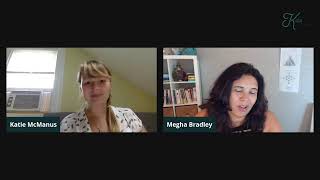
Katie McManus and Meg Bradley discuss how money shapes relationships, covering financial sovereignty and trust. Bradley, a money healer, explores the emotional dynamics that keep people stuck in unhealthy financial patterns with partners.
Chapters
Hello, I'm Katie McManus, business strategist and coach. And I'm here today as per usual on a Monday with Meg Bradley, who is the most talented money healer that I have met so far in my life. And I'm really excited because we, before we started talking or going live, we were talking about this new program that she's rolling out to teach people what she does. And, and I think that's just magical when we can pass on our gifts in that way. So congratulations, Mega. I'm sure we're going to be finding out a lot of details about that coming up, right?
Very shortly. Yes, within the next week.
Okay, amazing. Awesome. So next week, hopefully we're going to be in person next week.
That's right.
I'm going to be in Nashville. You live in Nashville. We're going to try to do our live in person in the same room.
Yeah, that'll be cool.
And we can go into the program and give people some information on it.
Oh, fabulous. Considering it's going to be all really to work with people who want to heal the world but also get out of their money. Story about being broke because so many people think that they have to be broke in order to serve.
It's crappy. It's crappy. And, and what we're talking about today kind of touches upon it because, you know, to serve, you have to be in relationship with, with other people and because now other people are the recipients of you serving. Right?
Yeah.
There's so much garbage when it comes to talking about how money and relationships work together or don't work together. And I wanna, I, I have some beliefs on this, but I'd love to hear from you, like, what, what pops for you around this? Oh, and I think you might be frozen.
Oh, no.
Oh, no. We were having some electronic issues with streamyard. Mega, can you hear us? Are you there? At least? I just want to say, at least your face froze with a very pleasant facial expression on it. That is always a benefit. I'm going to text you right now. And for those of you who are watching, hey, welcome. Welcome to a. A tech glitch on this live.
Yeah, exactly. Should we be surprised? No. I at this time would like to personally and publicly call out at&t. Because my Internet has been really shoddy the last few days. So that's just. There we go.
You're back. You're back.
I'm back.
If it happens again, just continue to, like, have a nice facial expression. Whenever it freezes for me, it's like.
I I. If it freezes again, I'm going to my WI Fi hotspot.
Okay, great. Okay. But anyway, I know you have a lot of opinions and thoughts around this, this topic, so what do you think?
Well, yeah, anytime you. They, you know, the number one statistical reason people get divorced is because of money. I think it's also one of the reasons people get married is because of money. And, and the thing with money in relationships is that they are often reflective of each other. So your inability to have a healthy relationship with money will reflect in your inability to have a healthy relationship with another human being. So then you, when you combine the other human.
Can you just say that again? I think that bears repeating.
If you can't have a healthy relationship with money, there's a good chance you can't have a healthy relationship with another human being. Yeah, yeah, it really is. It is. It would have. If I would have actually known that advice when I was 20 something, I would have perhaps not married someone who then tanked me into a financial collapse because of those two mirrors. Exactly. Right. Like I teach, I live what I teach. Right.
Through the fires. You can show people out of.
Big mistakes so that people can make smaller ones. That's what I do. So it's my job as a. As a heretic investigator. Yeah. So I, I think the big thing, you know, I love this conversation. I think that many times there's a lot of sabotage that happens with the way people approach trust and they blame on the other person when they've actually just avoided their own intuition, usually around money. Right. So, you know, there's so many directions you could go. I would say probably keep me on track because I can, I can ramble off into this because I heal. I've helped, I've helped facilitate very wealthy people navigate relationship issues and also people who are not so wealthy with their money situation. So.
Yeah, no, I mean, for me, as you're describing this, I'm thinking specifically of those scenarios where, you know, those people who like, fall in love with other people's potential.
I do. I have several of those T shirts.
Oh, yeah, you have the T shirt, I have the T shirt.
I have the T shirts. I should hang them in my closet.
I have the T shirt. Like all the accessories. I have the shoes. I have, like the days of the week. Underwear.
If I had a dollar for everything I've ever invested in someone else's potential, I'd be a freaking millionaire today.
I know, right? So there's that. But like, I think it's very common for Someone who falls in love with people's potential or with the idea of a person to also enter into financial situations where there's the same thing. Like, yeah, the idea is there, the potential. Like you've kind of built it up in your mind and then you're always disappointed.
Yes.
You know, it's taking jobs that are beneath you because the hiring manager says, oh, well, we look to, to promote you to the job you really want in a few months. And they never do.
I. Yes, yes, yes. Anytime. You. And. And the same. You know, I think the same applies for many times people invest in themselves when that relationship isn't intact either, and they fall in love with their own potential, but not their own action. And, and you can't. You can for infinitely. And Lord knows you and I have hung out in coaching programs and where people are spending hundreds and thousands of dollars in there. I've got the exit. We're going off the ramp right now. That they then like to blame the coach for their lack of realization of their own potential.
Yeah.
And I am actually putting into my agreement something that says, like in that program we were talking about, I'm actually putting something that says you are responsible for the realization of your potential.
Yeah.
And the thing is, is that for many people, they like to attribute the blame of that, like why that didn't materialize. Oh, I didn't actually get that raise because such and such is such a bad boss and blah, blah, blah, blah. And it's like, well, but what did you do when you, as soon as you were hired and they told you about the potential, but what sabotage was in your own roadway that you managed to run yourself off into the ditch, show up late five times, not do the three things that you were supposed to do. And now you want to bitch that you didn't get the opportunity that was promised you as potential.
Right.
And oh, gosh, I'll come down off my soapbox now.
I love you when you're a soapbox. No, and it's, well, there's so much here. You know, there's. You know, the coaching industry is full of people who actually have a great deal of healing to do. And oftentimes they say, okay, well, I'm going to invest in this. I'm going to make it a business. When it, in fact, what they actually just need is to go through it for their own healing.
Yeah.
You know, and then there's like a lot of garbage like, oh, well, there's this belief that they're actually, they are actually not worth investing that money. Unless there is a financial roi.
Correct.
So I'm gonna invest in this coaching program to learn how to become a coach and like to really heal myself. But I'm doing it so I can start a business when I don't actually want to start a business. Like I'm convincing myself. I do. Because I can't convince myself that I'm worth it.
Yeah. You know, back in the day when I was working in corporate America. Now, you and I have joked before about our age differential. Back in 1996, when I was working for Texas Instruments in the. We had a mass layoff. And when you're working with engineers, it's not a profession that you just pop up a side business on the side being an engineer. And yet these people were so petrified. Now, there was a ton of job. Know that there was a ton of jobs. There was a run on at the point we just come out of the first Iraq war. I think I've got my time. Yeah. And it was there. We were building a lot of bombs. A lot. And it was. And then Raytheon acquired this.
Texas Instruments didn't just make calculators.
Nope.
Okay. Learn something new every day.
They sold it off to Raytheon. For the record, I don't know what Raytheon said, but Raytheon's been in the aerotech field for a long time. But anyway, I was in the world of human resources back in IT in that day and age. And to politely and sweetly let everybody know that everything was fine and dandy. And while they. While we had a layoff, you know, a big downsizing corporate entity that was sitting in the side room firing everybody and reasons why I am an entrepreneur today. And the thing that really was interesting to me even then. And I shortly thereafter started my business as I parachuted out of corporate America and said, I don't want to ever go back unless I'm coming in to teach these people people things. It was startling to me how many people were so petrified of their own potential that they were more concerned about the loss of the job than they were about the opportunity that existed beyond it. And I think that that parallels relationships as well, because many times we'll stay where we're not supposed to, whether it's a lack of pay or lack of love that. Because it feels like anything else would be really threatening. Right.
Right.
So there's, you know, it's like remembering, I think in today's age, we're blessed right now that the economic situation in this country is that I Think most people are doing pretty well in terms of finding work or, you know, unless you happen to be in that mid gap where you don't want to make a $15 an hour job because it really doesn't make it darn bit of sense. But the people that are probably having the luxury of watching this on a. If you're staying holding on because you're waiting for the race or you're waiting for the business partner to give you that revenue share that they somehow or another, every year manage to lose money in the business and never be able to give you your share of the revenue or whatever the situation is, then that's when you go start, look at that relationship and say, is it sucking my soul dry? My favorite question. Answer is yes. Answer is hell no. Move on. And of course, I understand that's daunting, but remember your own potential and then love it. Love yourself into that potential.
Yeah. And I. I think on both sides, it has to do with trusting yourself and trusting the universe. You know, trusting yourself that you are resourceful and creative and charismatic enough to go and find a new relationship, access more money. You know, create access to money and relationships. You know, you have all that within you. And then also to trust the universe, the world around you, to provide it for you.
Yes. And that goes back to your relationship with your faith, whatever it might be.
Yeah.
Because if you think you are the. You know, if you're an atheist, I honor you because you own your own. The fact that you're an atheist. There's a lot of people that are so agnostic about everything that they're agnostic about their own path in life. And. And you better figure out where your lane is and get committed to it. And. And the reason I say that is, you know, if you will ride the fence on whether you are worth the investment or what the universe is nudging you forward to, if you will ride that fence, you just end up with a lot of splinters.
Yeah.
And. And then you keep trying to find new people to blame.
Yeah.
And so if you hang out with anyone who likes to sit around in the happy hour and just. Only thing that they have to do is talk about all the people who blame who to blame. Please find new happy hour partners.
Yeah. Mm.
Because you soon will also be coming up with who to blame.
Yeah. Yeah. 100%. I'm a firm believer that you are the sum total of the people you spend the five people you spend the most time with.
Yeah.
And you become those people. You being the sum total as you become those people. Some amalgamation of the. Of the five of them.
Yes.
I just want to go into the comments. Say, Donnie, thank you. Glad, glad to bring some smiles to your day. Sean Best is stay single, Katie. Less hassle that way as finances always cause problems. Okay, now here. Thank you, Sean. This is a something and I hope you don't feel picked on, but we're gonna, we're gonna pick on this because here, here's a belief system about relationships and how and how finances can function or not function within them.
Correct? Yeah. First of all, I want to acknowledge you, Sean, that that is typically the, the quick line of thought that feels, feels lightest path of least resistance. And for you, that might be path of least resistance and by all means honor it. And I think there's a lot of people who deprive themselves of what would be the relationship that they would enjoy having long term because of that same reservation. I have met people who have said, I'm afraid to end up in a relationship with someone who's going to take advantage of me. And that usually means you're going to end up in a relationship with someone who's going to take advantage of you. Nature of belief and attraction. Here's the thing. I believe that you can stay financially single and be in union with another person. And that has come from three divorces and a ton of financial crisis along with it. And I have come to this understanding we have in our society, especially in America. I don't know how it is, I cannot speak to other countries, but in America we had this ideology painted upon us. 2.5 kids in the dog and the house, everything else. And my mother gave me the worst piece of advice that anyone has ever given to another human being related to money. She said, give your husband all the money and let him take care of it. Now this is in the last 40 years. That ideology is still running strong for a lot of people, even in millennial generation, depending on where they are in the country and where their socioeconomic status is and what the religious beliefs are and everything else. And while money as a relationship component is vitally important to be completely open and honest and everybody own their lane and have their integrity. And it is possible that I have learned to maintain a marriage and a strong and healthy relationship without ever intertwining your finances. And you should not, you know, not to go biblical on everyone for a second. The Bible it talks about equally yoked and I didn't know meant 20 something years ago. And I think back on it and you know, Many times we dismiss. If we have trauma, we dismiss biblical wisdom, which is often a slippery slip. And so I didn't. I had a lot of religious trauma, so I didn't believe much of what was there. The whole thing about equally yoked, I was like, I don't need to be equally yoked. We do it as a team. We'll just love each other into balance. And the thing that I found is that when you maintain financial sovereignty from your partner, that does not mean there is not financial transparency and there's no reason to keep yourself from a relationship if you want one, just because money is part of the concern.
Well, and I just want to add here that I think the model that people have seen before is where they enter into a relationship where there's no ability to be equally yoked or to have financial sovereignty, and then all of a sudden, they no longer have choice. I don't have a way to make money, and they make all the money, so I have to stay with them or crap. I make all the money. They have no way to make even enough to take care of themselves.
Yeah.
I'm responsible for everything. And even if we did get divorced or break up, I'd still be responsible for their finances.
Yes.
And then instead of just paying for one household where we're, like, just eking by and, like, things are fine, I'm paying for two, even if I'm happy. Like, I can't afford that.
Yeah. Oh, yeah. Yeah.
Well, yeah, but when you do that, you rob yourself of. Of this belief system that you even have choice.
Right. And that. That could. I mean, we could probably spend a whole. Like, if we would dovetail this, we could probably do one on money and marri the financial implications of marriage as a whole, because there are so many legal overlaps and loops that quite honestly can't believe I'm really going to say this, but sometimes you look at marriage, I always say there is two types of marriage. There is a legal marriage, which is you decide you want to go all in and be financially intertwined with that person at a deep legal level. They happen to do something accidentally, and it ends up being you get sued too. That, that point where you're talking about is it's very intertwining. And I think that there's a lot of dysfunctional relationships that stay in place because of that. Checkmate. And I also, as you bring that up, and you and I have had conversations in the past about, like, our humanitarian. Our various humanitarian pursuits, and one of the things that is deepest for My heart is that I believe that a lot of abuse and abusive relationships, and including narcissistic, toxic, you know, gaslighting types of relationships end up staying in place because the, the other person, it does not matter if you are. It does not matter who the, who is the male or the female or if you're not in a non binary, it does not matter the nature of the relationship. But if you have unionized yourself with another human. Human being and one of. And one of the partners in that relationship has managed to develop the financial upper hand it. And that person is not healthy and whole. Go back to point one at the beginning of the call, you end up setting the perfect stage for a toxic abusive situation that will loop itself much deeper into your trauma than if you just could say, I'm out of here, I'm not taking this. And I think there's a lot of abuse that goes on and very high privilege abuse, meaning people that are living in really. I had, I think I've mentioned this before. At one time I had a client whose husband was an out in the open public figure and he kept her imprisoned in their bedroom and yelled at her and beat her. But they were very financially astute, very visible in the community, but yet she was a prisoner because she didn't have one penny that was not scrutinized and controlled by that person.
Yeah. And I want to stress here that the person who has a financial upper hand is not always the one that brings in the most money or brings in any money. It can just be someone who has made some power plays to make sure that they have full control over the money once it does come in.
Oh yeah, there's a lot of people, like I was told, give all your money to the other person.
Right.
Even though I was the one making the money.
Right.
And that was the really twisted thing about the entire dynamic. I'm glad you point that out because it. Yes, there's a lot of people who give up the money and they're actually the one who's holding the money in their hand.
I mean, you and I have talked about this. In my abusive relationship, I was the one that had. I was the only one in the relationship who had any income during that time. Yeah, any money he had, he was actually stealing from friends. I didn't know this until after the fact, but it was very, very early on that he started doing things that would make me feel like, oh, he, like he needs to manage this. And he was my credit cards, it was my money or, you know, it's it's astounding what people can do. And of course, like, I had to go through a lot of healing after that.
Right.
To mitigate this. And I'm sure that there's still some healing to be done, you know, when I do enter into a relationship or as I'm dealing with money and friends and all this stuff. But like, it's understandable that this damage happens. You know, if you're in this place of distrust, don't feel bad. But also there's another way to be about it that's a lot better.
Right. And that's where integrity in communication comes in.
Yeah.
And I think that many of us, and it's not just this money relationship conversations really, anywhere where you are afraid to truth for, for the expectation that something adverse to what you want to have happen happens. And with money, I think the way that that often goes is, oh, I'm gonna borrow 500, can I borrow $500? It starts small and it starts innocent usually.
Yeah.
And the thing is, is that you might actually want to lend someone $500.
Right.
And, and you know, sometimes I say don't lend money that you would not be willing to just donate to charity. Right. That's kind of my policy if I would willingly donate to charity. But somebody comes to me and says, can I borrow money? And I'll say, yeah, because I, I can withstand it never coming back to me in case that person's whatever their crisis. Because unfortunately, and this is why check cashing centers all over America every day are like the most common thing. I mean like literally, like there's Walmart in the check cashing center and a Waffle House. And I'm not trying to pick on the demographic. However, the problem is, is that it's a cycle of toxic abuse from our corporate entity structures down. Not to drive this political. That actually perpetuates that I can go rent, I can go rent money and then these people charge me so much interest and have me so backed up, they don't actually expect I'm going to pay it back.
Right, right.
Because they've got it set up for you to borrow for against the title of your car, they don't really think you're going to pay it back. Look at your interest rates. Right. And the same goes that I do this with people. If I have to loan somebody money, I give them a 10% or 15% interest rate and say there if you're going to owe me the money.
Right.
Because if you. Oh. And sometimes, unfortunately for them, they come to Me, and they ask me to borrow money, and then I have to sit down and I try to keep my coaching hat to not going to go too far into this. And then I'm like, well, what is it perpetuated the cycle of your need to have money? Now, let me be clear. I've had times in my life where I've had to borrow money from people. And I know what kind of a shit show my life was at that point, which is why I have the conversation. And then I usually find out it has nothing to do with the money. The money has metastasized itself into, oh, well, I have to have the money because I told such and such I would do something, and then I couldn't do it, and now they took this away from me, and now I'm trying to find a new place to live. And it's usually a much deeper backstory.
Right.
And that's the thing that you have to look out for. So when you are dating someone or you start looking at a business partnership with someone and just be really upfront, be willing to say, let's talk about money, and see how quickly they go, oh, no, we don't talk about money. We were taught not to talk about money. We don't talk about money. Everything's fine.
Yeah.
And then you ask them as they pull out the Platinum American Express. Okay. You pay it off every month.
No. Oh, my God. Well, and as a business strategist, I get a lot of new business owners who are like, they're very insecure. They don't know how to start a business on their own. And they don't feel like. They almost don't believe that people are going to come to them on their own.
Right.
So they're like, okay, cool, I'll start a partnership. And I advise against it every single time because I'm like, you don't know how to run a business on your own to go, like, from the start.
Yeah.
Then what's it going to be like to be in a business partnership with someone else who also doesn't know how to run a business on their own? It's kind of like someone who has no idea what they want in a relationship. No relationship experience, like, has never observed people in healthy relationships before entering a relationship. They don't know how to, like, set boundaries. They don't how to ask what they want. They don't know how to deal with love languages, so on and so forth.
Yeah. If you're going to hire, if you're going to decide to get a Business partner. I think you definitely need a business partnership coach in the process because it's just like getting married, you know, if you, if you just get married and you've never had somebody that can hold space for you to both be completely honest with each other. That's why they used to recommend premarital counseling. Although I won't go into my opinion on counseling as a general rule. But I do think that there is it. Business partnerships having been in them, are marriages. And they're more intense than marriage marriage. Like the, you know, go kissy kissy at night and go to sleep. Yeah, they're actually intense because there's no kissy kissy. It's, it's. This is. I, you know, I lent my name, my integrity, my everything. And those people are, you are yoked to those people. And it's not uncommon. Like you said, people were like, oh, I can't do it all myself. We will skip over human design, which some people need to be in partnership energetically, but it doesn't have to be same partner on paper. That's what JV partnerships are for. Or for some sort of other agreement. Yes. And that's so critically important because I know that so many people aren't, aren't feeling secure enough in their business or maybe they just don't have all the skills. You do not need to bring on partners.
Sorry, that's a puppy. She agrees with you.
You know, mine's just cast away on the other side with it behind the door. So, you know, I totally get it. But you know, one of the things that I think ends up happening with people, bring on partners. I know that I've done this. Yes. Would never do it now. They will send off and they don't know the future of their business. So they'll end up saying, I'll give you X thousands of shares of my business. You don't have a traded business. So a penny of a penny is a penny. And if you become really successful and you're the one who's hauling the load up the mountain and they're just hanging around doing whatever, guess what? You just gave them the control and the credentials. I think this is why employee owned companies are actually beneficial.
Right.
You actually earn your way. Right. You earn those shares. And so to that point, I think that one of the things people most often do is they hire for assistance, not for partnership.
Right.
Or should I say they partner for assistance and not for actual partnership. And you do not need to partner with your VA because you need a va. No, no. People do this.
We don't need a partner with a brainstorming partner.
No.
You know, I found myself doing this when I. When I first started out. My. My dear friend Kelsey. We are dear friends to this day. It didn't screw us up in any way, shape, or form. We. To launch, like, a program together because neither one of us felt confident in doing it ourselves.
Yeah.
And it was just. It's a natural place to be when you first start out. You know, it's. It's like the first time you ask someone out on a date, like, you get a little nervous. You have to talk to your friends a lot. And we designed this whole program and we started, like, marketing it, but we realized throughout, like, we were focusing on vastly different things. Like, there wasn't a lot of alignment there. And then we realized we had this really, really sweet, tender talk. We're just like, oh, I think. I think I want to do a program that's focused on this and you want to do a program that's focused on this and we actually don't have to do it together. And it was like, oh, and it was so freeing to realize, oh, wait, we were using each other as, like, what are the. The safety wheels on a bike.
Oh, yeah, the training wheels.
Yeah, Training wheels. Yeah. Which is fine, but, you know, but.
Don'T sign a paper, you know.
Right.
Put them on the LLC of the corporation. Yeah.
No problems. Katie. I'm just dedicated. My profession never met someone who understands that. I have met plenty who had problems. So if it is path of least resistance, so be it. Yeah. And we all have to find the thing that works best for us.
Yep. Absolutely.
Yeah. Mega. We're just past the half hour mark. I know our time together always flies by. I usually ask, you know, for us to end on something that people can do, but I'm curious, like, what's an area for growth that you're personally working on when it comes to money and relationships?
Well, I think think that mine is actually in the relationship side of. We didn't get into talking about this. We kind of left off right at this point. But who to invest in as my partners in my business, Meaning that that's my current area because I have, you know, a general amount of money that I'm going to spend for those teammates and those team members that I bring on. But I do count them as one. And one of them is in. She says, well, you know, we're really like your business partner. And I'm like, yes. And I understand that. And I am Currently working on the trust side of that because whenever you bring in assistance and they are in your business deeply and intimately, I mean, like, these people are going to be touching my client stuff. Right? Like, I mean, that is a close. It's not just money, it's trust. And it's one thing to write someone a check, it's another thing to trust them after you've written the check. So my personal thing is that I'm working on trusting the people I hire, which goes still into my related, ongoing personal development related to trusting other human beings. So that's mine. How about you?
Oh, I mean, there's so many. I think the general theme of, of like my personal development right now is asking for what I want. And you know, both, both financially and in relationships, you know, like, I think, I think we get programmed with this messaging that we're only allowed to ask for what we absolutely can justify that we need to survive. And I'm so fucking over that. Like, survive is like a leaky roof and like moldy food and water that, like, is kind of clean. But, like, I want so much more than that. And why allowed to ask for what I want? That's more. And why do I have to justify what I want, you know? And yeah, I mean, so much to unpack there. That's a conversation for another day, right?
So unapologetic asking.
Unapologetic asking. Yes. Yeah, that's my magic area of progression. And apparently for Margaret, this is great timing. So, Margaret, if you have any questions for either Mega or myself, please do reach out. We're both open to continuing this conversation in a way that serves you. Mega, thank you so much for joining me today. Is there any, any final message you want to leave for everyone?
You know, I, I think we, we mentioned it in the beginning, so I just recap it and it's that the relationship that you have with yourself is the relationship that shows up in your relationship so it looks like it's not going good or the way you want it to go. Take a little journal and go sit in a nice corner next to a flowing river or a cup of coffee or whatever and do some introspection about what it is that ticks you off so much about that other person in relation to money or in relationship, and they'll find your opportunity for your own growth. Okay. Yeah, As I do it myself, it's like.
I love how you set them up in like a really beautiful environment, nice drink. So that's the only thing that's going to be enjoyable about that process so.
Important, you know, sacred. Well, you know, I call that sacred space. And. And whether you're having a financial conversation with someone about really deeply important financial conversation or whether having a deeply important conversation with yourself, sacred space is. Is a powerful place to do it. So beautiful.
Thank you. Thank you for being with me today. I can't wait to see you. Oh, my gosh, in a few days. I know. It's amazing. It's. I, like, I don't almost don't believe that, like, yes, the pandemic is carrying on. We have this new variant and all this stuff, and also, like, there are ways where we're able to get back to the world. And it's so weird when, like, you're able to get back to the world in a way that's, like, travel, something that you love. And I haven't been able to do it that often, so. I'm so excited to see you and to experience Nashville.
Yeah. Well, welcome to Nashville. And, yeah, it will be a lot of fun.
It will be. All right, cool. And everyone, I hope you'll be able to tune in next Monday at 2:00pm Eastern Time, 1:00pm Central. Right, Megan? I will be in the same space, and we'll be having another conversation about money on Monday. Anyway, I'm Katie McManus, business strategist and coach. This is Mega Bradley Money Healer. Thank you for joining us. I hope you have a wonderful Monday and a great week.
Thank you.
Bye.
More from Katie





How to do self care right now, so you can do what needs to be done, for yourself, your business, and

How to do self care right now, so you can do what needs to be done, for yourself, your business, and

#greenscreen How to build a consulting business that makes you $200,000-$700,000 a year

#greenscreen How to build a consulting business that makes you $200,000-$700,000 a year

Maybe we’re not the imposters…? #businesscoach #startup #entrepreneur #smallbusiness #consulting

Maybe we’re not the imposters…? #businesscoach #startup #entrepreneur #smallbusiness #consulting
