Setting Money Goals
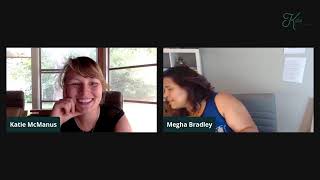
Katie McManus and Mega Bradley discuss money goals for solo entrepreneurs, covering revenue planning, pricing, and cash reserves alongside mindset work like belief alignment and your "money thermostat." They share how to reverse-engineer income targets into sales calls and why manifesting requires actual action.
Chapters
When manifestors and manifesting generators come together to create. Here we are.
Good afternoon, everyone. Katie McManus, business strategist and coach. And I'm here with the amazing mega Bradley Money healer, or I call her. There's a million different ways you could introduce her. And we're coming to you in our workout clothes today. We are doing this fast and quick, fast and dirty, or whatever it is. We want to talk to you about setting goals around money in your startup business. And I know for me, when I started this, coming from a background in sales, it was complete mind fuck because I came from businesses that had, you know, very predictable business like leads would come in and they're able to predict and give me a goal and then I was able to either close the business or not. And becoming an entrepreneur, like, it's not predictable at all. And. And there's a few things you want to keep in mind when you're setting goals around money and mega. I would love to hear your thoughts around this.
Yes. And first I'm going to disclaimer the labradoodle that decided to run its mouth in the background. So I know you're familiar with Doodle Doodle Fun.
So I have mine sleeping right there.
See, I wish mine was doing that right now. No, so. Well, yeah, I mean, I think the thing that happens initially is that especially if you're early in the process of defining business is that you make a sale and then you think you're doing good and then you're like, oh, I can stop and rest. And then because there's not goals often selling set and because people are afraid to even ask to, many ask the universe for goals to be achieved. They just sort of literally go hand to mouth all the way until they go, oh my gosh, I got to quit my job and move back into a tiny one bedroom apartment and now go find a job, not quit my job. So I think that's what happens for a lot of people is they don't bother to put goals in place and then they end up in panic mode and desperation and lowering their rates and 15,000 other outcomes associated to that.
Yeah, yeah. Well, and what I love about that is that it points to there's action that needs to take place. Like, you don't just set the goal right down on paper. It's like, that's not how manifesting works. You don't just say, I'm manifesting this and then not do anything.
That's my, that's my favorite thing is people are like, well, I set the intention. And I'm like, great. That. That's. That whole thing with watch the Secret and sit in your living room and think money's just gonna show up. It's. No, no.
Well, I mean, you know, if you want to win the lottery, you actually have to play the lottery. Right.
Literally. Yes. Like, yeah, like you can't. There is. Everything is an energetic investment. So all you do is say, well, I, you know, I wrote my revenue goals. Okay, fantastic. And then what did you do? Oh, well, you know, I just did the same stuff I normally do, which is hide out and do nothing and that. And then that's not. It's not shocking when things don't go quite excitingly the way you want. So. Yeah, yeah.
Well, and here's the thing, like to, to your. Both of our points, I think, is that you have to. When you're planning financial goals for your business, you have to treat it like a business, you know, so you know that you have a 50 closing rate and you need, you know, seven sales to be able to hit your revenue goal. Then there you have to have 14 sales calls, 15 to be. Right. Absolutely know this. And it's so easy as a solopreneur, an entrepreneur or someone who's just starting out, you know, offering some kind of service to forget that because you have so many other hats you're wearing. Right, right.
Well. And I think the thing that often, like I had mentioned before, you know, you have a big sale and you think, oh, okay, I can breathe. And it's such a. Because that the goals and the. That's great. So you achieved your monthly goal, your daily goal, your weekly goal, you know, the goals have to. Then, you know, that whole smart thing, specific and measurable and actionable and all those things, because that's what I see for a lot of people that they make a pile of money and then they are shocked when the money is gone. And I'm like, money flows like a river.
That's what I call the artist boom and bust cycle. You know, artists, like, they can generate a bunch of pieces of art and then they're broken and then they have to go and sell it. And then they sell it all and they're rich. And then they don't have anything else to sell. So then they have to go back into the cave and create all stuff. And it's just like, it's an up and down pattern. It's exhausting.
Yeah, yeah. So the most consistent thing is, you know, I have the blessing of, of, of a situation where I'M you know, selling a program and I have monthly goals and I'm selling a program that's a multi month program. So, so what am I going to do? I'm not going to stand around and go oh look, I've made X thousands of dollars stack of money and then hang out and then go oh shit, come the month before it's over I am going to be going great, that's fine. So how do you put it? Not only do you set the goal but you also have to go where's my reserve? And that's another thing I think that entrepreneurs are famous for is that going along with that whole binge and it's kind of like the artist thing, but it's slightly different is it's like you have to actually figure out your cash flow. Meaning that just because the money has all been given to you, if you're running a group program or you're running something that's assert, that's a multiple month continuity, it doesn't mean that you're suddenly rich for August and broke in October. And you have to then also make sure. Because I also think the other thing happens is people get comfortable in the current cycle of clients and then they just kind of forget that sales is a thing. But it's always a thing.
Always, always, always, always. Yeah. If you're not and it's actually, it's more painful if you drop your marketing and your promotions while you're full of clients because then you don't just pick it up where it left off. Like the algorithm forgets about you as well. So you then have to go back and really start from scratch and train your world to trust you again. And because you disappear they're like well who's this person? It's just kind of a fair weather friend.
Right. And I think that's why it's part of revenue goal or revenue planning is to also say where are those different buckets diversification different buckets of the ways that that revenue comes in. Not just a single program. There are multiple add ons that ultimately still funnel back into the main revenue stream.
Right.
So that way it keeps the wheels moving.
Yeah. This topic just reminds me of the very first time I hit my first twenty thousand dollar month in my business. And it was so funny because I had rolled out a group program and I'm like this is it, like I'm gonna get 12 people in this and then I'll get one one on one client and then I'll be good, like boom. That will be my Money that will be my $20,000 goal. And I'll never forget, like, the group program crashed and burned. Like, barely anyone signed up for it. And this happens. I want to be completely transparent with my audience here. You know, like, for every group program that I roll out that's successful, there's another fund that, like, no one signs up for. Okay. Literally throwing spaghetti at the wall. I mean, they're all fabulous by my vote, but, you know, sometimes it doesn't resonate with your audience, so you just have to keep drawing. But I'll never forget, I wasn't tracking my revenue that month because I was so discouraged by this group program. But then I'm. I was driving home from Maine from a few days there, and I had this moment where I'm like, oh, my God, I got that many clients, and they all paid in full. And then one. Another person did a payment plan. Another person did a payment plan. Then few people did sign up for the group program. And I actually had to stop at a rest stop because I'm like, oh, my God, I think I hit my goal. I think I hit my goal. And I, like, got on my phone. There was, like, no service where I was on 95 South. No service whatsoever. And I'm, like, holding up my phone, and I'm, like, trying to log into all of my accounts. And I had done it. I had done. Kind of bit me in the ass. Like, it just surprised me. Oh, my God, I just did it. So you can set this goal, but, like, just know that you have to give the universe multiple different ways for the money to arrive to you, to your point of multiple revenue streams.
Right. And you also have to actually believe the goal is achievable.
Yeah.
Which is the old joy of beliefs, belief work. People will randomly set goals. Or better yet, you have your coach set a goal for you, and you didn't really get on board with it. I had that happen. It's like, coach is like, I think you can make this much. Which, of course, you know, the coach is trying to, like, make sure that I fit in the benchmark of, you know, my clients did this much and whatever, and I was so not resonant the goal. And it was. And so this is for anyone listening who's a coach. It's like, you better make sure your clients are actually on frequency to what you've set for them as goals. Because if they're not, then guess what? They're going to end up going, oh, I fail at the school. It's like, well.
And I Would. I would argue on that that the client should always set the goal.
Absolutely. But there are business coaches who don't do that.
You know, the coach is there to push them. Like, I think you do a little bit more. I think you do a little bit more, you know, but, like, clients should always be setting the goal.
Absolutely. But there are people out there who decide to take it upon themselves. So if you happen to have hired one of those people, go back and have a conversation with them, and you can say, mega sent you. They'll go, yeah, whatever. But seriously, like, if you can't, if you're not setting your own goals and someone else is setting your goals because you paid them and you thought that they could do everything for you, because a lot of times people pull out a credit card. You're here to solve my problems for me. And your beliefs sabotage your goals. So you could say, I want to have a $50,000 month. And you could never hit a $50,000 a month if you are not vibrationally aligned to a $50,000 month. And it's amazing how fast, conversely, that when you are aligned, how fast the universe will magnetize your goal into reality.
Yeah. So, yeah, it really is. I mean, what's the poem? It's in thinking, grow rich. But it basically says, you know, if you ask for a penny of the universe, the universe will give you a penny.
Yeah.
If you ask for a quarter, it'll give you a quarter. But, like, once you set the rate, like, that's the universe gonna give you. You might as well set the rate at something appropriate that is fulfilling to you in your life.
Right. Yeah, absolutely. So I think that's. That's the thing. When the first time I did revenue modeling and the way that I did it was to literally sit there and go, what's sustainable? What's the number of hours I worked in reverse? How many hours a month do I want to be in my business? Yeah. And then I inverted the number of hours I wanted to be in my business to what it was that I had to ask for.
Yeah.
So that I wasn't turning into. I got a $50,000 goal. That means I'm going to work 80 hours a week and fall over dead. No.
I know. It's like, yeah, you can make $200,000 a year if you charge $100 an hour, but you have to work 40 hours a week for a hundred dollars an hour.
Yeah.
You know, and that for coaches. No, you can't do that.
Right.
For most solopreneurs, you don't have the bandwidth to do that because you also have to do promotion and marketing and sales calls, and you're not getting paid for any of that work.
Correct. And I think that the other part that goes with that is celebrating every time the goal gets closer. Like you were saying, pull over on the side of the freeway. But I used to be part of a coaching group, and I think this group still does it, but they would literally celebrate the last four digits of every single payment they made towards the goal. So it became a group momentum effort. And whether you have just an accountability partner or whether you have a coaching program or whatever the case might be, I think that success doesn't grow in a silo. So even if you tend to be a lone worker and a lone coach and alone, whatever, celebrating those high fives with somebody else creates more momentum, more energy towards the achievement of the goal.
Yeah, yeah. It's funny. I have a client who I absolutely adore, and she has a very hard time giving herself, like, a moment of pause to celebrate even the small wins. And so I assigned her to buy herself a bunch of stickers. So she literally has to give herself a sticker like a little kid going to the dentist every time she has, like, I love it in her life and business. And it's so funny. She sticks to it and it works.
Oh, yeah.
You know?
Yeah. And it can be lonely being an entrepreneur, especially if you're a solopreneur. Right. Because, you know, going back to one of the old. I will say it has value, but only in certain ways. And it's the whole don't talk about money thing and the whole belief. Don't talk about. And it's like, well, it's actually valuable to talk about money. It's valuable to talk about when you're up against it. It's valuable to ask for it. And it's also valuable. I made some. And that last one, people get real funny about it because it's like, oh, especially if you're with a partner, whether it's a business partner or whether it's a significant other who isn't making the money that you're making.
Right.
This is going. Water seeks its own level. So if you are rocking, got a big goal, but you're hanging out with people who have little goals, your goal is going to get attritioned because you're looking at those peers or that lover and going, I don't want to hear about my $20,000 sale I made earlier today. It took me 15 minutes to make. Yeah.
Oh, well, this is like, I stress this a lot. This is the importance of having business BFFs who are like, yeah, let's do it. Congratulations. I'm headed there next. Or I remember when I hit that, congratulations. There's more to come for you, you know, cheerleading without it, without the insecurity attached to it.
Yeah, yeah, I know people that have been afraid to even share their goals with the people that they're hanging out with. And if you, if you're, if you're afraid to share your goals, you need new people to share goals with.
Yeah, yeah, we've talked about this at length. Like, that, you know, this could be, you know, makes them feel bad or they're like, oh, well, cool, when are you flying me to your private island? You know, it's like there's this assumption that they're going to get some of your money. There is, oh, it's good to be you, you know?
Yeah. Or, or, or the, the winner of all of that is, who do you think you are to charge that kind of money? I've known you since you were. Whatever that's like, you might have known me, but you don't know the version of me that's really clear on my value. So I, I find that that is one of the biggest reasons to invest in whoever you invest in to help you with your business is to be that they have to. If you're trying to hunt the cheapest business coach, guess what you're doing to yourself. You are. Literally, if these people are willing to negotiate down with you and n and dime with you because you're playing in the small game, you are, you are repeating the very cycle you're trying to get out of. Now, I'm not saying you need to go find the most expensive person on the planet, but if you have to try to nickel and dime and negotiate horse trading for a business coach, you're going to get exactly what you asked for.
Yeah.
So that was hard for me to learn. And once I learned it, oh my God, my world changed because I started hiring people that were, that were seven figure business coaches, not, you know, $75,000 business coaches.
Yeah, yeah. You know, it's crazy, and I say this all the time, is that it's far easier to build a six figure business than it is to build a five figure business.
It really is.
Because, like, the product resonates far more when you're charging more for it. And I can speak from experience. My. I have several clients who told me that they decided to work with Me. Because the other people that they interviewed to be their business coach were too cheap.
Yeah.
Like, okay, well, I don't want that kind of business. I want to make the kind of business that Katie's. Or I want to make the kind of money that Katie's making.
Right. And that. And that goes for you and your business goals. If your business goals are so small because you. You're like, oh, I can't ask over. And I think that there's. And we've talked about this in past conversations that we've had, but, you know, there's this whole thing that we get programmed into an hourly rate. Ask, and we literally go sit down in the corner. Especially if you've parachuted out of corporate America and now we're sitting, and maybe you've become a consult or whatever the case might be that you literally have had people your entire life since the day you worked at the skating rink. I know that's where I worked. You know, it was like, oh, we're going to pay you. I think it was $10 an hour back in 1990. Whatever. That was pretty darn good. And, you know, but ever since then, it was whatever job I was doing, even if you got a salary, you still went back and you would go, oh, 4.3. 3 times, 40 times. You know, screw that. Like, you will never become financially free playing that game. And so if your goals involve you setting them by calculating in that way, you're going to put yourself on a hamster wheel.
Yeah. Yep. It just doesn't work that way.
No.
No.
So there's a lot to goal setting that involves making sure you set the right goal.
Well, you know, it's so funny, you know, when. When I think of people setting goals, there are two ways people do it. Like, they set the goal and then they. They do, like, only one action, and they're like, this is going to be the one thing that works out. And it hardly ever works out. It's almost like if you go out into the garden and you want to see a cardinal, and you. You set up a bird feeder and with like, bird feed that cardinals love, and you just sit there and you stare at it. You stare at it and you just ignore the rest of your world, and they're like cardinals flying around behind you, and they're talking to each other and they're dancing and they're fighting and blah, blah. And, you know, there's like baby cardinals, if you want to set that and set another one, and set another one and set another one, and then Just sit back and like watch everything.
Yeah.
Like you're guaranteed. Like the chances of you seeing a cardinal is far more likely. And it's the same thing with money. If you're like doing multiple things and you're sitting back and just being open and receptive to whatever shows up. Like instead of expectation, there's expectancy.
Yeah, I love that expectation. Instead of like pull that quote out. Yeah, that, yeah. And I think, I think that that's the, that's the ultimately. Usually when I'm working. Excuse me, Usually when I'm working with people, it's in the expectancy. They can say, I have a vision board with all this stuff on it and they got a, you know, they got the million dollar dollar bill I actually was looking to see on my desk because my son came in the other day and found one, some box that I was cleaning out. He's like, what's this million dollar bill? And I'm like, ah, you know, it's for a vision board, but if you just put it there, it doesn't mean you actually expect that it's going to show up.
Right.
And that's why I like muscle testing.
And if you haven't tried muscle testing, I urge all of you to book a call with MEGA because it is so revealing to what you actually believe is possible for you. I did a session with her and it was game changing.
Yeah. I do a thermostat test. I've got. Yeah, it's. Yeah. Where's your money thermostat. And you know, I'm not the only one who came up with that, trust me, I'm just. But where your thermostat is, you can guess your house will always be set to that. And so if you have a low setting thermostat because your family came from poverty and because your money story has to do with working hard and your family would actually kind of wonder what you must have done to come up with making $20,000 in a month or 50,000 dol in a month. And those are things that are all regulators on your thermostat.
Yep.
So.
Yeah. So for those of you who think that the only way that you can make money is by selling pictures of your feet on only fans.
Oh my God.
That is exactly what you're gonna get right now.
Half the people are now going to go Google that. Thanks to us.
I'm gonna share this. Do you know that when the pandemic hit, I lost several clients and a corporate client, like it was a big chunk of my income I. I panicked. And I was on TikTok because, like, I needed something to kind of, like, numb me out. And I feel like I went down the rabbit hole on people selling pictures of their feet. And I was like, not for me, but I'm gonna hold on to that idea if things get really bad.
There are some incredibly resourceful ways that people make money.
We're just doing a quick live today about this, but I would love to hear what's an activity that people can do. You and I always come up with fun activities that folks can do in their lives to heal their relationship with money and to actually bring more of it into themselves.
Well, you know, I think that the main thing is, look at whatever the price is that you've been charging for whatever package you have that's in your goal stack. And if you don't have a goal stack, then go make one. But then go ask somebody full price without batting an eyelash. Your new rate, meaning, like, if it's been your comfort zone for a long time, figure out the exponential stretch basket. And it's really interesting when people don't buy an eyelash and go, here's my credit card. And you go, oh, so go take an exercise of just literally doing inventory on your. On the money. That's. That. That fills your goal. Yeah, yeah, that's mine.
Mine is very similar. So I find that a lot of people when they're. Especially when they're starting a business, they base their prices off of how much they want to make this year. They forget there's ramp time. So whatever that is, they're gonna make half of it. So pick a number of what you want to make in year three. So $300,000, if that's what it is, and base your pricing on that. Because even if you don't hit that, even if you don't only get like, 40, 50% of that, you're still getting a six figure business in your first year of working.
Good one. Yeah.
Anyway, I have a call that I have to jump to, but we're gonna be doing regularly every Monday, except for a few exceptions. The time will be changing, but we'll be doing a little promo for it, talking more about money stuff and how to invite more into your life in a very holistic and resonant way for you.
Yep, exactly. Thank you, guys. Thank you.
Yes. Have a good workout.
Bye.
It.
More from Katie





How to do self care right now, so you can do what needs to be done, for yourself, your business, and

How to do self care right now, so you can do what needs to be done, for yourself, your business, and

#greenscreen How to build a consulting business that makes you $200,000-$700,000 a year

#greenscreen How to build a consulting business that makes you $200,000-$700,000 a year

Maybe we’re not the imposters…? #businesscoach #startup #entrepreneur #smallbusiness #consulting

Maybe we’re not the imposters…? #businesscoach #startup #entrepreneur #smallbusiness #consulting
