Small Shifts for Big Changes
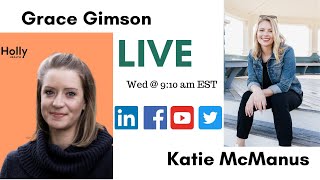
Katie McManus talks with Grace Gimson, founder of Holly Health, about an app that uses AI and psychology to help people make small behavioral changes for better health. The app tracks both mental and physical wellness and can be used by individuals or offered by companies to employees.
Chapters
Good morning, everyone. I'm Katie McManus, business strategist and leadership coach. And I am so excited to be here today with Grace Gimson, who is the founder and CEO of Holly Health. Grace, thank you so much for joining me today. And I should say happy nice or happy afternoon or good afternoon. I'm not awake yet. This is my first cup of coffee.
No worries. Thanks for having me. Yeah, happy to be here.
So we were just talking about the differences, weather wise, between UK and Cape Cod, and I was telling you that it's so, so humid here that I put these on. I don't know if you can see. These are my blue light glasses. They immediately fog over from the warmth from my face. It is just so. It's like soup here.
Oh, gosh. Well, yeah, bit problems over here. Bit too cold. Jumpers are out already. We're losing the sunlight. It's all a bit depressing.
I am so jealous. That is my weather.
Switch homes for a bit.
Yeah, yeah, yeah, that sounds good. We're not here to talk about the weather. We're here to talk about Holly Health. And what I am so excited to talk about is I'm a big advocate for small changes. Like, big changes never stick, so you never really see big results from them. And really, I mean, Holly Health is an app that's based in AI in psychology and utilizes AI so that you. You can implement small changes for, like, an amazing difference in your health.
Exactly, exactly. It's an app that we launched a couple of months ago. So it's all very new, but we've been building up to this for the last couple of years, and it's available now internationally, not in every single country, but a lot of places around the world. We have a few thousand people using it, and we're helping people to implement little behaviors across mental health, physical health, sleep, and just to feel generally a little bit more in control of things. I think particularly after the last 18 months or so, we really need a little bit of help to kind of feel like we're back in control. And of course, we know the kind of big overhauls don't work for most people. So Holly Health is our way of helping people to put those small things into action.
Yeah, well, what I love about it, and I'm one of the initial users, so super excited to have you. So what I love about it is, especially with the last 18 months, we're no longer going into the office. Many people don't have that commute time, so there's no outside signal that There's a time to change gears from work time to home time. And what I love about the app is that it actually has alarms and stuff that you can set up that tells you, okay, now it's time to go for a walk or remember later today you're going to have to meditate or, you know, whatever habits you and the app have decided are going to be most influential for you.
Yeah, exactly. We have had tons of different changes. Of course, there was a fear amongst employers at the start of the pandemic that is productivity going to go down? Are employees going to not know how to work at home? But the opposite has happened. And actually, I think a lot of people are feeling more burnt out than normal because they're working from when they get up to when they go to bed. And unless if they're really deliberate about switching on and off, it just all blurs together and gets a little bit out of control. What we wanted to do with Holly Health, and we actually designed this before the pandemic, but the pandemic has just kind of accelerated the need for it is created a way of people to think about a few things at once. So, firstly, it's about mindset. Are you ready to make some proactive changes? Do you want to put your health first? Is that going to be useful for you? The second thing is experimentation and working out which types of behaviors are going to be most relevant. And that's where we have some personalization to help for each person to know which things may or may not be more useful for their routine, and then it's about creating that routine. So, like you said, we have those kind of nudges and reminders and coaching messages to keep motivation up and keep people on track. And I think that's. It's. The challenges I faced in most of my career up to now are that I found it really hard to have that consistent daily focus on my health. For me, I would just be too busy and in my. In my head. And it was either I was focusing on my health right now or I wasn't. And I think that's the case for most people. I don't know about you, Katie.
Oh, well, it's funny because, like, as you're describing this, I'm reflecting back on when I was trying to be a runner. I've tried to be a runner so many times in my life. My body is just not built for it. I don't, and I get annoyed with it. But I remember setting up, like, all these reminders in Runkeeper that I Should go for like a five mile run. And you know, just to your point, when I'm already in my mind and thinking I don't have time for any of the things that are already on my plate and my phone pings and says, don't forget you have a five mile run later. I'm like, screw you, go away. No, that's not happening.
Yeah, for sure. And I think it's really important to set the bar lower. Yeah. To go for a five mile run is just, it's just not likely to happen. So we use an approach that's all about really tiny behaviors and habits. Like, the most crucial thing is building up your own confidence in yourself. Hi, doggy. And your own ability to keep up with your commitments. And so the bar should be like so easy that it's like two press ups a day and then you kind of cross that threshold, finding it really easy and then you can kind of step up and move along. So we help using the kind of back end of the system. We help people to know when to step up those changes and make recommendations for them to kind of keep progressing forward.
Yeah. I mean, it's so cool. And it's cool that it's not just like physical things, it's also like mental health things and, you know, self care. I mean general self care because, I mean, it has compounding effects on all parts of your health.
Yeah, yeah, definitely. And so we took a very deliberate approach to look at health holistically, which is where the Holly Health name came from. Holly is also the little bird that you interact with in the app. We wanted it to have a bit of a character around it. And yeah, we basically found that you can't really address just one thing at once. You can't just focus on your mental health and then everything's great. It has to be a fully combined approach to mental health, physical health, sleep, nutrition. And really there aren't many solutions that do that all at once. And we wanted to be the one thing that helps you to kind of take care of yourself and everything about yourself.
Yeah. And I think, I mean, an app like this is so helpful, especially for companies right now because there are so many challenges in the workplace, which, I mean, you said, you know, we're working from home. There was a joke for a while. It's like, no, you're living at work.
Yeah, yeah.
Things work from home. You know, you don't, you don't have any separation.
Yeah, for sure. And there are lots and lots of workplaces who are rolling out more digital health services to their teams right now. In fact, we did some research recently and found that of kind of large companies that we surveyed, about 68% of them have put in new digital well being services since the pandemic, which is really significant. And when we look at smaller companies, it's a little bit less, but still around 50%. So there's, there's clearly a drive to, to put in these services that can help people to look after their health a bit more proactively and in work, out of work, wherever they are. And we're definitely going to see that trend increase. I think there's, there's lots of different areas of your health that you can address using services like this. And our specific focus is on the behavior change aspect. We're a team of psychology people. I'm actually the least qualified in the team, but I have some awesome co founders with PhDs in psychological medicine and neuroscience and we have some core backgrounds in dietetics, health coaching. And our approach is about making those changes and keeping them up consistently. Whereas other companies might focus more on the initial education or the internal strategy with employers and that kind of thing.
Right, right. Well, and I. What I love about Holly Health is that it has like this multifaceted approach. So it's not just a diet app, it's not just a meditation app, it's not just a walking app, it kind of, it customizes whatever is going to be best for you. Using AI and psychology to make suggestions for you.
Yeah, yeah, absolutely. And hopefully that means that when we work with large employers, they don't have to think about putting in a mental health service, a physical health service, a sleep based service. They can basically work with us and then our service tailors to the individual.
Yeah, yeah, amazing. So speaking about that, what are your ambitions for Holly Health moving forward?
Oh, so pretty big. We set out initially with the goal of reaching population scale. For us, that means not just kind of one population, not just the uk, which is where we've originated, but really to reach populations internationally. So that means millions and millions of people, really. And the way that we get to that is by getting directly to consumers, which is what we've done with our initial launch. And right now we're really, really excited about some partnerships that we're about to begin with public health and also with employer providers. So this is how we get to people who aren't going to pay for the service themselves. So, for example, we're really, really keen on reaching sections in society who cannot afford a subscription mobile app service. And just would not think to spend their money on that. But they definitely can steal value from this type of support in preventing future health conditions. So. So we're really excited to work with public health for that reason. And I guess our ambitions are. It's kind of about impact. It's kind of about how much can we achieve as a women founded team. And that's. It's. We like to be a kind of representation of what can be done and. Yeah, we just want to see how far we can take it.
Yeah. Amazing. Amazing. I'm sorry. My. My dog is literally, like, chewing on my seat cushion as I'm sitting here.
I'm trying to get her to stop.
It's not working. Seven months, so she still, you know, has puppy teeth, I think.
I think we should meet her. Okay, Luna, come here. Come here, puppy. Come here.
Get out from under the table.
Come here.
All right, big dog. Okay, come here. Let's go.
She's big.
I know.
Oh, gosh. Hi.
Hi, big dog.
Hi, big dog. She's eight months.
She's seven months next week and already, like, 57 pounds. So if you're a future landlord of mine, please don't listen to that.
Oh, my gosh. Amazing.
But it's funny. I mean, really, she has been, you know, as we're talking about, like, health and wellness, like, you know, she needs a lot of exercise, and during the pandemic, I really wasn't getting out that much, and now that I have her, you know, you have to go and exercise her. She needs, like, between an hour to two and a half hours of exercise a day. And it's just that. That regular movement, it reminds me of, like, when I was in college, and that was, like, the. The time that I was most healthy because I was out and about so often.
Yeah.
And it's just, you know, we're talking about all these, like, small changes that you can make to improve your health. And, like, that's a huge one. It's just about.
I'm interested to know as well, since you've been out with the dog more often, have you found that it's impacted your sleep as well?
Yes. Yeah, it has. It actually. Well, I think also it's helped me sleep better because she wakes me up around, like, am. But I do, you know, the days where we go walking or we go on the beach or something, and I'm, like, getting UV rays and I'm moving my body, like, I do absolutely sleep better.
Okay, cool. Yeah. So it kind of makes me think about a few of the habits we have in the Holly Health app, which encourage time outdoors, not just for the purpose of exercise, but also for mental health. It's just kind of calming and puts you back in touch with nature. And I think the more things that we can do to forget what period of time we're in in history, the better. If we can put ourselves into a forest or a field or a mountain as often as we can, that generally helps us from a mental perspective, but also just triggering your circadian rhythm a bit more. And like being outdoors when it's light, even seeing when the sun's going down, it does stuff inside our body that we don't know a lot about. In fact, recent studies have shown that in our pancreas there are triggers based on sunlight. And that's a brand new thing that we didn't really understand. And that triggers your digestion to change at the right time so that you're not kept up through the night when you're digesting food.
Oh, interesting.
Yeah, there's, there's a lot of scientific reasons to spend time outdoors. So. Glad you're able to.
Yeah, no, I am too. And I just, you know, I think this is a sign that I'm going to have to give her a walk after we. Well, I'm curious, you know, when, when was the time that you were healthiest?
This is, it's an interesting one because I've had periods of time in my younger years where I, like you, was on my feet a lot. So I, out of university, I wanted to learn how to run businesses. So I basically left university and went straight into retail management. And in that role I was managing an area of stores and constantly walking up and down these supermarkets crazily. Actually, when I think back to that, I always think this is a sign of the changing times because I was forced to wear high heels every day walking up and down these stores. I'm not going to call out the, the company, but they've actually changed that rule now anyway.
So they required you to wear high heels.
They required women to wear skirts and high heels. And this was only seven or so years ago. So anyway, that just always pops into my head. So I was doing lots of exercise, but I was also really, really overworked. So I actually lost too much weight probably, and, and I wasn't so healthy. And so I, I guess, yeah, exercise isn't always associated with like, okay, your, your health is great. And I think that's something we still things to. We see kind of how people look and make assumptions on Their health. And I'm not sure that that is the right thing to do. It's not the right thing to do when people are clinically overweight. And it's not the right thing to do when somebody seems like a perfectly healthy weight. They may actually have really damaging behaviors day to day. And people who are clinically classified as overweight may actually be super healthy and doing tons and tons of exercise and have a lot of muscle. So how we see things from the outside, I think needs a lot of work, particularly when we look at governments and how they treat that kind of thing.
Yeah, well, I think you're. You're touching upon, you know, women's body image issues as well. And I always joke that, like, the times that I'm in my best shape are like, right after a breakup and when I'm working like 2.5 jobs.
Which.
Obviously, like, those things all indicate, you know, unhealthy behaviors happening as well.
Yeah, exactly.
Yeah.
So, yeah, I mean, to, to actually answer the question, I'm probably at my most healthy now because, I mean, we've got to practice what we preach, which is having. Having a balance, having, obviously working hard, but taking some time out as well. Sleeping. I've never slept more than eight hours a night consistently, and I'm doing that now. And the changes are ridiculous. There's. If there's one habit I can recommend, it's to consistently get eight hours of sleep a night. How do you. Oh, well, you've got your dog waking up early.
Well, I. Well, gosh, when was it? It was like 2016. No, 2015. I made a New Year's resolution that year that I was going to sleep eight hours a night. And it was. God, I mean, you know, I'm in my mid-20s and you know, you know, your friends are going out and there are dates to be going on and all this stuff. And I set like a bedtime like, of 10pm for myself. And it's crazy. After doing that for six months, I. I quit my job. Like all these other things that I realized needed to happen. I had this amazing clarity around. I ate better, I exercised less, actually, because, like, I just didn't need it. I had a lot more energy to move throughout my day. And then.
Oh, hello.
What do you want?
Geez.
Demanding.
Hello.
Yes, I see you.
I'm getting an. I hope people are just coming here for the dog content.
Don't eat my necklace. Thank you. But it's incredible. After doing that, I can't not sleep eight hours.
Yeah.
So I will literally Sleep through any alarm. Which is partially the reason why I don't do early calls most of the time. My business, because if I can't fall asleep the night before, I'm very concerned that I will sleep through my own. But it is one of the best things you can do for your body.
Yeah, yeah. And it's, it's a shame that we still have a bit of a culture of like, I'll sleep when I die and need it. And I look at the people who are kind of relentlessly working day and night and not really giving themselves that time, and I just know it will catch up at some point. And I mean, there's a lot of associations between long term chronic diseases and conditions and lack of sleep and. Yeah, I mean. Yeah, well, we're all trying.
Yeah, well, it's funny I use the term sleep shame. I think a lot of people sleep shame themselves. You know, like, there's this element of pride that gets handed around when you only sleep four hours a night and then you go and work a 12 hour day.
Yeah.
And it's real messed up.
Definitely. You know, we just switch it around the. Let's just brag about when we sleep.
I know, right? Well, I always think it's funny when people are like, oh, well, I'll catch up on sleep this weekend. It's like, well, it doesn't work that way. You actually have to sleep, what, eight hours a night for a week and a half for your body to get back to your normal rhythm or something like that. I mean, you're, you're the one that is.
Some of those lost cells will never, never be caught up again when you have like a really lost night of sleep. So say four or five hours, you'll never make that up and it can literally kill you. Yeah, yeah. Anyway, hopefully everyone is focusing on their sleep.
And I, we're having dog drama. There are turkeys in the backyard and the dogs are like, are growling at them. Calm down, it's okay. They're harmless. Well. And you know, when you don't get enough sleep, the other part of it is, you know, you really shouldn't be driving because it's the same impact as having a few drinks.
Yeah, yeah, definitely. Yeah.
Okay. So sorry.
You go. Don't worry.
No, no. So I was gonna say. Okay, so sleep is the number one. What are like, if you were to rank the habits that we should be.
Doing.
What would be number two? Number three.
Yeah. So it is really interesting to dig into the user behaviors from the people using the service. Right. Now and so the short answer is really it's not a one size fits all thing, which is why we built the service to be kind of experimental and adaptive and each person gets a different experience, so that's really important. But there are patterns and of course we cover both physical health and mental health. So there are a lot of people who are doing a mixture of this. And I would suggest that it's. Always good to have a few different things going on at once because not only does it improve your health in that area, but it just keeps you thinking about it. So you're, if you're thinking about how much movement you're getting, are you standing up from your desk every now and then as well as, okay, what am I doing with my nutrition this evening? Have I had enough variety of veg, that kind of thing. But a really interesting pattern that we are seeing and we think is a very underserved area right now and it's, it's an area where awareness is really, really growing is relationship with food. So this is, it's an overlap between mental health and nutrition. And the challenge here is we've been brought up in a world where food is seen as good or bad and we use food as a way to control our health mainly through restriction culture, diet industry. And for the last few decades this is what all of us have grown up with. So it's, it's no surprise that this is kind of a problem now. And we're only just starting to recognize that if we continue to do those kind of yo yo cycles as a way of trying to manage our health, it's firstly, it's not going to work for our physical health because you generally almost every time regain the same amount of weight and sometimes more. And psychologically every single time that that happens, we're losing self esteem, we're confusing our bodily signals because it sends our hormones all over the place and we, we lose touch with what hunger really is for us. So we've ended up with a really tricky situation where we, we have kind of emotional connection with food and often we don't really know what our body needs or wants. And we may turn to food as a coping mechanism. And because of the restriction we can tend to overeat more than we need to. So yeah, a big challenge with relationship with food and that's actually the habits that we have which help you to kind of rebuild that connection with your hunger signals, help you to check in with how you're feeling around the food that you're eating. Those are really Popular. And it's an area that we're really producing more and more content on, and we're finding people are really resonating with it. Yeah.
I mean, you're describing this, and it's reminding me of, like, the depths, the dark depths of the pandemic when, you know, I was trying really hard to not do unhealthy behaviors like drinking too much or, you know, I mean, really, that's it. But it was like, okay, well, I'm bored and I want to numb a little bit. And like, food is one of the things that's there. And, you know, in my family, it is absolutely something that we do emotionally is eating. And I decided, okay, well, I'm going to do this consciously. I'm going to, like, if I'm going to eat out of boredom, I'm going to consciously out of. Eat out of boredom. I'm not going to just, like, convince myself that I'm hungry.
And that is exactly the way to do it. That's the first step is just the awareness. And we. We use a lot of mindfulness approaches inside the Holly Health app, so that. Because for a lot of people, it's actually quite a big step to just have that awareness. Because a lot of our behaviors are kind of mindless, and particularly when it's associated with stress or a long, hard day, we can kind of do things automatically. Go for a glass of wine, get the chocolate out the cupboard, and before we know it, it's kind of gone. And we're like, did I satisfy myself? I don't know. Did I need that? Not sure. So the first step, as you say, is just, okay, right? I feel like I want this thing. Is it going to satisfy by me? Yes or no? Is there something else maybe I could do instead that would, like, equally make me feel better? And if. If food is what you want, then we shouldn't be restricting ourselves. We should be allowing us to do what we want, but within. Within a level that. That is meeting our needs and then not crossing over those needs. Right. Yeah, it's. It's quite a big process of re. Educating ourselves. Right.
I apologize. I'm not laughing at you. The puppy's gotten a squeaky toy now, and there's no way I'm getting it away from her. Well, and. And here's my problem with, like, the good food, bad food mentality is that, you know, cookies are, you know, in this mindset of bad food, they are my favorite thing in the world. And whenever I. I think of them as, like, oh, well, this is bad. I don't actually enjoy eating it.
Yeah.
So it's like one cookie. I don't actually enjoy eating it. So then I go for another one and I go for another one because I, it doesn't satiate me because I'm. I'm making myself feel bad for it as I'm doing it.
Yeah, yeah. And it's. There are lots of approaches that, that can be used. Daniela on our team, she actually it. Through her PhD, she worked with people with various different relationship with food challenges and helped them to use different approaches to reach that point of satisfaction and then to be able to tell themselves, okay, I'm fine now, let's stop. And to gradually remove that feeling of like, this is good or bad. If as soon as we see food as like, it's just food. I love some things. I don't like some things as much. I know what's good for me nutritionally. But of course there's always going to be some. Some nice things in there like cookies, like you're saying. And we just need to get to the point where we have that basic level of nutrition and we allow the. The things that make us feel great and taste really good, but we don't feel the need to overeat them. And we can stop after that one cookie rather than going for the whole packet.
Right, right, right, right. Well, we have a really great question by Jolie about menopause. So I'm curious, does Holly Health have differentiators for different phases of life?
That's a really interesting question. And menopause is an extremely challenging time where I'm sure from experience, you know this, Jolie, that you can really have some physiological changes, psychological changes, hormonal changes, and all of these impact our ability to maintain a healthy weight, keep exercising, keep our energy levels going. So lots and lots of challenges there. We at the moment have a lot of people who are going through this stage of their lives who are using the Holly Health service. And for them, it will be a case of what are their specific challenges. Right now they'll basically tell the app through a few questions, what's happening at this stage? And then the app will make recommendations on which behaviors would be most helpful. So at the moment, it's not based on whether you are going through that period in your life or not, but it's based on your current life situation and challenges. So in some ways it will be kind of personalized and helpful for that situation, but we haven't created specific programs for it at this stage. But it's Such a huge thing affects 50% of the population at some time in their lives. And we're just creating our kind of ongoing plans for, for more specialized content and programs. And menopause is definitely up there near the top with some personalized support that we'd like to create.
Yeah, amazing. We're past the half hour and I know watching a live for more than a half hour can be a little hard. It's basically a TV show at this point. But Grace, I'd love to hear, like, what is one thing that you'd urge everyone to go and try today to improve their health?
So many different things. I would say just go and reflect. Are you happy with your day to day routine and are you focusing on your health day to day? Because it's so easy for us to just kind of forget about it. Weeks go by and then we're like, oh, no, okay. I really do want to look after my health proactively. Um, I think once you've had that cognition of no, but I do want to do it more every day, then a whole lot of things will start to fall into place after that. Um, so, yeah, I would just go, go and have a think, like, is this something I want to prioritize in my life? If it is, there are lots of ways you can do that. Checking out the Holly Health app is one of those.
Yeah, I recommend it, I use it and I love it. And, and I, I know I'm not like the best user because I don't always check into it, but I utilize all those alerts to rem and it's like, it's such a nice check in. Just, you know, to be in the middle of my workday and look down and be like, oh, that's right, I need to go for a little walk or a little meditation later today.
Exactly. Yes. It's about the little reminders and nudges and having it in your mind.
Exactly. Yeah. So, like, I think it's. It's hard to remind yourself when you don't remember to remind yourself, but if you have an external thing that reminds you, for you, it's perfect. That was a very confusing way to say that. Anyway, I obviously need another cup of coffee and need to deal with the dogs. Grace, thank you so much for joining me today. This has been so much fun and so insightful and I hope we can do it again.
Yeah, me too. Thanks for having me. And yeah, I look forward to coming back soon. Yeah.
And everyone, if you're watching, please download the Holly Health app. It's amazing. I think you'll really enjoy it, and I'd love to hear any feedback you have or experiences or results that you're seeing. And Anyway, I'm Katie McManus, business strategist and leadership coach. This is Grace Gimson, co founder of Holly Health. Thank you so much for watching us today, and we look forward to seeing you soon.
Thank you. Bye.
More from Katie





How to do self care right now, so you can do what needs to be done, for yourself, your business, and

How to do self care right now, so you can do what needs to be done, for yourself, your business, and

#greenscreen How to build a consulting business that makes you $200,000-$700,000 a year

#greenscreen How to build a consulting business that makes you $200,000-$700,000 a year

Maybe we’re not the imposters…? #businesscoach #startup #entrepreneur #smallbusiness #consulting

Maybe we’re not the imposters…? #businesscoach #startup #entrepreneur #smallbusiness #consulting
