The C-Suite Leap
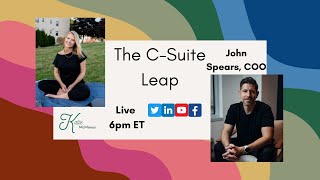
A recorded conversation between leadership coach Katie McManus and executive coach John Spears about authentic leadership in the C‑suite. They cover John’s non‑linear career (NGO, Obama campaign, SBA, USAID, ONE Campaign), the importance of authenticity, integration of work/life, practicing leadership, and how senior leaders can create trusting, creative workplaces.
Questions this video answers
42
2005
President Obama's campaign
Small Business Administration (SBA) and the U.S. Agency for International Development (USAID)
Chief Operating Officer (COO) — he served as acting COO and was named permanent COO
Chapters
Hello, I'm Katie McManus, business strategist and leadership coach. I'm here today with John Spears, who is an executive leadership coach to the C Suite, hence the topic, the C Suite Leap. I'm getting text messages. Anyway, John, thank you for joining me this evening.
Thanks for having me, Katie. I'm super excited to be here.
Oh, my gosh. So, I mean, I love this topic. It's not a topic that I typically talk about. I'm gonna. I'm sorry. Oh, my gosh. Very popular.
You're so popular, Katie.
Oh, my God. Okay, so how do I quit Messages. There we go. I think it's done. Okay, so. And hi, Chris. Welcome. So you have personally made the jump into the C suite. And I think there's a lot of, like, beliefs about what it takes to enter the C suite and what it means to be in the C suite. I think some people even think that you have to be like, kind of a sociopath or a psychopath to be. Be in the C suite. Well, because there are a lot of tough decisions and. And like, there's been this role model for. For what that is.
Yeah, you know, I think that's true. And for me, I've talked about this before. I am. It's. It's really interesting for me because I'm like the anti executive presence guy. Like, it's really surprising, I think, in some ways that I'm here at this level. I live in Washington, D.C. i have tattoos. I kind of like, am a recovering Washingtonian, recovering perfectionist, recovering workaholic. And so I kind of find myself surprised that I'm here because I'm doing things a little differently. And so I'm super excited to be able to share my experience and to talk to you about sort of what it's been like for me and taking a leap and being an authentic leader, what that means, and sort of going into the grain, going into inertia in charting my own path in this role.
Yeah. Well, I would love to start first with what has your career journey been?
Yeah, so it's super interesting. I wanted to be like a pastor, a youth pastor, or a pastor missionary or something growing up. So I went to a Christian college. I studied theology, I studied religion, and moved to Washington, D.C. in 2005, which dates me, you know, after. Right after college. I'm 42, and I came and I moved to D.C. to change the world. I was, like, super interested in philanthropy and in service and being a part of a mission based organization. And I spent my entire career in Some of those settings. So I worked for an international NGO that was working against human trafficking and bonded labor, and then went to go work on a national political campaign. So I worked on President Obama's campaign in a number of states, did that for two years. I moved back to Washington in 2011 to work in the administration, so working in government. My first job in government was at the Small Business Administration, where I was working on supply chain development. I had no clue, like, what. I don't know how I got the job, but I was like, hey, this is interesting. I want this experience. I said yes. And so I did that for, like, four years, which was super interesting and completely out of kind of my league in some ways. But I learned so, so much. And it was there that I really realized that I wanted to get back into some international work. So I went to the US Agency for International Development, which, where I was the senior advisor to the administrator working on LGBT issues, the Asia region, and then Management and Operations, which really kind of shifted my focus into being a CEO, into thinking about operations, into understanding operations. I really cut my teeth at USAID in 2015. 16, and then came to the ONE Campaign where I'm currently the CEO. First, for about four and a half years, I was the chief of staff. And about a year ago, I took on the acting role to be the coo. And I was just named permanently COO there. And I would say sort of as on my side hustle, on my side gig. I'm an executive coach, and I'm really, really passionate about helping and partnering with people to live the life of their dreams, particularly at the C suite. People who are super ambitious, who have big achievers, but still lack what they really want, the kind of life that they want to live, the connection with friends and family, having flexibility in their work, and really finding true joy in their roles.
Right. Well. Oh, my God. So much. So much. Like, I love how your life has been designed around. Wow. I want to have impact here. Just go and figure it out on the way. And also, like, wow, I really want to learn this thing. Thing. I'm just gonna push myself to figure it out. Yeah, right. And. And you know, the. The clients that you work with, you know, they have climbed to the top, being very ambitious, being kind of ruthless, like, with their lives. They've sacrificed a lot. And I love that you're kind of opening that door back up to them. Like, you know, you get to have some of your life back. You're at the top. You can have some. Some fun, too.
Totally Totally. I mean, I think one of the points that's really important to me and I think if you look at my career, it's not linear. It's like the anti linear kind of approach. It's kind of like a circular staircase. It's been kind of all over the place. But I think the number one thing that I've really brought to every role that I've taken is like, yes, I want to learn. I've been curious, I've been interested. And that's really opened up so much opportunity and possibility for me. For instance, I don't, you know, if you think about a normal, I shouldn't say normal, but sort of a COO role. Traditional. Yes. Thanks for that. Traditional. A COO oftentimes comes up in one of the workflows or the tunnels, funnels around up. So hr, finance, legal, it. I don't have any of that experience.
Right.
Zero. You know, the only real experience I had is at this 30,000 foot view. And I said yes, I'm like super interested in it. And I think that sort of really curious. I want to learn, I want to be open has really created so much opportunity for me in my day job, but also in coaching.
Yeah, yeah. What, what do you see is the top skill that people in the C suite will need to have in like the new millennia? The new, like in the, in this chapter of human history that we're moving into.
The, the top. I, I think, I think a few things, but I think the number one skill is authenticity. I think we're really past the days of traditional leadership and people showing up in a, in a really sort of traditional way. I think it's sort of played out. I don't think people buy it anymore. And I think for me as a leader, I often tell people I don't know the answer to that. And it's true. I just, I don't know the answer. And it's really unrealistic for me to think that I know the answer to everything. I think I'm a good problem solver, but I also create space for other people to lead and other people to kind of be participating in the process. And so for me to be able to say, hey, I got really nervous there, I didn't know what to do. I think it's really important. I think it's the thing that frankly got me this job. I didn't strive for it, I wasn't sort of angling for it, but I think I'm a pretty, pretty authentic guy. I think I'm just Real. I don't think I'm egotistical. And so I think that really adds to the ability to lead in whatever area that you're in.
Right, right. Chris Hennessy. I don't know if you saw it. He said, I damn sure don't buy it. Hello, Tamika. Hello, Edvon. Welcome. Thank you for joining us this evening. It's so funny you say that, because I, you know, growing up, 90s, 2000s, it's the model of the CEO or the CEO or the CMO has always been modeled to me as, like, some really, really uptight, like, serious, buttoned up, usually, like hetero male, you know?
Yeah.
Doesn't have a lot of a sense of humor. And I love seeing that being, you know, kind of put on its head. You know, it's. It's funny. I get the question because I. I have my own company. I even have a fractional coo, and someone asked me once, they're like, well, why aren't you CEO? And, like, because I just don't see myself that way because it just seems, like, too serious and too big. Like, I like, I like my role in my business the way it is, but I love how you're creating this new definition for it.
You know, what's. What's so interesting about that is one of my personal values is fun. It's joy. It's levity, even. You know, today I was in the office, we had a bunch of really hard conversations today, and it's really easy to allow the weight. The pressure of those conversations to influence your mood, how you're seeing things, kind of get. Allow those things to cloud your vision. And even when I'm dealing with really hard stuff, I want to have fun. I want to be creative. I want to, like, tap into joy, because to your point, like, that really uptight being. I've been there. It is not fun. It's not enjoyable. It's. There's no flow in that for me. There's a ton of anxiety in that. I'll just say, when I was at usaid, it was a government job. I was wearing a suit every day. It was super high pressure. We were dealing with. I was at the highest levels of government, and I got super anxious. I was just, like, anxious. I had to go on. I went on some medication. Lexapro. I was deep into therapy because I didn't know where all this was coming from. I never experienced this before in my life, and I just made a decision. I don't ever. It was great because of the vantage point and the impact that I was making, but that's just not who I am. I want to joke around. I don't want to wear a suit every day to work. And so to be able to, like, lead in this way and has been so freeing. It's given me so much more access to my own confidence. And one of the things that. When I think about what does it take to be a C suite? You know, Mark Manson, I don't know if you're familiar. He wrote an article that I first read from his, which is the subtle art of not giving a fuck. And that idea, I think, has really shifted my being and how I show up and not only my work, but in my life and my relationships, in the decisions that I make. That kind of perspective has been so freeing for me to, like, show up and have joy and have fun in life, which is like, who doesn't want to have fun? I don't. I don't. I don't know anyone who, like, wants to be uptight all the time.
Yeah, but.
Yeah.
No, no. I mean, I certainly. Well, what I love about that is that, like, the model you're talking about is so congruent. You know, it's like you get to be honest about your. So for those of you who are watching, congruent is when, like, your actions, your words, and your feelings all match up.
Yeah.
So if you're sad, you're at least acknowledging that you're sad. And, you know, if you need to do something, take care of the sadness, you're doing that. Now. Leaders who aren't congruent, they may have, like, gotten in a car accident on the way to work and then come in and, like, they're anxious and they're freaked out or something, and then they have to go and present on the numbers for the quarter. No in the room will trust them because they're not acknowledging that something happened to me that affected me. They're trying to play it off like everything's fine. And we've all been in that meeting where everyone's just kind of side eyeing each other, like, who's getting fired after this? Like, what aren't they telling us? You know? But I love that your model or the way you are and the way you coach your clients to be is very much. You just get to be honest about it.
Totally.
Right. And it opens the door for that laughter. Because if you're trying to hide something, there's no way you can find anything funny.
True. I would. I would also say that it takes a lot of energy to conceal that stuff. Like, I don't. I don't know about you, but, like, I've tried that, and I have been exhausted by that experience. And so it's just not a good use of our energy to. To kind of compartmentalize and to think about, you know, what. What makes me think about this personal insight is. So I was. I was married to a woman. I have two kids. And in 2011, when I moved back to DC, I started to realize some things about myself that. That I was gay, actually. And I remember thinking about being in conversations that led to me coming out that, um, I was thinking, what is the right response in this situation? Like, how should I be. How should I be in this situation? And all of that energy of trying to do that was just exhausting. And. And that was sort of when I really felt it all unraveling. And I was like, something. Something's different here. Something's different about me. And being able to have that congruency at all times just freed up so much energy for me to create, for me to show up the way I want to show up. For me to have a life of ease and flow in a new way that I had never experienced before that.
Yeah, yeah. No, as. As you're describing that. I'm kind of, to a lesser degree, thinking of all the jobs that I've had. They're like, bring your whole self to work. But then, like, you would. And they're like, oh, no, no, no, not those parts. Parts. You know, like that. Careful, you have your shit together parts. Can you leave those at home? But like, bring your whole self to work.
Totally. Yeah. I know those experiences. I've had them myself.
Yeah, well, and I love that you're. The way you work with your clients. You're opening the door for them to not only bring their whole selves to work, but also to bring their whole selves to their actual life, which I intuit they haven't for a while.
Totally. Totally. Giving people access to creating the life that they actually want to. Having the experience they want to have, the freedom, the flexibility, the relationships is. It's often foreign to them because there's a life of so much pressure. So I don't know if you've seen the new Disney movie Encanto, and I should probably.
I'm obsessed, actually. My dear friend Helen. I'm going to just brag for a moment. My dear friend Helen, who also does some work for me. Her cousin was the producer, and her cousin's daughter was the voice of Mariel, her Little self. The.
Okay, yeah. But there's this song that I'm just, I'm obsessed with. It's not like the Bruno song. It's surface pressure. It's about. Okay, know, I read, I listen to that song and it's like pressure, like a drip, drip, drip, blah, blah, blah, like. And it goes on to this experience. And I remember having this experience of so much pressure. Like, if I don't do it, who else is going to do it? It's all on me. I've got to. I got to prove myself. I've got to prove to other people I'm up for this task. And that's a real like unbearable experience for people. And I think a lot of people in life, but particularly at the C suite level, feel that pressure. They experience that pressure and that, you know, when I think about the experience that I want to have in life, it's not that constricting, closed, weighed down, weight of the world on my shoulders, pressure. It is an experience of openness and joy. And I think people can have that even at the highest levels of organizations. It's just not something that's modeled and people don't actually know that they have access to that, that they can choose that, that they can create that life for themselves. And it's. I mean, I'm living it now. I'm, you know, I am on that, on that path of having joy and working with really challenging situations.
Right.
Budget situations, HR situation. Like there are all these situations that come across my. I don't have a desk really because, you know, we're kind of hoteling at work, so. But come across my email that I have to deal with. And I'm having a new experience that I just never thought was possible. And I want more leaders in the world to be able to have that experience too.
Yeah, it's funny, I was talking with a client about this today. It's like the higher up you climb in an organization, the more power you wield, the more areas you're actually powerless in. Right. It's like the, the on the ground changes that need to be made. Like you have to rely on 17 different people to make sure that that happens. You actually like can't just go and do it. It's inappropriate, it upsets people and it's not your job anymore. And especially for the people who climb that far, like they're used to getting shit done. It's. It can be craze making.
Yeah, totally. And I would also say we actually had a conversation about this. I think it Was last week, I was sort of talking to you about my challenge of like meetings on my calendar and really wanting to use my energy in a different way. And you challenged me to say, hey, John, like, aren't you the COO of this organization? Like, can't you change that? I was like, oh, yes, I can. And I think particularly when we're talking about work life post pandemic. Right. I, you know, for me, I came into coaching during COVID and I realized what kind of life I want to live. It was. Things were made really crystal clear to me. And I think when you think about the experience that people want to have, the integration of work in life, I think the days of work life balance and compartmentalization are over. No, we are integrating.
Let's just acknowledge that compartmentalization was never actually a thing. Okay? Never. Why are we. Let's that.
You know, it's so funny. I think you're totally right. We want to have things nice and neat and we want to say, oh, this one thing doesn't bleed into the other thing.
Right.
But we all know that's bs, so. Yes. So I think there's this new acknowledgment of. Of that compartmentalization is a farce and that this idea of integrating our work and our lives and sort of creating boundaries, of course, but being able to flow in and out of that is much more realistic, I think, moving forward. And so the experience that people want to have at work or in their lives is just different. And I think leaders today, particularly obviously in the C suite, have an opportunity to be able to really shift that dynamic that's going to support the whole self of our colleagues and the people that we're working with.
Right, right. Well. And how powerful is it for one of those top leaders to give everyone underneath them permission? By setting a perfect example of here, you're allowed to bring your whole self for real this time. You don't have to spend so much energy pretending to be something you're not. And you get to balance it. Not balance it, but integrate it with your life. I know, like when I have. When I have 30 minutes between calls to go, like, play with my dog, I'm so much better in that next call.
Totally.
You know, when I can like go and run a load of dishes, you know, and not stress about it, you know, just makes me better in my work.
Yeah, totally.
Yeah.
I mean, I think for me, going back to the. To the situation of a schedule, we work in a global organization, people all over the world, in Africa, And Europe and the US and one of my challenges was I was getting on calls at 8am it's working. All through the day I might have had, there have been days where like I had to, in the three minutes between a call ending and the next one, like run to the bathroom, right, grab some Cheez its for my kids lunches that they didn't eat and just like scarf it down and like be ready for the next meeting. And I realized like, this is not the kind of life that I want to live. And so you know what? I blocked off from 8 to 9 o'clock in the mornings. I'm not doing calls. I told my assistant I will do one 8 or 8:30 call a week. I've blocked off my calendar at 5. I will not do calls after 5. I have an hour lunch. I can take a nap if I need to, I can walk my dog if I need to. I can play wordle if I need to. I can play Candy Crush. You know, like, I can use that, that time to really recharge me and to, to make sure that I am creating space, that I can show up as my best self, that I'm not frazzled, that I'm not hangry, that I'm not like holding in having to go to the bathroom because I don't have any time. Like, that's just no way that I want to live. And you're right, I get to create that. And if I'm having that experience, my colleagues are having that experience, you know, and I think, you know, it's been really important for me in my role to be authentic about the challenges that I face. I, you know, I, when I post on LinkedIn, a lot of it is about my own experience and my own experience about forgetting. You know, I remember a post that I put around, you know, I had been doing this role as the acting COO for like 10 months. I got named the permanent CO and then I just kind of like, like lost confidence for a day. Like, I was like, I forgot who I was. Yeah. And I was like, what the f is that? Like what? I've been doing this job. I, I literally just got hired and lost confidence. And I posted about that on LinkedIn and people are like, oh my God, John, thank you for sharing that. You know, there's this. Psychologically we have this. We feel like leaders or people in the C suite are like completely different than we are. Like they, they somehow like have everything figured out. And I, I just don't think. That's certainly not true in My, my case, I think there are some skills that I've learned that are able, that I'm able to like tap into when, when I have a narrative in my head to switch things. But like I'm, I'm having the same experience. We're, we're having the same experience a lot of times. And so I think being, going back to this kind of thing about being authentic, I think it's really important for us to be able to be clear about that and to share that and to empathize because I think that's what's missing in so many leaders. Particularly when you think about the lack of trust that people have around institutions, government, large businesses, leadership. There's just this disconnect because those leaders are out of touch on what's really happening on the ground.
Yeah. I have two thoughts. So first thought is that, you know, this kind of happens with entrepreneurs too. I call it the 10k freak out. It's like they hit their first ten thousand dollar month and they're like, oh my God, it's exciting. Like oh my God, like I have to do this every month now. I'm now the person who does this and it's like, hold on, you don't have to do it every month. It's nice and you'll get to that point. But deep breath, you know, more work to do. And also, have you seen the downfall of Boeing?
I have not.
No documentary.
I will check that out.
Well, I mean there's so much responsibility that we associate with C suite executives because they do have a lot of responsibility. And I, I think if the C suite of Boeing, and they just had another plane crash by the way, in China, third one in what, four years. Crazy. And I think if they adopted some of these leadership strategies and ways of being that you're talking about, it never would have happened. It absolutely never would have happened. It actually makes the world a safer place when leaders are able to say, you know what? We don't know, like, let's turn to some experts, let's get some voices. Yeah, you know, I've had a bad day. Don't like maybe I take a step back, you guys run the meeting.
Yeah, totally, totally. I think that's the biggest difference with sort of how we're being. You know, a lot of times I'm an ontological coach. So I really talk about with my clients how we be in the world, how we are in the world. And we, we talk about two different ways of being around. Your survival mechanism, your self defense mechanism. What are those Things that are going to protect you, keep you safe, keep you in your comfort zone and being in your essence, what are those. Those key parts of you that, that are light and in your flow and curiosity. And when we're in our ego, it's all about us. It's all about protecting our reputation, about being the smartest person in the room, about being right. And that's just no way to live, you know, Like, I don't know about you, I'm not always right.
I mean, I love it when I am right.
I love. I love. So I love being right. You know, hey, who doesn't like being right? But like, God, the world is so big. I. I'm just not. I don't always have the right perspective. I. I think, you know, where you sit is where you stand. And that really influences your perspective. And sometimes I get it wrong. And I think creating an open space to be honest and authentic and curious in a workplace is such a powerful move. Not only for me to be able to learn to get different perspectives, to get some elevation, but for other people in that conversation to chime in, to see their fingerprints on something to contribute. I mean, it just creates. It's not about me as a leader. It's about, how do you elevate the entire team to be able to lead and to thrive and to shine and be fulfilled and to see their real impact in the work that we're doing.
Yeah. You know, you're describing this, and I'm just thinking back to when I started working at Cisco Systems, and they have an acronym for everything. And I remember, like the first two months of being there, I'd be in a meeting and I'd be like, I don't even know what is being discussed here. It's just like acronym after acronym after acronym. And if someone higher up, it didn't even have to be like, Tim Robbins, if someone, like, on the managerial team were like, what does that mean again? I would have been like, thank God I'm not the only one. And even if they just threw a bone, like, pretended not to know it would have. Or ask some dumb question, said, hey, this is a dumb question. And I'm asking it because, you know, dumb questions are allowed here.
Yeah.
Oh, my God. It would have made me feel like I didn't have to pretend to understand and just write. You know, I'm just over here doodling on my piece of paper. Cause I don't even know what to be writing down.
Yep. And what's the. What was the impact of you participating in that meeting, with that feeling of like, I don't know what's happening, people are using this language.
There were no ideas I could contribute. It took me longer to onboard. I'm sure. I didn't feel any confidence. I felt so separate from everyone. Yeah. I mean, it costs. It definitely cost the business money.
Yeah.
And it also cost the business my brilliance, obviously. But, you know, but if it. It's costing. It's costing. If it's costing one person, like, maybe I had, like, one idea that would have helped everyone. I understood what was going on.
Totally.
Think of that in a company that has, what, over 100,000 people. Think of the intellectual capital you're leaving on the table.
That's right. Yeah. I mean, I think of that. I think of, you know, when people. When you're having that experience, you're closed. Right. There's just not this sort of open ease that happens. And I think when people show up fully, that's where, like, magic happens in people's lives. Like, you bring your brilliance and you're showing up and you're seeing those interactions and those ideas. And if you're in a room and you're feeling closed, that's an indication that something's off, something's not. Not right. And if. If you're in a workplace and you're feeling that, gosh, like, how, like, did you like that feeling? I can't even imagine if I would go to work every day feeling that way.
No.
I'd be like, get me out of here.
No, I mean, what's the thing it costs companies because people don't stay in rooms like that. They don't stay in companies like that. They don't stay with leaders who create those kinds of rooms.
Yeah.
You know, and every company should know that. You're like, people are loyal to other people, they're not loyal to companies.
Right.
You know, so, I mean, if you're watching this and you run a company and you're having any turnover problems, you need to talk to someone like John, because that's exactly what's happening.
Yeah, totally.
Yeah.
Yeah. People don't leave jobs, they leave managers.
Yeah. Yep. Truth. So what's. What are you excited for right now in.
In general, like, in the world or like, everywhere? You know, one of the things, you know, in thinking about this, our live today, like, all these ideas that I wrote down, I think the thing that I am most excited about and the most uncomfortable with is the idea of practice. Yeah. Having a practice, a practice mindset and. Yeah. Chris Hennessy, like, Mic drop. I love it. And there's a mic in your. In your name.
I know, I know. Just don't drop it on Chris.
No dropping on Chris. I would not want to do that. You know, I. I just turned. I know. I will say I. Chris commented on something earlier, and the one thing that I wish I had was, like, Chris's background, it's just, like, beautifully, like, uplit, you know, and it's like. Looks really cool. And I don't know. I'm gonna have to figure out. I don't know.
I'm always. I'm always like, whenever we do a zoom, I'm like, what's that plant? And what does he have on that little table back there? You know, I get really nosy, so.
I have two things people are always like. Is that like a mini ipod? Like, ipod shuffle on the floor? No, it's like an. It's an air purifier, number one.
Okay.
And the thing on the table is I do this, and I'm super excited about this. It's a. It's a jar. And every week, my kids and I, we put in, like, the best thing that happened that week so that at the end of the year, we can review it and be like, remember when we took this trip to Vegas and we saw a blue man group? Or, like, I won my track race or whatever? So, like, it was just like that. That's what that little thing on that table is. Anyway.
I love the idea. I wish my dog and I can do it, but she probably wouldn't come up with much beyond the park.
You can do it.
I know, but I want to do it with. Yeah, that's what I'm saying.
Yeah.
Well, she needs some verbal skills.
You can, like, help her, right? Dog biscuits, treats.
She gets plenty of those.
So the thing that I was saying about the thing that I'm most excited about is I turned 40. I'm 40. I'll be 42 this year. And I'm doing a bunch of new stuff. I just learned how to ski last season. And, like, let me tell you, learning how to ski at 40 is scary. Like, barreling down a mountain on, like, two little toothpicks is, like, the scariest thing I've ever done. And so I'm, like. I'm practicing. I'm taking lessons. I'm going all the time. I'm learning to, like, not be good at something, to, like, fail and, like, not make it about me. And I think in two other areas that I'm practicing, I'm, like, starting A business. I've never done that before. I've never had to create content in this way before. I've never had to talk about why folks should work with me. I've never had to think about the possibility of generating my own income. I've been in a bit. I worked in sort of a. An office setting for 20 years, and so practicing. That is pretty new. And I'm also practicing in my job. I'm. I've never managed other people in the C suite. So I have a chief financial officer. I have a chief. I have a general counsel that reports to me. I have head of hr. These are really senior leaders in our organization, and they're a key part of my team, and they're a key part of one's leadership. I'm trying stuff out. It's not perfect. It's a little messy at times. And I am working at not making it about me when I mess up and being open about it and saying, hey, that didn't go very well, guys. So, you know.
But what a beautiful way to build trust. I mean, that's it. Yeah. Yeah. Chris, it's tough to talk about why people should work with you. It feels kind of icky at first. Yeah.
Yes.
Yeah.
That's what I'm working on. I'm practicing that.
You're doing beautiful job as far as I can see.
Thank you.
Thank you. Yeah. Yeah. So many. So did you. I mean, you obviously successfully got down the mountain.
Yeah. I mean, this is. I'll tell you. So I started last year, but a few buddies of mine invited me on a trip, and I was like, sure. The last time I skied, I was 28 and didn't have lessons and was at the top of a hill and, like, went down a little portion of it and was like, heck, no. So I, like, took my skis off and I, like, just lit on my butt down. Down the hill.
That was snowboarding.
Yeah, it was me. I was like, here I go. And. And so, yeah, so last season, I, like, went a few times. I. They were like, really great skier skiers. And I was like, you know, But I loved it. I. I, like, did. I had a lesson, and I felt like, for me, skiing is like a life metaphor. I have lots of them, and I should probably, like. I think I'm going to write a book about it, because you learn how to ski, and there are some principles about ski skiing, and the reality is that the ground or the snow is always different. And regardless of what is coming up on the run, like, instinctually and internally, you know what to do. You have like the skills to navigate it. And skiing is really about confidence. It's about actually leaning down the mountain. It's about like being all in and not, not pushing away. Because when you're on your heels, you actually go faster and lose your balance. But when you lean in, you actually don't fight the process. Like fighting the mountain is not going to work for you anyway. I don't know how I got off this thing.
But anyway, practice, like controlled, trusting, falling. Otherwise you look like Chris Farley, like falling down the mountain in that movie, you know.
Totally. I've also done that and it might be humorous for other people, but it's not a very fun experience to have. So I think the thing that I'm looking forward to, the thing that's most exciting for me is practice and practicing, mainly getting out of my comfort zone. I firmly believe that everything I want in life is on the other side of fear. It's on the other side of my comfort zone. And there is a story that I can tell myself to keep me really small and comfortable and safe and really feeling like. And I just, I don't want to live that kind of boring life.
No, no.
Yeah.
No. Neither do your clients, which is why they're so, so lucky to get to work with you.
Yeah. I think. And you know this as a coach, but you know, if we're not on our leading edge, if we're not pushing ourselves in our business or in our lives or as leaders, people, people don't want that. People want, want people who are actually living the lives that they're talking about. Right. And I'm in that. I'm moving in that direction more and more. And I'm integrating these experiences to really create the life that I want. A life that is full of joy and aliveness, you know, and isn't. Isn't in from this sort of like victim or villain mentality, but is in the co creation with the universe and creating something that, that I actually want to experience and what I want other people to experience.
Right. Well, I mean, to live your life any other way, it's just constantly being in fear of. I'm not on the cutting edge, I am going to screw it up and then there's no forgiveness for screwing up. You know, that's terrifying.
Yeah.
You know, that's way scarier than doing something that's just a little outside your comfort.
So, you know, you just reminded me of something that I think is so important for people in general, but, but also Leaders. And that is being kind to yourself.
Yeah.
Kind of just being okay with where things are and giving yourself some grace when they don't turn out the way you want them to.
Yeah.
And being able to detach any meaning about your own value or your own worth.
Yeah.
When. When you fail.
Yeah.
When think things kind of go sideways. You know, I. I used to be super. I mean, I'm just. I'm super judgmental about myself, and I have high expectations. I mean, gosh, look, I mean, I'm a coo. I've had. I've had to really push myself to. To learn certain things and to work hard. And when I fail at this level, it's super easy for me to say, what are you doing here?
Right. Yeah.
You're an imposter.
There's data. I mean, the world is full of data and feedback and data and feedback, and then there's meaning. And the most beautiful thing about human beings is that we are meaning making machines. It's. It's the source of all the beautiful stories and poetry and music and artwork and, you know, beautiful architecture and landscaping and everything that's beautiful in the world is based off of our ability to create meaning. Right. And it's also like the dark underbelly.
Stop.
So bad, you know?
Totally.
Because if we can make something mean, something so beautiful, we can go the extreme opposite and make it mean that we are the most evil, conniving, awful human being in the world.
Totally. Totally. And that's why I think, really, for me, coaching has been a really powerful tool to be able to help me evaluate my relationship to those stories.
Yeah.
And to really separate fact from interpretation.
Right.
To see things as they really are. You know, some people, we've also talked about this. Like, I've been like, hey, Katie, I'm really struggling with this. She's like, you're like, you know, you're not a psych. Good news, bad news. Good news is you're not a psycho. Right. But. But. But we can create inflated egos from ourselves. We can create other stories about ourselves that are sort of that. That span the spectrum of, like, crazy good to crazy bad. And to be able to, like, see. See things as they really are and to be detached from the meaning that we normally ascribe to is a really powerful way to be in the world because it allows you to just be. Be okay with what is and to understand when you're making interpretations about things or, you know, how many times have you been in a meeting and someone says something and you're like, oh, they actually said this to me. And.
Right.
They were just saying they were just. Maybe they just, like, gave you a side eye for a minute, but it was because they were looking around the room and you create this story and how this person hates you and how they're out to get you, and you're like, whoa, whoa, whoa, whoa, whoa.
Oh, none of that happened. Everything that they say from there, every time they look your way, it's all just reaffirming that story that you had.
Yeah.
You know, I learned this skill at the leadership program that I did through my coaching program, and it's. You go to the person, you say, you know, the story I'm telling myself is that, you know, you're mad at me for some reason, or, you know, the story I'm telling myself is that I did something to piss you off, and I'm so sorry. And usually they're like, no. Yeah, not at all.
Like, totally. And be. But be able. Being able to, like, see the data or see, like, see what happened. This person looked at me, and I felt this way is, you know, such a different way than saying, this person is mad at me because they did X, Y, and Z.
Yes. Yes. Yep. Yep. We do it in our relationships. We just do it in the world. We do it everywhere. It's exhausting.
It is exhausting. And how much more kind of effective or impact can you have in the world if you're spending that energy doing good when you're spending that energy outside of yourself? Right. When you're. When we're egotistical, we're focusing on me and mine, and it's so insular. As opposed to, like, being open and focusing outward, like, the kind of impact that we can make.
Oh, well, how. How creative do you feel when you're feeling defensive?
Right.
You know, it's just. No. You have no access to your creativity then.
Or confidence or leadership.
Yep.
Or empathy.
Yep. Oh, empathy is a big one, because then if you're feeling defensive, it's all about you.
Totally. Yeah. You're like, I don't care about what you're feeling. Can you look how. How big my feelings are about me? Totally. It's a huge.
And you made me feel this way. No, I made myself feel this way.
Totally.
Of course. And here's one of my big problems with coaching is, you know. Yes. For 95% of the time, you know, if you do have, like, a psychopath or someone with a personality disorder who's harmful, then, you know, recognize that there are red flags for That I just always like putting that side note, because I know a lot of coaching is, like, it's all your own fault. You know, the world you create around you is your own fault. And yes, most of the time, but there's Mana Delvey's out there.
Have you watched it? Yes, I haven't watched it yet.
Oh, it was. So I. I don't. I don't share this a lot because it's not something I'm proud of. I actually dated a guy who was a con man, and thankfully, I was, like, broke as a joke when he was with me, so he didn't get much of my money. He got some. He owes, like, around $2 million to various people in California.
Oh, my goodness.
And he actually had to leave the country.
I'm, like, so intrigued.
He's a UK citizen and. Yeah. I mean, I'm friends with his ex wife. We. We connected and I helped. I helped with the. The divorce or the divorce in the custody battle. I, like, wrote this whole declaration and, like, testified against him and all this stuff. But, yeah, so it was. I knew it was going to be really triggering for me, and it was. And. But, you know, sometimes, like, for your shadow work, you kind of have to, like, go towards the flame and let it burn you a little bit and then, you know, recoup afterwards and it. And it helps you kind of see the world through brighter eyes.
Yeah.
So. Oh, Chris, I feel like we need some popcorn. That'll be.
I know. I'm like, tell me more. Katie, I want to, like. Can we talk about this now for the next few minutes?
Chris. Well, I'm gonna be on Chris's show on Monday. He's probably gonna ask about it.
Okay, I'm. I'm there. I. I'm gonna be there. I want to see that link.
Just like a little teaser. Yeah. Yeah. No, is insane. Insane. But it's.
It's.
That's one of the things that I like to just always put as a side note for coaching because, like, yes, most of the stuff is in our control. And also there are some bad actors out there.
Yeah, totally.
Yeah. There are some people in those meetings who are looking at you like you're. You tick them off, you know?
Yeah. No, and, you know, that's a really. Also a really good thing to note is that there are those naysayers that are going to be out there. There are those critics. There are people who are out. I don't say I have to get you, but who aren't supporters, who aren't bought into your leadership. And as a leader, it's your responsibility to show it fully, to acknowledge what that does to you. I know I had a few situations that's super interesting to me. I had one or two colleagues that in my engagement previously, I would like, I would feel small, I would feel like really small. And I would, I wouldn't be confident, I wouldn't state my point of view and I'd be like, what is going on here? Like, what's happening here? And it wasn't until I really dove into it, it's, I, I, I made the story up, whether it was true or not, that they aren't supporters, that they're not bought in, that they're going to not partner with me in the way that I, I would want. And so I didn't fully show up, and that hurt me and my leadership. And so as a leader, it's your job, it's our, I think it's our jobs to, to show up fully in those rooms. Even when you feel the glare of someone's eye. Right. Whether it's interpretation or real. Right. To your point, you gotta figure that out and use the data. But that's such an important skill to be able to have to show it fully even when there are naysayers. And I always think about this point that Brene Brown talked about about, like, caring about people, what people say about you. And she said, of course, like, it's, we're humans. Of course we care about what people say about us. We would be crazy if we didn't. And so a more accurate kind of approach is to write down the names of the three or four people on a really small card that you care about what they say about you and focus on that as opposed to, like, focusing on the fact that, you know, one of the things that I realized is that, like, I'm not for everybody, right? Not everyone is gonna, like, thrive under my leadership. Not everyone is going to want to be a client of mine. It's not going to be a good fit. And that is totally okay. And being at peace with that really gives, gives people access to more leadership, to more authenticity, to, like, really walking in and who they are.
Yeah, well, and I, I was actually talking to a client about this today. And it's, there's crit, there's critics, and then there's also people who care about you deeply, who you ask for feedback, and they don't actually know what they're giving feedback on, and they give you feedback that's not actually useful. And it just Messes with your head. You know, my parents love and I love them and they're so supportive of me and like, but they, I don't know, they're like, your hands are weird in video. And then I'm like, okay, I'll just put on my hands for forever. I give my Shannon, Molly Shannon, no hands ever.
Okay, hold on. Did they actually say that to you?
Yeah, yeah, they did. And I'm sorry, mom and dad to tell you.
Mom, dad, come on.
I know, but like, they love you, but, like, they're going to give you the wrong feedback. So, I mean, yes to everything you're saying. And also, you know, there are people who are in your team who may not understand what you're trying to accomplish.
Right.
You know, and may not understand, like, what's ultimately important. Now I'm self conscious about my hands because I brought it up, you guys.
Yeah, no, I just. Now I can't get the Molly Shannon thing out of my head now. So every time we talk, I'm going to think about that.
You're welcome. Yeah. Chris thinks my hands and videos. Great.
There you go. I agree, I agree.
I mean, we're. We've been talking for almost an hour. Well, what's, what's your final message? Because I know, I know you work with C suite and then you also support leaders who are wanting to like crack the C suite.
Yeah.
Which is a really hard thing to do. You know, no matter how authentic you are.
This is my final takeaway. I think with really any group that I'm working with is now is the time to live the life you've always wanted and you can create that. It's possible. And we are always at choice to be able to create that. We're at responsibility to create that. And what I like to do with my clients is created, help them to create structures that are going to support them in moving that direction. And look, if. I mean, I can go through sort of my history, but if I can create this life for myself, God. Like, that life isn't just accessible for a select few. It's accessible to all of us. We just need to get out of our own way and we need support in doing that. And there's nothing wrong with that. And, and so I'm just. I really love to work with people because I get to see the greatness in, in them and greatness that they don't themselves see. And to see people accomplish the goals that they want to accomplish is just incredible. It is the coolest thing. You know this as a Coach, to see people start from where they are and to create this life that they want is the most. Like, that's why I. I can't wait to be. Become a full. To do this full time, because I want to spend my time partnering with people and accomplishing in. In their. Their dream lives.
Yeah, you say that, and I'm like, oh, my God. Yeah. But I'm remembering all the moments where they called me, and they're like, you were right. I. I did it. And I'm like, yes, I was right. You know?
Yeah. And. And I would say, Katie, you do this incredibly well as a coach. Katie. Katie's my coach. My. My business coach. And Katie, when. When we first spoke, I was just starting out, I was like, okay, just graduated from this program. I got certified. I had my. I have my. My. My ICF pin. I was just like, I'm like, I. I have my. I have my. I don't wear it. I mean, it's right. Anyway, but, like, I was, like, very. I was like, gung ho about creating this, and I had no clue what I was doing, frankly. You know, I still am learning. And when we talked, you saw. You articulated something to me that really made me believe in myself, and it gave me this, like, boost of energy that, like, whoa, this is. You know, this is actually possible. It's actually something that I could create. And when every time we connect, like, I feel that way. And. And I think that's the power of coaching is like, when you see. When you, like, call someone's greatness into coming out of them, there's probably a better way to say that, but, like, that's just the power of that, and it's super energizing. I've seen it happen. For me, I have a coach, obviously, and I see it in the clients that I work with. And to see people come alive with, like, new energy and new passion and energy and a new vision for their lives backed up by action.
Yeah.
Like, it's the most amazing thing in the world.
Yeah, I'm. Well, thank you for that. And it's one of the ways that was described to me by a former coach of mine is that, like, you're allowed to have days where you don't believe in yourself, because I'm over here holding this whole basket full of believing in you.
Yeah.
Like, I love that. To have that down day because I got you.
Yeah.
You know, and it's like, of course, as a coach, you don't take on anyone who you don't believe they can do it. You know, you see that light and that fire and that ability in them. You're like, yes, I want this for you so bad.
I love it.
Okay, well, on that note, I'm gonna go cry, so I just want to give a shout out to everyone in the comments. Thank you for joining us. Tanya, wanna. Chris, you've been hanging with us this whole time.
Yeah. Super excited. Thanks for that.
Andrew, Edvon, Tamika, and Chris again. Daniel, or I'm sorry. Dennis Donahue. Hi. Welcome. Juana. I'm sorry you're catching us on the tail end, but this will be saved to all of our pages. John, again, thank you for joining me. This is so much fun tonight.
It's so fun.
Anyway, I'm Katie McManus, business strategist and leadership coach. This is John Spears. He's an executive leadership coach working with people in the C suite and who are looking to make that CPU sweet jump. If you're in that position, you should definitely reach out to him. Can't wait to see you all someday soon. John, have a great night.
You too.
All right, bye. Bye.
Bye.
More from Katie





How to do self care right now, so you can do what needs to be done, for yourself, your business, and

How to do self care right now, so you can do what needs to be done, for yourself, your business, and

#greenscreen How to build a consulting business that makes you $200,000-$700,000 a year

#greenscreen How to build a consulting business that makes you $200,000-$700,000 a year

Maybe we’re not the imposters…? #businesscoach #startup #entrepreneur #smallbusiness #consulting

Maybe we’re not the imposters…? #businesscoach #startup #entrepreneur #smallbusiness #consulting
