The Mid-30s Power Up With Sarah Wagoner
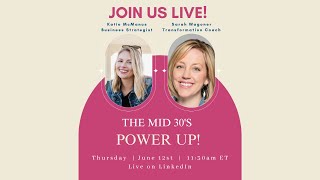
Katie McManus and Sarah Wagoner discuss the mid-30s shift when imposter syndrome fades and people get clearer about what matters. Sarah, who moved from HR into leadership coaching, works with parents reclaiming their careers and sees them get tapped to lead other leaders. They talk emotional intelligence, using feelings as data, and building a leadership style that actually works.
Chapters
Oh, I can taste yo, yo, yo, yo Words I can taste yo, yo, yo I can taste yo, yo, yo, yo I can taste yo, yo, yo I can taste yo, yo, yo, yo I can taste Y. I.
Hello and good afternoon. I'm Katie McManus, business strategist and money mindset coach, coming to you live today with Sarah Wagner, who's a leadership and transformation coach. Hi, Sarah. So good to have you here. Hello.
I love jamming to that music. That was fun.
I had so much fun picking it. Just a little housekeeping. We are going live to both my Facebook pages, to LinkedIn, to YouTube, and to Twitter. So if anyone has any questions from any of those platforms and you're commenting and we're not answering your question, just know that sometimes not all of them come through. So love this to be interactive. If you have any questions or something to add to the conversation, please do pop it in the chat. But again, if we don't acknowledge you, it is not that we're ignoring you. It's just that sometimes the technology doesn't like us. So, anyway, I'm so excited for our topic today.
Yes, me too. Well, I was excited that you invited me. I always have such a fun time chatting with you and just I was getting so pumped this morning, thinking about all the great things that we can talk about and imagining all the things that I don't even know that we're going to talk about, so.
I know, I know. Well, I think because we kind of just spitballed this topic based on, like, what the work that you do and, like, the things that, like, we have in common. And we were going through kind of that. That transformation that women go through when we hit our mid-30s. And literally this is so topical for me because I literally just turned 35.
Yes. Happy birthday.
But I'm officially, like, in the latter half of my 30s. Just a couple days in, but still. And it's so true that, you know, in your mid-30s, like, you get over. I don't want to say all the imposter syndrome that you have, but a massive amount of it. And it. For me, I don't know what your experience with this is.
It's.
It's kind of like this coming of age with my confidence of, like, yeah, I know my stuff. And also, well, fuck that. Like, I don't want. I don't want feeling unconfident to hold me back from what I want. And it has so far, like, I've just been afraid to act.
Yeah. I always. When people have a thirtieth birthday, I'm like, welcome to the decade where you care less and less every year about what people think about you. It's like this. You know, the 20s is, especially in your career, it's all about, like, climbing and doing the right thing to get promotions and getting the right job that's gonna get you money in your 401k. And then in your 30s, you're like, wait a second. I have enough experience that I don't have to stay here anymore, and I get to go tell people what I want. And it's just this kind of, like. Yeah, it just is really freeing, and it's so great. And then on top of it, a lot of women that I talk to who are having babies, it's like a double whammy. They're like, yeah, I don't. I don't care anymore. I don't have time. I don't have energy to about that. And, like, this is me. I'm awesome. Hire me or don't hire me, but I'm okay with that. Right.
Right. Well. And I think. I think for, you know, women who don't have babies and women who do have babies.
Yeah.
Common theme is we really do figure out what it is that we want for our lives, Whereas in our 20s, like, we just don't have any idea. We think we know, and so we try a bunch of stuff, and we're like, well, not that. Not that.
And it's fun, and that's fine. And that's, like, totally great. And then there's the shift that happens in your 30s where you realize what you actually do want.
Yeah.
And it feels so good. Yeah.
I'm curious.
I know we talked a little bit.
About, like, how is this showing up personally for both of us, But I'd love to hear, you know, what, you're shifting in in your, you know, mid-30s. Power up.
Yeah. Well, recently, so I've wanted to do a sprint triathlon since before our daughter was born. She's five and a half now, so it's been a while. And I, like, did enough PT this year. My hip is feeling better. My back feels good. I've been walking, like, three to five miles a day. Phone calls, listening to podcasts. And I thought, what the hell? Why don't I just sign up for this? So one day I tried to run, and I was like, oh, I didn't die or hurt anything or, like, fall down. And it wasn't embarrassing, granted. I ran in a different neighborhood so my neighbors wouldn't see me. So then I decided after mentally committing to this that I was going to sign up for a sprint triathlon. So I'm doing it.
That's awesome.
At the end of July, and I'm really excited. So it's like a short little swim in a pool. I grew up swimming in freshwater lakes all my life, but I have this thing about touching the bottom and seeing underwater that I don't like. So the thought of having to do an open water swim with goggles on just absolutely terrifies me. Oh, that's a perfect solution.
Okay, so you can't. So when you're swimming in a pond, you don't like seeing stuff and you don't like touching the bottom.
That's what you know.
Yeah, yeah, yeah. Okay, cool.
I don't want to know what's down there.
Oh, my God.
Unless it's like, rocks and only rocks, I'm not putting my feet down. I'm like that person who will swim into, like, the shallowest water until I'm like, scraping the bottom and then put my feet down and pop out. I'm not wussy about nature, but I had this thing about putting my feet into the mushy bottom of a lake.
Yeah, yeah. No, I. I actually don't like lake swimming at all because I. It's just like. It's so. Murphy. I'm an ocean girl. I'd rather sharks than. Than just, like, mush, you know?
Yeah, Yeah.
I feel like that's a little more my. My jam.
Yeah. Yeah. There's this huge snapping turtle that they discovered in the river in Chicago, and my friends were sending it around and I was like, hard. No. Worst nightmare ever. Far above sharks, snapping turtles, and they're calling it, like, chonk or something. And it is my worst nightmare.
How big is it?
It's really big. It's like the size of a pig.
Oh, my God. Nothing can take your foot off.
Yeah. And when they chomp, they get locked on, so you have to whack their necks to get them off. I mean, like. Yeah, it's freshwater nightmares. Yeah.
No, no, no.
Anyways, enough about me. What's your transformation that you're going through?
Oh, well, it's funny. So I have a fitness one also. But, you know, I think, like a lot of people, the pandemic was really hard for me. I. I've tried really hard to enjoy at home workouts and to really enjoy my peloton and to, you know, do at home, like, yoga and I hate it all.
Yeah.
I really like going to a place and picking up heavy things and putting them back down.
Yeah.
And not having a gym to go to or like being afraid of getting sick by going there, just really crimped, you know, my whole style. I've been very serious about getting back into the gym and it feels so good.
There's something about the collective energy in a gym that feels good. Like I'm with you. I have a hard time doing yoga at home by myself.
Right.
And like I did a 200 hour yoga teacher training. I was super into yoga at one point and now I just can't get into it by myself. Like part of what I love about it is like the breathing together and the Boston obviously isn't that everybody's favorite part, but like feeling everybody around you. I'm really into that collective energy. I've made live music one of my goals for this year. So I'm doing way more live music concerts. I'm signing up for like everything I can find. Signing up, like buying tickets.
Right.
And it is filling my soul. The collective energy is good. So good. Yeah.
You know, I, I saw this, I saw this tick tock. The new thing is like you see a tick tock and you refer to it as like an article that you read, but now I'm just gonna own that. I saw a tick tock.
Yeah.
It's someone who said, you know, like spaces hold like energy and memory.
Yeah.
When you go to a Buddhist temple that's been there for, for, you know, several hundred years and you meditate there, it is different because the space holds the energy of that. And I think it's the same thing for, you know, workout spaces and for music spaces. Like you do like get tuned in to the energy of the place and it really does have an impact.
It really does. Like I saw Lizzo two weeks ago and I think I'm still high on Lizzo. If anybody follows me on LinkedIn. I did make a series of Lizzo as career coach posts. So if you ever need a pump up, Lizzo has some really great career advice.
Well, speaking of women who really step into their power and don't let other people dictate, you know, what they're allowed to do.
Yes. She is the epitome of it.
Yeah. I mean she was twerking, what, playing a 300 year old glass flute or for Incredible. Incredible.
And she's like an incredible athlete too, to be able to sing and be on the stage and like she's got her businesses and I just, I couldn't get enough. I came home and I told my Husband. Like, if she came back tonight and said, I'm coming back for another night, I might go and see her again. Yeah. I screamed my face off. My hands hurt from clapping, My throat hurt from screaming. My legs hurt from dancing. I needed, like, a full day of recovery afterwards. I was, like, so high on Lizzo and also just so disabled after that concert. I was like, I can't. I'm just gonna sit here and watch the kids play.
It sounds like your fitness goals and your musicals have to, like, be scheduled, you know, strategically.
Yes. No longer ends the day after a Lizzo concert.
Right, right. Well, and it's, you know, like, to the business point. You know, there's a point in your 30s where you're just like, what are the limitations that I'm following? And are they limitations that I'm putting on myself or they actual limitations?
I mean, most of the time there are self limitations.
100. 100. You know, there can be limitations of, like, oh, well, to make this investment, I have to make X amount of dollars.
Yeah, right. Yeah. Or I need to. I was just talking with a client the other day, and they were saying, well, you know, the perk of staying is that I could finish this project. And I could say that I finished a project. And I said, is it really worth it for just another bullet on your resume?
Yeah.
Where else have you finished projects? And they replied, well, everywhere that I've ever worked. And I said, I think we're good.
Yeah, you're good.
You got the bullet points. Launch. You can do this. Like, it's all of these limiting beliefs that hold us back. That when you work with a coach, you realize sometimes are just literally beliefs. It's nothing.
Yeah. Do you find with your clients that they have this narrative that they're bad at finishing things in general, so they're constantly trying to prove themselves to themselves that they can finish stuff.
Huh. You know, not really. Yeah, I don't have that.
I have.
There's this common narrative of, like, I don't have enough of the different experiences. And what I usually find from talking with people, especially my clients, who are looking to pivot careers or find out, you know, elevate their. Elevate their career, find a new role, big promotion. They don't think they have the experience. And then I use put on my HR hat, and I start, like, digging around in their resume and just asking curious questions, and there's all this stuff that's missing from their story, and they think, oh, I just thought that was a normal thing that I did. I'm like, that is not normal. Yeah, that is not normal. Like that is an extraordinary experience. That one, you need to get down on your resume and two, let's make this story like really powerful so that you hear, so that whoever you're talking to in whatever context, here's your values, here's your passion, here's your goals. Yeah. It's usually just undervaluing what people think is their, their everyday experience.
Yeah, yeah, it's there. There's a super like woo quote that I saw the other day. It's like butterflies don't get to see their own wings.
Yeah.
You know, and it's like it's true for each and every one of us that we don't see like how we're exceptional and it happens to people who are starting a business. Like they don't. Like when I started my business, I didn't realize that every other coach didn't have a background in sal marketing.
Yeah.
Right. But I did and I, you know, had a really easy time starting. And then everyone's like, wait, how did you do that? And I started showing them and I realized like, wow, everyone, not everyone has this piece of the puzzle. Right. It sounds like it's the same with your clients as they're trying to kind of reposition their career. They don't realize all the incredible things that they've done along the way that makes them far more qualified than they give themselves credit for.
Yeah. Well, and I say it's the internal limiting beliefs, but I think back to the early career stuff, a lot of those beliefs are somebody who said something at some point in their career.
Right.
You can't be a consultant when you're 35. You don't have enough experience. You know, you need at least 15 years of experience to do this. You don't have experience in this, so you can't have this job. You know, and so then you internalize them and they become your internal beliefs. Yep. But not all feedback is created equal.
No.
You don't have to take it all. Even when you're hungry and like starting your career and trying to form everything. You don't have to listen to everything if it's not true to you.
Right. Well, and also, I mean the feedback that you're getting, you really have to look to see the person who's giving this is. Are they giving this from like a powerful place or are they giving this from a fear based place of what they would personally be terrified to do themselves? Yeah.
Or the advice so that you can be just like, that person.
Right.
Because they're sharing their experience, which is great. Love it. Share your experience. Share how you got to where you are. It might not be right for the person that you're sharing it with. So then it's on the person, the receiver, to say, nah, that's cool for you, not for me.
Right, Right. It's funny you say that, because the image I just had in my head is, like, the reason why I actually don't use female hairdressers, because every time I've gone to a woman to cut my hair, I end up with her haircut. Interesting variation of her haircut. And that's like, if her haircut's nice, like, that's great. But usually, like, it's not exactly what I want.
Yeah. No.
And it's like, I prefer to go to men to cut my hair because I'm never going to end up with their haircut. And they usually, like, do the thing that is going to be best for me because it's like, they're not projecting themselves onto me. Huh. Right. And it's like, this is just my experience. I'm not saying this is every single woman who cuts hair, but, like, that's so interesting.
I love that.
Enough experiences with that that I'm just like. Like, I'm just gonna stick with my dudes. Like, they're. They're incredible.
Yeah. Well. And so much of the advice we give is, like, projecting onto other people, and the feedback that we give is projecting onto other people. Like our own garbage that we haven't worked out.
Right, right. And I think that's. That's one of the things that coaching is an amazing skill for, because we're.
Yes.
There are parts of what you and I both do with our clients that, you know, does direct them. You know, here's what you can do, and here's how to do it.
Yeah.
Ultimately, when we're trying to help them figure out what they want, we're not telling them that. We're asking them the questions.
Right, Right. Yeah. And I think this happens a lot with managers, people, leaders. Mm. The projection piece, like, with a lack of information, you know, maybe you're. Someone on your team does something or says something. You know, we'll use a general example. And then you're left wondering, like, what did that mean? And then you're extrapolating it. It's all based on your own experience. And my advice is always just go back and ask the person.
Yeah.
You made up this whole story. It could be something. They stubbed their Toe on the way into the meeting and they've got a broken foot they didn't tell anybody about, or, you know, you have no idea what was going on for that person. And so I reflect a lot on like, leadership and parenting and the parallels of that. And as a parent, I'm always focusing on not projecting my own interests or my own thing onto my kids. And it's so the same as a leader, you need to have like, your, your container needs to be really clear and open and airy and like cleaned up and tidy to make sure that you're doing the right thing for people.
Right, Right. Well, and I think also, you know, I know a bit about the types of people that you attract. You attract people who are very aware of their emotional impact on their space.
Yes.
I think one of the problems for people like that, because you and I are both that way also, is we kind of assume everyone else is that way as well. When often we're in masculine environments where that's not the focus. Yeah, right. So like, we assume our manager is being intentional with their emotional imprint on the space and they're not.
Yeah.
We read it as if like they emotionally intended to make us feel that way.
Right. And masculine in the sense of like, anybody with any gender can have masculine energy. It doesn't even have to be just men like that. Masculine energy is very, like aggressive, task oriented, you know, driving energy. Like you. I think probably I'm like, I don't know, I don't really feel good about this. And people are like, it doesn't matter how you feel. Like, this is what we're doing. Yeah. And I think, well, it does because I know other people are having an experience with this.
Right.
You know, or something doesn't feel quite right and they're like, yeah, but like, we're on a timeline. Hurry up and do it.
Right.
You know, that's interesting that you called that out. Like, that's really true for me.
Well, and it's, you know, I think that's another thing, like the feminine. There's a lot of knowing that comes up as feelings. Right. There's a lot of knowledge and wisdom that comes out, like through our bodies and our heart center and throughout our guts. Like, like we have, we actually have like knowledge stored in those places and we know things there. And it doesn't have, like the finite masculine way of like, well, I know this. Here's the data, here's the proof, and blah, blah, blah, blah, blah, blah, blah.
Yeah.
And that usually carries weight in environments like that.
Yeah. Your gut feeling doesn't generate, like, a bar chart or a line chart. It doesn't.
Sometimes it's not even, like, you know, words that make sense.
Right. Yeah. But, you know. You know, and usually your gut feeling is right. For example.
Yeah.
We always say, like, if your gut doesn't feel good, get out of this situation.
Right.
Your gut will tell you long before the. The information makes it up to your brain.
Right. Well, because your brain is constantly trying to, you know, play the devil's advocate, weigh the pros and cons. Like, what are the dangers of me leaving the situation?
Yeah.
You know, which is, I think, why a lot of people stay in jobs that aren't great for them, even when they've gone through, like, the mid-30s. Power up.
Yes. I was reviewing some notes I did from some market research, and time and time again, the people I was interviewing were saying that their logic overrode their gut. And at some point, they realized that the money and the title, it all goes away in the end. But your time is finite.
Yeah.
And every single person I talked to had this moment of, like, my time is really important.
Yeah.
It's not the title. You leave the company, the title goes to somebody else, the money goes to somebody else. You know, I think nobody talks about, like, how amazing your career was at your funeral.
No.
And last year, Logan Roy, for the succession fans out there, was about him professionally because he was a abominable human. But, yeah, like, all these people that I talked to had these epiphanies, like, my time is more important. I chose the safe route. I was a lawyer. I was a lot of lawyers. I went into law. I got all these degrees. I thought it was the safe way to go. And then I realized I wasn't enjoying my time at all. Like, what? Is this all worth it?
Yeah. Yeah. Well, I think that's why you and I both ended up in coaching as well. Yeah.
Right.
You hit a point. You're like, this isn't it. This isn't how I want to spend my time. This isn't what the impact I want to have on the world.
Yeah. Yeah. I was. I got tired. Honestly, I got tired of having to fire people. Yeah. Because when you're in hr, like, the strategy and all of that stuff is fantastic and fun to work on and the development initiatives and all of that good, juicy stuff. But if there's a reorg and people need to be exited from the company or there's misconduct or there's a performance issue, you can't say, like, oh, I don't really want to work on that today. I want to work on this really cool strategic initiative that I'm running that's going to transform the company. It's like, no, you actually have to focus on that. And I wanted to work on the big heart transformation stuff. And like you said, I, I think I'm too emotional to be handling that. I actually want to, like, energetically impact me.
Like, oh, God, I, I actually have a really hard time when especially women, like, blame themselves for being too emotional for anything. Yeah, right. Like, like, because how many times have we been told throughout our lives that, oh, you're being too emotional about this.
Right, right.
Emotions are really like amazing markers for how the world is impacting us and like, what we can do better for ourselves.
Absolutely. And I found myself in so many situations where I was having all this data, like all these emotions, like, churning in my body. But what was coming out of my mouth was like, you know, the, but the professional version of whatever that was or, you know, like what the talking points were or. I, I didn't feel like I could fully step into my intuition and all of my emotions and everything that I could offer all that data. Like, it felt like I was constantly like up against this wall and it was amazing. You know, it serves me. I had an amazing HR career. I got to work on really cool projects. I got to sit on leadership reviews and executive meetings and I got to do all the succession planning with the leaders. And I did some really fun work. And then I got to a point where I just really wanted to dive into these juicy one on one meaningful conversations, especially with leaders who have the impact on, you know, five to eight people on their team. And then you go leaders of leaders, and the group gets even bigger.
Yeah.
And I think that like, safe one on one exploration, coaching, work, like that was the juice that I just wanted to. Yeah. Just want to swim in it. That got weird, but that's how I really feel about it.
I love the weird. No, but I mean that. But only someone who like, really is in their emotions and powerful with their emotions would be able to step into that and own it and be able to reflect back at other people, you know, the impact of their having. Yeah, right. Like that, like you had so much data in, in that all that emotion that really, like, you were just set up for to be strong and impactful in a different way.
Yeah.
Right.
Well, thank you. That was a good reframe.
So I'm, I'm curious because I know you have, you know, A couple spots open in your one on one coaching and like what are the typical transformations that your clients are after when they start working with you? Yeah.
A couple different things. So typically the people who come to me are parents. They have young children, youngish, probably like 10 and under at home. They're looking to double back down in their career and really wanting to re carve out that portion of their life in a powerful way.
Right.
They're sick of not feeling like they have a choice about what they're doing and they're ready to just kind of grab life by the throat like this is mine. You know, they've been up to their eyeballs in parenting and they're looking to reclaim their career and either restart it or maintain and grow their career through the early years of childhood. So a couple examples I just wrapped up with a leader, a pretty new people manager. Didn't feel like they were getting the support they needed at work. Wanted that safe one on one space. Wanted the co active coaching which is the training that you and I share. Also needed like the HR perspective on how do I handle this situation. What else am I not thinking of? The transformation. By the end of the six months that person was tapped to be a leader of leaders.
That's incredible.
Total accelerant on leadership qualities. Skills. Went from certainly just like the whole picture because when you're happy at work, you're happy at home and when you're happy at home, you're happier at work.
Yeah. So went from first role in leading anyone.
Yeah. To change. Wanting to change roles actually.
So leading people for the first time, hating it. Wanting to switch to like really stepping into their power and getting tapped to lead other leaders because they became so effective at that.
Yeah.
That's incredible.
Yeah, it was awesome. I mean like it's easy for me to fangirl on my clients because.
They'Re.
Doing such deep work. It's that reflection of their own bias, their own approach, just how they're operating in the nooks and crannies. You know, I'm not talking about how you read a script for a performance review or a performance evaluation. I'm talking about how you use your agency to flex within the parameters that HR has given you. So for example, HR says that you can't send the performance reviews to your team until the morning of the performance review. Inside they're kind of like, I don't know about that. Doesn't feel super safe. I don't feel like they have, you know, the state of mind that where I really Want to have a career conversation with them. So I want to send it ahead of time. HR says no. Okay, I get it. HR has to protect the company. Where do you work? In the nooks and crannies to create a really unique and important experience for that employee. Like, where are you working between the lines in a safe way that stretches your leadership impact on your people? How do you create psychological safety so that when people are having, you know, fertility struggles that you don't know about, and they come to you and they share with you exactly what's going on, that they need time off, you know, that's like an indication that you've set your team up really safely or something's going on at home and they feel safe telling you about that. That's like the. The. What I call the nooks and crannies of leadership.
Right.
And that's the stuff that makes people remember you as a leader, and that's what makes people feel like you're on their side.
Right.
And that was all the, like, juicy work that we did. So it was like, you know, coactive and, like, leadership stuff, and it was just this, like, beautiful mix of all the good stuff.
Yeah. Well, what I love about that so much is that, like, you're showing them how to kind of flex within the confines. Yeah, they're doing that. They're having impact. Like, everyone's seeing that they're doing something different and it's having impact. Like, that has the capability of changing the whole culture of the company, because they're going to start looking at this one person who's doing, like, following the rules, but, like, also doing it in their own way. And it's. It's having a positive impact on that team. And they're going to start questioning what's happening here. Like, what are they doing that's different from what everyone else is doing?
Yeah.
Is there a way we can bottle this that they're doing and apply it in other ways?
Yeah, it's like developing your own kind of secret sauce. Like going on the bottle analogy. Yeah. Yeah.
Did you know that they're coming out with a Good Burger sequel?
I do remember that.
Keenan. Keenan and Cal from Nickelodeon.
I don't remember that. My 90s child card away. That's amazing. Never mind.
But, yeah, there's a secret sauce that's. That's the.
The. Yeah. I want everybody to have a secret sauce that's like their own flavor. It's not just looking at some leader and copying what they're saying, because we've all had leaders like that, where you're like, okay, it's coming out of your mouth, but it doesn't feel like you.
Yeah.
And people really are, like, craving that human experience now. Especially with Zoom and especially with just, like, everything going on in the world. We need to be so human with each other. Yeah. So just helping people figure out that secret sauce is, like, my passion, obviously. I'm like, my hands are getting sweaty.
Well, and it's also, you know, we were talking about that, like, that masculine paradigm that happens at work. Like, that leaves a lot of people out.
Yeah.
Right. And especially, like, as companies are getting more and more focused on diversity, equity and inclusion, you know, having that more feminine energy where people are actually paying attention to how everyone's able to show up.
Yeah.
Is going to really, like, turbocharge the workplace so that everyone can be more productive, everyone can show up as themselves, and everyone can really step into their own power.
Yeah. But again, if you just try and implement that and it's coming out of your mouth, but it's not in your. The rest of you.
No.
And it feels weird. People are like, ooh, why are you asking me about my feelings? Get. Get out of here. Or why. Why are you asking me about my feelings? Are you going to, like, break this down and fire me? Like, it's. You got to do your own work. And leaders need to do their own work, just like parents need to do their own work before they parent their children. You got to know what's going on on the inside.
No. 100%. And I just want to say hi to Stephen and Gabriel. Welcome, both of you. Thanks for joining. So. So you mentioned before we hopped on that you have some. What were you calling them? Sessions. The 90 minutes.
Yeah. Yeah. Breakthrough sessions. I understand that it's really terrifying to just, like, pick a coach off the Internet. I promise I won't do you wrong, but I get it. I'm going to meet you there. So I think that in 90 minutes we can get you started on a breakthrough. So I'm offering these 90 minute breakthrough sessions, which is a new thing that I'm doing. Typically, I do like an intro call with people where we get to know each other, see if it's a good fit, do a little bit of coaching. But these breakthrough sessions are actually an investment in you for 90 minutes, and we'll get started on that transformation to see if you like it.
Amazing.
Yeah. So we'll do a little bit of pre work, and then for 90 minutes, we will just dive right into an actual Coaching session so that you get to experience it and make a decision from there. Yeah.
And so who is this right for?
This is great for leaders of leaders who are ready to transform their style, who are ready to be that really heartfelt, connected, transformational leader for people. I'm talking like, you want to leave a legacy on your team. Yeah. It is. For women leaders, especially in the early stages of parenthood, juggling leadership and home stuff, it is. It is a messy storm of things. And I want to support you getting through this in a way that makes you feel empowered. Yeah. And just generally women looking to reclaim their careers and recenter themselves after having kids.
Amazing.
Yeah. Open to all genders. Like, I talk a lot about women. That's my experience. And that was really why I got into this, because I won't stop until there are, you know, over 50 of women in leadership everywhere. So I think I've got my work cut out for me. But I've coached all sorts of different types of people with different backgrounds and different genders and different roles in companies, so.
Amazing. Amazing. So anyone who's watching, if you're wanting to change your career, you're wanting to really step into your power as a leader and, you know, the. The image that came to mind for me was the leader that when they leave the company, like people, like, where did they go and how can I follow?
Yeah, right. Yeah. It's this magnetic quality. And I think it goes to that powering up in the 30s. Like, you spend the first part of your career trying to get people to like you. So you're in an interview, you're just trying to get them to like you and give you an offer.
Right.
And then there's this shift where you have enough. Enough experience where you're magnetic. I want leaders to be magnetic. It makes your job easy because you've done the work for yourself, you've done the work for your team. People are going to be like, banging down the door to try and come and work for you. You're going to leave and be able to hire anybody you want because all your people are going to follow you. Like, it's an incredible quality to be that magnetic as a leader.
Right. Oh, my God.
And it's.
I. I mean, when you can say, I bring not just myself and my own skill set, but I also can pull all this top talent from a bunch of other places. When you're interviewing for new jobs, like, that is such an incredible negotiation tactic.
Yeah.
You know, you can command like a much higher salary. You can command Higher bonuses. You can command all these different perks for yourself when that's the case.
And not like that. And you're also just completely changing the way that people see leadership and management. Like, you're imprinting that on people where you're making an impact on the trajectory of management in companies.
Right, right.
Which is like, I'm in it for the big stakes. Like, I, I want to change the way that workplaces are and that's why I got into HR originally. So this is just my new angle.
Yeah.
It's one on one. It's doing that deep work. It's helping you create a legacy of leadership that people want to follow you, that people say, man, that was my best leader. Like you can call them in 25 years and they'll drop everything to come to your retirement party. Right. Like your retirement party is just packed.
Yeah, forget your funeral.
Like, there's so many more celebrations ahead of that where you want people to, like, you know, you just want to make an impact.
Right.
Meaning in the world. People want meaning in their life and this is a great way to do it. If you're working, you can create meaning for people, you can create meaning for yourself.
Yeah, no, it's so true. What, what's next for you in your business as you're, you know, really leaning into this mid-30s power up for yourself?
Oh, yeah. I. Well, obviously I want to get to that leader of leaders space. I want to get back into those leadership conversations, those strategy conversations. And I'm really chomping at the bit to do that, like with my new hat on. Yeah, I guess. New version of myself, like Sarah 2.0 or 3.0. I don't know what version we're on. Who knows? I'm thinking about doing some sprint group coaching, like one month Sprint challenges so that people can create these big transformations in themselves in a short amount of time. Because I know that we can do that together.
Right.
Yeah.
Amazing.
So I was, I was taking notes before this and all of my analogies are related to fire. I've been talking with my coach. I've been doing some coaching, like as part of the coactive training, the certification. So for people who don't know, there's like 109ish hours of classroom training and then you go through six months certification, which is like a whole bunch of stuff. So it's meant to be transformational for coaches. So I've been getting a lot of coaching and the way that I've described my coaching is always fire related. Okay. So we've got like, Phoenix rising. Right? Like, burn down ashes and like, re. Immersion. Yeah. Talking about, you know, I love being outside, and I grew up going to summer camp, and being a camp counselor is like, the foundation of who I am. Anybody I. Anybody I talk to knows this. And the way that I describe that is like, you know, when you have a campfire and the embers are burning, the fire is still there, and you just have to get the right amount of air in the right amount in the right spot, and your fire is back up and running.
Right.
That was another analogy. And then recently, the volcano analogy came up. Like, you know, like looking into the bubbling cauldron, like, the magma is like, popping and then it explodes, and it's just like it's forming a new path. It's forming new rock. It's just unapologetic. It just navigates its way down the slope and it creates a new landscape. And that's like the imagery that I have in mind when it comes to coaching and people who are ready to be coached and are ready for this adventure.
Right? Yeah.
Like, we blazing new trails, we are forming new rock formations. And it is not for the faint of heart. Like, we're doing this. Like, it's real.
Yeah, yeah. You know, it's so true. You know, there are. There are people who want change in their life, and they want it, but they don't actually want it because they're not actually willing to do the work to do it. Yeah, right. It's like they, they. They say that they want it because they kind of do, but it's also something that they just hear a lot of other people saying that they want. Right, right.
The hustle thing. Like, get up at 5:30, do your ice bath, drink your green tea, and here's your schedule for the day. And lift heavy. And then you've got to reach out to 50 prospects. Like, I'm not talking about that kind of transformation. I'm talking about, like, what do you really want?
Yeah.
How does your day register with what you really want? And how do you transform your day to day in those small and big moments that it changes your trajectory?
Right. Well, and I think. I think what you're describing is, like, how we see transformation again, like, from a very masculine paradigm. It's like, what are you doing? You know, doing, doing, doing, doing and adding more things and changing the things that you're already doing when actually real transformation is who are you being? Yeah, right.
You just coming as you are is the valuable thing. What if you have enough Experience. You just need to talk about it in a way that resonates with you, that doesn't sound like you're some, like, robot going for an interview. Like, what does it look like to be excited in an interview? To feel connected in an interview, to feel connected with the people that you're talking to on your team.
Right.
It's the shift, like, internal. It's not the tasks. Like, I'm not. I don't get up in the fives. It's a personal policy. And someone was like, yeah, but for a flight. And I was like, yeah, I don't. I don't book those flights. I don't wake up in the fives. So to anybody watching, I will not tell you to get up at 5:30 in the morning and work out as the sun is rising or before your kids wake up. Like, we know that doesn't work. Like, yeah, it's. It's so different than the doing. It's about the being.
Yeah.
And how you're being.
Yeah.
And I know you've done. You've experienced a lot of this because you've done the co Active training and you've done the leadership.
Oh, yeah. And I've done therapy, and I continue to do therapy, and I continue to.
Do all the things. So good coaching and therapy is such a good combination. It's just, like, so nourishing.
Oh, my God. Well, it's nourishing. I'm talking about fire, like, burning down, you know, they're just, you know. You know, burning man, Right?
Yeah.
Okay, so, like, burning that, like, effigy of the man in the. In the field. Like, I feel like when you're really going at it and you're really seeking your own transformation, you're constantly just burning that down for yourself.
Yeah.
Like, you build up, like, who you think you are, and you're like, wait a minute, that's not me at all. Like, I'm gonna burn that down. I'm gonna come up with, like, this new version of myself. And that works for a little while, then you have to burn it down. And it's. Each time you do it, though, you become more powerful and you become closer to who you actually are.
Yeah. I mean, there's a reason that nature burns things like fields. You know, a light strike burns a prairie so that growth can happen.
Yeah. Yeah, it is.
It's a really powerful analogy. What are you burning down right now?
Oh, I am burning down this belief that I have to do things perfectly, you know, especially since I'm always telling people, like, you don't have to be perfect. And yet I always hold myself to a different standard. I literally sent an email this morning where I outed myself for like, my adhd. Executive dysfunction has had me in straits for the last like three or four weeks over this launch I'm doing. And I like, was feeling so much shame and heaviness around it. And yesterday when I went to record my podcast, I literally was like, Neil, I just have to like, word vomit everything that's happening in my life right now. And then in there, there's an episode and we decided that I was gonna do an episode where I was just basically outing myself for up my own launch.
Yeah, I saw your email. It was awesome. And I can't undo it because it's emails. But like, I'm starting over.
Right, Cool, good.
I'm good. I wasn't emotionally attached to whatever that was. Like, good for her. We're starting over. Yeah.
Yeah. Like, who made the rule that there's no take backs?
Yeah, like the perfectionist.
Like, yeah, well, and also like, I think in a previous life I like came up with this belief that like being emotionally impacted by other people, like, like feeling sadness or being angry or like experiencing any like, heightened level of emotion that has to do with other people. Like, you know, deep levels of love made me weaker. Right. And it's like I'm burning that down because that robs me of the experience, but it also robs my relationships of people knowing like how deeply I care about them.
Yeah, well, and you're spending your energy, you know, like the human range of emotions is like, okay, I'll go like as wide as the screen before my hands disappear. Okay, so here's the full human range of emotions. And I think in so many of our experiences in the corporate world, it's like, okay, but like, make it this big.
Yeah.
Of the distribution are uncomfortable or they're too much or you're too emotional. And that's what makes you special. That's what your impact on the world is. I'm not saying, like, go to the depths and spout off and be, you know, whatever. Right? Like be, manage your emotions like an adult. But like, we don't have to keep it to this. This tiny itty bitty little range is such a stretch for people.
Well, and also like humans, like, we think we're good at compartmentalizing. We are not. That is not actually a thing like compartmentalizing, even for eight hours a day, where you're only in this portion of your emotional range, like that has an, like a. A physical, mental, emotional impact on your health.
Yeah.
That's when, like. And it's kind of like that. That volcano, like, the pressure builds and the pressure builds and the pressure builds, and then that's when you end up on the outer ranges.
Yeah, right.
That's when things break and you kind of, like, freak out and have an emotional breakdown. Like, you know, companies really have to get better at being, like, when we say, bring your whole self to work. Bring your whole self to work.
Period.
Period.
And we're not going to weaponize it. We're not going to say, oh, that person, you know?
Yeah, whatever. Yeah, yeah. No more. No more like hiding in the bathroom, crying. Cry. Cry at. In the board meeting. Cry everywhere.
Yeah. You know, I think that emotions are data, and I think when we suppress them or we don't share them, we're missing out on really valuable data.
Right. Yeah.
And I love this idea from the conscious leadership group. It's about. It's commitment number four, and there are 15 commitments of leadership. I just typed it up and sent it to somebody. Essentially, the gist of it is sharing what's true for you.
Right.
So in a moment, saying what's true for you, what's happening inside of you, what you're thinking, what you're feeling, doesn't have to have a conclusion. You can say, like, I'm feeling really excited about this. I'm having a hard time containing my excitement. Or, you know, something about this doesn't feel quite right. Or it feels like a friction on this value that I'm having, like, what's true for me in this moment. Because nobody can argue with what's true for you.
Right.
And be able to talk about that brings that data into the room about you as part of that experience.
Right.
And you as a full human. And I just. I think it's a really powerful way to communicate, but we have to be able to describe those emotions. So they also have a list, like a huge list of all the different emotions because, like, we don't have the verbiage for a lot of emotions.
Right, right.
So being able to articulate that is really cool and can be really powerful.
Yeah.
For leaders and for people on the team.
Yeah.
No.
100%. It's funny, the whole talk of emotions. I mean, I think you and I are really lucky that we were born in the generation that we were born in.
Yeah.
That's kind of where, like, the emotional conversation started. I remember talking to my dad when I was first going through the coach training and he's just like, you know, he's saying how astounded I was that, like, I had this, like, emotional vocabulary. And I was like, well, dad, like, how do you feel right now? And he's, like, feeling kind of tired, hungry.
Yeah.
But, like, that's what he was taught growing up is like, you know, what are you feeling? It's like, how are you feeling in your body? It's not necessarily like, what's your emotional status right now?
Yeah, I think for me, that's been a pivot. Yeah, that's been a pivot, like, in my family and my parenting style. Yeah. So, yeah, I've really been living into that quite a bit. And then Gen Z is just killing it. Like, amazing.
Oh, my God. They're my idols.
Love them.
Although I have. I have a couple friends.
No bucket hats, but I do love what they stand.
I do have a couple of friends who own a really cute general store here in. On Cape Cod. It's called General Store in Harwichport. If you're on the Cape, you have to come to it. But whenever they interview teenagers to work at time the same store, they have to be like, okay, cool. Count change. Like, give me 27 cents back today. Kids today don't know how to count change.
Yeah, obsolete. So I kind of get it. It was like when we were told we had to do math because we wouldn't have a calculator in our pocket.
Right. So funny. Okay, so you have your breakthrough sessions that you're offering, and a few spots open in your client list. And what. What's. What's like a last bit of wisdom that you want to leave with our audience today.
My last bit of wisdom? Well, that's tough. Okay. My last bit of wisdom is that time is of the essence. You're never going to get it back. Everyone I interviewed has touched on this, that time is more important than everything else. How you spend your time, who you spend your time with, and how it resonates with what's important to you.
Yeah.
Because you cannot get it back. You do not know how much you have. It's not like a bank account. You can't go look. And if you're feeling that urge to make a change, there's something there.
Right.
Like that primal urge, like something needs to transform. And I wrote this thing about pleasing versus the shift that you make when you have enough experience, because we talked about that in our. Our invitation. And I looked back at my leadership circle results from 2017 early, and I scored really high on pleasing oh, and it was like, we want Sarah to bring more of herself to work because she has so much to offer. And now looking back on that, I'm like, yeah, it's cool on paper, but, like, I was high and pleasing because that helped me be successful and, like, get all the accolades for the first part of my career. And it's easier said than done to shift into that space where you can say no with power and it's respected, where you can command, you know, what you want out of a job, where you can get companies to have to impress you, to come do whatever it is. And it's a harder shift than I ever imagined. And it's easier said than done.
Right.
So I think time is of the essence. Do what it is that feels important to you, even if it's scary. Right. Because you don't know what you have.
Yeah, yeah. You know, and I love that because, I mean, you're really going against all the evidence that you've built up to this point that, like, this is what helps you be successful. Like, that helped you get. Be successful to get here. It's not going to help you be successful to get there.
Yeah, yeah. You have to pivot. And it is transformational because you have to let go. You've got to burn down all of those beliefs you had about pleasing and keeping people comfortable and happy and scrambling around until 8 o' clock at work every night, but nobody knows you're doing it. But everything gets done right. There comes a point where you have enough. You are enough.
Right.
Have enough bullets on your resume. You have enough. And coming with that energy to your life and to your career is magnetic. It makes people want to be around you. It means you're living in alignment with your values. You get like this piece about the decisions that you make, the nos that you say, the yeses that you say, and that's what I'm here for.
Yeah, yeah, yeah. Perfectly said. Anyway, thank you again for doing this with me. It's always a delight to have you here and I hope we get to do this again soon.
Me too. I can't wait. This was fun.
Oh, my gosh. And for anyone who is looking to up level their career, really step into their power, Sarah is accepting some clients right now. Yeah. Recommend her highly enough. And again.
Well, I learned from the great school of Katie McManus. We go hand in hand.
One of my great success stories.
Oh, well, thank you. Oh, my imposter came in and was like, after I told everybody they should come as they are.
I know but, like, that's so real. It happens for us. Even though we train on this, right?
Yeah. Yeah. So now I'm gonna go do my own work on myself for the rest of the day. That could be great for my clients.
Right, Right. Anyway, everyone, thank you so much for joining. I hope you found this nice. Massively helpful. I'm Katie McManus, business strategist, Money mindset coach. And today we've had Sarah Wagner, leadership and transformation coach. Thank you again for joining, and we will see you all soon.
Yeah, thank you. Bye.
More from Katie





How to do self care right now, so you can do what needs to be done, for yourself, your business, and

How to do self care right now, so you can do what needs to be done, for yourself, your business, and

#greenscreen How to build a consulting business that makes you $200,000-$700,000 a year

#greenscreen How to build a consulting business that makes you $200,000-$700,000 a year

Maybe we’re not the imposters…? #businesscoach #startup #entrepreneur #smallbusiness #consulting

Maybe we’re not the imposters…? #businesscoach #startup #entrepreneur #smallbusiness #consulting
