The Myth of Being Vulnerable
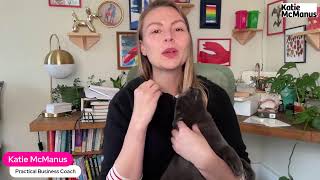
Katie McManus (practical business coach) presents a live talk titled "The Myth of Being Vulnerable," aimed at business owners using social media. She argues that not all vulnerability is equally useful: business-focused vulnerability should be bounded ("bowling bumpers"), aligned to values shared with ideal clients, and "chargeless" (no longer emotionally raw). She contrasts influencer-style oversharing with business-oriented sharing, gives personal examples (egg donation, past money crisis), and closes with a CTA for strategy calls and client success anecdotes.
Chapters
Sam. Hello and good morning, everyone. I'm Katie McManus, your practical business coach, coming to you live. Lots of different places. We are on both of my Facebook pages. We are on LinkedIn, YouTube, Instagram, Substack, and over here on my phone on TikTok. Good morning, everyone. Today, before I talk about the topic, just a little design with you. I do love this to be interactive, so if you have any questions as we go, please, please do pop them into the comments. If I don't respond, if you're on my computer over here, just know that sometimes the comments don't all come through, so I will go through and answer them after the fact. Any thoughts you have to add, please? I love this to be interactive. And what else? Just, you know, keep. Keep it chill. It's Monday morning. It is our first Monday in November. We have just shy of two months left to reach our goals for 2025 before we are starting a whole new year, which, holy. This year has gone way, way, way too fast. And I wish it were honestly over because of all the awful things that are happening in the world. But we'll talk about that another time. Today I want to talk about the myth of vulnerability when it comes to your social media marketing for your business, okay? Because I know we have all seen, seen all the advice by influencers and business gurus and social media coaches and everyone saying that it is important to be vulnerable. And if you followed me for a while, especially over on LinkedIn, where I share a lot of my life, you're probably like, well, Katie, you're so vulnerable on social media. What do you mean? Like, you're telling us there's a myth around this? Yes. Like vulnerability absolutely works. Okay? Sharing vulnerable, authentic parts of your life absolutely works to build trust with your audience. Where we want to be very discerning, however, is that, like, the vulnerability that builds trust and a following for influence influencers is very different than the vulnerability that builds trust and connection with potential clients, you know, because with influencers, what we're. What they're trying to do is, like, grab people's attention, make people see them as a real human, see them as like a bestie and follow them, right? Because they want to have as large an audience as possible so that they can show. Look at this mug. This is a great mug. I love this mug. This mug is so perfect for my coffee because they're trying to influence people to buy the shit that they're using. Okay? Um, that is one brand of how vulnerability works in the social media marketing space. However, it doesn't really translate into what works for business owners. Right. Because business owners aren't just trying to get people to follow them for the sake of, like, wanting to glob onto their life and hear all the details. They need you to take a further step. Right. If I am on here marketing myself, like, for my business coaching services, you know, I, I need whatever I share with you to, yeah. Make you trust me, to let you get to know me a little bit so you can, like, sort yourself in or out. Right. Because I don't want to get on the phone with someone who's like, morally opposed to everything that I am for or who doesn't laugh at my jokes because I got jokes. I'm funny. Right, Right, guys. Anyway, moving on from that, I hope you're laughing because I think that's really funny anyway. But I do. I want people who a need my services, who see me as credible in my space, who see that I am aligned in a lot of different ways specifically to how I help my clients. Right. That is a much higher standard than what influencers have to go after when they are creating content. Hi, Roy, welcome. Thank you for joining over on Tick Tock. Oh, and I have a few people. Hi, Alvarado 60 CF. Hello. Welcome. Hi, Efren, welcome. Good morning anyway, and thank you. Hi, dxv. Welcome. Okay, so anyway, and if you're joining on other platforms, please do say hi in the comments. So when we're thinking about creating content for our businesses and we're getting this advice about sharing vulnerably, it can be very tempting to do what the influencers do. Right. It can be very tempting to just be like, okay, well, I guess I just have to share every single aspect of my life and that'll be that. And while sure that can build you a fairly large following, it's not always going to translate into you getting clients and making money. Okay, so I want to talk through what actually works when it comes to sharing vulnerably on social media. I also want to talk about, like, why people kind of avoid posting to social media. Hi, Khan. Hi, Roy, welcome. Hi, Tracy. Good morning In Houston. Vulnerability. I'm going to share your little thing because I can over here. Vulnerability, when using you, when used properly, can get. Be a great connector. Yes. Happy Monday to you too. Exactly. So anyway, so when, when people are told that they have to share vulnerably on social media, there's a big reaction to it because, like, oh my God, like, I don't want to share all of My personal information, I don't want to share all of like my mental breakdowns and the things that like, make me sound kind of crazy and that maybe don't show me in the best light. Like, I don't want to share all that. That's, that's, that's stuff that's personal to me. And like, what if people see that and then they judge me? Which, I mean, is absolutely gonna happen. Okay. There's a reason why we like reading other people's vulnerable stories because we get to be like, oh my God, like, what would I have done in that situation? We get to, you know, kind of cast judgment, not necessarily in a bad way, but in a self reflective kind of way. Right. We, we like hearing other people's dirty laundry because it really does kind of make our, our brains go like, well, what would I have done in that situation? Right. It's fascinating to us. So anyway, you do not, and I have to talk to my clients about this all the time because when they think about sharing personal stories on social media, which is absolutely a thing that is going to help you get clients, they're terrified that they're going to have to share stuff they're not ready to share or that, like, they just don't want out there and they're afraid of that criticism and that judgment. And so there are really like three areas that I have my clients think through when they're coming up with what kinds of stories they're going to be sharing on social media so that they can kind of do the vulnerable thing, but also not open themselves up to the hurt that can come after the fact. And also so that they actually get clients out of it. Okay? It doesn't, it doesn't mean anything if you're starting a business and you're sharing all this vulnerable crap online if you don't end up getting clients at the end of the day or. All right, so we want what you share to A, be effective so that you make money and get clients, B, not make you have a complete shame spiral after you share it. And also, we don't want like this fear around sharing vulnerably to be the thing that keeps you from posting online anyway. Right. Because here's the truth of the matter. No one can hire you if they don't know that you exist. All right? As a base requirement for someone to hire you or buy your stuff, they have to know that you exist first. Okay? And if you are so afraid of sharing online because you're terrified that you're going to Share something too vulnerable that you just don't post at all, then guess what? No one's going to know that you exist and they're never going to be able to become your client. Okay. Hi. Hi, Diana. Welcome. So we want to make sure that we're dealing with that fear head on. We're giving you some really helpful, perfect parameters to follow so that you're not oversharing in a way that makes you feel gross and that you're understanding exactly what it is that you're sharing in a way that, like, will build that credibility with your ideal clients and build that trust so that you get clients at the end of the day. Okay, So I just want to go through, like, three of the things that I have my clients think through and really build parameters around so that when they're sharing personal stories online, they're not getting too vulnerable, they're not causing shame spirals, and so that they get clients. Okay. So the first thing that I like to talk through with them is that we have to set like, like bowling bumper. So, you know when you go bowling with people who absolutely suck at bowling, like, like me. Hi. Hello. I'm not good. I like, my aim is terrible, my footing bad. I. I don't know. I'm not. I'm not sporty. My hand. Eye coordination has never been great. Anyway, if you're really kind and you're bowling with me, you're letting me use the bumpers, right? Which means, like, there are bumpers that cover the goalies on other side. And I think that's what they're called. I don't know. Goalies. I don't know if you have a different name for that, then please tell me. But anyway. But basically it keeps the bowl on the track to go and hit the pins. Okay. It doesn't go off and get you zero points. Like, you get to kind of like let it ricochet back and forth, back and forth, back and forth until it hits the pins. Pins. All right. And so this is going to look different for everyone. So for someone, like, they may have a bowling bumper in their vulnerable content creation where they don't share any information about their marriage or their relationships. And that is perfectly fair. You don't have to. Another person may have a bowling bumper around not sharing things about their children. And again, that is absolutely valid. You don't necessarily have to share any information about your children. Hi, David. Hi. Fierce. But Hi, Ash. Hello, Mafi. And I love usernames that are just sounds. Anyway. And hi, Michael. Welcome. The Gutter thank you. Thank you. Gully gutter. Yeah, all the same thing. But I appreciate, I appreciate that, Michael. Thank you. Anyway, I love it when I get to call upon the audience for a word. Anyway, you also, you know, if you struggle with mental health, you know, you don't have to go into detail about that. You know, I have, I have played with this throughout my career as a business owner and as a content creator, you know, for my business, really kind of figuring out what my, like, bowling bumpers are, you know, and there are things that, like, I am comfortable sharing about that don't necessarily attract the right clients to me. Right. And so I just don't talk about them that often. It doesn't mean that I'm keeping them secret. It just means that, like, they're not helpful to my business. Okay. So. So we can create bowling bumpers around the things that we don't want to share and also around the things that bring in the wrong people. Okay. If that makes sense. Hello. Yes, hi. Hello, everyone. Thank you for being here. Anyway, so as you're thinking through what your bowling bumpers are, I want you to think about what are the conversations you don't want sparked at Thanksgiving, right? Like, what are the things that you do not want your family to come up to you and ask about? What are the things that, like, you would be uncomfortable with someone from high school who you maybe weren't great friends with or former colleagues or bosses knowing about you? Like, this is the Internet. We have to be very real that the Internet lives forever. Okay? So once you put it out there, it is going to be something that people can pull up. So you have to make sure that whatever it is that you are sharing, you are sharing knowing full well that this could come out in a real conversation in real life. Okay. It's very easy when you're, when you're online to just think like, oh, well, no one's going to see that. This. You don't know that. I, you know, can't tell you the amount of times that I've run into former co workers who work in a completely different industry than what I am in now. And they tell me that they see all of my lives. Like, it comes up, they'll join and I'll, I'll see them join. And it's wild to me that they're watching. And if you're watching, Hello. Good to see you. Hi. So anyway, they are going to find out, so make sure that it's something that you are comfortable coming full circle into a real life conversation. Likewise, you know, what is the stuff that you're just not ready to share. And we're going to talk about this later when we talk about, like, make sure that it's chargeless, but that kind of stuff you don't necessarily have to share. Okay? If it's something that you've only ever talked about with your therapist or your best friend and you haven't brought it to the world yet, like, really check in with yourself, are you okay with this? Right? And then of course, like any information that is not yours to share, you also want to make sure you know, are you okay? Is or is the person whose information it is, are they okay with you sharing it? Okay, so there are a lot of different angles you want to look at here. This is something I go through with, with my one on one clients and my group participants, and we can spend a fair amount of time on it, right? Because this is going to be absolutely different for everyone and it's 100% up to you to figure it out. And sometimes, like, you don't realize, like, what you're creating rules around until you have a, an objective third party kind of asking questions and helping you tease this out. All right? But full permission when you are thinking about sharing stuff vulnerably on social media to promote your business and to let your audience get to know you, to have bowling bumpers so that like, you're not sharing absolutely everything. Okay? Because people don't need to know everything. Okay. Someone doesn't need to know absolutely everything about you in order to trust you and see you as someone that they connect with. Okay? Okay. So that's number one, is set your bowling bumpers, okay. So that you don't go in the gutter. Thank you. Michael. Hi. Hi. Hermes. Ormes. Welcome. And Jennifer. My eyes are very, very fuzzy right now. It's morning, I haven't have glasses, should probably get them. Okay. The second thing I want you to think about when you're thinking about sharing vulnerably on social media to promote your business is what are the things that actually make sense for you to share? Right? Because the goal here is not just to get a gazillion followers, okay? You're not an influencer. All right? I know, I know. We get lumped in with influencers because we are creating content almost as often as they are. However, the goals are very different. Okay? When you're promoting your business on social media, the goal is not just to get a gazillion followers. The goal is to get the right followers. The goal is to get the followers who will potentially become your clients. And that's going to be a much smaller demographic than just anyone who has a social media account and who can possibly think you're interesting. All right, so for instance, you know, if you are. Oh, gosh, you know, if you're just an influencer who's a single gal in her 30s, and you want to create content to get in front of people who are around your age group who are, you know, also single, also in their 30s, maybe also live in a major city, whatever, like, you're going to be sharing your makeup routine. You're going to be sharing about dates. You're going to be sharing about, like, you know, what your meal prep stuff is. You're going to be sharing about, like, the fight you had with your sister, whatever. Because it gets you views and it gets you followers and it gets people, like, invested in your life. Right? Because you need views and followers and people invest in your life so that when you do buy something and you're, like, trying to sell it to them and you get brand deals, like you have the audience to sell it to, it's very different when you are running a business, let's say you are a dating coach for women who travel a lot for work and who want to find a partner who is, you know, not going to compete with them. Right. Because they're very ambitious and they just want, like, someone who has high eq, Right. That is going to be a much smaller demographic. Okay, that's. And it might just be people in your city. Right. So it's going to be a much smaller audience that you're going after. It's like a smaller piece of the pie. But they're far more likely to buy from you than just everyone. Okay. So anyway, so we want to make sure that when we're sharing vulnerable stories with our audience, that they make sense for the people that we're sharing this with. And let me. And it doesn't necessarily have to be something that's relevant to what you do. Okay? So, for instance, one of the things that I share about on LinkedIn fairly often is that I was an egg donor in my 20s. And I'll share my reasoning behind it. You know, for instance, I. In my 20s, I was really convinced that I wanted to be a mom. And I, you know, have fairly good genes and figured, okay, well, if there are people out there who want to be parents that badly, that they are gonna try to, you know, get pregnant any which way and spend this much money and, like, go through the heartbreak that is IVF and using an a donor and potentially using a surrogate. Like, you know, like, if I can help, let me help. Right? And it was one of the best things I've ever done and it's really, really fun. Icebreaker, you know, like two truths and a lie to tell people that I have seven children by six fathers because I don't actually have any. I changed my mind about actually having children myself. But there are seven children out there who are in six families and have had, you know, six fathers that I'm technically the biological mother to, which is wild and. Hi, Marie. Marie Eve. Hi. Brilliant. I can't speak today. Marie. Ev. So that's kind of fun. And that's like my little two truths and a lie. But like one of the reasons I like to share it is because it's, it's added value to my clients because my clients care about doing good in the world, right? They want to have an impact. They, they want to do something that is going to make other people's lives better, right? And by sharing this story, I don't necessarily connect the dots all the time and spoon feed them that point, but it really does matter to me that the actions that I have actively make the world a better place. Right? And so anyone who's reading my content who doesn't really give a damn about that, they're not going to care. They might, they might think it's like, interesting, but they're not going to care about making the world a better place. They're not going to care that this is one of my values, right? So that's one example. You know, I will also share about like my personal money crisis that I had. God, years and years ago at this point, you know, where I almost had to declare bankruptcy and I was so broke and yet I was still in the early stages of starting my business and I pulled myself out of like an immense amount of debt and by, you know, really like investing myself fully into my business by just going hard at it and you know, making it work and all the like, like the snotty, tear stained like crises and like meltdowns that I had along the way. I will share about that because you know what, that, that happens for my clients. You know, they have a lot of shame around money. You know, because we're taught to have shame around money. We're taught that like talking about money is taboo. You shouldn't ask what people make, you shouldn't negotiate, you shouldn't ask for too much. So if, like, if you ask for too much, you're greedy, and you're an evil person. There's all this baggage that comes with money. But I'll. What I'll share about that part of my story because there's. There's an aligned value with often what my clients are going through, right? I've hired the wrong people in my business sometimes, you know, like, we. We've all been there. And yet if you're an early, early stage in your business and you've done that, oftentimes there's a ton of shame that maybe you did this and, like, it was a catastrophic mistake and you're never going to recover from it. And like me, sharing about that shows people that you can make that mistake and still recover. You can make that mistake and still be successful. You can make that mistake and still go forth and do whatever the fuck you want, right? So make sure that the vulnerable things that you're sharing as you're creating vulnerable content to promote your business is aligned to your clients. It aligns you with, like, their values and the things that they may want to see in someone that they would hire for this, right? So like honesty, integrity, generosity, like, those may be values that you hold very dear. And guess what? If you hold them dear, your clients are going to want to see that you have those also. Right? Hi, Michael. Hello, Wakas. And I don't know that Alphabet, so hello to you as well. Welcome. Hi, Zion. Welcome, everyone. Okay, so find the value. Find the shared value in what you're sharing. Don't just share vulnerable stories. For the hell of sharing vulnerable stories, make sure that you're sharing things that are going to be shared values. And like I said previously, there are vulnerable stories that I'm very comfortable talking about. However, whenever I share about them, it attracts the wrong kind of client to me. Right? So there's like trauma that I've had in my past. Anytime I open up about it, I tend to attract people who are actively dealing with ptsd and unfortunately, I'm just not equipped to help them. And also, it's not really a great idea to do something that is going to activate a lot of your PTSD while you're still actively impacted by it. You want to heal from it for the most part first and then go and do something brave like start a business. Right? So anyway, so find that shared value. That's the second thing. Okay, so the first thing is set those bowling bumpers. Make sure that you're clear on what kinds of topics you're willing to share about to Find that shared value. Make sure sure that the stories you're sharing parlays some kind of shared value to your ideal client. It can either be super straightforward and let an obvious how it connects, or it can be kind of an aside, like a besides the point. But it does like show them who you are. Now the third thing, and I've kind of already alluded to this, is we want to make sure that we're doing chargeless stuff only. Okay? So I want you to just think back to any moment where something like scary or upsetting happened to you. And those first couple times that you talk about it, you're like super activated, right? So like yesterday I went to grab lunch and I actually that's not a great example because I, I could absolutely talk about it right now. So. Okay, so let's, let's use this example. So let's imagine like you just broke up with your significant other, right? And the first few times that you talk about it, like you're gonna feel so activated, you're gonna just feel like completely charged in your body and you might over share and you might start crying, you might like get really mad. Like the emotion is just so full in you because it's so new. Like there's still a charge to this information, to this story, right? That is not something you should be sharing. That is not something that we want to share as a business owner in our content when we're sharing vulnerably with our audience. Okay. Because it's going to read or come across like it is a journal entry and not like it's a share. That's something that absolutely an influencer could do. An influencer, like the more emotion they have, the better. Right? Because like that, that comes across so true when people are watching their stuff. And of course, like they're just interested in getting as many followers within their demographic. Right. We have kind of an opposite thing. We want to make sure that we're not making people feel like too activated by us. Right? We want them to like feel the feelings with us, but it has to be around something that we aren't feeling charged around. And there are a few reasons for this. So a can be very uncomfortable for your audience member to read or, or watch something like that if it's not your normal content. And that can actually like, like ruin trust with you, right? Because you might be sharing something that like activates something for them. Right? And two, you know, you're, when you share stuff that's like too charged, that's too vulnerable for you. That, like, you're still feeling insecure about. I guarantee you, you're going to get DMS from people who are trying to sell you things to fix it, or who want to give you advice or who want to share their opinion about your situation, and it's gonna feel really shitty. It's like, it. There's nothing that feels good about that. I remember at one point I was trying to lose some weight and I shared about it because, you know, I'm fairly open about it. And I got so many DMS from weight loss coaches trying to sell me their shit. And then I got a whole bunch of other people who are sharing, like, you know, you should take apple cider, a vinegar every morning and this and that and the other thing. And it's like, guys, I don't want this. I like, I don't want this advice. This is not what I asked for. I was just sharing about this so that I could normalize that. We all struggle with stuff like this, but it was also. I didn't do it from that, like, chargeless standpoint. I was still very open. I was still very, like. It was kind of like a live wire for me still. So we want to make sure that the things that we're sharing don't carry a charge for us. They're just, like. They're nullified. They're not connected to our electrical system. It's just, you know, it's like a standalone thing. We can talk about it without getting upset again or activated again. All right? That's really one of the most important things. Right? Because if you share something that's too vulnerable, like, that is the thing that is going to give you that shame spiral. I don't know if anyone. I mean, I'm sure you've heard of Brene Brown and her first TED Talk, she shared something about, like, how she had a spiritual awakening, which was also called a mental breakdown. And she shared this at this TED Talk. She didn't think anyone would ever see it. It went viral, and she had, like, a meltdown over days because it just felt like she shared too much. She wasn't ready for that many people to see it. We. We never want to set ourselves up for that. Okay? So. And. And just remember, as you're creating content for your business, as you're promoting yourself, as you're letting people get to know you, you just showing up every day or showing up consistently is enough to make sure that people know that you exist. All right? That's. That's like, the base amount. So if you're just starting out and you're like, God, this is a lot of stuff to try to consider. Just show up. Just get used to posting. Just get used to putting yourself out there. And it doesn't have to be vulnerable. You can share how you take your coffee. Right? The way I explain this to my clients is that vulnerability is a spectrum, right? When. When we share something that's quote unquote vulnerable, what we're doing is we're sharing something that typically the person we're sharing it with would have to be a friend or someone in our life to be able to know this about us. Right? And so, yeah, yeah, it could absolutely be about like how you had a mental breakdown after your divorce and, you know, cut off your hair and basically went crazy for a year. That can absolutely be what you share. Or it could be something as innocuous as this is how you take your coffee. And this is like your morning coffee routine, right? That's something that only like a dear friend who comes over to your house in the mornings or who was a part of your family would know. Right? And it's something that sounds silly. It sounds like, okay, well, who cares about that? But it is something that people can feel connected to because they could think, oh, well, I don't drink coffee. Like, and they can have an opinion about it, or they can say, oh my God, I can't live without my coffee either. And you know, you and I would absolutely connect in this way. So as you're thinking through this, don't get overwhelmed. Just start posting about your business. Tell people you're for hire, get yourself out there, get yourself comfortable. And if you're really struggling with what you can even say to get people interested into your services and to start getting clients, then, hello, I'm Katie, your practical business coach. And new business owners work with me so that they can leave their corporate 9 to 5 and replace their 6 figure salaries by doing work that they love, that they, that actually helps people. And we do it in a way that really does utilize all the strengths you already have. Okay? We're not trying to get you to do stuff that's way outside your comfort zone and really, really hard for you. I'm trying to find like the simplest, most enjoyable way for you to put yourself out there to get clients. And what's really incredible is that when you do this, you know, yes, you will attract people who want to pay money for the thing that you are brilliant at. Okay. I have had clients who have. God, I mean, taking their income from $160,000 a year to over seven figures. I had a client who literally just made over a hundred thousand dollars in, I think less than six. I'm sorry, less than three months worth of work for one of her consulting clients. I have another client who just signed her very first $10,000 a month retainer. And then, of course, I have clients who are just doing a side hustle and they want to make an extra $50,000 a year on top of their corpor stuff that they like doing, right? But the key here is you have to stop being weenie. Like, if you want to build whatever that is for you, whatever goal you have, you know, if you want to help the clients that you're really obsessed with, you have to stop being a weenie and you have to just start sharing about yourself. You have to start sharing about your business, right? Because they will never be able to discover you and therefore will never be able to hire you if you're not just like telling the world that you exist. Right? And one of the beautiful things about this day and age, and I know there are a lot of downsides to it, but social media is this incredible gift where we can for free show up and be like, hi, everyone, this is who I am. This is who I help. And if you, you know, fit into this little category, I'd love to talk to you. You know, in previous. Oh, no. I have a time limit on my phone for tick tock and I just hit it because I need parental controls for myself because I have ADHD and I will doom scroll for forever. But we're back now I lost the train of my thought. What was I saying? I don't know, it must have been really important, but I got distracted by my own parental controls anyway. Oh, but you know what? You have to stop being a weenie. You have to stop being weenie. You have to stop being afraid. And, and, you know, not even just stop being afraid. Do it afraid. Put yourself out there. Let people know that you're for hire. Let them know that you are here and let them connect with you and build trust with you. It's. It's really the only way. But the sky's the limit when you do that. Okay, Fred, do you want to join? Fred? Oh, yeah. We have a kitty. We have a kitty who decided to join for the wrap up. Anyway, so just remember, as you're thinking about sharing vulnerably on social media, I'll let you guys see the cat. You want to set your bowling bumpers, decide on the Things that you are willing to share about and decide the things that are completely off limits that you're never going to talk about. Okay? You get to make those rules up. They're 100% yours. Two, you want to figure out where the shared value is with your ideal clients and share things that make sense for them to hear and learn about you. And then, of course, we only want to share the things that no longer have a charge. Right, Fred? You don't want to share anything that's too vulnerable to you. No, no, no, no, no. Anyway, with that. Happy Monday, everyone. I hope this is helpful if you need any help in building your business, if you want to start getting clients and leave your corporate job and stay, start making multiple six figures. And I know there are a lot of business coaches that say that, but seriously, like, it is possible for you, believe that it's possible for you, then book a generate income strategy call with me and you can do that a few different ways. You can comment strategy call and I'll send you the link. You can go to my bio in a few different places and just click on the generate income strategy link that's there. Or you can DM me and I'll send it to you. And I'm going to need to get a lint roller for this fella because now I am covered in hair. Why did you do that? Anyway, Fred and I are going to go and get some treats for him and a little breakfast for me. I hope you have an amazing start to the week and let's finish this year strong. Let's really go for it because you know what? Like, I know it's been a shitty year in so many ways. Just because things are going badly doesn't mean everything has to go badly. Okay? You can make sure that your business has a really strong finish and I'm going to be here to help you get across that finish line. Anyway, I'm Katie, your practical business coach. Been live with you on Facebook, LinkedIn, YouTube, Instagram, Substack and TikTok. Follow me and comment with any questions you might have. I'm going to be going live a lot more often going forward and I can't wait to see you all very, very soon. Happy Monday, everyone. By.
More from Katie





How to do self care right now, so you can do what needs to be done, for yourself, your business, and

How to do self care right now, so you can do what needs to be done, for yourself, your business, and

#greenscreen How to build a consulting business that makes you $200,000-$700,000 a year

#greenscreen How to build a consulting business that makes you $200,000-$700,000 a year

Maybe we’re not the imposters…? #businesscoach #startup #entrepreneur #smallbusiness #consulting

Maybe we’re not the imposters…? #businesscoach #startup #entrepreneur #smallbusiness #consulting
