What I see when I look at you
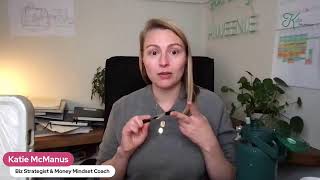
Katie McManus argues that your habitual way of seeing the world, your personal lens, is enough to build a business on. You don't need formal training or certificates. Fear and regret stop most people from starting.
Chapters
Hello and good afternoon. I'm Katie McManus, business strategist and money mindset coach. Just making sure, yes, I'm going live. Done it a couple times in the last couple of weeks where I've gone live on one device and forgotten to press the button on the other. But I am going live on The Facebooks, on LinkedIn, on YouTube, Twitter, and over here on my phone on Instagram because Instagram doesn't speak to Streamyard yet. Hello, guys, get with the program. Anyway, if you don't know me, welcome. I do lives a lot. If you check out my YouTube channel, you will see 300 plus videos and I tried to make these short, sweet, to the point and share with you different elements that'll help you really start your business. My whole belief system is that anything can be accomplished with just a little bit of bravery. Wow, I sounded like the genie from Loud and that. Anyway, just a little bit of breathing. Anyway, what I do with my clients is I help them really discover what their niche is. Design an offer that people actually want to buy and learn how to market and sell their services without like wanting to vomit because it can be really scary to put yourself out there in that way and to potentially be rejected by the people you want to have the most. Anyway, today I want to back it up from like the actual starting of the business. And I want to talk about the lens that we all see the world through. Okay, now there's no one lens. It's not like the pink lenses of the glasses. You know, it, you know, I'm going to get this thought together at some point. I promise. When I look at someone, when I'm talking to someone, this is how I kind of see them. And this is like the wheels turning in my brain. We all have this version of just depends on what our lens is, what our interests are. So when I'm talking to someone, I'm hearing what they do. I'm hearing like what they like to do in their spare time. I'm learning about, you know, as I'm, as I'm talking to them, I'm learning about how they are with other people. Are they a people person? Are they gregarious? Are they shy? Are they kind of reserved? Like, you know, all these different things. And in my mind, I can't even help it. Like, I start designing a business for them, I started thinking, cool, they could help these kinds of people. Oh, and they could do this to their marketing and, oh, this can be kind of their offer and, oh, they have that thing and then As I learn more and more about this person, I'm adding to that kind of like mock up plan and I honestly, I can't help it. I don't, I don't bring it up to everyone, but it's just something that is constantly going in my mind because that is my lens. Okay, Your lens could be something different. Your lens could be, you walk into a space and you see how the furniture could be arranged differently. You could have a lens for beautiful art. You could have a lens for how to teach things really well so that people really understand them and can act on them and all the things. You could have a lens for how technology works. Maybe that's just like you're constantly scanning the world for different representations of technology and how it shows up in day to day life and your mind could just be running in the background constantly trying to figure out how it could work better. In one of my favorite shows, which the second season is on right now, the Gilded Age on hbo if you're checking it out, oh my God, I need to talk to people about it because it's so good. One of. And I won't. No, no spoilers here. But one of the, you know, servants, the, the servant boys in one of the houses, he's trying to like fix his alarm clock. His alarm clocks were really unreliable back then. And it's just something that he's just driven to do. He's driven to try to like fix this one thing. And we all have a version of this in us, right? The problem is, is that we have been raised to think that like we're not special. You know, everyone gets a participation trophy and you know, like everyone has the same amount of skills and like here are your test scores and did you pass fail that class? And all the things. And it strips off as of what is actually specialist about us, right? It really does. We assume that the things that we know, the things that we are kind of secret experts on, we assume that other people know that stuff as well, you know, and we completely discounted in ourselves. I never, never in my wildest dreams would have thought that I would train on sales, right? But it's one of the main things I do with my clients. It's one of the things that is so needed by my clients now. When I started my business, I started off as dating coach for men, right? I've told the story a gazillion times. If you want to hear it, you can go hear it somewhere else in another video. But it wasn't until I had like Launched my business and changed niches a couple times and signed a bunch of clients that my coaching friends were like, wait a minute, how are you signing clients? Because they had never learned it, they had never worked in sales. Some of them had worked in sales. But like selling your own services is totally, totally different from selling a product. And it's one of the things that like I never realized. I scan the world for like what are compelling sales strategies, like what are the conversations and the, and the funnels that work really well. And so I started showing people and people started paying me for it. And here I am today and it's my business and I absolutely love it. You know, oftentimes when someone has one of these kinds of like inherent expertise things that like is just informed by the lens of which they look at the world, they discount it because they can't point to a training program that they went through. They just, they can't. Hi, hi, Mindset Orlando. There's no book that they read that made them an expert. It's just they, they spent their whole life without realizing it, absorbing all this information and becoming an experiential expert. And what's really hard for those people who've learned how to do these things and are just naturally good at it, for lack of a better term, because it's not like it's a genetic thing, it's just something that you have this almost compulsive inclination to get good at throughout your life because it's all kind of self taught. You discount that other people would pay for it, that you discount it because you don't have a certification, discount it because you don't have like a training program or degree that you can point to that this is where you got it from. I want to remind you that all the training programs and all the classes and all the degree programs and all the colleges, someone at some point had to stand up and say, you know what, I have had this experience in my life and because of like my lens, I've paid attention to this one thing a lot. And guess what? I've written a book about it and guess what? I'm going to do talks on it, I'm going to do lectures and this is going to be a new thing that we're going to train on in the world. Someone had to be first, okay? And today. So like someone had to be first for psychology. Psychology is a fairly young medical practice, all right? Actually most of medicine, it's a fairly young medical practice. But someone had to stand up at some point and Say, you know what? I actually. I have some theories about how, like, human emotion works and how we make decisions and why when people get a little. A little eccentric, like, what that can mean about them and what we should probably do with them. And of course, that's like a whole other conversation again, gets a little warped when we're talking about psychology. But someone had to be first. And that first person, like, they started doing their thing, you know, they started seeing patients, they started talking about it, they started writing about it. Nothing stopped them, right? The people who really impacted the world of learning, nothing stopped them because they just said, fuck it. I know a lot about this thing. I have these theories. It seems to play out pretty well. Let me share what I think with the world. You know, just because there are all these training programs out there and degree programs, it doesn't mean that what you have to share right now is any less valuable. Today I made a TikTok with. With Martha Stewart in the background. And of course, like, you know, you can have whatever feelings you want about Martha Stewart. Full permission. But, you know, I think she's so inspiring because this is a lady who literally got rich by showing people how to fold dinner napkins. She's like, no, no, no, no, no. This is important. Let me show you how to fold a dinner napkin into a swan that will, like, surprise and delight your guests. She showed us shit that, like, if you looked at a book, you could figure out, like, it was all stuff that was, like, in cooking books. It was, you know, random housekeeping tips. And she just thought, oh, well, let me turn this into entertainment, okay? That was the lens through which she saw the world, and she made an entire empire out of it. All right? If you do something that changes lives, maybe you're a coach, maybe you're a consultant, maybe you're a personal trainer, maybe you're a psychologist. Whatever it is that you do, think of how much more significant the impact would be for what you do, where you transform lives from. Here's how to fold a napkin, Right? So my point here is that, like, whatever lens you look at the world, whatever it is, there is a business that can be created around it. And if you're watching this, and if you're in my world, I bet you've been playing around with the idea of starting a business. I bet you have thought about all the different ways in which you could sell your service, things that you could teach people, things that you could be a mentor on. And I invite you, if you are actually ready to take that first step, and start the business and you don't know how, then book a generate income strategy. Call with me. The link is in my bio. It's a free 30 minutes. We'll discuss if I can even help you. If I can, I'll point you in the direction of some resources that'll serve you better than I can. But if I can, if I can help you and, and help you get started, we will create a game plan right then and there. My second point is, you know, the only thing that is holding you back from starting a business besides just not knowing how, which is, you know, I teach it all the time. It's easy to learn, right? The thing that's actually holding you back is fear. There's this voice in your head that's telling you you're not good enough. You're not good enough. You don't have any training here. You're not an expert. Like, no one gave you a certificate. You know, you shouldn't be doing this. Fuck that voice. That voice is the voice that will keep you small your entire life. You know, there's a secret language of regret, and really it's only three words. It's incredible. The secret language, it's only three words and it mixes with English language really well. Basically, if you add one of these words into a sentence, it's indicative that you've. You've done something that you regret or you haven't done something that you regret not doing. Does that make sense grammatically? Yeah. These three words are shoulda coulda, and what a. I should have done this. Oh, I could have done that. I would have if I could have, you know, Bullshit. If there's something that you really want to do, if there is an experience that you want, if there are people you want to spend time with, if there's a challenge you want to take on, even if you can't logically justify it to yourself in this moment, I want you to go after it full force. I want you to go for. I want you to throw everything you have emotionally, energetically, and like, be financially responsible here, obviously, but throw whatever you can into making that happen. You know, like starting about a month or so ago, I started talking about, like, dying interestingly or dying interesting, being an interesting person so that on your deathbed, like, you have interesting stories to tell and you have no regrets. It's not you regretting anything, it's just you saying, you know what? I lived a really good life, and it was ironic that I started talking about that about a month or two ago is because I lost someone recently, my aunt. And it's been really present for me over the last couple weeks, which is why I've been on and off on the social media, on and off on lives. But, like, whatever it is that you want to accomplish, there's no guarantee that tomorrow will come. There's absolutely no guarantee. And I know from experience, very recent experience, that, you know, my aunt was taken to the ER on a Wednesday night, went into surgery on Thursday, was dead by Friday night. There's absolutely no guarantee that. That you'll have tomorrow. So whatever it is that you want in this life, whatever experience you want to have, whatever business you want to build. Hi, Heather. You need to throw your all at it right now, all right? My aunt Ang, she lived a very good life. You know, she's in her early 70s. You know, she did a lot of different things. She changed her career multiple times. She did a lot of philanthropy at the end, and she was not expecting to have her life cut short right then. Like, we all took for granted that she'd be around for at least another 20 years. And I wonder, you know, whenever. Hi, you want that dog? Okay. Hi, I want that dog of yours. Yes, you can have her. She's kind of annoying. I love her, but, yeah, just come and get her. Heather. Hi, John. Welcome. But back to the point, whatever lens it is that you look at the world through, don't worry about the fact that you don't have training. If you don't have training, that you're not an expert, like, those things can happen. You can become an expert at pretty much anything. All right? You can absolutely go after that. But if you want to pursue a life where that gets to be your life, that gets to be your conversation every single day, you have to go for it. Like, fear is going to hold you back every single day. And fear doesn't care if you have regrets at the end of your life. Fear, if you're just, is very happy. If you have a roof over your head, you have food to eat, you have people around you, even if they're kind of shitty to you, and you have a paycheck that allows for you to get all the things that you need, doesn't care about anything beyond that. I want you to have more. I really, really do. So whatever it is that you're thinking you want to start, this is your sign. Go do it now. All right? With that, Heather's coming to steal my dog. I have a call in about five minutes, and I need to get ready for it. Thank you so much for joining John and Heather and Mindset Orlando and anyone else seems sometimes to come sometimes don't always work from all the different platforms. One of the downsides of Streamyard. But what are you going to do if you commented? I will be going and checking to make sure I respond to everyone. Otherwise thank you for being here. I hope this is useful. And as always, I'm Katie McManus, business strategist and money mindset coach. I'll see you tomorrow for one. Bye.
More from Katie





How to do self care right now, so you can do what needs to be done, for yourself, your business, and

How to do self care right now, so you can do what needs to be done, for yourself, your business, and

#greenscreen How to build a consulting business that makes you $200,000-$700,000 a year

#greenscreen How to build a consulting business that makes you $200,000-$700,000 a year

Maybe we’re not the imposters…? #businesscoach #startup #entrepreneur #smallbusiness #consulting

Maybe we’re not the imposters…? #businesscoach #startup #entrepreneur #smallbusiness #consulting
