When Excitement to Launch Stops You In Your Tracks...
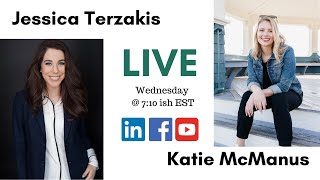
Katie McManus and Jessica Terzakis talk about launching group coaching programs. They cover market research, the gap between excitement and execution, and how to move past the blocks that stop you from actually shipping.
Chapters
Hello, Good evening. I'm Katie McManus, business strategist and leadership coach. I'm here with another incredible business strategist, Jessica Terzakis. And Jessica, I'm realizing I forgot the name of your business as I was introducing you.
It's Terzakis. It's my last name. So now you won't. Now you won't forget it.
Well, now I feel really silly for forgetting as.
And now you know it's the last name. So. So. Hey, everyone. I'm so excited to be here. Thank you, Katie, for, for inviting me on to this amazing live series you have. So I am co owner of Terzakis and Associates. I own it with my mom, which always gets a variety of reactions. We have a great time. And specifically what I do is I help service based entrepreneurs like coaches, consultants, speakers, and authors scale their business using group coaching programs.
Yes, yes. And I have to tell you, I am so jealous you get to work with your mom. If I could convince my mom to become a coach or something and go full, I would want to hang out with her all day long. So I'm totally into it. And I love that you focus on that because it's an area that some of my clients go into and I'm more than happy to support them. But my clients mainly do one on one coaching, you know, or they're rolling out something, you know, big and making a huge splash. But like that one on one, that group program really is its own animal. And but there are some commonalities that I'm really excited for us to dive into today. And that is how excitement to launch something can really be the thing that stops you in your tracks. And we've talked about this a little bit and I want to hear first and foremost what comes to mind when I say that for you.
Well, first of all, I have to say I love when clients are excited. So. Hi, David. Hi, Dale. Hi, Nick. Glad that you're joining us. So excitement is good. So when you say that, like, when excitement stops you in your tracks, it's obviously a good thing that you are because here's what I do notice, Katie. It's an interesting paradigm that you pointed out because I think a lot of times people come to me and they're like, I was told to do this. I was told to like launch this program. And I think a lot of times some people are sort of given an idea and if they're not excited about it, then it's sort of destined for failure. But. But when someone's excited, I first like, to ground their. Their emotions in some reality. And so that's what I'm excited to unpack with you because I tend to have the same conversation when someone comes to me with, like, oh, my gosh, I can't wait to launch this. I can't wait to do this, Jessica. Like, I. I want to get this out there right away. I've got this jewel. People need to see it. It's beautiful. I'm like, all right, hold on, hold on. Let's ground this.
Yes, yes, yes, yes, yes.
Yeah.
100%. All that. And what I find is, like, it's. Usually they're excited for their concept of the thing. It's not.
And.
But they haven't translated it into an idea that's marketable. So it's kind of like a doctor getting really excited about, like, this new medical device that it. It, you know, that they've bought, but no one understands what it does or what it helps. But they're just out there saying, hey, come and, you know, get, you know, something. Something. You know, I couldn't think of a medical term in there.
So it's absolutely true. I think it, you know, a lot of people, especially, you know, if we're talking, like, the health area, I get a lot of people who do nutrition or health coaching or something with people's overall health and wellness. And I think a lot of times people are very excited about their process and their system. I mean, I can't tell you how many people come to me and they're like, jessica, I've got my seven steps. I've got a cool acronym. I figured all of this out, and I say, great, but there really are a few steps, and I love how you pointed this out. There are a few steps you have to take no matter what you are launching, no matter what you are putting out in the world, and no matter how many times you have put something out in the world, it's sort of the same kind of set of questions and steps that you really want to think about.
Yeah. Yeah. Now I know for myself every time I've changed my niche, because I don't know if you know this. I started off as a dating coach for men, and then I did not know that. So I started off as dating coach men. Like, my audience knows this. I'm not going to go super into it. But then I got mostly all women clients, so the universe didn't want me coaching men on dating. And then all of those clients, except for one of them, wanted me to coach them on how they were showing up at work. So executive coaching, because how they were being at work was getting in the way of how they could have a personal life. And then all my coaching friends were like, wait, how did you start a business so fast? And that's how I started. I ended up here. But every single time I changed my niche, I would actually go out and interview another 50 people who were in that niche so I could get super clear on how they saw their problems, you know, where they were getting stuck, what they ultimately wanted, and what was keeping them from getting there. And so one of the things that I have, all my clients do is a set of interviews like this. And we've talked about market research. And I want to hear, you know, what's your experience with this? Because we have kind of the same thing going on.
We do, we do. So it's, it's one of those where I think people do the market research at the very beginning of their business or at the very beginning of when they're trying to figure out what their core offers and who they're trying to help is. And I feel like at some point people are like, well, I've done that. I figured that out. Like, why do I have to do that again? But I'll be honest with you, I have had, I have one client that I'm thinking of specifically. She's a real estate agent, and she wanted to teach other real estate agents how to increase their sales. And so she set up a series up. Now she's been in business for a while. This is not a new thing for her. She set up a series of market research interviews where she was just trying to figure out, like, what, what's your biggest problem? What does this cost you? How's this showing up, those kind of questions? She interviewed about 20 people. And from those interviews, she went away, crafted the offer, and she went back to them and said, based on what you told me, this is the offer I put together. What do you think? And she wasn't making a direct pitch, but it was so like, she built her program. No social media posts, no emails, no. No crazy marketing. And I think that the problem people have when they hear do market research is they're like, well, that's going to take more time. I'm not going to be. I want, I'm excited. I want to put this out there already. I want to get people in. I want to be teaching, you know, and so I think. And here's the other thing, actually, this. I don't know if you've experienced this Too. Katie is. I think a lot of times we are excited about our process and the idea of doing market research could potentially alter or change what we've created as a vision in our mind. Right? Like, no, I've got my acronym. This can't change. Right. This is my system. Right. You know, so I can't ask people for feedback because it's going to change. And I don't think people are like consciously thinking of that, but I do think maybe that's an underlying thing. So. So I love market research interviews. Oh my gosh.
Well, it's so funny you say that because in the coaching world, especially if you're a trained certified coach, the coaching programs that you can typically go through, they tell you, okay, you don't, you don't drive the boat. Like, your clients show up with an agenda. You're not supposed to specify anything that they're working on. And so when you're going through a training program like that, and I work with a lot of clients that have gone through CTI or ipac, a few other coach, coach training programs. And so they think, oh, shit, well, I can't have a curriculum then. I can't do that. Like, so when I tell them, okay, cool, you have to do market research because you have to figure out your niche and you have to figure out what their problems are and what outcomes they want. They're like, well, I can't guarantee those outcomes. And it's like, well, of course not. Line up with you so that they can do the work to get those outcomes. You know, it's like, it's like this. Oh my God, like, if I do the market research, then I'll have to promise this thing and then what if it doesn't happen? It's like, well, you're not promising anything. Like they have. That's not how coaching works. You can't guarantee anything. But right, right out there that, like, hey, if you want to lose weight in a holistic way without, without, you know, eating only at 1200 calories, then I'm the coach for you.
Totally. Yeah, it's, it's, it's, it's interesting because I think you see that with your one on one clients. I hear that with a lot of people who are trying to put their groups together for the first time, they're so worried. And, and I love this because this comes from a place of authenticity. Like, I don't want to be like that shiesty, kind of like, you know, salesperson.
Right?
Like, I want to be honest and I want to be truthful about what I'm positioning like, I don't want to over, you know, I don't want to guarantee anything. And I say the same thing, you know, it's not about guaranteeing, you know, it's about you have a system that if someone listens to you and does what you tell them to do, they should get to the outcome. So I'm in total agreement with that.
And it's so funny, we have David Fryman watching. I don't know if he's still here, but he's a lawyer and he'll tell you the trouble you could get into if you guarantee stuff when you can't guarantee it.
No, no, I definitely do not recommend guarantees now. I mean you could certainly paint, when you paint the outcome and when you speak to that, regardless of whether it's one to one or group, it's not that you're guaranteeing it, you're showing them and inviting them into possibility. So I frame it more in that way, you know.
Yeah, 100% I wanted to go into, because I know you have a really cool background about, of how you ended up here. Do you mind sharing with the audience how you ended up being a coach who helps people roll out their group programs?
Yeah, I was the complete opposite of an entrepreneur. I was a bureaucrat. I was a teacher. So I taught high school for about six years. I calculated it, I did the rough estimate. I think in the time that I taught, I had had over 50014 and 15 year olds like that I had taught by the time I started and left. So that's like my claim to fame is like I can wrangle 14 and 15 year olds. And so when I left, I mean, I think those of you listening to this probably are not unaware that teachers in the United States at least are just not paid. Like, I was just like, there is no, there's no way that I can sustain 70 hour weeks teaching and working to two full time jobs. So. Or two other part time jobs. Excuse me. So I left, made it to the point where I signed my, you know, I got tenure, I made it five years in. I was like, I can't, I can't do this anymore. Burnt out. And I made the leap and joined. At the time, my mom had just started the business and she was doing business consulting. And so this is my, this is my hope for you, Katie. Like she was like all along, you know, when I look back at it, like the last year I was teaching, she was like, you know, I'm starting this Thing. And I think it'd be really cool, like, if we did something together, because we have opposite personalities. And when I left, she was like, well, this is the perfect time. Like, come on in. And so it really was. It was a really perfect situation in which there was the business that already existed. I stepped into it. I had to figure out, you know, how to leave behind, like, the teacher. Like, working seven to two. Like, even now, like, I wake up in the morning and I still have this regiment of, like, wanting to be on the teacher schedule. But honestly, I think being a teacher, as frustrating as it was at the time, it was one of the greatest things that I did because it taught me how to teach. It taught me how to communicate. It taught me that so many entrepreneurs want to make a difference and need to become better teachers in doing that. And that's where I have the most fun.
Yeah, that's so amazing. And I just wanted to highlight, because it's a beautiful example of how you could take a skill set that you had that's completely unrelated and flip it into something that you could be wildly successful at as an entrepreneur and make a dramatic amount of money.
Sorry.
My dog, she was having a temper tantrum before, but here she's back. I gave her.
The tails wagging and everything.
I know she's gonna be so loud in a minute.
Oh, my gosh. I'm sorry. At my shepherd's right outside of the door that I, like, blockaded her out of the room, I was like. Because if she was barking, my dog would hear that. It would be just be crazy.
I'm unfortunately in an apartment that doesn't have doors right now, so there's no way, unless I, like, outside, and that's just going to be a whole other can of worms. Oh, man. How long have you been doing this since you made that transition?
Gosh, it's been five years now, which is wild to me. It feels like a lifetime ago. So I know, like, all of us have come from doing different things. Like, do you ever look back and those of you listening, maybe you feel the same way. Do you ever look back at, like, a person, previous thing you were doing and you made a transition into what you're currently doing? And I think back, like, 2015 and 16 was not a long time ago, but it feels like a lifetime ago. Like, entrepreneurship is just. It's one of, I think, the greatest personal development programs you could ever go through, right?
Yeah, yeah. Lightly put. Yes.
Yeah, yeah, yeah. It was. It's been so much fun. I think it was the best decision I made. I can't even imagine going back to being a teacher. I get that question all the time. Do you imagine being a teacher again? And I just say absolutely, like, no, it's just not possible. It's no. Love the kids. The system is the problem.
Right, right, right. Amazing. Well, you know, and it's, it's interesting. Like, so I started off as in sales really. And most of what I teach my clients now is like how to sell without feeling salesy.
Yeah.
You know, because that's like one of the main fears when someone starts a business. Like, oh God, like, do I have to sell? Do I have to be that smarmy, you know, used car salesman person? And you don't. And there's really nice way to do that. But, you know, and any one of these skills, teaching sales, if you're a marketer, if you're a lawyer, if you're a dentist, I'm sure there's a way to transfer that into being an entrepreneur.
Yeah. You know, I think something that is so worth just highlighting there is, I think the sales. Even with established business owners, because I work with people who have been in business, they've had some traction, they've definitely closed, you know, sales. And even when they get to the point where they're like, I want to scale, I want to help more people, the thing that takes the wind out of their sails more often than not. If it's not the tech, it's the sales. Yeah. Still, even with existing business owners, they're like, I don't, I don't want to come off as salesy or can't. Doesn't this, can't my offer just like sell itself? Like, can it just sound so good that like the sales are effortless? And I just was like, well, it. In a perfect world, but you can't just the build it and they'll come paradigm does not work when, when you scale. So. So I do think, you know, if you are someone who has the resistance to sales, I think one of the best things you could do for yourself is work with a sales coach and work with someone to shift that paradigm. Instead of you feeling like you're just taking people's money, that you're actually helping them change their life or their business or their health. And so, yeah, that's, that's one of the quickest things that, that gets the excitement like completely out of the room.
And I love that you touched that. Build it and they will come because both for coaching, one on one coaching, and for Courses, when people do get super excited about their idea, oftentimes they'll go just dive right in and they'll build it. And then we'll go through this existential crisis for about six months where they're freaking out that it didn't work.
Yep.
And that's usually when you and I get the phone call.
It is. It is. Yeah. In fact, I tell people, you know, there is. There. There are a lot of people in the course and sort of program world that, that suggest, you know, pre. Fill it or don't build it before you've sold it. And, you know, I know a lot of people get nervous around that because I think they believe that if they have everything built, that will translate to confidence and value.
Yeah.
But really, you know, you need to get out there and find people to get into this thing before you spend six months, because you're. You are so right. Katie. I was talking with the CL about this earlier. You know, the second you sit behind your computer and start fleshing out a concept, time becomes like. Time doesn't exist. Right. It's like you've gone into this, like, limbo where before you know it, six months have passed and you haven't done anything with it. So it's balancing the excitement with, I've got this amazing thing and I need to go talk to people about this and enroll some people in it so that I can co create. Right. I can build this thing with them and get their input. Because only until you get people in it, are you going to make money. Are you going to change people's lives? Are you going to become a better communicator and a better teacher? It doesn't happen in a vacuum by yourself.
Yeah, no. 100%. And you know, on the coaching side, you can be so enamored with your process. You can go on social media and you can post about it. You can post about the. The meditations you lead people through and visualizations and like, this activity that, you know, changes lives and no one's gonna understand it and you're just gonna get more and more and more frustrated because you're not gonna get on sales calls. And if you do get on calls, people are just gonna think you're giving it away for free. My least favorite thing. That's my biggest pet peeve. You can ask any of my clients who are watching. Yeah, it's just. It's super disheartening. And then it kills your confidence in all of it. You know, you just think, oh, gosh, I might not. I must not be that good at this. And it's just that you just don't know.
Yeah. And I would say, like I was talking with the. With a woman. This was, this was pre Covid. But it's. It's a similar conversation I've had. You know, she said, I built the content, I did my launch. No one signed up. And it becomes this emotional wound, right? Because it's, it's your, you know, your. It takes a lot of courage to put things out there. It takes a lot of courage to put, like, your creative work into the world. And something that I have noticed about people who launch programs that are really successful, one of the features that they have is that they're not emotionally attached to their offer. In other words, they're excited about it. They love it. They're like, yeah, this is. This is going to be exciting. But they are not so emotionally wrapped up and involved with it that to make a change, it will throws them into an existential crisis like that, that. That situation doesn't exist. And so that's why, you know, the program I have, like, I like it, but I could. I don't mind changing it. I don't mind if I retire it and do something else. Like, that's fine. And so I really do tell people, you know, as you scale, do not become like. Like, it's like a relationship, right. You don't be too involved, right. You need some healthy distance between you and that thing that you love. Right. So it's kind of like that.
I love that. That's such a great metaphor, and it's so true. And I think that probably gets translated on the sales call where you're a little more flexible. So if you're, if you're, if you've been rolling out this course for a few goes and it's been super successful, but all of a sudden the sales calls have shifted a little bit and people are saying, yeah, I need those things, but I also need this new thing. You can be a little more flexible and say, oh, amazing. Yeah, I can add that to the course. You know, I'm in control here. It's fine. We can change the rest of the be and it'll. It'll work so much better for the people who are coming on now.
Oh, yeah. I say to people all the time, you're teaching people, not curriculum. Right.
Love that.
The best, the best teachers. It's not about, you know, well, I've got this rigid contact. Can't, like deviate. It's all about what do the people in front of me need the most. Right, you. And so you have to be responsive. And so when someone says to me, I need to figure out how to stand out, it's. It's not really about your content. It's like, are you responsive? Do you listen to people? Are you giving them what they need? Balancing that, of course, with what's realistic and what you can do for them. But yeah, you teach people, not curriculum.
Wouldn't it be just paradigm altering if the US school system started thinking that way?
Oh, yeah, it really would.
Like I was, I've been messaging people all day because I posted something about crappy relationships to money, because we all have crappy relationships to money because we're never taught about money. You know, I spent, I spent three years in high school learning how to do a PowerPoint presentation in Word Art, and I've never done a PowerPoint presentation in my adult life for business. I've done it, like for funny things. But yeah, it's like, couldn't we have talked about balancing a checkbook or doing, you know, how credit cards work or how debt works, how savings work or index funds. Wouldn't that have been a little more helpful?
Oh, totally. I mean, I, I left that industry so jaded. It really, really was like five years in or six years in. That's not a lot of time, you know, And I think, you know, individual teachers really do not have a lot of influence or sway. You're just a tiny, tiny cog in this gigantic wheel. And you see like decisions take forever, changes that you think would be practical. It conflicts with administration and school. Like just have all these like. Yeah, yeah. So I agree, I agree.
So I'm curious, you know, when, when you get someone who comes to your door and they're, you know, super excited about what they've already created and you kind of have to dial them back, like, what is the process that you have them go through?
Well, usually the first thing I have them do and they don't like this because they feel like it's like the newbie stuff. They're like, well, I've already done that. Is I usually ask them to write down what are the biggest like complaints or challenges that your clients have come to you with before you started working with them. Right. Because these are people who have had some one to one clients. So write that down. Right. The next thing I have them do is write out, write down all of the, like, I talk with them about tangible outcomes versus vague outcomes. Because the thing is, you know, those two questions alone, if they Answer those two questions that usually influences, like, is this a program that is focused? Is this a program that's going to sell? Is this meeting a need in the market? Right. And those three steps are the things I take every single client through. Because, in fact, I was talking with someone today. He got on a phone I knew. I know him from some of my local networking, and he's like, I've got this idea. He fleshed all of it out. He's got this vision for the next 12 months. And I was like, how. What inspired you to create this? Exactly. Like, what told you that the market needed this? Right. And so, thankfully, he had done a little bit of verification and market research. But those are really the three steps, Katie. I try and keep it super simple because, you know, I want to harness that excitement and energy while at the same time, before we go any further, before you invest in time to put this out there and time and building it, you know, let's. Let's verify the idea. The other thing that I do, Katie, is, you know, I tell them to stop building content if they've got their idea. If they've got their idea, and they kind of know the general steps, I tell them to stop building content. And that stresses people out.
Yeah.
So, yeah, they don't like that. So that's. Well, how am I going to. Like, what am I going to invite them into? I'm like, you've got. You've got the program, like, you know, build it as you go. And I really, you know, that's how I was taught as a teacher. That's how most teachers teach. They've got the general layout of what they're going to do that semester. Like, if we're thinking in school terms, they've got the core assessments or core benchmarks. They don't have every single lesson figured out.
Right, right, right. Yep.
So, yeah, that's.
That's.
I. That's what I do. I really, you know, I try to keep that conversation up front as simple and straightforward as possible because, you know, we all know time is at the essence. You know, the last thing we want to do is, like, scrap something. More often than not, I don't. I tell people not to scrap ideas. It's like, let's just tweak it based on what the market is saying. And if they're resistant to that, we dig into, like, well, why don't you want to talk to your ideal client about something you've created? Like, let's dig into that.
Right, right.
I love.
I love pushing that you need to know the tangible outcome. I can't tell you how many times I've been on a call with someone who is a certified life coach, and they're like, I just want to help people be more confident. And I'm like, that's so beautiful. And also, that will not sell. You're not going to get one client that's paying what you should be charging for more confidence. What is it the thing that they're actually getting when they have more confidence? Is it higher pay? Is it a better job? Is it going for their dream? Is it like finding their dream soulmate? Yes.
And what I like about that is, you know, I think it actually makes the sale easier because when you say, like, we'll just get you more confident, Katie, like, come on, don't you want more confidence? Like, well, in your mind, you're like, I don't know what confident? Like, what will that look like? Like, I don't know what confidence means. You're trying to paint a picture in your mind. And that's. That's the problem is when you're vague like that the sale, like, you already have this fear of sales. The sale just became that much harder because now you're. It's almost like you're twisting someone's arm. Like, yeah, you need more confidence. Like, yes, you need this. And it's like, well, there, that's the disconnect. Right? So I know a lot of life coaches fear, like, well, I don't want to just help people on this. Like, I could do so much for them. And I say that's the beautiful thing. You can have more than one program.
Yep.
Yeah.
Yeah. And for one on one clients, you know, you're customizing their program to them once they're in the door. So if they want help on those areas of their life, beautiful. But they signed on to this primary thing, you know, but this isn't like confidence store. You're not here signing up, so you get cans of confidence that you can pour in your coffee in the morning.
No. Oh, no. And, you know, I think it is that. That the great thing is, is I think whether you're working one to one or whether you're going into a group situation, like, you have that answer of, like, what the tangible thing is. It's just that's not how you're thinking of it. So I love how you framed it. Like, okay, confidence. So that what, like, how are they going to know they're more confident? What will be. Like, what will feeling more confident look like in Their everyday life, you know, And I think having them drill into that is. That's how you become someone who stands out. That's how you don't just become the coach that says, I'm here to help you, and so are hundreds of other people. Like, it just becomes so much easier for you to have people see that you are valuable.
Right, Right. Yeah. And it's also, like, I'm not going to remember you if you're just the confidence person. Like, there are so many people talking about confidence. What makes you stick out? But if you're the dating coach who works specifically with lesbians who are recently divorced and have children and want to go out and find their next life partner, I'm gonna remember that. That is really specific. And I guarantee you there are some straight people, some. Some gay people, other people in the. In the Alphabet army who are resonating with that message and saying, hey, I know you work mainly with lesbians, but will you work with me as well?
Yeah.
You know, it doesn't rule people out, because the beautiful thing about this is you're going to be memorable. People are going to see you because you're going to be visible, and then they're going to like you or not like you.
You.
And they're going to be able to opt in not often.
And that's. That's. I think the beautiful thing is that I think, you know, there's the fear. Opening up a confidence store sounds like a good. You can sort of even conceptualize, like, what would be in it. Like, what would that experience of being in the confidence store look like? Right. That's where my. That's.
I don't even have to think about it. It would just have Spanx. Spanx everywhere. Like, for all body types, all different sizes, all the things. It just have Spanx and maybe some Lululemon leggings that make your ass look amazing. That would just be the confidence store.
Like, bright, bright colors and. Oh, my gosh, that would be so fun. But what were you talking about? Because now, David, we will just open a confidence store. Yeah. What were we talking about? What was our point?
This happens a lot on the show, just so you know, we lose the thread sometimes. It erupts into, like, try to figure out where they were going with this kind of thing in the chat.
Oh, I got it. I got it. We were talking about. I think we were talking about niching. Niching down or, you know, trying to solve a narrow problem at a time. Yeah, it's. It's funny because, you know, I think people fear that when they narrow down, they're going to turn. And I know from like a, you know, a life coaching, someone who's in that heart centered space, like, wants to help like as many people as they can. And it's like, well, you know, if you're trying to help everyone, it's almost like you're helping nobody. Like, in fact, I was talking with a nutritionist and she felt so bad about trying to put a program together and charge more than like, you know, 20 bucks to be in it. And I ended up saying to her, like, here's the cool thing about when you're like really clear on just Spanx all around. The really cool thing about when you're really specific is you get the right kind of person in, right. Because you're communicating directly to them. They see you as a premium. They're like, I will absolutely work with you because you're going to solve this top of mind problem. And the great thing that this nutritionist, I told her if you get the right person in, what that means for you is you could then donate your time. You could work like pro bono with people that couldn't necessarily afford your services. And so when you're stuck in this place of not wanting to charge anything, you're actually really not helping anybody. You're not helping the person that can afford you, and you're also not helping the person that desperately needs your services. And now you have the time and space to actually donate it for them, right? Totally.
And you know, the beautiful, I mean, not the beautiful thing, but the thing about charging a certain amount, especially if you're doing a service where it requires your client to do work work to see results. I can tell you, as someone who has hired a nutritionist who didn't charge enough before, I didn't do a damn thing that she told me to do because I tell.
Yeah. Why?
Well, I sign up for shit all the time because I just like buying experiences. And it's usually because I like the person and I want to be around them and I think they have something valuable. But like, I signed up for group courses that were under $1,000 and I never showed up because I didn't have any skin in the game, signed up for other transformational services that they didn't charge enough. So I didn't utilize any of the things they taught me. And the other part of it is sometimes I don't sign up because they're charging so little. I think, oh, they must not be that good. So I'm Just gonna go and find someone who's better that I can spend more money with because I love spending money, invest in myself, who is, you know, who's obviously better because they charge more. Not always.
But it's. It's. So I was. I was glad that you expanded on that because I hear this a lot. People are super excited in there. They are like, well, I'm just gonna. This is the first time I'm teaching this program. First time I'm putting this offer out there. Like, I just want to do it for free. And I'm like, it sounds good in theory, and it never works out the way you want it to because there's no accountability. And I think we don't necessarily bring this up, but I'm glad that you did. Lower prices for a lot of us, when we see that, we're like, what's going on there? Why is that so little? Really?
Right.
Yeah. You're like, it raises more flags as opposed to, like, it's. It's the exact opposite. You think people are going to see, like, oh, 50 bucks to join this program. What a deal.
We're like, no, no, no.
They're like, there's something doesn't feel right about this. Feels like a scam.
Totally. Totally. Well, I mean, like, I used to belong to a gym that was 200amonth. If you're charging 200amonth for your service, I'm sorry, but my gym never changed my life. I wish it had, but it never did. If you're telling me you're going to change my life for 200amonth, I'm sorry, I just don't believe you. You know, that's a really, like, hour and a half. Massage some places. Again, massages have never changed my life.
Right.
And here's the analogy. My dad's a carpenter. He builds beautiful furniture. He renovates homes. You know, the very first time he built a dining room table, it's not like he did it for free because it was the first time he built a dining room table. Like, the end result was he still made a dining room table. It was still beautiful. It still, you know, served the family that he built it for really well for a couple decades, you know, but it's not like he was like, well, this is my first attempt, so I'm just gonna, like, put it out there. You know, you guys are gonna refer me other people who need custom made dining room tables. Like, no, that's not how this works.
No. I see nothing but disappointment for people who try to bring people in for free. Especially with groups. Right? Because it's like, well, you want to get like 10 people into a group. You've come close. You've got like seven. I've had some people say like, well, can I just invite like three people in for free? I said, I would rather have you just have seven and have that be an amazing experience than for you to say, you know, I'm just going to bring three people in because it's just going to frustrate you, it's going to annoy you and it's really going to introduce a lot of like self doubt and self criticism that just is not necessary. Right, right.
I will, I will tell on myself here because I've rolled out a few group programs and I'm, I'm a very proud codependent. So I need feedback. And of course we can't rely on our clients. It's not their job to give us like positive or negative feedback all the time during our courses. So I always put in like one of my best friends into the group, but I make them do it for free just so I can have someone to call at the end of it and be like, was that okay? And they're like, yeah, it was great.
Oh yeah, no, I think that's great. I've had people go on like my. When I did a bunch of Facebook lives, I would have a friend. I'm like, all right, I'm going live on the stage. You'd be on to tell me, like, how am I doing? Like comment in the chat, like, you know, just give me something. Yeah. So I've done the same thing. Yeah.
So much fun. Is there, is there anything else? So like, if someone in the audience is thinking about starting a group and are wanting to roll out a training program, what is really the first step they should be looking at and if they are interested in getting help from you? What, how do they do that?
I would say the first thing is, you know, as we talked about earlier, do not overlook the principles that you had put in place when you first started your business. The market research. I'm telling you, it sounds like work. It is the best thing ever. Do your market research. You don't have to do 50 interviews, but get your market research in. These could be past clients, it could be current clients, it could be just people who would be ideals. The second thing is usually people say to me when they want to start a group, like, I've just got my one on one process. I have no idea how to put that into a program. Chances are among all of your one to one clients. There have been some consistencies, There have been some consistent, you know, principles that you've taught them, some steps that you've taken them through. Write those down. And if you want to get in touch, I would say let's connect on LinkedIn because I need to put more energy on this platform. So let's connect. Let's connect here. Fabulous.
You're also being. You're being streamed to Facebook and YouTube. So if you're watching this on the Facebook, YouTube. I know. I love Streamyard. I get to be like so lazy and just stream everywhere. Sometimes I prop my phone up and I also do Instagram. But if you're watching on those and you want to connect with Jessica, then please go over to LinkedIn and she's just Jessica Terzakis on LinkedIn as well.
Jessica, the only one?
Yeah, I think so. I don't think there are many other. Maybe some other Terzakuses, but there's that Jessica combo very commonly. Jessica, this has been so much fun. I'm so glad James put us in touch.
Likewise. Yeah, I can't believe 40 minutes has almost flown by. This is a blast. Thank you again for having me.
I know. Thank you. And thank you, Luna, for not becoming a terrorist. She's now asleep on the floor. That worked out perfectly. And thank you to our amazing audience. Thank you for joining us. If we do roll out the confidence store where we're selling a ton of Spanx, you guys will be the first to know. So anyway, thanks again. I'm Katie McManus, business strategist and leadership coach Jessica Terazak with Chisakis and Associates. And thank you for joining us. Have a good night.
Thank you.
More from Katie





How to do self care right now, so you can do what needs to be done, for yourself, your business, and

How to do self care right now, so you can do what needs to be done, for yourself, your business, and

#greenscreen How to build a consulting business that makes you $200,000-$700,000 a year

#greenscreen How to build a consulting business that makes you $200,000-$700,000 a year

Maybe we’re not the imposters…? #businesscoach #startup #entrepreneur #smallbusiness #consulting

Maybe we’re not the imposters…? #businesscoach #startup #entrepreneur #smallbusiness #consulting
