The AI Training At Your Job Won't Save You (Here's How To Last)
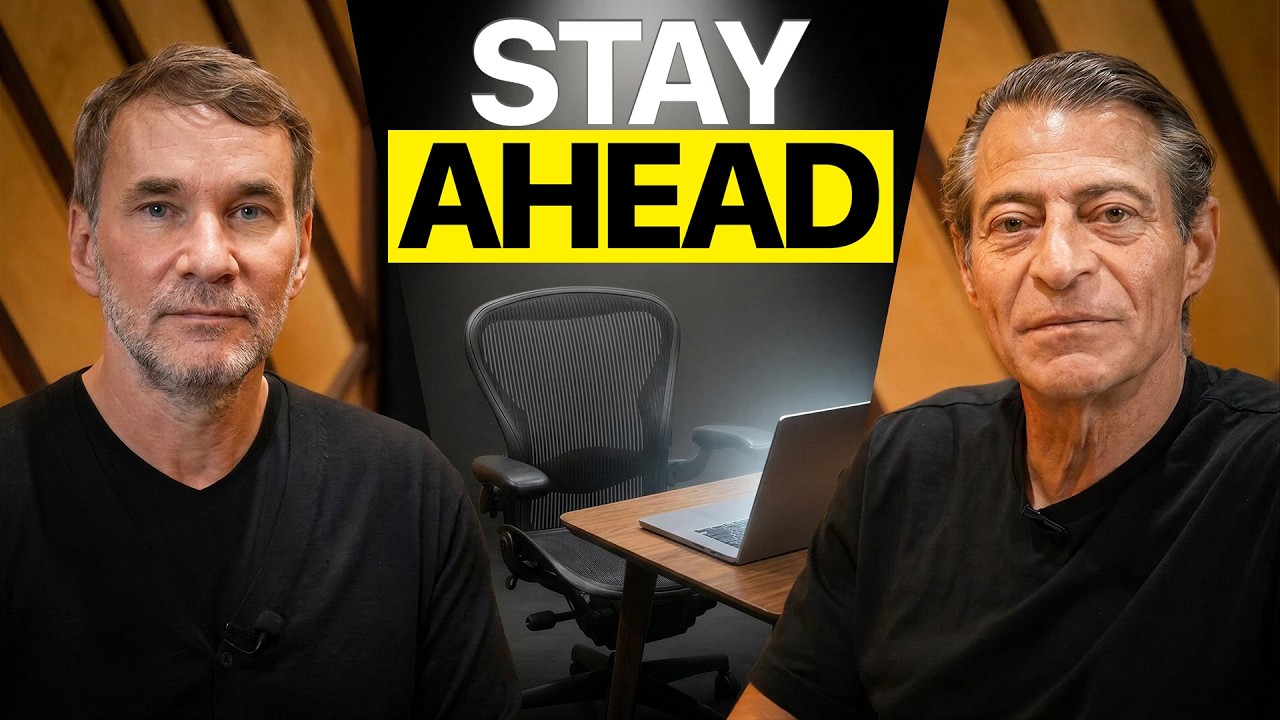
Keith Ferrazzi and Peter Diamandis explain why most big companies aren't getting real value from AI despite using the same tools as startups. Ferrazzi's "AI Black Belt" program certifies employees on measurable workflow redesign, while his nonprofit Workbridge helps reskill workers displaced by automation, partnering with leaders like Glenn Youngkin.
Chapters
Almost every company has now bought the exact same AI technology as everybody else. Almost none of them are getting the results back that they expected. I spent 30 years inside the rooms where the world's biggest companies decide how work actually gets done. And every single month I hear from 100 Fortune 500 tech executives about what's really happening behind all of the broad announcements. So today I'm sitting down with Peter Diamandis to discuss why companies Peter founded XPRIZE. He co-founded Singularity University, and he spent his entire career seeing where technology goes years before the rest of us even get there. By the end of this conversation, you're going to know what the handful of companies who really are getting great results, what they're doing differently, and whether you can fix the company that you already have or you need to build a new one.
So Keith, we're here in my Moonshots podcast studio. podcast studio and every week, twice a week, we talk about how fast the AI world is changing. I mean, I used to be able to track an entire year of progress. It's hard to track 3 days of progress right now. And I have to imagine that a lot of companies are both excited about these tools that are coming their way, but also fearful about getting left behind. How do I best do this? You know, we're not an AI-native company. How do we compete against AI-native startups?
Yeah.
What are you seeing inside of companies?
You know, this is where I love our partnership because you're looking at the technology And you're looking at the speed and the velocity, the advancements of technology. I spend every day of my life in large enterprises working with the executive teams, trying to take that technology and figure out what to do with it. And I promise you, it is not nearly at the speed that you're seeing.
Yeah.
I mean, there are a few companies out there, particularly, you know, the core tech companies like Anthropic, like Google, et cetera. But I even see under the hoods of those organizations, they're not even using it with the velocity with which the technology itself is advancing. Let's talk for a second about what's really happening. As you know, I've got a group of 90 of the Fortune 500s, the chief technology officers, the chief operating officers, heads of HR, chief financial officers, and I bring this group together. And my mission is very simple. We will help each other leap forward years by sharing our real-life best practices. No bullshit fireside chats about what's possible.
Yeah.
Everybody comes and they talk about, here's what I'm using AI for, here's the results that I've gotten, and here's what you can do. Institute has to scrape to find these examples.
So is it that they are not actually getting the kinds of breakthroughs that they imagine they're going to get, or are they not experimenting enough? Because, I mean, the problem with large corporations is they're so stuck in their ways, and everybody's protecting their fiefdom. Are they running the experiments?
I've created a model that I help my teams understand, that there's 3 ways of thinking about AI implementation inside of a company. One is the fundamental redesign of your company. Right? So Amazon fundamentally redesigned the future of publishing, commerce, et cetera. They saw technology back in the time and they reinvented an entire industry. There's that possibility. The next possibility is how do you take what you do every day? I'm a procurement person and I'm buying shit.
Yeah.
How do I use AI to re-engineer the workflows of what I do every single day? That's not the third area, which is how do I use the tools to improve productivity? The problem is that most companies, they first access to AI relative to the tools. So all of a sudden you got Claude or ChatGPT available to you or Gemini available to you. It wouldn't be a surprise that a single individual thinking about how to use a tool differently wouldn't find radical results, right? They're gonna see productivity enhancements. And I do see that depending upon the space, engineering, 50 to 80% improvement in productivity of specific engineers. Not everybody can use the tools well. So we should talk about how do you get your people using the tools better to advance productivity of their particular role? Now, the second place As you well know, AI is not new. It's been around for a long time. So how do you think about how AI re-engineers the product of your company? The technology companies have been using AI for a long time. That's been around. And the question is, how do we rethink business models, entirely new business models to rethink the company? And that's number 2. And then the place where we're gaining the least traction, but it's the greatest possibility, is re-engineering workflows. Yeah. And I can say that customer service is the place that will make the greatest impact today. We're gonna be seeing the absolute elimination of call centers down to the very basics. We're gonna be seeing significantly improved customer experience. So that has actually gone further than anyone else. And we can talk about the successes there. Sales support is another one, freeing salespeople up to sell. And that's been a big, and what I call zero-based workflow redesign. And then the third area is gonna be supply chain. Those are the areas where we're gonna see the biggest impact. And those are the ones that we've been able to find the real research. YC is the largest incubator in the world, right? They give them each half a million bucks. So $100 million a quarter.
Yeah.
And they're birthing these companies. I think 12% of all unicorns come out of YC. These kids think differently.
Yeah. They're AI natives.
It's fully—
I mean, these companies are built from the ground up using AI at every process. Exactly.
And I was talking to these kids, getting to know them, talking to Gary Tan who runs this thing. And Gary had created this super brain to run the company, to run YC. So Everything that everybody does at YC was entered into AI, and all of the workflows were in AI. You queried the business out of that, and the AI was actually constantly refining the workflows. So, you know, it's like there was never a need to set an agenda for a meeting. AI would do that. The accountability of did we do something was always being prompted by AI, the workflow improvement. There's a company called Red Hat, which you might know.
I remember Red Hat, sure.
And it was bought by IBM. Matt Hicks had an idea separately from what he saw there of creating a super brain for a 20,000-person company. So what he did is he had all of the people at the executive team level write a 10-page dossier of, okay, you're the finance head, you're the HR head. I want you to write a 10-page dossier of all of the workflows that you do.
What do you do every day?
What do you do every day? What are the things that your group does? Then he had the same 10-page of everybody who reports to each of them, right? So now you've got 2 layers of deep documentation from your brain What you do and how you do it. And you put that into the AI. Then they went over to ServiceNow and they took, which is a process re-engineering, they took all of the inputs from ServiceNow and they put that into the AI. Then they put a plugin to the ERM system, which allowed all the data to flow about what's going on here. So now Matt Hicks has the opportunity to sit there and say, wait a second, I see that New England sales isn't as good as Florida sales. I wanna know what are they doing different?
Right. Fundamental insights you'd never have before.
An executive would've had to ask that question and maybe got an answer or 2 weeks later. And in the meantime, somebody would've been covering up what they— like, it would've been bullshit.
And even better, the New England office can actually query the AI, how can I get as good as the, you know, the team down in Orlando?
And more importantly, underneath it all, the AI is making recommendations of the re-engineering of the workflows. So I was working with Cisco in a research project, and we were looking at how— what are the best practices of some person in procurement to re-engineer the end-to-end workflows of supply chain? Because we all know that A person in procurement needs sales forecasting. It needs manufacturing scheduling. There's all— end-to-end is the issue, right? So we're trying to get this and we're coming up with the best methodology for zero-based workflow redesign. And then when I saw what Matt was doing, I was like, wow, we don't even have to do that down here. AI can be a partner. It falls out of it. It falls out of it, right? So this is extraordinary. What's about to happen if this super brain becomes commercialized, which right now there's nobody commercializing it. I'm now in the process of working with some folks to do that. If it becomes commercialized, the corporate advancement of the use use of AI to fundamentally re-engineer the way corporations work, the old change management won't matter anymore. The fact that somebody's holding back information or somebody's scared about something, et cetera, it won't matter anymore. And that will be a major unlock, massive unlock.
Agreed. So, you know, this is what Elon's vision for Macrohard as well, right? Which is digitizing all your employees. And it takes it a step further. And there are other companies doing this. Rather than you writing down what you do, the AI is observing you during the day all week and it's documenting exactly what you do.
Yeah.
Is
that easier in an engineering-based company than a company where you're not necessarily plugged into observability as you—
Or you're recording every phone call, every Zoom, and you're allowing—
Ambient listening across corporations. I'm surprised how quickly that picked up.
Yeah, for sure.
Even major companies like Sony and Sony.
The implications of this are immense. I mean, it's about increasing corporate efficiency, right?
Let's talk about theory.
Yeah. And it's the good news is the companies are gonna become much more productive, much more efficient. The cost will come down. And what we've seen is seen as well, of course, in one of the conversations you and I've talked about, I think at the end of the day, a company that's doing X amount of revenue and work can accomplish that with ultimately 80% fewer employees.
Potentially.
And that leads to fear. I mean, there were, you know, everything from Amazon workers wearing glasses that's recording what they're doing and teaching the robots that'll eventually replace them. We saw that at Meta as well. And that's got to— like, I'm training my company's AI to ultimately replace me.
Yeah. I want to use an example of a large governmental institution. And maybe I shouldn't say who it is yet, so I just won't. But it's one we all know. And
one of the US government—
One of the US government departments.
Yeah.
And the leader of it—
That you coach?
That I coach.
Right.
And the leader of it, I have such admiration for and such respect for. I told a joke to him and I said, hey, you know the joke. He was talking about how does he communicate to his people in the institution. And I said, well, you know the joke. joke. 2 hikers walking along the path and a bear comes out of the woods. And one hiker starts running and the other hiker pauses and puts on his tennis shoes. And the guy looks back and says, what the hell are you doing? You're putting on your tennis shoes. You cannot outrun a bear. And the guy looks up and he goes, don't worry, I don't have to outrun the bear. I just have to outrun you.
Yeah.
And I frankly, you know, look, you and I are very competitive.
Yeah.
And I think that that's— by the way, in some organizations, that's a valuable message to say, get off your ass.
Yes.
And put on your tennis shoes and become AI relevant or you'll be out of a job.
Be the 20%.
Be the 20%. So like you and I can, you know, we get excited about something like that. And he said, no, no, that's not my message. He said, my message is I am committed to every single employee in this agency that I'm going to make them more competitive than anybody in the industry, even in the private sector. I'm going to give every one of them a chance to step up and be extraordinary. And I was like, okay, that's a better message. Yeah, right. But so my— so what—
And so that doesn't exist most Anywhere today. And it needs a caring leader. And it needs a process.
I grew up, as you know, in manufacturing. My job, my desire and design out of life was I wanted to change the future of American manufacturing. And this was a day when the Japanese, which was using Six Sigma, TQM, et cetera, was trusting frontline teams incrementally changing culture. What I realized, Peter, is culture is not tough to change.
Really?
Not tough to change at all. You just have to change process.
And the culture falls out?
And the culture is the process. So when the lethargic top-down command and control organizations of American steel were beaten quickly by the Japanese, who had small teams iterating every day. Their process was small teams iterating better quality improvement, continuous process improvement. They got higher quality and lower price points. Process change. Agile was a process change over waterfall. It changed the culture. Anybody who was ever present at the transformation of process change, there was a period of time in American manufacturing where safety numbers were bad. They changed the process of safety, which elevated safety, but it also elevated a culture of care, of focus. I realized that my old brain as an industrial engineer focused on process is, in fact, how we change culture. And that's how we change high-performing team culture through process. You've experienced my stress testing and things like that.
Yeah.
So what we did in this case is I just dusted off the old manual for Six Sigma Black Belts. And we are now coming together and we're creating AI Black Belts in companies.
All right.
So we say to a— I was just down at Lowe's. We had the entire company present, and it was AI Day, and we were inviting people to be black belts of AI. If anybody raised their hand and said, I want to get better, they were a yellow belt, right? And so they, they learned all the tools and learned how to use the tools, and they got put into small peer-to-peer groups of other yellow belts. And we put somebody who was highly proficient in AI in their particular role, knowing how to do it in their role. We put it in small peer-to-peer coaching groups, organic coaching groups, and it was a black belt that was coaching the yellow belts. Right. And then as people get more proficient, and proficiency means showing results and outcomes from their use of tools, because this was the other miss that a lot of companies made. They just wanted you to burn tokens, which I've heard you and Jensen and people talk about.
Token maxing.
Of course, Jensen, by the way, is token maxing. It's his job, right?
Yeah.
But no, no, it's not about token maxing. It's about how can you show measurable outcomes? So to get to a brown belt, you've got to show measurable outcomes from your yellow belt tool use. And then once you're at brown belt, Then the next stage is, can you start to redesign the workflows around you, not just the use of tools to get to black belt? And are you willing to teach?
Right.
So we've created— we use positive psychology, a sense of ownership and branding and celebration and winning and peer-to-peer. You know how much I—
Elevation.
And elevation. Co-elevation. It's the principle of my work around co-elevation.
Yeah.
So that's the process we brought to this government institution and a number of others, and they're crushing it.
That process can help a company increase its efficiency per employee. And as you said, it's going to weed out Those who don't jump on the bandwagon. Those who are adding value per unit time or unit token are going to help the company grow. And a growing company employs them and more and more others. But the notion that in fact we're going to see efficiency of companies— and I think what hasn't hit yet is the massive increase in agentic systems that are coming. And so there is going to be a downsizing in companies.
Now double-click on this with me. Give me an example of what you mean by agentic systems. You mean like—
I was with Michael Kratsios, who's the head of Office of Science and Technology Policy, yesterday interviewing for Moonshots. And we were talking about the idea that in the research world, what's likely to happen— I mean, so how does research occur today? At companies and at universities, there's an individual who sets up, thinks through an experiment, designs the experiment, runs the experiment. But where we're heading towards is those are no longer individuals. Those are now agents who— are asked to maximize breakthroughs in particular materials. They design the experiments, they run the experiments on robotic systems, they get the data and they run it again. And it's running a million times faster than with humans.
Yeah.
And with no humans in the loop. And human— only thing that humans are doing are guiding, like we want a better material to do this.
One of the things that woke me up was watching IBM. As you know, IBM is the leading large company in quantum. In quantum.
Yeah.
So where they've already started using quantum for big results is in R&D. Just everything you're talking about and then like stick in a lightning bolt to its journey.
But one could imagine going from just beyond research and science to designs of products, like having agents research what do people need and then come up with products and then put them up on the web and have them gather the data and are people buying it? And then let's iterate. You know, when I was interviewing Eric Schmidt in this room, he talked about learning loops that the most successful companies in the world are running learning loops. They're running experiments, getting data, refining their thesis, and running it. This will all go towards agents doing these things.
Just like the Superbrain. I mean, it's basically, that's the beginning of it, right? And so this obviously brings up the question that you and I, we wanna maybe segue into. What is the societal impact here?
There is confusion about what the data is saying. There was a huge amount of fear. We had Dario and Sam Altman and others talking about, you know, we're gonna, AI's gonna replace all of these jobs. And it was the job apocalypse. And we now have a number of them reversing position, backpedaling. And we see a number of individuals who are saying, listen, technology forever has created more jobs and opportunities than it's eliminated. It's changed what people do, but ultimately on the whole, there's more opportunity. We've now swung from job apocalypse to creating a whole bunch of new jobs. In my mind, it's more the solopreneur and it's the smaller companies.
So can I Let me get into what I've been really thinking about. And it was interesting. I had to go back again to my roots to understand what's happening here today.
Please.
So I grew up in Pittsburgh. My dad was an unemployed steelworker. Did a little bit of research. And when the Rust Belt collapsed, there were about 450,000 jobs lost in about a 10-year period in the steel industry in the United States. And my dad was one of those.
Right.
At the very same time, everybody always says, well, Pittsburgh has thrived. It rejuvenated. And it's true, over a period of time, um, more than, more than 5 million jobs were created, right? Even in, in that area alone. Yet when you fly into Pittsburgh with me to go visit my mom and we drive out Route 30 and we go out along the Monongahela River, there's shantytowns and people like— if my, if my mom didn't have me, she'd be living on welfare. Pensions were erased from my father. He didn't have any. And, and there's entire populations. Now, what happened to that group of individuals? Those people were never retrained. You're not gonna retrain my father, a 45-year-old steelworker ditch digger. You're gonna retrain him to go to work in a self-driving automotive car at CMU.
Right.
It's not gonna be his thing, right? Yeah. That role was displaced.
Yes.
Now, what happened to that role? They became disenfranchised with the Democratic Party. They were Democrats. They were blue-collar Democrats. Sure. All our life. That group is MAGA today. That group is now a group of so frustrated individuals that the Democrats of the Clinton era, etc., did not serve them, that they were looking for other opportunities. Some of them want to blow up the system right now. What we're about to do, without a question, is we're going to at least lose a couple million jobs that are not going to get retrained in this new world. A call center worker who's sitting At a call center.
Yes.
And that is going to be moving over to AI and we're going to be more satisfied with that interaction than we currently are with a human who can't access all the information available to them and give us really cool new things, etc. That job is gone.
Yes.
So what I started to realize was it's not a macro question. Stop talking about the macro. It disguises the problem and we can't fix it at a macro level. I said, I'm just going to go simple. We're going to create a nonprofit called Workbridge. We named this idea. And we're going to go to large corporations that have call centers. By the way, we're going to stack all the roles.
The roles that are most likely to be displaced first.
What's next? We know customer service reps are gone. They're not gone. They're 20% of 80%. There's going to be places for them. But let's stack that role. Now let's fix it for that role. Let's save 2 million people. I don't mean jobs. Let's save 2 million people. This is an AI-first mindset. So these individuals will no longer be doing what they've been doing. Now, you can take that role and the first thing you look at is, are there things that you can notice in your customer experience that actually could be done by a human today that aren't just answering a phone call? IKEA. Do you know the IKEA example? Yeah, sure. Right? So, you know the example of what they did?
No, please.
85,000 employees were about to be lost from their call centers. And they realized that they had— they saw data that showed there was a dearth of people in their system that could help you redesign your house with IKEA products. And that's a much more intimate thing, and AI wasn't going to do that. And so they were able to replace
anything. The sarcastic person in me says, isn't going to do that yet.
Yet. No, no, exactly. But I'm okay with that. Workbridge, the idea is we go to a company like a large financial services institution and say, look, you've got You've got 20,000 people in your call centers and you know right now you want to get rid of 2,000 of them. But you're afraid that if you get rid of 2,000, it's going to create fear and low customer satisfaction among the 18,000.
Very true. Right? Right.
So, you're kind of holding on to them and you're waiting until you can get rid of 50% of them at once and say, it's done for now. Yeah. So, let's not do that. Let's create a beautiful package that allows somebody to say, listen, 50% of you will be gone, but we've got the coolest place for you to go. And there's 3 options. One is there's an internal set of— like companies like Elevance and other healthcare companies, we could very quickly, even inside their own system, move somebody from currently being a call center person to elder care or something in human care, in nursing, etc. Right. So there's internal skill transfer. Then there's external jobs that do require new training and development. We can give people an entire work bridge into a new place. And yes, there is going to be a third path that you and I have talked about a lot, which is the universal basic income and those kind of things. And, you know, and we're even designing that because that one we are going to have to work with government. But I do believe that we could create a marketplace where an individual could, um, could go on to a TaskRabbit-like system and shop for cool things that they could be doing. Right. That would advance society. And in order to get their monthly income, they've got to earn points from being generous in local society, and they can badge it, and we can make people feel good about it. So, the bottom line is we're going to create a package called Workbridge. And I'm working with the former governor of Virginia, Glenn Youngkin, who's just an extraordinary guy, was the CEO of Carlyle. Just such a clean thinker. And he and I have been having a blast because I'm bringing the large corporations, he's bringing his knowledge of government and governors, which will be a big part partner in all of this, and I'm really excited about this. But we're just starting at one place. I, I don't, I don't have time for these bullshit conversations that say we don't have to worry because 10 million jobs will be created. Bullshit, right? I don't have time for the catastrophizing that, frankly, you and I were doing for a while because we were scared. I was like, I'm like, okay, get out of your mind, Keith. Let's just solve the problem.
Put something in place that actually solves it and demonstrate. I mean, I think the most important thing is creating a demonstration that other people can model, right?
Exactly.
And at the end of the day, I think the government is left holding the bag on these individuals. So you're either going to be supporting them—
And you don't do it in the States. Nobody helped those people like my father. Government was holding the bag and welfare's not gonna do it.
Yeah.
Like, we've gotta— we owe them better than that. And in fact, you know, you've heard, you know, you've talked to me about this. Elon has teased the idea that potentially he'll give a big chunk of his money away or what Michael Dell is doing, doing right now with Gershner and the team around the Trump accounts.
Yeah.
I do think there's an opportunity to go to the billionaire, trillionaire population and say, there's a swath of population here that's going to be left out, but I want to give them purposeful, exciting things to do, make them a functional part of society, not disenfranchised like my dad's population, and we'll create systems around that. So I'm actually more positive, Peter, than I ever have been. Because I think we're starting to see that there is a transitionary roadmap that if we put our mind to it, and this is what happened when you and I were talking about the, you know, what are we going to do? We have to— when the pitchforks come out, what are we going to do? Kind of conversations. I said to these people who were saying it was going to happen, now let's start planning. And it was through forcing people like, you know, Steve Jervenson and others saying, guys, what would we do now? That I started to come up with this. And that's how we created Workbridge.
That's great. And it needs to be replicated, you know, hundreds of times over.
Well, we're going to, we're going to scale it.
And by the way, you know, AI is the greatest teacher of all in terms of helping somebody reeducate or retool themselves from the bottom up. And I think that's something— the tech causing the problems are also the greatest tools to help us solve the problems.
So if you like this content, I hope you'll subscribe. This is where we're going to be continuing to have these dialogues that I think will be really impactful to you.