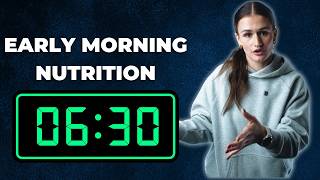
In this instructional video, the speaker outlines a comprehensive nutrition strategy for athletes with early‑morning practices. The core message is that athletes must fuel their bodies before training, using a small carbohydrate‑rich “mini‑meal” to refill muscle glycogen stores that deplete overnight. A simple rule is presented: the number of minutes before practice equals the grams of carbs to consume (e.g., 30 min → ~30 g carbs). The speaker discusses how to schedule sleep and meal preparation so athletes can obtain adequate rest while still eating the pre‑practice fuel, emphasizing discipline and meal‑prep habits. Strategies for dealing with morning nausea or lack of appetite are offered, such as consuming a cup of orange juice (≈30 g carbs) to quickly raise energy. Post‑practice nutrition is covered via a “performance plate” (≈50 % carbs, 25 % protein, healthy fats, and colorful fruits/vegetables). For convenience, a protein‑overnight‑oats recipe is suggested as an on‑the‑go post‑practice meal. The video concludes with a call‑to‑action inviting viewers to join a personalized nutrition and hydration program for individualized plans.
Chapters
If you have early morning practice or training, you still have to be fueling your body. Showing up to that training or practice without fuel is like a race car showing up to the track without gas in it. It's not going to get very far, and neither is your body. So in the next few minutes, I'm going to teach you what you need to be eating before practice, how much, when to be eating it, what to do if you're feeling sick in the mornings, and lastly, you got to make sure you're not skipping this part, is what you need to be eating after your practice or training to make sure you get the most of it. So let's start with what to eat. You guys all have mini muscle energy tanks all over your body. These tanks run off of carbs. So I want you to imagine when you go to sleep at night after eating dinner and stuff, you're somewhat full, right? Your energy tanks are somewhat full. But guess what? When you're sleeping, your body doesn't shut down. Sure, you're asleep, but your brain is still running, your heart's still beating, all of your organs are still functioning. It's using energy in the form of carbohydrates to run. And so when you wake up in the morning, though you feel rested, you your energy tanks are going to have depleted. You're not going to have as much in there. So if you come and you show up to this practice with a low tank, you're going to run out of gas, you're going to hit the wall, you're going to have slow reaction time, your brain's not going to function as well, you'll have that brain fog all training long. So an easy way to fix this is by having a mini carb meal before your practice. This could look like some oatmeal, this could look like some toast with honey on it, this could look like half of a bagel, this could look like a smoothie, banana on toast, just some type of food that has carbs in it so that you're filling this tank back up for practice or for your training. You now know that you need a mini carb meal, but now you got to know how much of that you need to actually be eating before practice. An easy way to say this is the amount of minutes you have before practice is the amount of carbs you're going to eat. So if you have 60 minutes before practice, you're going to eat about 60 carbs. That could be like a banana and a piece of toast. If you got 45 minutes beforehand, you have about 45 carbs. That could be a banana and applesauce. If you got 30 minutes beforehand, you would need 30 carbs. That could just simply be a banana or a piece of toast. Most of you should be up about 30 minutes beforehand, so I'm not going to give you anything lower than that. So this is what you need to be eating and how much of it you need to be eating. But now we got to talk about when. This answers the question a little bit, but I get questions all the time from athletes who are asking me, "Ah, should I have— I practice at 6 AM, should I wake up at 4:30 to start eating? Like, what do I do?" This is a complex topic because we're talking about sleep here. We're not just talking about fueling before your practice. The easy answer is, is I don't want you cutting your sleep short in order to eat a meal at 4:30 AM. I need you to get your sleep too. However, there are some things that you can do to make sure you're getting your sleep and you're getting your fuel in the morning. So first things first is when— what time is your practice? Let's say your practice is at 6:30 AM in the morning, and then we say, well, what time do you go to bed? And they say, oh, like between, you know, 10 10 and 10:30. They're going to bed at 10:30 PM and they're waking up at 6:30 PM. That's 8 hours. That's like, that's what I want the minimum to be for my athletes. So within this situation, with it only being 8 hours from bedtime to wake-up time, there's a few different things we can do. We can either say, well, how do we make it so that you can go to bed at 10 PM every night so that you can wake up at 6 AM and eat this 30 minutes before and still get 8 hours of sleep? That would be an ideal situation. An even more awesome situation could be, well, how do you get to bed by 9:45 to then wake up at 5:45 AM to then get this 45 grams of carbs in you. Now, Alex, this is where the absolute sheer discipline comes in to athletics. It's not fun going to bed at 9:45, waking up at 4:45, and then having to slam down 45 carbs before you go work out in the morning. That's not fun, but that's what awesome players do. It's also not fun to Make sure before you go to bed that you're packing your lunch, you're packing your snacks for the day, you're bringing your breakfast with you, and you have it ready to go in the fridge so that when you wake up at 5:45 AM, you're not having to scramble and grab things or later on skip meals in the day because you didn't prep them. So we're like, prep, get to bed on time, wake up on time, eat your mini meal, and then head to practice. It takes discipline. I know it seems overwhelming at first too, but anything that you've ever gotten good at has taken reps and has had to and has taken practice. And this is just another thing that you got to make sure that you're practicing and putting in the reps for. All right, this leads me to what if I feel sick in the morning? What if I don't want to eat? What if I feel gross? I get it, no one wants to eat at 5:45 AM. Appetite is a feeling and fueling is a skill. You got to make sure that you're developing the skill of fueling. You're not going to feel like eating that in the morning, and that's okay. You're probably not feeling like getting up at— getting up and going to a 6:30 AM practice, but you're going to do it anyway, so just make this be, I'm gonna do it anyway too. That being said, you want to make sure that you're paying attention to this and this when it comes to feeling sick. In the past, you've probably felt sick because you were eating the wrong amounts of the wrong things at the wrong times. I had an athlete who had early morning practice, and all we did was have her get up 30 minutes before practice started and have 1 cup of orange juice, which is roughly 30 grams of carbs, and her performance in practice and in that training skyrocketed. The coaches noticed her energy was better, she was getting more out of the training itself, she was able to lift harder and lift more, all because of 1 cup of orange juice. Because she was filling this tank back up and giving herself the energy that she needed. It doesn't need to be elaborate, it doesn't need to be this full crazy meal. Don't eat eggs and bacon 30 minutes before your practice. It just needs to be a simple amount of the right kind of food and the right amount of food at the right time. And then ultimately, if you feel so— if you're still feeling sick, put in the reps and your body will adjust. The final piece is making sure that you're eating after this mini meal. Sure, it might be your first breakfast, but you're gonna need a second breakfast because during that practice and/or that training, your muscles literally break apart. There's little micro tears in those muscles, and that's a good thing because that allows our muscles to grow back bigger and stronger if we give it the material that it needs in order to grow back bigger and stronger. And that comes with eating post-practice through a performance plate. Typically, a performance plate needs to be structured similar to this. We want carbs, a half of your meal being carbs, a fourth of it being protein. We want some healthy fats in there, and then we want colors, which is like fruits and vegetables. In the morning, you might not be able to get your vegetable in, I get it. You can throw it into a different meal throughout the day. But I also recognize that it's not gonna be easy to just run home after practice and make this awesome egg and bacon breakfast. You need something that's really simple. So something that's really easy that would be on the go that would still hit this Performance Plate method is protein overnight oats. We'll put the recipe in the description below for you guys to try 'em out. But essentially, you make 'em in a mason jar, You put oats, you put protein, you put Greek yogurt, you make sure that you have some healthy fats in there. You can meal prep them and make 7 of them within 10 minutes and have them all ready to go for the week. And then in the morning, all it takes is you grabbing that out of the fridge and running out the door and eating post-practice. Okay, so there you have it. You got your early morning practice or training nutrition strategy. If you're feeling a little overwhelmed, or if you feel like this is a lot to absorb, or if you're like, wait, how much do I need to be having? Or what, what's the portion size that I'm supposed to be having for myself here to be hitting my goals? Maybe you're trying to gain weight, maybe you're training multiple times a day and you're trying to figure out how to do that, come join my program. We'll do it for you. We'll teach you exactly how to do it. You'll have a personalized nutrition plan. You'll have a personalized hydration plan. You'll know exactly what to eat before every single practice. It'll make things really simple for you. We'll also put that in the description below if you want to check it out.