Kevin McCann walks through the Hatchbuck Secrets course for marketers building or managing contact lists. It covers eight CRM setup steps from importing contacts to creating task categories, then moves into a marketing execution loop of strategy, campaigns, and optimization. Each lesson includes the why, the how-to, and real examples from client work.
Chapters
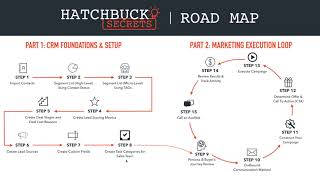
Welcome to Hatchbuck secrets. I'm Kevin McCann and this first video we're going to walk through a course introduction and overview of what you can expect to see within Hatchbuck Secrets. So first, you're either in one of two camps right now. You either don't have a list of contacts in your CRM system, and if that's you, there's a couple things you want to do. You either want to implement an inbound marketing process to drive traffic to your website so that you can capture leads to get a list going, or two, not necessarily an ideal scenario, but buy a list to import it into your CRM system so that you can then start marketing out to that list. If you need help with either of these two, check out lead-launcher.com we can help you get this set up. Ideally starting with an inbound marketing process, whether it be organic traffic or paid traffic, we can help implement the whole thing for you. Now, if you're in the second camp, which is you have a list of contacts ready to go inside of your CRM system and you want to start marketing to them, this course is absolutely for you. So what we're going to do within this course is take you on a journey to maximize the value of your CRM system and put it to work to grow your business rapidly. So along that journey, the left side of the map here, the eight steps are the tactics or the foundations. We call the setup. And then the second portion is that marketing execution loop that we'll dig into in great depth. So first you're going to notice up at the top here, importing contacts. So we're going to walk through best practices on importing contacts from a CSV file and making sure that you include the most important elements of a contact list within your CRM system so that you can effectively market to that list. The second step is making sure that segmentation at a high level is done using the contact status, basically where that person or that contact is within your marketing journey. So the buyer's journey or the sales journey, they're either a lead or a prospect or an engaged prospect. So we'll walk into some details around that. The third step is to micro segment. So once we've got the high level segmentation of these contacts, we want to then micro segment that list based on certain characteristics of that group of people, things that they care about, problems that they're facing that you can solve, opportunities that they're looking to achieve that again you can also solve. So micro segmentation, using this, this concept we call tags critical. Step four is lead scoring. So once the marketing process begins, we want to establish scoring to each one of the activities that they take so that you can then stack rank your list on who is more engaged than the rest of them so that you know where to focus your efforts as a sales organization. Step five is creating the deal stages and the deal lost reason. So as opportunities arise and they hit the sales pipeline and the funnel, we want to make sure that we know where they live within that sales process or those deal stages. Step six is creating lead sources. So there's many ways a lead can enter your sales funnel and we'll cover those in step six. And then step seven is custom fields. And these, these will be areas that you know, for instance, if we want to grab additional information about our contacts, like for instance, maybe their contract start date or something outside of the norm of, you know, address, phone number, you know, number of employees in their company, etc. Etc. There's certain characteristics that you may want to be capturing, like dates that a contract begins, date that they renew their agreement with you, favorite color, favorite animal, their alma mater, whatever it is that you want to use to make communication to that list more relevant to them. Custom fields is a way to do that. And we'll cover that in step seven. And then step eight is creating task categories for the sales team. And this is kind of the peak of CRM, where a lot of sales reps hate CRM because of all of the stuff they have to do in it. They have to enter data, they have to add new deals to the pipeline, they have to check off tasks, all that stuff. We're going to walk through a process to make that super simple and super automated. So step eight is key. There, the right side of this map here, the marketing execution loop. This is where now once we have the defined list of who we're going to go after, really getting into detail of what that person cares about, the journey that they want to go to, where you know, where you basically want to take them, and then how you go about doing that, whether it's emails, phone calls, constructing the campaigns, what the calls to action need to look like, how we execute the campaign and then review the results and track activity and then, you know, call an audible. Basically either stay on the same path or we pivot and do something differently. So this becomes a continuum once all these contacts are in the database. So stay tuned. That's coming up in the second half of this, this program. So inside of each step, the way that we lay this out is that we'll typically start with a strategy, basically the why behind each step. So give you different use cases or business scenarios to help provide context around why. You know, why do we use tags, for instance, or why do we use contact statuses and what's the best practice or what's the business challenge that I'd be facing where tags would actually matter to me? So that's generally how we'll start each one of these steps. Then we'll show you how to do it and we'll provide examples and real, you know, real world scenarios where we're doing this, you know, hundreds of times for our clients and how you can utilize it to your benefit. Ultimately, the goal here is to create an environment where we're teaching you efficiently with quick execution steps so that you can maximize your value within the CRM system that you're utilizing and make sure that you're, you're generating not only new marketing opportunities, but closed business because of it. So that's the introduction. See you in the next video.