Building Trust in Agriculture through Strategic Communication - Dr. Kevin Folta, 12/6/2019
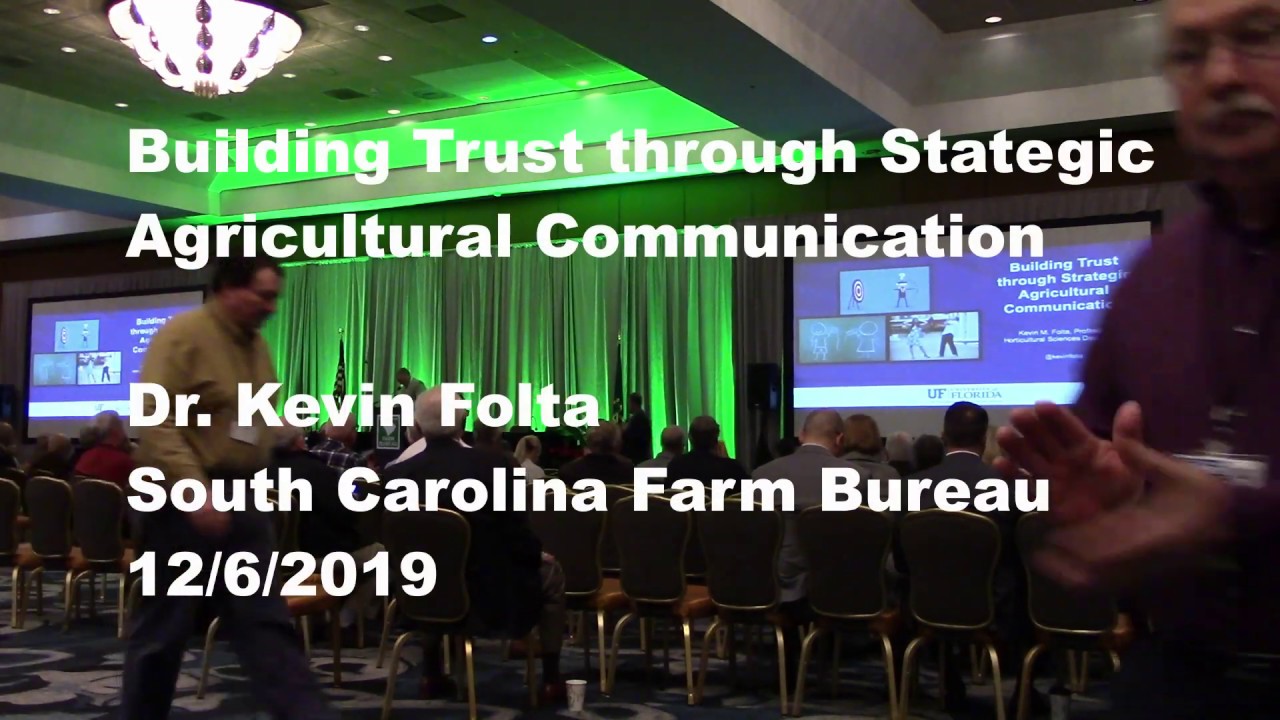
In this presentation Dr. Kevin Folta explains why the agricultural sector struggles to win public trust despite having scientific facts and advanced technologies. He argues that facts alone do not change minds; trust must be earned first. Folta introduces the Trust Equation (competence, reliability, intimacy, self‑motivation) and shows how it can be manipulated. He explains Kahneman’s System 1 (emotional, fast) versus System 2 (logical, slow) thinking, illustrating how anti‑agriculture messages exploit System 1 while scientists often default to System 2. Drawing on Chris Voss’s hostage‑negotiation tactics, he stresses active listening and empathy as the foundation for building intimacy. He then moves to values‑driven storytelling, citing Simon Sinek, Jonah Sachs, and the concept of making the audience the hero. Practical guidance follows: use social media (Twitter, Facebook, podcasts, photos, short videos) to create or amplify content, share trustworthy stories, and counter misinformation. Real‑world examples include a mis‑reported Scientific American article, a misleading Guardian piece on glyphosate, and a South Australian canola moratorium campaign. Folta outlines a toolkit of five books (Thinking Fast and Slow, Never Split the Difference, etc.) and offers concrete steps for farmers, scientists, and agricultural organizations to develop online presence, engage critics with the “Hug Your Haters” approach, and build community‑based trust. He ends with a call to action for attendees to set up social‑media accounts, help county farm bureaus launch values‑first websites, and contact him for personal assistance.
Chapters
Thank you. Wow, thank you very much. It's really great to be here. I could not think of a better presentation than the one that Dr. Loudon just gave as a prelude to what I'll talk to you about here today. Really what I'm going to talk to you about is along the same line, and you'll even see some overlap in the slides. What I would like to talk to you about is how do we take the successes and the framing of what you do and why you do it Yeah. And translate it to the next level, to a bigger level, where it can have a positive perception on the overall perception of farming, and I always say science. I think of these things together. So we talked a lot about the things you can control, the things you can't control. And what I see when I speak to a lot of agricultural audiences is we fail to take advantage of one critical thing that we can control, yet can have tremendous influence. on other aspects of food and farming. So I have to ask, just a show of hands, and this is a little bit older audience, typically in an agricultural setting, but how many people here use social media like Facebook or Twitter to talk about what they do and why they do it? Okay, so a few. Okay, good. And really the reason I bring this up is because When we look at the things we can control and the things we can't control, here's an opportunity for us to use the most powerful medium of our time to share what we do and why we do it to an audience that needs to understand it better. So people over and over again say, we love farmers and we love scientists, but we don't really like farming and we're not so sure about science. And so it's that strange paradox that really makes me wonder, what's wrong here? What's happening? And what it is, is that we're failing at communication. We're failing to translate what we do and why we do it to the people who need to know, who need to understand your passion, my passion, who need to understand why we do what we do, why we have a pivotal place in producing the world's safest, most abundant, most affordable food supply. So what I would like to talk to you today is about that translation. How we move from success and greatness at the individual level to bringing that to all of us, and changing the perception of farming, changing the perception of agriculture. I always like to include dairy ranchers in there too, because they're going through hard times. So we'll talk about that. And as mentioned, I'm a researcher. I'm a scientific researcher. That's what I do as my main job. Thank you. But I've watched as the internet has grown and as technology has become available, especially in the area of genetic engineering, which is my specialty. I'm a DNA scientist. Why is it that we can create these solutions that can help farmers, that can give sight to the blind, to a million children around the world, that can feed the malnourished, yet we can't use them? We have these technologies and they're here today, but they aren't getting to the people who need them. And it breaks my heart. And it isn't a question of making more technology. It isn't a question of that. And, you know, it's sad to believe, and I'll talk a lot about this today, it wasn't a question of me going out and giving people more facts and information. It was about me learning how to communicate the good things that we do. And do it through the right medium. And that's what we'll spend the time on today. My whole career in this started in Wisconsin when, about 20 years ago actually, about 19 years ago, when I just finished my PhD, so I knew absolutely everything. And I went to this place, Willy Street Co-op, and it's a little grocery store in the neighborhood. It tends to be very green and all the things that go along with that, including a remarkable misunderstanding of what agriculture is. And if you wanted to go to a place and see every single label of no this, no that, no this, and they have that. This was the place. And horrible ideas about what agriculture was. And I said, well, I can talk to you about what the biotechnology side is. We can have a discussion on this GMO topic. And they said, sure, let's do that. And I came to the community room and we had a brief— well, lots of people showed up. And I talked to them about these little esoteric differences in DNA science, about plasmids and vectors and 35S promoters and multiple cloning sites. And all this stuff. And all the details about what I did. Okay, so tying back with Dr. Loudon's talk, speaking about what I did and how I did it. I didn't talk about why. I talked about all these gross little details of molecular biology and DNA, and guess how many hearts and minds I changed that day? It was zero. It was my first spectacular fail in science communication, that I went out to speak to people about a topic that they were willing to come and listen to me, and I came off as arrogant, As aloof, as somebody who wasn't willing to listen or understand their concerns. And that was where I really started to learn the lessons that would translate into a complete reversal of how I would talk to people about science, and farming, and agriculture. The good news is, is that there's a lot of misinformation— well, the bad news is there's a lot of bad information out there, and the internet makes it more accessible than ever. The good news is, Yes. Is that there are some people out there who are very willing to find good information, to talk to you, to talk to me, to seek the good sources of reputable information that can help guide them to better choices for their families around food. The other side of the coin is that there's a very small population of people who say the sky is falling, that agriculture is killing us, that it's poisoning the environment, that food and farming are a detriment to the planet. Destroying the soil. You've heard it all. But that's a very small amount of the population, yet they are extremely vocal, and they are extremely adept, very talented at using the internet to disseminate bad information. The good news is that most people don't know one way or the other. And the majority of people are in the center of that curve, in the blue portion of that pie. They don't know who to believe. They don't know what to trust. They hear something bad on Dr. Oz, and then they go to the internet, and it's a lot of detailed information from scientists and farmers. So how do we get to the point where we can talk to the right people about what we do, but more importantly, why we do it? And this was a real wake-up call for me as a scientist, was that facts don't change minds. I mean, it's the stuff we as professors use as currency, right? It's the stuff that we talk about in front of classrooms every day. But it was really hard for me to realize that facts don't matter. Facts don't matter. They don't matter until you establish trust. And we'll spend a lot of time talking about trust today. Maya Angelou said it best. She said, I've learned what people— I learned that people will forget what you said and forget what you did, but they will never forget How you made them feel. And so whereas we tend to be very similar as farmers and scientists, people who rely on evidence and facts and the details, and are proud of that, share that, we're not changing the way people feel about what we do and why we do it. And so here's how we're going to fix that. I mentioned before that farmers and scientists are a lot alike, and it's mostly because we have a good basis for trust. People consistently will rate farmers and scientists with physicians and nurses and engineers as the most trustworthy and knowledgeable and competent. And so that's a good basis for us to begin this journey. The problem is, is that they don't like what we do. And you've read it all, right? You know how, as I mentioned, all the negative things you see about farming and food. And what that means is that we're leaving the castle. We're leaving a communications gap that we need to fill. We're not talking about why we do what we do. So how do we do that? I always like to talk about the trust equation, and this is a lot of fun. And what's neat about this talk today is that what you'll find in here, I think, when I really started to think about these concepts, they didn't just change the way I would speak to people in science. It changed the way that I have my relationships at home. It changed my relationship with my boss and my— the people who work for me. And all of these concepts are really neat. They translate in so many ways. Trust breaks down to a combination of competence, reliability, and intimacy. So what that means is, how much do you know, or how good are you at what you do? Are you willing to do it? And then, do you care? And self-motivation means what's in it for you, right? And so trust comes from, obviously, when you're very knowledgeable and competent and you're willing to do it and you really care, and it's not really in for you, it's in for a much bigger cause. That's where trust comes from. But trust can be manipulated, and this is the way that how people normally perceive you and me. Very competent, reliable, maybe we don't really care about the bigger picture. and we're in it for ourselves. And I think this is the general consensus. You look— they look at organizations like PETA, Greenpeace, all these folks, oh, they're competent and reliable, they really care, and they're not motivated to try to make the world a better place for everybody. Because that's how they have manipulated that equation. What's worse is that they'll take somebody like me who goes out and talks about biotechnology and the good things that we can do for Using technology for people and the planet. I have a podcast that has over a million downloads and 200-some episodes that's been going on for years now, and I've been sharing beautiful stories about what technology can do. If you read online or you Google me or Google Images me, you'll find that people have taken a very concerted effort to destroy me personally and my message, saying he doesn't know what he's talking about, he doesn't really care, he's in it for Monsanto. You read that everywhere. Google Images is horrible. But this is what they try to do to someone like me who steps into those conversations. But I don't really care because I know that we're making a difference. So what can we control? And when we talked about the idea of what we can control and what we can't control, this is a great place for us to be able to fix the aspects of this equation. We can increase our competence by continuing education and getting better at what we do. We can increase our reliability by doing it more often and following through with what we say we're going to do. But how do we increase intimacy and decrease self-motivation? And that's a perception, right? How does the world change the way they see us? How do we control that? And the good news is we can. And we fail to do it. That's the bad news. We have an opportunity here to fix it. And all the people who are against the food and farming, or science and farming, they are masters of using the internet to be able to shape the perception that they wish to see. We're not so good at it. Getting better, and we'll talk about that today. You know, a lot of good examples. Here's Scientific American, a very trusted source since the middle 1800s, putting up an article online, Broccoli is Dying, Corn is Toxic, Long Live Microbiomes. This is a— was a completely— False. false article that it was an indictment against modern agriculture. And this was in Scientific American. And of course I wrote about it, and I wrote to them, and I tried to get it fixed, and they retracted it and put up something that was probably worse. Another good example, like the Guardian newspaper in Britain, you can say how you feel about that one way or the other, but if you say the name Erin Brockovich, she comes across as somebody who is generally associated with trust and fighting for the little guy. At least that's the perception. She did an article on glyphosate. Most of you are familiar with what glyphosate is. It's a nonspecific, nonselective weed killer that has been used for years with great safety record, amazingly nontoxic to applicators and to consumers. Yet it has been framed as this toxic carcinogen by people who want to remove it from the use of farming. And she wrote an article called The Weed Killer in Our Food Is Killing Us: Growing Research Shows That Glyphosate Is One of the Most Widely used herbicides in the US causes cancer, which there's no data to support that. Some very weak epidemiological data at best. But she even says here in the article, almonds, carrots, quinoa, and beets, these are just some of the foods which typically contain high levels of glyphosate. Now I don't know if any of you grow almonds, carrots, quinoa, or beets. But if you apply glyphosate to them, they don't grow so good. I mean, this is a herbicide. And yet she continues in this article to write this entire piece about how poisonous this stuff is and how it's in the food that you consume. Totally false. Yet she's a trusted source. She also works for the— turns out she works for the European law firm Weitz Lutzenberg, who is litigating the glyphosate cases in the EU. She's one of their major consultants. Yet didn't disclose that in this particular opinion piece. And it had hundreds of thousands of shares. It was shared widely. So this is what we're up against as an agricultural community. You've got people trying to take away very effective tools of agriculture based upon misinformation. And we need to be in the spaces to counter. I know I certainly am. But I need your help. And we need to be doing this more broadly as a scientific agricultural community. And how we need to do that is by, you know, competence and reliability, we've got that. Okay, I see a lot of gray hair in here. You know, we know this is a place full of competence and reliability. How do we fix the other part? And we're going to talk about intimacy and self-motivation. How do we show we care and that we're in it for the greater good? And the way we have to do that is by using some tools. We'll talk about that. I'll talk about 5 different books. The first book is Thinking Fast and Slow by Dan Kahneman, and what Kahneman tells us is about the way we respond to information. He talks about the human brain. And the human brain can break down into 2 different parts. He calls them System 1, which is emotional and reactive. It's the part of the brain that when you hear rustling in the bushes, you take the kids and run the other direction. This is the part that through evolution was something that was very successful in helping to keep us safe. System 2 is the logical and calculating part of the brain. It's the part of the brain that processes information. So this is very strategic and slow. So when someone is trying to scare somebody about food and farming, the hormones in your beef, the antibiotics in your chicken, the gluten in your salt, whatever that means, they're putting fearful messages into System 1, into the reptile brain, right? They're scaring you there. Then again, we come as scientists and farmers and say, that's not true. Here's the real information about the way we use hormones in an agricultural context, or here's how we really use antibiotics. We go to System 2. We're trying to solve a problem of fear, which is in the heart, by appealing to information to the head. And as I mentioned before, facts don't matter because of the trust issue. They need to trust us first. We need to develop the intimacy, And the lack of sense of motivate— self-motivation for informational flow. And the problem is, is that people form trusted communities. They tend to also hang around with people who are like them. They associate and share information inside these, what sociologists refer to as tribes, social tribes of people with like-minded ideas and mission. And we even have those in many different contexts. But we can think of the ones that are opposed to food and farming and how hard they are to crack into. They insulate themselves from information coming from the outside. They try to resist that, and even will remove members or bring in other information to downplay the good information that we may bring. These communities are so powerful that we even create them. We manufacture these communities. So that there are people who are like us with similar ideas and goals and mission. So the idea of System 1 thinking, the appealing to the fear part of the brain, and then having these communities of people who share information that may be bad, these are the things we're up against when we try to communicate about science and agriculture. And so to earn trust, we're going to have to override that, overcome those tribal barriers, We're going to talk now about empathy and authenticity, transparency, all that stuff. The most important things here will be empathy and common context. We'll talk about what that means. There's a book called Never Split the Difference that talks about hostage negotiation. And this is a great book. The first half of it's really, really solid. And I like this book to listen to it rather than to read it because the stories are fascinating. And it's written by a guy named Chris Voss. And Voss was an FBI hostage negotiator, also New York City hostage negotiator, who saw they were not having great success in getting out hostages, getting all of them home. And that's the idea of Never Split the Difference, was we need to get everybody out. You can't just get— you have 8 hostages and, ah, we'll take 5, you keep 3, don't worry about it. You've got to get everybody out. And he saw that what they were doing wasn't working, making demands of the hostage takers. Using force. People were being hurt. People were being killed. And Voss started to do something completely different. He used psychology. He started to ask questions. He was listening. And he calls it active listening, or he even calls it tactical listening. But the idea was, was to build a sense of rapport between the hostage taker and the hostage negotiator, to build trust. And instead of making demands about, here's what you need to do, or, you're going to do this, or, we're going to send in this if you don't do what we need, he would say, why are you here today? How do you think the people in there feel? And is there a way we can get them out alive? What happened to you today that brings you to this place? And would listen to what they were saying. And this taught me something so important, is that as a scientist— and I suspect farmers are mostly the same way— when we listen to somebody, We're listening so that our wheels are spinning because we're going to counter what they say. We're listening to debate. We're listening to poke holes in their argument. We have to be listening to understand. And listening to understand is very different than listening to debate. Listening to understand means saying to somebody, I understand you, even though I disagree with you. I understand where you're coming from. I understand if I was in your shoes, I would feel the same way. Maybe I would feel the same way too. Think about that in political context. I mean, you know, can you think of somebody who you disagree with vehemently, but can you understand why they feel that way? From their worldview, their life experience, the regulations they're being imposed from, or the things that are happening in their lives. And so this is a really important thing for me. I won't talk about all the other details in this, but it's a fantastic first thought is we build empathy We show empathy and we build trust when we start to understand people at that level. It comes from that act of listening. The other thing was that Aristotle knew this long ago. He would talk about the best way to do persuasion was a combination of ethos, pathos, and logos. And pathos, so you see the word sympathy and empathy. Logos, words and logic. And there you see System 1 and System 2. The emotions, Against evidence. And we already said that emotions will always win, especially around issues of food and farming, and parents who maybe just want to take care of their kids, or older adults that just want to make the right food decisions. Now, these are, these are the fragile folks we're dealing with here. And, and so we will always lose that argument when we try to appeal to the head over the heart. So where farmers have to come from in these discussions, scientists too, Our ethos, our ethics. Why we do what we do. Our competence, our reliability, the parts of the trust equation. That is the part that we have to use. We have to lead with ethics. And what does that mean? It means, it means what are the things that are important to you? What are your values? Why do you put your feet on the floor every single day and do this? The why. As was discussed earlier. Why do you do what you do? And I can tell you why I do what I do. As a scientist, you know, I'm sure I like to make journal articles, and I like to, you know, spread information and all that good stuff, and I teach classes and, you know, that kind of thing. But to me, it all boils down to really 4 areas. Areas for me is I worry about keeping the American farmer in the black. We've got 1.5% of our population feeding the rest of us. And I think we have technology and then this kind of communication stuff that can really help shape perception of agriculture. I worry about the developing world. I've been to places that desperately need the technology we have already created, that we've had for 2 decades, that children in need cannot have. I worry about the American consumer who makes the wrong food choices, and can we improve fruits and vegetables to make them have better choices. And I worry about doing this with environmental sustainability, because none of it matters if we don't have the social license to do that. And that comes from showing that we care about the same things people care about. So my areas are, you know, farmers, consumers, environment, and the food insecure. And when I tell somebody this, now we're on the same page. Right. Because whether you're an anti-GMO activist, Or, you know, some militant vegan, or a, um, or someone in the boardroom at Bayer. We all agree that these are important aspects: sustainability and covering, taking care of more people, and ensuring the progress of farming, ability to feed everybody. So when we start from that common cause, that common set of values, shared values, that's the way we connect with people. The other big part of this is telling the story, and I don't want to dwell on this too long, but this book was written by Jonah Sachs, and he actually was the guy who created the campaign called The Meatrix, which was an anti-meat campaign that was online, and it was very effective. And from a communications standpoint, I still analyze this and think about it. And what he says is, who do you— who is the hero? in your efforts. And when we talk to people about agriculture and science, we're not the heroes, okay? The people we're trying to talk to, to support us, they're the heroes. They're the ones we need to mobilize and get them excited about what we do and why we do it. And that's what's, that's what's really important. We've seen this already today. Simon Sinek talks about that idea that people don't buy what you do, they buy why you do it. And I won't go into too much detail because Dr. Loud covered this so beautifully earlier. But you see this in advertising. Back in the 1970s, it was about horsepower and miles per gallon. Today it's about the Subaru Love Promise and respect for consumers and the planet. And it's not just Subaru, it's even the big truck companies. If you read their websites carefully, they start to talk about these ideas of why they do what they do. Apple knew this in the 1980s. They talked about Apple values, you know, innovative products, things that were game-changing, pushing the edge. Gateway and Toshiba were talking about the size of their hard drives and how much RAM they had. And who's around today? You know, who's one of the biggest companies on the planet? It's because they led with their values. And this is what we all need to remember. So the idea here is to practice active listening, talk about, about the common mission, the common values, talk about why you do what you do, because we have to earn trust. So that's part 1 of the talk today. We need to earn trust. And then how do we do that? How do we do that best? How do we coalesce all of the trust that we build into maybe shaping the perception of agriculture and science. And unfortunately, that means we have to be using the internet. And we have to be using the same tools that the folks who are working against us are using, and we have to use them more effectively. And I think we can do that, and I'll show you some examples of how it's working. There's 2 ways you can participate: generate content, Or amplify the content of other people. And so what we're looking at here is if you can produce something, some sort of content, a photograph, a small article, a video, something out on the farm, and share that with 1,000 people, which is very easy to do through the pipelines of the internet, and that gets shared with 1,000 people, you have now reached 1 million people for free and fast. And that's realistic. So what I'm really urging you to do is to rethink your participation in these discussions online and rethink your ways of connecting with these audiences. It's a very powerful tool that needs you to be part of it. And there's a lot of ways to do that, and I won't talk about what these different things are right here, but basically the idea is if you're able to use Twitter, Twitter. Which is a very short format discussion. I get all my news through Twitter. I get— everything I read is from selected sources from various, a variety of places that come from a very fast and short format. Twitter allows you to do that. Put your information out there in a very short form that leads to maybe something longer and more durable. That's a really important one. But creating content, there are farmers who take pictures of a sunset in their hubcap and it gets a million There are farmers who talk about their children, they talk about the grandkids, they talk about what a combine is. And these videos get a lot of attention. We need more of that. We need more content from farms. We need more content from agriculture. And we have to start talking to other people, not just ourselves. Scientists are remarkable at speaking to scientists. Farmers are very good at speaking with farmers. But we don't speak outside of those groups, those trusted communities. A good example, this Cook's Cook is a magazine which if you were to think it's online, maybe 1.6 million subscribers, it's free. The audience for this generally has very suspect views of farming and of food. I wrote an article for them called GMO Safety and Lost Opportunities. What's GMO? It got very good reviews. It got a lot of great feedback, some negative, but a lot of very good feedback. And the idea was, was to share my values, talk about the children who can be helped, the farmers, the improved products for consumers, and the decreased environmental impact of using biotechnology as one tool in increasing agricultural production. I produce articles for farming audiences to codify what they already know so that our farmers can be experts in the newest technologies. Because people trust farmers. They want to hear it from you. And so I try to provide those things as well. I'm showing you these examples because these are things that are so simple to do. You just got to do them. And these are types of content that you could very easily produce as well that would be very welcome. Correcting bad articles. This showed up last year in the news, and I wrote a response to correct the bad information that was penetrating the internet. And it's just important for us to have that out there. We have to have that available. I do a podcast, and as I mentioned, we're a million episodes, but this is just downloadable audio interviews with experts in food and farming. And it's been a, uh, it's been a very good medicine. I've been an extremely successful series, and, um, it's for something I just do in my office. with a microphone and the internet, it's so easy to do that anybody can do this. Anybody can do it. And it's turned out to be extremely successful and wildly popular. What's happening in South Australia right now, they are— whereas all of the Australian continent is allowed to use genetic engineering, so GM canola mainly, and cotton, South Australia is one state where it's outlawed. Why? They put in a moratorium in 2004 that still stands to this day, with no reason to do it other than a few activists didn't like it. And now you can't shift that law away. Yet growers want it. Growers want— in South Africa want to be able to— South Australia want to be able to grow the same crops that their neighbor across the street in Victoria can grow. You know, they have choice, they don't. And so they've been taking to the internet in a very strategic way, using Twitter to post 1-minute videos. You can see 64 retweets, which means that somebody has shared this 64 times. This is from this morning. These went up yesterday. And I spent a month in Australia talking to farmers and academics and industry about how to do this effectively, to change those rules. And you see it starting to work. The amplification. If you don't want to create content, share the content others create. So if you don't want to do it, that's fine. Share what other people are doing. That helps them spread their content. And this is a great example of actual Twitter conversations. This is where someone puts information on the internet and it's shared by others. The PETA's, the Greenpeace's, and those folks in the world are masters of manipulating Us? We're down here. Farmer to farmer, scientist to scientist. We're not manipulating that. We're not contributing to this conversation as powerfully as we could because we're not taking place in that space. We're not participating. We're leaving it to someone else to tell your story. And that's a real problem. A good example of how well this works When I was in Australia, I took a picture of canola and I said, canola is one of the most beautiful crops. Not an inflammatory statement at all, right? This isn't the usual internet, like, hey, this is a very— just, canola is beautiful. And in one day, 40,561 people saw this, and a bunch of people interacted with it and shared it with others. And this was just a picture of flowers. This shows you how powerful this medium can be to getting out a message and communicating. Communicating our message to develop the trust we need to develop. There's plenty of people who do this. There's lots of people in agriculture who are taking part in these conversations, in dairy and other areas. But I really would encourage you to watch some of them. They're outstanding. In Australia, people are sharing these messages, and they're penetrating even deeper. And see, what's so important about that is that you're starting to see In here, the different political folks that are involved in this be brought into the conversation, be targeted so that they can see, look, there's support for these farmers who are— who want a choice to use the technology that they're banned from using. But very, very powerful. Very powerful. So share good information. I'll just leave it at that. Find good information, be part of that online discussion, and share that information. Thank you. The last thing I'll leave you with is a good example of how this can be done correctly. And the book Hug Your Haters is really important. Hug Your Haters is by Jay Baer, who says that the internet is a spectator sport. And what he reminds us is that when we're looking at the comments after an article, someone writes some horrible article about farming, and you go down to that bottom and people will be complaining about farming, and then you'll see one good comment from someone who knows what they're talking about. You or me, or it's me. Get in there and say something positive. How do we do that? Because for every one person who's reading the articles, or who's writing a comment on a news article, there are thousands of people reading it, trying to decide who to trust. And how do we win that trust? Let me give you a good example. This is very common online. Taste of Venice Restaurant says, food is awful, service horrible. If you think this is great, go home and open a jar of Prego. Might taste like Venice if you drank the canal water. I'll never eat there again. And the chef, in typical internet form, says, obviously you don't know anything about Italian food. It's my family's restaurant. Hope you never return. We don't need people like you here. Now this is what we typically would see on the internet, right? You put out some You make a general statement and I come back argumentatively and want to duke it out with you and this goes on back and forth. And guess what? The person who's looking for a place to go eat will read these reviews and he's not earning your trust. In fact, he's kind of showing he's kind of a jerk. I don't know that I'd want to go there. But what if he followed the formula I talked about today? What if he said, I'm sorry you had a bad experience. Meals out are special times and I understand why you'd use a I'm listening. My family has run this business for 15 years and customer satisfaction is our first priority, our values. It's our family. We want your satisfaction. We'd love to try again. Coming in, it's on me. We want to get it right. I'm sorry you were disappointed. Now, if this person never comes back again, anybody who reads this would see a caring, not self-motivated, competent, reliable person will win the trust. And the problem is, is that we're not having these conversations. You're not out there doing this. I'm not out there doing this. Most scientists and farmers don't. We need to be in that space better. That's what we need to be doing if we're going to change this. And I think we can. I think we can. And why do we need to do this? And I think there's a lot here. It's one aspect of things we can trust, or we can control. We can build trust around food and farming, around science, by participating in this conversation where we have been absent. We've let someone else tell our story. We've let someone else tell what— tell us what we— tell them what we do and how we do it. It's time for us to really step into that conversation and take that back. Thank you. And so if you're someone who is new to social media, you're not interested before, you don't have a Twitter account or a Facebook account, get one. If you'd like to get one, there's 2 ways you can do that. You can give a teenager $20, or I'll be around all day and I'll be more than happy to help you do it without giving me $20. I'll be happy to help you set one up and show you how to use it because I want you to be part of this discussion. I need your expertise. Thank you. I need to share your information that I don't have, and I will do that. We're all in this together, and I think we can take control of this. The bad guys know this, and we don't do it. And it's 5 minutes a day, maybe 5 minutes a week, whatever it is. It's not much time at all. So I'll wrap it up by saying, you know, the relatively small agricultural community, we need to be participating in the messaging. We need to identify our audience and remember that facts do not matter until we've established trust. That industry professionals, you know, we're good at talking to each other but not good at talking to them. And it really starts after listening. We need to be amplifying other people's work and generating our own content, even if it's just a photo on a Facebook page. We need to handle criticism with class. And this is the most important line: have the courage To tell the truth. And it sounds so strange. All of us know the truth about what we do. We know the good things about it. We know how we contribute to the safest, most affordable food supply in human history. Why don't we talk about it? Why don't we share that information and get excited about it? This is what's so important, is we just have to have the courage to step into the public forum. And share what we do and why we do it. Be transparent and authentic. And I think this is necessary. There's a lot of challenges and a lot of things we can't control in agriculture. And as was mentioned before, weather, prices, you name it. This is one place where we can control it. And if everybody got into this, if everybody gave a little bit of time, we would see a radical change. I really believe that. And we are seeing it in places like Southwest We can control perception. So that's all I'll talk about today. I'll be around all day. Please find me if you'd like to sign up. I'm really happy to help you with that. Once again, thank you so much for having me over. Thank you so much. I don't know if there's— Oh sure, I'd be happy to take questions. Yes, questions. I think I have a few minutes if you'd like to— any questions? I can ask you questions. I'm a professor, I do that. I think it's— I can't emphasize enough how important this is because when we do have opportunities to get farmers in front of audiences, they just, they just love it. And I just encourage you to step into that. The other thing that's really important too is in the current discussions of, you know, I've been going to ag conferences for years and it always used to be about, you know, new BMPs and maybe new varieties and, you know, whatever, new equipment. But now you hear about mental health, you hear about issues of suicide, you hear about the effects of all of the challenges. And I really think this kind of participation has a role in helping with that, because it offers you an online community, people who are willing to listen, and people who are excited to hear about what you think, and maybe find some shared experiences there too, and some good advice. And maybe even help to find people in a desperate situation that could use your wisdom. So there's that too. Thank you. I have one question. Yes, yes sir. What advice would you give to a county farm bureau that wants to start a website to help offset some of the things that are happening that wouldn't necessarily be a site to get to the right— what kind of advice would you give to a county farm bureau? Excellent. So the question was, what advice would I give to a county farm bureau that wants to set up a website to correct the bad information that's out there? It goes back to the same idea. It starts with the values. And if you try to correct the bad information by saying, here's a factual refutation of point by point of the things that we hear, it'll never work. It has to be the values we have as Farm Bureau are, you know, continuation of sustainable farming that's economically sustainable for farmers, socially responsible, and working in concert with environmental, environmental constraints, you know, and within that framework, here's how we know what we know about these issues. So it's always about leading with values. Any other questions or comments? And reach out if you'd like, if you know somebody in the Farm Bureau who would like me to review content. I mean, there's people who charge a fortune for this. I do it as part of my job. I think it's a really important part of my job, so very happy to help you under, you know, help anyone. Can you put your contact back on the screen, please? Yeah, my contact. Oh yeah, I'm sorry. Actually, maybe you can do that. And I'll be around, and if there's anything, you can find me easy, pretty easy online. Certainly activists have no problem finding me. If you write to my university, they'll send you all my emails from the last 15 years. Did that stuff come up? Yeah. So I think we're just about done. That should come up. I'm just, I'm at Kfolta, like my last name's Folta, F-O-L-T-A, first name Kevin. So Kfolta and then @ufl.edu, so universityofflorida.edu. And so Kfolta@ufl.edu. That's the best place to find me. Is that even on there? No, it's not. Yes, it is. Yeah, so, um, and I answer every email, I answer every phone call, and I will spend a lot of time to help you with however you'd like to do this. Find me at this conference. I have my laptop, it's fully charged. I will sign you up on all of these things and connect you with a network of other farmers who would love to have you in that network, and I'll show you how to use it. Thank you. Love to have you aboard. Any other questions? I think we're in time. If you can't find me, I'm really happy to answer anything personally. Thank you very much. Thank you. We've got a small party here.
More from Kevin



Talking Biotech 503 - A New Strategy in the War on Obesity. Dr. Erik Issacson, Wave Life Sciences

Organic Production, Conventional Agriculture, Health Anxiety, and Social Media Disinformation

Stop Political Appointees from Grant Decisions - Dr. Colette Dalawalla, Talking Biotech 501




