Vânia Maria Pereira explains how climate change will expand cassava cultivation in Africa by 17.5% but also spread whiteflies into 600 million km² by 2030, intensifying diseases like cassava brown streak. Researchers are developing resistant crop varieties and using genetic tools to protect this staple for one-sixth of Africa's population.
Chapters
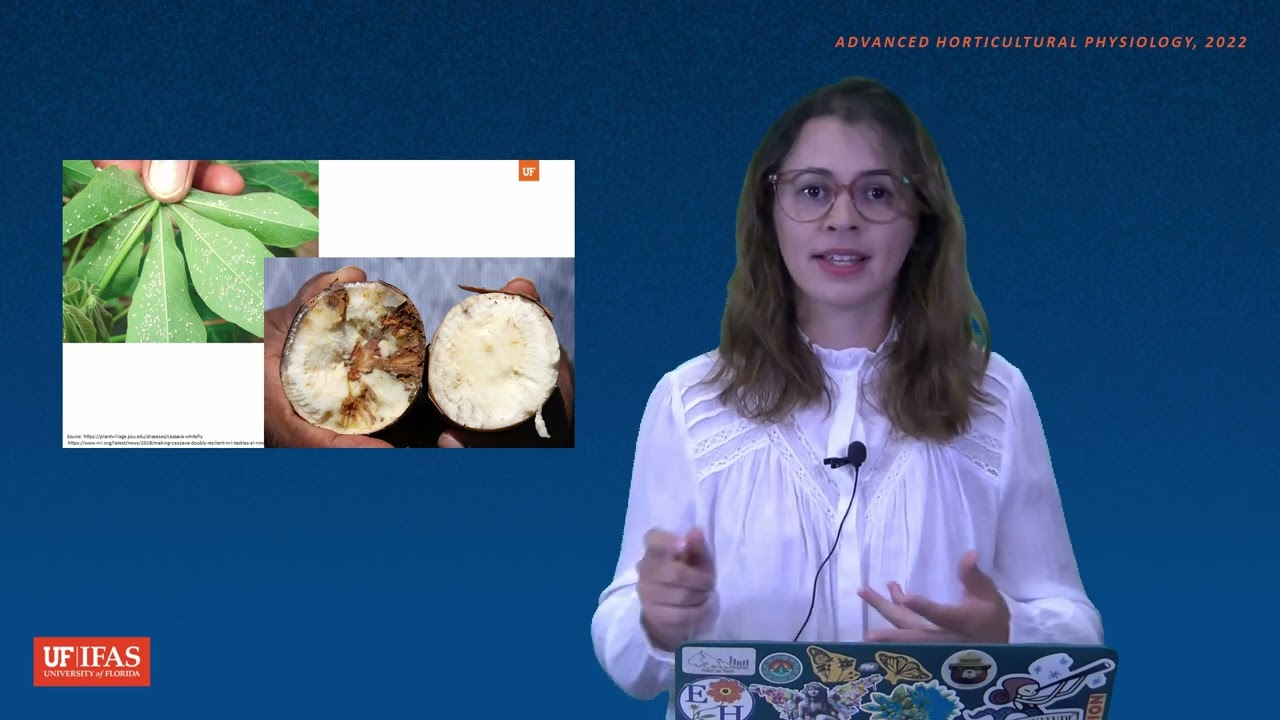
Hi, my name is Vânia Maria Pereira. I'm a second-year PhD student here at University of Florida, and today I'm going to talk about the impact of climate changes on pests and disease in cassava in African countries. Cassava is one of the major crops in the world and is mostly likely originated in Brazil, where I'm from, so I have a very close relationship with this crop. It's a major staple food in Africa, where 1 of 6 people depends on that for everyday consumption. Why cassava is such a special crop? Cassava is a perennial plant which is grown as an annual crop, which gives to them a remarkable plasticity and adaptation to different environments. So if the climate changes, this is actually a good thing for them because of this high adaptability, They are able to adapt to the different climates that's coming up. And in African countries, this will be an expansion on 17.5% on area of production. With the expansion of the plant production also comes the expansion of pests and diseases that threaten the production of cassava in African countries, as such whiteflies, mealybugs, cassava brown streak disease, and cassava mosaic virus. So whiteflies is one of the major pests in African countries, being responsible for the dispersion of cassava brown streak disease over short distance. This disease's emergence and effects are linked to high insect populations, which in the 21st century has jeopardized food security in many countries of Africa. Due to the changes in climate, The geographic distribution of these insects and also the disease are projected to increase, where by 2030 the whitefly is expected to have an expansion into 600 million square kilometers where the species is not present yet, creating a high expansion of the vectors and consequently of the cassava brown streak disease. So how the research has been approaching this problem? They are working on different solutions, and the first one is the control of the vectors, so a close monitoring of the insect population and also a potential use of biological control with natural enemies, to focus on decreasing the short-distance spread of the disease. Moreover, restricting the material movement from affected areas, since cassava is a vegetatively propagated plant, this would decrease the long-distance spread of the infected material. Furthermore, focusing on superior cultivar and production for breeding purpose. So the virus-resistant cultivars have been recorded by classical breeding on breeding lines such as Namikonga, but also by molecular biotechnology approach with transgenic CBSVvCP herpin-derived, which provide resistance to CBSV and cassava mosaic virus. Studies also suggest the use of genes such as CK2 as a target for RNA interference, which is on the pictures over here, which is a technology directed to transgenesis of the virus-resistant cassava as a more effective way to create resistance than breeding. These are some of the main areas that researchers have been working on, so to decrease the effects of the insect, the vector, and also the disease on the plants due to the climate change, but moreover to increase the plant yield of this major staple crop for African countries. Thank you.