A University of Florida graduate presentation on the 1988 paper that introduced Taq polymerase to PCR. Taq's heat stability lets you skip adding fresh enzyme each cycle, detect single-copy DNA molecules, and amplify fragments up to 2 kb with far fewer nonspecific products than the older Klenow enzyme.
Thank you for watching Transformative Advances in Molecular Biology, a retrospective look at critical events in the history of the discipline. The presentations in the series were prepared by graduate students in a journal colloquium at the University of Florida, supervised by Mark Settles and Kevin Folta.
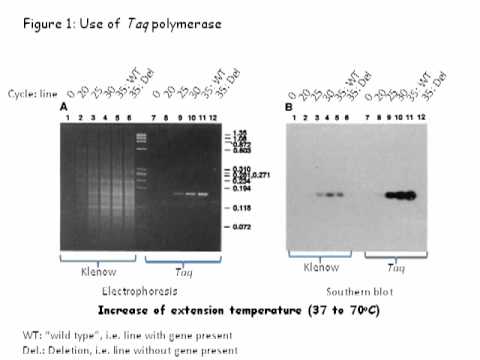
So in this video, we will discuss the preliminary aspects of polymerase chain reaction, PCR, a method that changed the way we see DNA manipulation. When we think about PCR, 2 things come to mind. First is the powerful amplification of specific DNA fragments, which most of us perform on a daily basis. Second is the figure of Kary Mullis, who received the Nobel Prize in Chemistry in 1993 for his, for his discovery, and whose ideas are marked by geniality and controversy. Although 2 previous papers by Kary Mullis had reported the PCR technique, we decided to discuss the 1988 Science article as it was the first to use the thermostable DNA polymerase, the Taq. PCR is characterized by repetitive cycles of denaturation, annealing, and extension of a reaction containing primarily DNA, dNTPs, DNA polymerase, and a pair of primers to function as templates for this enzyme. Before incorporation of Taq, the Klenow fragment of E. coli DNA polymerase would be used. Since Taq is a thermostable DNA polymerase, they did not need to add fresh enzyme at every cycle as done with Klenow, and could increase temperature during annealing and extension, which leads to greater specificity. This figure shows a comparison between amplification using Clono and Taq as the DNA polymerase. Up to 35 cycles of reactions were performed, and gel electrophoresis or Southern blot were used to detect the amplified fragments, represented on panel A and B, respectively. A cell line with a deletion for the locus of interest was used as a negative control. The use of Taq allowed the extension temperature to be increased from 37 to 70 degrees Celsius. This resulted in greater specificity of the reaction, as can be seen in panel A by a reduction in specific amplification by comparing the gel products of reactions using Clenol or Taq. A more specific fragment analysis by Southern blot shows that amplification is also increased when Taq is used. The intensity of the band increases as more cycles of reactions are performed, but the actual PCR efficiency is lower. This is because some of the main components become limited in the reaction, and the enzyme is not able to amplify the newly synthesized DNA completely in the allotted time. Next, the authors tested factors that might improve the DNA amplification process. starting by extension time and concentration of tag. Unspecific bands started to be present when the extension time and concentration of the enzyme increased, as can be seen in lanes 4, 9, and 10. Increasing the annealing temperature from 40°C to 55°C improved the specificity as demonstrated on Figure 2B. The DNA from cell line containing the target was diluted on DNA from the cell line with the deletion of the target. After 40 cycles of PCR at 55 degrees, the authors demonstrate that it is possible to amplify DNA fragments even when the target is diluted to 10⁻⁴, as shown in the figure by using gel electrophoresis, or 10⁻⁶ by using Southern blot. Annealing at 40 degrees Reduced the threshold to 10⁻² and 10⁻⁴ using gel electrophoresis and Southern blot, respectively. Only gel electrophoresis is shown in this picture. To prove the power of PCR, the authors tested if amplification would occur even when a single copy of the target was present. At 10⁻⁶ dilution, it is expected 0.3 copies of the gene, and thus, 4 out of the 15 amplifications should return positive under a Poisson distribution. Although they instead observed 9 positive results on Southern analysis, these were likely to contain only 1 copy of the gene. On the gel, it was only possible to see 3 of the 15 of the positive results.
To compare the ability of amplification between Clonal and Taq, different sizes of beta-globin genes were synthesized with various primer sets. In Figure A, Clonal could not amplify longer than 250 base pair targets, while Taq amplified all the targets from 110 base pair to 400 base pair. Moreover, Taq was able to synthesize up to 2 kb target sequences, with longer station time, which is shown in Figure B. Using Phase Lambda Human Fibroblast cDNA library, the application of Taq capacity is shown. 16 products were randomly selected, and the cDNA inserts were PCR'd with Taq. As results, the corresponding sizes of the inserts from 400 to 2,000 base pairs base pairs were detected. One plug that does not contain insert in it was also synthesized as it was predicted. This indicates that the PCR performed with Taq may be effective to isolate the inserts of proximal or basal recombinants. 100 base pairs of a single copy beta-globin gene is sequenced after PCR amplification with both Clonal and Taq. In the sequencing result of the product synthesized by Clonal, there are some unclear reasons that 2 nucleotides were detected. However, the sequences of the products amplified by Taq is clearly read. This may be because Clonal amplifies products nonspecifically, thereby it synthesized delta globin present in the genome instead of beta globin. Delta globin is highly related to beta globin, and only a few nucleotides are different between these two. The differences are indicated by downward arrows in the probe sequence. In this experiment, it was represented that Taq have higher specificity in amplification than Clonal. In conclusion, the thermostable Taq primers can amplify products. Specifically letting primer annealing temperature increase during PCR. The specificity of Taq polymerase PCR is affected by the primer extension time, amount of enzymes, annealing temperature, and template concentration. Taq polymerase is able to amplify as little as a single target molecule in 10^5 to 10^6 cells and as long as 2 kb target size. Also, Taq polymerase PCR may be applied to isolate the insert of plasmid or base recombinants.
Thank you for watching, and please check out the other exciting topics in the series.