Plant Genetic Improvement
Kevin Folta, a University of Florida professor, traces plant breeding from domestication through CRISPR, using examples like disease-resistant citrus and non-browning apples. He argues modern genetic techniques are safer and faster than traditional methods but face stricter regulation and public fear.
Chapters
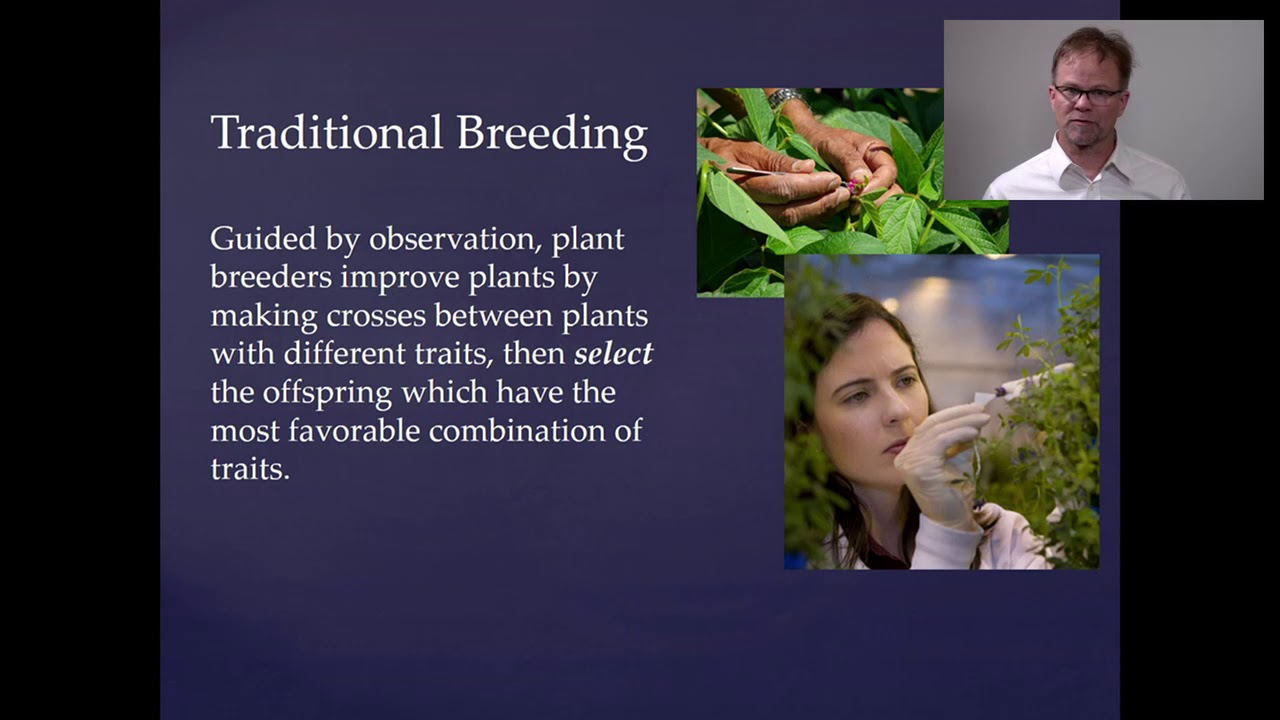
Hi everybody, and welcome to today's discussion, which is about plant genetic improvement. And the reason I'd like to do this particular presentation is because there are a lot of questions about what plant genetic improvement really is. How do we take plants from the wild that are just just growing naturally and make them food? How has that process taken place over the years and how have we accelerated that pace with modern biotechnological tools? The reason this is important is because there's a lot of discussion and debate about how plant biology should be shaped by human intervention. And I think once we understand all of the different facets of plant genetic improvement, it makes this discussion much more useful. It helps us have a better debate because we can actually talk about important issues and evidence rather than misinformation and stuff that floats around on the internet. So that's what we'll talk about today. Why do we bother to improve crops? And it's because the plants that we have that are naturally available are not sufficient for food, especially on a growing planet. We have to help farmers, and it's a question of alleviating many of the challenges to cultivation— issues like disease or, or foreign competition, the high cost of farm inputs, whether that's fuel or labor or chemistry. The environment is extremely important. We want to minimize our environmental impact of farming, and we want to take limited resources, including water, and use them extremely wisely. We want consumers in the industrialized world to have unprecedented access to the best fruits and vegetables, foods that have been shown to have a profound effect on long-term developmental disease. That if we can help people make better choices by giving them maybe better food or food that lasts longer or food that's available through more time of the year, this could have a tremendous effect on public health. And finally, Helping those in the developing world and help resolving food insecurity issues. There are a huge number of people, 1 out of 6, that will go to bed hungry tonight. And even though this condition is improving, there are tremendous ways that technologies can benefit those in the most impoverished nations. So this is why we need to be able to improve crops and improve crops rapidly. It's not enough to be able to say this is an issue we'll deal with in 50 years. This is because many of the challenges are happening right now. This guy's a great example. He lives in Yemen, a 12-year-old boy who's getting drops of oil placed on his tongue that are enriched with vitamin A, or actually enriched with beta-carotene that his body will convert into vitamin A. Vitamin A is necessary for proper vision and proper body physiology in general. Those living in deficiency will go blind and eventually succumb to other types of disease, including diseases that we generally don't think of as being life-threatening, but issues like diarrhea, other types of disease certainly do claim the lives of many because of a basis in vitamin A deficiency. Here in the state of Florida, we have a problem with citrus greening, a disease that's caused by a bacterium that's spread by an insect. The trees that are affected gradually lose productivity and eventually die. We need a solution for this yesterday. In other parts of the world, such as Uganda, the banana is a central part of the diet. They call it matoke. Yet many diseases, such as bacterial wilt, affect banana production. There's also issues again with vitamin A deficiency, where maybe if there were bananas that could deliver beta-carotene, the orange stuff in carrots, That could help alleviate some of the problems. So these are just 3 examples of solutions that are desperately needed, and they're needed now. So how can we genetically improve those plants that would be associated with these situations to be able to meet these challenges? Genetic improvement has a variety of different faces. We genetically improve plants to have better varieties with improved yields, maybe to have better nutrition or alleviation of toxins that naturally accumulate in plants. Ultimately, it'd be great to have hypoallergenic peanuts and wheat and plants that could survive climate extremes. This is why taking plants from the wild, which all plants started there, every one of our food crops, and bringing them into human control requires targets, things that we're trying to achieve by changing genetics slowly over time, and maybe today a little more rapidly. Now with every kind of progress, there's people who get a little upset about it. I hear all the time, I don't want it improved, leave it just the way nature left it. We don't want improvements, your kind of scale of improvements. We want things just the way they were, the way Mother Nature intended, right? We hear that all the time. People say, don't mess with genes, that's not our job, we shouldn't be doing that kind of thing. But humans have been doing it for an awfully long time, and I hope what I show you in the next 20 minutes of slides makes you feel that maybe we really don't know what natural is. So where do our crops come from? And if you look at the genetic origins of all of the major food crops in our stores, you see that very little comes from North America. In fact, just about everything is a foreigner on our soil. And we have plants that are coming primarily from South America— our tomatoes, potatoes, peanut, and strawberry— that brassicas coming from the Middle East, or from actually from the Mediterranean, that barley and wheat coming from the Fertile Crescent. If you look around the globe, you find that very few of the crops that we consume, or the food products we consume on a daily basis, have any origin here. Everything has been moved, despite nature's interests, to places where they could be cultivated abundantly, places where we could have better control of the genetics and the growing conditions. And this is how we have all of our crops here in North America. It's because of that domestication, and because of moving things from where they belong to where they are, that gave us a exceptional range of diversity and an exceptional range of products that are available, great improvements over their wild antecedents. And you can see in these examples with corn and its great-great-great-great-grandparent 10,000 years ago, teosinte, a shrub-like corn relative that produced a few little kernels that were in rock-hard casings, that through time humans have adapted to be what is modern-day corn. Tomatoes, the tremendous diversity we see in the grocery store— I love tomatoes— the outstanding diversity we see really started with small vines that grew on the ground and gave a few little berries, sometimes that featured flavors that were really off-putting to the palate. And then bananas on the bottom. The wild banana is loaded with seeds. And very little of that banana pulp that we really enjoy. And that through some remarkable genetic changes, we have bananas that we enjoy today that are seedless. So humans have intervened in all of these cases, that this is taking something from nature that wasn't very good and brought it under human control. And in our cultivation systems, we've generated plants that— plant varieties that are exceptional in yield, that survive disease, and most of all are exciting for the palate. So how do we do this? What's the mechanism behind driving plant genetics? And really it all starts just with plant sex. We know that plant sex is the first part of this seed production process, that you can take pollen from the male parts of the plant and deposit that on the female parts of the plant on the stigmatic surface, and you can facilitate fertilization. Now humans don't have to do that, it happens on its own. It happens sometimes in flowers before the flower even opens, so that way the pollen stays mostly within that particular flower— self-fertilization. We see other examples where cross-pollination must occur, and that's facilitated by wind. with specialized pollen that maybe will carry on air currents. We see other types of flowers that can attract pollinators such as bees or moths, and they in turn can facilitate that pollen exchange with different flowers. There's a lot of ways that this happens, and this is the way it happens in nature. But just as nature does things and humans usually can do a little bit better, we put on our bumblebee suits and actually do that pollen exchange for the plant. And in this way we facilitate targeted plant breeding. Plant breeding, or as we sometimes call it traditional breeding, is really plant genetic exchange that's guided by human intervention. We then select for the offspring that give us the traits we like. So it's a question of evaluating many parent— parental lines for plants, looking at different plants for their potential to give us the traits we want. Maybe a plant with outstanding fruit quality can be crossed with a plant that has outstanding disease resistance and poor fruit quality. Those 2 together may eventually yield a plant that has both traits. Humans have been participating in plant breeding for millennia and either doing it on purpose or doing it simply because they selected the plants that maybe survived in environmental Or biotic challenge, meaning humans maybe planted that field of early corn and insects came and ate all of it except for one plant. That plant was the only one that was now selected for those genetics to be carried forward into the next generation. So the question in traditional plant breeding is, is it natural Well, to some degree it can happen on its own, but the idea of making observations and then standing as the intermediate to move pollen to stigma is something that is not terribly natural, and as is human— humans serve as an intermediate. Now, how many genes are affected when we make that genetic cross? We generally don't know, but somewhere between 30,000 and maybe 60,000. Maybe a lot more in the case of a polyploid, which we'll talk about in a little bit. We know that we don't really evaluate these plants for safety. We don't evaluate them for environmental impact typically. Sometimes we'll evaluate them for invasiveness just to make sure that we're not releasing something from a plant breeding program that can cause problems in an invasive context. People don't really care That we're mixing genetics in ways that maybe never have been done before on the, on the earth. No one evaluates them for health risks. Nobody wants a label, or nobody wants them banned. The problem is, is that plant breeding takes a long time. And to breed a new tree, like you can imagine growing an apple tree and maybe taking 5 years, 8 years, 10 years before you see flowers and fruit. To make the cross, then growing up the next generation and waiting for flowers and fruit, and then to try the fruit and then evaluate the disease resistance. You can see how breeding plants can be a tremendous investment of decades of work. That's why plant breeders get so much of my respect. I like results tomorrow, not in 50 years. But these are people who have spent their careers dedicated to improving crops through traditional breeding and really are the people who are responsible for the wide variety of elite varieties that we have today. It's also important to note that plants derived from traditional breeding can be patented, and they are. It's very important that plant breeders' rights are respected and that when someone dedicates decades to generating the next variety which is not just their time but millions of dollars in labor, acreage, water, fertilizer, other inputs to analyze hundreds, thousands of different plants. It's important that their programs receive some sort of return in order to keep plant breeders in the business of plant breeding. Another trick in plant breeding is something called Inbreeding or the production of inbreds, and that most plants undergo what's called inbreeding depression. And this is a case that when you self a plant through subsequent generations, the vigor of the plant decreases. And you can imagine why— that when you're continually selfing a plant, its genetic diversity decreases with each subsequent generation. It's like taking that mutt and inbreeding it against its near relatives, or again, you know, in this case against itself, that you're going to lose a lot of the genes that are present in just a few copies, and you're going to start to see a fixing of the genetics. But actually, when you fix it, you break it. It's an example of how, as you make something more genetically uniform, it doesn't grow as well. However, it has very important roles. There are very important roles For this uniformity. This is an example of how you can use 2 inbreds to create a hybrid, and this is the way that modern corn production is done. That elite inbreds, in this case let's just say B73 and Mo17, these are 2 historical cases. When you take these 2 plants that don't grow very well on their own and produce rather inferior types of products, are bred together. Now you introduce this genetic mixing. You now take 2 things that are very genetically uniform and you create something that is genetically not uniform, something that's got wild variation. And then you start to see the expression of modern agriculturally useful traits: the large ear, the large plant, the disease resistance packages. All of this comes from traditional breeding and the production of these hybrids. The graph that's shown here on the right shows that 20 to 30 bushels per acre was kind of commonplace until the 1920s when the introduction of hybrids from inbreds began. And you started to see these crosses that would accelerate the pace of yields. That now you see modern corn varieties which have tremendous yields that would be off this chart. This only goes till 2000. There are cases that when you just try to do it exactly right with all the inputs measured, Yields upward of 400, 500 bushels are now being achieved. Pretty impressive. Now, people don't get too worried about this. We don't know what genes are being affected. We know that there are 40,000 to 45,000 genes in corn, and that when you make this hybrid, there's even 40— there's probably 5,000 genes that are different between B73 and Mo17. So one doesn't even have the genes that the other has, yet we're mixing them together in ways that we don't know, understand, or ever really care about. Tremendous numbers of viruses and relics of virus— viral invasions are mixed together as well, which constitute a tremendous portion of the corn genome. We don't test for side effects. It doesn't occur naturally. The production of inbreds and hybrids is something that is Human-mediated. We don't test for adverse effects. We don't look for them necessarily. No testing for health risks. You don't do extensive animal feeding studies. Again, don't look for environmental impact unless potentially invasiveness. It's something that's completely acceptable by organic production and nobody's looking for a label or a ban. And again, this process takes a very long time. You can even cross things that nature never intended to be crossed. So plants from very diverse backgrounds that never would cross in nature can be done by human intervention. The problem is something that we refer to as— well, let's think about it this way. You have a gene in variety A that you want to move in variety B. In this case, let's say flower color. It's not so simple that you can just move that one It's like a good house in a bad neighborhood. You just can't pick it up and move it. You got to take the entire genetic neighborhood along with it. And in this case, it's something that we refer to as linkage drag. It means that all the genes that are physically connected to the gene you want will move along with that gene. So it's almost impossible to move one trait from one plant to another through traditional breeding. So the best example of this is shown on the next slide. Strawberries are a combination of genetics from North and South America. North America coming from the work of colonial settlers who would travel back to Europe and bring strawberries with them from the North American continent. In 1712, a French spy brought some strawberries back from Chile. And there they sat together in a French botanical garden for years before hybridizing. This is what led to the creation of the modern-day strawberry— 2 sets of genetics that never would have gotten together without human intervention and a whole bunch of boat rides. And of course someone to notice this and make the selection. In this case, it was a teenager. It's a great story. You can read about it online and in a book called The Strawberry by George Darrow. But here's a case where many genes were mixed together in ways that we don't understand. Nobody really cares, never been tested, everybody just enjoys their strawberry shortcake. You know, nobody worries much about what happened here. But maybe a better example is when we take 2 things that would never cross together naturally and do it to solve a problem. Now the American chestnut is dying, well died in the late 1800s from chestnut blight. It was a fungal-mediated disease that destroyed the entire American chestnut population that used to dominate Appalachia. The Chinese chestnut does not catch the disease. So could we take that gene from the Chinese chestnut and use that to protect the American chestnut? Well, you could, but as this chart shows, that when you cross the American and Chinese chestnut, you end up with a mix of half American chestnut genetics and half Chinese chestnut genetics. They may not be adapted very well to the growth in Appalachia. So what you do is what's called a backcross. You take that half-and-half plant and cross it against the American chestnut parent. Then you plant that next one, will be 3/4 American chestnut. That 1/4, that contains the disease resistance gene from the Chinese chestnut. Because all the ones that don't contain it will die. So then you cross that one against the American chestnut, and you can see how this would take a long time. And now in the next generation, you end up with something that's 7/8 American chestnut and just 1/8 Chinese chestnut. And you make crosses year after year, year after year, decade after decade, and at some point you'll have something that's substantially American chestnut with A little bit of Chinese chestnut, but that little bit that you— that's there contains the gene that gives it the disease resistance. Here you took 2 plants that would never cross together. Nobody cares what genes you're mixing except for the people who want the resistance gene. Nobody wants it banned or labeled, and certainly can be grown in any production system. We also know that we can cross the impossible. And this is cases where we can take 2 things that would have a very disparate set of genetics and kind of force those genetics together. And this is crossing maybe 2 species that aren't necessarily interfertile. And you get fertilization events, but they lead to these very sick and diminished embryos that would turn into very poorly performing plants. Yet if you want all those genetics in one place, you can do it with something called embryo rescue. You can go into a plant and, or at least a seed, and remove the seed's embryo and then use tissue culture, or growing them in a bottle, all on the perfect conditions for hormones, nutrients, and all the things that little embryo needs to develop into a mature plant, or at least a more mature plant. And in this case, you can actually create crosses that would never survive if it wasn't for human intervention. Again, this is done all the time. Nobody really cares, nobody knows what genes you're moving, nobody really tests it for human health effects or environmental effects, and certainly no one's interested in labeling it or banning it. It may also take a considerably long time because this particular plant that comes from this may be used in traditional breeding crosses down the road. The other thing that we can do with genetics and plant genetic improvement is the creation of polyploids. Now in a normal fertilization event, you'll get one half of a set of chromosomes from mom, half of a set of chromosomes from dad, and together gives you one whole set of chromosomes. In this case, you see on this graph on the— or on this figure to the left, that you have a parent species where each one's got, in this case, 3 different chromosomes, or 3 different sets of chromosomes, one from mom, one from dad. Then we have this opportunity to normally pass on one from mom and one from dad, but in this particular case, it's showing what's called unreduced gametes, where the male and female contribution are doubled. This leads to what's called a tetraploid in the next generation, as the offspring now receives too many chromosomes from mom, too many from dad. Still an even number, just too many. And this happens all the time in plants, and it happens naturally. Plants produce non-reduced gametes, or say pollen and ovules with too many chromosomes. Good examples are beans, potatoes, strawberry, many of the brassicas. This is how it works. And when you have polyploidy happening, this figure on the bottom shows that a polyploid tends to be bigger. has larger leaves, larger flowers, and larger fruits. So this is why polyploids are exciting, and this is why polyploids have actually been selected through human cultivation. The other place where polyploids have a role is in seedlessness. Now watermelons are a great example. If you take a parent with a normal set of chromosomes, one from mom, one from dad, And you cross that against a polyploid or a tetraploid watermelon. The parent has 2 sets from mom, 2 sets from dad. The offspring will have 3 sets, 1 from mom, 2 from dad, or the other way around. Watermelons and bananas are bred like this, and this is how we have seedlessness. It's not really a— it's not something as scary as people like to make it out to be. Wheat breeding is exactly the same thing, that wheat has 6 sets of chromosomes. So each one of these coming from different ancient varieties of grain that come together in modern bread wheat. Now one important point that I haven't made so far that's a really important distinction. Here we've talked about mixing genes between things that would never mix naturally, doubling of chromosomes, which can be done naturally or the use of chemical agents. Are these genetic modifications? They certainly are. And if we talk about, you know, the term genetically modified, this is why we have to be so careful when we use it. This is genetic modification. We're changing genes. We're modifying genes. We're modifying genetic backgrounds. We're putting that one gene from Chinese chestnut and some of its neighbors into the background of American chestnut. That is a profound genetic modification that gives it great ability to resist disease. This is why the terminology is so important and why it's important that we're specific about how we're improving plants genetically. Many people will claim that these are all breeding techniques, and they are. These are all ways that plant breeders and technologists generate better plants. And again, with polyploids— I jumped the gun a little bit here— but all polyploids, we're moving a huge number of genes and nobody cares which ones we're moving or why we're moving them. They're not tested. We have seen this occurs in nature, absolutely, and nobody wants to label it. It does take a long time to generate a new polyploid crop. The other thing that we can do is mutation breeding. So this is cool. If there is not a trait or variation, genetic variation, that a breeder is interested in, can you create that variation? And one way to do it is to damage DNA. Can you use chemicals or radiation to damage DNA in a way that gives you the trait you want? So one good example might be susceptibility to disease. Plants have genes that actually allow them to be susceptible. It's a long story, but you can imagine that if you could— if you are susceptible to disease and you can destroy the gene that would make you susceptible, now you are resistant to disease. Another good example is high lycopene grapefruits. The genes that were involved in the turnover of the dark orange pigments were interrupted by gamma radiation, by using radiation to damage the genes that are associated with pigment accumulation inside fruits. This is another nice example of how genes are modified. It is genetic modification. We don't know what genes we're hitting usually. It just blankets the genome or all the genes with chemical or radiation mutagens to change it in ways that make it produce the trait that we really care about. And huge number of plants are affected by this kind of mutagenesis. Many of them are ornamentals, but a tremendous amount of them end up in our food supply. Nobody really cares. We have no idea how many genes we affect. We don't know how we affect them. It does occur in nature because plants are always changing and making mistakes when genes are copied or doubled or placed into pollen or ovules. Mistakes do occur. These are naturally occurring mutations. They happen because of errors in the hardware that replicates DNA, or it happens because of exposure to environmental conditions, things such as gamma radiation from cosmic rays or potassium-40 decay from the earth. There's a lot of reasons why genes may be hit by radiation. Ultraviolet light is another good example of a potential mutagen that you'll find occurring in nature. We never test these plants for health risks. We've been doing it for years. Nobody wants to label them or ban them, and we have absolutely no idea what genes are affected. And perfectly fine to put them in your organic garden. Nobody will care and you can sell the products as organic compliant. It takes a long time to be able to do this, as before, 50, maybe, well, somewhere between 5 and 50 years. 5 would be extremely fast to produce a new crop. Another trick is in somatic fusions, and I won't spend much time on this, but basically you can take the nuclei from 2 different plants, fuse them together, put them into tissue culture, and on the right combination of hormones and nutrients, produce a whole new plant that now has genetics of 2 parents smashed together in one place. And again, nobody cares. Yeah, you can do this. It's been done with citrus, and citrus sometimes has good resistance to disease because of this particular process. The next thing we'll talk about is genetic engineering, or some people refer to it as genetic modification. But you see why this term is not really very helpful, because everything we've looked at so far is an example of a genetic modification, in some cases a profound one. In this particular case, we're talking about transgenics. The production of a transgenic plant is a specific type of genetic engineering. So how this works is maybe taking a gene from one organism like a human, and placing it into a bacterium to produce something like insulin. We can also do the same in plants. A bacterial gene in plants gives it the ability to be resistant to specific insects. This is done in a variety of ways. By getting the gene into plants, which can be done either by physical methods, such as what's called biolistics, where small particles are coated with DNA and literally shot into cells. But the much more common method is something called Agrobacterium-mediated transfer, and this is where a bacterium that typically lives in the soil and does a genetic exchange with its host naturally— these bacteria are used in the laboratory to facilitate that genetic exchange with a plant cell. We then take that plant cell that now has the gene of interest, grow it on media, and produce an entirely new plant. That new plant, every cell contains that new gene of interest. This is what we refer to again as transgenics, transgenesis. There are a lot of good examples of this, such as Bt traits, the traits that confer insect resistance to things like corn or cotton, or herbicide resistance, where a metabolic gene from bacteria was placed into plants to do the same job it does, but it isn't affected by an herbicide. We also know in more recent examples, such as in potato and apple, of genes that suppress the browning reactions, or suppress a virus, as in the case of papaya or squash. These are examples of transgenics. This is an example of a genetic modification, but a very minor one. In this case, we're only moving maybe a gene or a couple of genes. And we know exactly what those genes do. It doesn't occur in nature, and you have to test for collateral effects, effects on health, potential environmental impact. So just a few genes, highly evaluated over a long time, yet this is the one that people want to ban and label. It's not allowed to be grown in an organic production context and takes a couple of years to generate. The regulatory process is really the long part. The science goes fast. The regulation and social acceptance goes slow. That's what I've always referred to as the Frankenfood Paradox. It doesn't make sense to me that the fastest way and the most precise way to do something is the one that people most fear. Another way to do this— well, I should mention that the current slate of crops that are available much smaller than people think. It's really just 4 crops that end up in food: corn, soy, sugar beets, and canola. In those cases, they're providing the ingredients— things like cornstarch or sugar or oil— that will end up in processed food products. A tremendous amount of this also goes into cattle feed. There's a minor acreage of squash, Hawaiian papayas, alfalfa for animal feed, and cotton for fiber. Recently, potatoes and apples that are non-browning have been approved and may be showing up in stores near you in the next few years. The other side of this is something called cisgenics or introgenics, and this was considered to be a way to introduce genes from a naturally occurring sexually compatible partner into a plant without all the breeding. And a great example is from apple. Apple gets a disease called apple scab where there are individual apple types in the wild that don't get apple scab. You could do the long-term breeding like we had to do with the chestnut and gradually move it into a modern contemporary apple background. But what if you could cut and paste that gene from that wild apple into the production apple? apple. It's been done and it works great. It also was done with traditional breeding. It took 50-some years and millions of dollars, and it was done in a laboratory in about 5 years for much less money. It's a way of moving that single gene from the wild into the cultivated variety and doing it very quickly. Again, in this case, it still is highly regulated. That it's lab-mediated, it's fast, we know exactly what genes are being moved and affected. It has to be tested for health impacts, environmental impacts. It can't be grown in organic production, and people are excited to label it and ban it. So once again, the most precise way of doing something using the smallest number of genes affected is the one that people fear most. Gene editing is a process of identifying a specific gene and creating a change in it. We sometimes hear this referred to as CRISPR, which is really the technical name for the mechanism that's used, but there are quite a few others as well. It's fast, it's efficient, anybody can do it in the laboratory, in a reasonably equipped laboratory, and it's really just a brand new technology that we're really starting to see tremendous improvements even in a few short years. This technology will revolutionize the way that we deal with plant genetic modifications. Gene editing has the advantage of being tremendously precise and not requiring the presence of foreign genes in the final product. However, even though we know exactly what gene we affect, we know its side effects, we can test for health risks if we need to, it's unsure how this will be regulated. Unfortunately, there's a lot of people pushing for the most stringent regulation, making it more regulated than transgenic and cisgenic crops. They say it's the most insidious form of genetic engineering because you don't know that it happened. On the other side of the discussion, scientists will say that we can create the same changes in plants That nature created. So in other words, if we know there's a specific mutation in a gene in barley that makes it resistant to a disease, we can create that same exact mutation in wheat. So you can't cross barley and wheat and have something reasonable as a product, but can you create that same genetic change? And it turns out you can. It's been done. And this type of gene editing stands to revolutionize agriculture. It's really important for us to understand what it is and what it isn't. In future episodes of videos I do, we'll discuss gene editing in some detail. So in summary, we've covered genetic engineering and all forms of genetic improvement. And I tend to think of this as plant genetic improvement. Some folks say these are all breeding tools. I tend to disagree with that particular evaluation because plant Plant breeding is an empirically driven, observation-driven process of making crosses between 2 different genetic types with the idea of genetic improvement. The ideas like transgenics and gene editing, that's a little bit different in that you're still doing genetic improvement, but it's not necessarily plant breeding. You're not making crosses in these cases. necessarily, at least as a step to move the gene of interest. But when you look at this entire chart, you notice a couple of things: that the more precise versions of genetic modification, the changes that we're able to do with transgenics, cisgenics, or gene editing, which is hidden right here underneath, right here underneath me, that tends to be the ones that people are most concerned about. Have the highest regulatory standards, have the most understanding of the genes affected, and the ones that can't be grown even in organic production systems. However, all of these other methods, such as creating extra sets of chromosomes, creating mutations with chemistry and radiation, those are perfectly acceptable. Everybody loves it, even though we have absolutely no idea what genes are affected. At least not at first blush. You can figure it out, but at least in the beginning, no one really knows, and historically nobody's ever cared. It's also important to point out that traditional breeding has led to products that have been dangerous for human health. There have been potatoes, celery, a few others that traditional breeding has sequestered large numbers of genes associated with anti-insect or antimicrobial products that then did disturb human health. This is why it's important for all of us to remember that anytime you change genes, there is risk. The question is, when we talk about these technologies, it's important for us to say that modern technologies and gene editing, genetic engineering, even poly— the creation of synthetic polyploids, mutations, all of these things, that they have no more risk than traditional breeding. And that's the proper way to frame that. There always is some risk, but no more risk than traditional breeding. And out of all of these processes, traditional breeding is likely the one that we least understand. So that's how we really want to frame this in your conversations. So the conclusion of all of this is that humans have always participated in plant genetic improvement, and traditional breeding has been a wonderful tool for us to achieve great improvements in plant biology. And no matter what we try to do with gene editing or transgenics or mutation breeding, it all starts with an outstanding base plant that came about through traditional breeding. And that's why traditional breeding is so important and why we need to continue to pursue interests in traditional breeding. Other methods of plant genetic improvement like mutation breeding, we see massive genetic change that nobody really is too concerned about. But modern techniques, we know which genes we're affecting, yet these are the ones that remain the center of public scrutiny and the things that really lead to a lot of division when we start talking about plant genetic improvement. And that's really unusual because here we have the most precise techniques, the fastest techniques, are the ones that people fear most. Go figure. The big problem for me in that particular scenario is because we need solutions fast. It takes time to do traditional breeding, polyploids, mutation breeding, and transgenics. And as you see right here, gene editing can be done extremely rapidly. That's important for me. It's important for me because I'm really worried about people in the developing world, helping our farmers deal with plant disease, and helping others achieve food security. And to me, I need fast solutions. I need to be able to employ our newest and fastest ways of solving these problems. These folks don't have time for traditional breeding on its own, that we need to be incorporating all the tools that we have. in order to meet these challenges. So thank you for watching. Again, my name's Kevin Folta. I'm a professor at the University of Florida. My contact information is here, and I do a weekly podcast called Talking Biotech. You also can obtain any of these slides for your own use, and I really do encourage you to use them in your presentations. Thank you very much for watching. Reach out if you have any questions.
More from Kevin



Talking Biotech 503 - A New Strategy in the War on Obesity. Dr. Erik Issacson, Wave Life Sciences

Organic Production, Conventional Agriculture, Health Anxiety, and Social Media Disinformation

Stop Political Appointees from Grant Decisions - Dr. Colette Dalawalla, Talking Biotech 501




