Talking Biotech 028 -- All About Bt
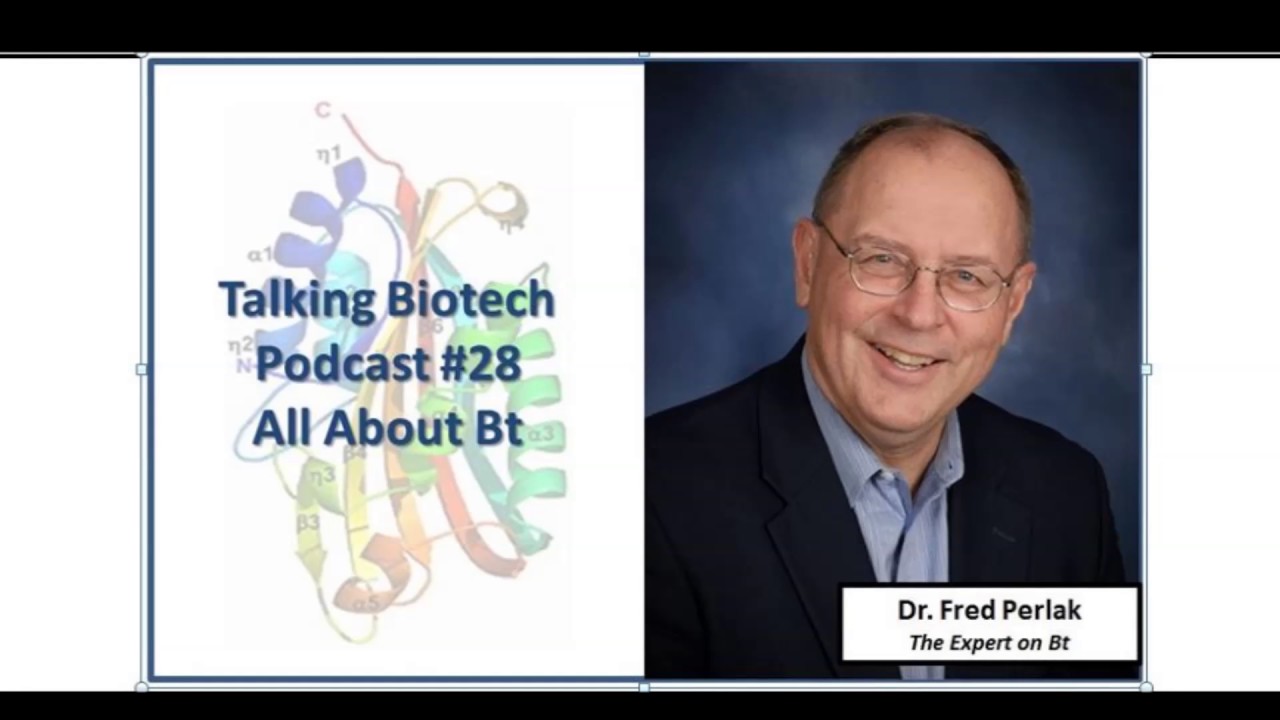
Fred Perlak, a retired Monsanto scientist, explains how Bt toxin kills insects by binding to gut receptors and why it spares bees and other non-targets. Cotton production in India doubled after Bt adoption, and refuge requirements have successfully delayed resistance in the U.S.
Chapters
I want to see science serve a useful purpose to improve the standard of living for all people. Hey, why is anyone fighting food advance? A very small percentage of the world's population is fortunate enough to have the luxury of turning down food.
We've arranged a society based on science and technology in which Nobody understands anything about science and technology.
You can't build a peaceful world on empty stomachs and human misery.
You're listening to Talking Biotech, a weekly podcast illuminating issues in agricultural and medical biotechnology. Your questions and concerns are addressed using a science-based approach with the goal of driving discovery to application with communication. Now here's your host, Yeah, hi everybody, it's me again, and we're here on Talking Biotech, but this week with a really interesting topic. And today's topic is Bt, or more appropriately, the Bt delta endotoxin. And this is a naturally found protein that resides in the bacterium Bacillus thuringiensis, and this bacterium is Ubiquitous. It's a soil bacterium that creates a protein that is toxic to certain specific insects, and this has been known for some time. And scientists— and this was something that growing up I was pretty excited to learn about, that I can remember this from back in the late '70s— that scientists would be able to use this very safe insecticide and isolate the genes that led to, or at least the gene that confers this toxicity, and move that into plants, and that would allow plants to protect themselves against the insects. Now this made perfect sense because plants produce many compounds that protect themselves from insects— nicotine, caffeine— these are all compounds that plants produce as anti-insecticidal, and nature does this all the time. It finds ways to protect itself from its predators. And so this seemed to be a really easy way to take a natural protection and install that into the plant using genetic engineering. Seemed super simple and seemed like a great idea. And so if we want to learn more about it, we can turn to several places. One place might be the internet, where we can learn all about it. They're finding that GMO corn leaches insecticide proteins This is really interesting. It's a BT protein, Bacillus thuringiensis.
I don't know.
You can read about it on the website if you want. Anyway, scientists are recording that this protein is being found in rivers and streams everywhere where this corn is growing close to the rivers. They're basically when they decompose, they're leaching this stuff out. The scientists studied this in India because I guess they were there, and anyhow, they found that— Found that the internet is a rather lousy place to get information about these topics and that you really need to tune to the experts. I'm not even exactly sure what he's referring to there because I don't believe that India grows Bt corn, but when in fact stood in the way of an interesting, compelling story. So what we could do is talk to an expert, somebody who knows about this, and somebody who studied this particular molecule and the plants that have been derived from it from the very beginning. I'm very excited today to be joined by Dr. Fred Perlaque. Dr. Fred Perlaque recently retired from the Monsanto Corporation, where he worked with Bt for almost an entire career. His findings of being somebody there from the beginning really help aid our understanding of what this really is and what it really isn't. In the second half of the podcast, I'll field some of your questions on the Bt topic, and there's actually quite a few very good ones. So first, Dr. Perlaque, followed by your questions. Today on Talking Biotech, we really take a step backwards to understand the fundamental basis of one of the major crop traits that we find all around the world. And this is the insect resistance trait known as Bt. And we're really very fortunate to have with us today Dr. Fred Perlaack coming to us from his home. And he has a rich history at the foundation of this technology. He originally was a bench scientist with the Monsanto Company, worked his way through the years through the cotton program, eventually was a distinguished science fellow, or still is a distinguished science fellow, but finished his career really working with the Gates Foundation in technology transfer to developing countries.
Right.
And, um, really fortunate to have him with us today. Uh, welcome, Dr. Perlaque.
Hi, Kevin. It is a pleasure to talk to you and your listeners.
Well, I, I think this is really an interesting opportunity because we talk all the time about BT. You read a lot about BT, but there's some really strange, elusive gray area in this, is that why would a bacterium— why would a bacterium make something that was toxic to specific insects. And, uh, who figured that out? Who put— well, who is the person who put 2 and 2 together that really figured out the bacteria would kill the insect?
Well, the story goes back a long, long way. Um, one of, um, people have identified Bacillus thuringiensis because it has unusual characteristics. It is a grand positive spore-forming rod commonly found in soil, but it has the unusual characteristic of producing a large amount of its total protein, almost 50% of its protein, as a crystalline inclusion, a diamond-shaped crystal found with inside the cell during the sporulation process that is a pure protein. that has the ability to kill these insects. One of the first people to describe it was Louis Pasteur, who the legend goes was trying to identify what was devastating the silkworm population in France during the 1860s, and he found Bacillus thuringiensis as the causative organism. Silkworms are Lepidopterans, and it was a very important part of the silk industry in France. Over the years, people identified that it had the ability to kill Lepidopterans, and in fact, during the '40s and '50s and early '60s and so, people had been using it and spraying it over crops to control Lepidopteran insects. So the insecticidal properties of Bacillus thuringiensis were well known. I first studied Bt as a graduate student And I was interested in Curtis Thorne's lab at the University of Massachusetts in the relationship between sporulation and crystal production, and the molecular mechanisms that required crystal production also seemed to be coincidental with sporulation. The same triggers, the same molecular mechanisms that triggered sporulation triggered crystal production. It was a very interesting genetics problem.
It's really interesting because I remember learning about this as far back as really the early '80s, late '70s myself when we were talking about genetic engineering in school and how this would allow a plant to protect itself. And it seemed like this brilliant idea that you— that even as a kid I thought, this is great because now we won't have— you know, we knew about DDT and we heard all the stories in school. And what was the climate like back in the 1970s and '80s that really presented this opportunity to use the biotech approaches, kind of the self-protecting plant, to combat the insects?
Well, the— in the '70s, as I was a graduate student in the late '70s, from '75 to '80, only then were we starting to understand the potential behind plasmids and restriction endonucleases, and those were cutting-edge kind of technologies, much the way CRISPR is described now, for example. And everyone picked Bt up and said, oh, if only we could get this particular protein produced in plants. It was the most obvious kind of thing to want to do. The missings were the isolation of the Bt gene and The concept of isolating and studying and expressing genes in other sources was unproven. And secondly, transforming plants or putting genes into plants was another second big unknown. Now the first unknown, isolating a Bt gene and getting it to express in another host, was solved by Helen Whiteley from the University of Washington at Seattle. She isolated a Bt gene and managed to express it in E. coli, a gram-negative organism, at a pretty efficient mechanism, and to the point where it produced a protein that still had the ability to kill insects. This was, this was a pretty big deal because to those of us in the Bacillus world, how could a gene be put into E. coli that was sporulation regulated when E. coli didn't produce spores? And we kind of figured it out eventually. I mean, as a molecular biology community. The second unknown was how do you get it into plants? And that's where the crew at Monsanto— that's Rob Fraley and Rob Horsch and Steve Rogers— were capable of putting a kanamycin resistance gene, MPT2, and getting it expressed in in plants back in 1982. Once that was shown, there were two— it was just a matter of execution from that point on.
And let me step back just for a second, in that the Npt2 gene is really, as you mentioned, encodes kanamycin resistance. And this is important because if you can get the gene in that encodes the resistance, now it allows you to put in genes along with it And then put that tissue onto a kanamycin plate, and the only thing that really survives is the construct that has the kanamycin gene, and very likely the gene that you put in as well.
Right. It all looks so obvious and so easy in retrospect, but when you live through it, we were kind of feeling our way. Even those of us who were so close to the technology We were feeling our way in the dark, so to speak. It's just— it was just so much of a mystery. We had no conventional wisdom to rely on. Every case was an exception. So when we tried to put the Bt gene that we had isolated and characterized into plants, it didn't work at all. And there was a lot of consternation as to why that was.
And that's, uh, that really is rather interesting because nowadays most folks who study this area, transformation of plants is so routine, even in very— even in highly recalcitrant species. And to think back to— you were working mostly with tobacco at that time?
Right. These were— this wasn't my work. This was the work of Rob Horsch and Rob Frailly and Ernie Jaworski and Steve Rogers. And they were working first with petunias and then to tobacco. Turns out that the Solanaceae species— tobacco, tomato— are fairly easy to transform. And they have a number of advantages for a laboratory situation. They grow well in small pots. They produce lots of seeds. They're Very fertile, they're easy to grow, they can— and you can generate lots of transformants very, very easily. So for all those reasons, tobacco and tomato were among the— they were sort of the white rats of the plant research environment in the '90s and '80s. Okay.
And so if we look at something like Bt, do we know exactly how it works? Like, what is the mechanism that makes it effective inside the Lepidopteran organism? And does that mechanism also allow it to be used very safely with respect to non-targets?
The mechanism for Bt is very well understood. It's been studied for a very long time. It has the ability to disrupt the electron potential across the surface of the gut of the insect. Insects transport materials or nutrients from their digestive tract, from their gut, into their bloodstream through a mechanism of electron potential, much the way— in a broad sense, the way other organisms do. They utilize carrier proteins and membranes and receptors to move material across. In the case of Bt, this specific protein binds to a very, very specific receptor, much the way a key fits into a lock. And once this protein binds to the receptor, it opens and disrupts that electron potential by essentially poking a hole in the gut of the insect. So the potential is destroyed and he loses the ability to transport nutrients from his digestive tract to his bloodstream. That kills the insect very, very rapidly. It is a very specific mechanism because it depends on the receptor found only in the Lepidoptera insect. The BTs that we originally studied and the majority of BTs bind to that specific receptor. They don't affect other non-target insects. such as honeybees or whiteflies or beetle forms. That particular Bt only hits the Lepidopteran-type insects. So it's a— from— and the other aspect, it's extremely potent. Small amounts have the ability to kill the insects. So for putting this protein into plants, it's ideal. It's specific, only hits the pest you want. It's highly active, so you only need a little bit, and it disrupts the insects very early in their growth stage so that you don't get a lot of damage to the plants. It's the ideal protein to talk about putting into plants to control insects.
And as I mentioned before, it, you know, this is something that I remember reading about so long ago. And as you mentioned, just, it seems so ideal. It seems like a total no-brainer that this would be the most obvious and incredibly well-received opportunity to change the way that we're protecting plants from insects. And what was the— so this mostly went into cotton and corn early on. And what were the— what was the current management practice for for using pesticides on corn and cotton at the time?
Well, it's not as obvious as it originally had— as it originally— as it looks now. When we first were working on this, we had no idea what crop would be appropriate. Corn was a long way still from transformation back in the mid-1980s, and it wasn't transformed until The early '90s. So when you looked at the choices, cotton becomes a very good choice because there is a good number of cotton acres, anywhere from 12 to 15 million acres on an annual basis grown in the United States. It's an international crop with close to 100 million acres. But most importantly, cotton uses a lot of chemical insecticides. For example, in the United States, cotton still makes up less than 10% of the total acreage, but back in the '80s and '90s, it accounted for 50% of the chemical insecticide use. Now, back when we started this program in the mid-1980s, Pyrethroids were very effective at controlling lepidopteran insects. The biggest problem farmers faced were boll weevils. However, the insect pests gradually developed resistance to pyrethroids. That opened the way for Bt cotton to be quite effective to help control those insects. In 1995, the year before we commercially launched Bullgard cotton, farmers, especially in the Mid-South, were overrun by tobacco budworm, a devastating pest of cotton. That's Virescens. And to the point where they couldn't spray enough to keep their crop whole and lost whole whole fields to the tobacco budworm. Pyrethroids were completely ineffective.
There's actually one of my colleagues here at University of Florida, his father, his family has a farm in Mississippi, and they were cotton farmers, and they almost lost everything because of the intense insect pressure with no really solid solutions. And he'll talk all about when genetic engineering and the Bollgard cotton first came to the farm and how it changed everything for his family. And it's a really nice personal story about how these technologies can change things for people, that it's not just, you know, the common myth that this is only to keep companies in business.
The key for something like Bt cotton is not just what it is, but what it does to the whole management process. So let's take someplace like India, for example. When we launched Bollgard cotton— since we launched Bollgard cotton in India in 2002, production of Indian cotton has doubled. That's a fact. They produce twice as much cotton as they used to. And you can say, well, it's because of Bt cotton, but that's only a small part of the Prior to Bt cotton, the biggest concern for an Indian farmer was that he'd be wiped out by these insect pests. No matter how much he sprayed, no matter how much he spent, he could still lose his crop, which was a devastating issue for an Indian farmer. If you now have Bt cotton, you take the devastating catastrophic event off the table. That allows him now to invest wisely in his field. He'll buy better seed. He'll use fertilizer. He'll put in irrigation systems. He'll cultivate his field. He'll, he'll control secondary pests, all because he knows he won't lose his crop. Every dollar he spends, he knows is well invested. So although Bt cotton helps him control his insects, what's What's doubled the production of cotton in India is the fact that all these other benefits now make economic sense for the farmer. It's an interesting story. And it just helps people understand that farmers make decisions based on their knowledge of their crop, and they know more than anybody. And they don't do that lightly. They do it very wisely.
Yes, that's, uh, it's really the— really surprising to me to hear the claims that farmers don't get a choice and that they are not free to choose. I have friends who farm that they, uh, they want the newest and best all the time and that they are always asking their seed salespeople what's coming, what's coming. And they can pick conventional strategies or traded, you know, or genetically engineered seeds as they wish. I guess the big question about cotton is you hear a lot of the narrative about how the cotton actually has led to farmer suicides and things like that in India. And what is really the best way for somebody to counter that claim?
Well, suicides have been a big part of the agricultural community in India for decades. It preceded BT cotton. It precedes precedes any technology. The Indian government has been trying to institute policies to minimize that and to take care of their population. Suicides are a problem. They're a problem in a number of countries, and it's not unique to just India. It's a big problem in Japan, South Korea, China. A sense of hopelessness and despair. It's a rough world out there. And these sorts of pressures weigh heavily, not just on farmers, but on others. So the— what I tell people is that it's a tragic story of suicides and it's not a new one. There are people who are trying to address it. Technologies like Bt cotton actually lessen the potential for suicides because they do help farmers in a way that they can understand. That doesn't mean they'll eliminate suicide. Suicides are still going to happen. But at least it takes some of the concerns out of a farmer's production capability. We can quote all sorts of statistics that show that farmer suicides didn't increase after Bt cotton. They've actually gone down. That the suicide rate in Indian society is higher among non-farmers farmers than among farmers. But statistics are really a shallow way to look at it. These are people and their lives. All you can do is hope that people don't feel that kind of despair. Farmers in America have so many advantages. We have safety nets, we have insurance, we have guaranteed loans, we have support systems That's all lacking in India. That makes life difficult.
What about some of the other criticisms that since these target Lepidopterans, which include butterflies, how many critics will say that this is responsible for the decrease in monarch populations and also harming bees? What is a good way to address that concern?
First and foremost is bees aren't Lepidopterans. Bees are another class of insect. When any BT or any protein product like a BT is— goes through regulatory approval, one of the model insects to test for activities are honeybees. And if it had activity, it would never make it through the regulatory process. Secondly, monarch butterflies don't eat cotton. They don't eat corn leaves. They eat milkweed. And so unless you have BT on milkweed, you're not going to be killing monarch butterflies. There were some experiments done a long time ago, back in the '90s, I believe, where they looked at corn pollen and the milkweed was dusted with corn pollen to the point where it was yellow. And under those conditions, it would kill the larvae of monarch butterflies. But under a practical situation with the current technology, that doesn't happen. It's just not a factor. And it's much more environmentally beneficial to monarch butterflies than blanket spraying the field with a pyrethroid, an organophosphate, or a carbamate, all of which kill all forms of monarch butterflies quite efficiently. So that one doesn't hold up. That doesn't hold up to scientific scrutiny.
What about eventual insect resistance to the Bt protein? And I know that there's been reports of pockets of that occurring. And is that something that was always predicted, and how are farmers remedying that situation?
We always anticipated that resistance development was possible. When we first launched our Bt crops, we came out with a novel program at the urging of many of our collaborators, many well-known entomologists. These are people like J.R. Bradley and Fred Gould and Ron Smith, and a whole host of others who had encouraged us to have refuge within the fields. So a farmer who plants a Bt crop is required to put in a refuge, an area that is not planted with Bt that can serve as a refuge for breeding populations. The concept is that it keeps the gene pool low with levels of resistance. Therefore, resistance takes longer to develop. Rick Roush was involved in this as well. We've done this in the United States quite effectively, and we've managed to hold off resistance to things like the pink bollworm in Arizona, the corn earworm, and the tobacco budworm quite effectively in the United States. This is 2016. We launched in 1996, and resistance to those insects is not common or not widely reported. So it effectively still works quite well.
Which is pretty amazing if you think about it. And I think the other thing that really is disappointing to me about this is it looks like a durable solution that is great here in the industrialized world but really seems to be more tuned for serving those who don't have access to the pesticide or the insecticide spectrum that we have here in North America. And if you could just kind of wave the magic wand, what are some of the applications that you think would most benefit the developing world farmers? So things like the Bt brinjal. Are there other opportunities that could really serve others? if we were able to implement them?
I think the key to something like Bt crops is that they're a tool to be used and not a panacea for everything. I would not recommend putting Bt into every crop, into every situation. Bt rice is not necessarily a good thing. Bt brinjal works well because there are no alternatives. Certain vegetable crops with very specific pests like Bt brinjal is a great opportunity, and I'm sure they exist out there. The key is that as a tool, it has to be part of an integrated pest management system, part of a major education undertaking to allow beneficial insects, minimize chemical insecticide use and maximize the value and benefits that the farmer gets. Brinjal is a good example, or eggplant. I don't know offhand which other ones might really work well. Another pest that has problems in Africa is the— using it for controlling certain boring pests in cowpea. There's a number of effective uses there. Using it for white corn in Africa or small plots of corn in Africa would be an extremely effective way to bring new technology to those farmers. So I, I'd say probably using it in corn. Now, there's not just one BT. There's a whole range of BTs, and just like once penicillin was identified in antibiotics, BTs and their diversity are getting to be better and better known. In fact, you can engineer some of the toxins to increase their activity and reduce their possibility for resistance using multiple receptor binding sites and activities. So we're coming into a real renaissance in molecular breeding and molecular protein modeling and molecular changes that becomes possible with new technology. The future is quite bright for this sort of thing.
One of the real successes of BT was the BT potato, and I know this was Successful in North America and even in Europe, in Romania and other places. What happened with the BT potato and where is it today?
Well, the BT potato story is a very interesting one. It wasn't just BT potato, it was also resistance to a disease called potato leafroll virus. It causes a disease called net necrosis in the potatoes. If you've gotten potato chips and you find brown ones in the middle with a ring around in the inside, that brown ring is caused by a disease called net necrosis. In the early '90s, Monsanto and work that I did with a number of other collaborators were successful in coming up with a potato that was resistant to the Colorado potato beetle, as well as immune to a disease called potato leafroll virus, PLRV. We launched the potato here in the US, but because of protests, because of issues with McDonald's and other companies shying away from a new technology, we decided not to pursue the product aggressively and it never made it after a preliminary minor launch. I have a theory as to why this happened the way it did. In the case of places where Bt crops have been successful— corn, cotton, genetically engineered soy— those are crops that farmers are vertically They produce the crop and they have an outlet to the marketplace either through their own feed operations or farmers' own gins for cotton. There's a way to get it to the marketplace. In the case of things like rice and wheat and potato, they have to go through a processor, a middleman. Farmers do not have strong farmer associations in those crops. Right. They're dependent on the processors who then process the potatoes or the wheat or the rice for consumption eventually by the consumers. That middleman is the problem. They weren't getting enough of the value, so they restricted the technology, and that allowed the technology to not move forward. There are other factors. Potato consumption was going down in the '90s. It was not considered as healthy a food, and there's only 1.2 million acres— there was only 1.2 million acres of potatoes. So it was a great product. It hit a great niche. And the big value was not just the Bt, but it was the virus resistance that allowed the reduction of dramatic numbers of insecticides.
So sprays.
It just didn't make it. There wasn't enough pull-through. It's probably one of the most disappointing parts of my career is that that didn't get to go forward. One last thing, just so you knew, one of the things that separated Monsanto from all our competition, and this is not obvious to people, is why did Monsanto succeed where so many others failed? The reason is Monsanto dealt well with the ambiguity. People didn't know what the products would be. They didn't know what the market would be. All they knew, and all we knew, was that it was worth doing, that it added value. And that was enough. That was enough to get us to invest millions of dollars, build whole facilities, changed the scope of agriculture, just knowing that it was worth doing. All of us were so idealistic. We were going to change the world. We didn't want to use chemical insecticides. We had talked to farmers, knew what their concerns were. Many of us were farmers. Not me. Many of the people I worked with, they knew what it was like to be on that tractor. I didn't want to. So we did it because we loved agriculture. That's an important part.
I get excited about any technology that allows us to feed more people with fewer resources, and this is a great example of how we could do that. And how do we get everybody on board? And that's, that's kind of— and I know you've done the Reddit exercise where you've gone and answered questions on Reddit. How did you find that, and how do you feel we as scientists need to better communicate what these technologies are and what they aren't to get the public more excited about opportunities using these technologies?
The key to communicating with people is an old line that says, close your mouth and open your eyes. I think as scientists, we can do a better job, or just in general, we can do a better job in any conversation by listening more and speaking less. People have concerns, and that's normal, that's understandable. But I think listening to exactly what those concerns are allows people to address them. In this year of political debates, No one wants to listen. Everybody wants to get their point across. That's in my way. In my view, that is not the way to lead or to influence the debate. I think listening better, listening more attentively to what people's concerns are makes a big difference. There's no easy answer, and there's no easy way to. I mean, we've had Bt crops and genetically engineered crops for 20 years, and people say, well, I still don't trust them. Well, what is it going to take? What sort of information do you want? Well, I want another 20 years of testing. Well, that's not, that's not going to work. Let's talk about what's possible and what the possible concerns are that you might have. I don't envy your work, Kevin. I know how frustrating this is, and I'm just pleased and amazed that you work at it so aggressively. Thank you very much from my part as the greater scientific community.
I appreciate that a lot. I think it's because I get so excited about things technology can do for people, especially especially in the developing world, and especially in here too. You know, what can we do for our farmers to keep them competitive? And coming from a place where we don't grow any genetically engineered crops, or very limited, yet you see the solutions that genetic engineering could pose for the citrus industry, for tomato, for strawberry, to really allow us to grow food more sustainably. And I think that that's the message that when We all get on the same page and say, this is just one technology. It's one part of a large spectrum of solutions that we need to work together integratedly. It's not a panacea, just like you said. I think that message starts to resonate. I think that we maybe early on as scientists came out too strong with, this is the feed the world, save the world, protect everybody from everything technology. And it kind of lost the middle, you know, the people who are just skeptical and want to feed their families, I agree.
I mean, we live in such a fantastic world here. We, we have computers in our telephones that used to be the size 20, 30 years ago of a whole room. We fly through the air at close to the speed of sound. We, we take drugs that are tailored for our body if we have a serious disease. People can survive sequence our genome and tell us exactly what's the best medication to address a serious disease like some carcinoma that we might have. That is just absolutely incredible. We live in a wonderful world. I am quite pleased with some of the new technology that's come out. The The Arctic apples and the potatoes that don't bruise or resistant to the fungal diseases, those are incredible products. A big part of feeding populations is reducing the overall waste. If we can find more creative ways to do that, that's a big plus for everybody.
So, Dr. Perlaque, thank you very much for being with us today. Where can people find you on social media or maybe get in touch with you if they have additional questions?
Although I am retired, I still do exist in the public sector. I have a Twitter site at @FredPerlak, F-R-E-D-P-E-R-L-A-K. People can reach me there. I'd be more than happy to answer any questions or engage in any dialogue. Thanks again for your time, Kevin. I really enjoyed doing this.
Thank you for listening to the Talking Biotech Podcast. Now, since the reboot only a few weeks ago, we've seen tremendous increases in the number of listeners, and we thank you for that. You're obviously telling friends and family, retweeting episodes, and sharing them with episodes and sharing them in social media space. That's great because you are the amplifier to our little microphone. Now if you have questions you would like to hear answered here, send a tweet to @TalkingBiotech or send an email to talkingbiotech@gmail.com. And remember, This pirate ship is 100% supported personally by Kevin Folta, and no outside contributions are ever accepted. I always tell him it's a bonehead move, because if everybody sent him a penny, he could cover his annual costs in a week or two. That means lots of folks are downloading his production and enjoying the content. The Amazing Adventures of Captain Kevin Folta. Amazing stories of plant biology and new technology open our eyes to where our food comes from, as well as where it can go. As moving innovation to application requires communication, we now return to Talking Biotech, already in progress.
Yes, Talking Biotech, already in progress. And a little bit of a shout out to some folks out I've talked to in the last week or two. I had a really nice time with visiting University of Missouri, great time talking to grad students and postdocs there. We had a wonderful discussion about career moves and their future and had a nice workshop there. Thanks, Nat, for arranging that for us. And also had a really good time talking to NC State University and Cornell University, and seems like I did another one too. But there was— these are all via— the last ones here were done via Skype. Lots of guest lectures this week, and also here at University of Florida, of course. I had a number of guest lectures in the last week which were a lot of fun, and 2 more today. All good. It's exciting to be able to share these ideas, and most of these seminars are about research items that we do from my lab where we study the effects of light on plant growth and development, as well as the volatile compounds that influence flavors and how we can breed for better flavors in small fruit crops. So that's what we do. But going forward today, we really want to talk about the questions. Oh, one more important point, just for what it's worth. Dr. Perlak spent the time with me today We didn't have to ask for permission. We didn't have anybody check a script or questions or go through the interview before and approve it before we could play it. I recorded it exactly as I recorded it and even offered to send him a copy before I would put it out. He said, nah, don't worry about it. So, you know, just because you know those points will come up. So it was done free and clear. And And it was a very nice interview. I really enjoyed the time with him, and he's such a good advocate for science, but also for teaching us how to teach science. So going back to your questions, I asked last week if there were any questions regarding these technologies or whatever, um, in the usual mailbag, and I can really focus on what the questions are that have to do with BT. And Greg sent by email, whatever happened to that 1999 study that showed that corn was killing the monarchs. And the contention of that study was that it wasn't corn really killing monarchs, it was pollen from corn that allegedly would drift onto milkweed. And if those caterpillars that were using milkweed as a host plant, which monarchs do, then that milkweed would, would become toxic. I think the first thing that you can do When considering these studies is you go, well, this first report came out in 1999, and let's see, it's 2016, so 17 years and we haven't had a strong confirmation. That means a lot in science. I think that if you— that one-off papers really have to be considered extremely weak evidence, because in science There's always a race to be number 2. We get excited about finding out something new and interesting and realizing how we can integrate our interests and expertise with it. So that right off the top is evidence that there wasn't much there. It was seemingly okay work. I remember this came out of Cornell, and this was back in 1999, and it said that under laboratory conditions, That if you were to sprinkle— and I remember they, they sprinkled corn pollen, BT corn pollen, on the leaves and then put those leaves in a chamber with the caterpillars, and it was their only food source— they ate it and they died. They had higher mortality with the BT than the isogenic control. And there was— I don't have the I should put the paper in front of me before I would discuss it, but I seem to remember there were 3 different treatments that there was a, uh, a BT corn. Well, anyway, long story short, it killed monarch larvae and people freaked out. Um, but what they didn't tell you, what we really got to the bottom on this, is that the, the report in Nature that was a short report and they didn't put a whole lot of information about how much pollen they actually used. They said it was something like, you know, visually what you would expect to find in a field. And when you really looked into that a little more carefully, you would find out that— and when people did look carefully— you had to use something like 1,000 grains per square centimeter in order to show toxic effects. And that you would go out in the field and you rarely find anything even 10% of that. That most of the time, uh, pollen grains are, uh, found in, uh, much smaller abundance, you know, between say 25 and maybe 100 grains, or maybe, you know, maybe a little more than that at times. Again, should have done some homework, but probably, uh, 10 to 20% of what they tested as the lethal dose for monarchs. And that's if you are at the edge of a field. Corn pollen doesn't move very far. And other work was done on this years later by mostly looking at cotton. And this was because in China they were very concerned about silkworms and tested this very rigorously and showed absolutely no effect on cotton pollen on silkworm populations. So these old studies are old for a reason, and if something else new comes up, then certainly it would be worth looking at because it's an important question. But at this point, it doesn't appear to have any kind of really strong effect. One point— that's on monarch butterflies. So let's come back to the next question then is from Matthew via Twitter. What are the effects of BT on bees? And this is a good question because early on, way back when they were first developing BT, there were a couple of BT forms that did show negative effects on bees. And it's because these are proteins that have species specificity, but, you know, you always can have a little wiggle in there depending on the molecule. And how it's matching with the appropriate receptors in the gut of the insect, as Dr. Perlaque pointed out. And so these— one of the tests they do is effect on bees, and when you see something is toxic to bees, you don't use it anymore. The other really interesting part about bees is that there has been a lot of research in these areas and really was summed up very well in a number of papers. One of them was from 2008 and is called a meta-analysis of effects of BT crops on honeybees. And what a meta-analysis is, is it's essentially a centralized report that draws from the data from many other reports and kind of does like a compilation. And sometimes we'll use new statistical methods to compare between different trials and different areas. And you do have to be careful when interpreting such data, but I think in many cases, especially when the outcomes are negative, you can generally trust those because you're seeing concurrence or congruence across a large number of diverse studies. And what we saw in the PLOS ONE paper, and this is by Duan et al., January 9th, 2008, Is that they looked at a whole series of 25 independent studies that were assessed for the effects of Cry on bee mortality or even bee survival. And what it really showed is that there was no really direct effect on bees. And I remember one report saying that if you fed bees monstrous amounts of BT, you could get them to adopt unusual behaviors in terms of flying or location, but that's with unrealistic amounts of pollen that were essentially force-fed in a laboratory. So there are a large number of reports out there, and as we would anticipate, nothing looking really dangerous towards bees. The next question comes from Debbie via Twitter. Why not just use organic insecticide in fields. And I think the question is, is the cost and the efficacy. That you're still using BT, you're using it in its spore form. It works well. You're talking about, you know, a quarter of a kilogram to a kilogram per acre. But about a, you know, but this stuff is expensive. You're probably talking about— I don't know, about, you know, $5 an acre to $10 an acre, so it costs quite a bit. The nice thing about it, there's no re-entry interval, you don't have to worry about it, you can spray it on and eat it if you want, just bacteria spores. And the downside is that it breaks down in the sun and washes off in the rain, so you have a problem there if you have to continually reapply during times during earset. When you're most likely to get earworm pressure. The one thing about using the organic equivalent, this Dipel stuff, or Thuricide as it's sometimes applied in other ways, is that there is one good argument here that it really is the best tool for many pests that organic growers have. And that the widespread use of Bt and development of resistance in corn and other insects would limit their efficacy of using the BT powders on their plants. And that's, that's a legitimate question. So that's it for Talking Biotech today. I'm always excited to take your questions via Twitter @KevinFolta or @TalkingBiotech and via email at talkingbiotech@gmail.com. Let's make America sciency again. Let's continue to press for real science-driven answers to our questions and urge everybody to communicate really exciting science findings, because that's another way that we'll once again be able to achieve acceptance of technology, is when that technology is doing good things. And we all have to be talking about it to amplify that message. So thank you very much for listening, and we'll talk to you next week on Talking Biotech. Thank you for listening to the Talking Biotech podcast. Please send your suggestions for guests, comments, or questions to talkingbiotech@gmail.com.
Please write a review on iTunes and recommend this podcast to a friend.
More downloads and reviews raise the visibility of this podcast and help us reach a wider audience with science.
More from Kevin



Talking Biotech 503 - A New Strategy in the War on Obesity. Dr. Erik Issacson, Wave Life Sciences

Organic Production, Conventional Agriculture, Health Anxiety, and Social Media Disinformation

Stop Political Appointees from Grant Decisions - Dr. Colette Dalawalla, Talking Biotech 501




