Talking Biotech 033 - Dandelion-- the New Rubber Industry
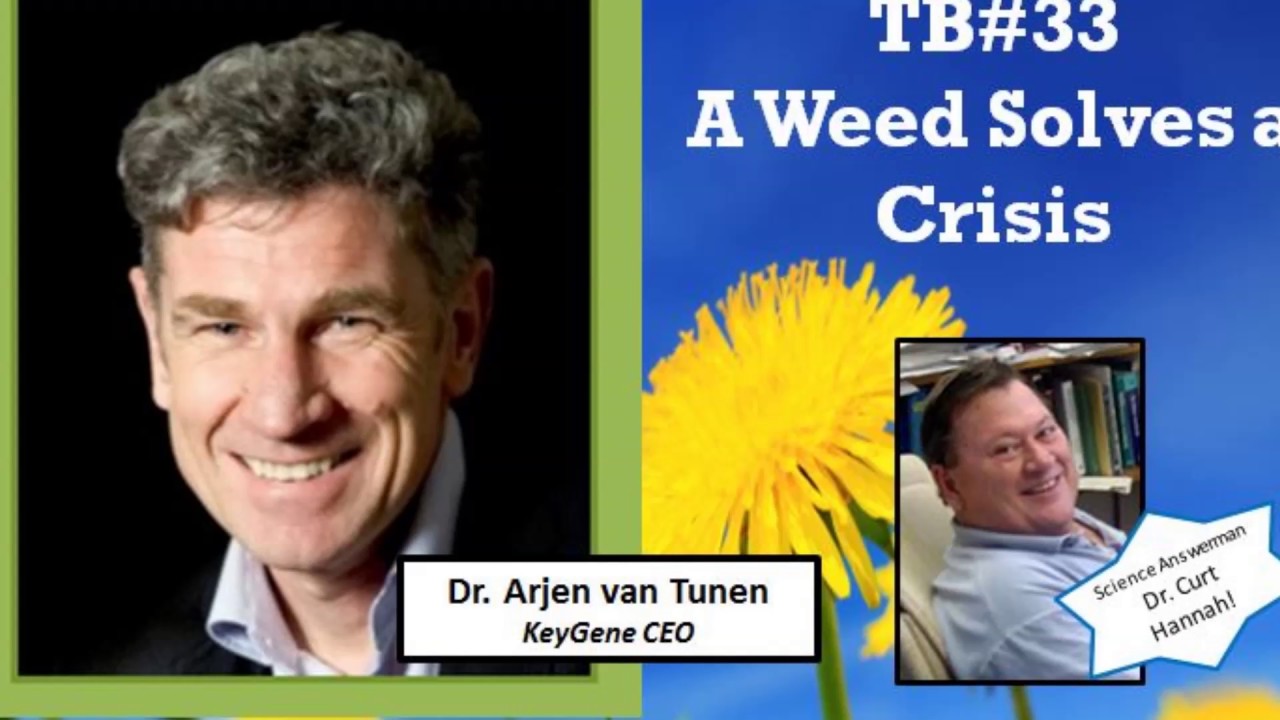
KeyGene is developing Kazakhstan dandelion as a rubber crop to address global shortages. The company uses hybridization to combine the Kazakh dandelion's hardiness with higher latex production, targeting commercial harvest in five years. Early prototype tires already exist, and growing dandelion on marginal lands could reduce pressure on tropical rubber plantations.
Questions this video answers
Dr. Curt Hanna explains that older hybrids disappear because they are no longer competitive, but their germplasm remains in breeding programs and is a valuable source of diversity for future varieties. Modern molecular markers and genomics accelerate the re‑introduction of useful alleles, and yield gains of about 1 % per year have been achieved through traditional breeding.
Chapters
I want to see science serve a useful purpose to improve the standard of living for all people.
Hey, why is anyone fighting food advance?
A very small percentage of the world's population is fortunate enough to have the luxury of turning down food.
We've arranged this society based on science and technology in which Because nobody understands anything about science and technology.
You can't build a peaceful world on empty stomachs and human misery.
You're listening to Talking Biotech, a weekly podcast illuminating issues in agricultural and medical biotechnology. Your questions and concerns are addressed using a science-based approach with the goal of driving discovery to application with communication.
Now here's your host, Hello and welcome to Talking Biotech number 33. Today, a couple good things. So first of all, the episode features Dr. Arjen van Toenen, and Dr. van Toenen comes from QiGene. He's the CEO of QiGene, and we'll talk about a plant that most of us don't consider to have tremendous value. And if anything, we think of as a nuisance. And it just goes to show you that sometimes we have to really look carefully at that with the raw materials that nature gave us, and that humans can shape them into very useful plant products. And this could have tremendous value going forward. I won't tell you what it is.
Haha.
I would be remiss to not address the 800-pound gorilla in the room. When I start the podcast, The introduction has 3 voices and 4 quotations. One comes from Penn Jillette, the magician and comedian and philosopher. The other one is Carl Sagan, and Dr. Sagan being recognized for his work at talking about science to the public interface, who certainly has always been a hero of mine. And the last is 2 quotations from Dr. Norman Borlaug, who— should be a household name. Nobel Peace Prize winner, an exceptional scientist who introduced genetics to areas of the world to serve the world's most poverty-stricken areas, changing the way that they had access to genetics and ensuring that more people would be able to survive because of improved crops. So I was very grateful this week to be not just nominated, to actually receive the Norman Borlaug CAST Agricultural Communications Award, which is really a tremendously huge honor beyond words. I think it was the first time I was ever knocked speechless in a while, and I just wanted to really express how grateful I am for this opportunity. And to be named to anything that would be associated with Dr. Borlaug certainly is the pinnacle of someone's career who would be dedicated to science and science communication and the application of science to solve human problems. And with that, it's something that has been— it's been a wonderful time since I've known that I would be receiving this award and looking forward to hopefully get using this as a platform to share more science and maybe even increase the audience of this podcast or whatever. So with that, I'll complete the podcast. Thank you all for listening. And we'll— No, yeah, you know, I mean, it's kind of a— it's kind of hard to imagine how You know, now what do you do? You know, it's, uh, it doesn't get much, much better than this. So, um, we'll, uh, go ahead with today's interview and, uh, we'll go from there. Thank you very much for listening. Uh, your kind words, your thoughts, your tweets, your reviews of the Talking Biotech podcast made it a significant part of the package that people looked at when they considered how to assign this, uh, Very prestigious honor, and I really appreciate that. So thank you very much for listening, and on to today's interview. Today on the Talking Biotech podcast, we go to the Netherlands and speak to QiGene CEO Dr. Arjen van Toenen. And Dr. van Toenen is, as I mentioned, CEO of QiGene, a company that is recognized for their edgy innovation in plant breeding. And I had the pleasure of seeing his presentation at the Plant Animal Genome meeting this winter in San Diego and just amazed me, and I couldn't wait to get him on the podcast. So welcome to the Talking Biotech podcast, Dr. Vantunen.
Yeah, welcome.
Could you tell me about Keygene and what the company does in more entirety?
Keygene is an ag biotech company, so we are one of the larger specialized, dedicated ag biotech companies in the world. I think the largest in Europe. And what we basically do is that we develop methods and also traits for improved crops and new varieties. So we call ourselves the crop innovation company.
Okay, and with the particular problem we're going to discuss today, or with— what is the problem that you're looking to solve?
Well, the problem we are looking to solve is the threat of a shortage of natural rubber. At this moment in time, rubber applications are widespread, and of all the rubber which is used in the world, around 45% for the rubber applications, natural rubber is required for quality reasons. Natural rubber is, is in much better quality than the synthetic rubber, and for those 45% of the applications, you need rubber coming from the Hevea rubber tree. And the issue there is that only in 2 countries— basically 80% of all the natural rubber comes from Thailand and Indonesia— There seems to— there is a shortage threatening because of the growing economies in the world. That's on the one side. And on the other side, it is also increasingly becoming more expensive to collect the rubber from the rubber tree with the increased prices also of labor in those 2 countries. So there's a requirement for more natural rubber, and there is a— that also requires an alternative crop. So we need other crops from which we can extract natural rubber.
And this was really the first I've known of this particular shortage, this, this particular crisis, was when I saw your talk last year at Plant Animal Genome. And really was amazing to me because I've always known that other plants produce a latex-type compound, but I never knew that the solution may come from a common weed. So what is the solution that KeyGene has proposed?
Yeah, by the way, there's one other strategic problem connected to rubber trees. In South America, where originally this tree is coming from, there is a fungus which is attacking those trees that makes it impossible to grow rubber trees commercially in South America. Unfortunately, the fungus did not reach Southeast Asia yet, but when that happens, that will inflict a big crisis on that crop, that rubber tree, the rubber tree plantations. So it's another reason to develop alternative crops for natural rubber. And basically, there are only a few options to develop alternative crops. One is wayuli, which is a plant growing in a desert. It's a kind of a— how do you call it? It's a bushy plant. And the other one is the dandelion, the Kazakhstan dandelion.
And the Kazakhstan dandelion compared to the one that we see in the Western Hemisphere where Western world where we see this small, well, bushy plant with a yellow flower. It's very familiar here and grows ubiquitously in any kind of plain or any kind of place in, in a landscape or front yard. And what is particularly attractive about the Kazakhstan dandelion that makes it a target for your work?
Yeah, the interesting thing about the Kazakhstan dandelion is that there is a latex, especially in the roots, but it's also visible a little bit in the In the leaves is the white milky sap, and from that latex, from that sap, from the roots of the Kazakhstan dandelion, you can, you can extract it and you can make a very high-quality rubber out of it. And basically, that is already known for many, many years, for centuries, because Kazakhstan people, they tend to go, go out in the, in the mountains where these plants are growing And they would extract, they would take a little bit of those roots and they would chew on it. So it's a kind of a chewing gum. So it was a gummy substance. And earlier this last century, it was also discovered that you can make even very good rubber out of it. And actually, in the Second World War, when we had basically the similar situation, Southeast Asia was not reachable for the German army, the American army, And also not for the Russian army. In the Second World War, Kazakhstan dandelion was commercially grown to extract rubber for the tires of the Messerschmitts and of the, of the trucks of the, of the various armies. So that's where it's coming from.
So why don't we use this Kazakhstan dandelion today in all of our rubber production? Why is this not a major cultivated crop as it exists from the wild?
Yeah, there's one problem with the Kazakhstan dandelion. It's a very tiny, tiny, tiny plant. So to commercially grow it, it is unattractive. And that's also the reason why after the Second World War, that crop disappeared. So when the necessity to grow it, because the other thing was not possible, Southeast Asia was cut off by the Japanese army occupation, then that crop disappeared. But we only need a factor of 3, let's say, increase of the amount of rubber produced per square hectare or per square acre, if you want. So that's what we're trying to do, to increase the amount of rubber production per square hectare. And when we can reach that objective, Then we have a commercial new crop available.
You're doing a variety of either crosses or other tricks in order to increase the size and the latex in the dandelions coming through this breeding program. So could you touch on some of the key priorities of that breeding program and some of the strategies you're using?
Well, the main strategy, The first and most important trick we are doing is that we are going to make an interspecific cross, which is a cross between 2 species, like crossing between, let's say, a donkey and a horse, as if you might think. And what we have done and are doing is making crosses between the Kazakhstan dandelion and the normal Dutch dandelion. And you probably also have normal dandelions in the United States. In your gardens, the normal dandelion is much bigger, and it can also get quite a big root. So the first thing we are doing now and have done is to make a cross between normal Dutch dandelion, common dandelion, and this tiny Kazakhstan dandelion. And we succeeded in doing that, and we have selected now plants which have the on the one hand the fitness. and the size of the common dandelion, and on the other hand, the capability of producing the appropriate rubber in the roots from Kazakhstan dandelion. So we have an interspecific cross, kind of a mule in the dandelion world.
Yeah, and that's a really important breakthrough in that you're able to have a good cross that has traits that reflect all of the qualities you want. But, you know, mules are sterile. They can't reproduce because of the interspecific nature. So is this a genetic dead end, or, or how do you propose to take this to the next level if you have this, uh, cross that, that is not necessarily full fertility?
Well, first of all, it's, it's not so easy to make the cross, and we did not do it just by— just like that. But we used DNA probing tools to follow the different genes from the Kazakh dandelion which are, which are involved in this rubber biosynthesis. And on the other hand, we also follow the genes which cause the fitness in the common dandelion. And using biotechnology, we could, we could make the, the perfect combination between those 2 types of genes. So the fitness genes of common dandelion and the latex genes, the rubber genes from the Kazakhstan dandelion, these were combined. And when you do that, you can simply self-propagate the crop you— which was derived from that. So that is in contrast to the situation between the cross between donkeys and and horses. In our case, the plants were perfectly fertile because Kazakhstan dandelion and common dandelion are much more alike than those two animals we were talking about.
Ah, okay. So they're close enough where you still can have fertile offspring. I wasn't— okay, so I was— I'm thinking about apomixis and apomixis that's occurring in dandelions and how How has this cross helped you to better understand that process?
Well, yeah, apomixis is the ability of a plant, and there are various plants who have that feature, to make seeds without fertilization. So the flower just grows, and without pollen from another flower, seeds are produced, and all those seeds are a perfect copy Genetically spoken, from another plant. So it's a clone. So it's clonal propagation of seeds. And in dandelion, that is very handy because if we are talking about production of rubber through dandelion, then we need a lot of seeds. And the cost of seed production, if we have to make individual crosses or if we have to use bees and humblebees to make all those pollinations, that is going to be very expensive. But if you have the capability of apomixes in that crop, then you have clonal propagation automatically. So you have seed production at a very low cost. And that keeps the whole picture producing a lot of rubber for a restricted amount of dollars. And that keeps that financial picture very affordable.
And it also ensures some genetic uniformity as well, because once you get the correct combination, you're now producing millions of clones. I mean, anyone who's seen a dandelion reproduce, you know that you have all of these seed heads that come through that composite flower, or all these seeds that come through that composite flower, that are, that are airborne and on the little parachute, you know, that gets blown in the wind. So you make a lot of dandelion seeds from one foundational plant, which Must be a really strong benefit to this approach.
Exactly, exactly. So if you make the perfect dandelion, you can very quickly propagate it in the same perfect genetic constitution. Yes, indeed.
And so why not just use a transgenic approach? Because they're, you know, a genetic engineering approach. We know the genes, as you mentioned, you know, we know genes that can confer size and robust growth. And we know the latex biosynthetic pathway pretty well, so why not just boost that in the one dandelion or increase size in the other?
Yeah, it's not so simple as it may sound because there are multiple genes involved in the synthesis of the rubber polymer itself, but then the rubber polymer also has to be produced in a particle, so an intracellular vesicle, and then that intracellular vesicle filled up with rubber polymer molecules, it has to be transported to the outside of the cell, and then it is excreted in special ducts. And so there is not only the synthesis genes which are involved, it's also the genes involved in, let's say, keeping the polymers on that latex particle. And there's also the excretion of the rubber, which is very important in the rubber ducts in the form of latex. So everything together, most of the genes we already know, but there are still a number of genes which are involved in synthesis of good quality rubber in the Russian dandelion Kazakhstan and the lion, which we still don't do not know. So there was also a little bit of trial and error in this whole system, which I described earlier. When we followed the genes from the Kazakhstan, then the lion, there were some unknown factors which we also had to select for. So it's it's more complicated than you think. It's not only one gene which you could use in the transgenic situation; it's a whole set of genes. And several of the genes are not even known, so a transgenic situation is not possible.
What were some of the other byproducts of this research with respect to understanding apomixis and that process by clonal propagation of seed production without fertilization?
Yeah, that's also very interesting. In normal dandelion, so the dandelion which grows here in the Netherlands, it's a very interesting phenomenon, but North of the Rhine River, which flows through the middle of the Netherlands, north of the Rhine River or south, I don't know, I always forget which way around it is, but north of the Rhine River, all the dandelions are apomictic, so they reproduce without pollination, and south of it, then the dandelions are sexually propagated, or the other way around, I have to check. And, and, and using that, that these 2 types of dandelions, we were very interested in identifying the 2 genes which are, which are involved in this apomixis phenomenon. And it's the DIP gene, diplospory gene, and it's the PAR gene for parthenogenesis. And basically what we also presented in a conference in California a couple of months ago, and half a year ago at the famous Mendel conference, 150-year Mendel conference in Brno in Czech Republic, was that we have identified and also cloned the DIB gene. So the first half of the apomixis process. And we are now busy characterizing that gene. And we're also busy together with Wageningen University identifying and isolating the second gene, the PAR gene. And when we have those 2 genes, we think we can start using and introducing Apomixis in other species, other— in the real crops, not dandelion, but real crops. So just to summarize, in dandelion for rubber production, we can, we can use the natural genes just by crossing. But when we want to introduce, for instance, Apomixis in corn or in soybean, we need the genes from dandelion and introduce those genes into corn and/or soybean or other crops by transgenesis. Because in corn, there is no Apomixis known.
That's right. And so, and I can think of 1,000 other crops where this would be an amazing breakthrough. But what— how would you describe that to somebody who— like, why would you want apomixis occurring in other crops? I mean, isn't this idea of genetic segregation and biodiversity a good thing? Or like, why would you want apomictic behavior?
Well, there's several reasons. For instance, apomixis could reduce the cost of seed production significantly. So that's one thing. Another advantage would be that if you have apomixis, you can immediately fix, let's say, a very beneficial cross. And you can, you can deduce and derive genetically identical seeds from that. So you can make a cross between one parent and another parent. And then you know for sure that when you induce epimixis, all the seeds coming from that child, or that offspring, will be identical. So you can very quickly fix an optimal cross and start propagating it through seeds. And that can speed up the whole process of variety development tremendously. For instance, in a crop like soybean, you can also make a cross between one plant and another plant, which is, which is very tedious to make, like for instance in In soybean, it's very difficult to make a cross between the father and the mother because it's self-pollinating so much. But when you have made a cross by very careful pollination, then you can immediately fix it through Apomixis. So speed of variety development, better variety development, and also lower costs of seed production are a number of the advantages of Apomixis.
One of the big ones I think about is getting around the problem of self-incompatibility. That where you have to include pollen from a separate, a separate variety in a, say, in an orchard or in, in some sort of large plant production scenario, um, like cherries or apples or— well, cherries anyway— where you have to have this alternative pollen source in order to produce your crop, that could this kind of genetic strategy get us around those problems of having to plant multiple genotypes or multiple varieties even though one of them is not used in the commercial production per se?
Yes, yes, indeed. And of course, you know, insects pollinate, and sometimes when we have, let's say, wet weather, that insect pollination can be a problem. So it will also increase the amount of seed production under bad weather conditions because you don't need the insects or you don't need so much of the insects. So there's a lot of, a lot of things you can think of here.
And that's just, uh, it's really— that's what one of the most exciting things about seeing your talk was. Here's a really great solution for a modern problem, this problem of decreasing latex availability, or rubber, for the production of rubber. But at the same time, you solved a really intriguing basic biology question that may have incredible application in the broader plant field, and it's pretty exciting. And where— when do you think that we would first start to see dandelion-produced tires for our cars and bicycles?
Oh, we already made a tire with rubber coming from Kazakhstan dandelion together with a Dutch-India company, a tire company, Vredestein. And so, and we already know that the tires made from that dandelion source are very good in quality. So we know already that we can do that. Now it's more a matter of scaling it up and also start growing our interspecific hybrids between common dandelion and the Kazakhstan dandelion in order to produce enough rubber. And probably the first applications will not be tires, but maybe shoes or, or gloves or other, let's say, applications of rubber in which the volume of rubber amount is, is much lower, much smaller.
I see. And that's, um, I just am— I get excited anytime I think about these kinds of breakthroughs, and it seems to be much more sustainable too compared to potentially rubber tree plantations. When you talk about the, the potential threats from the fungus, that's one issue, but how about just its agricultural impact? If you're talking about water resources or other inputs, is the dandelion something that looks really favorable compared to the traditional mechanisms of production?
First of all, you have to compare it with the current production method of natural rubber, which is rubber trees, which goes at the expense of the national forests in Indonesia and on Borneo. I think a number of the ape species are under pressure as a result of large-scale use of plantations. So that's number one. Secondly, I think there is an advantage in dandelion in that it is used to grow on marginal grounds. If you take a look at common dandelion where it's growing, it can grow under relatively poor, let's say, nutritional and water conditions. So my expectation is that the Russian dandelion crossed with the common dandelion, that combination, that it will grow under conditions in which it is very difficult to grow interesting other crops. And then the second thing is you have to, of course, compare it with the situation where we cannot allow ourselves to cut down the last forests in Southeast Asia to produce more rubber plantations. And so I think there's a clear benefit in switching Or partly switching towards the use of dandelion as a source for rubber.
What kind of timeframe are we looking to for us to begin to see Apomyxis and other plants and rubber from these interspecific hybrids? When will we actually see those products?
Yeah, rubber with the interspecific hybrids, we expect that within the coming 5 years or so, we will start producing the first commercial harvest for product applications. And we are not doing that alone. For instance, we are in the rubber program, we are collaborating with a US company called Cultivate and also with a number of organizations including Wageningen University here in Europe and with the Kazakhstan government. So we expect in the coming 5 years that we will have the first commercial harvest. Together with our partners. And then for the upper mixes, I think it will take longer because there we are still in the process of identifying the second gene and introducing this phenomenon in, in another species. So my expectation is that there we need between 5 and 10 years before, before we can come up with first applications.
So Dr. Arjen van Turen, Thank you so much for your time today. I really appreciate you telling us about this, uh, very interesting breakthrough and very interesting opportunity. Uh, thank you very much for joining me today.
You're welcome. Thank you.
That's Dr. Arjen van Toenen, the CEO of KeyGene in the Netherlands, coming up with interesting ways to make the rubber literally hit the road in the future. We'll be right back after this short message with Hello everybody. Now you might have noticed that the Talking Biotech podcast frequently incorporates guest hosts. The goal here is to expose those interested in science communication to a wider audience, and maybe provide a friendly entrance to how to actually engage the public in a meaningful way. Now it's always hard to find a guest host take who is interested in the topics we cover, that first step, but I'm glad to offer this platform for you to tell your story, and work with me in discussing new technologies with people that created them or understand them well. So if you're interested in joining me as a co-host, send a note to talkingbiotechpodcast@gmail.com and let me know. We'll devise questions together, we'll find fun ways to make you part of the discussion, Heck, you do the whole damn thing. I'll just listen. Remember, science flows best when innovation moves to application, and that takes communication. If this vehicle can bring more voices to the discussion, it only amplifies my interest in sharing the beautiful stories of science and technology that can help people and help the planet. Yeah, I'm embarrassed as hell to I'm glad to be able to say that that is a Musek version of Mac Davis, I Believe in Music. So I got an interesting question this week by Twitter, and unfortunately was only able to partially answer it, so I thought I would ask an expert. And being surrounded by experts, that's easy to do, so I sent someone out with a microphone to interview Dr. Curt Hanna. Let's see if I can find him. Vern, are you there somewhere?
Yup, I'm here!
How's it going? Doing okay?
Yeah, it's good to talk to you too. This is an interesting thing, doing the remote podcast.
Yeah, so are you there with Professor Hanna? How's he doing?
Yeah, he's here too.
Okay, why don't you just go for it then? Thanks.
Okay, so this is Vern Blazek sitting here with Dr. Curt Hanna. Curt Hanna is a professor at the University of Florida in Gainesville, Florida. He's an expert on something called ADP-glucose Something that sounds like a diabetes drug or something. You know, is that accurate?
Well, not quite, but first, glad to meet you face-to-face, Vern. No, ADP-glucose pyrophosphorylase actually is an enzyme involved in starch biosynthesis. It's found in all plants, bacteria, And it's, it's an important enzyme because it's, it's a regulatory step in the pathway. Starch is important because it makes up about 70% of the dry weight of a seed.
Okay, so you said a lot of real fancy stuff there, which is good because I'm here to ask you a question from one of the listeners of the Talking Biotech podcast that had a question.
About corn.
The question comes from Jeff Holmos. It says, the claim I keep hearing is that GM food crops are reducing variety, that certain types of corn can't be found anymore. Your thoughts? So asking you, Dr. Hanna, what are your thoughts on that question?
Well, technically the statement is correct, and And it's correct because the old hybrids are just no longer competitive. It's very similar to our cell phones. I'm old enough to remember when people used to carry bag phones around as their cell phone. Cell phones certainly have improved over the, over the years and we no longer see bag phones. And the same is true with hybrid corn. New varieties come out every year that are superior to the ones in the preceding years. So technically it's true, old hybrids go away, kind of like the Edsel car went away because it wasn't competitive. The important point though is that the germplasm that was used to develop those hybrids is still available and still being used in breeding programs. It's valued not only because of the diversity it represents, but also because it's a good source for future hybrids as the environment changes. These old lines will be valuable, and they're valuable now as gene sources.
And one comment I've heard Kevin make before, is that it seems like we're past the bottleneck, that modern molecular tools and genomics technologies allow scientists to perhaps be able to more rapidly introduce these older lines back into more elite lines. And how much truth is there to that, that we actually are seeing more diversity than maybe we've seen in the previous decade or so.
Well, that's—
Kevin's statement is correct. These new techniques of molecular markers and things allows the breeders to follow these things much more efficiently. The other point that should be made with corn is there's roughly 40,000 genes in the genome of corn, and about 5% of these, about 4,000 of these genes are not found in every corn line. So breeders add and subtract genes in the new varieties via breeding. And there are also systems in corn that actually synthesize new genes by taking pieces of old genes and putting them together to make new genes. So simple traditional breeding has actually introduced new genes in the past.
How do breeders actually know that a new hybrid may be superior to the old ones?
Excellent question. This is done by, by testing. New hybrids are grown in many locations throughout the world, and there are actually some interesting data Developed where people have looked at hybrids, looked at their yields as a function of when they were released. And the data form a very interesting pattern. The breeding efforts lead to about a 1% increase in yield over time. So in, say, 50 years, Just by traditional breeding, yield has increased 50%. So new hybrids are looked at quite extensively, tested in many locations throughout the world, and certain hybrids are deemed superior for particular areas of the country. So one hybrid may not be superior, say, in northern Illinois versus, say, southern Missouri or northern Florida. So these are, these are environmentally sensitive differences, and each, each variety is chosen for a particular location.
Well, that's really wonderful. So you're not just a professor, you also have been known to fall off a combine here and there. So what, what do you know about farming?
Uh, interesting point. You've been talking to some Some friends of mine, I can tell. Yeah, I was born and raised on a farm in Indiana and remain active in the farming operation. I do go back every fall and run a $300,000 combine. And yes, I did fall off and broke some ribs, actually. Unfortunately, it was the beginning of the season and I had to continue harvesting and Well, Professor Emeritus Kurt Hanna, thank you so much for your time today.
This is Vern Blazek for Talking Biotech, and back to Kevin Folta at the mothership.
Thank you, Vern, and thank you, Professor Hanna. Always wonderful to work with experts who can answer someone's question. So if you have questions, send it to me at talkingbiotech@gmail.com, and if I can't answer it, I'll track down one of the 50 colleagues I work with, or the hundreds of people I work with who can't answer that question, and we'll take care of you. So, so ends episode number 33, and I want to thank you for listening. But more importantly, I want to thank you for your support over the last year or whatever it's been. It's been the support of strangers, people who I don't know reaching out and saying thank you, people saying defending me online. People discussing the reality of the science and the reality of what I do with the people who don't, and, and, uh, and the people who want to really malevolently, uh, kind of tarnish my record and reputation. I appreciate that a lot. When I was off on hiatus from November to February, I would, uh, run and listen, hear the theme song of this podcast. I would hear those quotes going on in my head. I'd listen to the episodes, and I'd be so upset because I just wanted to be back doing this. And it really means a lot, not just to be back here with you, but also to receive the recognition of the Borlaug Award. That really, um, that's like I said earlier, where do you go from there? Um, it really is a An honor beyond words. And we all need to be stepping up and taking care of the work that he's no longer here to do. We've got big shoes to fill, and, um, and we need to step up our game to make sure that we're moving technology into the hands of those who need it. So I will conclude that for today, but listen to this. It was a song that was produced I can't remember the guy's name who does this. I met him; he's really good for CIMMYT, the International Center for Maize and Wheat. And it's all actual interviews or words of Dr. Borlaug that have been melded together musically and tell a beautiful story. So thank you so much for listening to Talking Biotech. Listen to this, share it with some friends. Thank you very much.
I grew up on the land. On a small farm in northeast Iowa, I felt that families on the lands needed help from scientists, and I dedicated my life to science. The first and foremost problem in this crowded and overcrowded world is one of food, and the magnitude of the problem that confronts us is fantastic and frightening. In many parts of the world, yields are very low. We cannot continue to ignore this problem of food. Food distribution is of prime importance to solving human problems. How do we draw attention to its importance? It has to come from within. And I am not one to sit idly by and see man increasing his numbers faster than food production. We must continue to improve our technology if we are to keep pace with this growing demand for food, if we are to have a stable world. The good farmer is the person who can put all Plants talk to you. They tell you whether they're healthy, whether they're happy, and the way they The way they grow and develop is an outward manifestation of this. The plants will talk in a quiet, intelligent voice. You have to live with them. You have to feel their pulse. This is very critical. Look what happened to the dinosaur. When he lost his ability to change, he became obsolete. Is this the destiny of the human species? And I am not one to sit idly by and see man increasing his numbers faster than food production. I am not one to sit idly by. If I have anything to contribute to this world, I'm going to play that card and play it hard. When I know that our scientific facts are right, I'm going to play that card and play it hard. It is my hope that all who are When children are born into this world, we can provide with the basic necessities for decent, humane life. And this seems to be urgent to me, to try to help in some small, modest sort of way. We might be surprised how much we could improve the environment.
More from Kevin



Talking Biotech 503 - A New Strategy in the War on Obesity. Dr. Erik Issacson, Wave Life Sciences

Organic Production, Conventional Agriculture, Health Anxiety, and Social Media Disinformation

Stop Political Appointees from Grant Decisions - Dr. Colette Dalawalla, Talking Biotech 501




