Talking Biotech 037 -- Gene Editing Virus-Resistant Pigs
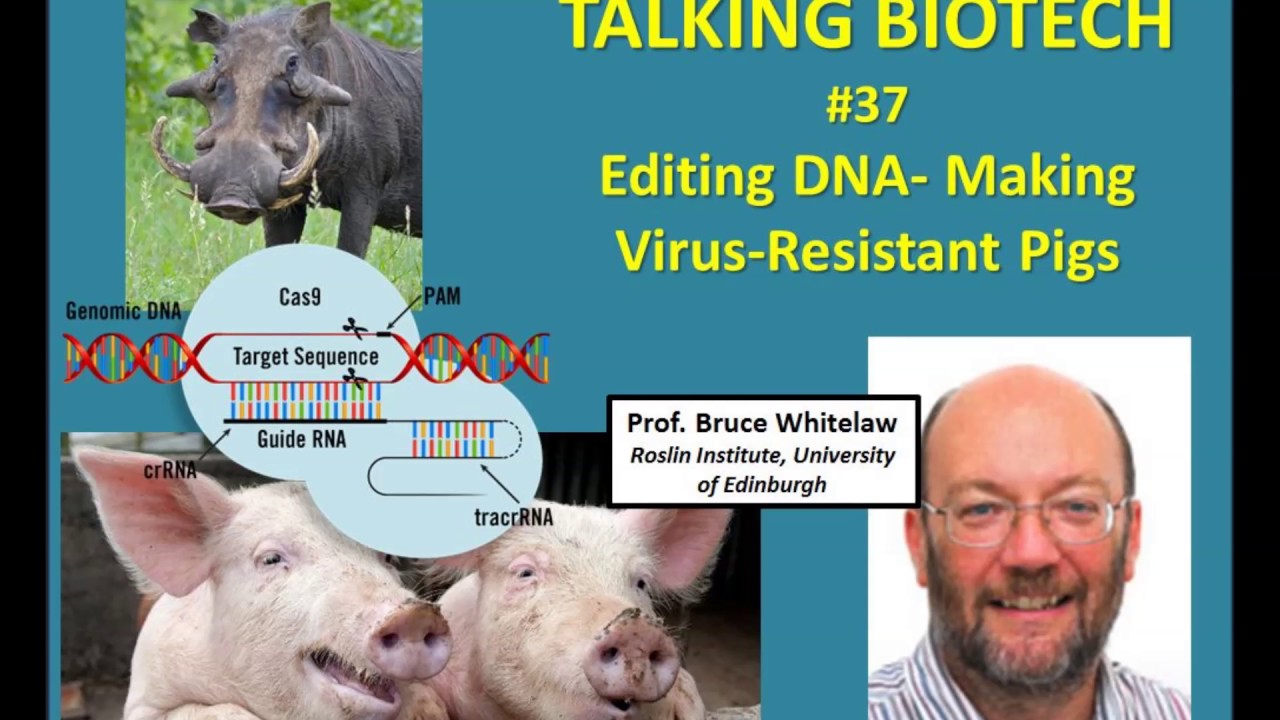
Bruce Whitelaw at the Roslin Institute used CRISPR to give domestic pigs a gene variant from African warthogs that makes them resistant to African swine fever, a lethal virus with no vaccine. The edit changes a single amino acid in the RELA gene. Challenge trials start this year.
Chapters
I want to see science serve a useful purpose to improve the standard of living for all people.
Hey, why is anyone fighting food advance? A very small percentage of the world's population is fortunate enough to have the luxury of turning down food.
We've arranged a society based on science and technology in which Because nobody understands anything about science and technology.
You can't build a peaceful world on empty stomachs and human misery.
You're listening to Talking Biotech, a weekly podcast illuminating issues in agricultural and medical biotechnology. Your questions and concerns are addressed using a science-based approach with the goal of driving discovery to application with communication. Now here's your host, And now, your host, Dr. Kevin Folta.
And welcome to the Talking Biotech Podcast, the podcast where we're not just learning about the newest breakthroughs in science and plant genetic improvement, animal genetic improvement, medicine, but we're also learning about how to talk about them with a skeptical public. And my name is Kevin Folta. I'm a professor, I'm a scientist, I have an active research program. And my third full-time job is going out and talking to people about science. And I'm very glad that you've listened to this today because today marks a milestone in Talking Biotech History. Today we'll have someone out there will have the 200,000th download, and for that you will win a podcast about pigs. And I wanted to joke with my guest today so bad. I, I, the whole— during the whole interview I'm thinking Somewhere you gotta sneak in Jurassic pork. Gotta sneak it in, and I didn't, so blew it. But, um, today's guest is, uh, Dr. Bruce Whitelaw from the Roslin Institute in Edinburgh, Scotland. And the Roslin Institute is the place that's famous for Dolly the sheep and Helen Sang, our guest on episode number 7, and a variety of other scientific endeavors that have to do with genetic improvement in animals. Now this is especially important because the genetic improvements are coming from gene editing, or this CRISPR-Cas9 system, and if you don't know this, please get acquainted with it because it will be defining what's happening in the future of biotechnology and is the newest edge in precision improvement of plants, animals, and as we saw last week, Fungus, with the mushroom. In episode 2, we spoke with Dr. Alison Van Eenennaam about gene editing in cattle and how they were able to change a transcription factor so that dairy cows would not grow horns. They could get around the process of polling, where they have to physically remove or scoop out the tissues that would lead to horns in a mature animal. In the future, we'll talk about double muscling in livestock, also a CRISPR-mediated change in genes that causes them to gain more mass, more muscle mass, which could have tremendous capacity to change the way different meat is produced in animals. Now again, all of this is done with the newest technology in gene editing, and it allows scientists to make these precise changes in existing genes. It's like we're using a word processor to edit DNA. It's kind of like once I had a grant proposal that had the autocorrect on there, and I had a typo. Instead of transgenic plants, it said transgender pants, and that was— I left it in. It didn't get funded, and in the review of the proposal, it said that they wouldn't fund it until I had evidence of matching shoes and a decent handbag. So, touché. Teach me one. But thank you very much for listening to the Talking Biotech podcast. This is a wonderful interview today, and really hope you like it. Thank you again for listening. Today on Talking Biotech, we'll talk about swine and some of the breakthroughs that are occurring at the Roslin Institute over in Edinburgh in the UK. And with us today, we have Dr.— or Professor Bruce Whitelaw. And Professor Whitelaw is the Genus Chair of Biotechnology at the Rosalind Institute, also the head of a central research division in that institute. And you may recall from previous that we've spoken with Helen Tseng from the Rosalind Institute, a place that has quite a history with respect to the way that animals can be— or, well, many organisms But particularly breakthroughs in animals that really can influence down the road agriculture and food production. So welcome to the podcast, Professor Whitelaw.
Glad to be on it.
Could you start off by telling us about the particular problem? What, what, what is the problem of African swine fever, and why— what are the symptoms, and how bad is it?
So at Roslin, we are keen to use some of the new technologies to look at livestock diseases, diseases that currently are not treated by drugs, or we don't have either available or effective vaccines. And one of them is a disease called African swine fever, caused by a virus. It infects pigs, and pigs that are susceptible to this disease go into a cytokine storm status leading to massive hemorrhage and die within 5 to 10 days.
And how—
The disease itself— sorry, the disease itself is obviously, with a name like African swine fever, the disease itself is prevalent in Africa, but is spread by soft ticks and can also lie dormant in processed meat for perhaps even up to a year. And either through the spread of ticks or by the disposal of processed meat, the disease is now endemic in Eastern Europe and parts of Russia and the old Soviet Union.
I've read about some of the outbreaks in Poland and maybe Lithuania, and it really is a major problem in some of these areas.
It is, and previous to this outbreak— well, it's no longer an outbreak, it really is endemic— previous to this, the disease was only thought to spread by the soft tick, and occasionally the winds of Africa would blow this into Europe and we'd have small outbreaks, which European farming community dealt with by cull. But it now appears that some processed meat was discarded, probably from a ship that came into the Black Sea maybe nearly 10 years ago. And from there it has now spread, as you said, into vast areas of, of Western Russia and associated countries like Ukraine. And now in Eastern Europe, the perhaps the complicating factor in those that part of the world is we have a population of wild boar that exists there, and it is possible that the wild boar species is helping the spread of of this disease. But it is slowly stepping, you know, it's slowly marching. Westwards through Europe, and the farming communities in Europe are quite worried about this. It is not only Europe that suffered from this virus. In the past, there has been outbreaks within the Central America Caribbean area, and America is not immune to the potential of it appearing. Because we have no vaccine, because we have no way of treating it, Beyond cull, once it appears in a country, unless that area has an absence of wild pigs, it will spread. Thankfully, the virus only infects pigs, but unfortunately, when it does, at least the majority of animals on the planet, pigs on the planet, it will kill them.
But it doesn't seem to affect the wild pigs? I mean, you mentioned the boar. Are the boars just a repository of the virus that then can spread to domesticated populations, or are they affected as well?
They are affected as well. And the proximity of animals leads to a rapid spread, which sort of overcomes the fact that the disease is so rapid in its effect. But if a wild boar was to be infected out in the woods and die from this, The actual meat of that boar would still be infected for some considerable time, perhaps up to a year. In effect, within pigs, and this is very much a gross oversimplification, but we have 3 types of pigs on the planet. We have very ancient ones that live in Indonesia called the babirusa, a very ornate animal with multiple tusks and hair. We have Africans, African pigs, indigenous pigs in Africa like the bush pig or the warthog, and you have everything else, be it a large white, a wild boar, a mini pig, be it black, be it white, be it brown. And unfortunately, this virus, when it infects one of anything else, will kill it. And it's only the African pigs that appear to have some level of resilience to this virus. They're not resistant, they tolerate it. It is possible that all pigs in Africa are seroconverted for this virus.
And so that really ties in with the approach that your group has taken, that, you know, what is it that makes these African warthogs not develop the same symptom spectrum, at least the same penetrance of the, of the presentation of the disease, that you see in domestic pigs? And what is it that's true about them that you've uncovered?
Well, that's exactly the approach. We knew that the virus was the same, but the host must differ genetically in its response to that virus. So we— colleagues here in the United Kingdom were looking at proteins that the virus encoded, specifically proteins that the virus produced which suppressed the immune system of the infected animal. One of those proteins goes by the very unelegant name of A238L. And when we looked at this protein, it structurally resembled a factor which is common or present within the immune signaling pathways. And specifically, this was a protein factor in what's called the NF-kappa-B signaling pathway. NF-kappa-B is a nuclear transcription factor which drives the expression of most— certainly most immune genes at one time or another. So here we had a viral protein which looked like the repressor of this pathway. So we then looked at genes encoding the various proteins in the NF-kappa-B pathway. Pathway in pigs. And we took samples from your production pigs that you'll see on your farm, your large white or your landrace type animal. And we took samples from African pigs, the bush pig and the warthog. And we sequenced these genes. And for the initial part of this project, it was quite downheartening because when we sequenced these genes, they were all exactly the same. And this PhD student I had on the project kept coming to me saying, Bruce, I'm not sure this is such a good project after all. But then we hit what I believe is the jackpot. We came across a gene called RELA. It encodes for a protein called p65. And p65 is one of the major components of the dimeric NF-kappa-B transcription factor. So here we had a mutation in a protein central to the signaling pathway that the virus actively suppressed in the animal. When we looked a little bit closer at the sequence, not only was there this— and it was like a barcode. If you looked at sequences, any sequence from a warthog or bush pig, there was one sequence there. If you looked at the sequence from any other pig that we could get our hands on at the time, there was another sequence. You could differentiate based on this one gene where in the world, or you could identify whether the animal was African or not. And when we looked at the sequence in a bit more detail, it was a part of the protein which included an amino acid which was phosphorylated. Now phosphorylation is one of the primary ways of regulating nuclear transcription factors. More than that, we know in the human p65 protein that that site or the equivalent site is involved in regulating the activity of NF-kappa-B. So here we had a mutation in a gene which we know that the virus interacts with and a mutation that was at a site which we know should be involved in regulating the activity of that gene, that protein. And we hypothesized that that would therefore regulate the level of NF-kappaB activity in pigs.
And so maybe just to distill this down for the audience members that understand the science but aren't molecular biologists, the basic idea is that this NF-kappaB signaling pathway, this is conserved across mammals, or is this— how far does this go in terms of Fungi, or where else do we find NF-kappaB?
Doesn't quite go down to the lower life forms, but most of the vertebrate species, if not all of the vertebrate species, will carry NF-kappaB.
Okay, so NF-kappaB is a pivotal transcription factor. As most people know, this is a kind of protein that regulates basically whether you can turn on or turn off a gene, to say it in lay language. That essentially binds DNA through specific sequences or binds proteins that are binding DNA to regulate whether or not that gene is turned on or turned off. And in this case, NF-kappaB has a— in the warthog has a specific mutation that changes the way it's phosphorylated or the way other enzymes would add a phosphate group to that or phosphoryl group to modulate its activity. So it's basically a decoration on the protein that changes the way it behaves. And in this case, this enzyme from the warthog or bush pig is missing that particular— has a mutation in the sequence that provides that site for that modification that changes its activity. Does that seem to fit pretty good?
That's perfect. Absolutely perfect.
Okay, so basically it's— and this is really common. I mean, we see this all over evolution. That here's a— here obviously this pig survives, is very strong selection pressure on being able to tolerate a viral infection, and obviously this particular mutation may have been the basis for the selection. But now you have these multiple pools of pigs, you know, this warthog and then the domestic pig, and why can't you just breed them together and maybe transfer that gene that way?
So we use the word pig in common language for a whole variety of animals which are actually different species.
Ah, okay.
There are a variety of pig species, and the bush pig and warthog are unable to interbreed between themselves because they're different species. And obviously they are different species to our production animals that we have. I mean, the similarity between the bush pig or the warthog and the domestic pig is somewhere in the range of us to marmosets.
Oh, wow. I see. I would have never have guessed that. I thought these were all, uh, you know, they all have very, uh, similar body morphology and they, you know, they all, I would have guessed, you know, that we just domesticated these, uh, uh, you know, very rough looking, uh, you know, tusks and boars and things like that. that we just domesticated those things, and maybe that was what we were looking at, but they're a whole different species.
Whole different species, yes.
Okay, so how do you make a transgenic, or how do you do genetic engineering in a pig? And we've talked about plants before, and bacteria, and yeast, but how do you do this in a mammal?
So our approach is to manipulate the zygote, the fertilized egg, and we deliver the tool into that zygote. We isolate oocytes from donor animals or from slaughterhouse material, and we fertilize that at our experimental farm, and then we microinject into that fertilized zygote the tool to do the genetic engineering. Now, genetic engineering is quite a broad term, and Traditionally, and I suspect most people listening to this perceive it as a transgene or where you take a gene from one source and you put that into the genome of another organism in an additive manner. And certainly that type of approach has been successful and we've recently seen the first transgenic animal be regulated such that it could enter into the food chain with the AquaAdvantage salmon, the AquaBounty AquaAdvantage salmon, which is transgenic. So it has this extra gene in there. The new tools we have allow us to edit the genome. They are called genome editors for that reason. And what this allows us to do in in a genome. It's going and very precisely change the sequence at our target locus. So these editors are proteins, and we deliver them as an RNA, which the cell then translates to make the protein, the functional protein. And we deliver the RNA to the zygote, our fertilized egg, and Translation happens in the cytoplasm, and the protein migrates to the nucleus and causes the effect.
And that effect is exactly the effect that you have now prescribed in the newly edited cell. So, and then let's take a break right there, Professor Whitelaw. We're speaking today with Professor Bruce Whitelaw from the Roslin Institute in the University of Edinburgh, and we'll be right back with more Talking Biotech.
This week marks a milestone in Talking Biotech history, as someone out there will be the 200,000th download. That's pretty exciting. And when we look at the numbers, there are more downloads every week, except for that coffee or papaya one. Those went off the charts. Now lots of you ask, what can I do to help? And the answer is still the same. Tell a friend, write a review on iTunes, or run down the street in your town naked screaming Talking Biotech Podcast. I did that, and soon a number of law enforcement and mental healthcare professionals were acquainted with the podcast, and now It's all about sharing the stories of science and how technology can help people and the planet. So thank you again for listening, and now back to the Talking Biotech Podcast.
And we're back on the Talking Biotech Podcast with Professor Bruce Whitelaw from the Rosalind Institute. And we're speaking about CRISPR-edited pigs, how an allele from warthogs, or from wild pigs, has been brought into the domesticated pig to help alleviate issues associated with African swine fever virus. So, Professor Whitelaw, what can you tell us about these gene editing technologies?
If I may just go into these genome editors in a little bit more detail.
Sure, sure.
We, we have them in different flavors, and they have different names. They're zinc finger nucleases, they're TALENs, and they're now what's called the CRISPR-Cas9. And the CRISPR-Cas9 is the one that's igniting the world with excitement about how broadly applicable this tool is. In effect, they all do the same thing. They do it in different ways, but they all do the same thing, and that is they They have the ability to recognize a specific sequence within the genome, one sequence in the genome, and they then function like a molecular scissor where they cut the DNA. They are endonucleases in their enzymatic activity. So they will cut the DNA directed at that very specific site. Now, DNA damage or DNA ends is bad news for a cell. It triggers a whole cascade of mechanisms to repair it. The cell would slowly progress into cell death and be destroyed. And the reason why we have horrible diseases such as cancer where cells grow uncontrollably is that these processes have been overcome and altered. So natural processes exist in every cell to repair DNA damage. So once this genome editor cuts the DNA, causing the— usually causing a double-strand break in the DNA, these processes come into play. Now, they're very good, and they're good enough to keep most of us alive for many decades, but they do make mistakes. And those mistakes are what we capture in the first strategy that we have. So the genome editor will cut at the site you want, the repair will come in, and it'll make a mistake. It'll either put in a small insertion or a small deletion. We call that an indel for insertion and deletion. We cannot control what that indel will be. It might be 1 base deletion, it might be a 6 base addition, or so on. But we can determine exactly where it is. Now, if that target site is within the coding region of a gene, which is governed by what are called the tri-base— 3-base codon structure, it causes a frameshift if it's not a multiple of 3, and that frameshift will invariably cause a truncation of the protein. So we can go in with these molecular scissors, cut where we want, and the result will be, by this error-prone repair mechanism, will be a truncated protein. That process is called non-homologous end joining. The other approach we've got, which is even more elegant, is where we put in to this mix a DNA template carrying the sequence of choice. Invariably, that DNA template is used by the repair mechanism to repair the double-strand break. And in doing so, you can create a mutation of your choice at your site of choice. In this case, in that strategy, homology-directed repair strategy, What we're trying to do is change the sequence of our target gene. So in the case of our RELA, we've used both approaches. We've generated a truncated RELA protein, and we have changed the sequence of the RELA gene at the target site to carry what is the warthog sequence, or And in genetic terms, it's called an allele.
Yeah, so just, uh, maybe I'll help step this back for other listeners as well, is that, you know, this idea of gene editing is great because for those of us remember a set of encyclopedias, it was this set of, what, 30 different books that all had all this information before you had the internet. And you can think about a transgenic approach, like you mentioned the salmon or many different plants is maybe adding a new chapter to one of those books and just adding, you know, a few paragraphs to one of those books. Gene editing allows you to change the letter E to the letter A in one of those sentences, in one word. It's a precise, very specific approach that really is changing and revolutionizing our thinking about the way we're going to induce genetic variation. And really what your approach did is use this kind of guided template approach that allowed this CRISPR-Cas9 system to essentially take the domesticated pig and provide it with the warthog sequence. So now the sequence that makes the warthog asymptomatic because of the modification to NF-kappaB is now resident in the domesticated pig. And so do I have that all right?
You have that correct.
Okay, I just want to make sure I get it right so that others When they ask me later, you know, we get this, get this right on. So, but so the changes is really pretty small then. You said just a single base that maybe would change that phosphorylated—
It's a serine. So the difference between the African warthog and the bush pig are 3 amino acids. So we've created 3 base changes to change all 3 amino acids. We're also in the process of just changing the Serine, which we think is perhaps the most important. We have tried some in vitro cell culture studies to look at the different activity of these mutations, and they each seem to— of these three mutations, they at least in a very simple cell culture assay, they all seem to have some sort of activity, or the majority of the activity is associated with the serine. So. In the animals that we have on the ground just now, we have changed those 3 amino acids and just those 3 amino acids.
And I love how you say the animals on the ground. So you do actually— so this has worked so far, you have animals produced by this process?
Yeah, we have a series of animals. We've used both the homology-directed repair and the NHEJ approach, so we have animals with a truncated or shorter version of the protein, which takes completely or removes completely the distal transactivation domain where this site exists. We've also got animals that have the 3-amino acid change, and we're in the process of making animals which have a single amino acid change.
Oh, very good. And have they been tested for the disease yet?
Not yet. So the animals we have are generated— we generated the truncated animals a couple of years ago now. They're now being bred up for a test cohort. The issue with this is we have to go through 2 generations to ensure that we have got enough animals to do the testing.
Mm-hmm.
With the case of the amino acid changes, we're just at the first generation, so we're still a good 12 months away from challenging those animals, which are the ones that we're most excited about. The ones— the deleted, the truncated RALE, we'll be testing those later this year.
And so what has the public perception of this been? Because I've seen some play in the popular press and some discussion of this, And nobody seems to be too upset about this. And I think with the depth of the disease and the spreading of the disease, it would seem this would be really welcome, that people would be throwing money at you to get this out faster. But what has the response been?
Well, the response has been, from the money perspective, the response has been positive in that we have got both public and private funding to pursue this project and other similar projects. And there certainly is within the United Kingdom an interest in exploring how this genome editing technology can be utilized for the benefit of society. The same is true in the US, and there are a number of projects there that are progressing with both fusion of public and private public and private funding. From the case of the public, I think the public are certainly intrigued with these new tools from the perspective that they are precise. They change just single bases, and we all have different mutations and carry different versions of genes, so there's nothing different about that. I think the fact that certainly for the CRISPR-Cas9 version of the genome editor, the ease of its use means that most molecular labs, most universities around the world now are using the CRISPR tools. They are cheap to buy, to make, and very quick. And that ease of use has led to a huge range of types of applications, including discussions about whether we should ever edit the germline of human beings. And this gives the whole field a huge profile. And I think there's a momentum behind that which is very positive. And the stories and the scientific stories, the studies and reports that are coming out are all showing the power and positive impact that this technology can have. Now, the other aspect of the work that we're doing here, and I think we benefit from that as a research organization, but I think the realization that society can benefit if we— if our hypothesis is correct that these genes are involved in Diseases. It's the fact that we're actually trying to alleviate some of the distress that goes through animals. When there's an outbreak of African swine fever, yes, the pig is killed and disposed of by burning in some way or other, but there's a human being that has to kill that pig. So there's a welfare impact on the animals themselves, obviously, but there's also a welfare impact on on the individuals doing this process. So I think the fact that we're looking at something which should alleviate stress both to the animal and to the farming community is seen as a positive thing. Having said all that, we are still in a hypothesis situation. We predict, and I've given you the basis of the argument for why we think mutations in RELA might be helpful. And we will challenge the animals to try and determine if that is correct. It is possible the hypothesis is wrong. That's what a hypothesis is about. We might find that this gene is not the one that is leading to the dramatic difference in sensitivity to this virus between different pig species. Or indeed we might find it is a beneficial from the point of view of infection with this virus, but it could actually affect other traits that the animal has that would be undesirable either to the animal or to the farming community. So we're on a journey.
Well, that is an excellent point because NF-kappaB, I'm not that familiar with the animal literature around that particular protein. I remember looking at it a lot back when I was studying molecular biology back in the '90s. But you could assume that a rather pervasive transcription factor that's critical to development— because NF-kappaB even plays a role in early— as I recall, even has an early role in pattern formation in the developing zygote, as I recall. But there could be other collateral effects, and you won't know until the—
No, you're absolutely right. And obviously one of the mainstream approaches of molecular geneticists in working with the mouse is to knock out genes. And this gene really has been knocked out of the mouse genome, and the result is embryonic lethality.
Yeah.
So we were quite— no, we're not knocking the gene out. We're just tweaking its activity level. But, you know, this was a real risk when we started the study, and we now have viable animals. We have 3rd-generation viable animals. They appear to reproduce normally.
Mm-hmm.
We have not seen any disease, albeit the animal numbers are still low, but we've not seen any increase in disease or any other impairment on the animal. so far. Now, again, this is perhaps one of the real powers of the genome editors, where you can destroy the activity of a gene, you can destroy the gene completely, but it's more powerful when you just change the allele, just tweak it slightly such that maybe it's slightly more active or slightly less active. And the genome editors give us that ability.
Well, that's really— and that's what's nice about this. This is because you're not just making uninformed changes in a protein to make changes and see what they do. You're letting evolution guide you. You're looking at the blueprints from a warthog that can survive this and then testing the hypothesis that the same change in a domestic pig background will confer the same trait. And it worked great with the polled cows where they can eliminate the horn gene.
That's right.
Looks pretty good. And when these cases of double muscling and some of those cases which have also been, or will be guests on the podcast as well. And for me, I work in an octoploid organism. I work in a strawberry plant which has, you know, you're looking at 4 complete sets of chromosomes, or well, 8, you know, sets of chromosomes. And there, CRISPR-Cas9 gives you the capacity to be able to induce alleles throughout all of the homologous chromosomes that you would take years to do with breeding. And so this is a technology that I, I'm so happy that you joined me today because I want people to get more excited about the good things we can do with the newest technologies and why these are so enabling.
The scientific community is just fully engaged with certainly the CRISPR-Cas9, and every month, every week, we hear of multiple publications in the scientific press leading to improvements, versions that will give less off-target or different things. And we're not at the end of the journey yet. These tools are a revolution in molecular genetics, and they're just going to get better and better. The other aspect is it leads to the scientific— or it leads to people conceiving new strategies of how we might augment the genetics of animals and organisms. Be that a plant or an animal. And again, we're seeing vast approaches, vast array of different approaches coming out. It is— I can't underestimate it to your audience how revolutionary this tool is.
This is one of those things that I think we'll look back on this, and that's what's so cool about putting a podcast online, is that sometime in 20 years, you and I will sit together and talk about this day in how we were watching the infancy of a revolution begin and talking about it in its very first iterations. And I, I really do believe that.
Yeah, I, I look forward to that, Dave.
And maybe one other question is, do you, uh, work on a semi-daily basis around Helen Tsang?
Um, Helen's— um, I'm the head of the division that Helen's in. Her office is about 15 feet from mine. So yes.
And I appreciate your metric conversion for the, uh, typical U.S. audience. I speak in both languages being a scientist, but Helen was a guest back on episode 7, and Professor Tseng was just such a pleasure to talk to about her innovations in the avian influenza. And so if you could give her our best regards.
I certainly will do. I mean, the African swine fever is the project which has caught the media because we've published most in it, but we're looking at a number of diseases and we're working closely with Helen and other colleagues with influenza.
That's wonderful. And please don't hesitate to, you know, let me be a microphone for you because I really just, I've always adored the work that goes on there. I hope to visit there someday, but just the work that All of you are doing is amazing, and I'm so excited to read the website, and it's such a pleasure to talk to you. If people wanted to learn more about the Roslin Institute, where would they look?
Well, the first place to come is to our website. To find out specifically about the African swine fever project, just look through some of the news items that we've got attached to the current website.
Perfect. Okay, thank you so much. So that's Professor Bruce Whitelaw. He's the head of the Division of Developmental Biology at the Roslin Institute. Institute at, uh, and, um, in— that's in Edinburgh, Edinburgh, Scotland. Always have trouble with that one. But thank you so much for joining us today on Talking Biotech Podcast.
Glad to speak to you.
And that brings to an end number 37 in the Talking Biotech series. And thank you very much to Professor Whitelaw, who is, uh, just gives us such a beautiful description of how this technology works. And why it's exciting to me is because here's a case where animals that suffer and die from disease, how that disease can be prevented by a simple tweak in a single few bases of that genetic code. This is a great example of how these technologies can work, not just for people, not just for the planet, But for pigs. Thank you so much for listening, and we'll talk to you next time on the Talking Biotech Podcast.
Thank you for listening to the Talking Biotech Podcast. Please send your suggestions for guests, comments, or questions to talkingbiotech@gmail.com. Please write a review on iTunes and recommend this podcast to a friend. More downloads and reviews raise the visibility of of this podcast and help us reach a wider audience with science.
More from Kevin



Talking Biotech 503 - A New Strategy in the War on Obesity. Dr. Erik Issacson, Wave Life Sciences

Organic Production, Conventional Agriculture, Health Anxiety, and Social Media Disinformation

Stop Political Appointees from Grant Decisions - Dr. Colette Dalawalla, Talking Biotech 501




