Talking Biotech 041 -- Innovations to Beat Citrus Disease
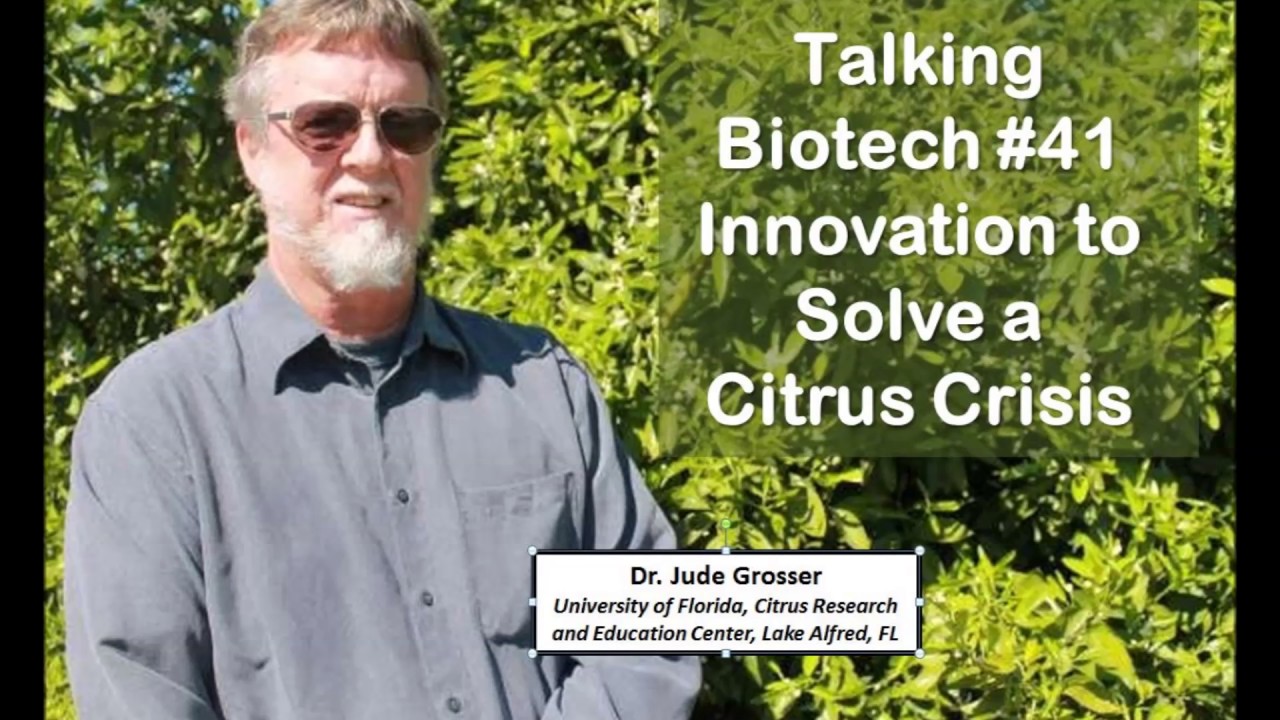
In this episode of the Talking Biotech podcast, host Kevin Folta interviews Dr. Jude Grosser, a senior researcher at the University of Florida Citrus Research and Education Center. The conversation centers on the devastating impact of citrus greening (huanglongbing) on Florida’s citrus industry—an industry that supports roughly 60,000 jobs—and the multi‑pronged biotechnological strategies being pursued to save it. Dr. Grosser explains how his lab uses tissue‑culture‑derived somaclonal variation to generate early‑maturing and seedless sweet orange clones, and how somatic hybridization creates tetraploid breeding parents that can be crossed to produce triploid, seedless fruit. He describes the development of novel rootstocks through the same polyploid approach, noting that some tetraploid rootstocks already show reduced infection rates and milder symptoms of greening. The interview then shifts to transgenic approaches: antimicrobial peptide (AMP) genes, and systemic‑acquired‑resistance (SAR) genes such as MPR1 (from Arabidopsis) and SABP2 (from tobacco), which have produced PCR‑negative, disease‑free trees in long‑term greenhouse trials. Dr. Grosser also discusses consumer‑acceptance strategies, including the use of all‑citrus DNA markers (anthocyanin‑based color selection) to avoid foreign DNA and improve marketability. The episode concludes with reflections on the cost of breeding (≈ $1 million per selection), the need for a diversified toolbox (breeding, transgenics, nutrition, insect control), and where growers and interested parties can find more information about the program.
Chapters
I want to see science serve a useful purpose to improve the standard of living for all people.
Hey, why is anyone fighting food advance? A very small percentage of the world's population is fortunate enough to have the luxury of turning down food. We've arranged a society based on science and technology in which Because nobody understands anything about science and technology.
You can't build a peaceful world on empty stomachs and human misery.
You're listening to Talking Biotech, a weekly podcast illuminating issues in agricultural and medical biotechnology. Your questions and concerns are addressed using a science-based approach with the goal of driving discovery to application with communication.
Now here's your host, Hi everybody, and welcome to Talking Biotech, your weekly podcast where we talk about how we move innovation to application and how we can facilitate that with better communication. My big interest is how we can really embrace the discoveries of agriculture and our newest technologies in ways to help people and ways to help the planet. And in my little sliver of the planet down here in Florida, we're seeing a real crisis, and this is happening in what's called the citrus greening disease. Citrus greening disease is a disease we've spoken about on the podcast before. It's a bacterial disease that's spread by an insect that causes changes in the tree's vascular conductivity that lead to eventual nutritional problems and issues in production like fruit drop and decreased yields on the trees. Really a problem. It's devastating here in the state of Florida and now is spreading throughout the country. It has been detected in California. The big problem is, is that so many areas of our state and so many areas of our country are dotted with small towns that are really dependent upon a thriving citrus industry that supports it. In the state of Florida, we have something like 60,000 jobs tied to this industry. That you can't just mothball and bring back when somebody figures out a solution. These are large facilities, logistical operations, and people who have lives and families. And in order to protect this and try to maintain not just the, the industry side, but also the flow of fresh juice, fresh fruit that people need to be eating more of, We have really seen tremendous efforts happening in genetic improvements of citrus, and that's one part of the equation. I mean, there's insect control, there's nutritional supplementation, there's other therapies that have been attempted, but this really will boil down ultimately— at least one part of the equation will be better trees. And one of the people who's working on that— well, we've heard a couple so far. We've heard on episode 14, uh, Rick Kress from Southern Gardens with their genetic engineering approach that looks promising. And in episode 36, Fred Gmitter taught us about where citrus comes from, what it is, and what is this thing that we call an orange tree. So today's extrapolation of these first 2 and kind of integration of the 2 is Dr. Jude Grosser, and he's also a faculty member at the University of Florida's Citrus Research and Education Center in Lake Alfred, Florida. Dr. Grosser has long been recognized as kind of at the leading edge, a really cutting-edge biotechnologist who takes on some really difficult techniques and applies them to a very difficult tree. His laboratory has long been recognized as a leader in innovative edges on how we can produce new trees that may have resistance to disease or better product quality. So today we'll talk to Dr. Jude Grosser, and you'll hear lots of neat techniques, things like somatic hybridization. These types of— or somaclonal variation induced in tissue culture— these are not what are recognized as GMO. They would not have to be labeled as GMO, at least in most places. I think some of the legislation has suggested that it would be, even though there's no recombinant DNA taking place through a laboratory step. But these trees at least look very highly likely to confer at least some level of tolerance to a major slate of diseases in citrus. So with that, we'll move along to the interview today with Dr. Jude Groser. And today on Talking Biotech, it's really a pleasure to talk to someone else here from University of Florida. We welcome Dr. Jude Groser from Citrus Research and Education Center. in Lake Alfred, Florida. Welcome, Dr. Groser.
Good morning. It's a pleasure to be here.
Yes, so I always think of you as kind of the, the person who really thinks outside the box to solve these problems. And right now the big problem being citrus greening. And of course other diseases too, we can't forget about. But what are some of your just real general approaches to this problem from your laboratory?
And then we'll kind of go through each one and maybe that's the best way to I was hired back in 1984 to bring some new tissue culture-based biotechnologies to the citrus breeding effort here at the center. And so we started out with simple things. So the first grant that we got was simply to make what are called somaclones of sweet orange. Now sweet orange is actually an F1 hybrid of pomelo and mandarin. And so it's very difficult to recreate an exact sweet orange by traditional breeding methods. So almost all the different cultivars of sweet orange that exist in the world are actually the result of natural mutations that have mostly been identified by very observant people that have found them out in the field. You might find a mutant branch on a tree that has a fruit that's a little bit different and maybe more interesting and has some extra value. And that's how most of these new oranges and the old oranges that we have have all come about. So somaclonal variation was attractive because you can get minor variation in a cultivar simply by putting it into tissue culture and regenerating plants. And you can either uncover some pre-existing genetic variation that would have never contributed to a new plant, or you can induce some cytological changes For example, you're not causing mutations in genes, but you can cause changes in the chromosome structures. For example, a piece of a chromosome might simply break off and flip-flop and reattach, or it might reattach to another chromosome. So you got the same genes, but they're in a different orientation, and that can affect their expression. So you can get some genes that are upregulated, some genes that are downregulated, and that can affect the phenotype of the orange. And so we've created thousands of these.
Wow.
Working with the 2 primary oranges in the Florida citrus industry, which are Hamelins and Valencia.
So let me go back really quick and touch on a couple things. So you said just the sweet orange itself is an unusual kind of hybrid between 2 things that probably would never hybridize naturally, right? Like in, in the wild, I mean, a pomelo and a mandarin?
Yes, well, actually they could hybridize in the wild if the trees were in proximity where the bees could get the pollen from the mandarin over to the pummelo. The pummelos are unusual as compared to oranges in that they're more like a traditional plant where cross-pollination will result in all the seeds in the fruit being of hybrid origin. So you got half— a random half a mom and a random half a dad. On the other hand, oranges and a lot of the mandarins are what we call polyembryonic, and they're unusual Because all of the seeds actually are derived from maternal tissue, from new cellular tissue, and they're not a product of fertilization. They're not a random half of mom and dad, but they're, they're all mom. So you're basically getting clones back of the mother, the tree where the seeds came from.
And a pomelo is like a big grapefruit, right? This is quite different than what we normally think, or what are the— what are pomelos?
Pomelos are generally larger Much larger than grapefruits in general, but there's a tremendous amount of genetic diversity within the pomelo, and they're actually one of the true citrus species. Well, the mandarins are too. Oranges are considered a species taxonomically, but if you follow the official rules of taxonomy, they would never be— they wouldn't be a species, nor would grapefruit on their own.
So all of the orange juice drinkers probably would be surprised that this product they have is really something that's squeezed from a rather unusual hybrid, right, across a pretty good genetic distance. Or when you talk about pomelo by mandarin, that isn't exactly genetic neighbors, are they?
That's right, that's correct.
And the other thing I'd like to touch on, just to go back, is this idea of using tissue culture to induce mutations. And this was the basis of your appointment, that when we talk about tissue culture, we're talking about taking plant tissue and placing it into a hormone medium where that will induce the production of new plants from those cells that are in the, in the media. So in other words, those single cells that are there, or maybe cells on a little piece of tissue, each one can be turned into a whole new plant. And what happens under the stress of culture and in the presence of those growth regulators, you can have wide-scale, really rather large changes in chromosomes and Doubling of chromosomes, all kinds of crazy things happen. And that is a way to take something that is already really good, like a Valencia orange, and then be able to add variation just by— it basically kind of shuffles a few cards in the deck. So you're not changing the whole thing radically, but maybe being able to introduce a new trait or 2 through tissue culture.
Right, and you're maintaining the integrity of that cultivar that you started with, which in this case would be the Valencia orange. And we've been successful at this. You know, the, the one of the first oranges that we released here from the center is a Valencia that actually matures 6 to 8 weeks earlier than the traditional Valencia clone. So this is a big advantage to our processors being able to get this high-quality fruit off the trees earlier, and it opens up better opportunities for blending with the hamlin. They don't have to wait as long for You know, the Valencias to come in. They don't have to, you know, spend a lot of money storing, storing juice at a very low temperature for the not-from-concentrate product. So it's a whole lot of advantages. And to the grower too, because he can get— the grower can get the fruit off of the tree before the threat of the freeze. And also with Valencias, you, you have the old fruit and the new fruit on the tree at the same time, which is a stress to the tree. And it kind of eliminates the possibility of mechanical harvesting because you'd be knocking all next year's crop off the tree when you're harvesting this year's crop. So having the fruit mature earlier provides a lot of opportunities for both the growers and the processors.
And so earliness has been your major trait through somaclonal variation, or are you seeing other traits as well?
We found that we also find seedless clones. Valencia, for example, averages about 5 seeds per clone, and We have about half a dozen clones that are almost completely seedless that, you know, may have enhanced fresh market value because of that trait.
And so I guess the best way to think about our talk today is the different ways that you have taken rather novel strategies to improve oranges. And you've also done this idea of somatic hybrids. Could you tell us a little bit about what that means and some of the products that have come through those somatic fusions?
Okay, that's, that's a technique that actually was my— has been my bread and butter of my career for 31 years here. And somatic hybridization is— the word somatic just means body cells instead of sexual cells. So you're taking just regular cells from 2 different varieties, and instead of making a traditional hybrid where you'd get a random half from mom and a random half from dad of the genetic input, You're adding all of it together. So you're fusing cells from both parents together. You got the whole genomes of both parents together. And the way we do this goes back to the tissue culture method that we already have talked about. You're taking the cells and fusing them in a Petri dish. So you need to be able to go from one single cell back to a whole plant. And so the tissue culture regeneration pathways are very important.
Okay.
And in citrus, we have 2 of those. One is called somatic embryogenesis, where you can simply induce cells to form embryos that are very comparable to an embryo that you would find in a seed. And you can enlarge the embryos and germinate the embryos to give you a root and a shoot, and you get what's equivalent to a seedling, and you can grow your plant back. The second method of plant regeneration in citrus is called organogenesis. And again, using a specific set of hormones or growth regulators, you can induce adventitious buds to form on tissue that will lead to shoots or even to roots, depending on the hormone types that you're using, the combinations that you're using. And then those shoots form, and you can cut those shoots off and put them on another tissue culture medium that induces rooting, and then you can recover a whole plant in that way. With the somatic hybridization process, what we do is we make what are called callus cultures, but it's simply undifferentiated cells. You can put those in the liquid medium where they grow very, very fast on shakers. In order to do the somatic hybridization, you need to remove the plant cell wall. Plant cells differ from human cells and animal cells in that They're surrounded by a very hard cell wall made out of cellulose. That's why wood is hard. It's made out of cellulose. So we use a battery of enzymes to digest away the cellulose wall, and that leaves the membrane that surrounds the cell intact, and everything inside— all the intracellular components are still intact inside of the cell. And then you can use either a chemical or an electrical-induced fusion technology to cause the cells to fuse together after this cellulose wall has been removed, and you can get the cells to actually fuse together. And then in some cases, the nuclei of the cells actually fuse together too. So that means that the genomes of both parents are actually fusing together, and so it's actually a doubling of the amount of chromosomes that you have in the cells. And so you end up with 4 sets of chromosomes instead of the normal 2 that you would have in a typical somatic cell. So it's 2 plus 2, all of mom, all of dad, you end up with 4, and these plants are called tetraploids. And so we generally pick parents that are complementary to each other, whether it's for scion improvement or for rootstock improvement. We haven't talked about that yet. But for the way that we're using this technology in scion improvement, is basically as a tool to build breeding parents. Now one of the major objectives of our breeding program is to generate seedless fresh fruit varieties that are competitive in the national and international markets. And the problem has been with the Florida varieties. We've got some really delicious mandarins and some oranges that are, that are very, very good, but they're very seedy. And these are adapted to the Florida environment, this hot, humid subtropical environment here. Do very, very well. The fruit's very juicy, very flavorful, but we can't compete in the marketplace because you have all these seedless varieties, clementines, and now the Cuties and the Halos are coming in from, from California, from Morocco, from Spain, South Africa, a number of places around the world. And so they're displacing our varieties, and it's tougher for our growers to compete. But if we have seedless varieties, that are adapted to the Florida environment, then we can regain our share of the marketplace and maybe even increase it. And so we're using the somatic hybridization program to generate tetraploid breeding parents. And so why would we want that? Because the tetraploids are also going to be seedy. Well, we have a model of seedless fruit, which is the banana. When you peel a banana, You never find a seed, and that's because a banana is what we call a triploid. A triploid has 3 sets of chromosomes instead of the normal 2, and this kind of interferes with normal meiosis, and so you don't get seed development. And this is the way that the bananas are naturally seedless. There are traditional diploid bananas that have 2 sets of chromosomes instead of the 3 in the wild, and when you peel them, you find just seed after seed. They're just full of seeds. So this is a natural way to get seedless fruits. And now there is one example of a naturally occurring triploid in citrus, which is the Persian or Tahiti lime. It's a triploid, 3 sets of chromosomes, and it's seedless. So once you get the tetraploid of complementary parents that have traits that, you know, work together to make a really solid breeding parent, you can cross those back traditionally with a diploid. So you're crossing a plant that has 2 sets of chromosomes with a plant that has 4 sets of chromosomes. So then you get, if the diploid is the female, for example, you have the egg that has 1 set of chromosomes, and then the tetraploid will produce pollen that has 2 sets of chromosomes. And so when you do a traditional cross, it's 1 2, you have 3, which is a triploid. All your progeny are triploids, and all those will grow up to make seedless fruit. So this is a very powerful technique to to make seedless hybrids that are all at this triploid level. And we've been doing this for a number of years, so we've got now probably more than 100 breeding parents that we've created by somatic hybridization that are at the tetraploid level, 4 sets of chromosomes. And we're using those in the traditional breeding program. And so we've been creating thousands of these triploid hybrids and evaluating those, and we just recently released the first Tangerine from this program, and it's, it's got a number, it's N40W-6-3, but the nickname we have for it is Kids Favorite because when elementary school kids come to visit the lab, if they come during the season when this is ripe, we usually pass a fruit out to each student and they, they keep coming back for more. They just, they can't get enough of it, so we nicknamed it Kids Favorite. So that's kind of how that technique works for scion improvement, which Scientists identified as a fruit variety that we grow on the tops of our trees. All of our trees are actually chimeras. This was discussed in your previous podcast with Rick Crest from Southern Gardens. So the top half of the tree grows the fruit, and the bottom half is called the rootstock. And the rootstock is very important because it does a lot of things for the tree. And one of the main things it can do is provide disease resistance. But we have a lot of variation in our soils in Florida, and the rootstocks can be selected that are adapted to any specific soil type. If you're having salinity problems, you can select a rootstock that performs well in high saline conditions. The rootstock can control the size of the tree. So if you want a high-density planting where the trees don't reach— don't go above a certain height, say 8 feet, you can select a rootstock that will keep the trees Right at the size you would like to have them. Also affects the fruit quality significantly. But most importantly, for the problem that we're talking about with the citrus greening disease, is the ability to impart tolerance to the whole tree. And we're finding that the rootstock has some ability to do this, providing some tolerance to the citrus greening disease, even when you have a sweet orange growing on the top of the tree that's susceptible to the disease. So there's, there's some mechanism being transmitted from the rootstock to the scion that enhances the tolerance of the tree. So we started working with complementary rootstocks 30 years ago. We were doing somatic hybridizations. For example, we started out with trying to make a hybrid of Carrizo citrange rootstock with sour orange rootstock. Sour orange used to be the number one rootstock in the world, but it's susceptible to a virus called Tristeza virus. It's transmitted by another insect called an aphid. And this has wiped out sour orange trees all over the world, and it's— we basically stopped using it as a rootstock, although it was such a fantastic rootstock otherwise. So this particular rootstock also does very well against a very important disease in Florida called citrus blight. And Carrizo Citrans, on the other hand, has resistance to the citrus tristeza virus that takes out the sour orange. But it is very susceptible to the citrus blight. So we thought by making a somatic fusion of these 2 rootstocks, we would end up with a tetraploid rootstock that maybe could handle both of these diseases. And so we made a lot of tetraploids using the somatic fusion technique of different rootstocks, and we put them out into field trials. And we learned right off the bat that when we use a tetraploid as the rootstock, that we always get some level of tree size control, which was also another important objective of the rootstock breeding programs. So we've made a lot of these tetraploids, and when we found out how they were doing, we felt like, hey, we have an opportunity to start a breeding program using traditional techniques with rootstocks at the tetraploid level. And this is very powerful because you can mix the genes from 4 different traditional rootstocks together at one time, as opposed to 2 in a traditional breeding cross of the normal diploid rootstocks that have 2 sets of chromosomes per cell. So this opened up a whole new opportunity for increasing the genetic diversity from which we can do our selection process. And so we started making hundreds of these, what we call— we call them tetrazygotes because they're zygotic hybrids of somatic hybrids. So here, here for both scion and rootstock breeding, you're using new biotechnologies to create breeding parents, and then you're going back to traditional breeding with these parents. So it's like you always talk about, Kevin, these Biotechnology is just providing us with new sets of tools that can enhance our ability to get the job done. So it's— we're always on the lookout for, you know, putting a new tool in the toolbox that can help, help us do our job. So we have all these rootstocks out in field trials, and we started noticing that with huanglongbing, the citrus greening disease, that we were seeing differences. And this is— although these— none of these rootstocks were actually created with this in mind, we just started seeing natural variation. And how the rootstock was dealing with the disease. So we're seeing some rootstocks were preventing the trees from becoming infected as fast as commercial rootstocks. So there was what we call a lower infection frequency. It takes much longer for the entire grove to become infected. And we also saw that when some of the trees on these different new rootstocks became infected, that the symptoms were much reduced as compared to symptoms of trees on the commercial rootstock. So This tells us as a breeder that we do indeed have genetic variability within our rootstock germplasm that can impact this disease. And if you start focusing on that, we feel like we can take that up another order of magnitude and get close to something that might even make the tree resistant to the disease completely, even though you still have a susceptible fruit type growing on the top of the tree.
What's really interesting is that many people, I think, would be surprised by what happens in citrus. That here you're making a, um, a polyploid by fusing together the nuclei from 2 different parents that, uh, you know, whole sets of chromosomes. And then you're taking, uh, a one spe— well, not one species, but one genotype or one line, one variety on the bottom, and fusing that onto a whole nother variety which sticks out of the ground. And it really does seem like here you're really kind of making the ultimate Frankenstein of a plant. That this thing not only has chromosomes that are put together, but also the physical structures of the tree are dissimilar, and nobody really seems to care.
And—
but that's good because it means we can use these kinds of innovations and genetic improvements to rapidly improve citrus and may be able to solve the problem. We'll come back in just a moment or two with more Talking Biotech podcast with Professor Jude Groser from University of Florida's Citrus Research and Education Center, and we'll come back and talk about the introduction of single genes, like single transgenes, which also is a complementary approach in citrus improvement. We'll be right back.
Grandma, don't touch that radio! Hi, talking biotechers, this is Vern Blazek of the Vern Blazek Science Power Hour and booth announcer for the Talking Biotech podcast. We're moving into our 40-somethingth episode, and we get lots of requests for an interview with Dr. Folta himself. What makes that dude tick? How is that cat wired? We'll explore the deep crevasses of his soul in Talking Biotech episode number 50. So, you might recall that I interviewed him on my podcast, It's the Vern Blaytheck Science Hour Hour, with your host, Vern Blaytheck. It was considered by some a raging case of non-transparency, by those who wanted to cash a check with a manufactured scandal. It was so much not a story that we're going to do it again, only using your questions. If you have a question you'd like me to ask Dr. Folta, send it to my attention at talkingbiotechpodcast@gmail.com. I'll assemble all of the questions, and grill that turkey with my interview for episode 50. He's a scientist, he's a thespian, and I'm a hard-hitting booth announcer that's glad to ask the hard questions. Let me know what you'd like to know. And now back to the Talking Biotech Podcast.
And welcome back to the Talking Biotech podcast. Today we're talking with Professor Jude Groser from the University of Florida Citrus Research and Education Station, or research facility, research center as we call them, down in Lake Alfred, Florida. And if there is a guy who could be dubbed the reigning wizard of plant genetic improvement, it might be Dr. Groser. He uses innovative techniques to improve trees. And in part 1, we talked about how he has used this idea of somatic hybridization, taking 2 cells from 2 different plants and putting them together in one cell that then can be grown to one new plant with twice the genetic material. But how does that contrast with the traditional methods of adding a single gene through genetic engineering?
Well, I, I think it's just a matter of of education. You know, what's happened in the wild for millennia, when there's a new pathogen that comes along that a species is highly susceptible to this particular pathogen, the pathogen moves through the population and does a lot of devastation, but there always seem to be a handful of genotypes that were either tolerant or resistant to the particular pathogen, and then they can interbreed and The species can then make it through the small bottleneck and then repopulate itself following that with all tolerant and resistant material. Now, we've kind of suppressed the ability of our cultivars that we grow for our food in the wild to do this because we've shrunk the areas around the world where the wild germplasm grows, and so there's very little of it left. We've really shrunk our— our genetic diversity in the wild, and we're really inhibiting the ability of the wild germplasm to overcome these types of situations anymore. But with the breeding programs, especially facilitated by these new biotechnologies, we can recreate a tremendous amount of genetic diversity by how we put the things together, how the different parents are put together, and what form they're put together in. And we have all this material out in the field now It's kind of like recreating the situation that went on for millennia. So we have all this diversity out there in the field now, and there's a natural exposure to the pathogen that's going on. And so the ones that are tolerant or resistant are showing up. You know, they stand out in the field when everything else is crashing and getting sicker and sicker and dying, and you still have these very healthy individuals out there. And so as breeders, we have to go out there and find them and then decide what's the best way to exploit the tolerance or resistance that we're finding in these and making commercial varieties that can sell in the marketplace. I think this goes hand in hand with the single gene approach. And for the long run, I think both approaches have significant merit. The obvious advantage of the single gene transformation technology is that you're maintaining the integrity of a particular cultivar and just adding the trait that you need, which in this case is tolerance or resistance to Huanglongbing. But you end up with the variety that the consumer is already familiar with, and there's nothing new to have to market or anything like that.
That's right, and the processors are familiar with that variety and the way it performs and its timing for yields and things like that too. And what about your transgenic program? I know you and Dr. Dutt have tried many different genes to test if they would confer resistance to HLB or citrus greening. How many have you tried and how many of them work and which ones seem promising?
Well, we started out collecting the AMP genes, antimicrobial peptide genes, and you discussed these in your In your previous podcast as well, but AMPs are produced by almost all organisms, and humans do produce them, as Rick Kress pointed out. And the way I like to describe it is think about your eye. Your eye is a nice, open, warm, moist environment. You would think that bacteria would thrive in your eye, yet your eye very rarely, if ever, gets infected. Why is that? Well, you have AMPs that your body produces. floating around in your eye. And so when a bacteria comes into your eye, the AMP attacks it, knocks a hole in the bacterial membrane, the bacteria cannot— it dies and cannot replicate and produce an infection. So you have a gene for that AMP in your chromosome that produces that. So what we did is we searched out the literature and found AMP genes that look like they worked against gram-negative bacteria that causes disease in other plants. And so we found about 10 of those, I guess, somewhere in that neighborhood. And we cloned them and we started putting them into citrus plants. And we found a number of them that gave us a fairly good response for 2 to 3 years in the field. But then we started to see that the tolerance was kind of breaking down a little bit. So we worked with another— started working another class of genes which are called SAR induction genes. And SAR is called systemic acquired resistance. It's part of the plant's own immune system. So plants have their own immune system that functions a little bit different than it does in animals and humans. But in the case of huanglongbing, for some reason in sweet orange, the immune system doesn't seem to be completely turned on. So for some reason, the bacteria can fool the orange plant into thinking maybe it's not infected, and it doesn't turn on its full systemic acquired resistance, which is triggered by the infection of the pathogen. So we got genes from other plants that are known to be in the regulatory pathway that turn on this systemic acquired resistance defense mechanism that already exists in the plants. And we have one called MPR1 from Arabidopsis that we've put into sweet orange and grapefruit plants, and it seems to be working quite well. We've had some sweet orange plants that have this particular gene from Arabidopsis, which is in the mustard family. And these plants have been out in the field for over 4 years, and multiple clones of these plants are still PCR negative for the Liberibacter. So that's a few of the clones are showing resistance, and a couple other clones have very low infections, but there's almost no symptoms. So they're showing a high level of resistance. Tolerance, and we have a second gene called SABP2 from tobacco that also is involved in turning on this systemic acquired resistance system, and it looks like it's working as well. In both cases, we've also had plants that, in cooperation with Southern Gardens, they were in their hot psyllid house where the trees were fed on by psyllids that were carrying the the greening bacterium and feeding on them constantly. And so they continually were inoculated with the pathogen that causes the greening disease. And after 2.5 years in this house, we have multiple copies of clones of these, some of these plants containing these 2 genes that came out of there still totally negative for the infection, were PCR negative, which means that they're— They're not infected. Showing potential resistance to the greening disease. So that's very exciting and we're moving forward with those genes as a hope for the future.
PCR negative means that they're not even— so PCR is the technique where we can detect the gene and amplify a gene product. And so if you were to take some, say, phloem exudate, some of the plant goo, and test that that to see if you could amplify the bacterial gene, that these actually come out negative. So super sensitive test and they're still coming out negative. So you said that maybe 2 years, 4 years, that these things are coming okay through a greenhouse that's infected with, uh, psyllids or the insect bearing the disease. How long does a normal tree last in that same greenhouse?
Well, the majority of the control trees Plants are usually infected within 6 to 12 months. Occasionally you'll have an outlier that might last all the way up to 2 years, but they generally all end up becoming infected. But this is the reason that we use replication. So when we put a particular transgenic plant in there, we put multiple clones of that plant into the test. And we do the same with the controls. If you have 3 replicates of the same clone in the test and 2 of them come out completely resistant but one is showing replication of the bacteria, then you will think that there's probably something not quite good enough about that particular clone. So it's very important to do replications, as it is with all science.
So you're talking a lot about transgenic technologies that appear to be working, just like Southern Gardens. It looks good. But how are consumers going to feel about this, and have you made any steps to maybe use genes that would be a little bit more comfortable for consumers?
Yes, we've spent a lot of effort on this because we understand that orange juice is considered a wholesome crop, and it's probably going to be held to really high standards. And we also understand that the Minute Maid and Simply Orange juice is owned by Coca-Cola, and Tropicana Pure Premium is owned by PepsiCo. And they all, you know, they sell soft drinks all around the world. So consumer issues are extremely important to their business. So the better we can make the plant and more attractive to the consumer, I think the more, the better chance it has of being adapted by these, these large international corporations that actually sell most of the orange juice around the world. So our goal has been to develop transgenic plants that will move these genes from other edible plants using technology that has DNA only from other edible plants. So people are already eating it. They shouldn't have any fear of having these genes in their orange juice. So we have a way to genetically engineer our naked cells or protoplasts that we talked about earlier that we use in the somatic fusion experiments. And we have a selection system that's quite clever. When you put the foreign gene in and it gets integrated into the chromosome of the plant, we have developed a color marker. We've actually— we started with grape. We have the gene that codes for the anthocyanin, which is what makes grapes purple, what makes wine purple. And it's also an antioxidant, so it's very good for you to eat. And we were able to use that as a color marker in citrus, and we've attached it with a switch. So every gene has a switch that's called a promoter, and this switch can turn the gene on everywhere in the plant— that's a constitutive promoter— or it can turn it on in specific tissues. So we call that a tissue-specific promoter. And we started out with a switch or a promoter from carrot that turns the gene on only in the embryo. So we can hook that up with the anthocyanin gene. And so when you regenerate embryos from your cells that have been engineered, when they start to make embryos, the embryos turn purple because the switch turns that anthocyanin gene on. But then when you select your embryos out, it could be even one out of a million, you can easily find it because the embryo is purple. You can pull the embryo out and germinate it, but when it germinates, that switch shuts off and the embryo goes back to the normal sweet orange color, which would be green in this case. So it's a very powerful selection scheme, and now we've been able to use those genes to identify other genes. So we now have a switch that's embryo-specific from citrus, and we've pulled the anthocyanin gene out of the blood orange that also codes for the purple color. And we put those together, so now we have an all-citrus selection system. So we can use that to identify our genetically modified cells, and that would include the gene that also can make the plants resistant to the citrus greening disease. And so we can regenerate plants that have no DNA that comes from a virus or a bacteria, which we think will make these plants much more— And the the fruit from these plants much more attractive to a consumer that might be concerned about foreign genes being in their orange juice.
And you mentioned in the beginning that, you know, Coke and Pepsi are really the big companies that are running the juice trade per se. But, you know, and I don't want to give the impression that you're doing research that's here to placate the needs of big companies. Really, at the end of the day, your client is the Florida farmer, right?
Absolutely. Absolutely.
And, uh, and so I think, um, what are your— if you had to look in your crystal ball, and I think you probably have a pretty good one with all your experience and, you know, boots-on-the-ground, uh, knowledge of this problem, how do you think we're going to solve the citrus greening problem in Florida?
Well, I, I think that there's going to be solutions coming from a package of, of things. Of course, I think that the transgenic solutions are going to be very real. And, and, and as Rick described, there's 4, there's 4 areas of consideration there with, with all the regulatory considerations and, and in the end, the consumer. But on the other hand, with the conventional breeding, I think that if you look at how the disease works, the population of disease The bacterial populations are— they go up in the wintertime and they go down in the summertime. They kind of oscillate. And there's kind of a line through that where the populations reach an adequate level to cause a disease. And I think you can move that line with the rootstock. I think you can move it with the scion. And I think you can move it with optimized nutrition, which we're still learning about. And with all 3 of those movements, you may be able to move that line to a point where it doesn't cause a significant disease. And so I think that's very important to pursue both of these strategies because we don't know which one's going to work the best or which one's going to be the fastest that we can deliver to the growers. So we have, we have to really go after both of them with full zest.
I agree. And I think, you know, we also layer over insect control and all kinds of other optimization of irrigation and fertilization, all the other things we, we can control. I guess the thing, and maybe we should conclude with then, is just kind of an interesting question that, that I think I don't know the answer, but I would love to hear your guess. As somebody who creates new orange varieties, How much do you think it takes dollars and cents-wise, everything together, to create a new orange variety?
That's a very good question, but I would say probably at least $1 million per selection. It's hard to quantify it because breeding is a continuum, and you've already talked to Dr. Gmitter. Dr. Gmitter and I have worked as a team, and for the past 30 years We've been, you know, building up this really big chest of fantastic breeding parents, and we're now figuring out, you know, which parents work best together to give us really good progeny. So for the first 25 years, you know, we didn't even have any cultivars that came from the program. But now the pipeline has been built and there's— the varieties are coming out the pipe at the other end, and each year there's more and more varieties being released. So this just demonstrates that you have to have a continuous support and effort going on. You can't interrupt it, and you can't stop it and lose germplasm. And then if you stay with it, you start getting the new varieties that the growers need to compete in the national and international marketplaces. So If you were to look at it at any window in time, if you were, you know, to go back, you know, 5 years ago and say, how much does it cost to produce a variety? The number would be— look like it was astronomical. But now that we've really got things cooking here, there's many new varieties coming out. I mean, in the last 5 years, we've released 8 new sweet oranges and, you know, more than 10 mandarins and several grapefruits. So there's all kinds of new things. Coming out in the rootstock area, we now have 17 rootstocks that have been fast-track released. So this has all happened in just the last few years. So it just shows you the importance that you have to have a constant effort. And when you start a new breeding program, the commodity has to be patient until the researchers have the time to build up the germplasm base and understand what are the better breeding parents and how do they go together.
Well, and it also is a really interesting aspect that I thought about recently, that here you as a breeder spend 31 years to really set the table for the future to be able to work more efficiently. So in other words, you know, you, you know, your blood, sweat, and tears is in the nucleus of every one of those plants, and your innovation and techniques have really shaped the way that the future breeders, you know, maybe even in 100 years We'll be able to more rapidly breed trees that can produce for Florida farmers, or for, I should say, farmers all over the world. Because I'm sure if it grows in Florida, it can do well everywhere. And well, I shouldn't say that, but they'll do well in many environments. So it really gives a broader— your words really give a broader idea to those who are interested in plant breeding as a career, and really the kind of legacy you establish within a breeding program. And I think it's one of the other exciting aspects of what you do. And so where can somebody find more information about your breeding program or about what's happening at Lake Alfred?
Well, the new cultivars that are being released can be found identified on the Florida Foundation Seed Producers website, and then the CREC website has links to my program and Fred Gmitter's program. And there's information on there. And of course, for specific information, the simple way is just email. Somebody can email me and ask me a specific question, and I can send them all the information that they would like to have. The last thing I'd like to say is that I think the potential for breeding juice varieties for Florida that are tolerant or possibly even resistant to Wolongbing is becoming more possible because we're identifying a lot of very tasty mandarin hybrids in the breeding program that are showing exceptional tolerance to disease. And one of the problems historically with mandarins is that when you make NFC out of the juice, it might taste really, really good fresh, but when you pasteurize it, the heating can cause some negative components to come out and cause off flavors in the juice. But we found a few of the tolerant selections that we're finding actually can be processed without bringing out these negative flavors. Some of them have a very strong orange note. So there is genetic diversity showing up now with the tolerance to the disease that will allow us to actually breed juice fruit that's very similar to an orange but will have enhanced tolerance to the disease and maybe even have even some more interesting flavors than just traditional orange juice. So it's very exciting.
Well, it is really exciting. It's a great time to learn about your program and what you and, you and Dr. Gemitter have done together. And, and it's been a really great experience for me to work with you and taste everything that you've produced. And I'm pretty excited about the future of oranges, even though we're at a real challenging time in production history because of disease. But necessity is the mother of invention, and you're an awfully good inventor. So Thank you for spending the time with us here today.
Thanks for the opportunity. It's been my pleasure.
And that's Dr. Jude Groser from the Citrus Research and Education Center down in Lake Alfred, Florida. And that brings to a close episode 41 of Talking Biotech podcast with Dr. Jude Groser. And one of the real pleasures about talking with Dr. Groser is it's just an extension of the relationship I'm lucky to share with him, that I get to see his successes and actually get to see them growing in the field, see them on farms where he has just a wonderful relationship with growers and the people in our industry who regard him as an expert's expert and someone deeply committed to solving problems of citrus growers in our state. So thank you very much again for listening. Remember to please write a review on iTunes or other places. We're actually moving up pretty well in the general pod— in the science podcast area, that your reviews of this podcast really add to the visibility and really help us share the message that we can use the best tools of biotechnology to help people and help the planet. Thank you for listening. My name is Kevin Folta. We'll talk to you next week on Talking Biotech Podcast.
Thank you. Thank you for listening to the Talking Biotech Podcast. Please send your suggestions for guests, comments, or questions to talkingbiotech@gmail.com. Please write a review on iTunes and recommend this podcast to a friend. More downloads and reviews raise the visibility of this podcast and help us reach a wider audience with science.
More from Kevin



Talking Biotech 503 - A New Strategy in the War on Obesity. Dr. Erik Issacson, Wave Life Sciences

Organic Production, Conventional Agriculture, Health Anxiety, and Social Media Disinformation

Stop Political Appointees from Grant Decisions - Dr. Colette Dalawalla, Talking Biotech 501




