Talking Biotech 044 - Indian Farmer Suicides, Your Questions
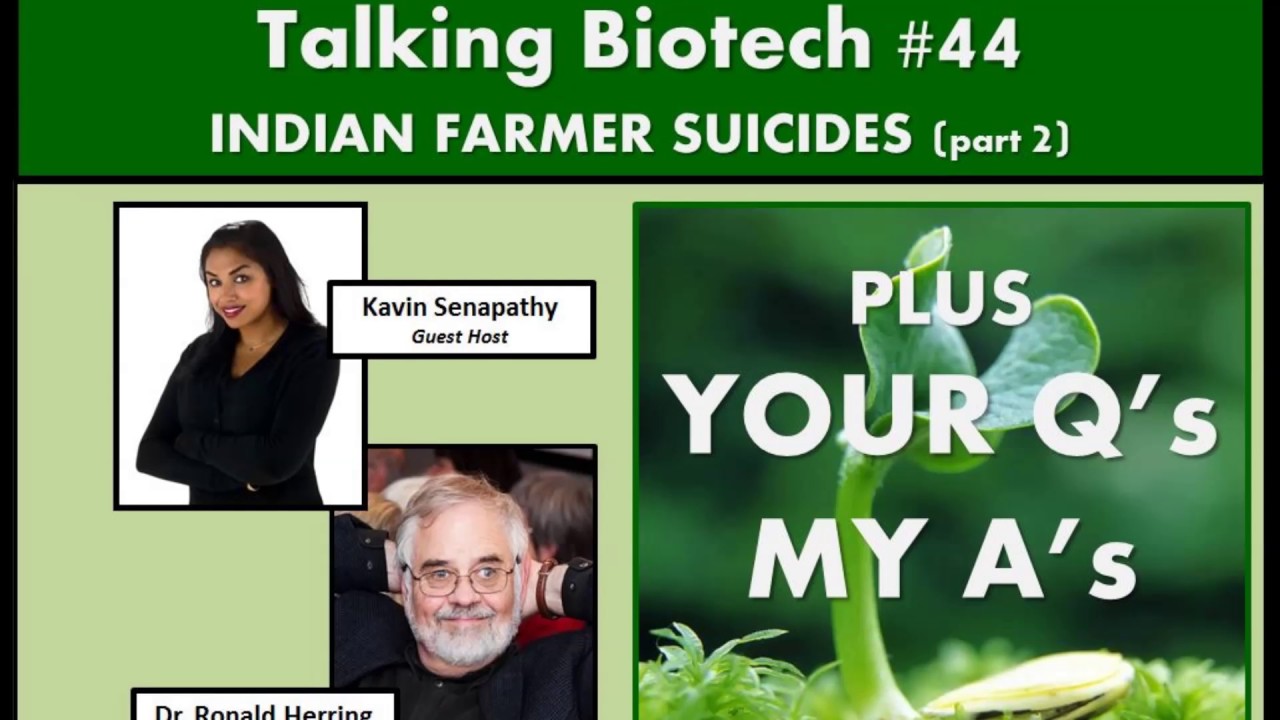
Kevin Folta and Professor Ronald Herring discuss Indian farmer suicides linked to Bt cotton and other GM crops, examining regulatory and social issues in agricultural biotechnology. Folta answers listener questions about how scientists communicate biotech to the public and shape policy.
Chapters
I want to see science serve a useful purpose to improve the standard of living for all people.
Hey, why is anyone fighting food advance? A very small percentage of the world's population is fortunate enough to have the luxury of turning down food. We've arranged a society based on science and technology in which Because nobody understands anything about science and technology. You can't build a peaceful world on empty stomachs and human misery.
You're listening to Talking Biotech, a weekly podcast illuminating issues in agricultural and medical biotechnology.
Your questions and concerns are addressed using a science-based approach with the goal of driving discovery to application with communication.
Now here's your host, Hi, Talking Biotechers, this is Vern Blazek taking care of the booth announcer duties at the Talking Biotech podcast. Today, part 1, you'll hear the rest of the interview with Professor Ronald Herring. So this is a continuation of last week's lengthy interview As it began to spill over into a separate episode. Calvin Sanapathy leads this interview debunking the myths of Indian farmer suicides. Dr. Herring, he's a social scientist. He's examined the phenomenon of Indian farmer suicides very carefully and illuminates this topic with firsthand understanding that really helps all of us become much more conversant In this important topic. In part 2 of today's show, Dr. Kevin Folta will answer your questions as they appeared on his public figure Facebook page. But first, we pick up the second half of the discussion with Professor Ronald Herring. Here he starts the conversation with Coven and Kevin as they discuss the influence We now return to last week's Talking Biotech podcast, already in progress.
I once wrote a piece discussing why I think, especially as, as an Indian woman, and I also consider myself a feminist, how she has essentially succeeded at appropriating her own culture and got some, got some backlash about that. about how I should talk about the science and not accuse her of something as bad as cultural appropriation.
I completely understand what you're saying, and it's— but I don't think we have anything specifically about— but it would be a great article to write. I guess you've seen Michael Specter's piece in The New Yorker about it.
I did.
I wrote an article essentially talking about how she I'd be really interested to see that, because everybody asks me this question, and I don't have a good answer, except that in most spheres, there are these kind of cultural brokers, or what I call epistemic brokers. That is, Vandana Shiva tells us that people are committing suicide, and it becomes part of a global network of suicide. Transferred through these transnational advocacy networks, and it becomes— it gets picked up by media all over the world. So this is in fact the reason we were in Varengal, was asking questions about this report that the sheep were dying of the Cry1Ac. They ate the leaves of Bt cotton and then they died. And so there was this international uproar about the dead sheep. So we went to find out what was going on with these dead sheep. And of course it turned out to be a hoax. The body disappeared, the autopsy results disappeared, nobody could find the shepherds that had the dead sheep. I mean, it was one of these mythologies that became an international myth. But these things do crop up in almost all fields. So we have people who deny the landing on the moon, we have people who think that the Israelis caused 9/11. There's a tremendous amount of this kind of myth and rumor-making. In the international social sphere. And of course it's become worse with the internet because we have these cocoons, these information cocoons. And once you're in a network that has the cocoon, you don't hear the other side of stories. So those people listening to Kevin's podcast may well be in an information cocoon in which they hear my take but not Vandana Shiva's take. So I think— and I think that has— segregated all of us into networks that make a common understanding of the world very, very difficult.
You know, if I could chime in on that, it's rather— it's something that as a scientist, my scientific training has taught me to do everything I can to avoid that kind of bias. And I've opened up the podcast and said repeatedly, if you have a point of view that's different, I don't want this to be an echo chamber or or a, you know, whatever. And, you know, Vandana Shiva, she would be more than welcome to discuss and try to convince me, you know. I mean, show me why I'm wrong. This week I even had a brief dialogue with Kerry Gilliam, which, you know, she agreed that she could come on. I think it would be a really nice discussion, and I'm not here to win points by taking people down and being difficult. I'd like to understand why they tick the way they do and And maybe try to help them understand the way that I think, because I do think a lot of these folks are— and I don't know with Shiva, but with most people— are genuinely good people who don't understand, and others are in it for making a buck and causing trouble.
Yeah, I both agree and disagree, Kevin. I think that at the top of transnational advocacy networks, these epistemic brokers, these cultural brokers, I think they do know. Everybody always asks me, can Vandana Shiva really believe the things she's saying, that farmers don't have any idea that the seeds they're growing are going to kill them? How can she think that she romanticizes farmers and then she says that they're all completely bamboozled by these multinational corporations promising miracle seeds and then killing them? How can both things be true? And I honestly— I don't know. Think that she knows what's going on. I honestly believe this, and one reason for that is that these stealth seeds that I talked about, she made a big deal out of why did the government suppress Navbarat 151? That's the illegal seeds being sold. Why did the government suppress the illegal seeds, which were indigenous and made by the people, produced by a small Indian firm, and then certify the Monsanto Mahiko seeds produced by a multinational corporation. We don't need biotechnology, she said. We could have Navbarat 151, which is also bollworm-resistant. And she knew absolutely certainly that the stealth seeds were there. They were produced by local farmers. They were backcrossing the transgene into their local varieties. All of which indicated these are not suicide seeds. There's no terminator technology. And she kept saying that for the next 15 years. So, I mean, it's clear that she knew that there was no terminator gene in this, and she didn't know, unfortunately, she never figured out that the Monsanto gene was what was producing these good results in Gujarat cotton.
Yeah, you know, I think that's a good lead-in to my next question, because you mentioned the people at the top, such as I think that the people at the top, they're sort of fundamentalist leaders, and they're largely disingenuous. But their messaging and their myth-making kind of trickles down to the general population, and that's where we get the people, I think, that Kevin says are— they're good people with good intentions. They just want to take care of their families. And they believe what they're being told. Believe a lot of this. So I mean, so when Westerners, you know, this general public, not the people at the top of this food chain, when they either march against Monsanto or lobby or make their voices heard against genetic engineering to supposedly help save Indian farmers, I think that they largely believe that they're truly helping. So Is there any maybe even unknown, or these people don't even know that there's a white savior complex going on with this GMO as whipping boy story?
You know, I'm reluctant, probably because I'm white, you know, I'm reluctant to call it a white savior complex. Because some of the people that make the most money off this turn out to be From countries that are not part of the U.S.-European cabal. So I wouldn't—I don't think white savior complex. I do think that it's part of this this kind of development mythology that some of us know what's best for development of other people, and we will provide the experts. We'll fly in a team in three weeks. The team will understand whatever country it is and say, "Well, it worked in Mozambique. Of course, it'll work here." You know, there's a—I think there is a kind of dismissal of knowledge and dismissal of the historical specificity and the cultural-political specificity of particular places with a kind of overweening technocratic dialogue about we're going to tell the rest of the world how to be rich like us. I do think that's out there. I think it's sort of suppressed from the way it was 20 years ago when Harvard Development Advisory Group was running Pakistan back in the '60s and '70s. I think that's less the case now. I wouldn't call it quite savior complex. I do agree that as you go down these chains of epistemic brokers, cultural brokers, down to people at the local level, absolutely they believe. They are honest. They are honest people with good values. I've talked to a lot of them. And they honestly believe farmers are at risk, and they're at risk because of these terrible things that are being done to them by a multinational corporation. And since multinational corporations have a pretty bad record for doing things against the welfare of local people, as well as against the welfare of people in their home countries, it's not a hard story to believe. And so if you're an idealistic young person coming out of a rural college, one of the first things you might want to do is join these save the farmers type movements. You know, if you ask why are there More suicides reporting in Andhra Pradesh and Maharashtra. I would say I've never seen this done, but my guess is that if you did an analysis of NGOs per capita or NGOs per farmer in those two states, certainly in Andhra, certainly in Andhra, I think you would you would find that it's among the highest in India and India is among the highest in the world. So the reporting of suicide. Is very much tied to the strength of these networks that use the suicides as a means of legitimating their own position on biotechnology. So I believe that's true, but I don't know for sure it's true. It's also true that Andhra Pradesh, because of the early suicides there in 1998, instituted the bounty, the ex gratia payment of 1 lakh of rupees, that every family with a farmer suicide would get 100,000 rupees, which is a lot of money for a farm family in 1998. The government immediately withdrew it because they found out that there were fake suicides, reports of suicides that weren't real, perhaps even some murders that were disguised as suicides. Now, the next government, though, said, well, the previous government has dissed the poor farmers. We're going to double the ex gratia payment, and we'll make it retroactive to 1998. So in the early 2000s, there was an increase in the suicide rate of farmers in Andhra Pradesh. I'm not so sure it wasn't a response to the fact that every time you reported a suicide, you would get 2 lakhs of rupees. And so I think there were some incentives built in, and that had to do with the density of NGOs on the ground and their political power to pressure the government in certain directions and not others.
Wow. Just from a common sense perspective, from me, not an expert, the idea of rewarding I wouldn't call it rewarding suicides, but I guess it is rewarding suicides. Doesn't seem like the best idea. No.
This paper I mentioned by Shamika Ravi from Brookings is— it's really pretty interesting in talking about the contagion effect. And she argues that there's a lot of social psychology literature out there that says that suicides can create contagion effects. And, for example, you have clusters of suicides. But there are clusters of suicide, just as in the United States we worry about the contagion effect of these mass killings that we have so frequently in our own country. So if there are contagion effects, the worst thing you can do is have the prime minister fly into the village where someone committed suicide or to produce a national news story about it. And that's what happened. These ex gratia payments of two lakhs of rupees—that's what People Live, the movie, was making fun of. I mean, it was it was a tragic thing to make fun of, but it was what do you expect? You provide this kind of incentive, and people are either going to claim a suicide that's not real, or someone may even commit suicide to save their family. This, of course, is the death of the salesman in the United States, in which the The suicide is done because the salesman can no longer take care of his family, so he commits suicide to collect on the insurance. So this is this is not an uncommon theme. It's not a particularly Indian theme, but it is the wrong way to proceed. Just as I think the blaming of everything on debt is the wrong way to proceed. It seems to be that mental health and physical health are much more critical. That more people commit suicide with either mental health problems diagnosed or undiagnosed. Or serious physical disabilities that they can't either they can't cure or they can't pay for the cure of, and those kinds of people in deep distress are more likely to commit suicide than someone who simply is running out of money. So I there's no doubt that money lenders are bloodsuckers in rural India. They charge high rates of interest. They harass people. There's no question that they they are a a pest for farmers. But at the same time, farmers have been experiencing that for many generations, and they don't commit suicide every time they have an unpayable debt.
Along the same line, you know, it's really an opportunity, it's a wonderful opportunity to talk to someone who's a scholar like you about this topic you studied. And could you help us who are confronted with this question all the time? Like, people will say, well, what about the Indian suicides? Can you give us like a really What's a good elevator-level answer to people who say that the Indian suicides are a legitimate problem? How do I respond in a terse way?
I mean, the short answer is that there's tons of peer-reviewed literature, careful studies, meta-analyses of lots of these studies. That's very clear. Most people don't want to read that. So what I would tell people is that farmers in India have been changing Bt cotton, have been changing cotton hybrids for a long time. They know what works in their fields. Their life depends on careful analysis of what's working in their fields. And virtually all of them who grow cotton grow Bt cotton. So this universal adoption should be a very strong indication that people are not buying a seed that will kill them because it's killing their neighbors. And secondly, I would tell people to ask the question, why do farmers take risk growing illegal seeds, and they do. Farmers take risks growing illegal seeds not just in India but in China and Vietnam and all of South America. They take these risks to grow illegal seeds because the returns are very high. So those 2 things, right? They wouldn't be growing these seeds unless they thought they produced good results for them and their farmers, for them and their farmer friends and neighbors. And they wouldn't be taking risks to grow illegal seeds unless this particular transgene, particular trait, produce good results in the field. Now, I mean, that was much too long, and I'm deeply sorry about that.
It's a really long— it's a very high building with a long elevator.
It's a long elevator, it's the 13th floor.
But that's great. So a good distillation might be, because the incentives to grow this are so good that everybody's doing it, and then at the same time, if it was causing suicide, you wouldn't do it.
And people are adopting it, which reinforces both of those perspectives.
I think that's right. The adoption curve is very steep. And I do not believe that you can fool farmers year after year after year by the millions by telling them that something that's not working is working. I just do not believe that farmers work in that world of make-believe. They can't afford magical thinking. They use Bt cotton because it improves insect control, and the insect in question can destroy their whole crop. So this is very straightforward. It's very simple. The brouhaha made about the fact that it's a GMO is really pretty bizarre when you think about it. And most farmers, of course, don't think about it that way.
I'll keep an eye out next time I'm in India for all of these dead bodies that should be everywhere based on based on the idea of the epidemic of farmer suicides. And, you know, at a very high level, if you want to say that in an elevator speech, yeah, I mean, where are all these dead bodies?
Oh, I wouldn't ask a question like that because Vandana Shiva will give you all these very precise numbers. She loves numbers. They're always in multiples of 10,000. There's some kind of numerology in effect here. bumps everything by 10,000. When an American huckster would say 4,215, she'll just say 4,000, 8,000, you know, 18,000, 36,000. Anyway, it's kind of an odd numerology if you follow her statements over the years.
Interesting. What do you think is the future of GE cotton in India?
You know, I think that the— what farmers want is an extension of this technology to other crops. But within the cotton sector, what they would like is control of other pests. Saving them from the bollworm has made an enormous difference in both their bottom line and their health, because they're not spraying nearly as many neurotoxins in their fields. But these sucking pests, the thrips and jassids and little diptera, all these kind of sucking pests. They are now an increasing problem because once you stop generic spraying of pesticides, the other pests are of course going to increase. So that's a big issue now. And there are both biotech solutions to this and there are traditional breeding. I've seen some fields that look really interesting by changing the morphology of the leaf. So that the little sucking pests can't get their proboscis all the way into the tissue. And so by changing the leaf morphology, you may be able to control this either through biotech advances or through traditional breeding advances. So I think the battle in cotton will continue just as it has always been with crops. It's an arms race against the things that want to eat your crop and the farmer who wants to protect the crop. So that, I think, that battle will continue. The public sector scientists in India, of course, very, very discouraged because of the rejection of Bt brinjal, which is the same transgene, same effect. Farmers I've talked to would prefer to have Bt brinjal or Bt bhindi, ladies' fingers. What do we call— okra. Bt okra. They would love to have this because of the amount of spraying they're doing. So there's a kind of, at the national level, There's a certain amount of hostility and suspicion to biotech, and the biotech public sector scientists are quite discouraged as well. If you were going to invest in new technology, you might not want to go to India; you'd probably go to some other country. And then now, under the new government, the Minister of Agriculture seems to be—he seems to have preferences for. Different kinds of technology. He says farmers should actually pray for their crops. And by this Raj Yoga technique you can infuse your crops with Shakti, with power that allows them to resist global warming and pests and everything else. So you don't need biotechnology if you have Raj Yoga. So this is a little unsettling, too, that there's no strong agriculture minister pushing for agricultural biotechnology. And the final thing I'd say about the regulatory structure, I mean, what's critical about biotech that people often miss is how do you structure state science, right? So Bt Brinjal was rejected because the minister of environment ruled on grounds of food safety that there's too much risk to Bt Brinjal. So you have a minister of environment ruling on food safety. The minister of agriculture supported B.T. Brindle, the prime minister did. But the minister of environment had a veto power. So there's a battle over state science going on. There's a new biotech regulatory authority which would be broader than the ministry of environment. But it's unclear how that will be constituted. So if science wins this battle in creating a biotech regulatory authority that is science-based, then the future could be much better than it looks right now. If not, I think stealth seeds will still multiply. These seeds move all around the world. You can't stop germplasm. It's true that something like you can't do F2s of hybrid maize, but people do use F2s of Bt cotton. So you can replicate germplasm In different countries, it's easy to move across borders. And the only problem for Indian farmers is that they will always be behind the curve. They will never be at the frontiers because they'll only be using technologies that are already available, like the Flex BT, which is already available. It's being sold as fast as it can be produced, farmers tell me. But that's always a step behind, and India's not being autonomous in developing their own biotech. And that's sort of the outcome of this strong uncertainty created by the regulatory structure within India.
Thank you for joining us, Professor Herring. And if people want to know more about this issue of Indian farmer suicide and Bt cotton, where can they find out? And are you on social media? Where can people find you?
The easiest way to see the links to work that I find valuable is from my website, and that's easy to find on cornell.edu. And so if you just Google my name, you'd see the things that— in the references to the papers that are there, see the kind of things that I have found useful. And I'm always available on email. I answer questions all the time, email and telephone. It's rjh5@cornell.edu, but it's easy to find on the web. I'm sorry, we're doing a MOOC. We're doing a MOOC in September on the edX platform, the Science and Politics of the GMO. So that's something people could tune into. So I'm happy to talk to groups large and small, and to—
Thank you.
make available various kinds of documents that I've read that I find useful. But I think that's— I don't post things on social media and so on. It just created too many enemies and too many hassles, as Kevin must know better than anyone.
Well, you know, enemies are just friends who don't know it yet. If you're telling the truth and being forthright, eventually they'll come around. Maybe I'm just too much of an optimist, but we'll see how that goes.
That defines the far end of the continuum for optimism.
Well, I like to think that with facts and with evidence, we can sort out any problem. And it's just a question of us communicating that to them more clearly. And it'll probably be on my tombstone someday, but oh well, what are we going to do, right?
In contrast, Kevin, to your optimism, one of the discussions we have in this university course— there are only a dozen university courses at Cornell, and this is one of them. It's called the GMO Debate. And one of the things that I disagree with the scientists about is the position you just expressed assumes away one of the most important variables in this whole debate, which is that there are huge limits to science. Science can never tell you that there won't be a black swan, right? Unknown unknowns, and science will never tell you what's an appropriate risk preference. So some people construct uncertainty as risk, and once you decide something is risky, then that kind of personal position on it is not going to be dislodged by showing you more peer-reviewed articles. I think there's tremendous evidence for this, that no matter how many peer-reviewed articles you stack up against Seralini, lots of people say, well, There are doubts. We have doubts. We're not certain. Science can't tell us everything. Then there are these kind of ethical and religious objections that are beyond facticity. The facts themselves don't have any purchase on some people's positions on the natural and the unnatural or playing God. You know? So these kinds of objections to biotech are not going to be resolved by— by facts alone, just, just as we've seen in other kinds of disputes around the world. So that's just my little caution that it's not just the science. Okay.
Oh, no, absolutely. And I'm not, and I'm not so naive to not be aware of the social overlays and certainly the risk aversion. I've spoken to a lot of people about this. And I know that folks like You know, Taleb have been really critical of any kind of discussion of these technologies. The difference for me, and this is just the way I swing, is that for me, I can measure the deficiency today of 20,000 people that will die because of malnutrition that maybe a substantial amount may be solvable. And so do we risk them versus a versus the You know, 1 in a billion chance that there could be some sort of large-scale problem with the technology. And as somebody who, you know, who peers into the test tube and who runs the gels and who does the sequencing and the computational analysis, the risk to me is, is so infinitesimal that I can't even fathom why we would take our known problems and let those roll because of this. far-out risk. And I think down the road, as we become more comfortable with the technology, that we will look back at this as a very dark time in our history when we refused to implement something that could have helped.
No, we're on exactly the same page. I take exactly the same stance you do. I'm just saying that, you know, my mother would not fly in airplanes because I said, well, the risk of driving 2,000 miles is much greater than flying an airplane. She said, yeah, but an airplane can fall out of the air. My mother, she's an educated person, but she just had a tremendous fear of flying, as does John Madden, this kind of big powerful football hero guy. He's always on the train because he's afraid of airplanes. So it's— I think that it's difficult to make the statement you just made. It's one that I agree with. It's one that virtually all of my colleagues agree with here at Cornell. But it is still not the case that you're going to convince someone else that an infinitesimal risk is infinitesimal. And of course one of our disasters is the golden rice, promised for so long, cover of Time magazine in 2000, and so on and so forth. There have been so many setbacks at the breeding level. Ingo always says that it's the fault of the regulators and so on, but there are just all these— have been these problems in just the simple breeding— I don't know if you agree with this, Kevin, but as I see it, there have been a number of setbacks that are breeding problems, not biotech problems. And it's not just that there is opposition to golden rice. So Ingo used to have a clock on his website that said, how many babies died today because you didn't take my golden rice? But it's more complicated than that, right?
Sure, sure. It is more complicated. There have There have been certainly questions about the amount of vitamin or beta-carotene in the original golden rice varieties. And also the question that the varieties that were carrying the transgenes were not necessarily those that were the best yielding for the places they were needed. And those are legitimate discussions. But in my mind is that if it's— you don't think of it as—
I'll put the hat on of the people who are the critics.
Let your food be your medicine. And here you have an opportunity. You know, if my vision's getting a little bit fuzzy, I'm gonna go give it— give this rice a shot. And even if it's something that helps me, uh, through a few more weeks of having vision, or helping my child survive an illness that was temporary because he was— his vitamin A deficiency wasn't as severe, you know, to me that means a lot. And so I think when we start making the broad generalizations about how this technology can't work or doesn't work, we forget about the few cases, even if it's one case that somebody's assisted by this, we need to do it. And it's— and again, it's just my weird wiring.
Cool.
And somebody who's an eternal optimist and somebody who worries about people who can't— who has a hard time thinking about, you know, when I sit down to eat, I mean, I finish everything on my plate because I don't want to waste anything because I know somebody somewhere doesn't have anything. And so that— it's just my odd wiring, and that's why I take those kinds of positions.
No, I agree with you. There's one thing though about the anti-biotech movement that has affected Golden Rice that's kind of interesting Evidently, the problem now is the instability of expression of the beta-carotene-producing gene. It is a breeding problem, but the instability would not matter if one took your point of view. That is, I don't care if it's unstable, so I get a little bit too much beta-carotene. My body's not going to make any more vitamin A. I'm not going to get vitamin A toxicity if there's too much. And if there's too little, I'm better off than if I didn't have any beta-carotene, right? So that instability, though, makes biotech scientists back off and say, we better go back to the drawing board. So, I mean, that's one of the ways in which this regulatory scheme, that everything biotech lives in a separate category— we would never ask those questions of conventionally bred crops, right? So we ask those questions, and it does delay the development. And again, if you're desperate, you'd much rather have the vitamin A rice, whether it's stable or unstable, as long as it survives the cooking pot, right? And it does.
Yeah, that's exactly right. And as somebody who's close to plant breeding, we understand that very few traits have great stability, where we try to get stability in our traits. But even, even the flavors or sugars, the sugar you accumulate in your, in your strawberry is affected by the nighttime temperature. And absolutely, absolutely. So, so, you know, all these things are mushy. And, you know, but I'd take a, I'll take a mushy solution.
Yeah, well, I wish, I wish Golden Rice would just get into the market. One last thing about Golden Rice, everybody. Much of the biotech community has said, well, we need public sector, public sector, public sector, I've talked to a guy in the private sector who said, look, if we had been doing golden rice, we wouldn't have started with so few varieties. We would have started with a much broader spectrum of rice varieties so that we'd have a better chance of a hit than what they did at Erie. So, and that's also, I mean, that's a commercial mentality that you're investing in something, you want to make sure you get a hit out of it, as opposed to more public sector kind of response in which there's, there's kind of a soft budget constraint.
You know, this is biology, and biology is frequently a mess, and you just have to just kind of roll with that. But then you start talking about risk again.
Right. That's right.
All right, well, thank you very much for joining us today, Professors Herring and Folta.
It's been a pleasure talking to both of you today. I really enjoyed it.
Yeah, I've been trying to find time for Professor Herring for a long time. I've enjoyed interacting with him at these meetings that really are built around biotech, where we get to have discussions about the best way to communicate these concepts. And this really multifaceted, complicated issue of Indian suicides always comes up.
Yeah, I mean, I'm sure we could have spent hours on this, and maybe some of the audience would have enjoyed that. But it's I mean, what I have taken away from this, uh, more than anything is that it's far more complex than people imagine.
And that— and it makes sense. I mean, India is not a monolith by any means. And just, uh, the people who I know from there, I mean, there's so many different regions and so many different histories and so many different ways of thinking that it's a— it makes that tapestry of that particular country Even, even deeper in terms of the easy way to think about it. I mean, just, it's not a simple solution. And to talk about the issues in biotechnology and farming, it lends itself very well to misrepresentation and to misinterpretation.
Well, thank you, Kevin, for co-hosting today, and for letting me host. And if you liked what you heard, Please write a review on iTunes, tell a friend, and share this all over, all over the internet.
Yeah, do that. It's, it's actually funny how well this is growing, and I think this particular episode is kind of set up to get good response. So thank everybody, thank you so much everybody for listening. Thank you, Kevin, for taking, taking the steering wheel on this one. It was wonderful to watch you do it from the passenger seat.
Hi everybody, this is Kevin Folta back on the Talking Biotech podcast with part 2 today where we'll answer your questions. And this is a really popular segment that I just haven't done in a long time. And last night put up a tweet that said if you have questions that I can help answer, submit them to my public figure professional Facebook page, and a contradiction in terms. So that's where I asked people to send their questions, and I haven't looked ahead of time, so that's kind of fun. Let me see if I can even find it here. All right, and we'll answer them in order. How can we promote change at what we are supposed to be, scientific institutes that are currently denying the safety, sustainability of GMOs. Here we have our state's major medical school and science museum both promoting anti-GMO views. And that's a really good question. I mean, I— first of all, let us know what the— who those are, what state you're in. I dread to think it might be mine. It's really important for us to be able to identify examples of this, and I think that when you look at even places like the Cleveland Clinic that publish really, really poor information that is driven mostly by activists who are working through maybe a single person there. Or a science museum which may have a person who's working in the PR end who's selling what she thinks or what he thinks rather than what the science says. And Really, really important. And so let me know, send me an email at kevinfolta@gmail.com, and we'll take a look at those things. And usually if we cast a little bit of light on this from the scientific side, we have been able to at least be able to influence at least a little bit more balance, if not complete correction. The next question comes from Varun, and it says, should the technology ever become simplified enough Do you think that more good or harm will come from allowing people to use GM to create new crops at home, much like we can currently create hybrids with little or no regulation? And Varun, I'm not sold on the idea, and it's not because I'm a gene jockey and that I need to somehow maintain that, you know, that sphere of tools to my own devices. But it's really about safety. I mean, let's face it, you know, you could make something dangerous. It's possible, and that's why every genetically engineered food is tested extensively, even though there's no plausible reason for why it would be dangerous. So in other words, you place a gene into that plant, you don't know exactly where it will sit down, you don't know exactly how it'll change the genetic neighborhood unless you have very powerful tools. And with today's omics technologies, you can test to see if there is evidence of collateral change. There are people who claim that just the introduction of the gene causes major problems. That's not what scientists say. But the basic story is, and this was reaffirmed recently by the National Academy of Science, where they said it's important for us to begin to explore how we can use the best and most sensitive tools to evaluate crops one by one. That way we can be guaranteeing that we're providing a safe product for the food supply, and maybe even an improved product. That's why things like this, getting— like any technology, you know, you don't want to have a nuclear reactor in your backyard, as nice as it would be, right? Okay, next question comes from Bella. What's the best thing to say to someone who denies the positive effects of GMOs? And I think what, what really the best thing to do is to always lead with your values. So Bella, if, if what's important to you, what's important to your family? For me, I always talk about the reason I went into science was because I wanted to make a change in the world. I wanted to leave this rock better than I found it, and that's working out great. And I say that because I don't feel that I'm doing enough. But the idea is that we can— if you talk about what's important to you, for me it's about feeding hungry people in this nation and other places, having better nutrition. For people here, helping people make better choices in their food, better choices in their diets, keeping farmers in business, worrying about ways that we can impact the environment less when we farm or when we generate any kind of— and we generate food. Those are the things that are important to me. And so when I'm talking to someone who is against the technology, I'll say, well, this is what I'm all about here. So this technology allows me to expand and focus on those areas that are important to me. And I always talk about— I don't talk about Roundup Ready corn and Bt cotton. You know, those don't move the needle for most people. Those are traits for farmers, not for consumers. So what I talk about are things like the peanuts that have been made that have less likelihood to cause allergic reactions. What a great technology to be able to use that we don't use. Things like the papaya is a great example, where the papaya industry in Hawaii was saved by genetic engineering back in the 1990s. Right now you have the Bt eggplant, or the brinjal. This is great technology that's doing very good things in Bangladesh and seeks to do more in India and the Philippines. And I think next week we'll have Tony Shelton on to talk about the BT Brinjal. And Dr. Herring mentioned it in the previous example too. So the way that you talk to people about it, start with your shared values. Start with the things that, that really help them build trust with you as a speaker because you share similar values. And they do—
people People don't know that.
They think this is creepy technology. They don't realize that it's just another way to genetically improve a plant. We're all on the same page, and we're all trying to do what's right, and this is just one technology that we find very helpful in achieving a common goal. We can talk to Joshua Mark. What do you say to people who worry about GMO crops causing decreased biodiversity? And that's a great question. And we talked about this, this week with actually an expert in my field who wrote an opinion piece about the strengths and weaknesses of GMOs, or genetic engineering, and said that this whole idea of monocultures is awful. And I said, hold on a minute, if you compare the genetic diversity in corn and soy and cotton and a lot of the big egg crops that are genetically engineered, and compare that to horticultural crops, things like citrus, apples, bananas, grapes— oh, great example— strawberries, blueberries. These are all extremely narrow. If you look at those, are monocultures, okay? This is where you— bananas are a great example, grapes. There's just one kind everywhere, or a very limited number of kinds of grapes. Apples, you know, the few varieties we have have been here forever. So these are really the, the places where I worry about a lack of genetic diversity. In annual crops or row crops where people are breeding and every year come out with new, new varieties and new types, where farmers plant even on one On one farm, multiple kinds of seed that may be yielding at different times, it's not as much of a problem as people like to infer. Granted, there are more acres of them, and if there was a problem, you would see wider-spread devastation, you know, that would be faster, but kind of gone in a year. I'm much more, much more worried about narrowness in germplasm. When we look at tree crops and horticultural crops. The other thought too is that we are on the other side of the diversity bottleneck. That over the last, I don't know, 20 years, it's been more attractive and possible to be able to breed in genes from wild populations. And we've been using genomics tools and molecular markers. And if you don't know what those are, these are basically the way that we can follow a gene from generation to generation using PCR, that or other methods, but principally PCR, that method where you can detect if a criminal was at a crime scene, if the hair at the scene matches the guy who's in the jail cell. Always good to check that. So we can use different techniques that don't cost a lot of money to be able to follow a gene from generation to generation. And that allows us to do quite a bit with accelerating breeding and opening those genetic bottlenecks. Do you think GMO food will be more accepted by the general public in the future? And I think so. I think it is now. The majority of people don't care. I think you're looking at a very small vocal minority that have been in inspired by a certain worldview that then is confirmed by people who are making a buck off of manufacturing risk. And, you know, the people who call me a lying shill, you know, that say that I get all my money from Monsanto, that I'm paid to lie about science, you hear it every day. They're the ones who actually, if you look at it, are the ones who are financed by these industries. Some of the more vocal documentarians and folks who are, you know, doing the speaking circuit, they all cash a check at the end of the day, and if they can scare that audience, they'll sell more books and documentaries. We know for sure that there are people who have family members who run major parts of the industry, and while, you know, While they're out being a mouthpiece, you look to their parents, and they're the ones who own gigantic interests in steering the general population away from foods made with genetically engineered ingredients, because it affects their industry and their bottom line. So, that's really the trick. I think that people do really accept this stuff, they understand that it works, and I think What'll really make a difference is when we start to talk more about how genetic engineering can rescue the citrus industry, how genetic engineering can change the lives of farmers in Bangladesh where they're now consuming the Bt eggplant, where farmers who use cotton, like today with Dr. Herring in part 1 of today's episode, how cotton revolutionized and made decreasing pesticide use and increasing the profits for individual farmers. And that's all been backed up by peer review. Those stories really move the needle, and stick with those. And I think with those, people will be very likely to embrace a technology that can be very helpful. The next question comes from Oriole. Oriole, I guess it's like Oreo without the E on the end. Is the Cavendish banana considered a GMO? And no, this is the problem with GMO as a term. I hate it. I go with genetic engineering. It's not genetically engineered, meaning that the gene composition has not been affected by addition of a single gene or small suite of genes in the laboratory. Now, the Cavendish banana, as we heard back with Pat Heslop-Harrison, I think in episode 8 or 7. It's a banana that has an extra set of chromosomes. So you can find wild diploid bananas— diploid meaning you get a set from mom and a set from dad. The Cavendish banana is a triploid, which means it gets 2 sets from one parent and one set from the other. And because you're triploid, you don't make sterile seeds. The embryos in the seeds are dead on arrival. So if you look at the little tiny seeds in there, they just never developed, and that's because the embryo isn't viable. It has an extra set of chromosomes, not sure what to do with those in terms of the next generation. So the— but still the fruit develops. Okay. So this is a really important development in fruit. Seedless watermelons the same way. You can make a triploid by crossing a diploid with a tetraploid. So you cross one with 2 sets of chromosomes with one with 4 sets of chromosomes, and you get this fruit that now produces triploid seeds and triploid material that, that that, that has the extra chromosomes that keep that from being fertile. So, um, it's not a GMO, not genetically engineered, but certainly a genetic freak. Hi Kevin, do you have any advice on how to best explain the safety record of GMOs to those without a scientific background? And thanks. And I guess it goes back to a question I kind of already answered, is that is Lead with your values. When you talk to somebody, say, what's important to you? What are you worried about? What are— what's important about you, for you and your family, about food and farming? So once you have that conversation, it's easy to go forward and then talk about the ways that the technology can be very positive to reinforce the things that you both agree on. You see, this is the way it works, is that you have to get on the same side as people before they're going to listen to you. You have to earn their trust. They, they're suspicious of anybody who says, this is great technology, you'll love it, just eat it, be quiet, shut up, right? We've seen that a million times. So the way that we change this is by talking about who we are and why we do what we do. Why is the technology important? How does the technology help us feed more people? How does the technology help the environment? How does the technology help farmers. And when we start with those kinds of ideas about what our values are, what's important, then convincing others that this technology is a tool in the toolbox, it's pretty easy. And maybe that's the other side of this too, you know. Don't ever claim that this is a silver bullet that's out there to solve every problem in humankind history. It's just another way to genetically change a plant plant. It's just the way we can do it with more precision than we have in the past. So, you know, it's not magic, it's not the solution to everything, but it certainly is one more tool that, that people can use to solve problems. And that's a good way to, to approach it. Let's see here. Next we have Desiree. I have many allergies. I get concerned about GMO foods. Afraid of blends with things I may develop allergies to. What precautions are taken to— what precautions are taken in the development to make sure— make it so developed GMO foods will not result in some of us being totally unable to eat them if they are blended with things we are allergic to? I get excited by foods and expand food options to eat, but what about the reverse? What if splicing leaves some of us unable to eat certain foods anymore? I think you really have 2 questions there. So the first question is, how is— what precautions are taken in development? It's very easy to test something for allergenicity. Simple skin tests on animals or on humans— well, humans are animals, I suppose— but they're very simple tests that can be done, very simple predictions that can be done in silico. So you can use a computer to look for epitopes and molecule— well, sequences which will trigger allergenicity or antibody interaction if you just do computational tests of those proteins ahead of time. And in genetic engineering, we know exactly what we're installing into the plant. The chances of creating something that would cause allergenicity are pretty low. I mean, almost none. Could happen, but almost zero. And to raise that specter, I don't get too nervous about that. But it does say here that you get excited, but what if you have something like peanuts that are mixed in? Well, then the trick is, is really to be eating whole foods. I mean, staying away from processed foods that may contain small little wisps of products that could cause allergenicity, things like a little bit of peanut oil or peanut dust. I totally get that. I know personally, I know I don't tear open a bag and dig in very often. I'm, you know, I eat a lot of fruits and vegetables, you know, fresh meats or whatever, but the main idea is is that understanding what causes problems for you and steering clear of it. That's pretty straightforward. Is there work being done using GMOs to make crops manageable for given climate— manageable given climate change? If so, are there any projects you can talk about? And I think there's a ton in this area. You see so many plants that are being adapted to abiotic stress. How they deal with changes in, in heat, cold, freezing, maybe really high incidence of high temperature, drought, flooding. This is a huge area of science, and we know a lot about genes that can help. Unfortunately, there hasn't been much of this technology ever deployed. Part of that is because of the difficulty in getting plants approved. And, and the very small markets that these would serve. Now, when I think about this, I think about a major problem that's happening, say, in the Pacific Northwest, where climate is changing, temperatures are shifting, and the trees that are adapted to that annual cycle of heat and cold, they just aren't getting enough cold hours. And you see changes in tree populations that can't adapt to fast enough to the rapid change in the temperature. And this is a major problem because you're seeing large-scale populations and forests changing. And maybe this is a good place where these technologies could help us because you can't breed trees fast. The other place where we're seeing problems are even like here in my state. The temperatures are warm throughout the winter and plants that require chilling Before they'll flower, things like blueberries, peaches, they're not getting enough chilling hours, and so farmers are seeing very poor fruit set when the spring and summer come along. So, as we've been doing in Florida for a long time, breeders are trying to identify varieties that require very minimal chilling before they'll flower. And Right now in our peach breeding program and the blueberry breeding program, there's a huge range that's being evaluated for how many chilling hours it requires before it will flower and have a good fruit set. And what you see are that the varieties that we used to plant down south now are probably more fitting to be growing a little further north. And the problem is we're trying to deal with the change that's happening year by year with processes, development of new, you know, plants, new varieties, and that takes 10 years, 15 years, 20 years. So we're very slow to be able to respond to such challenges. I think this is the last one. Thomas, do you see the newly signed label— there's 2 more— do you see the newly signed labeling law as a chance for public engagement and education on these genetic and the use of genetic engineering in our food supply, and how would you like to see it be implemented? And you know, Thomas, I don't know, I, I hate this topic of labeling, and for 2 reasons. And, and the outcome of this last labeling bill is probably the worst it could be, and here's why. If you're going to label something, which, you know, people are— first of all, I'm against the idea in general because We should be labeling on the content, not on the process. We should be labeling based upon the ingredients. If an ingredient is dangerous, if an ingredient could cause an allergy, that's critical, critical information for a label's real estate. And in this case, we're simply taking up space that could convey real information to convey information that people don't understand. You call something genetically modified ingredients, You know that, you know, made with genetic engineering. People don't know what that means. So what what you what good is it? Now the idea of so that's the first side. I think it's a total mess. Don't even go there to begin with. However, if you have to do it, do it in a very easy way and do it voluntarily. The grocery manufacturers could have taken the day that. Vermont flipped on July 1st and said we now will require some foods— of course cheese is exempt— to say contains genetically engineered ingredients. If the whole food industry would have said let's follow Vermont's standard voluntarily and adopted Vermont standard, now you don't need state-by-state laws because everything is already voluntarily labeled, and if people want a right to know, they know. Of course, those of us who are in the science know that it's not about a right to know, it's about scaring people away from food, and that's exactly what they want. Now, the problem is with the labeling legislation that did pass is it's broad, it's ambiguous, and I don't know that it has any kind of ability to enforce whether something is really GE or not. What's worse is that it's— the perception is that it has bypassed public trust by going with a QR code rather than simple wording. You know, the problem with this technology from the beginning and those who have been promoting it is that they haven't sought to earn the public's trust. And this looks— just looks like more obfuscation. And I don't know what focus groups they were using who said that a QR code would be wonderful, but I don't know, it doesn't mean much to me. I didn't even know what the damn thing was until pretty recently. I thought it was like a screwed up checkerboard or something. I don't know. So, so my feeling is, is that this will solve nothing. It's just making, uh, the issue more divisive. I think you either do it in a smart, voluntarily way. voluntary way, or don't do it at all. And the day we have to legislate protecting people from nothing is a really sad day. The last question I got, I got from email. I'm gonna find it here, hang on. You know, it's, you know, it's live entertainment, right, when you're digging around. Okay, I drive overnight and heard Jeffrey Smith trash you on Coast to Coast AM the other night. Can you sue them? How do you fight back against that? I heard this too. Somebody told me on Twitter about it, and I was able to obtain a copy of the discussion. And yeah, good old Jeffy. Yeah, he said that I'm— he said, oh, Folta, well, he's paid by Monsanto, and Monsanto tells him what to say and how to say it. And then he went on to talk about how Roundup causes suicides and obesity and all the other BS that he normally talks about to scare people. And of course, the Coast to Coast AM audience ate it up. How do you respond? Well, I think you just let him go. Let him have the validation of that audience. I mean, he was appearing on the show right between the story of the devil doll that came to life and the something about about demons, and I don't know. Maybe that's right where it belongs. If you're discussing the dangers of GMO amongst the stories of Bigfoot, UFOs, demons, out-of-body experiences, I think that's in the right place. So thank you very much for all of your questions. I hope this. was helpful, and we'll do it again really soon. So that's it for Talking Biotech podcast today. My name is Kevin Folta. Remember to share the science with others. Lead with your values. Talk about what's important to you and your family, and share that with other people when you talk about the good parts of the safest food supply in human history. Thank you very much for listening. And we'll talk to you again next week.
Thank you for listening to the Talking Biotech Podcast.
Please send your suggestions for guests, comments, or questions to talkingbiotech@gmail.com.
Please write a review on iTunes and recommend this podcast to a friend.
More downloads and reviews raise the visibility of this podcast. Please rate the podcast and help us reach a wider audience with science.
More from Kevin



Talking Biotech 503 - A New Strategy in the War on Obesity. Dr. Erik Issacson, Wave Life Sciences

Organic Production, Conventional Agriculture, Health Anxiety, and Social Media Disinformation

Stop Political Appointees from Grant Decisions - Dr. Colette Dalawalla, Talking Biotech 501




