Talking Biotech 048 -- GE Eggplants, Brinjals and Aubergines
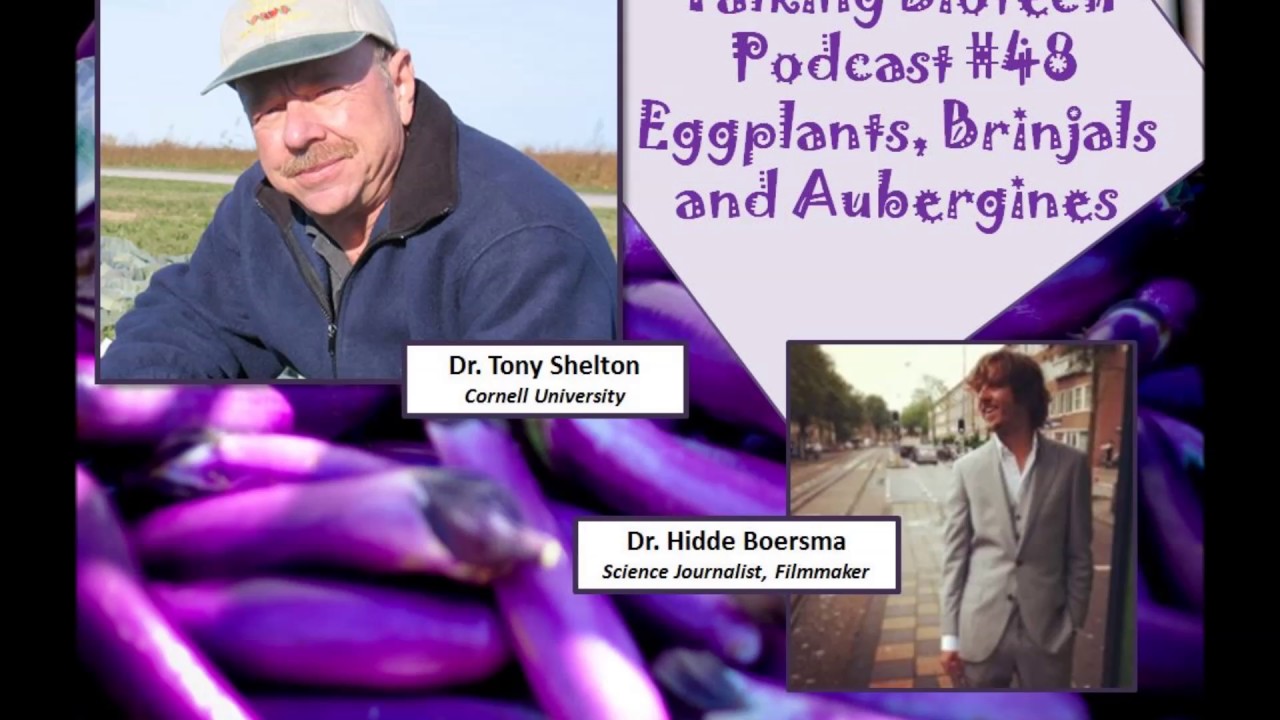
Cornell entomologist Tony Shelton and filmmaker Hidde Boersma discuss Bt eggplant in Bangladesh, which cuts pesticide sprays from 160 per season to nearly zero. Greenpeace blocked the crop in India, but Bangladeshi farmers saw higher yields and lower health risks. Boersma's documentary "Well Fed" shows their stories.
Chapters
I want to see science serve a useful purpose to improve the standard of living for all people.
Hey, why is anyone fighting food advance?
A very small percentage of the world's population is fortunate enough to have the luxury of turning down food.
We've arranged a society based on science and technology in which Because nobody understands anything about science and technology.
You can't build a peaceful world on empty stomachs and human misery.
You're listening to Talking Biotech, a weekly podcast illuminating issues in agricultural and medical biotechnology. Your questions and concerns are addressed using a science-based approach with the goal of driving discovery to application with communication.
Now here's your host, Today on Talking Biotech, it's really a pleasure to welcome Dr. Tony Shelton. Dr. Shelton comes from Cornell University where he's an international professor of entomology. And last year I had the opportunity to see him speak at a class in Cornell about his work in creating and participating in the development of the BT brinjal, So this is an eggplant, or aubergine if you will, and its deployment throughout Bangladesh. So welcome to the podcast, Dr. Shelton.
Okay, great. Thanks very much for having me, Kevin.
It's really great that you were able to join us because this is another topic that I think really helps people understand the good things that this technology can do that isn't tethered to a company. You know, all the things that people say about the negative side of this technology. But let's start back to the beginning. When we talk about eggplants, and it's, it's a kind of an odd fruit or vegetable, whatever it is, technically a fruit. In the West over here, we sometimes buy it at the grocery store. You get it here and there in a restaurant maybe, but what does it mean to food security in places throughout Asia?
Okay, so eggplant is actually one of the most widely grown vegetables throughout Asia. In Bangladesh in particular, it's the second most popular vegetable right behind potatoes. So it is incredibly important. It's a good source of dietary fiber, vitamin B1, and copper, and magnesium, vitamin B6, niacin. So it's a pretty nutritious crop as well. And it's grown, well, let's see, about 150,000 hectares of eggplant are grown annually in Bangladesh. In India, it's about 3 times that much. A very widely used crop.
And so if we talk about the diet of people who live there, is it something that maybe you eat every day or maybe once a week or how— I guess it depends on where you are, but in general, are there areas where this is a really important cornerstone of Oh yes, definitely.
In Bangladesh, again, it's the 2nd most popular vegetable, so it's eaten pretty much daily.
Okay, so what are the large barriers to production of eggplants?
Well, there's an insect called the fruit and shoot borer. It's a A caterpillar that the adult moth lays its eggs on either the shoots or on the fruit, and then the eggs hatch into larvae that just bore down into the fruit or the shoot. If they bore down into the shoot, they will kill it, causing the plant to become bushy. And if one of those shoots is going to be Would have developed into a flower, then that flower will not develop once the shoot is infested. So it's really a major, major problem, both in the plant during its reproductive as well as its non-reproductive phase.
I've seen Pam Ronald show pictures of this in her talks where she shows it actually— where there's an insect that actually is eating the fruit item itself, the aubergine or the brinjal itself. And is that still a big problem, or is it mostly in the vegetative parts of the plant?
It's a problem in both phases of the plant's development, but certainly if the larvae get into the fruit, they will just bore or mine in the fruit, and you'll find these tunnels full of insects and their frass, what we call frass, or their waste. And that simply makes it unmarketable and also somewhat dangerous to eat too when you have infested fruit.
Well, yes, you open up all the avenues for fungus and mycotoxins, other types of problems Right. So when we think about the toxicity related to the agricultural aspects of this crop, what— how is the insect managed and controlled?
Well, the primary management is just to spray it and to spray it regularly. So depending upon the area and the season, You know, it can be— there are reports of up to 160 sprays during the season. So this is a, you know, 4-month crop, and you can figure that out, and it's almost a daily application of insecticides. I think on average, though, it's probably about 80 sprays during the season, and they're pretty nasty sprays too— organophosphates, carbamates, some pyrethroids. And generally the farmers will mix all these insecticides together and then just spray with a backpack sprayer. Farmers really don't have any personal protective equipment like what we would encourage people to use in the US, and farmers typically report skin irritations, lung irritations, etc., from spraying these chemicals. And again, you know, in India when I was talking to an eggplant farmer and it was— he was just about to have the eggplant go to market and it was just— the eggplant is supposed to be purple and this was just covered with white residue and obviously pesticide residue and he just was going to wipe it off and then have it go to market. That might wipe off the color, but those pesticides certainly get into the skin of the fruit and, you know, hazardous to human consumption as well. He affectionately called it a pesticide bomb because it had so many pesticides on it. And when I asked him if he ate what he grew, he said, no, I don't.
It's pretty sad. You also mentioned a couple classes of insecticides that, you know, I'm not an expert in insecticides, and I think there's a lot of discussion about that on, on the podcast and in the parlance of discussion of genetically engineered crops. When we talk about things like organophosphates and carbamates, what are those classes like? Maybe how do they work, and just real generally, and what are some of the risks of using those classes, and do we still use them here?
So organophosphates and carbamates tend to be— they're an older class of classes of insecticides. They are nerve poisons. Some of them are still utilized in the U.S., but the EPA has encouraged companies to go to other classes of insecticides that are a bit safer. Organophosphates and carbamates are relatively— they're really broad spectrum. They will kill the pest insect, but they'll also kill many of the beneficial insects as well. They're not very selective in nature, and they also have a high toxic— relatively high toxicity to humans. I'm not against the use of pesticides when they're warranted, but we try and minimize the use of them.
Yeah, I think that's a really important point, that, you know, that they are used judiciously. They're also expensive, and there's not a lot of farmers that want to spend the extra money to apply, especially to large field ag crops, excess insect control.
I don't, I don't know of any farmer who wants to apply an insecticide.
Yeah.
I also don't know any farmer who wants to suffer the loss from a pest species. And so what we try and teach farmers to do is what we call integrated pest management. And in that, we try and prevent the— say, in this case, the insect from causing any damage. But when it becomes likely that economic damage will result, then we need to implement some level of control, whether it be an insecticide, whether it be a biological control agent, etc. But what we really try and do in integrated pest management is to reduce the likelihood that a major pest will even attack the plant. And one of the cornerstones of integrated pest management is host plant resistance. Now we have a number of commercial crops, unfortunately not so many vegetables, that are just bred to be resistant to a particular pest. And we try and— plant breeders try and breed those to what we call the key pest in an area, whether it be a disease-causing organism or an insect. So if you can get host plant resistance to the key pest, you know, you're halfway home in producing a good crop. Now whether that host plant resistance is developed through traditional plant breeding or developed through genetic engineering, I really don't see any difference between those two. But what you really do need to do as a foundation for integrated pest management is to have host plant resistance. And in fact, that's what's been done by engineering eggplant to produce a protein from a bacterium. Bacillus thuringiensis. So once the insect takes a little pinprick bite out of the plant that is expressing that Bt protein, then it gets a stomachache, stops feeding, and dies. It's a great, great way of having host plant resistance.
Now that's really great. I know we've, we've talked a lot about Bt on, on the podcast, mostly in the areas of its mechanism. We actually had Fred Perlak on, on episode 28, where he discussed how it worked and its application. So let's do this. We'll take a short break here, and when we come back on the other side, you framed the question beautifully, or at least the problem beautifully, that there's a need for this very important food staple to have resistance to the disease, and that right now chemical controls are being used to do it. Maybe there's a better way to take that on. This is the Talking Biotech podcast, talking to Professor Tony Shelton from Cornell University. We'll be right back in just a minute. Hello, Talking Biotech aficionados, thanks for listening. We continue this enterprise with the hope of spreading the infection of science. It's a curious pathogen that, when you contract it, makes you immune to nonsense and poor quality information. Like cupping. Now we need you to step up and be a shill for Big Podcast. Go to the place where you download podcasts and write a review for Talking Biotech. It can be positive, it can be negative, I don't care. Just share your thoughts, because that's the only way that I can get better at doing this. Suggest guests, suggest guest posts, suggest a topic that you just want to understand better. Remember, this podcast is fueled by the kind interest of a wonderful audience, and your feedback helps keep us relevant. And You know, we've elected to not entertain sponsors or solicit donations, so your good vibrations fuel my groove. And remember, remember, tell a friend, write a review. And now back to the Talking Biotech Podcast. We're back on the Talking Biotech Podcast with Professor Tony Shelton, International Professor of Entomology at Cornell University. Who's up in Geneva, New York. And Dr. Shelton is talking to us today about the BT eggplant, or the brinjal, a food staple worldwide that, especially in parts of Asia, that has some challenges to growing it, which are based upon insect problems. And he's been instrumental in a team that has implemented a genetic engineering approach to limit the damage to this crop, and resulting in what appears to be Very positive effects for the people that grow it. So we'll go back to pick up where we left off. When we contrast and compare different methods of insect control, and what you mentioned about integrated pest management is so important, but when we talk about Bt being produced by the plant and compare that to sprays such as carbamates or organophosphates, how do the two compare and contrast as mechanisms of control, especially on their environmental impacts?
Okay, so Bt, which has been used as an insecticide, a foliar-sprayed insecticide, has been used for maybe 70 years. And when it is sprayed on, the insect— it occurs on the leaf, and then the larvae would come along and feed on it and then ingest that. And get a stomachache and stop feeding and die, usually in 2 to 3 days. That contrasts remarkably with the organophosphates or carbamate insecticides, that if a little droplet gets on the back of the insect or on the front of the insect, or the insect walks across a residue, then that will go into the insect's body and cause nerve damage. And the insect will die. So the way that these act is fundamentally different. The Bt has to be ingested by the insect. The problem with, you know, and you can say, well, why don't you just spray the Bt on, which organic growers do regularly? The problem with that is that it disappears in about a matter of a couple of days. And so you really have to almost soak the plant in it every day or every other day for the Bt to provide as much control as it would if the plant were just engineering the Bt and expressing that, say, in the fruits or the shoots. So it's a very different idea. I mean, in the case of Bt, it's just a different way of— Applying it, either having the plant produce it or spraying it repeatedly. And that's really a major— you know, it's the same protein, has the same lack of toxicity to humans. It's just a different way of applying that same protein.
Well, and you also have to spend the time to apply it. You have to go buy a bag of Dipel or whatever you're going to, you know, however you're going to administer it. Which costs money. So having the plant make its own protection seems like such a— I remember talking about this in our biology classes back in 1981 and thinking about how cool this would be to be able to see plants protect themselves against insects. And everybody was on board. You know, this is a brilliant idea.
Yeah.
Um, so let's, uh, maybe move forward a little bit to the project itself. So the, the Can you tell me more about the project that financed and really initiated the efforts to develop the Bt brinjal, and where and when was that developed?
Okay, well, Mahyco, which is an Indian seed company, they produce many different vegetables and cotton. Other field crops as well. So they had the idea of putting Bt gene into eggplant. And as they were doing this, you know, Cornell and USAID found out about it too, and we felt that what we could do at Cornell in India was to help facilitate the development and the deployment Of this, of this eggplant. So a seed company like Myco, you know, they make money from selling hybrid seed. And we took a kind of a novel approach because we said, okay, why don't— why doesn't Myco donate the breeding lines that have this Bt in it, distribute those to What essentially are land grant universities in India, they can put it into their open pollinated lines, distribute that to those lines to growers free of charge, or almost free of charge, and then growers will start utilizing that. And at the same time, MyEco could also sell hybrid seeds.
Right.
To growers in India. So there was going to be what we call a poor pro outlet, that would be the open pollinated lines, and another line of distribution of the seeds which would be through hybrids. Farmers love hybrids because they will produce more, a better crop. But they also, you know, do cost more. So this was a two-pronged approach to getting this BT technology out there in India. And it was developed and field-tested, went through all the biosafety authorities in India, and then it became a political hotbed. And Greenpeace, it's rumored, spent about $100 million to derail the Bt eggplant in India simply because they have this— I'm not sure what to politely call it, but it is diametrically opposed to genetically engineered crops, not for any scientific reason, but really more for— well, in fact, some of them, some of the people in Greenpeace have said that it's really our top fundraiser if we can get people to rally around the idea of being against genetically engineered crops, that will provide us with funds that we can use for other things. So unfortunately, Greenpeace has been against things like golden rice, papaya that resists papaya ringspot disease, a devastating disease throughout many countries, and also they have been opposed to Bt eggplant. And unfortunately, in February of 2010, the Minister for the Environment, the last gatekeeper to really— last gatekeeper for Bt eggplant to be commercialized, he put a moratorium on it. And he put that moratorium on it, and it still sits. Well, more than 6 years later. What's odd about it, I mean, the Minister of the Environment, you think, should try and protect the environment. Well, the insects, you know, they don't care about any moratorium. They will still attack the eggplant, and growers will continue to spray maybe 80 times during the season with some pretty nasty stuff. So that's— there's unfortunately a very bad irony in there. Minister of the Environment, influenced by a $100 million campaign by Greenpeace, put a moratorium, and there it sits right now.
Yeah, it's not unlike what we see in other countries where Greenpeace has a very active presence that is not just working at the level of the politicians but is also on the ground kind of tarnishing the reputation of technology before it can even be deployed. And are there— have there been, or is there— are there reports of Greenpeace describing this to the layperson as something that would be dangerous or cancer-causing or causing infertility, that kind of thing?
Oh yes, pretty creative with their ideas on that. I should mention though, is once in 2010 when this occurred Soon after that, we had the Minister for Agriculture and the Minister for Environment in Bangladesh come over to Cornell. Bangladesh is one of the poorest countries in the world. When they came over, they said, you know, we'd like to go ahead with Bt brinjal, Bt eggplant in Bangladesh. And I said, well, you know what happened in India? And they said, yes, we are not India though. And I, my responsibility, the minister said, was I have 160 million people to feed and I have an environment to protect. And we don't have Greenpeace so active over in Bangladesh. We're too poor of a country. So we would like to go ahead. And so we started working with Bangladesh. And in 2000 2014, the government of Bangladesh made a regulation allowing the production of Bt eggplant. So it was first grown by about 20 farmers in 2014, and when it was out in the field, boy, there was a lot of controversy, and that certainly got the antis pretty Uh, active. 2015, we had about 108 farmers growing it. 2016, we had probably about 500 farmers growing it. And the farmers can save their seed, and, you know, in fact, many of the farmers give it to other growers. In 2016, they're anticipating 5,000 farmers. In Bangladesh, growing BT eggplant. So farmers are are not stupid people; they're very bright people. And in fact, if they see an advantage growing this BT eggplant, they will utilize it. So it's really on the uphill rise, and I don't see any way of getting the genie back into the bottle in Bangladesh. It's It's been a remarkable success story. I was over in Bangladesh in March, and I was talking with one of the growers. He had about a, maybe a quarter-acre plot. It's a demonstration trial. And in that quarter-acre plot, he has Bt eggplant in the center of it, of the plot, and then around it there are 2 borders, 2 border rows of non-Bt eggplant. And it was harvest time, so I went through the border rows, the non-BT eggplant. Every one of those fruit was infested. In the interior part of the field, there was no fruit that was infested at all. The farmer was so happy with this technology, and he had his father out in the field and his niece in the field. You know, they were just smiling. They were Very, very happy. I asked him how many times he would have sprayed if he did not have this Bt eggplant, and he said, I would have sprayed about 100 times. I asked him how many times he sprayed this year with the Bt eggplant, and he said he had to spray twice, and that was for the whitefly, which is a pest that is not affected by, by the Bt protein. So, I mean, he had his father and his Young niece walking in the field that in a normal— if he did not have the BT eggplant, there would be a lot of concern about especially young people walking through an eggplant field that had received so many insecticide sprays. But he had no problem with his father or niece out in the field. He was very ecstatic. He had sold everything in the central market. And he advertises it as reduced pesticide input, and so he was getting a premium for it as well. So I went away from that field visit thinking, you know, this technology can change people's lives. In a poor country like Bangladesh, or in India, or other places, it can change people's lives.
Mm-hmm.
And that was just a remarkable feeling to be on a team that was helping change people's lives for the better.
That is one of the— it's one of the themes of the podcast is how do we use technology not to make new products that companies sell to farmers, which is still great stuff, right? But how do we have impacts on the ground with people who need help? And I think so much credit goes to the agriculture Secretary of Bangladesh, or Minister of Agriculture. Can you tell a little bit more about her and what her attitude has been and how she, you know, maybe a little bit about her that you might know?
She is a pretty strong-willed person who believes in science and believes in this technology. And wants to make Bangladesh agriculture productive and safe for the environment. And what a bold move that is for someone to just say, we're going to go ahead with this. We see what's happening in India where it has a moratorium. We see other countries debating about it. But Bangladesh, we're going to go forward. It's an amazing Amazingly positive woman.
Hmm.
And I've talked with her about the need for stewardship of this valuable technology. We don't want the plants deployed and in, in such a manner that they will fail because of the insects evolving resistance in a few years. So we do have strategies to delay the evolution of resistance. And she understood this perfectly well. She repeated, stewardship, stewardship, stewardship. That's what we need to do. And so that really made me smile.
Well, it's nice, but since the seeds are kind of given away or can be handed from farmer to farmer, how many of them are, are not traveling with that stewardship message? And are seeds actually getting back into India where farmers may want to grow them because of the low inputs? But then fail to plant the fougère and stop scouting because they feel that they have insect protection?
Well, these are great, great questions. We know that insects are very dynamic and, you know, they will change over time. When we're starting off with this project though, there will be a A relatively low adoption rate there has been of the Bt eggplant because the seeds are just being produced. But it's ramping up. So in 2017, for example, have maybe 5,000 farmers growing it. If 5,000 farmers grow it, we won't have as much natural refuge, that is non-Bt eggplants out in the field. So we just really need to monitor any changes in susceptibility over time. So that's part of the stewardship. As far as farmers, you know, keeping the seed and whether they're going to keep the seed for the refuge plantings, this is really a strong— we need a strong push for education to these farmers. Farmers see, you know, they have pretty good memories too, and if they see or hear about resistance and practices that will lead to resistance, they remember and they will do all they can if they're educated to try and avoid that situation. So education is a real key component to what we're trying to do. In Bangladesh. As far as it getting into other countries, you know, there are certainly rumors that it has made its way over to India. India and Bangladesh share a border, and Ron Herring probably talked about how Bt cotton got into India when it was not regulated, and then farmers just started adopting it. And threatened to go on strike if the government did not allow the registration of the Bt cotton. And the farmers, you know, won that argument.
And what about— so when I use this example of Bt brinjal as one of the success stories of the technology that has directly affected the lives of people, I get pushback. And there are people who will say, well, no, it's been a miserable failure, that you can find assessments by this person who is some scientist in Bangladesh who says that it's been nothing but a scourge to farmers. Are you aware of that kind of counterargument, and where did that come from?
I am aware of it, and then actually in 2014 when I was in Bangladesh and, you know, watching these 20 farmers who had been allowed to grow the plants. I went to— while I was in Bangladesh, a news story came across my desk that one farmer was saying that this was actually a disaster, a crop failure. So we went out to his field and asked him about that, and he said, well, a couple of people came up on motorcycles and they wanted me to they were interviewing me and asked if I would say that this crop was a disaster. And I said, no, it's not a disaster, and just look around. And that's not the story that they wanted, so they just went back and wrote their own story.
Hmm.
There was, uh, when it was first produced though, it was grown in these 20 fields. It was grown During the rainy season. So although there were not any reported infestations of the eggplant fruit and shoot borer, there were some plants that were wilting because of bacterial wilt, an organism in the soil. And, you know, maybe some of these fields might have had 5 or 10% wilting plants, which were removed and then replanted with BT eggplant. But again, it was taking— the Bt eggplant was taking care of its main targeted pest, and that's an insect. It's not any more or less susceptible to diseases than non-Bt eggplant. So farmers really need to manage it. And in fact, so in 2015, when we were working with 108 farmers, we said, okay, You have to rotate out of a solanaceous crop. You know, you really don't put the BT eggplant in the soil that is already infested with this pathogen. Otherwise, you know, just like a non-BT eggplant, it will have problems. So again, it's all part of what we call integrated pest management, where you think about the whole suite of practices for producing a good crop. So, you know, where does this misinformation come from? There was a Mark Lynas who is— was an anti-biotechnologist and then, you know, started reading about— becoming more knowledgeable about the technology and now he's a strong advocate for it. He wrote an article in the New York Times, an opinion piece, and there were a couple of letters, you know, attacking him. And one of them said, you know, look, I talked with this farmer that you said loves this technology, and that farmer says no, he doesn't. So several months ago, there was a film crew over in Bangladesh interviewing this farmer who was kind of caught in the middle of this argument. And he's very, very clear that he loves this technology. And we actually have a video of him talking on our website. The website is called bt-eggplant.cornell.edu. And it's an actual interview with a farmer saying that he likes this technology. There's also a couple of other videos on that website. One in particular is 3 farmers that we interviewed who are talking about this technology. So I'd encourage your audience to just log on to that and look at some of these videos, and then they can make up their own minds.
Oh, that sounds great. I'll actually put a link to the websites on To the videos on the web, on the talkingbiotechpodcast.com website. And just go there and I'll link that right up. And what about— I've seen some other really beautiful videos on this come from the Cornell Alliance for Science effort. And are those the same videos or a little different?
We work very closely with Alliance for Science. We overlap with them. And I think we help each other get the information out about the facts about biotechnology. I should also mention too that our project funded by USAID, it's a 3-year project that started in October 2015. It's for Bt eggplant in Bangladesh and also for Bt eggplant in the Philippines.
It's not commercialized in the Philippines. There were many field trials that were run, and some of those are now resulting in refereed, peer-reviewed refereed publications. Those are on the website as well. But Bangladesh Greenpeace was a strong adversary about having BT eggplant grown in in the Philippines, and they went to the Supreme Court and tried to get further trials blocked. The Supreme Court heard the case and initially agreed with Greenpeace, which was an odd thing to do, but earlier this week they reversed that and they said we'll open the road for further trials on Bt eggplant in the Philippines. Bt eggplant and a number of other crops. So over time, I think things are changing, but it certainly is an interesting time in which to be working on these crops, these genetically engineered crops. But I got into this business The reason I became an entomologist was I was interested in 3 things: biology, food security issues, and environmental issues. And it's great to now have the opportunity to use some modern technology to solve very old-world problems in a much more effective and environmentally safe manner. Well, it's, it's, it's really commendable, and it is such a beautiful example of what our science should be doing and, and what we are doing in universities that really do center around how do we make things better for people and the planet by using the best technology. And I think that, you know, my feeling is that something like the Bt eggplant, if the story gets bigger, if it starts to move to other countries, that it really can serve as kind of that first domino that you can hold up and say, look everybody, this is doing good things for the people in the environment. Why do we stand against this technology? And, and let the air out of the sails of the, of the folks like Jeffrey Smith and Vandana Shiva that just promote, um, fear and use a fear message and to, uh, to scare people away from technology that can help them. And, uh, so what, what are— where do you see the eggplant moving Next, beyond, say, the Philippines, are there other countries that are really looking at this?
Oh, I think Vietnam would be very interested in it. Vietnam has started growing genetically engineered corn or maize. So there are a number of countries— this pest, the eggplant fruit and shoot borer, has been a long-standing problem throughout Asia. It's estimated that, you know, just the infestation by this pest, even when it's regularly sprayed, is about a 67% loss. So it's such a contrast to see an unsprayed BT eggplant producing perfectly clean fruit versus a non-BT eggplant that is sprayed regularly and still has a dramatic loss to it. So we'll see how this story ends, but what a bold move by the Minister of Agriculture in Bangladesh to say, I've got 160 million people to feed and I have an environment to protect, let's move forward.
Yes, yeah, we need more leaders in the world like, like her, and I think time will be amazingly kind to her when they look back and say she was the one who really started this trend where we were able to feed more people using technology.
Yeah, but it's a, it's a critical time right now because again, Bangladesh is the only country in the world to grow this— well, the only developing country in the developing world to grow a food crop that is very, very important in their diet. So there is a battle going on by, you know, the proponents and the farmers versus groups like Greenpeace who are against this technology. And it's so ironic because, you know, Greenpeace, when I was in college, they were doing some, some good things, and they still do some good things, but their stance on biotechnology has no scientific basis at all. And as they have said, they use it for more fundraising than anything else. That's very unfortunate.
One thing about the B.T. Brinjal is that this just seems to be the story that we've always been waiting for. You don't have a national multinational company. Farmers can do what they want with the seeds, and it's working. And how do we get this story out there better? It just seems so natural.
You know, explaining science to the general public is often very difficult. And you're certainly aware of those surveys that say, you know, 80% of the people don't want any genes in their food. And we know that we just really have— that indicates we really have challenges in science education. People, you know, concerned about vaccinating their children because of possible autism. So these rumors start and they spread like wildfire. And it's really imperative that scientists speak up and try and inform the dialogue. about biotechnology. And the eggplant one example is a beautiful example because there's no one who's really making any money on this, you know, except for the farmers. It's not going into, into the pockets of multinational corporations. It is just a worthwhile project. And I'm reminded of the Nobel Prize winner Lloyd Boyd Orr, who said you can't have peace on empty stomachs. And actually, Norman Borlaug used that phrase when he accepted his Nobel Peace Prize, because to have social justice, you, you really need to have people have Well, going forward, if people wanted to learn more about the project other than, say, looking at the website, which was again, uh, was it bt-eggplant.cornell.edu? Correct.
Okay. And if there's— are there other places that, uh, in more of the traditional social media like Facebook or Twitter that they can follow the story?
Yes. Mark Linus, Yes. If you could sign on to his Twitter account, you know, he puts out messages on a daily basis. I'm a little slow on Twitter, but Alliance for Science also has a very active Twitter messaging on this project. Anyway, it's been a pleasure talking with you, Kevin. And thank you for the opportunity.
Well, thank you very much. This was a wonderful opportunity to talk to you and learn more about this outstanding break— well, I would say a breakthrough in so many social ways and how we can apply technology to change the lives of people. So thank you very much for being with us today. And that was Professor Tony Shelton, who comes from Geneva, New York. He's a Cornell professor or international professor of entomology. who has been an expert in development of the Bt eggplant, but also works on a number of other projects that hopefully we'll talk to him about in the very near future. In this portion of the Talking Biotech podcast, we are fortunate to talk to Hidde Boersma, and he's joining us from Amsterdam in the Netherlands. Hi, Hidda, how are you?
Hi, Kevin, I'm good. You?
Well, having a good time. And I should call you Dr. Hidda Borsma, right?
That's true, yeah.
Now, you are a scientist who also— now, are you a scientist who also is a filmmaker, or are you a scientist who turned into a filmmaker?
It's the latter, actually. So I turned into a science journalist sometimes in 2008. When I finished my PhD. And now since a year, I'm also a documentary maker.
And your, um, your PhD is in, uh, in microbiology?
Yeah, microbial ecology. Yeah, I did a lot of, uh, bacterial typing in the, in the mycosphere, so it's— which is the area underneath the hyphae of, uh, of mushrooms.
Oh, okay, very cool.
Very basic research.
Yeah, that, that's, uh, but, but it puts you in a unique position to be able to examine the current controversies around food, especially around genetic engineering. And this mostly is in reference to your upcoming documentary called Well Fed. And when do you anticipate this one will be in wide release?
We hope— we're still looking for somewhere to be broadcasted, but it's going to be premiered somewhere in November. We think.
Okay, so November of 2016, this should be available.
Yeah.
And, um, the, the story is really beautifully shot, um, which I was able to see this, um, uh, myself, and I really enjoyed it because it was kind of a story within a story. And the basic— why don't you tell us the basic premise, you know, starting from the beginning and maybe your interaction with your friends And maybe take us for a walk through the major parts of the story.
Yeah, the thing is, we actually started, me and a friend of mine who is a filmmaker, who is sitting actually next to me at the moment, who we got into a conversation about GMOs. And like a lot of my urban friends in Amsterdam, they actually oppose GMOs, and not because they know a lot about it, but generally because they oppose capitalism or they oppose the works of Monsanto. And so we got into a conversation and I said, well, it's fine if you oppose this, but be sure that you also know that you're also opposing the use of this technique for poorer farmers. And then we got into conversation and said, well, I don't know anything about that because the only thing I hear is about Syngenta and Monsanto. So I thought, well, let's have a look. Let's go around the world and see different projects, a project not linked to Monsanto, but small-scale project where the poorest farmers actually, they get a better life from GMOs. That was actually the start of the story. So we thought, well, let's go to Bangladesh, because there you have a project which is specifically targeting poor farmers. And we actually wanted to, to see, to make some kind of a moral appeal. So if you oppose GMOs, you oppose also this. So we didn't want a documentary with a lot of facts, but we just wanted to show the lives of the farmers in Bangladesh and to show how their lives are improved by this technique.
And that was, that was really shocking because this is how I first became familiar with your work was through a video that was with—
The Digital Story.
Oh yeah.
Al Jazeera, I think, or not? Because it was originally published on Al Jazeera.
Okay, okay.
Yeah, yeah, so it was a side story actually. It has the same feel, so it uses the same photos and film from the documentary.
Okay, yeah, that's what I saw first.
Yeah.
And I was really surprised just at how well you were able to elegantly capture really the stories of the people who were being affected by this product. And the product was the BT Brinjal being grown in Bangladesh. And how did this transform with your experience actually standing there with the farmers? How did you find that this product was able to transform their ability to grow a crop?
Yeah, the thing is we started out by talking to farmers who don't have access to the BT Brinjal, and it's incredible to see how they perform agriculture. It's really sad because they use such an immense amount of pesticides. They spray their brinzels, their aubergines, they spray them approximately 80 times, 80 up to 100 times a season. And a season is 200 days, so they have 2 seasons in a year, which means they spray almost every 2 or 3 days with very toxic pesticides to make sure that Their crops aren't infested with the fruit and shoot borer. And it's not only bad for their health, but it's also very bad for their finances because I think around 60% of the money they invest are going into pesticides. And then we went to the very few farmers actually still, there are only 250 farmers now who use this BT brinjal, and the difference was enormous. Because they didn't have— they did better yields, they had to use less pesticides, and their health was improving. So it was so incredibly obvious how this technology helps the people there.
Yeah, and I think one of the most shocking scenes for me was the one gentleman who goes out into— one farmer goes out to spray his field, and he puts basically one of those old silver tanks on his back and goes out and just starts spraying a cloud of pesticide, and he doesn't have any protective equipment. He looks, um, you know, he— but he's out spraying just like he's doing 80 times per season.
Yeah.
Yeah. And I think that really is a— was a, was a very elegant setup to really the solution, where you're showing marketplaces of people selling this Brynjolf that— or this Or aubergine, eggplant. We have too many names for this thing.
Yeah, definitely.
But with this product, which is a food staple in Bangladesh.
Yeah, and it was very typical, actually funny but also sad, that they actually protect their hair when they start spraying because the thing they're spraying is very sticky, but they don't protect their airways. They don't put anything for in front of their mouth. So they inhale these toxic pesticides like almost every day. And we also talked to a professional pesticide sprayer who isn't a farmer but who is hired by farmers to do this spraying, and he was so incredibly unhealthy. He had pain, he had burn marks on his arms, and he breathed heavily. He was very unhealthy.
Well, yes, I guess a lot of— most of what they're using over there are kind of old-school organophosphates that are highly regulated here, or, you know, very bad, or even banned in some cases.
Yeah, a lot of those pesticides are banned, at least I know in Europe, because of their toxicity profile.
And what were some of the ways in which this product transformed the scenario for families, like when you would see maybe their children or the well-being of those farm families?
Yeah, the thing is we talked to 3 different farmers who grew this BT brinjal and they immediately said like our income has raised, it has raised so many— how do you say that in English? Oh, so heavily.
Yeah.
Uh, that, um, that they are able to buy more land or to do, to make investments in their home because a lot of those homes are still made of, uh, tin plates and, and they started transform— transforming the houses into, into bricks. So the standard of living of those people is is being elevated in 3 years. And you saw one of the farmers we actually spoke to was growing this BT perennials for the 3rd year, and he was this smart that he started selling the seeds because often you hear that people aren't allowed to save seeds from genetically modified plants, but in this case it's no problem. And he was this He started selling a lot of seed and seedlings to farmers in the neighborhood. So his income, his social position actually is elevated in a 3-year period. It's so clear.
It was so beautiful to see this happening. And I think one of the— as you progress towards the end of the film, and not to give away anything, but some of the most powerful scenes are where you see the, uh, the way that people raise food and what they eat and how they eat in the developing world or in places like Bangladesh versus how we eat in the West. Uh, and, uh, and, and some of just the juxtaposition of the imagery was, was very powerful because it really made you appreciate what we have. And at the same time, here is something that can really change the lives of farm families in a, in a, in what is a very poor nation in general.
Oh yeah, definitely, definitely. It's one of the poorest nations in Asia. And it has a big problem, of course, because it's also the most crowded country in the world. So it has to be— it has to do very efficient agriculture to make sure that all the people are fed. And yeah, like you said, we really wanted to do a moral appeal on the people here in the West, because it's so easy to be against genetically modified, uh, food crops if you have enough to eat, if you have different— if you can make a, an informed decision on whether you want to buy organic or not. And, and here in Bangladesh, it's, it's all down to the bare essentials. So the people— those people need to feed themselves. And like, one harvest, one failed harvest It's the difference between being able to feed your family and not being able to feed your family. That was— GMs can be like— genetically modified crops can be a sure solution to that.
One of the— so you had many stars of this show. I think it was between you and your friend, also, you know, the farmers, but also Mark Lynas, who you have brought in throughout the entire film. And what was it like to work with Mark, and, and why was he such an important person to connect to your story?
Yeah, I, I don't think I've ever met someone who can, like, uh, make a point so eloquently as Mark Linus. It was, it was very easy working with him as a filmmaker because we did a couple of interviews with a lot of people, and then you have to repeat, or a lot of, a lot of stuff isn't used. But we had, like, I think, 1 and a half hours of film material, and it's all— we can use it all because it's, it's incredible. But the interesting thing, of course, is that Mark Lynas used to be, uh, like my friends. They— he used to oppose genetically modified crops, and then he started really digging into it, and he's— and, and suddenly found out, well, I'm wrong. This is a technique which can make a difference in, in developing countries. So that was— that's— we hope that he will Yeah, make that point also to my friends that it's time to change your, change your stance on this topic.
And how have your friends changed now that they've been able to be part of your film and also spend time with you in these, in places like Bangladesh?
Yeah, like my friend who was with me, the filmmaker, he had at the end, he was very impressed with the, with the, with talking to, to the people in Bangladesh and thought of it. I was really wrong. I was actually prejudiced against this technique. And he said, well, I think like we're in the West, we have this, this, this set of beliefs. So you're either— if you're like, if you're left-wing, that means you're pro-government, you're pro-refugees, um, you're pro-women's rights, and at the same time you're against nuclear energy and you're against, uh, GMOs. And even though you're not educated in all the topics, but you get the set of meaning. And this is, he said at the end of the story, this is not how it used to be. And he really changed his stance on this topic. Like he thought, well, there's no reason for me to believe anymore that this is a harmful technique. On the contrary, it's a technique which can make a difference. And the rest of my friends still have to see the movie. I hope they will have the same transformation.
Well, I think that's one of the beautiful parts of this film is that I don't know that you're going to always change people who have very strong feelings, um, you know, about this, but because much of it is emotional and not based on evidence to begin with, that they may say that you are just a filmmaker for Monsanto, you know. Um, but, but I think people who are still thinking about this, who are searching for answers, who want to make up their mind I think this will be a very, very powerful piece of evidence for them to think about.
Yeah, I hope so.
So what is next for you as a filmmaker?
Well, the upcoming years, I hope we will travel around various film festivals and get this message around. I think like a lot of people who go— like the general public who goes to film festivals is often left liberal who have an antipathy against this technique.
So we hope to be engaged in a lot of discussion and hopefully also And if people want to learn more about you or your films, where can they find more information?
Yeah, they should go to my website, which is the Dutch website, of course. It's hard to translate in English. The best thing is actually probably maybe if you copy a link or something to my website, because it's in Dutch, so it's too hard to translate.
Okay, so those who are listening, please go to the Talk Biotech Podcast website, and I'll have a link on the page that takes you to the website. And then just use Google Translate. It'll translate the page for you, and you can at least learn more about Hide and his work and future aspirations. I hope that this one is really the first one of a series, because I would, I would love to see the same kind of treatment towards all the examples, you know, the banana and golden rice, which you mentioned, and And many other examples. What would you think would be your next project if you could pick one?
Yeah, like you said, we actually also plan to go to Uganda to the banana project, but we ran out of money actually. But these are all interesting stories. I think we really need to get the message out that this technique— we are at like the verge of like a turning moment that this technique is not only used for what they say, what they call monoculture, but it's used in so many African and Asian countries. I really want to go to the Philippines and to Uganda and Tanzania to where the cassava is being transformed. Those are such incredible, impressive, and important stories to tell. So I really would love to go there.
Well, thank you very much for joining me today. This is a Hidde Borsma, who was the producer and also the— you actually wrote, well, came up with the concept and the theme for the story, right, for the movie?
Yeah, true. Yeah.
Yeah, so, but the movie is called Well Fed and should be available somewhere in November of 2016. Thank you very much for joining me today on the Talking Biotech podcast.
Thank you. Great. Thanks.
That's it for the Talking Biotech podcast today. My name is Kevin Folta. Thank you very much for listening, and learn this story of the Bt brinjal, the Bt eggplant. Talk about this one when someone says there is nothing good about genetic engineering. This one, along with the papaya, with insulin, with cheese enzymes, with the more familiar and less discussed The small victories of this technology need to be front and center, because remember, this technology isn't about feeding the world. This technology is about feeding a world. And if your world is the world of a Bengal farmer and his small family standing over a few acres of crops you need to protect, this is a very important technology and something that all of us should be fighting for. Thank you, Kevin. So thank you very much for listening to the Talking Biotech Podcast, and we'll talk again to you next week.
Thank you for listening to the Talking Biotech Podcast. Please send your suggestions for guests, comments, or questions to talkingbiotech@gmail.com. Please write a review on iTunes and recommend this podcast to a friend. More downloads and reviews Which raise the visibility of this podcast and help us reach a wider audience with science.
More from Kevin



Talking Biotech 503 - A New Strategy in the War on Obesity. Dr. Erik Issacson, Wave Life Sciences

Organic Production, Conventional Agriculture, Health Anxiety, and Social Media Disinformation

Stop Political Appointees from Grant Decisions - Dr. Colette Dalawalla, Talking Biotech 501




