Talking Biotech 062 -- DNA Evidence of Dog Domestication
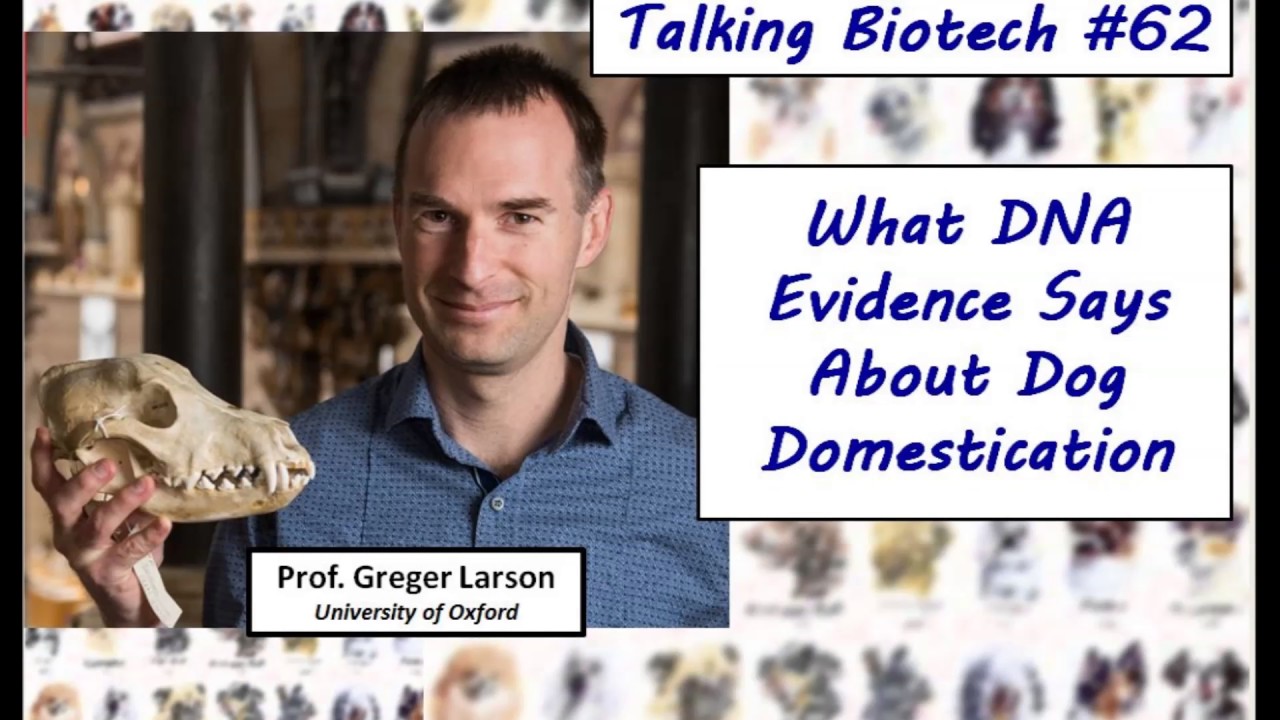
In this episode of the Talking Biotech podcast, host Kevin Folta interviews Dr. Gregor (Gregory) Larson, a professor of evolutionary genomics at the University of Oxford, about the origins of domestic dogs. Larson explains his unconventional path into ancient DNA research and describes the suite of molecular tools his lab uses—whole‑genome sequencing, mitochondrial capture, and a 3,500‑SNP panel—to retrieve genetic information from ancient canine remains. The conversation covers the consensus that dogs descend from gray wolves and were the first domestic animal, but highlights ongoing debates about when, where, and how many times domestication occurred. Larson presents the “ecomorph” hypothesis, suggesting that wolf populations that began scavenging near human groups gradually diverged, leading to mutualistic relationships before intentional selection. He details the serendipitous discovery of a 5,000‑year‑old dog from Newgrange, whose petrous bone yielded ~80 % endogenous DNA, enabling a high‑quality genome that revealed a deep east‑west split in ancient dogs and supported a possible dual‑origin model. The episode also discusses the integration of high‑resolution geometric morphometrics with genomic data to test these hypotheses, the role of dogs in reshaping human perception of domestication, and future research directions—including extensive screening of >1,200 ancient dogs, investigations of North American canids, and the rapid diversification of modern breeds. The podcast concludes with brief segments on science communication in a post‑truth era and a call‑to‑action from agricultural outreach specialist Chelsea Boonstra.
Chapters
I want to see science serve a useful purpose to improve the standard of living for all people.
Hey, why is anyone fighting food advance?
A very small percentage of the world's population is fortunate enough to have the luxury of turning down food.
We've arranged a society based on science and technology in which Because nobody understands anything about science and technology.
You can't build a peaceful world on empty stomachs and human misery.
You're listening to Talking Biotech, a weekly podcast illuminating issues in agricultural and medical biotechnology. Your questions and concerns are addressed using a science-based approach with the goal of driving discovery to application with communication.
Now here's your host, Welcome to the Talking Biotech Podcast, the weekly podcast where we discuss contemporary issues in science and technology with a focus on biotechnology, and we also look at new innovations that can help people and the planet. I'm Kevin Folta, and today it's exciting to be talking to Dr. Gregory Larson, and Professor Larson is an expert on the evolution of dogs. He's a professor of evolutionary genomics at the University of Oxford. So welcome to the podcast, Dr. Larson.
Thanks for having me.
Yeah, this is really exciting. I think out of all the topics that I've received recommendations on, it has been, can you please delve into the domestication of dogs and help us? You know, we have these companion animals and they're close to us. And very interesting in terms of their evolutionary history. It's all very recent, but, you know, but we don't know much about it. So let's do this. First, could you please describe for us a little bit about your background and your current research?
I started— I was a relatively late entrant to academia. I worked for an environmental consultancy after I graduated from undergraduate, and I was mostly in Central Asia and kind of wandering around speaking some Russian and doing stuff related to environmental impact assessments and that kind of thing. And I just had been reading a lot of Stephen Jay Gould and a lot of just popular science books, and I just started getting really interested in evolution. And so I decided to go back to apply for some schools, and I ended up doing a master's degree in archaeology at Oxford before starting a PhD in Colorado and then finishing my PhD here in Oxford, working primarily with ancient DNA. And it was through that whole process that I really thought that it would be a lot of fun to use ancient DNA as a way to explore primarily animal domestication, simply because I thought that, you know, there's been so much change. If we look at the modern populations alone, it's difficult to use them as a proxy for anything that was happening in the past. We've had such enormous influences on these animals that what they look like now bears no relationship to what they used to look like 5,000 or 10,000 years ago. But if we could directly witness them and we could look at the bones and extract the DNA going back to the very beginnings of domestication, that might give us a much better insight into the process itself.
And that's maybe a good place to start— why is DNA such a useful tool to be able to do this?
There is just an absolute ton of information in DNA, and because each individual base pair is not necessarily linked to the one next to it, all those individual markers can be used as a signature of an individual within a population, and that can be put into a time and a space so that you can compare individuals through that time and space and say what their relationships were. And because also DNA underscores the morphology and the behavior of animals, and we know often what those links are, you can look for specific genetic types in ancient animals and be able to then determine what they look like or how they behaved in a way that you wouldn't be able to glean from just the bones themselves.
That's really, really cool. And I guess the question that comes to my mind is, are you really working with a set of markers that have been well established within canine lineage, or are you doing whole genome sequencing at this point and just making large-scale genetic comparisons?
We're doing a multi-pronged approach. We are doing a lot of whole genome sequencing. We're also doing a lot of capturing of whole genomes. We're capturing mitochondrial genomes, and we've also designed a 3,500 SNP set that has markers that are both relative— will give us information relative to ancestry as well as to those SNPs that that I was talking about that are associated with morphology. And we're going to capture those 3,500 SNPs in probably between 300 and 500 ancient dogs and wolves to give us a very good impression of a large number of dogs and wolves through time and space with respect to both their morphology and their ancestry.
Okay, so let me, let me like unpack that a little bit for the listener that may not be up to speed 100% on the technology. So the idea of using SNPs are single nucleotide polymorphisms, and these are maybe conserved changes in DNA that you can associate with a specific trait or a specific lineage. And there are really high-throughput techniques that allow you to assess the presence or absence of SNPs across the genome. And it allows maybe an evolutionary biologist— and I'm not, I'm more of a functional genomics guy— but allows us to do the same thing, associate a given trait with a— or a given change, let's say, in morphology from a skeleton or whatever remains we have with a specific change in DNA. And then the other idea is this idea of whole genome sequencing, to extract DNA and be able to look at all of the genes and all of the DNA as best we can. And mitochondrial capture being looking at just the component of the mitochondria which has its own DNA, which tends to follow— which does follow maternal inheritance. So you can learn a lot about the female lineage Or the maternal lineage. Do I have that right in terms of how you would frame that as an evolutionary biologist?
That is a much better description than I could possibly even attempt. Oh, okay.
Well, let's go back then and talk about dogs, and based on the current information that you have, what is the current hypothesis about domestication of the wild animals that would eventually become dogs?
So there's a handful of things that everybody agrees on, and then quite a few things on which people might not necessarily agree, or at least there's a lot of differing opinion on. One thing that everybody agrees on, or at least for the most part anyway, is that dogs are descended from gray wolves, or from a population of gray wolves that are very closely related to the ones that exist now. So, you know, they didn't come from jackals, they didn't come from hyenas, they didn't come from any number of other organisms. But dogs are very clearly— the most closely related thing that they are is gray wolves, and everybody's very happy with that. And the other thing that everybody's very happy with is that dogs were domesticated prior— both prior to the advent of settled agriculture, and also that dogs were the very first domestic animal. And they precede all plants and all animals. And for most of our history as a species that starts about 200,000 years ago, we did not associate with the natural world in which we had domestic plants or animals. And it was about 15,000 years ago, although some would say it's a bit deeper than that, when people and dogs started interacting in a way that eventually led to domestication. So that means that it's only been 15,000 years since we've had any domestic animal, and it was probably 5,000 years after dogs that we start getting the first other animals and plants.
And did Darwin talk about dogs in the domestication literature that he had produced back in the 1800s?
Yes, he did. He talked to— I mean, he wrote an entire book about domestication in which he touched upon just about every plant and animal, and it was often very insightful, but it's It's interesting going back and reading that now because you recognize how little evidence there was for anything, and he was relying on a lot of other experts and didn't really bring a whole lot of insight himself into it other than to recognize it clearly as the proxy for evolution writ large, which is what he was— it was kind of the sugar that went down as he was trying to hype that idea amongst the general population.
So you talk about the points that we agree on, that scientists look to to the gray wolf as being kind of the ancestral root of the dog lineage. But what are the differences and where are some of the key hypotheses that have maybe recently— maybe refer back to your work from last June that was published in Science?
Yeah, so the big questions then are more about the pattern and the process is the way I like to think about it. So the pattern is the what, the where, the when. And the process is more about the how and the why. And from a pattern perspective, we're still not entirely sure about where dogs were domesticated. We're not really too clear. We have minimum bounds on when dogs were domesticated, but there's a big room for error there. And how many times, we don't necessarily know either. But this is what we started to do last year when we were playing with the genome that we derived from a 5,000-year-old dog from Ireland, from a site called Newgrange. And by looking at that genome, relative to a lot of modern genomes, and by looking at the archaeological record, what we determined was it looked as though there was a very deep split between dogs currently from the east part of Eurasia and dogs from further west. But that, that split postdated the earliest appearance of archaeological dogs in Europe, which seemed to suggest that perhaps dogs were domesticated 2 times on both sides of the Old World, and then the dogs that were originally domesticated in Europe were replaced by those that were domesticated So that was a hypothesis that we put forward in the Science paper. We felt like we had a lot of supporting bits of evidence to say that that was maybe the— what we should now think of as the standard interpretation. But it is still a hypothesis and still requires quite a bit of testing, which is what we're doing right now by generating lots more whole genomes of ancient dogs and wolves going all the way back to 70,000 to 80,000 years ago across all of not just the Old World but the New World as well.
That's really cool. So where do you get Old dogs. It's like old— where are most of the skeletal remains? I'm assuming this is all from skeletal remains and DNA brought from them. Where do you get that and how do you find it?
We collaborate with a very large number of archaeologists and zooarchaeologists and anthropologists who are working sometimes directly on archaeological sites where dogs have been buried or bone fragments from dogs are found. And then also with a lot of museum curators who have been housing these remains for some cases over a century. So by going to both museums and to private collections and speaking with a lot of archaeologists who have their own collections, we've been able to put out calls and say, look, we're really interested in this material and come on board and join this large consortium. And we've had enormously positive response. And we probably have somewhere between 50 and 100 people who have— probably closer to 100— who have donated material in one way, shape, or form that is now part of the big project.
And I know that a lot of these associations and these inferences about evolution have been made by looking at discrete portions of morphology, and maybe skeletal morphology, very small angles and small structures, and you know, just small, very subtle changes can really tell a lot inside how we— what we learn about the relatedness between different animals that could potentially belong to a common lineage, and how well does the DNA information match with what you're finding in the skeletal information in terms of correlation?
That's a really good question, and what we are— what we're doing is we're pursuing not just a genomic approach, but we're also using a high-resolution morphological approach, which is a field called geometric morphometrics, which involves rather than simply taking basic metrical statistics like length and width on a particular tooth. What GMM does is it allows us to take both 2D and 3D photographs or make use of those photographs to then landmark important points on the structure of the tooth or the mandible or sometimes even the whole skull. And then we can compare and contrast photographs from huge numbers. And we've got over 5,000 photographs of several different teeth and mandibles and skulls. By using this geometric morphometrics, what we can do is transform those different clouds of points so that we can then remove size from the equation and evaluate shape completely independently of size. And that means that we don't have to worry about how old an animal is necessarily, or how big it was. It's just about what evolution is doing to the shapes of the whole skull, or to the teeth, or to the mandibles. And then we can look at differences in those shapes in time and space in the same way that we would do with genetic data. So one of the big projects, of course, is to take the high-resolution genetic data that we can get from whole genomes and contrast it with the high-resolution morphological data and test the hypotheses against each other. So if we are suggesting, say, that there's 2 independent populations of wolves that were domesticated on both sides of the Old World, we would then expect to see 2 groupings of size and shape of those wolves in the Old World as well. And do we or do we not?
And so these are the kinds of questions that we're asking and that we're evaluating a lot of the data right now, but it's And I guess along this line, we speak about the molecular data, one of the stars of the show has been this Newgrange dog, and can you tell us about that particular specimen and how that played into a key role in some of the analyses?
Absolutely, I mean, for me it's a wonderful story about serendipity and the way that science actually works. which is that, you know, we put a lot of thought into things and people prime themselves for understanding things by investing a lot into getting background information and doing your due diligence. But sometimes something just falls out of the sky, which is what happened in this case. Which was a colleague of ours was a part of the team that recognized the preservation qualities, the DNA preservation qualities of a bone in your skull called the petrosal bone or the petrous bone, which is an inner ear bone. And it's a very, very dense bone. And it was recognized just a couple years ago how much better DNA is preserved in that particular bone element than, say, teeth or a femur or any other kind of bone that you would find in an archaeological site. And so what he's been doing is looking for petrous bones in lots of different archaeological sites. And this particular bone, I'm not even sure was initially identified as a dog. They sequenced it thinking it was some other organism and then recognized it was a dog once they got the DNA from it. And then we were all at a conference and he said, oh yeah, I know you guys are working on this dog project. We've screened this bone and it's like 80% in endogenous, meaning that 80% of the DNA in a 5,000-year-old bone was actually from the dog itself rather than being from the environment or from the soil or from the matrix that the dog was eventually found in, which is a phenomenal number. To give you an impression, when we wrote the grant, we said most of the results that we're going to get, most from the bones, we're expecting somewhere between 1% and 3% endogenous, meaning the vast majority of DNA that we're going to get is not going to be anywhere closely related. It's going to be bacteria or fungus Or anything else. And so we were going to have to look very hard to find the endogenous proportion. Well, this bone came just like a bolt out of hell with just like 80% endogenous, which just shocked us. But that meant that it was very easy, or significantly easier anyway, to sequence the entire genome of this 5,000-year-old dog, which we then did in collaboration with the group that found it. And then that allowed us to start comparing it with the modern genomes. And yeah, that's how it became the star of a show.
Well, with that idea, let's take a short break here, and we'll come back on the other side of the break with Dr. Gregor Larson. Professor Larson is a professor of evolutionary genomics at the University of Oxford, and we'll be right back with the Talking Biotech podcast.
The term post-truth is Truth was added to the dictionary this last year. It refers to a political climate where emotion rules over evidence, and truths are framed by feelings of a majority, rather than what is in fact reality. It happens in science too, and that's why science communication is more important than ever. And while you gentle podcast listener Are a critical component of science dissemination. Thank you for listening to this podcast, but most of all, thank you for sharing the information with friends and families. Remind them of the good things technology can do. And of course, if you could write a review on this podcast on iTunes, it would be very much appreciated.
Thank you.
It's because it raises our visibility and helps us share more science. When misinformation abounds, credible sources need to shine, and you control the science chamois. Fact-free policy decisions can only be countered by a literate electorate, and you hold a key position in helping spread the evidence-based story. Stories of Science.
My name is Chelsea Boonstra, and welcome to the Boonstra Report, where we talk about all things agriculture. Today I want to talk about why working with consumers is so important, regardless if you're somebody who just works in the ag industry or if you're a farmer yourself. It's so It's so easy to find negative comments on social media because social media is so easy to share. I mean, social media is your best friend, but it's also your worst enemy. We need to start working together as people of the ag industry in getting our messages out there, whether it's sharing a video, a picture, or just a post. And what I'd actually like people to start doing is I'd like them to share, I am an advocate for agriculture. Or, I have a passion for agriculture because... and I want you to finish off the sentence, and I want you to tag me in it so that I can share it. Because what I want to do is I want the message out there of why agriculture is so important to people. So I need your help. I'd like— create a post on Twitter or Facebook and tag me in it, ChelseaBoonstra, all one word, so that I can actually share it on my page on Twitter or Facebook. and that we can get that message out there. So be sure to follow me on Twitter, Instagram, and Facebook though, @ChelseaBoonstra, all one word. And thanks so much for listening today, guys, and let's start being positive leaders for agriculture.
So thank you, Chelsea, for the Boonstra Report. And we're back to the Talking Biotech podcast today, talking with Professor Gregor Larson at Oxford University, a professor of evolutionary genomics and We're talking about dogs and dog domestication and evidence taken from DNA analyses overlaid with what we knew from morphological studies from skeletal remains to really kind of develop a better hypothesis about when these really important companion animals became part of our biology. And really the way to step off into the second part of the discussion today is, can you describe the competing hypotheses Not about when and where, but maybe about how. Why did dogs and humans get together?
That is a— that's a great— it's a really good question, and it's very difficult to get to a satisfying answer from this because— so whatever we get from the bones and whatever we get from the DNA, it's hard to reconstruct that interaction, the behavior, the slow changes in morphology that was the result of a selection pressure, however intentionally applied by people or by the environment. And so, yeah, one thing I would say though is that I think when a lot of people ask why dogs were domesticated, already loaded in that question is an assumption of intentionality, is the assumption that people had some forethought and thought, hmm, I see this wolf population out there, and if I bring a couple of those puppies in, we can select for tameness and then create a pet that our 4-year-olds can play with and they won't get eaten. And, you know, which is an important assumption to question because keep in mind, if dogs are the first domestic animal, there is no model. You know, we can go to near Aleppo in the 1930s and grab a couple of Syrian hamsters and bring them back, and that's— which is what actually happened. And now that explains the hundreds of thousands to millions of hamsters that are in bedrooms all across North America and everywhere else. That's that is intentional. That's grabbing them, bringing them back in, hoping they reproduce in captivity, and when we then when they do, they then start to alter their behavior and genomes to be able to survive in that human niche. With dogs, we there is no model. You don't you have no domestic plant. You have no domestic animal. So how on earth could you possibly have foreseen a dog from a wolf? I mean, if you and I look at a wolf now, you don't see a chihuahua, and you don't see something with floppy ears and a shortened. Face. So how was it possible for these 2 things to get together? And I think there are still quite a few people who like the pet keeping model, who struggle to come up with any other way, because what that allows for is severing gene flow between the domestic population and the wild one, which is an important prerequisite for domestication. Because if you have too much gene flow, then everything that you want to change about that wolf to make it a dog will just get swamped out every time it goes out and mates with a another wolf. So how do you sever gene flow without having intentionality? And this is the big question. So we've got a hypothesis that we put forward a couple years ago in working with Bob Wayne at UCLA, where it might come down to what we call ecomorphs, which are variants, are populations of organisms that haven't quite achieved different species level or even different subspecies level, but have different cultures. And there's a classic paper that's Yeah. There's a study that's just come out recently about killer whales demonstrating that there are pods of killer whales off the northwest coast of North America, some of which eat sea lions and mammals, sea mammals, and others of which eat salmon. And they don't really interact that much. They recognize each other, but when they raise their pups, they raise their pups to eat that particular food source. And there's a very strong specialization in terms of their diet. And what that means is that you end up with 2 populations that to you and I look identical but culturally are very different and dietarily are very different. They pursue very different resource strategies, and that can be the wedge that starts to drive those 2 populations evolutionarily to be more distinct from one another, at which point, given a long enough period of time, you might then evolve certain reproductive incompatibilities, which would mean that you would effectively become 2 different species, started from just a different way that you interact with your environment and a different way that you acquire protein and subsistence. So we think that one possibility might be that there was a population of wolves that rather than eating caribou or eating anything else in the landscape started following us. And that process of becoming more accustomed to us and becoming more reliant upon the foodstuffs that we were providing, or at least the niche that we were providing, sort of began to reify into this process where they started to become a bit different and then made themselves more amenable to selection pressures that were more intentionally applied later on in the process. But so the question is always, how do you start a process if the beginning of that process is basically impossible to imagine and impossible to replicate? And I think that that's at least a reasonable model that allows for an evolutionary example of how dogs descended from wolves, rather than something that insists upon humans being these smart hunter-gatherers that were just going out and grabbing things and domesticating them, when you consider that for 185,000 years of our history we did nothing of the sort.
Well, how much of that process then of these, you know, maybe dogs that were becoming more— wolves that were becoming more accustomed to human presence and maybe living off of scavenging and around us, how much of this was mutual and mutualism where we both got benefit? Where maybe did we select them or did they select us or was it both?
And, you know, I think this is another classic evolutionary thing where, you know, to think of it as one It's never quite how evolution works, and I think that certainly we wouldn't have tolerated the presence of those wolves around us unless at some point they were providing some benefit. Because remember, we're competing on a landscape, and often where it's an adversarial relationship. I mean, the prosecution of wolves has been so great that we have exterminated them from large parts of their natural range after we had dogs, of course. So there must have been some benefit. And what some really fun research that should emerge in the next little while is demonstrating is that.
Right.
In several different hunter-gatherer populations, people, several, maybe 1,000 years after dogs were initially domesticated, people were keeping dogs in their camp and revering them as high-status members of society, almost certainly because they were helping hunter-gatherers in marginal environments hunt effectively and therefore survive in environments where they probably couldn't have done without dogs. And so by doing so, then when you see the burials, they are burying these things with grave goods that rival the people's grave goods. I mean, they're being treated as virtual humans on the site or as gods in some way. And so I think something along those lines, whether they were acting as sentries or whether they were helping people hunt or whether they were identifying carcasses on a landscape that people couldn't find or whatever it was, there must have been at some stage some benefit where there was— they were tolerated on both sides, both the wolves tolerating the people and vice versa. And that pushes the relationship closer, which then sets the stage for a little bit more deliberate and active selection that then eventually becomes Chihuahuas and poodles and whatever else we were trying to invent in the next 50 years.
It's actually interesting that you brought that up because when you look back at, like, say, artwork from Egypt or other places through antiquity, dogs have very distinct forms and very recognizable. You recognize that one as the Egyptian dog, you know, and other forms that you may see and associate with different times or places. And has any of that work kind of crossed the line to inform your analyses?
Certainly. So we're looking at that too. I mean, archaeologists have been looking at the bones on a site called Skatteholm, for example, in Sweden, and it looks as though there may be up to 3 different distinct sizes of dogs even 8,000 years ago. So, but a lot of— I'm working with some people who are doing a lot of iconography where they think they can even see individual dogs in some of the cave paintings in Saudi Arabia and things. So it is interesting that this relationship goes back so far, 15,000 years at least. That suggests that's plenty of time for people to have actively selected dogs to do a wide variety of different things, and for individual forms to, for cultural reasons or for environmental reasons, to kind of form and be played with different times and places. And that can get reflected in a whole range of different ways, whether that's through iconography or through written records or through, you know, breeding stuff that started in the late mid-19th century. So yeah, we're certainly trying to include as much information from as wide a variety of disciplines as we can.
And I've read a lot of your work, especially in the popular press that just erupted last June. And there was some— a few statements about how dog domestication was a vital part of human evolution, and where would we be today without companion animals like dogs?
You know, it's a fun thing I like to say because it is kind of pure speculation, but I don't think it's complete bollocks. I think that, you know, if dogs— and dogs are the first domestic animal, you don't have them. And so when you have dogs, it completely reorients the way in which people then perceive the natural world. Keep in mind, before dogs, our species has been around for 185,000 years, at least. And during that time, there is no wild-domestic dichotomy. And when you consider children's books or the way that we even phrase our language about domestication or domestic, we tend to draw this distinction, or draw a continuum sometimes, between truly wild and truly domestic. If you remove that whole framework of perceiving the world, that's what hunter-gatherers were like for 185,000 years before you had dogs. And that means that the way in which you think about the natural world gets completely reoriented with the emergence of domestic dogs. And that allows you to start to think about domestication in other contexts. And I'm not suggesting necessarily that dogs then necessarily lead to domestic plants and animals further down the line. It was at least 5,000 years between the first dogs and the first cows or sheep or pigs. But I do think that it starts to— this process where it almost becomes inevitable that people would then start reacting and associating with lots of other organisms in a way that might mimic that relationship that they had with dogs that didn't exist for well over 150,000 years before that. So whether or not it necessarily leads to it or it's a precursor, I'm not 100% certain. But you could certainly go all the way back to that point and say that before that, trying to put yourselves in the shoes of those hunter-gatherers would be very difficult, given how important domestication is now to modern civilization.
And could you maybe speak just briefly to the idea of breeds, where we've gone since the domestication event in this rapid generation of breeds which have been selected for specific traits? Does it— what does it tell us about the way in which humans can influence the, uh, let's say, malleability of that basal set of genetics that was there from the initially domesticated gray wolves?
Yeah, breeds are fascinating because what they really are is a testament to the plasticity and responsiveness of evolution. It really is remarkable that domestic dogs now, there is more than a tenfold difference in adult body weight size, which is bigger than all of canids, wild canids across the world. I mean, we have taken this basic form and through active selection, not to do a job, not because it was helpful in any particular circumstance, but because of pure aesthetic reasoning and just kind of desire to have fun with something that we can then push this form into just amazing myriad of shapes and sizes and colors and tails and ears and noses and the whole nine yards. So what we've done to dogs in the last 150 years is really— it's a phenomenal example of evolution in real time.
Really what you're looking at right now is a big data issue that you're generating huge amounts of data That now you're able to put together computationally to come up with some sort of a story. And how, what are we learning?
We are, just to give you a little bit of background about where we're going with all this, is that we are just now getting tons of data in. We've, our collection phase is more or less finished and we've really started, we've started the screening stage. We've screened well over 1,200 dogs genomically, and we're now picking those ones that are the most interesting for deeper sequencing and for capture approaches. And some of that data is now starting to come in, and some of the stories that are already hitting my desk are just blowing me away. And it's— we are gonna— I mean, this is turning out to be a much more fun investigation than I could have ever imagined, and I already have pretty high expectations for it. So over the course of the next 12 to 18 months, we're gonna be generating just a lot of really fun narratives and really kind of rethinking this entire thing about where, when, how many times, and why, and how, and the whole Okay, so let me zip back into kind of a lightning round here.
Dog or cat, what's the best companion animal?
Dog.
Do you have a dog?
I used to. I grew up with dogs for the first 18 years of my life and love dogs. My 5-year-old is so unafraid of dogs that regardless of the size or the shape or how intimidating it looks, she'll go up and grab its head immediately. So I think that may have been passed down for me. But right now, I don't actually have one at home. I work so much and I'm on the road to such a degree that it wouldn't be fair on a dog for me to have one right now.
Yeah, but if you could have one, what kind would you have?
We had an English Mastiff for a long time and she was just great. I know that there's lots of downsides with breeds and I'm getting more into that research, of course, but regardless of necessarily what breed it is, I think a big dog is a lot more fun than And overall, the research that you're doing in dogs and other domestic animals, where is really the dog story going next?
And what are maybe some hints about what you think we'll see in the next big paper?
So we are really trying to get to the bottom of the origins. I mean, that's one thing that has been— we're looking at a lot of things that are a little bit further down the timeline of the relationship between between humans and dogs and trying to track some of the genes that we find that identify different breeds from one another. You see how far back some of those go. But what I really want to know is, how many times were dogs domesticated, from which wolf populations, and what happened from there? And some of the stuff we've started investigating, a lot of North American dogs as well. And for a very long time, people have always said that North America was kind of a backwater when you think about dog domestication. All dogs in North America are coming from East Asia, and it's just— they're pretty uniform genetically. There's really not a whole lot going on there. We started to investigate it, and without giving too much away, it turns out that North America is becoming a lot more of an interesting story than anybody would have guessed. That's the thing that's really blowing me away right now. I think that's going to be a paper that should be out in the next 6 months or so.
That's really, really cool. I guess because I think about this as a plant biologist And our best example of the dog of the plant world is probably corn, in that here was a wild species called teosinte, where now we have the, you know, which had a little tiny kernels, a few hard kernels on a little ear. And now we've got corn, corn domesticated and really improved corn. But we can go back to maybe a dozen different genetic changes that really define those differences between where it was and where it is. Do you think that that's much more complex in dogs?
I think corn and dogs share a whole lot. You've seen the recent corn papers that have just come out. Some very good friends and colleagues of mine have been working on it. One thing that I love is that a lot of the traits that we associate with modern corn are actually relatively recent inventions that have been spread very quickly through populations. Those are exactly the kinds of questions we're asking about dogs. Another way that dogs and corn are very similar is the amount of gene flow or admixture between domesticated versions of corn and wild teosinte, and where— which populations of wild teosinte were contributing genomic material to domestic corn as it was moving through a region, often hybridizing and merging with populations that themselves were never initially domesticated. And that same thing is happening in dogs. I suspect that dogs are coming from maybe 1, 2, maybe more populations of wolves, but then as dogs move into other regions, they're probably hybridizing with wolves from those regions. Even though those wolves were never initially domesticated, now they're contributing genetic stock to those domesticated dogs, and they then are able to adapt to environments in which they were not domesticated in. And that's a, it's a really interesting theme that's developing through a ton of domestic animals and plants, many of which we're investigating, including pigs and chickens and a variety of other things as well.
Well, this was really fascinating, and I really appreciate you taking the time to spend a few minutes with us today to talk about this topic, and if people wanted to learn more about the project or about your laboratory, where could they find out more information?
We are on the web, if you type my name into Google, I'm like the first 8 or 9 pages, I'm not hard to find, and if you go to our website which is paleobarn.com, spelled with the English spelling with the A, then there's a description of the site, we put up our papers there, and I'm We have a bunch of tweets there that regularly refer to papers or to other things that we're putting out. So, and it just, you know, keep an eye on the stuff that's coming out from the lab because the next 12 to 18 months are going to be pretty fantastic.
And what about on Twitter and social media?
Yeah, so I tweet @Gregor_Larson, Gregor_Larson something, and our lab PaleoBarn also has a Twitter account. And you can reach me by email at any time. I'm very happy to get back to people, and I love to hear people from the own dog stories and their own ideas of how that whole process might have taken place, because it's— everybody's got an idea and it's always fun to share stories. So yeah, I'm easy to track down and I'm out there.
Well, Professor Greger Larsen, thank you so much for joining us on Talking Biotech. Really appreciate the time and look forward to hearing about pigs and chickens someday, okay?
Absolutely, we're all over it.
All right, thank you very much for joining us.
Thank you.
Talking Biotech podcast. Please send your suggestions for guests, comments, or questions to talkingbiotech@gmail.com. Please write a review on iTunes and recommend this podcast to a friend. More downloads and reviews raise the visibility of this podcast and help us reach a wider audience with science.
More from Kevin



Talking Biotech 503 - A New Strategy in the War on Obesity. Dr. Erik Issacson, Wave Life Sciences

Organic Production, Conventional Agriculture, Health Anxiety, and Social Media Disinformation

Stop Political Appointees from Grant Decisions - Dr. Colette Dalawalla, Talking Biotech 501




