Talking Biotech 064 -- Communicating Effectively with Critics
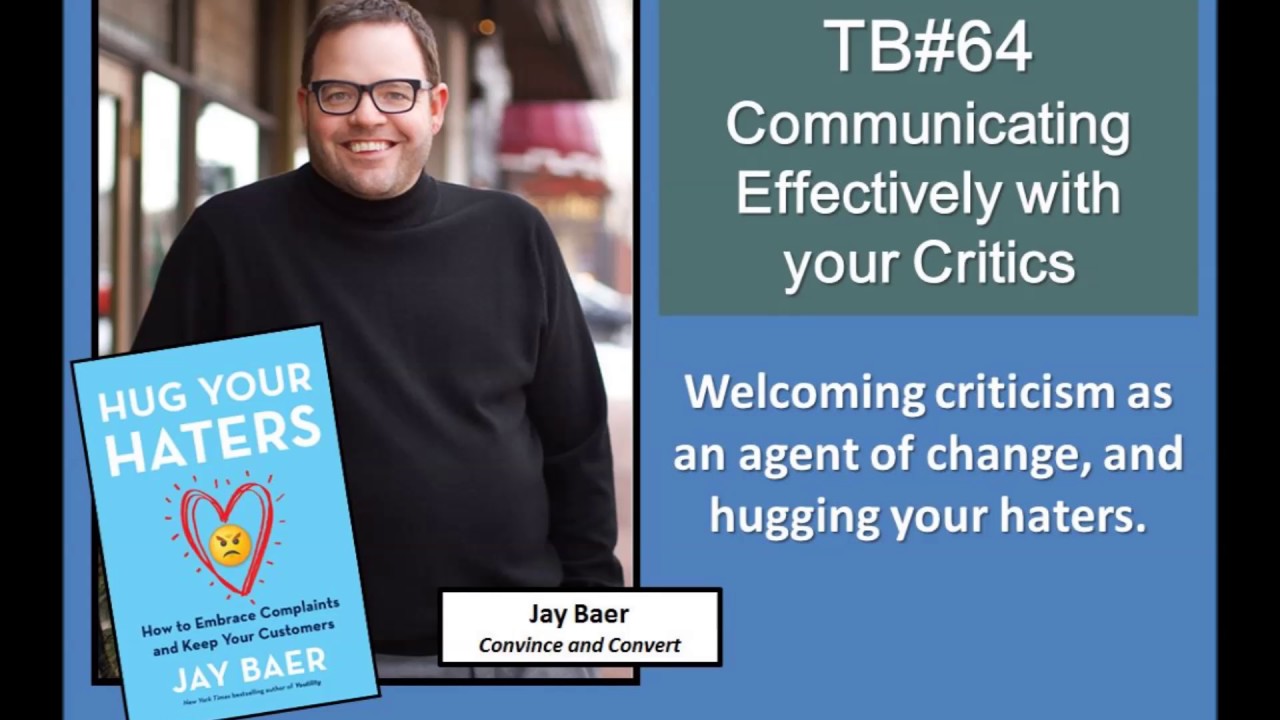
Jay Baer, author of Hug Your Haters, explains how scientists can engage critics more effectively. He shares the Reply Only Twice rule, real examples like KLM's 24/7 social media team, and why listening and asking why before presenting data changes outcomes.
Chapters
I want to see science serve a useful purpose to improve the standard of living for all people.
Hey, why is anyone fighting food advance?
A very small percentage of the world's population is fortunate enough to have the luxury of turning down food. We've arranged a society based on science and technology in which Because nobody understands anything about science and technology. You can't build a peaceful world on empty stomachs and human misery.
You're listening to Talking Biotech, a weekly podcast illuminating issues in agricultural and medical biotechnology. Your questions and concerns are addressed using a science-based approach with the goal of driving discovery to application with communication.
Now here's your host, Welcome again to the Talking Biotech podcast. It's the weekly podcast where we discuss contemporary issues in science and technology with a focus on biotechnology and new innovations that can help people and the planet. I'm Kevin Folta, and today we'll be talking more about the communication side. How do we engage in contentious issue conversations that can work out better to our advantage? And a big part of this is the strategy and the philosophy we take on as we begin to talk to people who may disagree with us. And with us today is an expert in this particular area. We welcome from Bloomington, Indiana, Jay Baer. Hi, Jay.
Kevin, thanks so much for having me. Delighted to be here on the show. Not sure I'm an expert, but I'll do the best I can.
Well, if you're not an expert, you have inadvertently stumbled into a wonderful formula that really works, and you've articulated this better than anybody, and I'm so happy to Thank you. So could you tell me, tell us first about, tell me about your background. Now, your background is in farming, right?
To some degree. I didn't grow up on a farm, but my family on both sides actually owned farms. I'm from the Midwest originally. So while I didn't, you know, grow up baling hay and such, certainly have been around farms for pretty much my whole life and have done quite a bit of work in bio as well on the consulting side. So have seen all sides of the industry.
Okay, and so what do you do now? What's your major role and who's the audience you speak to?
So I have a company now called Convince and Convert that does 3 things. We have 3 lines of business. One is a live division which involves me doing 60 or so presentations and programs around the world on marketing and customer service. We have a media division which runs one of the world's largest marketing blogs. We have 5 different weekly podcasts that we produce, a daily email newsletter. Things along those lines. I have lots of sponsors, corporate sponsors for that work. And then we have a consulting practice which provides marketing and customer service advice for some of the most interesting brands in the world. Our clients are 3M and the United Nations, Adidas, Allstate, Cisco, Salesforce.com, Comcast, Hilton, P.F. Chang's. We have a really terrific group of clients that we get to work with every day. It's a lot of fun. I've actually been in online marketing since 1993. Which is about as long as you could have been in online marketing. When I got in the business, we didn't even have a browser to speak of, much less Twitter. So it's been a long and winding road.
Yeah, I was going to say, if you did this in '93, did you do both the websites or which?
I spent about the first 3 to 4 years of my career, I spent going to companies, even relatively small businesses in Phoenix where I'm from originally, and saying, hey, you should get a website. And they're like, why would I want to do that? Why would I want customers to be able to get a hold of me? It seemed like a pretty good answer at that time. Now, of course, I wrote 5 books and one of those books is about real-time social media customer service, at least in part. Things have changed quite a bit in the ensuing years.
That's so funny because when I was in graduate school in the '90s, I took up as kind of a way to make an extra buck developing websites and web presence for small companies. I would walk down the street and literally go from strip mall to strip mall and say, hey, let me tell you about this thing called the internet. And I can sell you a domain name and it would be this. And everything I would do was at a little bit of a premium. And people would say, oh, absolutely not interested. I don't know. There's no such thing. This will never catch on.
Yeah, and I wonder what the equivalent of that is today. What are people selling today that people are like, yeah, I have no interest in that? Probably some sort of beacon or other kind of advanced mobile technology maybe.
Or maybe the MyPillow.
I love the MyPillow.
It's a great reference.
Well, I've been poo-pooing this, and I go, you know, it's a bag full of foam. How, how much of an innovation can we have here? I may be wrong.
It's all marketing.
So to get to, you know, where— why I really wanted you to be engaged with this audience is because I'm a scientist, and many of us scientists have a problem. We come up with solutions, or, or with science, or with discussion of issues like climate change, issues of vaccines, or genetic engineering, and we engage the public incorrectly. That is, when we even choose to do it. And so much of what we do is we talk about what we do and then find out on Twitter that we're being taken apart, or that someone's, you know, harassing us in a comment section of a news article. And then we get in there and start swinging. You know, we start saying, you know, if you're going to say that about me, here's why you're an idiot. Why is that a bad approach?
Well, I wrote a whole book about this called Hug Your Haters, which says that you should embrace complaints and that people who complain about you are useful and valuable and in fact are your most important customers, that your critics are your friends, not your enemies. The problem is when you attack your attacker, it never convinces them. Like, show me an example in any industry where somebody attacks you and you answer back with malice and they're like, oh, you know what? You're right. You're right. You have convinced me. I change my opinion. You get so much more progress with honey than with vinegar in this context, but it almost never happens because especially when it's a personal issue, you feel like you are being personally attacked. And so it's very, very difficult to take the high road. metaphorically speaking, when you feel like somebody is calling your baby ugly. And scientists have pride of fact, right? They say, this is not a matter of conjecture, this is empirically true, so for you, Mr. Internet Commenter, to suggest that it's not true offends me at a very, very deep DNA level because it's clearly not true. Unfortunately, this is going to happen more, not less, Kevin, because I think we are living in a post-factual world, unfortunately. So if your listeners are bothered by people telling them things that are not true, we're going have to have a long talk because it's going to happen more and more.
Yeah, I agree. I think that this whole idea of post-truth, truthiness, you know, as Colbert first framed it back in 2006, is right now—
Boy, doesn't that seem prescient now at this point, right? Doesn't that seem 10 years early? It seems like he was a crystal ball.
Oh yeah, I mean, and I think I would accuse him of that in many ways, but I think almost the pendulum is starting to shift back the other direction. And maybe we can touch on that in a minute. But I think one of the big deals when you're looking at addressing a post-truth comment, for instance, especially in a public social media forum, it even adds more importance to take the high road because of the others that may be watching. And is there any thoughts or any analysis on that?
Well, so let's think about this from a business perspective, which is the space that I inhabit mostly. So for the entirety of the history of business since like the time of Pompeii, there was really no upside to being good at customer service and being kind to your critics because the entirety of interactions between individuals and businesses took place in private. It was face-to-face back in the day, and then we had telephone, and then we had email and letters, of course, but every interaction between a customer, a potential customer, and a business took place in private. So if you're really good to customers, only that customer would know, and conversely, if you were really bad to customers, only that customer would know. Now, is there a word-of-mouth impact there? Of course, customers tell their friends, wow, I was treated really well, I was treated very poorly. But, but how many people does an average customer really come into contact with? Like, you know, word of mouth starting with one person doesn't typically create a huge level of awareness. Now, however, With the advent of the internet, especially social media and forums and ratings and review sites, an increasing share of the interactions between companies and customers, or between scientists and the public, takes place in public. It is a spectator sport. So of course it would be fantastic if you could convince or at least settle down your critics, but we have to understand that the larger opportunity here, the larger obligation I would say, is that tens or hundreds or thousands or tens of thousands of people are watching how you handle this. They're watching how you handle it when you're attacked. They're watching how you handle it when somebody else piles on. And to, and to sort of jump into that fray, swords drawn, knives out, is typically counterproductive.
I really agree. And as somebody who did it wrong for a long time. I mean, I'm one of those guys that, you know, I'm reasonably quick-witted, and if you go after me, I will come back at you with a bit better insult that's more penetrating. But it just made me look like the bigger jerk.
Yeah, I mean, you know, we see it in brands now. I just wrote a blog post today about a major brand that called a customer out on Twitter, and everybody applauded them and said, wasn't that great? I thought, well, yeah, temporarily people are like, yay, that's funny, but ultimately, is that Is that how you want to be seen, as somebody who attacks critics, who can't reason with them, who can't explain to them rationally and with a dose of humanity, and most importantly empathy, that there's a difference of agreement? I mean, we can disagree without being disagreeable, but it's so easy to get pulled down into that muck because there's a knee-jerk reaction. One of my favorite parts in the book is we interviewed a bunch of psychiatrists and said, What happens when you're confronted with negativity and criticism? And Kevin, it's amazing. Your brain chemistry actually changes. Like it triggers a fight or flight response that is, that is on the same plane as, as being held at gunpoint. And so it's very, very common that people answer critics in social media, in review sites, forums, et cetera, with a tremendous amount of angst and negativity because they're, they, they are in that, that fight or flight And that typically does not yield very good interactions with the public.
And it's exactly a parallel, which is interesting, that if somebody did hold a gun to your head, avoiding the reptilian responses and having a measured and prepared kind of strategy to handle it is the difference between life and death. And it's overcoming that basic reptilian adrenaline surge, right?
Yeah, and so what we say in the book is that you have to be fast Fast, but not instant. Speed matters in social media. Speed matters online. Speed matters in dialogue. There's an example I talk about in the book where Discover Card, the financial services company, the credit card company, a guy went on Twitter to complain about getting a bunch of emails from Discover Card asking him to take out a new credit card application. He went on Twitter and said, hey, why do you guys keep emailing me? And they answered him back in 4 minutes and said, hey, we're really sorry, you know, we'll take you off the list. And he said, you know what, I'm going to actually give it a try because you were so fast and so kind with how you answered my tweet. And so within 10 minutes and 2 tweets, he went from complaining about a credit card application to actually taking out a credit card application. But that only happened because they answered him within 4 minutes. If they answered him 2 days later, there's no way that would have occurred. So speed matters. Speed is in fact the killer app. But you have to be fast but not instant, because when you respond in a knee-jerk reaction, you're still in that mindset of, I'm being attacked, I must defend myself. And that's when the dialogue and the discourse can get really, really negative. And while sometimes that actually feels great in the moment, it feels amazing when you blow some idiot out of the water. It's great. I used to do it all the time as well. But then you take a step back 2 days later and say, you know what, this is now on my permanent internet record. Is that really what I want associated with my name and my brand?
Yeah, exactly. That's an excellent way to put it. Maybe another— just to touch on another example from your work, and maybe not— it's a little bit tangential, but one that I just loved. It wasn't so much a knee-jerk reaction to a complaint, but kind of a long-term, very carefully measured response to numerous complaints And that goes back to KLM. And could you just tell that story real quick? I mean, the video is beautiful and sells it, but could you just talk about what that is?
Yeah, so they have 2 programs that are amazing. KLM, the Royal Dutch Airlines. The first one is they now have a full-time team of 150 people that do nothing but answer customers on Twitter and on Facebook. They typically answer customers within 15 minutes or so, 24 hours a day, and they answer in 14 different languages. So if you tweet them at 3 in the morning in Turkish, they'll email you back by 3:15 in Turkish, which is pretty remarkable. Last year they sold $25 million worth of airline tickets accidentally. And the reason that they were able to create this program was not some sort of corporate strategy, it was a volcano. So you remember a few years ago there was the giant Icelandic volcano eruption. I do not— my Icelandic is terrible. I'm not going to pronounce the volcano's name, but it was this huge eruption. And the ash cloud grounded all the flights in Europe. Everybody. Nobody could fly. And so KLM was getting all of these phone calls and tweets and emails like, what are we going to do? I'm stuck in Warsaw, or I'm trying to get to Warsaw, or whatever. And so they had an emergency meeting and they said, okay, we got 2 options here. We can either kind of triage this and try to answer people who we think their problem is most acute, or they have the most frequent flyer miles, and we could somehow create an order for how we're going to answer people, or we can just find a way to answer everybody. But let's remember, if we do that, we can never go back because you can't say to your customers 3 months later, terrific customer service provided during times of volcano. You can't do that, right?
Right.
And so they said, you know what, answer everybody. And so they took hundreds of people from the airline who typically had regular jobs, Pilots, flight attendants, baggage handlers, because none of those activities were happening, gave them card tables and laptops and just said, answer everybody. And so they did, and that was the beginning of their program that continues today. It's amazing. They're known as one of the best in the world. The other thing that they've done, the story that you're alluding to, is they used to have a problem when people would lose their items on a plane. They'd leave their headphones in the seatback pocket or their sunglasses or their paperback book. Happens all the time, of course.
Right.
And so what they used to do, which is what most airlines do, is the cleaning crew or the flight attendants go through, they find something, they mark it down. This is in seat 13C on this flight. They would actually put a Post-it note, literally a sticky note on the item, take it behind the scenes in the, in the, you know, in the airport where the crew area is and put it on this giant desk where all the lost items were like this, like a garage sale essentially. And then if somebody were like, oh wait, where's my headphones? They would call or tweet or email the airline. the airline would make them fill out this like really, really complicated form, and then somebody would have to take the form and go to the desk and try and say, well, okay, is this the right— are these the right headphones? Or are these brown? Or are these tortoiseshell sunglasses? It's really a bad situation. So a lot of people couldn't get their items returned, and if they could, it would take like 2 or 3 weeks, which is a long time. So somebody working at KLM said— this was not a corporate program either, she came up with this herself— she said, well, wait a second, a lot of flyers are still in the airport making connections to other cities. If we could find this stuff instantly and look it up, we could give them their stuff back before they even leave. And so now the process is, if somebody finds something, they send an immediate text message to a dedicated person, and they staff this 24 hours a day. That lost and found person looks up the passenger's seat number in the manifest and then says, oh, if they're connecting to another flight, They're still on the grounds of the airport, and then they rush over to the gate to give them their item back before they even knew they lost it. And it was so successful, they actually recruited a trained beagle to actually help people get their items back. And so the beagle runs around Amsterdam's Schiphol Airport returning people's iPhones and such.
And this was the interesting thing I didn't get from that. Maybe it's too deep in the weeds. Does the dog smell the item and then go track the owner?
No, they lead the dog over to the gate just to make it more of a showpiece.
Okay, well, it takes the magic out of it. Thanks for that.
Yeah, sorry. The security considerations there would be a little tricky for the beagle to navigate.
Yeah, okay, well, that's good. So we'll take a little bit of a break here. I'm talking with Jay Baer from Convince Convert, author of Hug Your Haters. We're talking about some of these social media foibles and communications mistakes we make when we try to talk to people in a time of communications conflict. We're Talking Biotech Podcast, and we'll be back in just a moment.
Thank you for listening to the Talking Biotech Podcast. As always, we're excited to deliver the exciting stories of how DNA-based technologies are providing new solutions for people all over the planet. We're learning more about who we are as a species, the life around us, and how we can produce better food for more people, with sensitivity to this big stupid rock in space that sustains us. This podcast is funded 100% by Kevin Folta. It comes to you free each week For your listening pleasure. We actively turn away advertisers that could defray the costs of this enterprise, because that would simply reinforce the beliefs of the whistleblowing merchants of doubt that believe education is simply a tentacle of corporate conspiracy. You can help by writing a review on iTunes, tell your friends, write a review on a blog, Or leave some positive thoughts on the BuzzFeed article about me, FernBlazer. Most of all, share the beautiful stories of science that you hear each week, and thank you for listening to the Talking Biotech Podcast.
Welcome to the Bunch Report, where we talk about all things agriculture. Today I want to talk about women in ag and basically how they're perceived. Coming into a job, I come from a farm and I'm now a celery grower. And you know, you get into situations where, you know, you're talking to a farmer and they'd rather talk to the guy because they automatically assume right away that they know more than what the girl, what the girl would know. I have a strong farm background. I still have lots to learn about the ag industry, you know. products and stuff, but I think men should stop underestimating. They need to stop kind of saying, hey, you know, women, they should be out cleaning the house, making the field suppers. And I think it's not fair because there's so many women out there who I see, and it's just like, it blows my mind what they are accomplishing, and I want to be able to accomplish that. And I think men, you know, when next time The next time a girl comes to your farm, or the next time, you know, a girl's talking to you about ag, don't just assume that she knows nothing. Ask her questions. I think it's only fair that we let the women show us what they're capable of. You know what, growing up on our farm, the farm is dominated by women. And, you know, we get out there and we work our butts off, and I and our workers respect that. I think, you know, it's becoming more common that more and more women are becoming super common in the industry. Give her a chance. Don't straight away say, oh, you know, what's your boss's number? You know, call to ask somebody. Give them a chance. Let them prove to you that they are meant to do this job and what they are capable of, because you'll be surprised, because women are rock stars, men. And that's all today on the Bunch Report. Please be sure to follow me @ChelseaBoonstra on Facebook, Twitter, and Instagram. Have a great day, everyone.
And thank you, Chelsea, with the Boonstra Report from the voice of Chelsea Boonstra. We're back with Jay Baer, who's here from Convince and Convert and also the author of Hug Your Haters, one of my favorite books and probably the book that I've either bought for or convinced people to buy more than any book in my life.
Thank you, sir.
Yay!
Checks in the mail, right? Yeah, no, that's really, uh, really good. So just a couple of, um, and I was gonna save this for the end, but I'll start it here. In a time when you go back through this last election cycle, you go back through, uh, just the voices of contention and the anger that just seems to be a little more prevalent in our discourse. Is there a more enhanced place for civil dialogue? And do you think that by engaging someone civilly and constructively, it actually makes you really stand out and be more effective?
Oh, absolutely. No question. The default state is always the angry response that takes the pot and puts it even more egregiously on boil. The individuals and the companies that follow the Hug Your Haters formula That focus on being empathetic every time and saying, look, it is my responsibility to take this pot off boil and make this dialogue constructive, not aggressive, stand out like a sore thumb in a good way in any sort of feed, any sort of online environment. And I'll tell you though, this works very, very well offline too. I use this tactic when I'm on the phone with companies. I use this tactic when I'm talking to I try to when I'm talking to my children, to my spouse. This idea of sort of taking the high road can really change a lot of things about your relationships. And it seems so simple, but it can be really effective.
Now, that's— I think I see the same thing too, that just coming in softly, but also that idea of empathy. I know in the talks I give, that became The first note in my strategy that I use in discussing science, and I learned this from hostage negotiations, that the one place where you can't screw up, how do you listen to somebody actively and really learn their concerns?
Yeah.
And that's something that has helped me everywhere from arguing in a public dialogue about biotechnology or even deciding what we're going to have for dinner at home.
No question. Empathy is the root of all success in that regard. And hostage negotiations is a great example. In fact, the book, you may have read it, Never Split the Difference, is a fantastic read, one of my favorite books of the year.
Yeah, that's what I was referring to. And I think plenty of room for that in our dialogue as scientists is that same idea, starting out by saying, because that's where we come from as scientists, we jump into this guns blazing, you know, facts and charts, here's statistics, here, you know, beat you to death with the numbers. But if you first sit down and say, why is this a concern to you? Where did you get your information? And I guess I would feel the same way if I was you. And I knew that it builds this bond with the person that you're trying to share information with, that now opens a conduit where you can actually have a productive dialogue.
No doubt. And I feel like scientists typically are guilty of trying to out-fact their critics and to say, this is incorrect, so let me wage this conversational war with data. And that seems very logical to a scientific mind. But to somebody who is not a scientific mind, being argued with via facts is the exact opposite of what they want. And is exactly what they expect. So, so much of success in this world and in this way is about defying expectations. So since you're all scientists, people expect you to argue with data and facts. When you instead argue with humanity, empathy, and emotion, it completely sets people on their back foot and is much more effective, I find.
Oh, you're exactly right. I think it's— especially because the people who oppose the science, whether you're talking about any of these contentious areas, they're coming from a place where they can speak to the heart, and they're laying on the heavy pathos, and then we come from the other side with, oh, here's the numbers and the facts, and we lose every damn time. And I think that this idea of, of what we've been talking about from our end is leading with ethics, and about why we do what we do, what our priorities are, and what we would like to see change, and how our viewpoint really is consistent with You have the same amount, I mean, you have just as much to offer on the human side, on the empathy side, on the pathos side.
It's just that it always gets subsumed in favor of the scientific side. You just have to flip the script on it.
No, exactly. But how do we deal with, like, let's just talk about people who we frequently will run into in those situations. So we run into internet trolls, we run to people who, you know, have already made up their mind. And our first response as scientists is, all right, I can win this, I can teach them, I can give them facts and pull it off. Is there an easy way to identify when other strategies might be more effective? Or when do we bail out? You know, when do we decide to call it quits with somebody who just is there not to learn, but just to engage with hostility?
Yep.
What has turned out to be the most powerful and popular lesson and piece of advice in the entire book is called Jay Baer's Rule of Reply Only Twice. And my Rule of Reply Only Twice says that you never, ever, ever, ever under any circumstances reply to any person more than twice online, positive or negative, because it is counterproductive. If they argue with you, you answer rationally and hopefully With a degree of empathy and humanity. If they come back at you again and they slam you, you answer a second time. And after that, if they come back a third time, you just walk away because they have proven after 2 exchanges that they are not persuadable, that they are fixed in their position and no amount of back and forth is going to change that. And recognize that if you take the high road and you handle it well, all the people looking on are going to think differently of you. You may not convince that person, but you may convince the spectators, and the spectators are much more numerous than the individual who started it in the first place.
You know, and then that was a transformative, uh, bit that I took from your book, was that respond only twice, because I was kind of guilty of maybe responding 5 or 7 times And when I started to respond twice, my terminal response always had, if you have other questions, please contact me at my real name and real email address. And I wasn't leaving it there for them, for the person who was difficult. I was leaving it there as a popcorn trail for all of the people who might just have questions or hung up in that discussion.
So that's right. And some of those online places, forums and discussion boards, I mean, the atomic half-life of those things is infinite. If you do a Google search, you can get pulled into a discussion post from 5 years ago. So it's not as if it's going to expire or the internet's going to delete it. Somebody may find that and call you or email you way down the line.
Yeah, or it shows up on your university president's desk maybe 8 years after you said something before you were really a public figure.
Also possibly true. That is great. We do a lot of university work in my consulting firm, and we're starting to do more programs where we're training professors on these exact same issues and say, okay, your reputation is tied to the university's reputation. We're not going to tell you what to say because that's neither right nor practical, but we're going to train you on some of these hug your haters approaches so that you are armed with some devices and some tools and some strategies and some psychology to go out and handle this well.
And it's valuable because a lot of folks, like the field of science especially, has not selected necessarily for the most socially adjusted, communicative, strategic folks. I mean, you know, we're trained to lock into a computer and write grants.
There's possibly a reverse correlation there.
Yeah, it really is. And I think that's been— it's part of the problem. So when the toothpaste is out of the tube, how do we fix it? I mean, is there a way to really do a retrograde hug on a hater?
Oh, absolutely. And in fact, it's one of the things I talk about a lot to businesses, especially in ratings and reviews, where they might have a bunch of bad Yelp reviews or TripAdvisor reviews or Angie's List or all these other sites, and they say, okay, We've never answered critics before in public. We've just ignored all of this commentary, and now we believe you, Jay. We should answer them. Should we go back and answer the ones that might be 3 years old? And I would say, yeah, you absolutely should. Even though that person may not see it, other people will see it, and it's that breadcrumb for the future that you're putting out there. So you can always go back and say, you know what, I realize with some distance That maybe I didn't handle this as well as I could have, and I wanted to tell you this other thing and extend the olive branch. And it's amazing not only how well that works, but how much credit you get when you sort of put that mea culpa out there.
Ooh, I know what I'm doing tonight.
The apology tour? Yeah, I got— The Kevin apology tour? I like it.
I got some things to fix. Well, because I did the classic mistake. I went out there with facts blazing, and I turned off so many people who could have been allies. And I think this idea, and especially, we have another really strong farm component, ag component to folks who listen to the podcast. And I think that our farm groups also do the same thing. They tend to be like, we know the evidence, we know the facts of what happens here, too bad. And how important is the idea of transparency in a hug your haters scenario? How much of a hug is transparency, especially in an agricultural context where maybe you could invite people to the farm, things like that?
Oh, it's huge. It makes a tremendous amount of difference. And even if they don't take you up on it, the fact that you offered shows that you have nothing to hide. And we have to remember that the goal is not to convince somebody. I mean, that would be great, but that almost never happens. The goal is to neutralize critics, not change their mind, because if they're really critical and they're slamming you on the internet, nothing you can say is likely to change their mind. Your best outcome is to prevent them from actively and aggressively attacking you and propagating a falsehood or an opinion that you disagree with. And so, to some degree, we've got to move the score a little bit inward and stop thinking that if somebody challenges you, your opportunity, your obligation is to convince them otherwise. I would argue that your obligation is to neutralize them. And when you start thinking about that, that you're in a containment role, not a convincing role, it actually changes how you think about all of this.
And I think that's kind of the, you know, take-home message from your book is it's a fundamental retraining of the way that we take on conflict and the way that we take on those types of communications opportunities. And is there any other really strong take-home message that you'd like to emphasize that comes from your book? Anything else that I missed?
Yeah, there is a— there's a big one, which is that Everybody has a right to complain. And even though many complaints are outlandish, are not necessarily based in fact, their perception is their reality. And you can never forget that. What they believe is what they believe for whatever reason. And so if If you're getting a consistent type of complaint or a consistent theme of attack, you should pay attention to that.
Yeah.
Where there's smoke, there's fire. And one of the things that we do a lot on the consulting side of our business is help businesses understand themes of complaint and say, you know what, if we've had 11 customers worldwide complain about lemonade this month, hey guys, maybe we should check the lemonade. Maybe there's something, maybe there's a there there. And in many cases, there are. And so, paying attention to patterns and understanding that what complaints really give you is the raw materials for improvement. Because I'll tell you a simple fact, Kevin. Praise is massively overrated. Praise is the most overrated thing in business and it's the most overrated thing in life. Because every time somebody says to you, oh, you're so great at this. You're a fantastic scientist. You're a terrific educator. I love your show. It makes you feel terrific, but it doesn't teach you anything because we almost always already know what we're good at. What makes us better people, what makes us better business people, what makes us better scientists, what makes us better husbands and fathers and wives and spouses and sisters and friends is negative feedback and criticism. And most people who are unhappy never say a thing. They are silent and disaffected and they disappear. The people who actually go out of their way to take their time to tell you something that they think you should do differently or better are doing you a colossal favor, and we can never forget that.
Wow, that's really such great advice. I'm a department chair at a university, and so every year I have annual evaluations with faculty. I'm speaking to a junior faculty member who says, I submitted this grant last year, and all 5 reviewers wrote back that this wasn't very clear. These idiots didn't get it. And I started to think, maybe that's on you, that, you know, you clearly have some opportunity here to take that criticism from 5 people who for free are taking the time to give their expert evaluation of your work. Maybe this is a way for you to revise your communications of this concept in order to make sure that they understand it. They just gave you the keys to the castle here.
Yep, absolutely. Absolutely. And without that raw material for improvement, you don't know what to work on. You're just blind to your own shortcomings.
So Jay Baer, thank you so much. You know, you're one of my favorite books in a long time, and it should be required reading in elementary school. They should be forced to learn this because it's life lessons.
From your lips to my publisher's ears. I love it.
No, I mean, it's a life lesson that took me 40 years to to figure out and another 10 to kind of get close to figuring out and then validated when I read your book that, man, this is exactly the formula. Where do people find your book and how do they get in touch with you or follow you?
So, the book is available all the places and ways that books are available, your local bookstore, Amazon, of course, etc. There's an audiobook read by me if you prefer that format, Kindle, etc., of course. The official website is hugyourhaters.com. And for more information on myself, you can go to convinceandconvert.com, which is our blog about marketing and customer service. And my personal site is jbair.com.
Awesome. Thank you so much, Jay. We really appreciate you being on the podcast.
Thank you. You bet. My pleasure.
Thank you for listening to the Talking Biotech podcast. Please send your suggestions for guests, comments, or questions to talkingbiotech@gmail.com. Please write a review on iTunes and recommend this podcast to a friend. More downloads and reviews raise the visibility of this podcast and help us reach a wider audience with science.
More from Kevin



Talking Biotech 503 - A New Strategy in the War on Obesity. Dr. Erik Issacson, Wave Life Sciences

Organic Production, Conventional Agriculture, Health Anxiety, and Social Media Disinformation

Stop Political Appointees from Grant Decisions - Dr. Colette Dalawalla, Talking Biotech 501




