Talking Biotech 065 - Plant R Genes, Pathogens and Applications
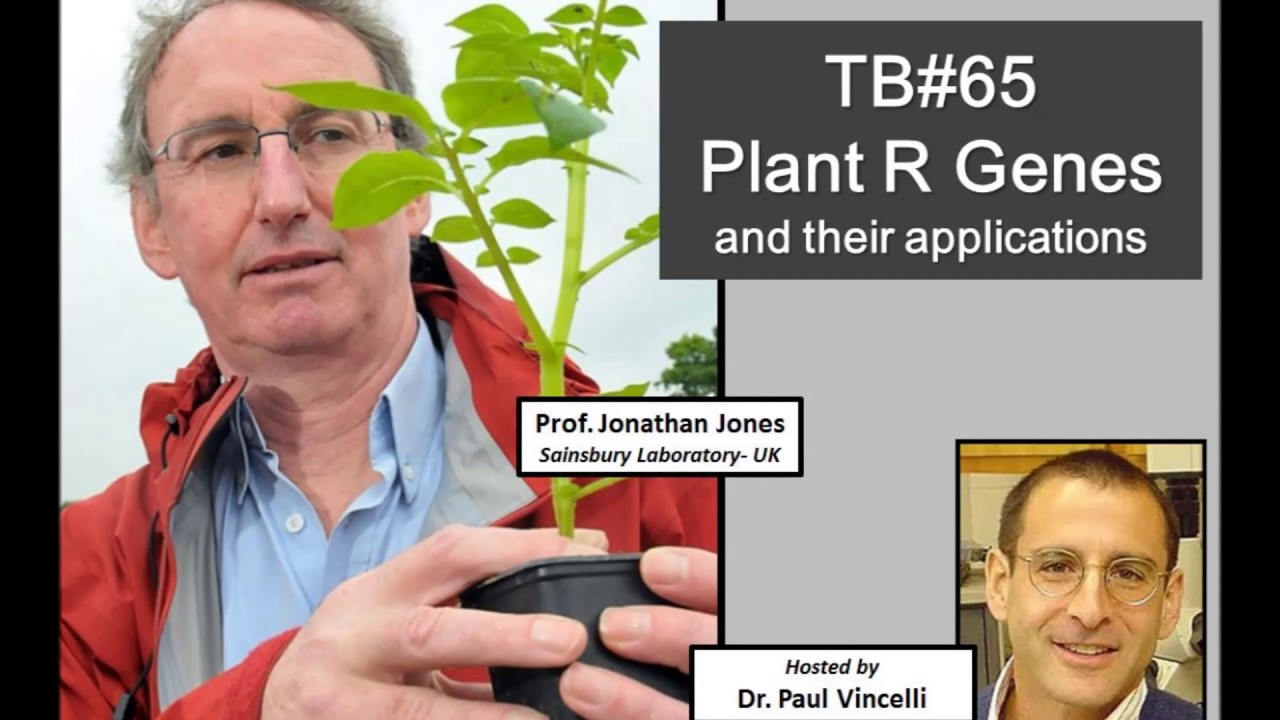
In this episode of the Talking Biotech podcast, host Dr. Paul Vincelli (sitting in for Dr. Kevin Folta) interviews Dr. Jonathan Jones of the Sainsbury Laboratory about plant resistance (R) genes and their role in modern crop protection. Dr. Jones recounts his personal journey from early ecological activism to plant genetics, describing the evolution of the public‑sector Plant Breeding Institute and his work on early transgenic plants. He explains the gene‑for‑gene model of plant immunity, the discovery of leucine‑rich‑repeat (LRR) receptors on the cell surface, and the subsequent identification of intracellular NLR receptors that detect pathogen effectors. The conversation moves to practical breeding strategies: the limitations of single R‑gene deployment in monocultures, the benefits of stacking multiple R genes at a single locus, and the use of sequence‑capture and long‑read sequencing to rapidly clone dozens of R genes from diverse species. Dr. Jones gives concrete examples—pepper‑derived BS2 for bacterial spot resistance in tomato, pigeon‑pea‑derived genes for Asian soybean rust, and Solanum species genes for potato late blight—illustrating how gene stacking could create “non‑host” crops. The interview also touches on the transgene vs. cisgene debate, arguing that the trait, not the delivery method, should be the regulatory focus, and discusses how gene‑editing (knock‑in breeding) can blur the line further. Finally, they mention the Two Blades Foundation’s role in translating research to field solutions, and speculate that post‑Brexit UK regulation may become more science‑based, potentially easing the path for genetically engineered crops. The episode ends with calls for listener support and outreach.
Chapters
I want to see science serve a useful purpose to improve the standard of living for all people. Hey, why is anyone fighting food advance? A very small percentage of the world's population is fortunate enough to have the luxury of turning down food. We've arranged the society based on science and technology in which Because nobody understands anything about science and technology. You can't build a peaceful world on empty stomachs and human misery.
You're listening to Talking Biotech, the weekly podcast illuminating issues in agriculture and medical biotechnology. Your questions and concerns are answered using a science-based approach with the goal of driving innovation to application with communication. Now here's Here's your host, Dr. Paul Vincelli.
Welcome to the Talking Biotech Podcast, the weekly podcast where we discuss contemporary issues in science and technology with a focus on biotechnology and new innovations that can help people and the planet. I'm Paul Vincelli sitting in for Dr. Kevin Folta. Thanks again, Kevin, for the chance to do this. And today we're gonna be talking about a variety of topics, but one of the topics near and dear to me as a plant pathologist interest is R genes or resistance genes. Our guest today is Dr. Jonathan Jones from the Sainsbury Laboratory in Norwich, England. Norwich is about 100 miles, a little bit more than 100 miles northeast of London. And he is one of the premier researchers on the nature of R genes. So we are thrilled to have you speak with us today, Jonathan. Thanks for taking the time.
Pleasure to be with you.
Well, so there's a lot of directions we could go in in this interview, but I'm most interested in starting by hearing something about your perspective. Yeah, kind of why did you get into plant science and what were some of the lessons that you learned along the way, especially the ones that are most salient? So let's just start with that.
Well, when I was a kid, I did math, physics, chemistry at school, but I really wanted to save the world from an ecological crisis, which I was an early subscriber to all these green magazines like The Ecologist. And I thought, you know, the world doesn't need more physicists and chemists, it needs some biologists. You know, very misconceived actually and naive. But it's been pretty good fun. I struggled with the ecology type stuff. It was a bit too descriptive for me. But once I discovered genetics, I found I really loved plants science. And also, Plant science is, you know, plants are just amazing that they turn all that CO2 and light energy from the sun into sugar, and we all depend on it. And how that all happens makes plants a fascinating object of study. So I did a PhD at the Plant Breeding Institute in Cambridge, having done a degree in botany. And there I was a bit of a, you know, long before it became unfashionable, a bit of a Marxist. I was interested in how— What does that mean? Interface between the public sector and the private sector. And the Plant Breeding Institute was a terrific entity. It came up with varieties that really dominated the plant varieties of wheat in particular, but also barley and sugar beet and a number of other crops that were grown by farmers in the '70s in the UK. And it left me with a strong sense that there's a require— you need a strong public sector activity in this space. And the Plant Breeding Institute was very sadly privatized by Margaret Thatcher in her zeal in the late '80s. Then I did a PhD, I worked on wheat chromosomes and rye chromosomes. And I was there at the time that cloning DNA from plants started. So I was able to work with some of the first cloned plant DNA sequences, repeated DNA sequences from heterochromatin. with a leading guy in the field, now retired, John Bedbrook, and a PhD with my mentor was Dick Flavel, maybe known to some of you out there. Then I did a postdoc at Harvard with Fred Ausubel, and that was pretty interesting, working on symbiotic nitrogen fixation. What I learned there was how to work with these broad host range plasmids that went on to be useful in Agrobacterium manipulation to deliver DNA to plants. And so I made some of the first transgenic plants when I took up a position as a scientist at a company called Advanced Genetic Sciences in the Bay Area.
Mm-hmm.
From '83 to '88. And that company was the first to bring a genetically modified organism into the field, in the case of Frostban. the ice-minus bacteria. And I realized then just how irrational people can be about technology if it's misrepresented or misperceived. This was a bacterium which was a plant pathology problem in that it carried a protein that triggered ice nucleation, and the ice nucleation caused damage to leaves of plants. And so what was done was to And this is built on work from Steve Lindauer at Berkeley, mutate the ice nucleation gene and release a strain that was otherwise identical, and it would colonize the leaf niches and exclude the ice-plus bacteria, just thus reducing frost damage. And it was, yeah, it never became a product in part because of misperceptions.
I remember that work. I was a graduate student at the time. And so by sort of outcompeting ice-nucleating strains of the bacterium, and you would gain how much protection in frost? How many degrees?
Well, 3 or 4 degrees, I think. I mean, it would depend. You'd be— you couldn't really count on totally occupying the whole mesophil space with your chosen bacterial strain. But where you occupied most of it, you know, that's what lab experiments said you could achieve.
Yeah, and which is significant. I mean, that could be the difference between substantial damage and, you know, and ability to just carry on with the crops.
And all the grapevines there, they had these so-called smudge pots where, you know, you tried— if you had these inversions of the low temperature near the ground, you got all this frost damage. And so they'd They'd burn all kinds of nasty stuff to try and keep the fields warm enough that it wouldn't happen, break up the inversion.
Yeah. So you've been at the Sainsbury Lab and I meant to say this, so I'll say it now. The Sainsbury Lab for listeners is really a world-leading institute working on plant-microbe interactions. And in fact, you are certainly one of their premier representatives and one of the graduate students that I was talking to about this interview, he said, oh, the Jones. So, so you're well, you're well known, well beyond the Sainsbury Lab. But, but you've been there for 28 years. What are, what are some of your strong impressions of that?
Well, I primarily feel enormous good fortune, actually. The AGS was starting to run out of money and I was looking for another job and it had to be a job where my future wife, Caroline Dean, could also work. And she got a job at the John Innes Centre. I got a job at the Sainsbury Lab. The Sainsbury Lab was funded out of David Samesey's private charity. And the idea is you had a core budget, which meant that you could make— take slightly riskier courses of action than the funding agencies would be likely to support with that, especially for someone who really didn't have a track record in the UK. So when I started, the problem was that there was genetics that said there was something interesting going on in plant-pathogen interactions, the so-called gene-for-gene interaction, the key of which is that there's dominant resistance genes in hosts that confer resistance. And to evade that recognition, pathogens have to come up with recessive mutations. You have to lose something that presumably enabled the plant to recognize them. And what on earth this was, you know, all a total mystery. So I worked in a system where there was pioneering work by Pierre de Witt in Holland, Wageningen. He cloned a couple of avirulence genes from a fungus called Cladosporium fulvum, a leaf mold pathogen of tomato. So basically my mission was to do genetics to wrestle the resistance gene out of the— genes out of the genome. We cloned these so-called CF genes, and actually they were cell surface receptors. They were the first Cell surface leucine-rich repeat receptors shown to be important in immunity, subsequently shown to be important in Drosophila and humans. And, but we, you know, then the challenge was to figure out how they work. And I have to say, we didn't make enormous progress in my lab on that problem. Simultaneously, like early '90s, resistance genes were cloned by others, Brian Staskowitz, Barbara Baker, Greg Martin. And these were intracellular proteins, and it made slightly more sense that they would be recognizing molecules from at least some of the pathogens that they conferred resistance to. But they were also rather puzzling, and they also had leucine-rich repeats. So it was a lot of fun at the time. You know, we'd call each other covertly in hushed tones on the phone and say, my one's got leucine-rich repeats. Yeah, mine has too. Wow. So it was pretty interesting. So the— and then of course at that time was when people like— was fairly soon after Brian Staskowitz had cloned first bacterial avirulence gene with the late, great Noel Keane. And these were proteins that It's very hard to make any sense of. We now know, of course, that they're delivered by type 3 secretion from bacteria into the host cell, that they are so-called effectors whose role it is to often suppress immunity, and that the avirulence genes, so-called, encode recognized effectors. But for a long time, it was a big puzzle. Why on earth would these pathogens make molecules that enabled the plant to detect and resist them? What would be the point of that? And so we've now got a synthesis of, you know, and it was, I guess, sort of one of my more important contributions with Jeff Dangl as well, is to write a review that constituted a synthesis of how there are cell surface receptors that detect pathogen molecules and activate defense. Then there are effectors delivered by pathogens that suppress that activation of defense. And then plants have evolved these intracellular receptors that can detect the effectors, or some of the effectors, and they only need to recognize one, the effectors that pathogens have evolved to suppress host immunity.
First of all, I'm an applied plant pathologist. work hard to understand the molecular components of the things that I do. But I am an applied plant pathologist. And so during my career, 26 years here at the University of Kentucky, this whole model that you're describing really emerged. It wasn't, we didn't understand any of this when I was in graduate school, the model of how plants have receptor molecules of a particular type that then record the presence of the pathogen and signal, create this signal cascade, and ultimately lead to defense. This whole model was not even understood, and it's really quite impressive and remarkable to tease out the complexity of this. So am I correct that there are parallels with these leucine-rich repeats with animal systems? I mean, isn't this some— there's some parallel there in defenses in animal systems as well?
I mean, leucine-rich repeats are just a protein module the core of which is a leucine, XX, leucine, X, leucine. And what they— what that motif provides is a surface on which different interaction capacities can be presented or can evolve. So it's just very good for interactions. And so through, you know, independent evolution, convergent evolution, plants and animals have deployed this motif to— as part of their recognition capacity. So yes, I mean, I think— and it was pretty much independently discovered in plants and animals. So the plants— sorry, the animal immune system, at least in mammals, you know, you've got 2 levels of it. You've got the innate system, which is based on encoded recognition capacities, and then— You've got the adaptive immune system, the antibody system, which is more based on, let's say, somatically evolved recognition capacities. But the innate immune system of plants and animals certainly has some commonalities. In fact, we just wrote a review that came out in Science a couple of weeks ago called something like Innate Innate intracellular immune surveillance devices in plants and animals, and we cover that overlay.
Yeah, that is actually the paper that I saw the title of which and thought, yeah, that's pretty interesting. So we're going to take a short break and we're talking to Dr. Jonathan Jones from the Sainsbury Lab in Norwich, England. And when we come back, we'll continue to talk about R genes, resistance genes, and other aspects of molecular biology and disease management.
Don't go away. Don't go away.
Thank you for listening to the Talking Biotech Podcast. As always, we're excited to deliver the exciting stories of how DNA-based technologies are providing new solutions For people all over the planet. We're learning more about who we are as a species, the life around us, and how we can produce better food for more people, with sensitivity to this big stupid rock in space that sustains us. This podcast is funded 100% by Kevin Folta, and comes to you free each week, for your listening pleasure. Thank you for listening. Listening pleasure. We actively turn away advertisers that could defray the costs of this enterprise, because that would simply reinforce the beliefs of the whistleblowing merchants of doubt that believe education is simply a tentacle of corporate conspiracy. You can help by writing a review on iTunes, tell your friends, write a review on a blog, Or leave some positive thoughts on the BuzzFeed article about me, Vern Blaytheare. Most of all, share the beautiful stories of science that you hear each week. And thank you for listening to the Talking Biotech Podcast.
And we're back on the Talking Biotech Podcast with Dr. Jonathan Jones from the Sainsbury Lab in Norwich, England. And once again, Jonathan, thanks for your time and sharing your knowledge with us. So this whole concept of an R gene or resistance gene and its role as a receptor molecule to know that the plant is infected and to trigger defenses, this whole concept and the details of this rather complex topic have been studied by you and Dangl and And others. So we have a lot of listeners of the podcast series that will want to know, so, you know, that's very interesting, but why do we— how does that help us?
Yeah, well, plant breeders have used disease resistance genes for a very long time. Previously, I guess relatively unconsciously, they just select the stuff that didn't die. And then now in a much more programmed way, now there are You can define a particular locus and develop molecular markers to help you breed for it. I think that the— you might take a perverse view of resistance genes and say, well, look, every time you breed a new variety with some new resistance gene and you plant it out there, then pathogens mutate to overcome it, so they're pretty useless, aren't they?
Yeah. What's the point, right?
Yeah. So, and, you know, in fact, underlying that would be the question, so if they're so useless, how did they evolve? And the answer is, to my mind at least, I'm a follower of Chris Mundt and Bruce McDonald and people like that on it. The, quote, natural environment for which, under which these resistance genes evolved is one where you have heterogeneity in the genetics of the population. You have mixed populations of individuals and you also often have other species growing there. So if in any particular population any particular resistance gene is relatively rare, the selection on the pathogen to overcome that resistance gene is going to be weak, especially as if the pathogen's got to grow on some other plant in that population with a different combination of resistance gene alleles. So what kills you with respect to using resistance is the monocultures. So if you've got a plant where you've got millions of genetically identical plants and one resistance gene, then any pathogen race that can mutate to overcome that resistance gene is in like Flynn. So the question is, how do you cope with that? So one solution would be that you clone lots of resistance genes and you put them into different plants of the same genotype of that variety and then you plant a mixture. But of course, you're not going to do that if every time you do it, it costs you tens of millions to register each transgenic event. So it's just actually, under current circumstances, not practical for the breeding companies. The alternative is that I think this is a plausible approach. There's certainly one we're following. Is you make a stack. So here's the argument. You've got a plant that's got a resistance gene that you've put into it, then it's easy for the pathogen to mutate to overcome it. If it's got 3 different resistance genes that recognize 3 different pathogen molecules, to make a mutation that overcomes it, to make a new race that overcomes those 3, you've got to have 3 independent mutations, and that's going to be rare.
Yes.
You're not going to say it's never going to happen, You know, never bet against the pathogen, but, because there's billions of them.
Sure.
But the rate at which you get a resist— your resistance mechanism overcome is going to be a lot lower if you can deploy a stack of 3 resistance genes or more in the— when the one locus in the one plant. Furthermore, if you've cloned some resistance genes and you can deploy them together, one locus where you put them in, using the GM method, then you reduce the risk or you make it impossible for careless plant breeders to separate them and put out plants with only one gene in that are hostage to fortune from the standpoint of selecting for variants that can overcome each of those genes. So they're always deployed together.
Mm-hmm.
Then it's going to be harder for the pathogen to even have some preexisting variation that can overcome one of them. And of course, if you're thinking about cloned genes, then you've got the opportunity to reach out into other species as a source of resistance. And the archetypal or paradigmatic example of this was the work of Brian Staskowitz, who studied Xanthomonas resistance in tomato and pepper. Xanthomonas resistance in tomato is essentially— there are very few genetic resources you can use, but there's a lot of variation in pepper that you can use. So he cloned a gene called BS2, Bacterial Spot Resistance 2.
Sure.
Put it into tomato, lo and behold, it confers Xanthomonas resistance in fields in Florida, which are, you know, very severely damaged by Xanthomonas. So we've done a similar thing. Soybean in Brazil is hit by Asian soybean rust, blew in from Africa. It's a $2 billion a year problem, or it's a $2 billion a year fungicide market, you might want to think if you're a shareholder of Bayer or BASF or Syngenta. But wouldn't it be better if we could actually come up with a genotype that's resistant? So we've cloned here at the Sainsbury Lab a gene from pigeon pea in collaboration with Sergio Bromanchenko in Brazil, the gene for pigeon pea, from pigeon pea for Asian soybean rust resistance. And we've got a couple more in the pipeline. And we hope that we'll be able to generate a stack that will essentially turn soybean into a non-host for Asian soybean rust.
Sure.
And we're trying to do the same For, in my lab, for potato late blight. So there, Solanum nigrum and Solanum americanum, its diploid ancestor, basically are immune to Phytophthora infestans, the late blight pathogen of potato. So if we can clone enough genes out of these and stack them up in cultivated varieties, maybe we can turn cultivated potato into a non-host potato late blight, which is probably a $5 to $8 billion a year problem worldwide. That's the direction of travel.
Yeah. And of course, that's the disease that was underlying the Irish Potato Famine. And we still deal with it today. So there are a couple things that I think are worth highlighting from your comments. One, these examples, the bacterial spot example, that arginine from pepper placed in tomato and functioning beautifully to create a resistant plant. I want to remind everybody that all what's happening is an arginine gene, a receptor molecule, a gene for a receptor molecule is being moved. So the defenses that the plant fights back with are the same defenses that it, its own natural defenses. It's just the receptor molecule that triggers the path, the plant to respond in a defensive way. And the other thing is that I found interesting, I knew about this idea of stacking genes in, say, a construct, where you've putting our genes together to move as one in the breeding process. Not only does that reduce the probability of a virulent pathogen overcoming those genes, but as you said, it's easier for the breeder to keep these genes together. If they're a constructed construct versus a independent genes that segregate independently through the hybridization.
Right. So it's just one locus to track, plus you avoid the linkage drag where you bring in in cis to your gene of interest bad alleles of other genes that compromise yield, which is a big problem that breeders have to wrestle with. So yeah, it's definitely 21st century breeding ought to look like, is to be able to do this.
Wonderful.
So you have done—
published some recent work on mining of genomes for rgenes in sort of a high-throughput capacity. Can you tell us a little bit about that?
Yeah, sure. So it uses a, you know, well-rehearsed method that molecular biologists can use, which is sequence capture. So, you know, we know that, you know, in a genome like potato, which is maybe, let's say, a gigabase of DNA, There's 750 resistance genes, so that's maybe 2 megabase of DNA corresponding to resistance genes. So if we're interested in understanding genetic variation for resistance, in other words cloning new resistance genes, we only want to sequence the resistance genes. And you can dial up now with companies. I probably shouldn't be endorsing any particular vendor, but, you know, you can dial up. We buy 20,000 oligos that are biotinylated RNA oligos that are 120 base corresponding to 2.4 megabase of sequence. You can specify the sequences of these. You order them, you know, $2,500 or something. You get them back. And then you make your library of DNA for next-gen sequencing, whether Illumina or longer read platforms. And you then melt those DNA molecules and anneal to the capture molecules that you've ordered, that you've bought. And then you stick those to some support with streptavidin, and you wash away all the other stuff that you don't care about. And then when you release and sequence, you're more or less just sequencing the R genes. In fact, you get about 50 to 70% of your reads are from the resistance genes. And that means that you can sequence them with much better depth. You can assemble them with much more certainty. You know, all these assembly algorithms are good but imperfect. If you can combine them with longer reads or greater read depth, you get better assemblies. And so for cloning resistance genes now, we can assemble essentially all the genes with the reading frame plus 2 kb either side using the long-read platform PacBio. And then we can identify 6 or 7 or 8 co-segregating genes that are expressed, and we basically transform them in either transiently or stably, and you can identify which guy's doing the business. So it means you don't have to make BAC libraries to clone your resistance genes anymore, and that is a godsend, I can tell you. It's bloody— it reduces the workload immensely.
Sort of blowing open the doors to the available ARG genes that exist among the various plants available to us.
Yes.
So, yeah, so this is There's just so many things I've seen out of your lab and as I've looked through, and that was certainly one. So one of the topics as an educator that I run into and get questions about when I talk about genetic engineering is the concept of transgenes versus cisgenes and potential ecological issues associated with those. So for the audience's sake, First of all, transgenes are those— well, cisgenes are genes that come from within the normal breeding pool of a plant species. And the simplest way would be potato to potato or wild relative of potato to potato. Those would be all considered cisgenes. Whereas transgenes are genes that have been moved through the genetic engineering process from outside the breeding pool of a plant into that breeding pool. The, um, so what, first of all, have that explained that well? And secondly, what considerations do you have regarding whether those sorts of issues, transgenes, would represent an ecological issue or risk to wild populations?
Yeah, I'm never very comfortable with this, you know, this categorization, to be honest, because, um, you know, if you buy into it, you're almost capitulating to the argument that there's something wrong with transgenes. which there isn't as far as I'm concerned. So, you know, the— I mean, Agrobect— I think that there's a GM method which uses Agrobacterium, a plant pathogen, which has naturally evolved to deliver DNA to host cells as part of its virulence strategy. And it's— sweet potato is— carries an event from an infection with Agrobacterium from, you know, thousands of years ago. The GM method that we use these days delivers some DNA to, you know, an unpredictable— and that's, you know, the only criticism you can make of the method, I think— position in the genome that confers a trait. And I think all you need to consider about a gene that's gone in is whether or not it confers a useful trait. If it— if you've got a Bt, you know, crystal protein from Bacillus thuringiensis that confers insect resistance, then you get— end up with a plant that's got a useful trait, which is insect resistance and reduction in the need to apply insecticides, which are all, you know, nerve toxins. So less nerve toxins applications is a good thing. So So, you know, I mean, this distinction between cisgene and transgene. So let's take the example of RPIvnt1, Phytophthora and first anthracnose resistance gene from Solanum venturii. So that gene, if I put it into potato transgenically, because you could have bred it in, you could say, well, that's a cisgene. But if I put it into tomato, which is also susceptible to late blight, then it's a transgene, but it's the same gene. So why get hung up on this distinction? I mean, I think I can understand people thinking, well, let's just put plant genes into plants. If we could have cis genes as any plant gene in a plant, then I could live with that. That'd be fine. And then if you put in something like a bacterial gene for insect resistance, then, you know, maybe. But, you know, is it more likely or less likely to be damaging to human health? I mean, you know, plants make some pretty poisonous compounds like strychnine, for example. That's natural. Strychnine is really not— you could take a couple of genes from a plant and put them in for strychnine biosynthesis and put them into another plant, and you could call it a cisgene, but that would be a lot more dangerous than taking a Bt gene from a bacterium and putting it into a plant for insect control.
Yeah, so ultimately there's a strong argument for, as our National Academy of Sciences recently said and has affirmed multiple times, paying attention to the trait itself and what it does, not the method by which the gene was moved.
Exactly. I mean, I think that the gene editing advances enable one to try and reframe the debate. Because, you know, I think you could argue, well, first of all, with editing you can make mutations in any particular gene that, and some of those loss-of-function mutations are beneficial. You know, the MLO gene, when you mutate it, results in elevated resistance to powdery mildew, for example, in pretty much any plant you do that. But where you— what we— I'll tell you what my dream is, is, and we're trying this sort of thing right now with tomato and soon-to-be potato, where we take, for a gene like the RPIVNT1 gene, which is from Solanum venturii, confers blight resistance, you can see the ortholog of it in cultivated potato or in tomato. So if we can just recombine that reading frame into the corresponding position in the tomato, I think that's just breeding, because you're using homologous recombination in the same way as breeders use homologous recombination that is confined to the stage of meiosis. So we basically, we force some homologous recombination in the lab, but we put it in a precise position, and the outcome is a plant that's got an extra antenna function The extra capacity to perceive molecules from pathogens and then activate its very effective defenses.
Its normally natural defenses, yeah. Exactly.
So anyway, I think that's breeding. That's, to my mind, we might want to call it knock-in breeding to distinguish it from, you know, conventional breeding. But it's— and at that point, it's a plant gene in a plant and there's nothing else in there. And I hope to goodness it'll be regulated just as breeding.
Yeah, good. And so I'll add too to the discussion. I like to explore all aspects of the issues related to genetic engineering, but a very good argument was made by somebody I follow on Twitter, and he pointed out that there are ecological risks. Well, and we probably know this, both of us, you and I, but there are ecological risks to not using technology too. And so I particularly see genetic engineering as a plant pathologist as a way to reduce pesticide use. And there's no doubt that we can't expect growers to reduce pesticide use unless we give them alternatives. And I think that's what your lab is doing with these rapid cloning approaches and even identifying, first of all, what our genes are. I mean, this is all part of developing resistance in our crops.
That's exactly where we want to get to. And interestingly, David Sainsbury, who funded this lab as a charitable organization, has funded An additional charitable company called the Two Blades Foundation, www.twoblades.org. And it's basically— its mission is to do its utmost to ensure that all of the great advances in the science of the last 30 years, which the Sainsbury Lab has in part contributed to, can actually be converted into solutions in the field to the most pressing crop problems. So they work on wheat stem rust, they work on— they help us in interactions with Simplot bringing our genes to market. They work on this pepper-derived resistance in tomato to Xanthomonas and a number of other really good projects.
Great. So if the listeners want to find out more about your research program, where would you send them?
Well, my website's a good start. I mean, the Sainsbury Lab website. So if you, you know, if you Google TSL Norwich Jonathan Jones, I'm sure you'll get straight there. That 2Blades website I mentioned is another good point of departure to look at at least how the community of scientists I work with envisage this knowledge being brought to public use. Yeah, those would be 2 good starts.
Good. And I think Two Blades is on Twitter, right? And I should follow them actually.
You should.
Yeah, and I will actually.
So should everybody else.
Yeah, and you as well are active on Twitter.
Well, I do tweet a bit, although I think some people find me a bit boring and predictable because there's a lot of bemoaning, you know, the disaster that is Brexit.
Okay.
Although having said that, the, you know, the tiny silver lining around the big dark cloud that is Brexit is it may mean that in the UK, we'll be able to set up a more science-based regulatory framework for GM crops than is currently or imminently feasible in the European Union, which has an incredibly political and negative view of GM crops.
Yeah, I've been following that as well, and that's been the impression I've gotten from several scientists, that it may actually result in an opening of in the use of genetically engineered crops in England. So that'll be interesting.
Certainly will. Yeah.
So Jonathan, I really appreciate your time, and I'm honored to be speaking to you today. And so thank you once again for joining us.
Paul, it's been a pleasure.
And thank you all for listening to the Talking Biotech podcast. Follow us on Twitter @TalkingBiotech, write a review on iTunes, And tell a friend to listen, as your support allows us to deliver more about exciting science to more people. I'm Paul Vincelli, and thank you for listening.
Thank you for listening to the Talking Biotech Podcast. Please send your suggestions for guests, comments, or questions to talkingbiotech@gmail.com. Please write a review on iTunes and recommend this podcast to a friend. More downloads and reviews raise the visibility of this podcast and help us reach a wider audience with science.
More from Kevin



Talking Biotech 503 - A New Strategy in the War on Obesity. Dr. Erik Issacson, Wave Life Sciences

Organic Production, Conventional Agriculture, Health Anxiety, and Social Media Disinformation

Stop Political Appointees from Grant Decisions - Dr. Colette Dalawalla, Talking Biotech 501




