Barbara McClintock discovered that genes can move. Her work on maize revealed the breakage-fusion-bridge cycle, where the Ds element transposes to new positions and causes chromosome breaks, deletions, and duplications. This explained variegated kernel patterns and showed genetic instability comes from mobile DNA, not just sequence changes.
Welcome to Transformative Advances in Molecular Biology, a YouTube series prepared by graduate students in a journal colloquium at the University of Florida. Dr. Mark Settles and I decided that instead of the traditional discussion of contemporary science literature, that it'd be fun and informative to look backwards to review the seminal discoveries that seeded contemporary molecular biology. This series offers student presentations of milestone papers in this area.
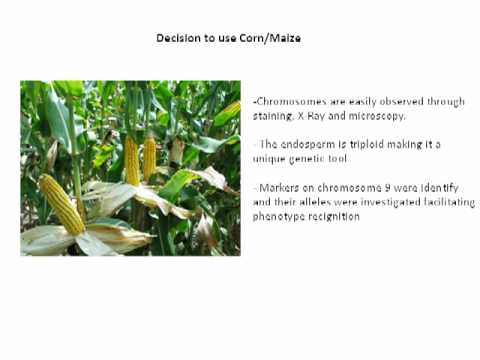
Today's presentation is on Barbara McClintock's work on transposable elements. In 1944, she became the 3rd woman elected to the National Academy of Sciences. In the 1940s and 1950s, McClintock's work on cytogenetics of maize led her to theorize that genes are transposable, that they can move around on and between chromosomes. McClintock drew this inference by observing changing patterns of coloration in maize kernels over generations of controlled crosses. The idea that genes could move around did not seem to fit in with what was known about genes at the time, but improved molecular techniques of the 1970s and early 1980s allowed other scientists to confirm her discovery, and consequently she was awarded the Nobel Prize in Physiology or Medicine in 1983. This made McClintock the first American woman to win an unshared Albert Nobel Prize. McClintock was born in Hartford, Connecticut, and obtained her undergraduate and doctoral degrees at Cornell University. From 1931 through 1933, she was supported by a fellowship from the National Research Council. From 1941 until her death, she worked at Cold Spring Harbor in New York. Among her many honors awarded to her includes the National Medal of Sciences, the government's highest science award. Her decision to use corn-maize revolved around 3 major reasons. One of them was that it was easy to observe the chromosomes. The second was that the presence of an endo— a triploid endosperm in the kernel. And third, useful markers existed at chromosome 9 that yielded heritable alterations to both endosperm and plant tissues that allowed her to continue experimental data. Now, a quick review of the underlying theories that she utilized to make her major breakthroughs in this paper include understanding the breakage-fusion bridge cycle. In the late 1930s, among her stock of X-ray plants, McClintock discovered plants whose chromosomes broke spontaneously without further irradiation. Further, the breakages continued as the plants grew. in a cycle of breakage, fusion, and bridge, as fused chromosomes tugged apart at cell division. McClintock's description of the breakage-fusion-bridge cycle in 1938 reaffirmed her status as one of the greatest figures in maize cytogenetics. The first type that is depicted on the top of the screen, A, is chromatid type, and in this series, sister chromatids cross over causing the production of dicentric chromatid. Then a bridge configuration is made by separation of centromeres of the dicentric chromatid. A breakage forms at some point between the 2 centromeres of the dicentric chromatid, then fusion occurs between the sister chromatids at the position of the preceding anaphase break, and the cycle continues. For the chromosome type, which is depicted on the second half, was— it initiates at the sporophyte of each gamete, and it contributes a chromosome at which, which has been broken in anaphase of the division preceding gamete formation. In telophase— in the telophase nucleoli, the fusions now occur between the broken ends of the chromosomes rather than between the broken ends of sister chromatids. This creates dicentric chromosomes and breakage occurs at some point between the centromeres. Now, some important features of her past research experiences and the knowledge acquired during the development of these investigations enabled McClintock to uncover transposable elements. While experimenting with maize, she realized that some plants had undergone a chromosome-type breakage-fusion-bridge cycle in early developmental periods. She became very interested since both expected and unexpected types of chromosome aberrations were observed. Most importantly, she observed that in self-pollinated plants that had undergone the BFB cycle, a vast number of new mutable loci appeared, and that in each case these mutations were associated with some factor that controlled the time and frequency of mutations. Also, an association of these events with the meiotic cell was made clear by the appearance of sectors of tissue derived from sister cells where the time and/or frequency of the mutation differed.
After intensive studies, she realized that the expression of mutability was associated to a locus on the short arm of chromosome 9 where breaks were occurring. She named the locus Ds for this association. This type of breakage event arises from the formation of acentric and dicentric chromatin typical of the BFB cycle. However, some aberrant formations appear. These included deficiencies in the chromosome arm at regions adjacent to Ds, translocations to a complementary chromosome at the Ds location, And duplications or inversions of segments within chromosome 9 also at the Ds site. A major aspect of her study involved the transposition of Ds from one location in the chromosome complement to another. She realized this while studying linkage analysis trying to determine the exact location of the Ds elements, for which she used 6 marker loci along the chromosome arm. In order to study the inheritance behavior of the element, She relied on plants produced from seeds where a new position of the Ds element was detected. She established that regularly, the appearance of Ds at a new location meant its disappearance from a previously known location, and that this event involved a breakage in the chromosome arm at the Ds site. An example of this mechanism of translocation was provided by a duplication of a segment of the short arm of chromosome 9. In the duplication, The new position of Ds coincides with the location of one of the breaks. The other break was situated at the previously known Ds location. The findings led her to conclude that the breaks were Ds-initiated. However, Ds elements by themselves were not enough to create the translocations. Another heritable factor, which she called Ac for activator, was necessary for the breakage event to take place. If Ac was absent from the nucleus, no event at ds was detected and no predisposition arose. From this, she was able to explain the nature of the variegated tissue phenotype. The chromosome arm carrying a ds must also carry the dominant marker, while the homolog should carry all the recessive alleles. If a cross with parents carrying one of the indicated chromosomes is made, and if the parent carrying the dominant marker also carries an Ac factor, 2 types of kernels will appear: A, those carrying an Ac factor, and B, those carrying no Ac. The kernels that did not receive an Ac factor will show all the dominant features. On the other hand, the kernels with an Ac and a Ds factor will show phenotypes with multiple types of events. During development of these kernels, a breakage in chromosome 9 due to Ds translocation will result in loss of a segment of the chromosome arm. Cells arising from one in which these events had occurred may show the recessive phenotype, while the other cells will show a dominant phenotype, creating variegation on the kernel surface. Later on, she discovered that the time of occurrence of the Ds breakage depended upon the dose of Ac present. The higher the dose of Ac, the later in development the breakage of Ds will occur. Perhaps one of the most striking findings of Barbara McClintock while studying transposable elements was that they were capable of disrupting the expressivity of a particular phenotype by inserting themselves at their respective locus. By analyzing the development of mutability of the different loci on chromosome 9, she realized that the presence of Ds elements at close at the marker locus may result in frequent changes in the phenotypic expression of the marker. This conclusion was later reinforced by other evidences in which the chromatin material had a crucial role in the generation of mutations at a particular loci, and that they didn't necessarily involve changes in the components of the genes themselves. Here, 2 of the major contributions by Hurd's studies are introduced. The first involves the notion of a gene, defined by Hurd as a section or sectors on the chromosome with a specific function that are associated in some manner with cellular reactions or with the development of specific phenotypes. The other infers that the mutability of genes involves the instability of the genetic material and arises from structural alterations of the chromatin at the locus. These findings firmly contradicted the consensus at the time.
Thank you for watching, and please check out the other exciting topics in the series.