760: LIVE from the WISE Summit 2023 - with Kian Katanforoosh, CEO & Founder, Workera | The...
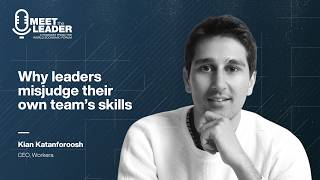
Kian Katanforoosh, CEO of Workera, describes a skills-measurement platform that uses AI to benchmark employees across 10,000 skills and match them to projects and mentors. The platform personalizes learning paths and supports internal mobility by mapping granular skills to job roles.
Questions this video answers
$45 million
About four years ("going to be four years old in a few months" — 2023)
About 10,000 skills (on the platform today)
Chapters
Welcome back, everybody. It's your time to Ed up on the edup Experience podcast, where we make education your business. This is Elvin Freitas, co founder of the Ed Up Experience. I am here podcasting live from the World Innovation Summit for Education, otherwise known as wise, in Qatar, Doha, Qatar, 2023 at the beautiful convention center. And I have another guest with me today, and his name is. See if I get this right, because again, I got it right beforehand. But we'll see what happens when the microphone's on. Kian Katan Forest. Good. Yes. Oh, nice. And he's the CEO and founder of Work Era. How you doing?
I'm doing very well, Elvin. Thank you for having me. Yes, thank you for the conversation.
Absolutely. Thanks for being here. All right, so first question is, of course, what is workera?
Workera is a company that helps enterprises and governments understand their talents at an incredibly accurate and granular level of skills. Through these measurement technologies, we understand an entire workforce. We generate skills data, and that skills data then helps organizations personalize learning, match people to the right projects, match people to the right mentors. And all of that is. Is. Is in a way, making organizations more effective and future proof.
Okay, so that was high level. Let's break this down. How does that work on a granular level? Let's give examples of things like that.
Yeah. So, you know, the premise is, the world is changing so fast, organizations are not ready. Many of them are prone to disruption.
Yes.
And they don't know the skills. They have the skills. They don't have the skills they need. And so we come in and we're going to benchmark their workforce, get a good sense of where they're at, and we do it at a super granular level, as I was saying. So just to give you an example, many people would call digital literacy a skill.
Yes.
And they would ask their employees to report on a survey whether they have the digital literacy skill thumbs up or thumbs down.
That's true. Yeah.
And what we do is we say digital literacy is probably hundreds of skills. Each skill is a domain broken down into sub domains, into subtopics, into individual skills that are tied to cognitions that can be measured. And then we measure those cognitions and we report that to the employee to help them understand their skills gaps and help generate personalized learning plans from content they have access to through their organization.
Ah, I get it now. Okay, good. So you're assessing them, right? The employees. How do you assess them?
We assess them with a variety of methods, but it all starts with what are you assessing?
A business wants to assess and upskill people on things that they care about, on the business objectives, on the projects. So the first step is let's take those projects and, and turn them into skills ontologies. Skills ontologies are large graphs of granular skills for us.
Okay.
Once this is aligned to the project, we go into the measurements. Assign certain skills ontologies and measurements to certain pools of employees in the company and they receive an invite, they get access to the platform and then there is an AI mentor that would walk them to an assessment. The assessment is adaptive. So it may go easier if you're a beginner, if it may go harder if you're an expert in the variety of domains, it will select the next question based on its most recent understanding of your skills. Yeah, the questions may be, you know, pretty straightforward multiple choice question. They may be more complicated, multiple select. They may be conversations. Actually with an AI there is a variety of measurement instruments.
So when you pitch this idea to the organizations or companies, what's their challenge questions to you? What are they saying? Why do we need this? What's the point? This is like, you know, is it going to be more time for us, more money? What do you say to them?
Yeah, the ROI is important. I would say generally enterprises are trying to adopt the latest technologies.
Sure.
They're worried about generative AI. They're a little bit lost. And so, you know, if you ask them, my challenge to them is do you know the skills you have and don't have? And they usually don't. And so we help them understand that. And then subsequently they tell me, you know, what do we do with that skills data like how do we build an effective organization? And then we help them, you know, depending on where the level of maturity, after benchmarking them that we find we can tell them you're not AI talent ready. You are level two out of five, you're level three out of five. And when you're level two or three out of five, this is our recommendation for how to upskill. Usually also they have bought content in the past, they've bought a multiple E learning providers, they have in person trainings, they have a lot of content, but the content is sitting there. Employees are saying, our managers are recommending content that is not relevant for us. The content is too easy for me, it's too hard and you end up with really low engagement. And so we help those organizations have higher engagement on their content because they can make it all skills based and based on the skills gaps of their employees.
Got it. And it's, and like you said, it's all based on the projects that the companies need to get done. And then you come in and you kind of break it down based on the project assess. Right, yeah. Okay, got it. And so let's talk about, you know, AI. Obviously that's a big thing about what's going on here at Wise Creative Fluency. Right. Human flourishing in the age of AI. It's actually right behind us. So it's nice to read from it. Easy to read. But what do you think about that and what do you think about how AI influences your work and things like that?
Yeah, I mean, I teach the deep learning classes at Stanford University and have done that for the last six years. So I've seen firsthand how students learn AI and how they apply AI. And my view of AI as it ties to education is there are three sets of innovations that are quickly going to come in. The first set is tied to skills assessments, actually skills measurements. Today we can measure skills at a much more precise level than before. And I'll give you a very concrete example. If I know that you can do two times two equals four. And I ask you, I can predict so many more things about you. I can predict that you probably can do 2 +2 =4, you probably can do 2 +2 =0. You may be able to do square root of 9 =3. But I may ask you a more difficult question to get there. Long story short, AI will help us predict people's skills in a much fast tracked manner. And I can test a thousand skills in an hour, potentially where before it was not possible. And so our understanding of learners will be much more precise and granular. And that will impact personalized learning. But personalized learning also require another technology, which is the second one I was going to mention. It is helping with AI scan through content and interpret the skills covered in that content.
For personalized learning to work, you need to understand the learner, you need to understand the world of content, and then you need to match them together. AI is helping us understand the learner. It's also helping us scan through content and say this class covered 75 skills. This is the list at these levels of proficiencies. And now you can serve it to the right people if they need it. And then the third innovation is on the delivery side. AI will help learning experience become much more immersive, become more conversational. It will help us nudge people who are behind. It will help us bring to their attention what's in it from me. Am I getting a reward for completing that AI can help us enhance the entire set of delivery tools that will also have an impact on the completion and engagement of learners.
Wow. So.
Before you start, how old is workera?
Workera is going to be four years old in a few months.
Oh, really? Oh, congrats. That's great. So I always like to ask this question, so before you went in, I'm sure you had some ideas of how things might turn out. You said, oh, maybe if we do this, this is what's going to happen. So when you went in and you actually did these things, what learnings did you take away and say, oh, wow, I didn't think that would be happening when we did this and we had this idea. So it's kind of like you learned this on the go as you were trying it and then you had to pivot and say, you know what, let's not do that. No, no, that was the plan. Now we can't because we're actually trying to implement it and we're getting feedback. So let's. Period is good. Anything that comes from any trends that you saw, anything like that.
Yeah. I would mention two.
Yeah.
One is a few years ago I was not expecting that in 2023 we will have a consumer grade chatbot available to humanity.
I don't think anybody was man.
Yeah, it was impossible to predict. And if you would ask me, you know, I would say, my friends and I would would say maybe we would first have chatbots that are going to be niche, maybe on healthcare data or maybe on educational data. But here we have a general foundation model that works for everything. It completely changed the game and it allowed us to update our previous generation of language models with a new generation that helps us measure and predict skills in a much more accurate way. And then this leads me to my second one, which is a big learning for me is I tell you that the example of 2 times 2, 2, 2 plus 2. It turns out that 2 times 2 and 2 plus 2 are connected because if you have AI learn through curriculums, they will notice that 2 plus 2 is taught before 2 times 2. So if someone knows 2 times 2, they also know 2 plus 2 because they learned it before. Right?
Okay. Yeah.
That's a semantic connection between skills. Now, another interesting characteristic that we noticed is there are skills that have nothing to do with each other that are actually correlated. Interesting. Like possibly the fact that you can do 2 times 2 also means you can recite the alphabets in reverse order. And the only way to know that is by measuring millions of measurements. Yeah.
Okay.
And having the cross correlation between those skills. So as we were measuring more and more people around the world, we were noticing some of those emergent behaviors and correlation between skills that allow us to predict things that people have not done yet. And that's very helpful in reskilling, because reskilling is all about understanding a person's potential today for a future task that they may be carrying out. And so those predictions will help us identify what type of reskilling is most relevant for people. Does that make sense? Yeah. No.
No, that makes sense. Okay, that was interesting. So what's the future of workera? What are you guys working on? What do you want to do? What's your goal?
Yeah, workera is.
Is today able to measure competency, personalized learning in enterprises. The next step for us will be able to do it for more skills, even more skills, even more skills. And we have 10,000 skills today on the platform, but we could do much more. The second aspect is I would like the skills data to be also used for other purposes, such as identifying internal mobility opportunities for employees.
Identifying mentors, matching them to employees, and building mentorship pyramids based on skills. All based on skills. And so it's starting. We have a few customers that are already using it for those purposes, even if the original purpose was hiring. And then, of course, helping enterprises recruit in the context of their existing benchmarks internally so that you can understand your team and turn these assessments into a recruiting mode so that you can compare applicants to existing workforce. And then, you know, we, we're a venture backed company. We, we raised $45 million. We're on the hook to, to, to. To hopefully reach another milestone by the end of next year. And that's, that's the short term goal for us.
Yeah, gotcha. I did want to ask you before I ask you my last question, we had this conversation on the podcast a couple of months ago and this person came on and they were talking about skills and he said there's a big difference between skills and capabilities. What do you think about that?
Because you, I honestly, skill. People call skills everything. Some people are going to say, yeah, KSA is knowledge, skills and abilities. Some people are going to differentiate knowledge from skills. Yeah. Capabilities from skills. I tend to call most things skills and just bucket everything in together. But when I think about capabilities is the first step to capabilities is skills for your workforce to innovate and have the capability to innovate, they need skills. So skills is a prerequisite to capability. If you Will, if tomorrow you want to, you're Elon Musk and you want to build a rocket going to Mars. That's the capability. You want the capability to build a rocket to go to Mars. The skills you need are thermodynamics, turbine, aerospace, aeronautics related skills. So it's a prerequisite to capability.
Gotcha. Okay, good. That's really good insight. I appreciate that. All right, last question for you. What do you see as the future of education?
Well, I see it in the corporate workforce. I feel there's a few ideas that are going to come to life. First.
I think the future of the education is not self directed learning.
Interesting. A lot of people are saying that.
I think that the premise of self directed learning in the last 10 years has shown that completion rates are very low and it's hard to engage employees. I think the future is actually more top down learning is managers being empowered to translate business objectives into skills and then AI helping us teach those skills to individuals. Yeah, many managers have been promoted because of their subject matter expertise in a domain. They have not been promoted because they were good talent managers. They're not necessarily good at measuring skills. They're not good at recommending courses. You don't have time to look at and scan through the millions of courses that are online and figure out which one is the right one for your employees. So I think we will need AI agents to come and empower managers to be better talent managers. A manager needs a psychometrician in their pocket. They need a learning scientist in their pocket. And those are what is going to make them a better talent manager and allow them to help their team develop skills more rapidly. And that's one of the trends that I'm seeing. The second one is organizational learning. How do you help a massive organization learn and plan their workforce ahead of time? You know, when we're looking at jobs, I believe that by 2030 we're going to see about a third of the jobs gone. Yeah, about a third of the jobs merged, about a third of the jobs unchanged. And yet we will see more creation of jobs than job losses. So how is AI going to help us move people into these careers that are completely different potentially from what they were doing? And so the prediction that I, that I have and I want to share is that there will be more career transitions in the next 10 years than there has ever been in the history of humanity. Even if you add all the career transitions up to now.
More career transitions in the next 10 years than ever have happened in the history of humanity.
Addition.
Yeah, addition. Okay, I like that. All right. Anything else you want to add? That was awesome.
No, I mean just, you know, if people are interested to learn more about workera AI talent readiness measurements and personalized learning, I'm all here so I would love to get in touch. Cool.
Where can they reach you?
They can reach me on LinkedIn kiaan katanforush or they can reach out to me at Kiana AI.
Cool. All right, so we're going to put that in the show notes so thank you so much for your time. This has been super cool, very interesting and I'm going to outro you. I'm going to try it again. Ready? Katan foreish.
Good job.
I did it. Yes. CEO and founder of work era. Thanks again, man.
I really appreciate it. Good, good. Thank you El for having me with that.
Ladies and gentlemen, you just add up.
More from Kian

Library of Minds: 100x AI Engineers Will Be Treated Like Elite Athletes | Kian Katanforoosh (Workera, Stanford)
Stanford AI Expert: 71% of People Won't Survive the AI Shift — Here's the 30-Minute Fix
Stanford CS230 | Autumn 2025 | Lecture 4: Adversarial Robustness and Generative Models
Stanford CS230 | Autumn 2025 | Lecture 2: Supervised, Self-Supervised, & Weakly Supervised Learning