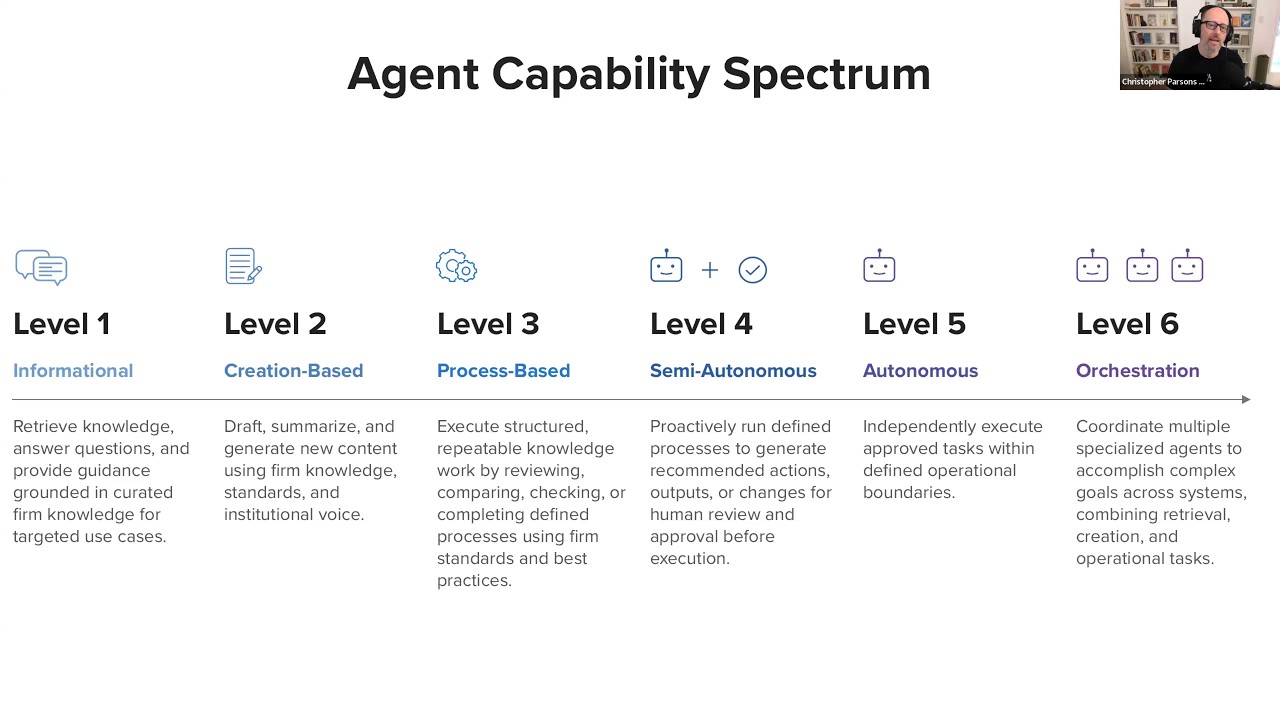
In this presentation Christopher Parsons introduces a structured "agent capability spectrum" to create a shared vocabulary for discussing AI agents within architecture, engineering, and construction (AEC) firms. He outlines six progressive levels of agent capability: Level 1 informational agents that retrieve knowledge and answer questions (e.g., Revit assistant, sustainability advisor, HR policy advisor); Level 2 creation‑based agents that draft, summarize, and generate new content using firm standards (e.g., brand communications assistant, healthcare proposal assistant, learning‑and‑development assistant); Level 3 process‑based agents that execute repeatable, structured workflows and perform checks against best‑practice checklists (e.g., fee‑proposal review, contract/NDA review, content‑quality assistant). Parsons notes that the current Synthesis Knowledge Agent product is focused on building Levels 1‑3. He then briefly describes the higher tiers: Level 4 semi‑autonomous agents that propose actions while keeping a human in the loop; Level 5 autonomous agents that can independently execute approved tasks within defined boundaries; and Level 6 orchestration agents that manage and coordinate multiple agents to tackle complex tasks. The talk emphasizes the need for common terminology and sets the stage for future development beyond the initial three levels.
Chapters
As we start talking about agents, I want to acknowledge that we may all be coming from a different place when we hear that term. I actually wrote a piece about this last month in our newsletter called Agent: One Word, Very Different Meanings. And the reason I wrote it is I just have found myself in a lot of these conversations and people are talking past each other because when they say agent, they mean something that somebody else, either kind of between companies or even within companies. And so this was, um, In this piece, I introduced an agent capability spectrum that I'm gonna introduce you to now so that we just kind of have some common vocabulary when we're talking about agents. So for us at level 1, you have informational agents. These can retrieve knowledge, answer questions, provide guidance, curate it in the firm's knowledge for specific use cases. So as an example, a good level 1 agent might be a Revit assistant that's grounded in your Revit knowledge and can answer Revit questions., or a sustainability advisor grounded in your sustainability knowledge, a design precedent explorer that understands the projects in the portfolio the firm has done and can help find people from a big picture, find examples of projects that have done something similar so they can help them jumpstart their next project. A level 1 agent could be an HR policy advisor that helps get people very accurate answers about HR policies and benefits, or even it could be a seasonal agent that helps people through something like open enrollment. Right, to get a lot of those questions answered, the 101, the 201-level questions without having to go to HR, and they can get access to that 24/7. So these informational agents are kind of the level 1 in our spectrum. From there, we go to creation-based agents. So these allow you to draft and summarize and generate new content using firm knowledge standards and institutional voice. So some examples of level 2 agents might be a brand communications assistant or a healthcare proposal assistant that helps you write approaches or project descriptions, or a learning and development assistant that helps create learning objectives or a detailed course outline or a variety of different things when you're creating learning development content. So those are all creation-based agents. Level 3 is process-based agents. So those help you execute, uh, structured repeatable workflows. Ones that require you to review something or compare something or check something or complete a process using your standards and your best practices and your kind of what good looks like. So a couple examples there might be a fee proposal review assistant that evaluates a fee proposal and compares it against a fee proposal checklist, or a contract and NDA review assistant that reviews new contracts and NDAs and compares them against, you know, standard clauses that you want to, to find in your, in your contracts. Or a content quality assistant that reviews content on Synthesis and compares that to kind of best practices for what that content should look like or looks potentially for conflicting information. So levels 1 through 3 are what we had been focused on initially in the Synthesis Knowledge Agent, um, product. Beyond that though, there's room, you know, for agents to go even further. So level 4, um, are semi-autonomous agents. So those can proactively run defined processes to generate recommended actions, outputs, but they're gonna keep a human in the loop to review before making a change. So these are kind of like team members, but they, they need to come, come to you for approval. Level 5 would be autonomous agents. So those can independently execute approved tasks, tasks within very well-defined boundaries, but they're able to start doing, you know, work on their own. And then Level 6, you get to agents that are orchestrating and managing other agents to do much more complicated tasks. So as I mentioned, today we're going to be talking about levels 1 through 3. That's what we're building for. And as the future unfolds, we'll see where things go in terms of going up higher up the stack.