AI in AEC: From Knowledge Management to Intelligent Workflows
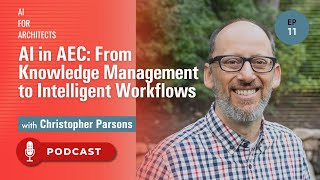
Podcast interview (AI for Architects) with Christopher Parsons, founder & CEO of Knowledge Architecture. Parsons recounts his path from a history major to tech work during the dot‑com boom, then to founding Knowledge Architecture in 2009–2010 and building Synthesis (an intranet → LMS → AI search platform) for AEC firms. The conversation covers product evolution (social intranet → integrated knowledge+learning platform), community-building via the K Connect conference and newsletter (Smarter by Design), firm adoption patterns (clients ~25–3,000 people; majority 50–500), onboarding and pricing (typical onboarding 4–6 months; annual licensing tiers disclosed), ROI and use cases (proposal drafting, video knowledge, sustainability “digital twin”), and near‑term roadmap items (LMS public beta in Q4, knowledge agents in 2026).
Questions this video answers
Around 2009–2010 (Parsons launched Knowledge Architecture and first Synthesis 'social intranet' in 2010).
About 150+ AEC firm clients (majority in the U.S.; ~85% U.S.).
Smallest client ~25 people; largest client up to ~3,000 people; majority of clients in the 50–500 employee range.
Typically ranges 4–6 months (some firms 2–3 months, others up to a year depending on scope).
Under 50 employees: $14,400/year; 50–99 employees: $19,200/year; 100–199 employees: $24,000/year.
Chapters
Have good procedures, build a really great asset, because if you do sell it, you've made it more valuable. And if you don't sell it, that's a better business to work in anyway.
Welcome to AI for Architects, the podcast exploring how artificial intelligence is transforming the AEC industry and what it means for the future of your practice and our profession. I'm Aya Schlachter, founder and CEO of MGS Global Group, a company dedicated to driving growth for architects. Each episode we dive deep into AI's impact on architecture. You'll hear from leading architects, experts and innovators who are shaping the future of our field with AI. Artificial intelligence is here and accelerating faster than we expect. Together, we'll build AI literacy to help you thrive in this evolving landscape. Think of AI as a way to stay ahead of the curve. Whether you're an early adopter or a fast follower, architects need to get moving. So what does this mean for the future of our profession? Join us as as we explore the exciting opportunities and critical challenges presented by AI. Ready to explore. Let's dive into the episode. Hi everyone, welcome back to the AI for Architects podcast. I'm Aya Schlochter and today I'm really excited to be joined by Christopher Parsons. Chris is a founder and CEO of Knowledge Architecture, the team behind Synthesis and KA Connect conference, which has been leading the conversation around knowledge management in AEC firms for for more than 15 years. In our chat, we want to get into how AI is reshaping knowledge management and his journey, starting out as a history major to working in tech during the dot com boom and eventually finding his way to the AEC industry and where he launched Knowledge Architecture back in 2009. We'll talk about how knowledge management has evolved from simply capturing information to sharing it across firms to this new stage where AI puts knowledge right into the workflow. Chris also gives us a look at synthesis and its new search, which is already being tested by over 80 firms. What I love most about Chris is how he thinks about knowledge not just as data or files, but as an infrastructure that firms need to take seriously if they want to grow and adapt. We'll dig into what's driving the shift and what it makes to make it work for firms. And we're still at the beginning of this AI transformation, so I'm looking forward to this conversation. Chris, welcome to the podcast.
Oh, thank you so much. It's good to see you.
I know you know you're all over the Internet and you've been interviewed in a lot of podcasts but can you give us a brief history of your founder story? And I know your history major and how you transition from that to the synthesis.
Yeah, sure. So I was a history major. I did not like history in high school because it was like a lot of memorizing dates and facts and didn't seem that it came kind of dry. So when I went my freshman year, first semester, I had the. One of the best teachers I've ever had in my entire life. And in the first day of class, she just drew these like waves on the board and just like these kind of arcs. I'm gesturing with my hand. If you're listening, just imagine three arcs on a board. And she wrote the United Kingdom under one. She wrote the United States under the next one. And then she wrote question mark under the third. And so her point was like, history is about shifts and big things that happen over time. You want to understand the context, whether it's literature or sociology, like all the different things that are happening. And she's like, I don't need you to know the exact dates of World War II, but you should know it started roughly in 1939, ended roughly in 1945. And like, what it was about and what the impact it had on the world was. And I just like, that strategic view of history was just like, really like, it lit me up. And it continues to inform the way I think about technology and knowledge management today. So I assumed, though, with a history major, I was going to law school. But I graduated in 1999, which was right in the middle of the dot com boom. And for those of your listeners that don't know what that is, there was a huge rush when the Internet came out around a lot of companies being built. A lot of money got raised. Every business that existed was rushing to build a website, put a dot com at the end of their name, and there was a huge boom and then there was a big bust. And I worked in San Francisco, right in the heart of this dot com boom. And there were just layoffs everywhere. I unfortunately went in the fourth round of layoffs, like in my company that was a consulting firm to a lot of these dot coms, and wanted to stay in the city of San Francisco. And I wanted to be walkable to work. And because of those constraints, I ended up finding this really lovely architecture firm that was about 670 people when I joined. They had no technology person and they outsourced some guy that came around like a couple hours a week and tried to help. And so I built the technology Team there fell in love with architecture. I planned to stay there for like 6 months, 12 months to kind of ride out the recession, but ended up staying for five years and introduced BIM into that firm for the first time, built our first intranet, built our first CRM. Just put a lot of that information knowledge infrastructure in place for the first time, went to a larger firm and did the same thing, the multi office bigger firm. And then in 2009 I kind of hit this crossroads where what I had figured out in it, I like design technology, I liked doing servers and networks and that kind of stuff. But what I really loved was knowledge management. Whether it was intranets or learning and development or information management, just like a really mentorship, like all the things around knowledge. That's what got me really excited. So I was either going to go to a really large firm and just be their head of knowledge management or, or start a business. And I decided to go the latter route, started Knowledge Architecture to just build a technology company, but more than that, a community and a firm that could offer best practices to AEC firms who wanted to get more intentional about managing and more strategic about managing their knowledge. So that's in a nutshell, that's kind of history major to hear.
So I just want to unpack that a little bit because as a person who's pivoted several times, right, you're a history major, but how did you know about all the techie stuff? Did you learn that in school? Because history majors, I see them as people who read a lot of books and literature. How did. So that's why I just wanted to know, were you doing a lot of computer stuff while you were in history major?
That's such a good question. Nobody's ever asked me that. So it's well, well found. So my little brother, you know, whatever, he's 46 now, my little brother in high school was really into computers and so we got a computer and. And I kind of like got into it some, not nearly as much as he was. But what that meant is I got an. I started learning HTML really early. And so I went to, I had a summer internship like a brokerage company and I built them a website. And then when I went to Wake Forest, that's where I went to school. They had what was called a TRA program. So it's like a residential advisor, like an ra, but a T was for technology. And so I was part of the TRA program. So I basically was tech support for my floor as well as I worked in the language Lab with supporting professors, you know, and all of their technology needs. So, yeah, I ended up with all these like little random tech jobs throughout college. And when I came to graduate in 1999, if you had a heartbeat and you could turn on a computer, you had a job in technology consulting. So, like, totally. In any other world, I would have been unqualified as a history major to get a job in technology. But it was just such a. There was so much need for talent at the time that I was able to get my way into it.
I found a question no one asked. That was my struggle.
There you go. You did it. That's one. And we're only 10 minutes in, so good job.
So that's that. And now you've lived through the dot com bubble in 2008, housing crisis, and now. And then I know you're now an entrepreneur, right? You're a founder entrepreneur. I'm just going to ask about how you were able to grow the business from 2010 or 2010, when you started consulting, to the pandemic, and now I think you're going through a growth spurt or explosion because I see you everywhere. Chris. So how did that.
Yeah, thank you.
Those milestones, like, talk to us about your challenges from 2010 and then the pandemic and then now.
Yeah, that's great. So I didn't have an entrepreneurship background. Like, I wasn't born into a family of entrepreneurs. I wasn't one of those kids that did little businesses and side hustles on the side or dreamed of being an entrepreneur. Like, I just thought I was going to just like work in an organization. And back at that first architecture firm, our financial person, our controller said to me, she said, you're going to have your own business one day. And I'm like, what are you talking about? That's what would make you think that? She goes, I've seen this before. I've seen people like you before. You're going to do it. And I'm like, whatever. But it planted the seed in the back of my head and I started thinking about it and I started really like realizing that there was something unique I wanted to do. And I really wanted to have control over my own destiny and kind of pick who I worked with, the projects I worked with. When you're in IT or in kind of like a support function in a, in an AEC firm, you don't really contribute to bringing in work. And so when we'd have slowdowns and stuff, like, I was powerless to help. It also meant, okay, so we can't do this project or we have to lay some of the people off. And it just felt terrible that I had nothing. I was just at the winds and the mercy of the business. And so I just wanted to be leading a business where I could kind of, at least if things go wrong, at least I was able to do something and put an effort forth. And, and I just had a vision that I just wanted to execute. So it was really not knowing any better, but it was. We have 150 plus AEC firms as clients. We're, you know, a profitable, stable business. But I started this was, I thought this was just going to be me by myself with four clients. That was the vision. Like in 2010, what I wanted to do was be a fractional chief knowledge officer, get four clients, work with one of them each day of the week, and then on Friday I'd kind of like sell bills and then go off early and go running or something like that, go hiking. That was really what I wanted to do. And as I got into consulting, I realized I didn't want to do consulting. I wanted to build a product because I kept saying the same thing over and over again and kept trying to solve the same problem. This should be a product and this should be a service that like, that we can just operationalize and do over and over again. So it led us to build Synthesis, which is our. Started off as an intranet platform, it's now a learning management and AI search platform as well. But yes, started building intranets for AC firms. And luckily when I was in those two firms, I built a lot of network in the industry. So I was part of a group called the AEC IT Leaders Roundtable. So when people had seen some of the stuff I'd built and they're like, hey, if you ever want to start licensing that, we'd love to buy it. Well, that helps. So I'm like, cool, like I'm going to call you on that now. Like let's, let's go. And so was able to establish some clients, especially in like Boston, Seattle and Wisconsin. It's a little bit random, but like the way those three cities worked is they also had like little local roundtables of architects that got together and talked about technology. So one of them bought and they told their friends and they brought me in and I'd buy them lunch and I show them all what we were doing. And so we grew pretty quickly because we were riding a wave of what I called Knowledge Management 2.0, which was bringing social media Inside a business for knowledge.
So what year was this? Now I'm just.
This was, this is still like 2010. So like the first version of synthesis was, we called it a social intranet. And it was like, how can you use now like these kind of comments and likes and blogs and hashtags to move knowledge through an organization so people can ask questions and get answers? Or hey, I just worked on this really cool thing, you should know about it. Or there's a lesson learned from a project. Like that was the big thesis. And like companies had these static intranets before that were just like basically files, you know. And we just brought something that was more beautifully designed. It had social components, it had integrations with software that people cared about like Deltec and Open Asset and New Forma. And so we just brought a very different paradigm of what an intranet could be that was specifically built for architects and engineers. And like people loved it because there was nothing like that. And SharePoint was the dominant platform at the time. It was really hard to use back in 2009. It's gotten much better since. But it was really hard back then.
I'm happy to talk about the founder story because I'm going to share some resources of from TRXL's podcast as well because I want to hear about the evolution of Ka, like from 2010 and now. How did you evolve?
So speaking from us. So that's like a product piece of it. The other part is kind of marketing. And how do people find out about us? Yeah, and community has been at the center of our marketing approach. It was actually, it took me a while to figure out their community was how we were marketing again, like first time entrepreneur. I didn't know. What I knew is that when you're trying to do something new or when I had been in the past, like for example, when my firms were implementing BIM in San Francisco, I started a thing called the San Francisco Digital Design Breakfast Club. So I got the other firms in town together. We'd meet up for breakfast once a month and just talk about what's going on with bim. What platforms are you using, what trainers are you using, how are you building standards? Like, I feel like learning in community lets you go further, faster, right? Get smarter together. And so when I started Knowledge Architecture, I launched K Connect, which is our conference, not to be a marketing tool, but to be a knowledge sharing tool. Let's all figure out how to do knowledge management together. And I thought 15 people would come, we'd have a little roundtable, but 80 people came.
This is your first one.
2010. Yeah.
Yeah. Because I did my research. You started 2010. And I'm like, well, 80 people. Wow, that's amazing.
Because people have been wanting to talk about this. They're just. When I was trying to learn how to do knowledge management inside those two firms, there were no books, no conferences, no community, no software. And I'm like, these are all the things I wished I'd had when I was trying to learn how to do knowledge management. And so that conference ended up drawing a lot of people, ended up being a good marketing tool for us, which was funny. Like, it makes sense in retrospect, but at the time, I swear, like, that's not how I was looking at it.
I know. Like, I started my podcast in 2020. Right. But then my business grew, like, 400% after I started my podcast. I'm just highlighting women in architecture. That was how it started, but it's. I didn't know it was a marketing tool, but that's for another story question for you. How was Your most recent Ka Connect? This is, what, your 15th year of doing this?
Yeah. So good. Yeah. So that the name of that conference was K Connect. That was K Connect 2010. We just did K Connect 2025 in August in Sundance, Utah. It was wonderful. It was my favorite. It was my. They're all my favorites, but that was my favorite one. I really, really, really loved it.
What was special about this one and how many people came?
I think what was really special about it is reflecting back on the first one to now. When we first did the first conference, there were very few people with a knowledge management title in the industry. Most firms weren't using the term knowledge management. They were doing knowledge management. This is one of my core theses. Like, you're doing it, whether you call it that or not. Like you are. In order to grow a business, you have to transfer knowledge to the next generation. You have to teach people new things. You to adopt new technology. You have to be doing that. But some firms do it strategically and intentionally, and some are more reactive. And when you become aware that you can do it and become more proactive about it, you can get better at it, like any other skill. So in 2025, like, there are lots of firms that have knowledge management directors and teams and knowledge management leaders and L and D folks. So, like, the maturity in our community around understanding what knowledge management is and practicing it, it's just astounding to see how much change has happened and just how the level of sophistication of firms and how they're getting smarter. It's just like sometimes I was sitting there watching some of these speakers that I've been working with just being like, this is amazing. Look how far we've all come together as a community. So that's like one of the.
So is it like, is it same number of people at 250 or like, what's the cap?
Yeah, so we got over 300 at K Connect 2019 before the pandemic, when it was hosted here in San Francis at a bigger venue. And when we took a few years off during the pandemic, for obvious reasons, we didn't bring it back until 2024 and we shrank it some intentionally. Like one thing that we did is we require you have to be an AEC firm member to come. And so in the past we had like software companies would come or consultants would come or out of industry people even would come. And we really wanted to focus it in on this is just for AEC professionals. Yeah. So it's great. It was like 135, 140 something along.
So anyone can come as us. They're in the AEC industry as long.
As they're an AEC firm. Yeah.
Okay. And then that's great because I was actually looking into your conference, but I was not in town. I was gone the whole summer. But congratulations on that conference.
Thanks.
You also have a newsletter called Smarter by Design. Can you talk about that? And the content that you share in your newsletter, is that only LinkedIn or can we subscribe to that?
You can subscribe on LinkedIn in the subscribe feature, which I would, but it's also hosted on our website as well. And people can sign up for our email newsletter, like our email chain on our website Smarter by Design. The title comes from a talk that I gave in 2016 for my manifesto for knowledge management for the AEC industry. Yes, it's a manifesto. My kind of thesis is that firms, AEC firms should design their business with the same level of intention and care that they design buildings and bridges. But I think business is a design problem. And I think that using knowledge and learning management as a core ingredient in that design can help your firm become smarter, more sustainable, better place to work, really help you do higher quality work, all the things do better design. And so I think that the firms that I look at that are my biggest inspiration in the industry are just really smart companies. They've been very intentional about designing the way that knowledge flows in the organization, the way that Learning and development happens the way they manage information. And so I started the newsletter to celebrate those firms and try and write case studies of the ones that inspire me the most but also synthesize and share trends that I'm seeing cross firms because I spend a lot of time with ABC firms and there's a lot of exciting stuff happening now with AI and the like. And so it's a great time to be writing.
Yeah, I actually read most of your. Your content. I have one more question before we dive deep into your the software. So in terms of industry, right now you're working with 150 AEC firms. You probably have a unique pulse in the industry and the economy. What do you think is going to happen that you're seeing right now in. In Q4, entering 2026 in terms of the US economy? Are you only working in the US also or. Most of your clients are in the US so just as a general pulse for all the firm owners out there.
Yeah, so we are mostly in the U.S. although we have clients in Australia, New Zealand, England, Canada, English speaking countries. You know what that is? Yeah, I'd say 85% US. I'm not an economist, so I don't want to make predictions on the economy. I think that people feel cautious right now and it's not just about the economy. I think AI has people really, they whipsaw emotionally through very excited versus terrified versus frustrated versus cautiously optimistic. Like I feel that there's this sense that there's a big change coming to the economy, to the industry. AI is going to be a big part of it. Although demographic shifts is a big part of it too. In generations and baby boomers retiring, that's a big part of it. But it feels like we're about to go through a rapid pace of change. But it doesn't feel like it's quite taken off yet. Like it's. The plane's going down the Runway, it's picking up some speed, but it hasn't quite lifted off. That's the vibe I'm perceiving.
That's good. And I always want to ask people in a different industry because you're also servicing AEC industry, but thanks for that. Now let's talk about the problem that Knowledge Architecture and synthesis is trying to solve. Right. I actually, when I first saw you, I think it was on LinkedIn because I've also have that problem of knowledge management in my firm and how to really capture and share the knowledge. And then I saw you on LinkedIn and then I saw one of the speakers in AAC Innovate shared up. I don't know if you know that, but they shared a case study on your company. Shepley Bulfinch, Jim Martin had the entire maybe 60% of his slides were, you know, about your company and what it, you know, what you do. What he said about your company is like you're an intranet that celebrates projects, connecting people, technical discussions, design and sustainability, best practices and documentation. And they had 700 plus learning development videos, lectures and town halls. And I love this. What he said get storing data is not hoarding, it's knowledge. Databases are where knowledge goes to die. Search resurrects it. So this is what he was talking about. So I was so impressed by all the things that your company is doing. I wish we could do a screen share, but I think it's on the website, right? How they had documented videos from a person who was leaving the company and they can search. So can you talk about the user interface of your maybe one case study Because I know there's a lot. Just one case study you can share?
Yeah, well, I think just on that point. So I was in the room for Shepley's. They're a long term client of ours. They're fantastic. Jess Purcell, who's their design technology manager, spoke at K Connect 2025 and those talks will be up in the next couple of weeks. And so she talked about video specifically to the point that you're getting at and how that has just changed. Her talk was called like why how video became our new superpower at Sheffield Bench. So that's a. It was a crowd favorite. So I encourage people to watch it. Oh my gosh. What case study? I'm going to pick, I'm going to pick one case study. As an example. There's a company called Bora Architecture and Interiors up in Portland. The director of sustainability, his name is Corey Squire. And Corey came to the firm, he was their sustainability consultant before and liked them so much and saw their vision for where they were going to go for sustainability. Came on as sustainability director, he wrote a book called People Planet Design. Do I have that right? Sorry Corey, if I got that wrong, you'll find it. And he basically built their intranet out to be this incredible sustainability resource for the company. So starting with like big picture, like what does good look like in terms of what are our strategies and our goals for healthy buildings, but then breaking that into different design strategies, best practices, down to what materials we source, why we do some materials, why we don't Others, what are kind of rules of thumb are for design, like window wall ratios. Like it's an incredibly comprehensive resource. So that's built out using the intranet side on the AI search piece. Now all of that is searchable within the platform. So anybody can ask any questions about sustainability. You know, it gives them instant results. He even uploaded his book to the Internet. So that's also searchable, you know, within the platform. So we affectionately call that robocory. We've built like a digital twin for Corey on his platform that people can interact with. So if Corey's traveling, he's on a job site, he's on vacation, whatever it is, like people can still get advice on sustainability. But it also means that Corey doesn't have to answer basic questions over and over and over again. He can allow the AI to do that and he can take the more hard problems. Right. He can actually help a team where it's yeah, we followed the best practices, but there's this really unique condition on this project. Can you help us with this? And so it's just become a really empowering tool for both the users, but then also for the subject matter expert in this case.
So Bora is a small firm, medium.
Sized firm, 70 people. So I would call that mid size.
Yeah, because I saw most of the firm. The two other case studies from a TRXL podcast are firms from 250 and above. So in terms of adoption, is it based on firm size or the ready? Like how ready are the firms to onboard you as as a service provider? Like what's the minimum requirement? Like, not all the firms can work with you. They need to have some kind of data sets. Right. Or really organ information. If you're running a growing architecture firm, you're probably not short on projects, you're short on people. Talent shortage is real. Finding and retaining skilled professionals takes time. Meanwhile, deadlines keep getting closer. And when you're balancing growth with quality, it gets harder to maintain your project standards as the work piles up. We are here to bridge the gap. We provide qualified architecture staff on demand so you can scale your delivery without compromising quality. That's what MGS Global Group does. Whether you're overwhelmed with construction documentation, need BIM support, or your internal systems just aren't built for this level of growth. Our team plugs in seamlessly. Think of us as an extension of your in house team. Without the long hiring process. And because we work across time zones, your projects keep moving even after your office closes for the day. If your timelines are starting to Feel stretched and your team's at capacity. Visit mgsglobalgroove.com we can get started in 24 hours. We're here to help you scale smarter and deliver faster with quality, consistency and peace of mind.
Yeah, so like the smallest firm we work with is around 25 people.
Okay.
And then we work with firms as big as 3,000. But like the majority of our firms are in that 50 to 500 person range. And it's not the biggest challenge. Like why somebody would work with synthesis isn't so much. They're, it's, do they have a problem that we can help them solve. So if you're a five person firm or a ten person firm, you just may not have, you don't onboard that many people per year. You don't necessarily need a project management manual because you've got a project manager and they just do, Denise just does what Denise does. Like she's the project manager. So it's like when you start hitting a scale where you need to take one person and now you need five people to be able to do it, or you're taking on multiple different building types or you've got ownership transition. Right. The people that built the business are now retiring. There are all these drivers of change that happen in companies and they're usually connected to, there are these firm sizes where it becomes really hard to operate the way you used to when you hit that number. So like somewhere in 25 to 30, it becomes uncomfortable. Like you need some more support functions to take on the increased sophistication of the practice. But you can't hire overhead too quickly because then you become unprofitable. So there's this like dance you have to do around firm sizes. But if you move through those kind of inflection points, then you, if you're still managing knowledge the way you did when you were 10 people, but now you're 40. Like it's really frustrating for employees because they can't find what they need. They don't know what our values are. They don't know what the standard is. And so you run into these growing pains. And that's usually when people call us. And that could happen when you get to be 40 people, when you get to be 80, when you get to be 200, you do a merger. There's all these different events that happen. But like you get the feeling that like we're not making the best use of our knowledge and people can't find what they need. They're not learning fast enough. That's A great time for someone to bring in Knowledge Architecture.
So Knowledge Architecture is really an internal Internet for firms as well as a search engine. That's the version 3.0, correct?
Yeah. So you got two of them. And so we've also now added a learning management system or LMS into the platform.
Can you describe all three?
Yeah, yeah, sure. So we talk about it as being a knowledge and an integrated knowledge and learning platform for AEC firms. And so that starts with capturing knowledge. So it could be a standard, it could be a policy, it could be a procedure, and then you share knowledge. Right. So capture could be. It could be a video, it could be just a page that you edit. So imagine like a Wikipedia could be a document you upload, sharing knowledge. We have a social component to it, right. So you write posts, you get comments, you say, hey, we've got this new thing. I learned this thing on this project. Here's a lesson learned. Hey, has anybody ever done this thing with flashing on a project? So you ask a question, you get answers. So there's knowledge sharing, you get to knowledge transfer. So that's where the learning management comes in. It's okay. We. It could be something as simple as onboarding. So somebody new joins the firm. You need to understand all of our standards, but like all of our culture, we also want you to learn the way that we do revit here at our firm, all kinds of onboarding stuff. But then somebody becomes a project manager for the first time, or they work on in ca in construction administration for the first time, or they go do their first site visit, or they've been working on retail projects, but now they're going to work on a healthcare project. So there's all these moments that happen in an employee's life cycle with the firm where they need new knowledge. Right. And so a lot of what we're doing is helping make sure that we get the right knowledge to the right person at the right time. Whether that's through knowledge sharing, whether that's through learning and development and assigning courses, or whether that's through search. Right. So they can discover what they need in order to solve their problem. So that's the kind of integrated approach that we're taking to it.
That's great. I mean, I'm looking at your website, I see screenshots of the user interface. It looks pretty straightforward and quite easy to use and understand. In terms of collecting data, do you train the firms to do that, like the quality of data? Because I hear garbage in versus garbage out. So sure. I mean Is that part of your services as well, like training and how to input data?
Yeah, so I think we do that on a couple of different fronts. I'll go back to the community again. We learned most of what we know around good data management or knowledge management from our community. And we just then take their ideas and formalize them and or connect pieces and parts of other people's ideas and turn them into best practices. So for sure, like it can be as simple as how do you. So you've added all of your project management guidelines or your sustainability guidelines, but how do you keep them up to date? Right. So what are the rhythms for data hygiene look like? Or it could be you want to get all of your project history into synthesis. So it's easy to find how many higher ed projects we did in California in the last five years and what was the square footage, what was the construction cost and it was a project manager, like all that kind of stuff. So we help firms think about strategizing like what projects matter, what data points matter. Because like where firms oftentimes get stuck is they want to do everything all at once. Right. And so much of knowledge management is about prioritization because you can't manage all the knowledge in your organization. So you need to figure out what knowledge matters most and start there. And so some of it's training, but some of it's just philosophy. But then also having them see what other firms do through our community and getting inspired and realizing, okay, well they did that, we can do it too.
I have a question. For my personal reasons, we're an architecture support company and we've helped hundreds of firms and our bottleneck is really in the proposal writing. Right. So yeah. Have you ever had a case study where I will put in like my thousands of proposals and load it and when I get an RFI or request for quotation from a company, I can just say this is a request. How many hours historically we've done it in the past like a multifamily or whatever. Can they help me generate a quotation based on historical data? Is your intranet. That's smart. That they can say in the past MGS has done X amount. It took an average of this number of hours. And square footage wise, can you do that?
We can do most of what you're saying today. So you can upload all your proposals which even just doing that and with some like light tagging it makes it really easy. So you find you can filter and say, well, I want to find proposals that are for I'm not going to be able to speak to your use case as much, but I'll generalize it to an agency firm. But we know it's a wastewater treatment plant. We know we want to find the last five proposals we did for something like this. Right. So just findability of the previous proposals is step one with our AI search. Now you can basically just ask. It's like, draft me an approach to a wastewater treatment plan and how we'll manage risk or how we'll manage timeline. And it can then look across those proposals that match that criteria and then generate an AI summary and then link back to the proposals where it drew that information. So this kind of. We call it a marketing research assistant. Like, it can really accelerate that proposal development process.
Wow, that's so powerful. Because the bottleneck is really in the proposal writing as well. And quotations.
Right in the writing. But like, in many firms too, it's like their marketing coordinators, new ones come in, they don't know the history of the firm and all of the different work that they've done. And so by centralizing the knowledge and making it available to everybody and searchable, they can get up to speed much more quickly. They don't have to keep asking, like, what projects have we done this for? Like, what were those? Wastewater treatment. And then go hunt through the network trying to find old proposals. Like, yeah, just having this stuff organized in one place and searchable has really just changed that whole process.
That's great. So let's talk about onboarding on your end. Let's say I want to start working with you. What do I do from now until, like, from our first discovery call until later on? And also let's talk about cost and pricing.
Okay, good. I feel like I'm getting interviewed here, so.
Yes, which you are. That's why I ask. I'm like. Because I never heard anything about cost in the other podcast. So I'm like, yeah, yeah, fair enough.
So onboarding is. It ranges from four to six months for most firms.
Got it.
We have done this 200 times at this point. So, like, we've got a pretty straightforward process, but we customize it obviously to meet your goals. And usually the customization is around. On our website, we've got a thing called the intranet maturity model that I don't know if you want to put in show notes or something like that, but it basically helps us do discovery and understand what matters most to your company. Okay, so is it like the three broad buckets are. I have the information I need to do my job. So it's written from the point of view of an employee. I know what's happening at the firm and I'm getting. I'm part of a learning organization, so I'm getting learning opportunities. And so within those we've got like sub points. So it could be that project data is really important, or it could be that standards and best practices are really important, or it might be it's more about internal communications and sharing what the vision and strategy are for the company, what people are working on. They just want to share design inspiration. So we use that tool to help talk through clients to understand what matters most in year one. Like, what is a business challenge that we can use our technology to help you move the needle on, and that really informs the way that we implement. And so firms can go faster. We've had firms go closer to two or three months and we've had firms take a year. And it depends how ambitious their goals are, what kind of quality their existing content is already in. Do they have to rewrite a bunch of stuff or write a bunch of new stuff, or do they basically have stuff in documents that they just need to transfer? And then what kind of resource bandwidth can they put towards it? So it's a little bit of an it depends answer, but on average, four to six months is what we say to get you live. But then we stay with you after you launch through our client success program, and we keep meeting with you to help refine, set your goals, measure if new features come out, we teach you about them. If you've got new business challenges, you open a new office, you start a new service, you acquire a company, your company will evolve and grow. And like our team is there to help you evolve synthesis as your firm evolves and grows.
So if I start with you, then maybe I have to bring in my marketing team, lead my hr, my office manager, the one who does all the things. Because we all have different knowledge in our database, right? So that's part of the scope that you're going to do, depending on what we're looking for. That's why it takes three to six months.
It does.
Because what if, I mean, if we don't have. If we're all busy, it will take longer, right. If I don't have time to take care of the things that we need. Okay, I got it. So in terms of cost, is it like depending on the size, the scale, the scope, what's the minimum, like, engagement?
The minimum. So like the. We have an A1 to 49 band and then we have a 50 to 99 band.
Employees.
You mean employee. Thank you. Yes. 1 to 49 employees. 50 to 99 employees. And after that it's 100 to 199, 200 to 299, et cetera.
So what is the cost for the first three tiers?
The first three tiers, let's see, it's 14, 4. For the first tier, it's. I'm not doing the sales per month.
Is it per month?
No. Annually. Annually.
Okay.
Yeah. 14,400 per year. For a firm under 50, I think it's 19,200. For a firm, that's 50 to 99. And I think it's 24,000 for a firm that's 100 to 199.
That's great, though, because, you know, it's so hard not to see the numbers if you don't know. But I think it's really worth the investment if it can streamline your process, especially when your team is growing. And I heard this in your podcast with Ellen when she grew her firm from 60 to 250 with your help. So that was really very impressive. Let's talk about ROI and the business model principals always ask about. Bottom line, what kind of ROI are firms actually seeing from your project management software in terms of projects and also employee retention and employee acquisition? I'm sure you have a lot of ROIs that happen because they're working with you.
Yeah, that's a great question. I think you touched on some of the big ones. So employee engagement and retention is a huge one. It's super expensive to replace employees.
I know.
And one of the inspiring pieces of writing that we've used is the company Gallup that does all the surveys. They have an instrument called the Q12, which is an employee engagement survey. So it's called Q12 because there's 12 questions. It's super creative, and it asks things like, I have a manager who cares about me, or I have a friend at work. There's some things like that to predict engagement, but there's other ones. Like you might remember I told you the Internet maturity model. I have the information I need to do my job. That is taken straight out of the Gallup employee engagement survey. Because when people are going to work and they have to just make it up or go to the Internet or not have the right tools or not understand what's going on in the company, which is also part of the employee engagement piece, is like, people feel like they know what the firm's prioritizing and what matters and that they're contributing. People can really like there's retention in terms of them leaving, but there's also people being there but checked out, you know, and disengaged. And all of that shows up in billability and utilization about the quality of the work. And so there's a lot of stuff around engagement. Obviously there's efficiency stuff. It's like people are going off and reinventing standards when there already is one or using another procedure. But we could, we've already figured how to streamline it. So there's all kinds of things you can do. Roi, efficiency wise, the hardest one to talk about. But a lot of our clients believe it is just like innovation, that being able to like move best practices between different offices or between different teams really quickly and just improving the quality of the work. I haven't seen anyone actually try and measure that in dollars like in our clients. Like I've seen people try and measure the other ones but not in dollars. But I think there's a sense of to me that most of the firms that are really, really doing well with the product don't even try and measure this stuff. I think Jim from Shepley said in his presentation, are you trying to measure the ROI of email at this point? It's like no, you just use it because you know you do it. You have to do it to be a real company. And I think people are looking at our technology and knowledge management and learning management in general as that is just like how we need to work now. It's not an optional thing.
That's great. Now I know we're close to time, but how are you managing, scaling your company in terms of how big is your now? Like you have 150 clients. Do they all work with you? Do we get assigned if I sign in my own project client relations manager, how does that work?
Yeah, yeah, it's a good question. So we a couple things like there's basically we're 12 to 14 people depending on how you count it. With some people that are like with us but not full time. We're divided basically in half. Half of it's like product and engineering and the other half is client success. So we do all of our own development, we don't outsource that and we don't, we do all of our own implementation and support as well. So you will work with a knowledge architecture team member. Every client gets a dedicated client success manager who supports you asynchronously. They meet with you like whatever your kind of preferred we have clients that prefer to go to all of our resources and try and be self directed and we have other ones that really want to lean on their client success team. So it's really up to you how much you use that client success resource. It's the same thing with the community. Like we have clients that are super and heavily engaged in the community and others like no, we can handle this ourselves. So you know, it's there as kind of a resource for you.
For the first onboarding though, will we get one every week to talk? Is it once a week? Yeah. Calls or how does that work?
Typically it's weekly. So we have both. We have an implementation kind of technical support lead and then a client success lead. So the client success person will stay with you even after you're launched. So there is like a big bunch of effort to get live and then once that happens, your client success manager stays with you and helps you set goals and keep making progress as you go forward.
So for firms that are busy, do they have a dedicated non billable employee who does this? Because people are busy with all the projects. Right. So in your like now you have 150 clients. Do they have a dedicated person just for that or people just work ad hoc when they have time, they focus a few hours on knowledge architecture and uploading data. Or the most successful clients.
Yeah. Even if we thin slice most successful, I'd say like I can think of firms that do it like by committee you have to have a named person. That's the point of that, you know.
Exactly.
Right. So whether that person's full time or not, that's not necessary. Like a lot of people are it directors or marketing managers or HR managers or an operations person. Usually it's better when there's more than one champion. It's even better if it's someone from the business side, meaning hr, marketing, IT etc, and then someone from practice because they understand what's important to the people working on projects and they can help do that. But that lift of what we call a champion isn't super heavy. Once you're live, it's a few hours a week to be able to keep the intranet moving. And then there's just like the next level down is what we call community managers. Right. So that's who organizes the HR content, the marketing content. They're going to spend again a couple hours a week, maybe eight hours a month depending on how you do it. But most of that work isn't like synthesis work. That's like we have a new we have an open enrollment. We need to get that on the Internet. That's just HR work. You know, we have a new technology we're implementing. We want to put a training video together that is design technology or IT work. So once it's up and running, it doesn't require a lot of overhead to keep it going.
That's great. So I have two more questions before we wrap up. You mentioned the baby boomers. They're selling their businesses. Have you ever encountered a baby boomer going to asking you for your services so they can build their asset, they can sell their company? Because a lot of people. Right, because that's a. I mean, a lot of them will be transitioning. And I think your tool is such a great tool for knowledge transfer, especially when 80% of the firms are solopreneurs and a lot of them, maybe 40%, are about 20 to sell their businesses.
Yeah.
Do you see that? Do you have clients?
It's interesting. We have not had anyone come to us with explicitly, like, we want to work with you for two years to get our data in order to sell it. It's a smart idea. But the truth is, like, AEC firms are always for sale. It's just not always externally. Meaning, like, if you're going to retire and you want your business to keep going, you're going to sell to the next generation of shareholders. You're either going to do an external sale, an internal sale, or you're going to shut the business down. There's really only three ways the story can end. Right. And so there's a great book, I can't remember the author's name, called Built to Sell and Jim Collins, Built to Last. Is Jim Collins Built to Sell? I don't remember his name, but the basic thesis of the book is you should build your business like you're going to sell it whether or not you're intending to sell it. Meaning get all your data organized, have good procedures, build a really great asset. Because if you do sell it, you've made it more valuable. And if you don't sell it, that's a better business to work in anyway. Right. Like a business that has all of its knowledge and its organization, all that dialed in, like that's just a better company. And so you do knowledge management. Either way.
I know, Christopher, for someone with no business experience, you're, I think, very savvy entrepreneur.
Thank you. I really enjoy it. I mean, I think that I'll take the compliment, but what I will say is I've read a lot about it and done a lot of work and listened and been able to be mentored by a lot of other people via podcasts and books, like, kind of remote mentored. But I think that the business education might get oversold. And this isn't to take away anything with a business major or an mba. I think those are valuable programs, but I don't think they're required to be an entrepreneur. I think that what you need to be an entrepreneur is you need to be have something you're so passionate about that you're willing to, like, crawl up a mountain in order to make it happen. And you have to have perseverance and you have to be creative and you have to have a vision and you have to listen and be willing to learn and can never stop learning. And so if you've got that kind of personality, you can learn. Business people have done it. People have been doing business for a long time. Like it's learnable.
Exactly. So as a founder, what's next? Number My last question as a founder, what's next in the next three to a year? AI is moving so fast and my last question is, how do you switch off your entrepreneur brain and what do you do for fun? Sure.
So what's next at a high level? I mean, we've talked about the learning management piece that's in private beta now, that will go into public beta in Q4 and then it'll go out. That means that any of our clients can use it. So we're very excited to be doing learning management. It's something I've always wanted to do, it's something we've always done and now we're actually putting a lot of resource towards it. On the AI side, the next big thing is knowledge agents in the platform. So that's going to allow you to create. Imagine they're almost like the digital employees that have a very specific skill set. So that could be helping you. Right. Proposals that could be helping you if you're a technology person, Draft support ticket responses based on your knowledge base. For you, that could be. If you're an hr, it could be opening, answering open enrollment questions for you. So there's all these, man, if I could just get one more person on my team or half a person on my team. Well, we think the workforce of the future is a mix of humans and agents and we're very excited to be building that. So that's a 2026 thing, is a knowledge agent platform. The other question was how do I shut it off?
And what do you do for fun?
Yeah, I mean shutting it off. I don't know. I don't know that it ever. It never, it never never. Yeah, it never fully shuts off. I'm actually a kind of a person. I used to try and be more like I'm going to work really standard hours and take weekends off and turn off my phone and try and detach. And now what I do is I work every day, but I take big breaks every day too. Like I'm a long distance runner, like a trail runner. What I do for fun is long distance trail running. That may not sound like fun to everybody in that I used to do it.
I used to do triathlons.
Right. So you might have heard the term type two fun. Right. So it is a. This is type two fun.
So you're trail riding for 40 miles but thinking about K8, right.
I am it like eventually like it will wind, like does stop. Like I do that too.
I'm an entrepreneur, I think about my business all the time.
But you can think about it from a much pulled back perspective.
Bird's eye perspective.
Bird's eye perspective. You can. I meditate in the morning. That helps. It's not so much shutting it off. It's like getting away from my desk and away from on my phone. I don't have email, Slack or LinkedIn on my phone.
Amazing.
So it's just like text messaging and weather essentially so I can text my wife and maps. So getting off of email, that lets me do that longer term thinking, you know, the big picture stuff on a daily basis just. And going on walks and just getting in nature. I try and be outside doing stuff every single day. So I limit my desk time I think is one of the things that makes me really happy. But it doesn't mean I'm not thinking about same same.
That's why I can't shut down. But Chris, thank you so much for your time. I really enjoyed our conversation. I'll drop all the links of your website, LinkedIn and our show notes, but any parting words for emerging professionals who want to pursue architecture and any advice you can give in this AI world?
I think like the advice, it's a little bit different than what you're asking. What I would say is our community is open to people who aren't clients. And we've had people in our community for 15 years who have never been clients, probably never will be clients, but they want to learn and share and contribute to how the industry's doing knowledge and learning management. And we welcome people to do that. So that's whether that's at our conference, whether that's subscribing to our newsletter, reach out and connect with me on LinkedIn. Like we are a very open and transparent and sharing community. I think you've probably seen that over time and we encourage people to take part of that whether or not they're going to become a client of ours. That's totally we love having an impact that goes just beyond that part of our business.
Thanks so much Chris. Thanks for everything that you do.
Appreciate you. All right. Thank you so much.
Thanks for joining us in another episode of AI for Architects. I hope today's episode spark your curiosity about AI's impact and opportunities in architecture. Subscribe to our podcast so you don't miss our upcoming episodes and sign up for our newsletter for exclusive content and AI tool reviews at aiforchitects. AI Forward. Slubscribe this podcast is brought to you by MGS Global Group. Driving growth for Architects everywhere.
More from Christopher

Human in the Loop? Testing Our Assumptions About Where People Add Value in Learning | Todd Henderson

Redesigning Work for the AI Era: How Greenprint Turns Implicit Knowledge into Shared Intelligence

Designing Learning Like a Product: Branding, Culture, and the Unseen Work of Building an LMS

Scaling Design Excellence: How Diamond Schmitt Amplifies Knowledge Through Learning and AI

From Tame to Wicked Problems: Rethinking Learning and Development in a VUCA World | Ellen Bensky

Learning at the Speed of Change: Adapting L&D to Your New AEC Workforce | Kristina Williams

Designing Modern Learning Organizations: Rethinking AEC Learning Development in the Age of AI

The Link Between Learning, Motivation, and Career Fulfillment for AEC Professionals


Why Communication Skills Are Foundational to Teaching, Leading, and Adapting in AEC F

A Framework for Collaboration and Quality: SMMA’s ISO 9001 Journey | Ryan Farias & Jessica Smith