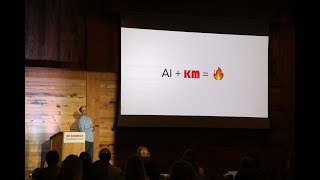
Christopher Parsons opens Day Two with a short talk arguing that AI combined with strong knowledge management (KM) will unlock AI’s practical value for organizations. He previews Synthesis product work: a next-generation AI-driven search that finds relevant snippets across media and summarizes via an LLM (public beta "at the end of the year"); video captions and an AEC transcription model that convert video to text for AI use; a learning management system (LMS) to surface high-quality L&D content into Synthesis; expanded integrations (UniNet, AEC 360, Microsoft Dynamics, Zendesk) and plans for connectors (SharePoint/Teams/Freshworks and a search connector API). Parsons emphasizes that AI needs high-quality, up-to-date, firm-wide knowledge to produce good answers and predicts mainstream AI adoption in 2025–2026 will catalyze investment in KM, ushering a "golden era" for knowledge management.
Questions this video answers
"At the end of the year."
October 5, 2024
Chapters
Cool. Well, welcome back to Day two. I'm very excited for today's program. I just wanted to share a couple thoughts with you on AI. So I just want to hear you guys shout some things out. If I say AI is blank, what comes to mind? Overrated. What is this? Complex. Okay. Evolving. That's a good one. Scary. What was that one? Annoying. Frightening. Cool. I think it's promising. It's not perfect, but I think there's something there. I'm just going to go out on a limb and say I think there's something there that we can do, but I think it's going to need something else. I think it's AI. Plus knowledge management is going to be fire. That's my view. That's my conviction. I've been watching this very closely. I've been talking about thinking about AI for about 10 years. We took a really hard look at it in 2015 and it was too early to bring it into synthesis. Now it's the time. And so why do I think kind of AI and knowledge management are going to be the perfect match? So many of you in this room know that we're building what we call next generation search, which will have AI driven search summaries. So in this example, I searched for what is a one CJP initiative. And then our search is going to kind of find the most relevant snippets from videos or posts or documents or pages from across the Internet and then feed it into an LLM to summarize it with citations. Right? So this is the thing that we're currently working on. It'll go in public beta at the end of the year, so we're excited about that. We also recently did video captions and we did this primarily for accessibility purposes, but it's also true that by converting all those videos into text, we've now made those available to AI, especially with our AEC transcription model. Many of you in this room know we're building a learning management system and again, we're doing this primarily for learning and development reasons. But it will also bring a bunch of new high quality content into synthesis to make available to AI Search. We've expanded our integrations to include UniNet, AEC 360, Microsoft Dynamics and Zendesk. And we're looking into future explorations for things like SharePoint or Teams or Freshworks. And we're going to build a search connector API to let you push content from other systems into synthesis to make it available to AI. So that's the kind of the technology piece of why I think this is true. But I think the even more important thing is the people and process side of how you're going to make AI work. So we think that KM unlocks this promise because what AI wants is high quality, accurate, firm wide knowledge. So you imagine two firms, one of them has had a strong knowledge management practice for years, right? They've captured really good information and then when you feed that content into AI and you know, for this purpose we could be considering synthesis AI, but the point is true, kind of more writ large too. So you imagine you ask questions and if you've got great content, you're going to get great answers. If you haven't been investing in knowledge management and you don't have great content or it's out of date or it conflicts or it's missing, you're not going to have a great experience with AI. So the secret to making AI work is good knowledge management. And that's what KM focuses on, right, is the acquisition and maintenance of that high quality, firm wide, accurate knowledge. So the good news for the firm on this side who hadn't been investing is we think that AI is going to be a catalyst for knowledge management in those companies because when they have their first experiences with AI, and I know we've all been experimenting with it over the last 18 months, but I think in 2025, 2026, we're gonna see much more mainstream adoption and it's gonna become more and more of all of your team's kind of regular workflows. And when it doesn't go well because there isn't good knowledge to support it, I think folks are gonna want to invest, whether that's money or resources or time or prioritizing knowledge. I really think that's coming. Does anyone else think this is true? Am I out on a limb here? Okay, good. So I think we're going to enter a golden era for knowledge management. Knowledge management has been around since 1995, kind of formally. I mean it's really been around probably since Hammurabi and tablets and like, I mean we've been trying to manage knowledge for a long time, but the field of knowledge management since 1995 and it's felt in some ways like the promise of knowledge management is always just over the next horizon. I don't think that's what's happening here. I think we're really going to kind of go into something new. So we're very excited to be on this journey with you. I think we're very much in the beginning of this new era of knowledge management. It's going to be a collaboration from this community to figure out how to navigate it together and share stuff that's working and share challenges. So it's a very exciting time. And I would encourage you, as you're reflecting back on what you heard yesterday, whether it was in the talks or the roundtables or the hangouts, and how you're managing knowledge and how other people are and you're thinking about what you hear today, I want you to obviously pay attention to what you're hearing, but maybe in the back of your brain somewhere, you're kind of dreaming a little bit, saying, like, well, what happens with AI, whether it's search or some other kind of AI technology, if we do all this knowledge capture and the transfer and all the knowledge management, we're looking at doing so. That's just kind of my opening to the day. We're not going to talk a lot about AI on the stage this year. You best believe we're going to next year. That's going to be a big thing here as we just really see this kind of make its way through the community.