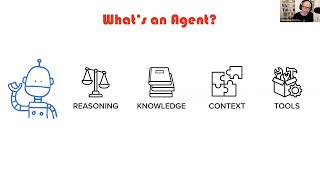
Christopher Parsons presents early design work (2026 project) on "knowledge agents" for synthesis AI. He defines agents as systems combining reasoning, knowledge, context, and tools, and emphasizes two core design elements: a job description (specifying role, tone, format, constraints) and grounding knowledge (a limited subset of a firm’s documents or resources). Parsons walks through multiple use-cases—marketing research, brand communications, help-desk responses, video operations, Revit standards, sustainability advising, and a seasonal open-enrollment assistant—showing how starter prompts, attached content, and strict grounding can tailor agent behavior for different organizational needs.
Chapters
So knowledge agents is the next big thing for synthesis AI. This is a 2026 project, just to be clear to everybody here, and it is in design now. So I'm going to show you some early design work. We've been doing research for the last six months on this project and we're now kind of figuring out how we're going to design and build this thing. So I want to show you kind of the use cases and what we're going after. So, so back to what's an agent, right? It combines reasoning, knowledge, context and tools. And so here's an example. So you could build in synthesis a marketing research assistant. So what that would let you do is find firm approved positioning language and project intelligence, drawing from the boilerplate library and project directory. So what's kind of unique here, right, is you're specifying what you want it to do, kind of a job description, as well as you're grounding it in a subset of your firm's knowledge. It might be just the boilerplate library in the project directory. In the design for knowledge agents in synthesis, you could also have these starter queries like you see here to both explain to somebody how they might use this agent, but also they can click on them and actually use them. If they're common questions or common queries or common tasks, you can just streamline that process for folks. So behind the scenes of this marketing research assistant, you've got a job description, so you're telling it what it's there to do. Your role is to do XYZ you. When responding, you can talk about the tone, you can talk about the format, like complete sentences and avoiding jargon, clarify technical terms, define acronyms. However you want this agent to behave, think about it like writing a job description for an employee. You're gonna write a job description for a knowledge agent to tell it how it wants you to help people. And then the other part of that, right, there's more to it. But like two big concepts are the job description and then the grounding knowledge. So we're saying actually just answer only drawing from, in this example, the project directory and then a boilerplate text library that we've created. Or maybe you create a brand communications assistant that helps you draft social posts and blogs and announcements using your brand voice. But it's drawing from content on the intranet to help you do that. LinkedIn posts or blog posts, whatever it might be. Or maybe you create a help desk communications assistant. So based on that grounding knowledge, that is all of the technology documentation, you know on your intranet, you can paste in a ticket that comes into the help desk. You can tell it in the job description, like, hey, here's how we talk to people, here's how we want to structure our answers. Be friendly and warm, Be technical, but not overly technical. However you want to describe it and then it can automatically generate the response for you based on that grounded knowledge on your intranet and the job description you gave it on how you wanted to answer questions. Or a video ops assistant. This is something we've been seeing people try to do with AI. Search is put in a link to a video and say, generate a short description or suggest breaking this video into chapters or list the key takeaways or thinking ahead to the lms, like how would you break this down into a lesson or a series of lessons? So again, you can ground it in knowledge, give it a draw description, and you can see down here on the bottom, you can also attach content to the agent. So maybe you just direct it directly to that video. As an example, you can imagine creating a revit assistant that's grounded in all your revit standards and best practices. And maybe it's grounding in the revit courses in your lms, your synthesis lms. And then this is an example of the starter prompts. Like these might be things that you actually just want people to come here and click, right? Because they're like common questions and you're trying to like put them in their, in their path. You can imagine creating a sustainability advisor, right, based on all your sustainability standards and your best practices and your codes. Maybe some learning content that helps people, you know, go to, you know, draw on the expertise of your sustainability folks without having them have to ping those people all the time, right? So it can kind of be an assistant, you know, to that sustainability team. And maybe the agent can handle, you know, level one and level two type questions, which lets your director of sustainability and the rest of their team focus on research and design and tackling higher level or harder problems. And also the sustainability advisor, the knowledge agent will be available 24 by 7, right? Doesn't need to take PTO, doesn't go on break, so it's available to help people when they need it. And lastly, one of the, and these examples have come from just talking through clients for this year and trying to like watch what people are doing with AI search that we think could be made even to the next level by constraining a subset of knowledge and letting you configure those job descriptions, right? So these have emerged Organically through feedback in the community. This one we kind of like because it's an idea of a seasonal agent. So most of your firms are in open enrollment right now. It's that time of year. What if you stood up an open enrollment 2025 assistant? Right. You grounded that in whatever it is, a PDF or a guide that your HR team had put together. And then people could come to this again, 24 by 7. They're oftentimes looking at benefits with their partner, you know, off hours or on the weekend. Right. So they can get answers to, again, the level one and the level two questions. Maybe in the job description, you actually instruct this to be verbatim, right. You don't want it getting creative or kind of writing kind of these summaries. You actually want it siting directly from the open enrollment material. So again, you're able to tune and kind of like craft these agents to the specific use case that you're trying to solve. And I say seasonal agent because you could stand this up for open enrollment in 2025 and then either delete it or just kind of disable it for the rest of the year. And then when 2026 comes around, maybe you need to update the job description. You obviously want to update the grounding knowledge, but then people can use it again in open enrollment 2026 6. So this is something, as I mentioned, we're actively working on in design. This is a great time, if you guys have feedback or questions about this, to send them in. And yeah, we really appreciate that.